
By the Elevate GTM Solutions Team · Updated November 10, 2026 · 21 min read
GTM Planning Template: A One-Page Go-to-Market Plan You Can Copy and Fill In
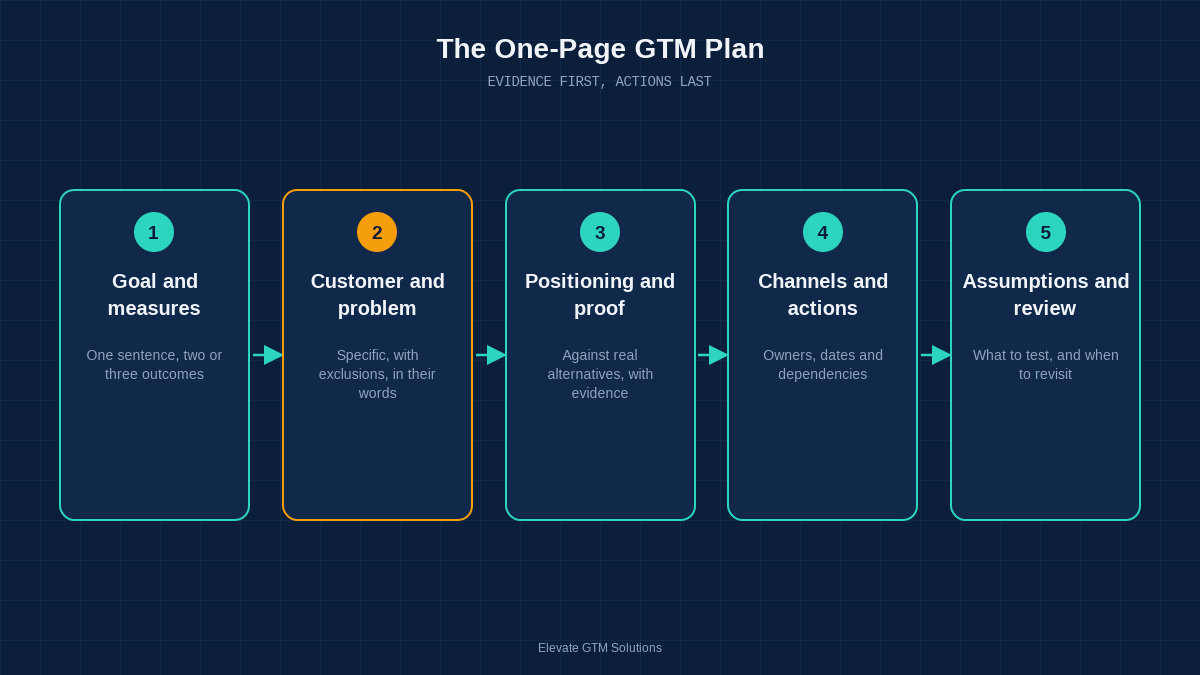
Searches for a go-to-market plan template return everything from a single-page canvas to a forty-slide deck. Both can be right, depending on the company. What they share is a purpose: to force the decisions that make a launch or a quarter succeed, and to record them in a form other people can use. A template does not make those decisions. It makes it harder to skip them.
This guide gives you a one-page template you can copy, explains what each field is for and what a good entry looks like, shows a filled example with invented details, offers extended modules for launches, new markets and enterprise teams, and describes how to review and update the plan so it does not become a document that ages in a folder. Elevate GTM Solutions makes a GTM strategy platform whose outputs map onto these fields, so we have an interest. The template works fine in a document or spreadsheet, and the method does not depend on any product.
What Is a GTM Planning Template?
A GTM planning template is a structured form for recording the decisions behind a go-to-market effort: the target customer, the problem, the alternatives, positioning, messaging with proof, pricing logic, channels and motion, launch plan, owners, measures, risks and assumptions to test. A good one fits on a page, forces specific answers, separates evidence from belief and includes a review date. It is a thinking tool as much as a record: the value comes from filling it in with real evidence and revisiting it regularly.
How long should a GTM plan be? As short as it can be while still guiding action. One page for a startup or a single product, with modules added for launches or enterprise needs.
Is a template a strategy? No. It records strategy decisions. The decisions come from evidence and conversations.
The one-page template
Copy this into a document or spreadsheet.
| Section | Field | What to write |
|---|---|---|
| 1. Goal | Objective and time frame | One sentence: what we want to achieve and by when |
| Success measures | Two or three outcomes, with how they are measured | |
| 2. Customer | Ideal customer | Specific type of company or person, with the attributes that define fit |
| Not a fit | Who we will not pursue, and why | |
| Buying group | Roles involved and what each cares about | |
| 3. Problem | Situation and trigger | What is happening when they look for a solution, in their words |
| Cost of the problem | What it costs them, in time, money or risk | |
| 4. Alternatives | What they use today | Competitors, spreadsheets, building in-house, doing nothing |
| 5. Positioning | Statement | For [customer], who [problem], we are [category] that [difference], unlike [alternative] |
| Proof | Evidence we can show | |
| 6. Messaging | Three pillars | Claims, each with proof |
| Forbidden claims | What we will not say | |
| 7. Pricing | Value metric and hypothesis | What we charge for and why, with the evidence |
| 8. Motion and channels | Primary motion | Founder-led, sales-led, product-led, partner-led or other |
| Channels | Two to four, each with an owner and a goal | |
| 9. Plan | Key actions | Five to eight actions with owner and date |
| Dependencies | What must happen first | |
| 10. Enablement | What the field needs | Customer profile, talk tracks, objection responses, qualification questions |
| 11. Measures | Leading and lagging | What we will watch and how often |
| 12. Risks | Top risks | The main risks and the response to each |
| 13. Assumptions | To test | The riskiest beliefs, the cheapest test and the date |
| 14. Governance | Owner and review | Decision owner, review date and who must be consulted |
If you can fill in sections 2 to 6 with evidence, you have most of the value. The rest turns the decisions into action.
What each section is for
Goal
A plan without a goal is a list of tasks. Write one outcome and the measures that would show it was reached. Keep it narrow enough to act on.
Customer
Specific beats broad. "B2B companies" is a market. "Operations leaders at logistics firms with fifty to two hundred staff who lose deliveries to scheduling errors" is a customer. Say who is excluded, because exclusions make targeting and qualification sharper.
Problem
Write the problem in customers' own words, drawn from conversations. Add what it costs them. A problem with no cost rarely gets budget.
Alternatives
Include everything the buyer might do instead of choosing you: competitors, a spreadsheet, an internal build or nothing. Positioning only makes sense against real alternatives.
Positioning
Positioning states why a specific customer should choose you over those alternatives. Use the template statement and test it: can a seller repeat it in their own words?
Messaging
Three pillars are enough. Each needs proof you can show a skeptic. List forbidden claims, which stops well-meaning teammates from making promises you cannot keep.
Pricing
You may only have a hypothesis. Record the value metric, the reasoning and the evidence, and mark what is untested.
Motion and channels
Choose one primary motion and a few channels. Give each an owner and a goal. A channel without an owner will not be run.
Plan
Five to eight actions with owners and dates. Name dependencies, such as "positioning approved before assets."
Enablement
List what sellers, marketers and customer success need to carry the plan: a one-page customer profile, talk tracks, objection responses and qualification questions.
Measures
Pick leading measures you can watch weekly and lagging measures for monthly or quarterly review. Define each. Our guide to GTM metrics and KPIs covers definitions.
Risks
Name the top risks and a response to each. Include evidence risks, such as "we have spoken to only six buyers."
Assumptions
List what you believe but have not proven, rank by risk and name the cheapest test. This section turns a plan into a learning system.
Governance
Name the decision owner, the review date and the people who must be consulted. A plan without an owner will not change when facts do.
A filled example
This example uses invented details for a company selling scheduling software to field-service firms. It is an illustration.
| Section | Entry |
|---|---|
| Goal | Reach twenty paying customers in the owner-operator segment by the end of the next quarter. Measures: paid customers, meetings to opportunity rate, time from first call to pilot |
| Ideal customer | Field-service firms with ten to forty technicians, scheduling in spreadsheets, owner involved in operations |
| Not a fit | Firms below ten technicians, firms needing deep invoicing |
| Buying group | Owner or general manager (cost of missed appointments), dispatcher (daily use) |
| Situation | "I find out about missed appointments when the customer calls me" |
| Cost | Lost repeat business and refunds, reported in interviews |
| Alternatives | Spreadsheets, a larger suite, doing nothing |
| Positioning | For field-service owners who lose appointments to scheduling errors, we are scheduling software a team can start in days and technicians can use on a phone, unlike spreadsheets or heavy suites |
| Proof | Two customers live in a week, five quotes about phone use |
| Pillars | Start in days. Simple on a phone. Fewer missed appointments (early evidence, labeled) |
| Forbidden claims | "Most accurate on the market"; comparisons we cannot support |
| Pricing | Monthly per technician. Three of five owners accepted a paid pilot at a lower level than first assumed |
| Motion | Founder-led sales |
| Channels | Direct outreach to a list of two hundred firms (owner: founder); partnership with a payments provider (owner: head of partnerships) |
| Key actions | Finalize pillars (week 1), build list (week 2), run reviewed outreach batch (weeks 3 to 4), pilot offers (weeks 4 to 6), review (week 8) |
| Dependencies | Positioning approved before outreach copy |
| Enablement | One-page profile, discovery guide, three objection responses |
| Measures | Leading: replies by theme, meetings. Lagging: win rate, cycle. Weekly and monthly |
| Risks | Small sample of interviews; dependence on one channel |
| Assumptions | Owners will pay for pilots (mostly supported). Dispatchers will adopt it (untested) |
| Governance | Owner: founder. Review: every Friday. Consulted: head of sales, first seller |
Notice how short the entries are. They are specific, and they point to evidence.
Extension modules
Add a module only when the situation needs it.
Launch module
| Field | Entry |
|---|---|
| Launch tier | One, two or three, with the reasoning |
| Launch owner and roles | Product, marketing, sales, customer success, finance, sponsor |
| Timeline | Dated steps working back from release |
| Readiness checklist | Customer, positioning, messaging, pricing, assets, enablement, channels, support, measurement, risks |
| Go, narrow or hold criteria | What must be true to release, and who decides |
| Communication plan | Who hears what, when, from whom |
| Early signals | What to watch in the first weeks |
| Reviews | Thirty and ninety days |
Our guide to enterprise product launch readiness covers this in depth.
New market module
| Field | Entry |
|---|---|
| Market evidence | Buyer conversations, competitors and demand signals in the new market |
| What stays the same | Core positioning, claims and qualification criteria |
| What adapts | Language, proof points, pricing presentation, channels |
| Local constraints | Regulation, payment, data and support requirements |
| Partners | Who helps and how |
| Entry test | A small, time-boxed pilot with success and failure thresholds |
| Exception log | Local departures from the standard, with reasons |
Enterprise module
| Field | Entry |
|---|---|
| Scopes | Products, segments and regions covered |
| Decision rights | Who decides what, and who approves exceptions |
| Version comparison | How strategies for different scopes are compared |
| Governance | Review rhythm and audit trail |
| Integration plan | Connections to the CRM, enablement and outreach tools |
| Training | Plan by audience |
A spreadsheet layout
If you prefer a spreadsheet, use one tab per area and keep the columns consistent.
| Tab | Columns |
|---|---|
| Strategy | Section, field, entry, evidence, confidence (high, medium, low), owner, last reviewed |
| Actions | Action, owner, start, due, dependency, status, notes |
| Measures | Measure, definition, type (leading or lagging), source, owner, baseline, target, review cadence |
| Assumptions | Assumption, risk if wrong, test, sample, success threshold, failure threshold, date, result, decision |
| Risks | Risk, likelihood, impact, response, owner, review date |
| Change log | Date, change, reason, decided by |
The confidence column is the most useful addition. It makes the difference between what you know and what you hope visible to everyone who reads the plan.
A launch module, filled in
This is a hypothetical illustration for a feature launch aimed at an existing segment.
| Field | Entry |
|---|---|
| Launch tier | Two: a major feature for an existing segment, with a repositioning of one product page |
| Owner and roles | Owner: product marketing manager. Product: feature lead. Marketing: content lead. Sales: head of sales. Customer success: onboarding lead. Sponsor: head of product |
| Timeline | Six weeks before release: evidence gathering. Four weeks: positioning decision. Three weeks: messaging approved. Two weeks: assets and seller briefing. One week: readiness check. Release week: go, narrow or hold decision. Thirty and ninety days: reviews |
| Readiness checklist | Customer named, positioning repeatable by a seller, pillars with proof, pricing decided, assets produced, sellers and support briefed, channels owned, measures set, risks listed |
| Go, narrow or hold | Go if all readiness items are met. Narrow if enablement is incomplete for one region. Hold if support documentation is missing |
| Communication plan | Executives at the decision meeting, sellers in the briefing, existing customers at release by email from customer success, prospects through the two chosen channels |
| Early signals | Customer questions, objections heard by sellers, feature adoption in the first fourteen days |
| Reviews | Thirty-day review of adoption and objections, ninety-day review of pipeline influence by segment |
A new market module, filled in
This is a hypothetical illustration for entering an adjacent region.
| Field | Entry |
|---|---|
| Market evidence | Ten buyer conversations in the new region, three competitors identified, two partner candidates |
| What stays the same | Core positioning, three pillars, forbidden claims and qualification criteria |
| What adapts | Examples and proof points, currency and pricing presentation, one channel |
| Local constraints | Data handling requirements reviewed with advisers, local payment preferences, support hours |
| Partners | One regional partner for introductions, with a referral process |
| Entry test | An eight-week pilot with a defined list, a target number of qualified conversations and a threshold for continuing |
| Exception log | Pricing display differs from the home market, with the reason and the approver |
| Review | Monthly during the pilot, then quarterly |
A quarterly reset template
Every quarter, hold a ninety-minute session to reset the plan.
| Step | Question | Output |
|---|---|---|
| 1 | What did we learn from wins, losses and conversations? | A list of findings with counts |
| 2 | Which assumptions were confirmed, rejected or still untested? | An updated assumptions table |
| 3 | Does the customer definition still hold? | A revised definition or a confirmation |
| 4 | Does the positioning still differentiate? | A revised statement or a confirmation |
| 5 | Which pillars landed and which did not? | Updated pillars and proof |
| 6 | Which channels earned their place? | Keep, change or stop |
| 7 | What are the next quarter's goals and measures? | A revised goal section |
| 8 | What changes in owners, dates and risks? | An updated actions table |
Archive the previous version and keep the change log current.
A workshop to fill in the template with a team
When several people must agree, run a working session instead of circulating a form.
| Time | Activity |
|---|---|
| 0 to 15 minutes | Review the evidence: wins, losses, quotes and competitor notes |
| 15 to 45 minutes | Agree the customer, exclusions and problem. Write them on the template |
| 45 to 75 minutes | Draft positioning and pillars. Test them by having two sellers repeat them |
| 75 to 100 minutes | Choose the motion and channels, and assign owners |
| 100 to 120 minutes | List assumptions, risks and the first actions, and set the review date |
Ground rules: evidence beats seniority, disagreements are written down and the decision owner decides at the end.
A template for experiments
| Field | Entry |
|---|---|
| Assumption | What we believe |
| Why it matters | What changes if we are wrong |
| Test | The cheapest way to check |
| Sample | Who and how many |
| Success threshold | The result that would convince us |
| Failure threshold | The result that would make us change course |
| Time box | Start and end dates |
| Result and decision | What happened, and what we decided |
Setting thresholds before a test keeps you honest about what counts as a result.
How to fill it in without guessing
- Start with evidence. Gather win and loss reasons, interview notes and competitor pages before you open the template.
- Fill sections 2 to 4 first. Customer, problem and alternatives come from conversations.
- Write positioning and pillars next. Test them with two sellers.
- Mark what you do not know. Put it in assumptions, not in confident prose.
- Fill in the plan last. Actions should follow from decisions.
- Share and revise. Ask three people what is unclear.
- Set the review date. Put it in the calendar before you close the document.
Reviewing and updating the plan
| Cadence | What to review | Who |
|---|---|---|
| Weekly (early stage) | Assumptions tested, what we heard, actions | Core team |
| Monthly | Results by segment and theme, risks, changes to positioning or channels | Owner, sales, marketing, product |
| Quarterly | The whole plan against evidence, with a reset of goals | Leadership |
| After major events | New competitor, pricing change, unexpected win or loss | Owner |
Record each change with the date and reason, in a short change log at the end of the document.
Using AI with the template
AI can help you fill in the template faster, with care.
| Task | How AI helps | Caution |
|---|---|---|
| Summarize interviews into the problem and alternatives fields | Structure and counts | Check against notes |
| Draft positioning options | Several versions | Add specifics and remove unsupported claims |
| Draft pillars with proof lists | A first pass | Verify proof |
| Propose risks and assumptions | A checklist | Add your own |
| Keep sections consistent | Flags conflicts | Decide which is right |
Give the assistant your evidence and ask it to separate what the sources say from what it infers. Our guide to building a GTM strategy with AI covers the method.
Common mistakes
| Mistake | What happens | Fix |
|---|---|---|
| Filling the template with opinion | A confident document built on guesses | Gather evidence first |
| Skipping exclusions | Targeting stays vague | State who is not a fit |
| Three pillars with no proof | Credibility problems | Add proof or remove the claim |
| Too many channels | Thin effort everywhere | Pick two to four with owners |
| No assumptions section | The plan cannot learn | List and rank assumptions |
| No review date | The plan ages | Set it in the calendar |
| Writing for approval, not use | Nobody reads it | Keep it to a page |
| One version per team | Inconsistency | One current version, archived history |
The template for different roles
| Role | How to use the template | What to emphasize |
|---|---|---|
| Founder | Fill in the whole page weekly | Customer, problem and assumptions |
| Product marketer | Own sections 2 to 7 and consult others | Positioning, pillars and proof |
| Sales leader | Own qualification and enablement | Who to pursue and how to handle objections |
| Marketing leader | Own channels and measures | Channel owners, goals and tagging |
| Regional lead | Adapt within standards | What changes locally and why |
| Customer success leader | Own post-sale parts | Promises made in sales and how they are kept |
| Executive sponsor | Review goals, risks and governance | Resources and blockers |
Rules for maintaining the template
| Rule | Why |
|---|---|
| One current version, in one place | Avoids competing copies |
| Archive old versions | Keeps history without confusion |
| Date every change and record the reason | Builds trust and learning |
| Mark confidence on each entry | Shows what is known and what is hoped |
| Review on a fixed schedule | Prevents drift |
| Keep it to a page, add modules only as needed | Preserves use |
| Link, do not copy | Point to evidence and assets in their home |
Questions to pressure-test your plan
Ask these before you finalize.
- Could a stranger tell, from the customer section, which companies to pursue and which to avoid?
- Would the customer recognize the problem statement as their own words?
- Could a seller repeat the positioning in their own words after one reading?
- Does every pillar have proof you could show a skeptic?
- Which alternative is most likely to beat us, and what do we say about it honestly?
- What evidence supports our price hypothesis?
- Does every channel have an owner and a goal?
- What is the single riskiest assumption, and when will we test it?
- If results are poor in six weeks, what will we change first?
- Who will update this page, and when?
If you cannot answer three or more, you have found where to spend your next week.
Terms used in this template
| Term | Meaning |
|---|---|
| Ideal customer | The specific type of company or person you serve best |
| Positioning | How you are different, for a specific customer, against specific alternatives |
| Pillar | A core claim in your messaging, with proof |
| Value metric | The unit you charge for |
| Motion | The repeatable way you win customers |
| Assumption | A belief not yet proven |
| Readiness | Whether a launch has what it needs to go |
| Change log | A dated record of changes and reasons |
A hypothetical example of the template in use
This is an illustration, not a real company.
A product marketing manager at a software company was asked for a go-to-market plan for a new feature aimed at an existing segment. She had planned a long slide deck. Instead she filled in the one-page template. The customer and problem sections took an afternoon because she had notes from eight customer calls. The positioning section was harder: her first draft said the feature "improves efficiency," which two sellers called meaningless. She reworded it using a customer's phrase about avoiding double entry.
The assumptions section exposed that the team had not tested whether admins, who would use the feature daily, shared the enthusiasm of managers, who would buy it. She added three admin conversations to the plan. The one-page plan was shared in a meeting that took twenty minutes. The team agreed owners, and put a monthly review in the calendar. The plan was three weeks old when a competitor announced a similar feature, and the team updated one paragraph and the forbidden claims list within a day.
Three short planning situations
A founder with a week. Fill in sections 1 to 6 from the notes you already have. Mark every guess as low confidence. Book five conversations, and revise on Friday. The page does not need to be good. It needs to exist so that learning has somewhere to land.
A product marketer with a launch in six weeks. Fill in sections 2 to 7 in the first week by interviewing sellers and customers. Hold a positioning session in week two. Add the launch module and set the readiness review for week five. Put the go, narrow or hold decision on the calendar now.
A regional lead adapting a global plan. Copy the global template. Mark what must stay the same, such as the claims and the qualification criteria. Change examples, proof and channels with evidence from local conversations. Add every departure to the exception log with a reason, and send it to the strategy owner monthly.
How a template connects to other planning documents
| Document | Relationship |
|---|---|
| Annual plan | Sets goals and budget. The template adds the customer, message and motion behind them |
| Playbook | Turns the template's decisions into daily practice |
| Launch checklist | A detailed version of the launch module |
| Campaign briefs | Each carries a segment, persona and pillar from the template |
| Quarterly review | Uses the template's assumptions and measures |
| Board update | Draws from goals, measures, risks and learning |
If these documents contradict one another, the template should be corrected first and the others updated to match.
A scorecard for your own plan
Score each line from one to five and discuss the lowest.
| Criterion | Question | Score |
|---|---|---|
| Specificity | Does it name a specific customer and who is excluded? | |
| Evidence | Is each major claim backed by something we have seen or heard? | |
| Honesty | Are guesses marked as such? | |
| Usability | Could a new hire act on it tomorrow? | |
| Consistency | Do the sections agree with each other? | |
| Ownership | Does every action and channel have an owner? | |
| Testability | Do we know how we will find out if we are wrong? | |
| Freshness | Is there a review date and a change log? |
A plan that scores below three on specificity or evidence needs more conversations before more planning.
A closing checklist
- The goal is one sentence with measures.
- The customer section includes exclusions.
- The problem is in customers' words.
- Alternatives include doing nothing.
- Positioning has been repeated by two sellers.
- Each pillar has proof or a label that says it is untested.
- Forbidden claims are listed.
- Pricing is a hypothesis with evidence noted.
- Channels have owners and goals.
- Assumptions are ranked with tests and dates.
- A review date is in the calendar.
Objections to using a template, answered
"A template makes us rigid." A template makes decisions visible. You can change them whenever evidence says so, and the change log shows how and why.
"We do not have time for planning." A one-page plan takes a day to draft and saves time by preventing contradictory work. Weekly reviews take thirty minutes.
"Our situation is too unusual." Use the template as a prompt and change the fields. The discipline of stating customer, problem, alternatives, positioning, proof and assumptions applies to unusual situations as well.
"Nobody reads documents." Keep it to a page, put it where people work and review it in the meetings they already attend.
"We already have a strategy deck." Compare the deck with the template. If the deck cannot fill the customer, exclusions, proof, assumptions and owner fields, the deck is missing the parts that guide action.
"The plan will be out of date next month." Expect that. The review cadence and the change log exist for this reason.
"We cannot get evidence." Start with five conversations. Evidence is easier to collect than most teams believe, and a plan with honest gaps is better than a confident plan with none.
What to do this week
Copy the template into a document. Fill in sections 2 to 4 using notes from real conversations. Write a first positioning statement and ask two sellers whether they could repeat it. List three assumptions and the cheapest test for each. Set a review date.
In plain language
A planning template is a way to make yourself answer the questions that matter and write the answers where others can use them. Who is the customer, in specific terms. What problem do they have, in their words. What do they do today. Why would they choose you, and what is the proof. What will you say, and what will you not say. How will you reach them, who owns each step and how will you know if you are wrong. Fill it in from real conversations, mark what you do not know, keep it to a page and review it on a schedule. A short plan that is used and updated beats a long plan that is admired and forgotten.
Key takeaways
- A GTM planning template forces decisions and records them for others. It is not a strategy by itself.
- One page is enough for most startups and single products. Add modules for launches, new markets and enterprise needs.
- Fill sections 2 to 6 with evidence, mark what you do not know and keep an assumptions list.
- Name an owner and a review date, and keep a short change log.
- Use AI to draft and structure, with your own evidence and review.
Where Elevate GTM Solutions fits
Elevate GTM Solutions is an AI-native GTM operating system for B2B companies. Its outputs map onto this template: customer definition and exclusions, competitive framing, positioning, messaging pillars, pricing logic, channel plans, launch and execution plans and measurement, across 15 modules, with workflows, weekly plans and a recurring review rhythm. It lets teams compare versions side by side. It does not replace the customer conversations that fill the template with evidence. A free first strategy build is available, and published plans, billed annually, are Enable at USD 499 per month and Growth at USD 1,499 per month, with custom Scale pricing.
For related reading, see What Is Elevate GTM Solutions?, How to Build a GTM Strategy Without a Consultant, What Is a GTM Playbook? and GTM Strategy for Startups. See the pricing page, or request a demo.
Frequently Asked Questions
What should a GTM planning template include?
A goal and success measures, the ideal customer and exclusions, the problem, alternatives, positioning, messaging pillars with proof, pricing logic, motion and channels, key actions with owners and dates, enablement needs, measures, risks, assumptions to test and a governance line with an owner and review date.
How long should a GTM plan be?
One page for a startup or a single product, with extra modules for launches, new markets or enterprise needs. Shorter is better if it is specific and used.
What is the difference between a GTM plan and a GTM strategy?
The strategy decides the customer, positioning, messaging, pricing logic and channels. The plan records those decisions with owners, dates and measures. A template can hold both.
How do I fill in a GTM plan template?
Start with evidence from customer conversations and wins and losses, fill customer, problem and alternatives first, then positioning and pillars, mark what you do not know as assumptions, and fill in actions last.
How often should I update the plan?
Weekly in the early stage, monthly as the team grows and quarterly for a full reset, with off-cycle updates after major events such as a new competitor or pricing change.
Can AI fill in a GTM plan template?
AI can summarize evidence and draft options. People must supply the evidence, check claims, remove generic statements and make the decisions.
What is the most important section?
Customer, problem and alternatives, because the rest depends on them. A plan with an unclear customer produces confident but generic messaging.
How do I handle a launch or new market?
Add a launch or new market module with owners, a timeline, readiness checks, go or hold criteria, local adaptations and a small pilot with success and failure thresholds.
Should the template be a document or a spreadsheet?
Either works. Choose the one your team will keep current, and keep one current version with a change log.
Who should own the plan?
A named decision owner, often a founder, a head of product marketing or a GTM leader, with sales, marketing and product consulted.
How do I keep the plan from going stale?
Set a review date, keep an assumptions list, record changes and reasons and bring win and loss evidence to a monthly review.
What is the confidence column for?
It marks whether each entry is high, medium or low confidence, so readers can see what you know from evidence and what you are guessing. It makes a plan more honest and helps you decide what to test.
How do I run a quarterly reset?
Review findings from wins, losses and conversations, update the assumptions, confirm or revise the customer definition and positioning, check which pillars and channels worked, set the next quarter's goals and measures, and update owners and risks.
What should a launch module include?
The launch tier, owner and roles, a dated timeline, a readiness checklist, go, narrow or hold criteria, a communication plan, early signals and reviews at thirty and ninety days.
How do I fill in the template with a team?
Hold a two-hour working session that reviews evidence, agrees the customer and problem, drafts and tests positioning and pillars, chooses motion and channels, and lists assumptions, risks and first actions, with a decision owner at the end.