
By the Elevate GTM Solutions Team · Updated November 10, 2026 · 22 min read
GTM Strategy for Startups: A Practical Guide From First Customers to Repeatable Growth
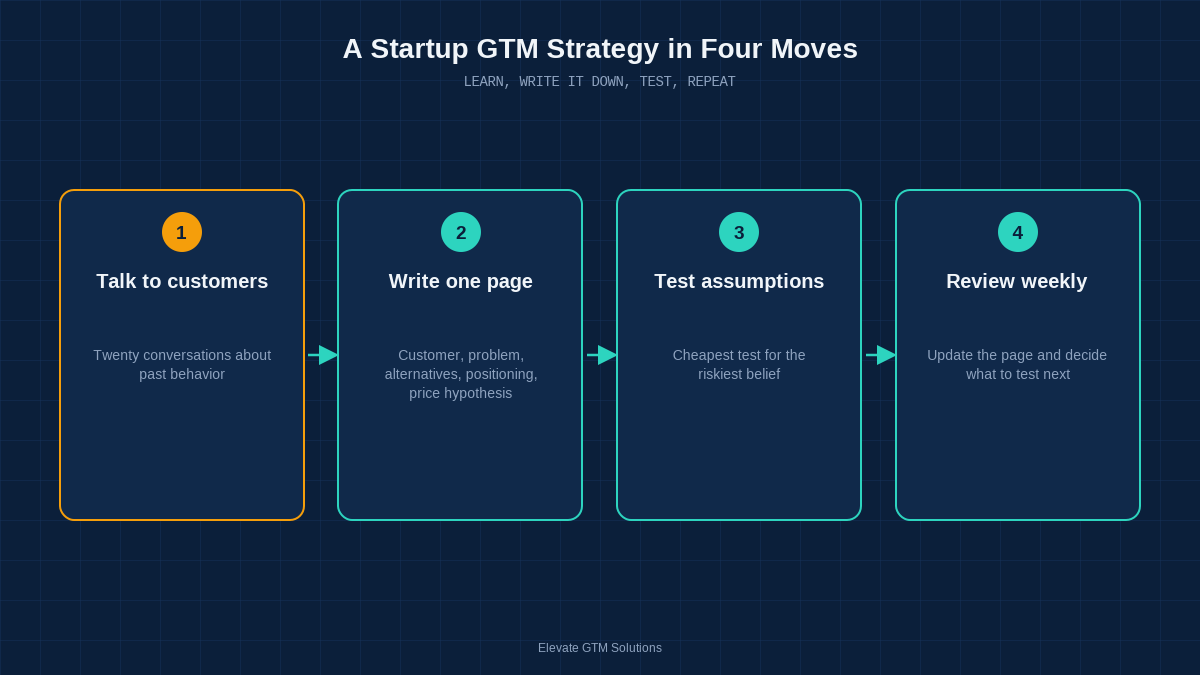
Most advice on go-to-market strategy is written for companies that already have customers, a sales team and a budget. A startup has a hypothesis. It believes a certain kind of customer has a certain problem and will pay to solve it, and the whole early job is to test that belief quickly and cheaply. A startup GTM strategy is therefore less a plan than a structured way of learning, with a written record of what you think, what you have proven and what you will test next.
This guide explains how to build one. It covers the questions a startup must answer, the stages most companies pass through, how to choose a first customer, how to position and price a young product, how to pick a first motion and channels, how to use AI without fooling yourself and how to keep the strategy alive as you grow. Elevate GTM Solutions makes a GTM strategy platform and offers a free first strategy build, so we have an interest. We say where a document and a handful of conversations are enough. Nothing here guarantees results, and every startup's situation differs.
How Do Startups Build a GTM Strategy?
Start with learning, not a plan. Talk to twenty or more people who might have the problem, and write down what you learn. Define one specific first customer and the problem in their words. Choose the alternatives they use today and position against them. Write three messages with proof. Form a price hypothesis and test it. Pick one go-to-market motion and two channels. Record assumptions and test the riskiest first. Review weekly at first, and update the strategy as evidence arrives. Use tools sparingly, and add structure as products, segments and people multiply.
How long does it take? A first one-page strategy can be written in a day. The learning that makes it good takes weeks of conversations.
Do startups need strategy software? Not at first. A shared document and a handful of tools often suffice.
What makes a startup strategy different
| Trait | Large company | Startup |
|---|---|---|
| Evidence | Years of data | A few conversations and wins |
| Main risk | Inconsistency and slow change | Building for a customer who does not exist |
| Main constraint | Coordination | Time, cash and attention |
| Strategy document | Long, formal, periodic | One page, informal, weekly |
| Tools | Many, integrated | Few, simple |
| Change | Slow | Fast, sometimes weekly |
| Test | Large pilots | Small, cheap experiments |
A startup that copies a large company's planning process produces a thorough document based on guesses.
The six questions a startup strategy must answer
| Question | What to write |
|---|---|
| 1. Who is the first customer? | A specific type of company or person, with who is not a fit |
| 2. What problem do they have? | The situation and trigger, in their words |
| 3. What do they do today? | Alternatives, including spreadsheets, doing nothing and competitors |
| 4. Why will they choose us? | Positioning: how we are different in a way they care about |
| 5. What will they pay? | A price hypothesis and the value metric |
| 6. How will we reach them? | A motion and two channels |
If you cannot answer one of them, that is your next piece of learning.
Stage 1: find a customer who feels the problem
Choose a narrow first customer
Narrow is not small. A specific customer is easier to find, easier to talk to and gives sharper learning. "Marketing teams" is a category. "Marketing leaders at B2B software companies with fifty to two hundred employees who lose launches to unclear positioning" is a customer.
Useful ways to narrow:
- By situation. Companies that have just had a particular trigger, such as a new funding round or a leadership change.
- By size. The range in which the problem is sharpest and the buyer has authority.
- By industry. Where the problem is most acute or the language is most consistent.
- By role. The person who feels the pain and has some control over the decision.
Run conversations that teach you something
Aim for twenty conversations before you finalize anything. Keep each to thirty minutes.
Questions that work:
- What was going on that made this a priority?
- What have you tried?
- What did you decide not to do, and why?
- Who else was involved, and what did they worry about?
- What would a good outcome look like?
- What did this cost you, in time or money, last quarter?
Avoid pitching, leading the witness and asking whether they would buy. Ask about past behavior, not future intentions.
Record what you learn
| Field | Example entry |
|---|---|
| Who | Operations lead at a forty-person logistics firm |
| Trigger | Missed deliveries caused a complaint from a key customer |
| What they use | A shared spreadsheet and phone calls |
| What they tried | A generic scheduling tool they abandoned |
| Who else matters | The owner, who approves spending |
| What they would pay for | Fewer missed deliveries, quick setup |
| Exact phrases | "I find out when the customer calls me" |
After ten conversations, patterns appear. After twenty, you can write a defensible first definition.
Stage 2: position and message
Positioning
Positioning explains why a specific customer should choose you over the alternatives they actually consider.
- Name the customer.
- Name the alternative they use today.
- State what you do differently, in terms they care about.
- State the proof.
A simple test: can the customer repeat it in their own words after one reading?
Messaging with proof
Write three claims. For each, list the evidence you can show: a customer quote, a measured result you are permitted to cite or a demonstration. Remove any claim you cannot support. An early startup earns credibility by being specific and honest.
| Claim | Proof | Status |
|---|---|---|
| Start in days, not months | Two customers who started within a week | Supported by two cases |
| Simple enough for field staff | Five interview quotes | Supported |
| Fewer missed appointments | One customer's report | Weak, label as early |
Pricing hypotheses
You will not know the right price at first. Form a hypothesis and test it.
| Decision | Questions | How to test |
|---|---|---|
| Value metric | What unit do customers feel value in: users, jobs, locations, usage? | Listen to how they describe the problem |
| Price level | What do alternatives cost, including doing nothing? | Ask about current spend and reference points |
| Packaging | Do they want a simple single plan or choices? | Offer one or two options to early customers |
| Discounting | What will early customers get for being references? | Agree terms clearly |
Treat any price suggested by a tool, including an AI tool, as a hypothesis. Buyers' reactions are the evidence.
Stage 3: choose a motion and channels
A go-to-market motion is the repeatable way you win customers. Common motions include founder-led sales, product-led growth, sales-led, partner-led and community-led.
| Motion | Fits when | Watch for |
|---|---|---|
| Founder-led sales | Early stage, complex or new problem, high-touch learning | Does not scale beyond the founder |
| Product-led | Easy to try, low price, quick value | Needs a product that sells itself |
| Sales-led | Higher price, complex buying, several stakeholders | Needs a repeatable pitch |
| Partner-led | A partner already serves your customer | Dependence on the partner |
| Community-led | Customers gather in identifiable places | Slow to build |
Choose one primary motion. Then choose two channels to reach your first customer: perhaps direct outreach and a partner, or content and a community. Doing two well beats doing six poorly.
Stage 4: test, learn and decide
Treat the strategy as a set of assumptions. List them, rank them by risk and test the riskiest first.
| Assumption | Risk if wrong | Cheapest test | Date |
|---|---|---|---|
| The operations lead feels the problem | High | Ten more conversations | |
| They will pay for fewer missed deliveries | High | Offer a paid pilot to three | |
| Setup in days is credible | Medium | Time an actual setup | |
| Direct outreach reaches them | Medium | Send fifty reviewed messages |
Each week, review what you learned, update the assumptions and decide what to test next. Keep a short decision record: what you decided, why and when to review.
How to use AI well as a startup
AI assistants can help a small team do the work of a larger one, with limits.
| Task | How AI helps | What you must do |
|---|---|---|
| Summarizing interviews | Fast structure and themes | Check a sample against the notes |
| Drafting positioning and messages | Several options quickly | Add specifics and remove unsupported claims |
| Researching alternatives | A first pass | Verify against the competitors' own pages |
| Writing outreach | Drafts for review | Keep your voice and check every claim |
| Estimating market size | A rough frame | Treat numbers as hypotheses, never as facts |
| Analyzing results | Summaries of what happened | Decide what it means |
Never publish a statistic from an AI answer without a primary source. Keep customer data out of tools your company has not approved. Our guide to building a GTM strategy with AI gives a step-by-step method.
Tools: keep them few
Early on, you need a place to record conversations, a one-page strategy and a way to contact people. Add tools as bottlenecks appear. See our guide to the best GTM tools for startups.
When to add structure
A one-page strategy works until it does not. Signs you need more structure:
- Several people describe the product differently.
- You have more than one segment or product.
- Updating the strategy takes more than a day.
- New hires ask where the current positioning lives.
- You spend more time reconciling documents than learning.
At that point, consider a structured process, a shared owner and a monthly review. A platform such as Elevate GTM Solutions, which offers a free first strategy build, is one way to test whether structure helps. A shared document with disciplined ownership is another.
A six-week plan for your first strategy
| Week | Focus | Output |
|---|---|---|
| 1 | List fifty people who might have the problem and book ten conversations | A list and a note template |
| 2 | Run the first ten conversations, record in the template | Ten sets of notes |
| 3 | Look for patterns, draft the first customer definition and problem statement | A draft with evidence counts |
| 4 | Run ten more conversations, concentrating on people who differ from your draft | Evidence for and against the draft |
| 5 | Write positioning, three claims with proof and a price hypothesis | A one-page strategy |
| 6 | Reach out by hand to a defined list, record replies, review the whole page | A revised strategy and a test plan |
If you cannot book ten conversations in a week, that is information about how reachable the customer is. Note it, because it will matter for your channels.
A longer interview guide
Choose questions that fit the person. Keep the conversation natural.
| Theme | Questions |
|---|---|
| Situation | Tell me about your role and team. How does this part of your work happen today? What tools are involved? |
| Trigger | What happened recently that made this a priority? When did you first notice it was a problem? |
| Cost | What did it cost last time it went wrong, in time, money or reputation? How often does it happen? |
| Alternatives | What have you tried? What did you stop using, and why? What do your peers use? |
| Decision | Who else had a say? What did each person worry about? How long did it take to decide? |
| Budget | Who pays for this today? How do you decide what is worth buying? |
| Language | How would you describe this problem to a colleague? What word do you use for it? |
| Success | What would a good outcome look like in three months? How would you know? |
| Objections | What would make you hesitate? What would you need to see? |
| Referrals | Who else should I talk to? |
Close by asking what you should have asked and did not. The answer is often the most valuable of the hour.
How to analyze interviews
Without structure, interviews blur into impressions. A simple method keeps you honest.
Code each conversation. After each, fill a template: who, trigger, alternatives, cost, decision makers, language, objections.
Count themes. Keep a tally of how many conversations mention each trigger, alternative and objection.
Separate facts from inferences. Mark what was said and what you concluded.
Look for disconfirming evidence. Search for the conversation that contradicts your draft and take it seriously.
Watch for politeness. Enthusiasm without specifics is weak evidence. A concrete story about last month is strong.
| Strength of evidence | Example |
|---|---|
| Strong | A buyer describes a specific recent failure, what it cost and what they tried |
| Medium | A buyer describes the problem in general and says it matters |
| Weak | A buyer says the idea sounds interesting |
| Misleading | A friend says they would definitely buy |
After twenty conversations, write the definition and note the count behind each claim.
Competing with bigger companies
A startup's competitors are often larger, better funded and better known. Strategy can still work.
| Approach | What it means | Example question |
|---|---|---|
| Narrow focus | Serve a segment larger players treat as an afterthought | Who is underserved by the big tools? |
| Different job | Solve a problem the incumbent does not | What do customers still do manually? |
| Speed | Be easier to start and faster to value | Can they be live in days? |
| Honesty about fit | Say plainly who you are not for | Which buyers should we refer elsewhere? |
| Integration | Work alongside incumbents instead of replacing them | What do customers already own? |
Avoid claiming to be better than a well-known competitor in general. Claim to be better for a specific customer and problem, and prove it.
Channels in detail, and cheap ways to test them
| Channel | What it involves | A cheap test | What to measure |
|---|---|---|---|
| Direct outreach | Email, LinkedIn or calls to a defined list | Fifty reviewed messages by hand | Reply quality, meetings, learnings |
| Content | Pages and articles about the problem | Three pieces on questions buyers ask | Organic visits that lead to conversations |
| Community | Participation where customers gather | Contribute helpfully for a month | Conversations that start |
| Partners | A company that already serves your customer | Ask three for a pilot referral | Qualified introductions |
| Events | Meeting people in person or online | One small, relevant event | Conversations and follow-ups |
| Product-led | A free or trial path | A simple trial for a few users | Activation and conversion |
| Paid | Advertising | A small budget on one message | Cost per conversation, quality |
Pick two. Run each long enough to learn, and compare outcomes honestly, not only volume.
Measures by stage
| Stage | Useful measures | Misleading measures |
|---|---|---|
| Finding the customer | Number and quality of conversations, patterns found, evidence behind claims | Vanity metrics such as followers |
| Repeating the motion | Meetings, opportunities, win rate, cycle length, reply quality | Emails sent |
| Scaling | Pipeline by segment, win rate by segment, cost of acquisition, consistency of message | Total activity |
Pick three measures, record a baseline and review weekly at first. Be wary of drawing conclusions from tiny samples.
Telling the story to investors and your board
Investors and boards usually want to see that you understand your customer and learn quickly. A useful summary has five parts:
- Customer. The specific customer and the evidence, including how many conversations.
- Problem. The situation and cost, in customers' words.
- Motion. The way you win customers and what you have learned about it.
- Evidence. Customers, pilots, replies and what you changed because of them.
- Next tests. The riskiest assumptions and the cheapest tests.
Avoid inflating market size with top-down numbers you cannot defend. Show what you have learned and how fast you are learning.
Hiring the first seller or marketer
A written strategy makes the first hire easier.
| Item | What to give a new hire |
|---|---|
| One-page strategy | Customer, problem, alternatives, positioning, messages, price hypothesis |
| Interview notes | Five or more recorded conversations to hear |
| Assumption log | What is believed and what is proven |
| Early playbook | Discovery questions, objection responses and qualification criteria |
| Weekly review | An invitation to join, and a place to bring what they learn |
Ask the new hire to challenge the strategy using what they hear. A fresh view is valuable.
A worked one-page strategy
This is an invented example of what the finished page might look like after about six weeks.
| Field | Entry |
|---|---|
| Customer | Owner-operators of field-service firms with ten to forty technicians who schedule in spreadsheets. Not a fit: firms below ten technicians, firms needing deep invoicing |
| Problem | They find out about missed appointments when the customer calls. Nine of twenty-two interviewees described this in nearly those words |
| Alternatives | Spreadsheets (fourteen of twenty-two), a larger field-service suite (five), doing nothing (three) |
| Positioning | Scheduling a team can start using in days and technicians can use on a phone, for firms that have outgrown spreadsheets but do not need a large suite |
| Message 1 | Start in days. Proof: two customers live within a week |
| Message 2 | Simple on a phone. Proof: five interview quotes |
| Message 3 | Fewer missed appointments. Proof: one customer's report, labeled early |
| Price hypothesis | A monthly fee per technician. Three of five owners accepted a paid pilot at a lower level than first assumed |
| Motion | Founder-led sales |
| Channels | Direct outreach to a list of two hundred firms, and a partnership with a payments provider |
| Assumptions to test | Owners will pay for a pilot (tested, mostly supported). Dispatchers will adopt it (untested). Partner introductions convert (untested) |
| Next review | Friday |
A page like this takes minutes to read and carries the whole company's current understanding.
An experiment template
| Field | Entry |
|---|---|
| Assumption | What we believe |
| Why it matters | What changes if we are wrong |
| Test | The cheapest way to check it |
| Sample | Who and how many |
| Success threshold | What result would convince us |
| Failure threshold | What result would make us change course |
| Time box | Start and end dates |
| Owner | Who runs it |
| Result and decision | What happened, and what we decided |
Setting thresholds before the test prevents you from reading any result as success.
A weekly review agenda
Thirty minutes, with everyone who talks to customers.
- What we heard (ten minutes). Two or three notable quotes and what surprised us.
- What the numbers say (five minutes). Meetings, replies, pipeline, with small-sample cautions.
- What changed in the strategy (five minutes). Edits to the page and why.
- What we test next (five minutes). The riskiest assumption and the experiment.
- Owners and dates (five minutes).
Record decisions on the one-page strategy. Archive old versions so there is one current page.
Questions founders often ask
"Should I wait until I have more data?" No. Start with what you have, write it down and improve it. A rough page used weekly beats a perfect plan written once.
"How do I know if I have found the right customer?" Look for repeated stories with similar triggers, buyers who respond with specifics and some willingness to pay or commit. If the same sentence appears in several conversations, you are probably close.
"What if customers want something different from what we built?" Then your strategy has found a gap. Decide whether to change the product, the customer or the message, and record why.
"Do I need a brand or a website before I start?" A simple page that states the problem and who it is for helps. Sophisticated branding can wait.
"When do I hire a marketer or a seller?" When you can describe what works well enough to write it down, and the founder's time is the bottleneck.
Common mistakes
| Mistake | What happens | Fix |
|---|---|---|
| Targeting everyone | Messages are generic | Pick a narrow first customer |
| Skipping conversations | Strategy based on opinion | Twenty conversations first |
| Pitching in interviews | You learn what flatters you | Ask about past behavior |
| Copying a large company's plan | A long document of guesses | One page, revised weekly |
| Too many channels | Thin effort everywhere | Two channels |
| Unproven claims | Credibility erodes | Remove or label |
| Fixed prices too early | No learning | Price hypotheses and tests |
| Automating outreach before the message works | Volume without learning | Do it by hand first |
| No review rhythm | The strategy goes stale | Weekly at first, then monthly |
A hypothetical example
This is an illustration, not a real startup.
Two founders were building software for field-service firms. Their first strategy said the customer was "service businesses." After ten conversations, they noticed that nine of the ten were owner-operators of firms with ten to forty technicians who scheduled in spreadsheets and learned of missed appointments from customers. They rewrote the customer definition and the problem statement in those words.
They then wrote three claims, removed one that they could not support and made a price hypothesis of a per-technician monthly fee. They chose founder-led sales as the motion, with direct outreach and a partnership with a payments provider as channels. They listed four assumptions and tested the riskiest first: whether owners would pay for a pilot. Three of five agreed to a paid pilot at a lower price than the founders had imagined, which led them to adjust the hypothesis.
At each weekly review they updated a single page. Four months later they had eleven customers, a clearer message than at the start and a short record of decisions. When they hired their first seller, they gave her the page. It took her a day to read.
Terms used in this guide
| Term | Meaning |
|---|---|
| Go-to-market strategy | The decisions about customer, problem, positioning, price and channels |
| Motion | The repeatable way you win customers |
| Founder-led sales | The founders sell directly in the early stage |
| Product-led growth | The product itself drives acquisition, conversion and expansion |
| Hypothesis | A belief to be tested, not a fact |
| Assumption log | A list of what you believe, the evidence and the test |
| Positioning | How you are different, for a specific customer, against specific alternatives |
| Proof | Evidence you can show to support a claim |
Final thoughts
A startup GTM strategy succeeds by being honest and fast. Be honest about what you know and do not, and write it down. Be fast about testing the riskiest assumptions, and change your mind when evidence says so. Choose a narrow first customer, use their words, make claims you can prove and treat price as something you learn. Keep your tools few, your reviews regular and your page short. When the team and the product grow, add structure deliberately, and keep the habit that got you here: talk to customers, record what you hear and let the evidence update the plan.
Strategy for different startup situations
| Situation | What to emphasize |
|---|---|
| First-time founders with no sales background | Conversations, a one-page strategy and hand-written outreach. Learn the language before scaling |
| A technical founder with a product but no customers | Find five people with the problem before building more |
| A startup selling to enterprises | Longer cycles, several stakeholders and pilots. Map the buying group and the path to a paid pilot |
| A product-led startup | Activation and the first value moment. Track what predicts conversion |
| A startup entering a crowded category | A narrow wedge and honest positioning against named incumbents |
| A startup after a pivot | Treat old evidence with caution. Run fresh conversations for the new customer |
Keeping the strategy honest as you grow
Growth brings pressure to simplify and to sound confident. Resist both. Keep the assumption log. When a claim in a deck is not supported by evidence, label it. When a number in a board update comes from a small sample, say so. Teams that stay honest about what they know make better decisions, and they find it easier to bring new people up to speed.
Quick answers to common founder questions
| Question | Short answer |
|---|---|
| How many conversations before I write the strategy? | About twenty, with a first draft after ten |
| How narrow should my first customer be? | Narrow enough that you can list fifty real examples |
| Should I price before I have customers? | Form a hypothesis, then test it in conversations |
| Which motion should I pick? | The one that fits how your customer buys, often founder-led at first |
| How many channels? | Two |
| How often should I update the page? | Weekly at first |
| When do I add software? | When a specific bottleneck appears |
| What if my first customer segment fails? | Record why, pick the next, and keep the learning |
A good startup strategy is a short document that gets edited often, and a habit of asking customers what is really going on.
What to do this week
Book five conversations with people who might have the problem. Write the one-page strategy in a day, marking what you do not know. List three assumptions and the cheapest way to test each. Cancel any tool you have not used this month.
In plain language
A startup strategy is a written record of what you believe about your customer, what you have proven and what you will test next. It starts small, grows from conversations and changes often. Pick a narrow first customer, describe their problem in their words, position against what they use today and make three claims you can support. Treat price as something to learn, choose one motion and two channels and review weekly. Use AI to organize your notes and draft options, and use real customers to decide what is true. When the team grows, add structure deliberately, and keep the habit that got you here: listen, write it down and update the page.
Key takeaways
- A startup strategy is a structured way of learning, written down and revised often.
- Start with a narrow first customer and conversations about past behavior.
- Position against the alternatives customers actually use, with three claims backed by proof.
- Treat price as a hypothesis and test it with buyers.
- Pick one motion and two channels, and review weekly.
- Use AI for structure and drafts, and your own evidence for facts.
- Add structure as products, segments and people multiply.
Where Elevate GTM Solutions fits
Elevate GTM Solutions is an AI-native GTM operating system for B2B companies. For a startup, a useful entry point is the free first strategy build, which produces structured outputs from the market, product and segment context you provide, so you can see whether structure helps. Published plans, billed annually, are Enable at USD 499 per month and Growth at USD 1,499 per month, with custom Scale pricing. It does not replace customer conversations, a CRM or an outreach tool, and it connects to HubSpot, Salesforce, LinkedIn, Notion and Claude for supported actions.
For related reading, see What Is Elevate GTM Solutions?, Best GTM Tools for Startups, What Is a GTM Strategy? and How to Build a GTM Strategy Without a Consultant. See the pricing page, or request a demo.
Frequently Asked Questions
How do startups build a GTM strategy?
Start with learning: talk to twenty or more people with the problem, define a narrow first customer, position against the alternatives they use, write three claims with proof, form a price hypothesis, pick one motion and two channels and test the riskiest assumptions first.
What should a startup GTM strategy include?
The first customer, the problem in their words, alternatives, positioning, three messages with proof, a price hypothesis, a motion and two channels, assumptions to test and a review date.
How many customer conversations do I need?
Aim for twenty before finalizing a first strategy, and continue regularly. Patterns often emerge after ten, and you can stop a round when new conversations stop revealing new themes.
What GTM motion should a startup choose?
Founder-led sales is common early. Product-led suits easy-to-try, low-price products. Sales-led suits higher-priced, complex purchases. Choose one primary motion and revisit it as evidence arrives.
How do I price an early-stage product?
Form a hypothesis based on how customers describe value and what alternatives cost, test it in conversations and early offers and adjust. Treat suggested prices from tools as hypotheses.
Should a startup use AI for GTM strategy?
Yes, for structuring interview notes, drafting options and research, with your own evidence, review and primary sources for any statistic.
Does a startup need GTM software?
Not at first. A shared document, a simple CRM and a few conversations are often enough. Add tools when specific bottlenecks appear.
When should a startup add structure?
When several people describe the product differently, you have more than one segment or product, updating the strategy takes more than a day or new hires cannot find the current positioning.
How often should a startup review its GTM strategy?
Weekly at first, then monthly as the team grows, with a quarterly reset using fresh win and loss evidence.
What are the biggest startup GTM mistakes?
Targeting everyone, skipping conversations, pitching in interviews, using too many channels, making unproven claims and automating outreach before the message works.
How do I analyze customer interviews?
Fill the same template after each conversation, count how many mention each trigger, alternative and objection, separate facts from inferences, look for evidence that contradicts your draft and treat concrete stories as stronger than general enthusiasm.
How do startups compete with bigger companies?
By narrowing focus, solving a job the incumbent does not, being faster to value, being honest about fit and working alongside incumbents. Claim to be better for a specific customer and problem, not in general.
How do I test a channel cheaply?
Run a small, time-boxed test: fifty reviewed outreach messages, three pieces of content, a month of community participation or three partner pilot asks, and compare outcomes beyond volume.
What should I show investors about my go-to-market?
The specific customer with the evidence behind it, the problem in customers' words, the motion and what you have learned, customers or pilots and the next riskiest tests.
What should I give my first sales hire?
The one-page strategy, recorded interview notes, the assumption log, an early playbook and an invitation to the weekly review.