
By the Elevate GTM Solutions Team · Updated November 10, 2026 · 13 min read
Unified GTM Platform vs Point Solutions: When One System Beats Many Tools
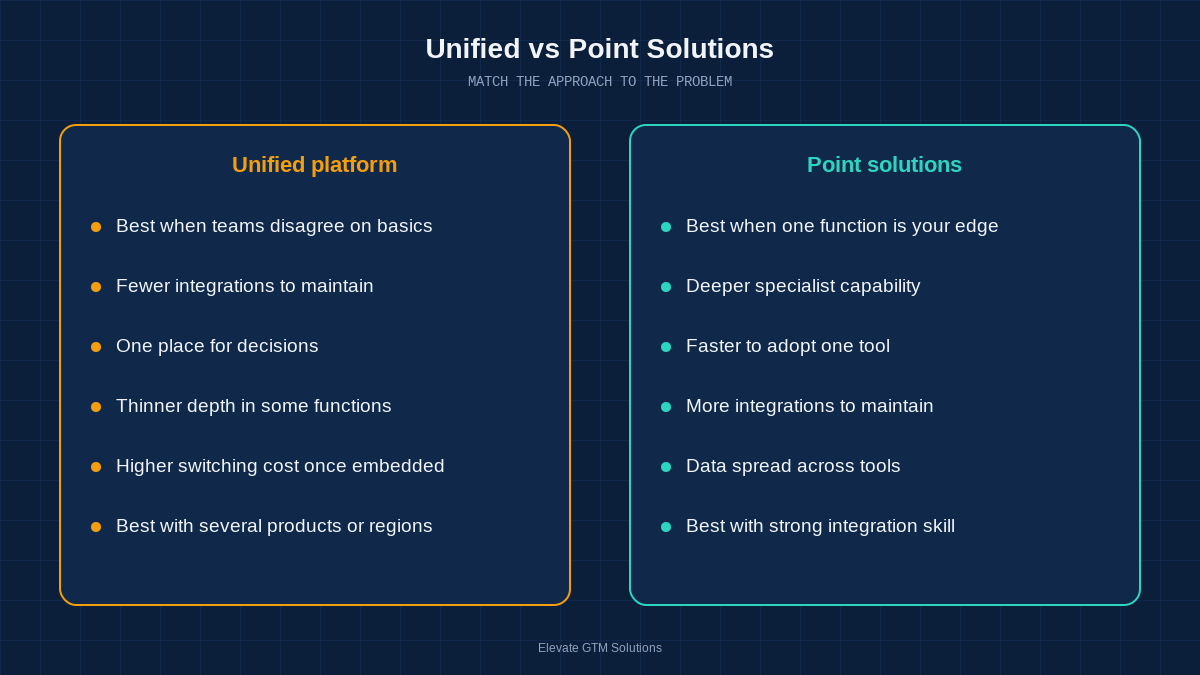
Every few years the go-to-market software market swings between two ideas. One says buy the best tool for each job and connect them. The other says put as much as you can in one platform. Both are sensible, and both have produced expensive regret. The current swing is toward consolidation, and the recent mergers show it: Terminus joined DemandScience in November 2024, Clari and Salesloft combined in December 2025, and Highspot and Seismic completed their merger on August 18, 2026. Buyers are asking again whether a unified GTM platform with strategy and execution beats a stack of point solutions.
This guide explains what "unified" can mean, compares unified and best-of-breed approaches on the dimensions that matter, says when each wins, and offers a middle path that many teams end up with. Elevate GTM Solutions describes itself as a unified GTM platform, so we have a stake in the question. We try to give the case for point solutions its due.
Unified GTM Platform or Point Solutions: Which Is Better?
Neither is better in general. A unified GTM platform wins when the main problem is fragmentation: different teams working from different definitions of the customer, message and plan, and too much effort spent reconciling tools. Point solutions win when one function needs depth that a broad platform will not match, such as advanced account-based advertising or large-scale outreach. Many teams use a unified strategy and planning layer as the shared core and keep best-of-breed tools for specialized jobs.
Is "unified" the same as an all-in-one suite? Not always. A suite bundles many functions. A unified strategy platform connects decisions across them.
Does consolidation prove unified is winning? It shows vendors are widening scope. It does not show that any given bundle fits your team.
What "unified" can mean
The word is used in three ways, and mixing them causes confusion.
| Meaning | What it is | Examples of the approach |
|---|---|---|
| Suite | One vendor sells many functions: CRM, marketing, service, analytics | HubSpot, Salesforce |
| Merged specialist | Two specialist vendors combine and integrate products over time | Salesloft with Clari, Seismic with Highspot, DemandScience with Terminus |
| Unified strategy layer | One system holds the decisions that connect functions: customer, positioning, messaging, pricing logic, plans | Elevate GTM Solutions, Ignition |
A suite unifies data and workflow inside one vendor. A merged specialist is in the middle of integrating products. A unified strategy layer sits above the tools and keeps decisions consistent across them. You can combine them: a suite for records, a strategy layer for decisions, specialists for depth.
The comparison
| Dimension | Unified platform or suite | Point solutions |
|---|---|---|
| Consistency across teams | Higher, if teams use the same system | Depends on integration and discipline |
| Depth in any single function | Often thinner than a specialist | Often deeper |
| Integration effort | Lower, inside one vendor | Higher, with more connections to maintain |
| Data in one place | More likely | Spread across tools |
| Vendor risk | Concentrated: one vendor, one contract | Spread, but many contracts |
| Switching cost | Higher once embedded | Lower per tool, higher in total |
| Speed to adopt | Slower to roll out broadly | Faster per tool |
| Cost structure | One larger commitment | Many smaller commitments that add up |
| Fit for unusual needs | Weaker | Stronger |
| Pace of innovation | Varies | Specialists often move faster in their niche |
Read the table as tendencies. Individual products break the pattern in both directions.
What the consolidation tells us
Three recent combinations are worth understanding as evidence of direction, not endorsement.
- Terminus and DemandScience merged in November 2024, and the Terminus platform now sits inside DemandScience's account-based experience offering.
- Clari and Salesloft completed their merger on December 3, 2025. The company adopted the Salesloft brand in September 2026 and says it is building toward one platform over time.
- Highspot and Seismic completed their merger on August 18, 2026, operating under the Seismic name, with Highspot continuing as Highspot by Seismic.
Three lessons follow. Vendors believe buyers want fewer vendors. Integration takes years, so merged products may be two products under one name for a while. And a vendor's roadmap can change under you, which is a risk of point solutions and of suites alike. If you buy from a company mid-integration, ask which products you are getting and how they connect today.
When a unified platform tends to win
- Teams disagree on basics. Different customer definitions, messages and metrics across functions.
- Several products, segments or regions need a consistent strategy.
- Reconciling tools takes more effort than using them. People copy data between systems and rebuild decks.
- Strategy goes stale quickly. Updates are slow because information is scattered.
- You have few specialists. A small team cannot maintain many integrations.
- Reporting needs a single view. Leaders want one picture of the motion.
When point solutions tend to win
- One function is your edge. For example, running account-based advertising at scale, or large outbound programs.
- You already have strong tools and the gap is narrow.
- Specialists matter. Deep analytics, advanced routing or enablement at enterprise scale.
- You need to move fast in one area without a platform rollout.
- Regulatory or technical constraints limit what can sit in one system.
- Your team has integration skill and wants control over each layer.
The middle path: a shared core with specialists around it
Many teams end up here, whether they plan it or not.
| Layer | What sits there | Why |
|---|---|---|
| Core records | CRM | Customers and pipeline |
| Core decisions | A unified GTM strategy and planning layer | One customer definition, positioning, messaging, pricing logic and plan |
| Specialists | Account intelligence, outreach, enablement, analytics | Depth where it matters |
| Connections | Supported integrations and workflow automation | Move information between layers |
The principle: unify the decisions, not necessarily the tools. If everyone shares the same customer definition and message, the tools around them can differ without producing chaos. If decisions are scattered, even a single suite will produce inconsistency, because the suite only unifies where data lives.
How to decide: six questions
- Where does the pain show up? In reconciling and misalignment, or in a function lacking capability?
- How many products, segments and regions do we run? More of them favors a shared core.
- How strong are our current tools? If most work well, add selectively.
- How much integration capacity do we have? Count people and time, not intentions.
- What would switching cost? Include data migration, training and lost productivity.
- Who will own the system? An unowned platform becomes shelfware.
If most answers point to fragmentation, lean unified. If they point to a capability gap, lean specialist.
Cost: look at total effort
| Cost element | Unified | Point solutions |
|---|---|---|
| Licenses | One or a few larger contracts | Many smaller ones |
| Integration | Lower | Higher and recurring |
| Training | One system to learn | Several to learn |
| Administration | Concentrated | Spread |
| Switching | Higher once embedded | Lower per tool |
| Opportunity cost | Slower to roll out broadly | Faster per area, slower in total consistency |
Compare over three years and include your team's time. Published prices, where they exist, tell only part of the story.
A migration approach that limits risk
If you decide to move toward a unified core:
- Start with decisions, not data. Settle customer definition, positioning and messaging in the shared layer first.
- Pilot on one product or segment. Run it for a quarter with a review date.
- Keep specialists where they work. Replace tools only if they overlap or underperform.
- Connect, then consolidate. Use supported integrations before retiring anything.
- Name an owner and a cadence. Monthly updates, quarterly reviews.
- Measure before and after. Time to update strategy, consistency of messaging across teams, win rates by segment.
A hypothetical example
This is an illustration, not a real company.
A software company with four products had a CRM, an outreach tool, an enablement platform and a separate set of strategy documents per product. Each product marketer wrote positioning in their own format. Sales used decks from last year. A new regional team asked which customer definition to use and received three different answers.
Leadership considered a single suite to replace most tools and decided against it: the outreach and enablement tools worked well and replacing them would cost months. Instead, they unified the decisions. They moved customer definitions, positioning and messaging for all four products into a shared strategy and planning layer, with one owner per product and a monthly review. The CRM stayed the system of record. The outreach and enablement tools received messaging from the shared layer.
After two quarters, the regional team started from the current definition, sellers worked from the same message and updates took days instead of weeks. The company had not unified its tools. It had unified what the tools were told to do.
What to ask vendors on either side
Unified platform or suite vendors
- What is genuinely native, and what is integrated from acquisitions?
- Show the depth of the function I care most about.
- What does switching out of this platform cost?
- What does the roadmap commit to, in writing?
Point solution vendors
- Which exact actions work with my CRM and other tools?
- Who maintains the integration when something breaks?
- What happens if you are acquired?
For both
- What do you not do, and who should I pair you with?
Questions your finance team will ask
What does consolidation actually save? Often fewer contracts and less integration work. Savings are real only if you retire overlapping tools, and many teams keep them.
What is the risk of one vendor? Concentration. Check contract terms on price increases, data export and what happens if the vendor is acquired, as several were.
How do we compare costs? Over three years, including licenses, integration work, administration, training and your team's time.
What if we outgrow it? Ask for data export formats and notice periods before signing.
Scenarios
| Situation | Reasonable direction |
|---|---|
| Two products, one segment, a small team | Keep point tools you have, add a shared strategy document |
| Five products, three regions, constant disagreement over messaging | A shared strategy layer, with existing tools kept |
| A sales-led team whose outbound engine works well | Keep specialists, add a strategy layer only if win rates stall |
| A company whose tools were acquired and are being merged | Ask what is native today, plan for change, avoid long commitments without protections |
| A startup with a tight budget | Documents and a few focused tools, revisit as the team grows |
Data ownership and governance
Whether unified or not, decide these before you commit.
| Question | Why it matters |
|---|---|
| Who owns the customer definition and positioning? | Without an owner the shared layer drifts |
| Which system is the source of truth for each type of data? | Duplicated truth creates conflict |
| Who approves changes, and how are they recorded? | Traceability and trust |
| How is access controlled? | Sensitive strategy and customer data |
| How do we export everything if we leave? | Avoids lock-in |
Exit planning
Choose tools you can leave. Check that you can export your inputs and outputs in usable formats, keep a record of decisions outside any single vendor, and avoid building processes that only work in one product. A shared strategy layer that you can export is easier to move than a bundle of workflows locked in a suite.
A short checklist before you consolidate
- Name the problem you expect consolidation to fix.
- List the tools you would retire, and confirm each has a replacement.
- Pilot with one product or region.
- Compare time to update strategy before and after.
- Agree an owner and a review date.
- Write down the exit plan.
Three architectures in detail
Most real stacks follow one of three patterns. Seeing them side by side helps you choose deliberately instead of drifting into one.
Pattern 1: Suite at the center
One vendor's suite holds records, marketing automation, service and reporting, and other tools plug into it.
| Aspect | What to expect |
|---|---|
| Strength | Data and workflow in one place, fewer integrations, one vendor relationship |
| Weakness | Depth varies by function, strategy still lives elsewhere, switching is costly |
| Fits | Teams that want fewer moving parts and accept some compromise on depth |
| Watch for | Paying for modules you do not use, and treating the suite as a strategy tool |
A suite unifies where data is stored. It does not decide who your customer is. Teams on a suite still need somewhere to settle that.
Pattern 2: Strategy layer at the center
A unified strategy and planning layer holds the decisions, and records, execution and intelligence tools are connected around it.
| Aspect | What to expect |
|---|---|
| Strength | Consistent decisions across tools, easy to change a tool without losing the strategy |
| Weakness | An additional system to own, and it depends on supported integrations |
| Fits | Several products, segments or regions, or tools that cannot be consolidated |
| Watch for | An unowned layer that goes stale, and one-way flows with no feedback |
Pattern 3: Best-of-breed hub
A CRM is the hub, and specialist tools connect to it. Decisions live in documents, decks and people's heads.
| Aspect | What to expect |
|---|---|
| Strength | Depth in each function, freedom to replace one tool |
| Weakness | Integration effort, scattered data, inconsistent definitions |
| Fits | Strong operations teams that can maintain integrations |
| Watch for | Tool sprawl and a growing set of overlapping subscriptions |
Choosing between them
| If this is true | Lean toward |
|---|---|
| Disagreement is about the customer and message | Strategy layer |
| Pain is the number of tools to administer | Suite |
| One function is your competitive edge | Best-of-breed hub |
| Several products or regions with different owners | Strategy layer |
| You have strong integration skills and few products | Best-of-breed hub |
These patterns combine. A common result is a CRM hub, a strategy layer for decisions and two or three specialists.
A three-year cost worksheet
Fill this in with your own numbers for each option you are weighing.
| Line | Option A (unified) | Option B (point solutions) | Option C (shared core plus specialists) |
|---|---|---|---|
| Licenses, year 1 | |||
| Licenses, years 2 and 3 | |||
| Implementation and integration | |||
| Data migration | |||
| Training | |||
| Administration (people and time) | |||
| Cost of dual running during transition | |||
| Expected savings from retired tools | |||
| Switching cost if we leave | |||
| Three-year total |
Three habits make the comparison honest. Count your own team's time at a loaded cost. Include the cost of running old and new systems in parallel. And put in the cost of failure: what a stalled rollout would cost in lost momentum.
What "native" and "integrated" really mean
Vendors describe products as unified, native or integrated. Ask questions that expose the difference.
| Question | Why it matters |
|---|---|
| Is this capability built into the product, or acquired and connected? | Acquired products may differ in data models and interfaces |
| Do the modules share one data model? | Shared data means consistent reporting |
| Do I log in once, and does one record update everywhere? | Basic signs of integration |
| Which parts are on separate roadmaps? | Roadmaps can diverge |
| What actions exactly work between two products? | A connection is not the same as synchronization |
| What does the contract say about product changes? | Protects you if products are merged or retired |
| What happens to my data if the vendor is acquired? | Continuity |
Write down the answers. They are useful when integration promises meet reality.
Lessons from the recent mergers
The three combinations discussed earlier are not predictions about any vendor's future. They offer practical lessons for buyers.
Brand and product are not the same thing. After the Clari and Salesloft merger, the company adopted the Salesloft name in September 2026 and said the Clari forecasting product keeps its name. After the Highspot and Seismic merger, the combined company operates as Seismic, with Highspot continuing as Highspot by Seismic. A single company name does not mean a single product.
Integration takes time. Merged vendors typically run parallel products while they build a unified platform. Ask what you are buying today and what is planned, and get commitments in writing.
Customers should expect change. Pricing, packaging, support and roadmaps can all shift. Negotiate protections such as price caps, termination rights if a product is retired, and data export.
Comparison pages go stale. Content written before these dates may treat the companies as rivals, or describe products that have been renamed.
Concentration risk cuts both ways. A consolidated vendor may be stronger and more stable. It may also be a larger single point of dependency.
Evaluate the product that exists. Judge what you can test now, not the combined vision in a press release.
Decision rights in a unified model
Unifying decisions only works if someone owns them.
| Decision | Typical owner | Who must be consulted |
|---|---|---|
| Ideal customer definition | Head of product marketing or GTM strategy | Sales, marketing, customer success |
| Positioning | Product marketing | Sales, product, executives |
| Messaging pillars | Product marketing | Marketing, sales |
| Pricing logic | Pricing owner or finance with product | Sales, product marketing |
| Channel plan | Marketing or growth | Sales, partners |
| Priorities for the quarter | GTM leadership | Function heads |
| Tool selection | RevOps or operations | Security, finance, users |
Write the owners down and put them where the team can see them. A shared layer with unclear ownership produces the same inconsistency as no shared layer.
Five company profiles and what tends to fit
These profiles are illustrations. They show how the same question gets different answers.
Profile 1: A twenty-person startup with one product
Situation. One product, a founder who sells, a part-time marketer and a CRM. What fits. Point solutions kept to a minimum: a CRM, one outreach tool, shared documents for the strategy. A free or low-cost first strategy build can test whether structure helps. Why. Fragmentation is not yet the problem, and complexity would cost more than it saves. Review when. A second product or a second segment arrives, or when three people tell different stories.
Profile 2: A growing company with three products
Situation. Three products, separate product marketers, sellers who cover all three. What fits. A shared strategy layer for customer definitions, positioning and messaging, with existing execution tools kept. Why. The pain is inconsistency across products, not missing function. Review when. Updates still take weeks, or the tool is not reviewed monthly.
Profile 3: A sales-led company with a strong outbound engine
Situation. Established outreach, a well-tuned CRM and consistently good conversion. What fits. Keep the specialist tools. Add strategy tooling only if win rates stall or a new segment appears. Why. Replacing a working engine rarely pays off. Review when. Results flatten, or the company enters a new market.
Profile 4: A company that has just acquired another
Situation. Two CRMs, two sets of messaging, two sales teams. What fits. Unify decisions first: one customer definition, one positioning and one message per product. Then decide which tools to consolidate. Why. Consolidating tools before settling decisions merges two inconsistent systems. Review when. The decisions are settled and tool overlap becomes the main cost.
Profile 5: An enterprise with regional business units
Situation. Several regions, local sales teams and a central strategy group. What fits. A shared strategy layer with clear rules on what is global and what regions may adapt, plus specialists chosen by function. Why. The problem is consistency with local flexibility, which tools alone do not solve. Review when. Exceptions multiply or regions work around the shared layer.
A ninety-day plan to unify decisions without replacing tools
Days 1 to 15: inventory and agree. List every place the customer definition, positioning and messaging live. Count the versions. Name an owner for each decision.
Days 16 to 40: settle the decisions. Run the sessions that settle the customer definition and message for one product or segment. Record the decision and reasons.
Days 41 to 60: publish one source. Put the settled decisions in one place with an owner. Retire or archive the old versions. Brief sellers and marketers.
Days 61 to 80: connect. Feed the decisions to outreach, enablement and campaign tools through supported connections or manual steps. Document each handoff.
Days 81 to 90: measure and decide. Compare time to update strategy, messaging consistency and win rate by segment with the baseline. Decide where to extend and where to stop.
Notice that no tool was replaced. Many teams find that unified decisions fix most of the pain they attributed to tool fragmentation.
Metrics that show whether unification is working
| Metric | How to measure | Direction |
|---|---|---|
| Time to update strategy after a change | Days from decision to updated material | Down |
| Messaging consistency | Compare site, deck and emails for the same product | Up |
| Version count | Number of live versions of the customer definition | Down to one |
| Lead acceptance | Share of marketing leads accepted by sales | Stable and explained |
| Win rate by segment | CRM data | Differences understood |
| Onboarding time for new sellers | Time to first qualified conversation | Down |
| Tool overlap cost | Spend on tools with overlapping jobs | Down |
Pick three metrics, record a baseline and review quarterly.
Objections to a unified approach, answered honestly
"A suite already does this." A suite unifies data storage and workflow. It does not decide your customer or message. Both may still be needed.
"One more system means more work." It does if nobody owns it. With an owner and a monthly review, it replaces rebuilding decks and reconciling versions.
"We tried a platform before and it became shelfware." The usual cause is no owner, no rhythm and no connection to how people work. Fix those first.
"Point solutions are more innovative." Often true in their niche. That is a reason to keep specialists for specialist jobs.
"Our team will resist." Involve sellers early, use their words in the output and show where their feedback changed the strategy.
What to ask about integrations and APIs
Whether you choose a suite, a strategy layer or best-of-breed, integration quality decides how much work you do by hand.
| Question | What a good answer includes |
|---|---|
| Which objects and actions are supported in each direction? | A specific list, not a logo |
| Is data synchronized continuously, on a schedule or by manual push? | A clear mode with limits |
| What happens when a record changes in both places? | A conflict rule |
| What are the rate limits and failure behaviors? | Documented and alerted |
| Who maintains the connection when an API changes? | The vendor, with a stated commitment |
| Is there an open API and documentation? | Yes, with examples |
| Can I see logs of what moved and when? | Yes |
| What does it cost to use the integration? | Included, or a stated charge |
Treat any claim of "seamless integration" as a prompt for these questions. A supported action in a connected platform is not the same as automatic synchronization of every field.
Signals that it is time to consolidate, and signals that it is not
| Signs consolidation may help | Signs it may not |
|---|---|
| Teams spend hours copying data between tools | Your tools work well and integrate cleanly |
| Reports from different tools disagree | One function depends on specialist depth |
| Several tools overlap in job and cost | The pain is a missing decision, not a missing tool |
| Administration is consuming operations time | Your team has strong integration skills |
| New hires struggle to learn many systems | A migration would disrupt a critical quarter |
| Contract renewals cluster and invite a review | Vendors are mid-integration and roadmaps are unclear |
If you are in the right-hand column, fix decisions and ownership before touching tools.
Points to negotiate in any platform contract
| Point | Why it matters |
|---|---|
| Price protection at renewal | Prevents large increases after you are embedded |
| Termination and notice | Gives you a way out |
| Data export in usable formats | Reduces lock-in |
| Product change clause | Protects you if a product is merged, renamed or retired |
| Service levels and support | Adoption depends on help |
| Security terms | Aligns with your policies |
| Usage definitions | Avoids surprise overages |
| Pilot or phased rollout | Lets you test before committing at full scale |
Bring finance, legal, security and the business owner into the negotiation together, so that a good price does not hide a poor term.
What a suite can and cannot settle
A short analysis helps when someone proposes "just buy the suite."
What a suite can settle. Where customer records live. How marketing and sales share contact data. A single reporting layer. Fewer vendor contracts. A common user interface for people who work in the CRM daily.
What a suite cannot settle. Which segment to prioritize. How to position against alternatives. What the message should be. What the price should signal. Whether the launch plan is sound. Those are decisions, and a suite stores their results without making them.
What often happens. A company buys a suite and expects the strategy to follow. Six months later, the CRM holds more data and teams still disagree about the customer. The reason is not the suite. The decisions were never made, so there was nothing consistent to configure.
The practical conclusion. Decide first, then configure. A suite is an excellent place to run a settled strategy. It is a poor substitute for settling one.
Migration risks to plan for
| Risk | What it looks like | Mitigation |
|---|---|---|
| Lost configuration | Rules and fields only one person understood disappear | Inventory before migrating |
| Data quality damage | Duplicates and mismatches during import | Clean first, test on a sample, keep backups |
| Productivity dip | Teams slow down while learning | Phase the rollout and avoid your busiest quarter |
| Parallel running costs | Paying for old and new systems | Set an end date and a rollback plan |
| Shadow tools | People keep using old spreadsheets | Retire old versions and make the new source the default |
| Stalled adoption | The new system is not used | Name an owner, train and review monthly |
| Contract surprises | Exit terms and fees were not checked | Negotiate before signing |
Key takeaways
- Unified can mean a suite, a merged specialist or a strategy layer. Be clear which one a vendor means.
- A unified approach tends to win when teams disagree on basics. Point solutions win when one function needs depth.
- Many teams unify the decisions in a shared layer and keep specialist tools around it.
- Recent mergers show vendors widening scope, but integration takes time. Ask what is native today.
- Compare cost over three years, including integration, training, administration and switching.
- Choose tools you can leave, and negotiate protections for product changes and data export.
Where Elevate GTM Solutions fits
Elevate GTM Solutions is an AI-native GTM operating system, a unified strategy layer. It connects context, intelligence, strategy, activation, execution and analytics through 15 modules plus a unified strategy, so decisions stay consistent across functions. It does not try to replace your CRM, data provider, outreach tool or enablement platform, and it connects to HubSpot, Salesforce and other tools for supported actions. Published plans start at USD 499 per month, billed annually, and a free first strategy build is available.
For related reading, see AI-Native vs Traditional GTM Platforms, GTM Platform vs CRM, Best GTM Strategy Software and What Is Elevate GTM Solutions?. See the pricing page, or request a demo.
Frequently Asked Questions
Is a unified GTM platform better than point solutions?
Neither is better in general. A unified platform tends to win when fragmentation and misalignment are the problem. Point solutions tend to win when one function needs depth. Many teams use a unified strategy layer as the shared core and keep specialists around it.
What is a unified GTM platform?
It can mean a suite from one vendor, a merged set of specialist products, or a unified strategy layer that holds the decisions connecting functions. Be clear which one a vendor means.
What are point solutions in go-to-market?
Specialized tools that do one job well, such as outreach, account intelligence, enablement or analytics.
Why are GTM vendors merging?
Vendors believe buyers want fewer vendors and wider platforms. Recent examples include Terminus and DemandScience in 2024, Clari and Salesloft in 2025, and Highspot and Seismic in 2026. Integration takes time, so check what you are buying.
Is an all-in-one suite the same as a unified platform?
Not necessarily. A suite unifies data and workflow within one vendor. A unified strategy layer unifies decisions across tools. They can be combined.
What is the risk of a unified platform?
Concentration with one vendor, higher switching costs once embedded, and thinner depth in some functions than specialists offer.
What is the risk of point solutions?
Integration effort, scattered data, and inconsistent definitions across teams unless decisions are shared.
Can I use both approaches?
Yes. A common pattern is a CRM for records, a unified strategy and planning layer for decisions, and specialist tools for outreach, intelligence, enablement and analytics.
Does Elevate GTM Solutions replace my existing tools?
No. It covers strategy, planning and workflow alignment and connects to tools such as HubSpot and Salesforce for supported actions.
What are the three common GTM stack architectures?
A suite at the center, a strategy layer at the center, or a best-of-breed hub around a CRM. Many real stacks combine them, for example a CRM hub, a strategy layer for decisions and a few specialists.
What does native versus integrated mean for GTM platforms?
Native means a capability is built into the product on a shared data model. Integrated means it is connected from another product, possibly acquired. Ask which parts are native, whether modules share data and what exact actions work between products.
How should I protect myself when a vendor merges with another?
Ask what you are buying today and what is planned, get roadmap commitments in writing, and negotiate price caps, termination rights if a product is retired and data export.
How do I compare the cost of unified and point solutions?
Use a three-year worksheet that includes licenses, integration, migration, training, administration, dual running, savings from retired tools and switching cost, and count your team's time.
Who should own the decisions in a unified GTM model?
Named owners for each decision: customer definition, positioning, messaging, pricing logic, channels and quarterly priorities, with the people who must be consulted written down.