
By the Elevate GTM Solutions Team · Updated November 10, 2026 · 16 min read
Best GTM Strategy Software in 2026: The Right Tool for Each Job
Ask three people for the best GTM strategy software and you will get three different products: a planning platform, a CRM and a presentation tool. All are reasonable answers to different questions. The phrase "GTM strategy software" covers at least six jobs, and most disappointing purchases come from buying a tool for one job and expecting it to do another.
This guide sorts the field by job. For each job it names tools that describe themselves as serving it, says what they are good at and what they are not designed to do, and gives you a way to shortlist. It is not a ranking. It does not claim one product is best for everyone, because that would be untrue. Elevate GTM Solutions makes one of the products discussed, so we say where it fits and where it does not, and we describe other vendors the way they describe themselves. Details were taken from vendors' public descriptions in November 2026 and will change, so confirm them before you buy.
What Is the Best GTM Strategy Software?
It depends on the job. For building and maintaining the strategy itself (customer definition, positioning, messaging, pricing logic, channel and launch plans), look at GTM strategy platforms such as Elevate GTM Solutions, an AI-native GTM operating system, or Ignition, a go-to-market operations platform focused on product launches. For recording customers and pipeline use a CRM such as HubSpot or Salesforce. For account intelligence and advertising consider Demandbase or 6sense. For enablement consider Seismic, which now includes Highspot. For outreach consider Outreach, Salesloft or Apollo. Most teams combine a strategy layer with execution tools.
Is there one tool that does everything? No. Platforms that claim to are strongest at one layer and thinner at the others.
Can spreadsheets and documents do the job? For one product and one owner, often yes. Problems start with several products, segments or contributors.
First, what do you mean by "GTM strategy software"?
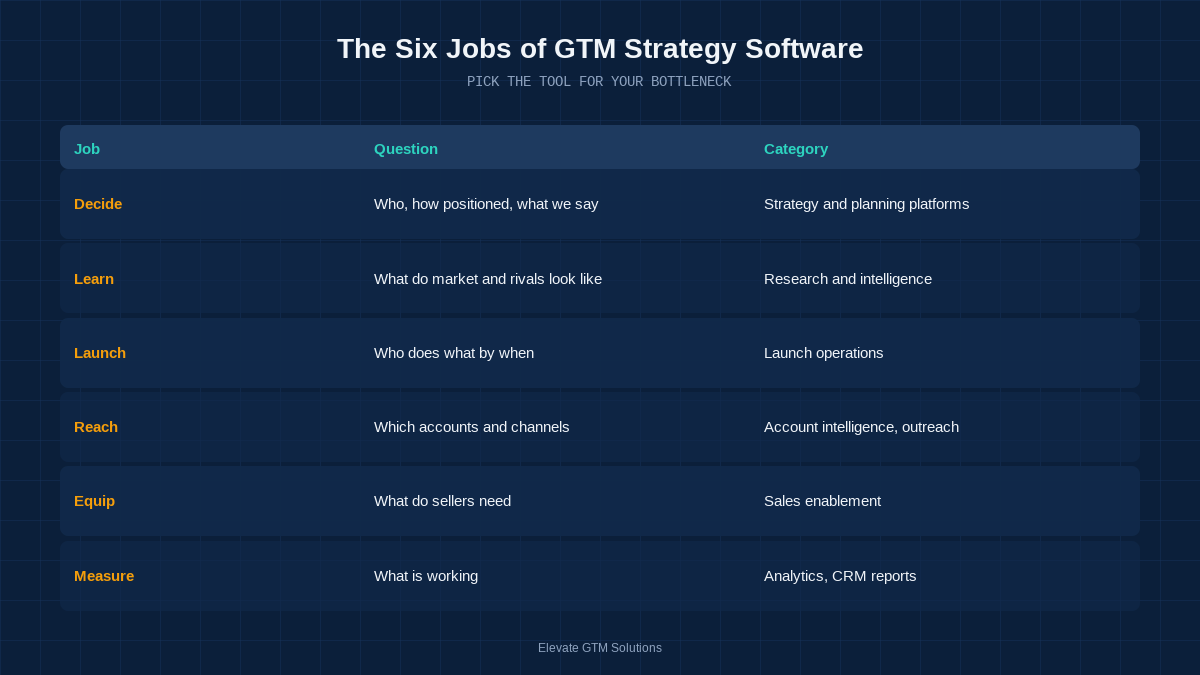
A go-to-market strategy answers six questions. Different software helps with different ones.
| Job | The question | Software category |
|---|---|---|
| 1. Decide | Who do we sell to, how are we positioned, what do we say and charge? | GTM strategy and planning platforms |
| 2. Learn | What do the market, buyers and competitors look like? | Research and competitive intelligence tools |
| 3. Launch | Who does what by when for this product or feature? | Launch and product marketing operations tools, work management |
| 4. Reach | Which accounts and buyers, through which channels? | Account intelligence, ABM, outreach and advertising tools |
| 5. Equip | What do sellers and partners need? | Sales enablement platforms |
| 6. Measure | What is working? | Revenue analytics, conversation intelligence, CRM reporting |
If you can say which of the six is your bottleneck, the shortlist gets short quickly. If you cannot, start by reading your last three lost deals. The reason usually points to one of the six.
The short list by job
The table gives a starting point. It is a map of categories with examples, not an endorsement.
| Job | Examples (alphabetical) | Best for | Not designed for |
|---|---|---|---|
| Decide: strategy and planning | Elevate GTM Solutions, Ignition | Teams that need a structured, updatable strategy and shared planning | Holding customer records or sending outreach |
| Learn: research and intelligence | Klue (competitive intelligence), analyst research, review sites | Tracking competitors and market change | Producing your strategy |
| Launch: operations | Asana, Wrike, Aha!, Ignition | Coordinating tasks and dates for a launch | Deciding positioning or pricing |
| Reach: account intelligence and ABM | 6sense, Demandbase, DemandScience (which absorbed Terminus) | Identifying in-market accounts and running account-based programs | Defining your strategy |
| Reach: outreach | Apollo, Outreach, Salesloft | Running sequences and managing rep workflow | Deciding what the message should be |
| Equip: enablement | Seismic (including Highspot) | Content, training and coaching at scale | Setting positioning |
| Record: CRM | HubSpot, Salesforce | Customer records, pipeline and forecasting | Strategy and positioning |
| Measure: analytics | Gong, HockeyStack, Salesloft with Clari | Conversation, attribution and pipeline analysis | Planning the motion |
Two notes on freshness. Highspot and Seismic completed a merger on August 18, 2026, and Highspot now appears as Highspot by Seismic. Clari and Salesloft completed their merger on December 3, 2025, and the combined company uses the Salesloft name. Terminus merged into DemandScience in November 2024. Older comparison pages that treat these as separate rivals are out of date.
Jobs one by one
Job 1: Decide. Strategy and planning platforms
This is the category most people mean by GTM strategy software, and it is the youngest.
What to expect. A place to hold your market, product and segment context, and structured outputs built from it: customer definition, positioning, messaging, pricing logic and plans. Better tools keep outputs connected, so changing the target segment updates what follows.
Elevate GTM Solutions describes itself as an AI-native GTM operating system with 15 connected modules plus a unified strategy. You provide market, industry, product and segment context and it generates structured strategy, then supports workflows, weekly plans and a review rhythm. It works across products, segments and regions. It does not hold customer records or send outreach.
Ignition describes itself as a go-to-market operations platform that aligns product, product marketing and sales. It centers on launches: launch plans sorted by date and owner, messaging, competitive context, release notes and asset coordination. It suits teams where product and product marketing share one process for shipping and launching.
How they differ. Elevate GTM Solutions starts from strategy and context and then plans execution, across markets and products. Ignition starts from the product lifecycle and the launch process. If your main problem is deciding who to target and what to say across segments, the first framing may fit. If your main problem is coordinating many launches, the second may fit. Some teams may use both.
Other options in this job. A shared set of documents, a spreadsheet and a whiteboard tool will serve a single-product team. They cost little and are flexible. They do not keep outputs connected, and their upkeep grows with the number of products and people.
Job 2: Learn. Research and competitive intelligence
Strategy needs evidence. Tools in this group help you collect it: competitor tracking, win and loss analysis, market data and review sites.
- Competitive intelligence platforms such as Klue track competitor changes and package them for sellers.
- Analyst research from firms such as Gartner and Forrester gives market structure and buyer benchmarks.
- Review sites such as G2 and Capterra show how customers describe products.
- Your own customers remain the best source and no software replaces them.
These tools feed a strategy. They do not write it.
Job 3: Launch. Operations and coordination
Once decisions are made, someone has to run the launch. Work management tools such as Asana and Wrike coordinate tasks and deadlines. Product tools such as Aha! connect roadmaps to releases. Ignition spans the product and launch cycle.
If launches are your bottleneck, a launch operations tool can help more than a strategy platform. If decisions are your bottleneck, coordination will not fix it.
Job 4: Reach. Intelligence, ABM and outreach
These tools find accounts and contact them.
- Demandbase describes itself as an AI-powered GTM intelligence platform covering account intelligence, B2B advertising and sales insight, and runs a B2B-focused advertising engine.
- 6sense is an account intelligence and intent platform for revenue teams.
- DemandScience absorbed Terminus in 2024 and presents an account-based experience platform alongside data and demand generation services.
- Apollo, Outreach and Salesloft run outreach and engagement. Outreach and Salesloft add conversation intelligence, forecasting and agents.
They assume you already know whom to target and what to say. If you do not, they will help you reach the wrong people faster. See Elevate vs Demandbase and Elevate vs 6sense for deeper comparisons.
Job 5: Equip. Enablement
Seismic, which now includes Highspot, manages content, training, coaching and buyer engagement for large teams. It works best when positioning and messaging are settled. Our guide to Gong vs Seismic after the Highspot merger covers it.
Job 6: Record and measure. CRM and analytics
HubSpot and Salesforce are the systems of record for customers and pipeline. Gong, HockeyStack and Clari within Salesloft analyze conversations, attribution and forecasts. A CRM tells you what happened. It was not built to decide what should happen next, which is why many teams still keep strategy in slides. Our article Why CRM Isn't Your GTM System explains the difference.
How to choose: seven criteria
Whatever the category, test candidates on the same criteria.
| Criterion | What to ask |
|---|---|
| Job fit | Which of the six jobs does it do well, and which does it merely touch? |
| Inputs | What must I provide, and how specific can I be? |
| Outputs | What leaves the product in a form my team will use? |
| Traceability | Can I see how an output follows from an input? |
| Update cycle | What happens when my market or assumptions change? |
| Integration | Which exact actions work with my CRM and other tools? |
| Ownership | Who in my company will keep it current? |
A tool that scores well on job fit and ownership is usually a better choice than one with more features.
A shortlist method that takes a week
- Name your bottleneck. Pick one of the six jobs.
- List three candidates for that job. Use the table above.
- Prepare one real scenario. A product, a segment and a question you actually need answered.
- Run the same scenario in each. Ask each vendor to show it live with your inputs.
- Have a skeptic review the output. A seller or product manager who will say what is missing.
- Check total effort. Include your team's time to enter inputs and review outputs.
- Decide on a pilot. One product or segment, with a review date.
Choosing by team size and stage
| Situation | Reasonable starting point |
|---|---|
| Single product, early stage, a few people | Documents and a spreadsheet, plus founder-led customer conversations. Consider a free first strategy build to test structure |
| Growing company with a few products | A strategy and planning platform plus the CRM you already have |
| Product-led company shipping often | A launch operations tool, with a strategy layer as the portfolio grows |
| Enterprise with several regions and business units | A strategy and planning platform for consistency, plus enablement and intelligence tools |
| Sales-led team with an established motion | Execution tools first, strategy tooling when win rates stall |
How to read any "best of" list, including this one
Lists like this one are useful and also easy to misuse. Several habits keep you honest.
Check who wrote it. Many "best GTM tools" pages are written by vendors, and the author usually appears near the top of the list. That is not wrong, but it explains why one product tends to come first. This page is written by the maker of one product discussed here, and we have kept the list alphabetical within each job for that reason.
Check the date. The market changed three times in the last two years through mergers. A list from last year may describe products that no longer exist under those names.
Check the category. Lists often mix a CRM, a data provider, a project tool and a strategy platform in one ranking. They are not substitutes, so a single ranking has no meaning.
Check what the claims rest on. "Industry-leading" and "trusted by thousands" are marketing. Look for specifics: what the product does, for whom, and where it stops.
Check for pricing. If prices are not published, treat any comparison of cost as an estimate.
Test it yourself. The only list that fits your situation is the one you build from a real scenario.
A scorecard you can copy
Score each candidate from one to five on each line, with the same people scoring each time.
| Criterion | Weight (your choice) | Tool A | Tool B | Tool C |
|---|---|---|---|---|
| Fit with our bottleneck | ||||
| Quality of output on our real scenario | ||||
| Specificity (does it sound like us, or like anyone?) | ||||
| Traceability from input to output | ||||
| Ease of keeping it current | ||||
| Integration with our CRM and tools | ||||
| Effort from our team to run it | ||||
| Clarity of pricing | ||||
| Honesty about limits |
Decide the weights before you score. If your team is thin, effort and ease of upkeep might count most. If the decision is high stakes, traceability might.
A hypothetical example
This is an illustration, not a description of a real company.
A software company with three products and about eighty people could not agree on which segment to prioritize. Marketing used one customer definition, sales another, and product a third. The head of product marketing named the bottleneck: decisions, not execution. The team already had a CRM and an outreach tool that worked well, so it did not look at those categories.
It shortlisted two strategy platforms and a shared-documents option. It prepared one real scenario, the newest product and its two candidate segments, and asked each option to produce a customer definition, positioning and messaging from the same inputs. A seller and a product manager reviewed the outputs and scored specificity and accuracy. They also noted how many hours the team spent entering inputs and reviewing.
The documents option was cheapest and produced the least consistent result across segments. One platform produced more connected outputs; the other fit the launch process more closely. The team piloted the first on one product for a quarter, with a named owner, a monthly review and a rule that every draft was tested on three customer calls. The decision was made on evidence from its own scenario, not on a ranking.
Questions to ask each type of vendor
Strategy and planning platforms
- Show me an output built from my inputs, live.
- What happens to every output when I change the target segment?
- How do I see why a recommendation was made?
- What can I export and who owns it?
Launch and operations tools
- How does it keep positioning and messaging attached to each launch?
- Who needs a seat, and what does each seat cost?
Account intelligence and ABM platforms
- What data sources feed the signals, and how fresh are they?
- What is included at each tier and what costs extra?
Enablement platforms
- How is content governed and how is usage measured?
- What changes during integration after the recent merger?
CRMs and analytics
- How much configuration will we need and who maintains it?
For all of them: what do you not do, and can I speak to a customer who has used it for six months?
How pricing tends to differ by category
Prices change, and many are not published, so this describes structure, not amounts.
| Category | Typical pricing shape |
|---|---|
| Strategy and planning platforms | Subscription by scopes, products or seats |
| Launch and operations tools | Per seat |
| Account intelligence and ABM | Annual contracts, often quote-based, scaling with accounts or data |
| Outreach and engagement | Per seat, with usage-based features |
| Enablement | Per seat or per team, quote-based |
| CRM | Per seat with tiers |
Total cost also includes your team's time. Build the comparison across three years, not one invoice.
When to change tools
Switch or add a tool when:
- The bottleneck has moved. If strategy is now settled and execution is slow, look at execution tools.
- Multiple versions of the truth exist. Several documents and decks that disagree are a sign you have outgrown them.
- Updates take longer than the decisions they support.
- New products or regions have multiplied the number of strategies you maintain.
Keep what works. Replacing a tool that fits its job with one that overlaps rarely pays off.
Common mistakes
Buying an execution tool to fix a strategy problem. Better outreach does not fix an unclear customer definition.
Buying a strategy tool to fix an execution problem. If the strategy is sound and execution is uneven, look at execution tools.
Comparing feature lists, not jobs. More features rarely beat a better match.
Skipping ownership. An unowned system goes stale like a document.
Trusting old comparison articles. Several vendors in this market merged recently. Check dates.
Treating AI output as finished. Every tool that uses AI produces drafts that need review against real customers.
What AI changes, and what it does not
AI has made structuring and drafting faster across all six jobs. In a field study of 5,172 customer-support agents published in the Quarterly Journal of Economics, access to an AI assistant raised issues resolved per hour by about 15 percent on average. In a Harvard Business School field experiment with 758 consultants, AI helped on tasks inside its capability and reduced performance on a task outside it. The practical lesson is to use AI for structured drafting and analysis, then check the output against customer evidence and keep a named decision owner.
What to look for in a strategy and planning platform
If your bottleneck is the Decide job, these are the features that separate a useful platform from a pretty one. Use them as a checklist in demos.
| Feature | What good looks like | Red flag |
|---|---|---|
| Structured inputs | You can describe market, product, segment and evidence in specific fields | A single free-text box that returns generic text |
| Specific outputs | Outputs name your customers, alternatives and proof, not categories | Output that would fit any company |
| Connected outputs | Changing the target segment changes positioning, messaging and plans | Each output stands alone |
| Traceability | You can see which inputs led to which output | Answers appear without reasoning |
| Version comparison | You can compare strategies for two segments or regions | One version at a time |
| Review and approval | A named person approves changes and the history is kept | Anyone can overwrite anything |
| Export and ownership | You can export outputs and keep them | Outputs locked in the product |
| Integrations | Exact supported actions with your CRM are listed | Logos without detail |
| AI controls | You can review, edit and reject what AI proposes | Actions or changes happen without review |
| Honest limits | The vendor says what it does not do | Claims to do everything |
| Clear pricing | Plans, scopes and seats are stated | Everything is "contact sales" with no structure |
Ask for the output built from your inputs, not a pre-built demo. The difference tells you more than any feature list.
Research and intelligence tools: how to feed the strategy
A strategy is only as good as its evidence, so decide how you will keep a steady flow of it.
| Evidence | How to get it | Tools that help |
|---|---|---|
| Why you win and lose | Structured win and loss interviews and CRM reason fields | CRM, call recording, interview notes |
| What buyers say | Calls, demos and support tickets | Conversation intelligence, support tools |
| What competitors claim | Their sites, pricing pages, release notes, reviews | Competitive intelligence tools or a regular manual review |
| Market shape | Analyst reports, public data, industry bodies | Research subscriptions, public sources |
| How buyers describe alternatives | Review sites and community discussions | G2, Capterra, community platforms |
| What your own data shows | Pipeline and conversion by segment | CRM and analytics |
Set a rhythm: a monthly review of new wins and losses, a quarterly look at competitors, and an annual look at the market. The strategy platform then holds the conclusions, not the raw material.
The first sixty days after you choose a tool
Choosing is the easy part. Adoption decides whether it pays off.
Days 1 to 10: set up and scope. Pick one product and one segment. Name an owner. Decide who reviews outputs. Gather inputs.
Days 11 to 25: first build and review. Generate outputs, review them with sellers and customer success, and list errors and gaps.
Days 26 to 40: correct and test. Improve inputs, regenerate, and test claims with a few buyers.
Days 41 to 55: decide and hand off. Hold a decision session, record it and produce short handoff material for sellers and marketers.
Days 56 to 60: set the rhythm. Schedule monthly reviews, a quarterly reset and an owner for inputs. Decide what you will measure.
A tool that is not reviewed monthly by day sixty is probably on its way to becoming shelfware.
Building the business case
Finance teams want a reason beyond "alignment." A simple method avoids invented numbers.
- Name the problem in your own data. For example, the time spent rebuilding decks each quarter, the number of conflicting versions in circulation, or win rates that differ by team for the same segment.
- State the cost of the problem. Hours multiplied by loaded cost, or the effect of a delayed launch. Use your figures and label assumptions.
- State the total cost of the tool. License plus your team's time to enter inputs and review outputs, over three years.
- Define the measures of success. Time to update the strategy, consistency of messaging across teams, win rate by segment, launch readiness.
- Agree a pilot and a review date. Evidence from a pilot beats a forecast.
- Include the cost of not acting. For example, a segment misjudged because teams disagreed.
Do not use industry statistics you cannot source. A modest, honest case from your own data is more persuasive.
The view from each seat
| Role | What they usually want from GTM strategy software |
|---|---|
| Founder | Speed to a clear strategy and a shared language for the team |
| Head of product marketing | One source for positioning, messaging and competitive framing |
| Head of sales | Messaging reps believe and a customer profile that matches who closes |
| Head of marketing | Priorities and channels tied to the strategy |
| RevOps | Clean handoff to the CRM and workflows |
| Product leader | Launch plans connected to the roadmap |
| Finance | Predictable cost and a measurable result |
| Security and legal | Clear data handling and access control |
Include these voices in the evaluation. A tool that one seat loves and another distrusts is likely to stall.
A scenario run three ways
This is a hypothetical illustration of how different kinds of tools handle the same question.
The question: "Which of our two candidate segments should we prioritize for the new product, and what do we say to it?"
With shared documents and a spreadsheet. The product marketer builds a comparison table by hand, drafts positioning in a document and messaging in another. It takes a few days. The output is flexible and specific to the people who wrote it. A month later, when sales changes a claim in a deck, the documents no longer agree, and nobody knows which is current.
With a work management tool. The team creates tasks for research, positioning and messaging, assigns owners and dates, and tracks progress. The tool is excellent at showing who is doing what by when. It holds no view of the customer or competitors, so the substance still lives in documents.
With a strategy and planning platform. The marketer enters the market, product, both segments and the evidence on wins, losses and alternatives. The platform produces connected outputs for each segment, and she compares the two side by side with a seller and a customer success manager. They correct two assumptions, regenerate and choose. The decision and the reasoning are recorded in one place, and a change to the chosen segment updates the related outputs.
None of the three removes the need for buyer conversations. They differ in how much effort goes into structure and consistency, and how well the result survives the next change.
Objections you will hear, and honest answers
"We can do this in documents." Often true for one product and one owner. The cost appears when products, segments and people multiply and versions drift.
"AI output is generic." It is, when inputs are thin. Specific inputs and review make it useful. Test with your own scenario.
"We already have a CRM." A CRM records what happened. It does not decide the target or the message, which is why many teams still keep strategy in slides.
"We cannot afford another tool." Compare cost with the time spent rebuilding decks and reconciling versions, and start with a free or low-cost first build if one exists.
"Our team will not use it." That is a risk with any tool. Name an owner, keep the review monthly and show sellers that outputs reflect what they hear.
"What if the vendor is acquired?" Choose tools you can export from, and keep a record of decisions outside any single product.
A decision path in words
If you want a quick route to a shortlist, answer these in order.
- Do you know who your best customers are? If not, start with evidence: win and loss analysis and customer conversations, with or without a strategy tool.
- Do teams disagree about the customer, message or plan? If yes, a strategy and planning layer is probably your first purchase.
- Is the main problem running launches on time? If yes, look at launch operations or work management before a strategy platform.
- Is the main problem finding in-market accounts? If yes, look at account intelligence.
- Is the main problem reaching buyers consistently? If yes, look at outreach and engagement tools, after the target and message are settled.
- Is the main problem equipping many sellers? If yes, look at enablement, after positioning is settled.
- Is the main problem visibility into what works? If yes, look at analytics and conversation intelligence.
Many teams answer yes to several. Take them in order, because the early ones determine whether the later tools help.
Key takeaways
- GTM strategy software covers six jobs: decide, learn, launch, reach, equip and measure. Pick the tool for your bottleneck.
- Strategy and planning platforms such as Elevate GTM Solutions and Ignition help decide and maintain the strategy. A CRM records what happened.
- Several vendors have merged recently, so check the date of any comparison you read.
- Test every candidate with the same real scenario and have a skeptical seller review the output.
- Judge tools on traceability, connected outputs, ease of updating, integration detail and honesty about limits.
- Build the business case from your own data, over three years, including your team's time.
Where Elevate GTM Solutions fits
Elevate GTM Solutions is an AI-native GTM operating system. It covers the Decide job and parts of Launch, Reach and Measure through connected modules, workflows and a recurring review rhythm. Published plans are Enable at USD 499 per month and Growth at USD 1,499 per month, billed annually, with custom Scale pricing, and a free first strategy build is available. It does not replace a CRM, a data provider or an outreach tool, and it connects to HubSpot, Salesforce and other tools for supported actions.
For related reading, see What Is Elevate GTM Solutions?, How to Choose a GTM Platform, Top GTM Platforms and Best GTM Strategy Software for Product Launches. See the pricing page for current terms, or request a demo to run your own scenario.
Frequently Asked Questions
What is the best GTM strategy software?
It depends on the job. For building and maintaining the strategy itself, look at GTM strategy platforms such as Elevate GTM Solutions or Ignition. For customer records use a CRM. For account intelligence, enablement and outreach there are separate categories. Most teams combine a strategy layer with execution tools.
What is GTM strategy software?
Software that helps a company decide and maintain its go-to-market strategy: customer definition, positioning, messaging, pricing logic, channel plans and launch plans. It differs from tools that execute campaigns or record customers.
Is a CRM GTM strategy software?
No. A CRM records customers and pipeline. It does not decide your target customer, positioning or messaging.
What is the best GTM strategy software for startups?
Startups with one product can often begin with documents, a spreadsheet and customer interviews. Some strategy platforms offer a free first build, which is a low-cost way to test whether the structure helps. Add tools as the number of products, segments and people grows.
What is the difference between GTM strategy software and sales engagement software?
Strategy software decides who to target and what to say. Sales engagement software runs outreach to the people you have chosen. They sit at different layers and are often used together.
Which GTM tools have merged recently?
Seismic and Highspot completed their merger on August 18, 2026. Clari and Salesloft completed theirs on December 3, 2025. Terminus merged into DemandScience in November 2024. Comparison pages written before those dates may be out of date.
Can AI build my GTM strategy?
AI can speed up structured drafting and analysis, and published studies show gains on some tasks and losses on others. Treat output as a draft, check it against customer evidence, and keep a named decision owner.
How do I choose between tools?
Name your bottleneck among the six jobs, shortlist three tools for that job, run the same real scenario in each, have a skeptic review the outputs, and pilot one before committing.
Does Elevate GTM Solutions replace my other tools?
No. It covers the strategy and planning layer and connects to tools such as HubSpot and Salesforce. You will still want a CRM, and likely tools for outreach and measurement.
What features matter most in GTM strategy software?
Structured inputs, specific outputs built from your context, connected outputs that update together, traceability from inputs to outputs, version comparison, review and approval, export and honest limits.
How do I build a business case for GTM strategy software?
Name the problem in your own data, such as time spent rebuilding decks or conflicting versions in circulation, estimate its cost, compare it with three-year tool cost including your team's time, define measures of success and agree a pilot with a review date.
How long does it take to adopt a GTM strategy platform?
A focused first build and review can take a few weeks. Plan sixty days to reach a steady rhythm of monthly reviews, and name an owner from the start.
What evidence should feed a GTM strategy?
Win and loss reasons, buyer conversations, competitor positioning, market data and your own pipeline by segment. Set a monthly, quarterly and annual rhythm for refreshing each.
Who should own GTM strategy software inside a company?
Usually product marketing or a head of strategy, with a named approver for changes and input from sales, marketing and customer success.