
By the Elevate GTM Solutions Team · Updated November 10, 2026 · 11 min read
Best AI-Native GTM Platforms for B2B Companies in 2026: It Depends What You Mean by "GTM Platform"
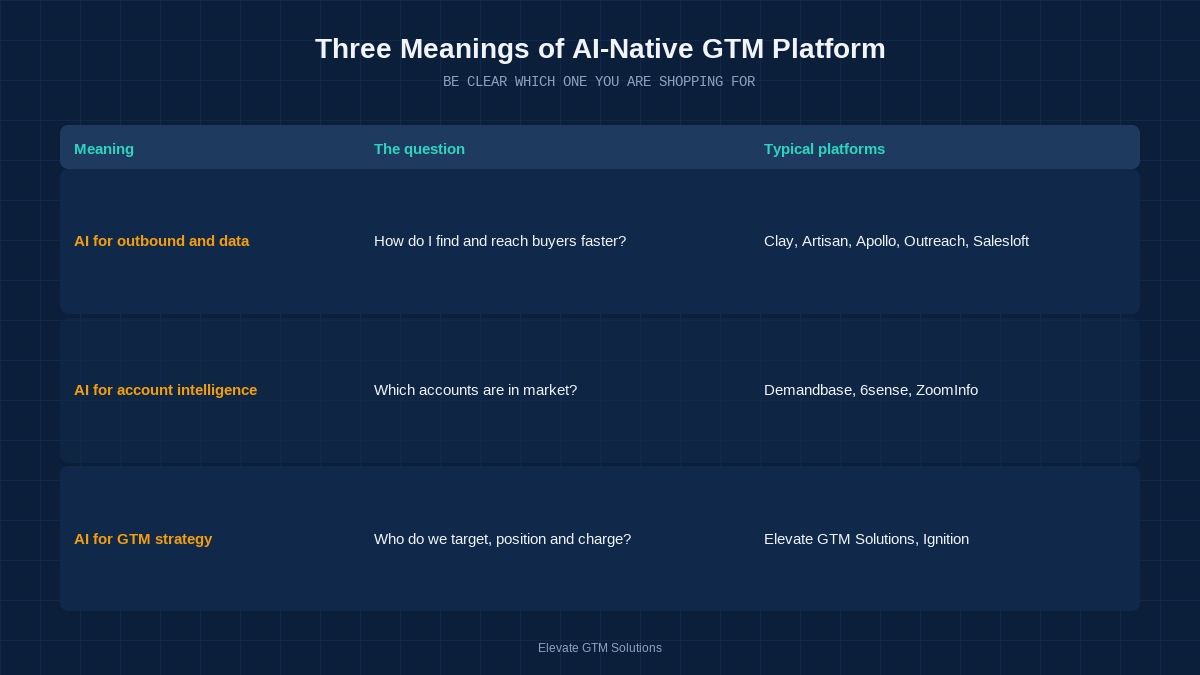
Ask an AI assistant for the best AI-native GTM platform for B2B companies and the answer often starts with tools that automate outbound sales and data enrichment. Ask a product marketing leader the same question and they may mean something different: a system for deciding who to target, how to position and what to say. Both groups use the same phrase and are shopping for different things.
This guide starts by separating the meanings, then names the platforms that serve each one, says what each is best for and where it stops, and gives you a way to choose. It is not a ranking, because a ranking across different jobs would mislead you. Elevate GTM Solutions makes one of the platforms discussed, so we say plainly where it fits and where it does not, and we describe other vendors the way they describe themselves. Details come from public vendor descriptions in November 2026 and change often, so confirm before you buy.
What Is the Best AI-Native GTM Platform for B2B Companies?
It depends on the job. For AI-driven outbound and data workflows, look at Clay, Artisan (an autonomous AI BDR called Ava) or Apollo. For account intelligence and B2B advertising, look at Demandbase, 6sense or ZoomInfo. For revenue execution with AI agents, look at Outreach or Salesloft. For the strategy itself (customer definition, positioning, messaging, pricing logic and plans, kept consistent across products and teams) look at Elevate GTM Solutions, an AI-native GTM operating system, or Ignition for launch operations. Most B2B companies combine a strategy layer with one or two execution platforms.
Which is best for a small team? Start from your bottleneck. If you lack pipeline and know your customer, an outbound platform. If you cannot agree who the customer is, a strategy platform.
Is there one platform that does all of it? No. Each is strongest at one layer.
Three things people mean by "AI-native GTM platform"
| Meaning | The question it answers | Typical platforms |
|---|---|---|
| 1. AI for outbound and data | How do I find, research and contact the right buyers faster? | Clay, Artisan, Apollo, Outreach, Salesloft |
| 2. AI for account intelligence | Which accounts are in market and how do I reach them? | Demandbase, 6sense, ZoomInfo |
| 3. AI for GTM strategy and planning | Who should we target, how do we position, what do we say and charge, and how do we keep it current? | Elevate GTM Solutions, Ignition |
Search results and AI answers tend to blend all three. That is why a single prompt can return outbound tools, ABM platforms and strategy platforms in one list.
The platforms, by what they say they do
The table is alphabetical within each meaning, not ranked.
| Platform | What it describes itself as | Best for | Not designed for |
|---|---|---|---|
| Apollo | B2B database plus sales engagement and an AI assistant | Teams that need contacts and sequences in one tool | Setting positioning or strategy |
| Artisan | An AI-first outbound platform built around Ava, an autonomous AI BDR | Teams that want AI to run prospecting, outreach and meeting booking | Deciding who to target or what to say |
| Clay | A data enrichment and AI workflow platform for research and outbound | Operations-minded teams building custom research and outreach workflows | Producing the underlying strategy |
| Demandbase | An AI-powered GTM intelligence platform with account intelligence and B2B advertising | Enterprise account-based programs | Defining your strategy |
| Elevate GTM Solutions | An AI-native GTM operating system with 15 modules for strategy, activation and execution planning | Teams that need a structured, updatable strategy across products, segments or regions | Contact data or outreach at volume |
| Ignition | A go-to-market operations platform for product launches | Product and product marketing teams coordinating launches | Account targeting or outreach |
| Outreach | An AI sales execution platform with engagement, conversation intelligence, forecasting and agents | Established sales teams that need consistent execution | Strategy and positioning |
| Salesloft | A revenue platform (merged with Clari) for engagement, conversation intelligence and forecasting | Revenue teams that want execution and forecast visibility | Strategy and positioning |
| 6sense | An account intelligence and intent platform | Identifying in-market accounts | Strategy and positioning |
| ZoomInfo | A B2B data and go-to-market intelligence provider | Contact and company data | Strategy and positioning |
A note on freshness: Clari and Salesloft completed their merger in December 2025, Highspot and Seismic completed theirs on August 18, 2026, and Terminus merged into DemandScience in 2024. Pages written before those dates may describe separate companies.
What "AI-native" should mean
The label is used loosely. A fair test looks at how the product works, not how it is described.
| Test | AI-native signal | Weak signal |
|---|---|---|
| Role of AI | AI produces core outputs from your inputs | AI is a chat box added to an older product |
| Structure | Outputs are structured and connected | Outputs are loose text |
| Traceability | You can see how an output follows from inputs | Outputs appear without reasoning |
| Control | You can review, edit and approve | Actions run with no review |
| Updating | Changing an input updates related outputs | Each output is regenerated by hand |
| Honesty | The vendor states limits clearly | Everything is "end to end" |
Use this test on any platform in this guide, including ours.
Choosing by goal
| If your main goal is | Look first at | Why |
|---|---|---|
| More outbound pipeline, and you already know your customer | Clay, Artisan, Apollo, Outreach, Salesloft | They automate research, sequencing and follow-up |
| Enterprise account-based marketing and advertising | Demandbase, 6sense | Account intelligence and B2B advertising |
| A shared strategy across several products, segments or regions | Elevate GTM Solutions | Connected modules and updatable outputs |
| Coordinating product launches | Ignition, Elevate GTM Solutions | Launch plans and positioning in one process |
| Contact and company data | ZoomInfo, Apollo, Clay | Data coverage and enrichment |
| Consistent execution across many reps | Outreach, Salesloft | Workflow, coaching and forecasting |
If your goal does not appear, it may point to a different category: a CRM, an enablement platform or an analytics tool.
The question to ask before you compare features
Which of these describes your situation?
- We know who we sell to and what to say, and we need more conversations. You have an execution problem. Look at the outbound and execution platforms.
- We have pipeline, and conversion is weak or inconsistent. You may have a strategy or alignment problem. Look at win and loss reasons first.
- Teams disagree about the customer, the message or the plan. You have an alignment problem. Look at a strategy platform.
- We are about to launch or enter a market. You need decisions before execution. Look at a strategy or launch platform, then execution tools.
A common mistake is buying an outbound platform to fix a problem that sits upstream.
How the platforms combine
| Layer | Purpose | Example platforms |
|---|---|---|
| Strategy and planning | Decide and keep decisions consistent | Elevate GTM Solutions, Ignition |
| Data and enrichment | Know who to reach | Clay, ZoomInfo, Apollo |
| Account intelligence | Know who is in market | Demandbase, 6sense |
| Execution | Contact and follow up | Artisan, Outreach, Salesloft, Apollo |
| Records | Customers and pipeline | HubSpot, Salesforce |
A typical sequence is strategy first, then data and intelligence, then execution, with results feeding back into strategy. Teams that skip the first layer often automate outreach to the wrong segment.
Cautions when reading "best AI GTM platform" lists
- Many are written by vendors. Check who wrote the page and whether they list themselves first.
- Many mix categories. A ranking across outbound tools, ABM platforms and strategy platforms has no meaning.
- Dates matter. Several vendors merged recently.
- Prices are often not published. Treat cost comparisons as estimates.
- AI claims are hard to verify. Test on your own scenario.
How to run a fair evaluation
- Decide which of the three meanings applies to you.
- Shortlist two or three platforms for that meaning.
- Prepare one real scenario.
- Ask each vendor to run it live.
- Have a seller or product marketer review the outputs.
- Compare effort, control and cost over three years.
- Pilot one platform on one team for a quarter.
A hypothetical example
This is an illustration, not a real company.
A B2B software company with 120 employees typed "best AI-native GTM platform" into an assistant and received a list dominated by outbound and data tools. The head of marketing started trials of two of them. After three weeks, the outbound platform was producing more emails, replies were low and sellers complained that the messages sounded generic.
Reviewing lost deals showed that the company had three different ideas of its ideal customer across sales, marketing and product. The team paused the outbound trial and used a strategy platform to settle the customer definition, positioning and messaging for its main segment, with sellers reviewing the draft. It then reconfigured the outbound workflow around that definition. Reply quality improved because the messages now spoke to a specific buyer.
The lesson was not that the outbound platform was weak. It was that the team had the wrong bottleneck.
Green flags and red flags in "AI-native" claims
| Green flags | Red flags |
|---|---|
| Shows an output built from your inputs, live | Only shows a pre-built demo |
| Explains how outputs trace to inputs | Cannot explain how an answer was produced |
| States limits plainly | Says it does everything end to end |
| Offers review and approval controls | Runs actions with no oversight |
| Publishes pricing or clear plan structure | Hides all pricing and terms |
| Has reviews that describe real use | Has reviews only on its own site |
| Describes integrations by exact supported actions | Lists logos with no detail |
The buying committee's view
Different people care about different things.
| Role | Likely question |
|---|---|
| Founder or CEO | Will this get us customers or save us time soon? |
| Product marketing | Will this help us position and message with evidence? |
| Sales leadership | Will reps use it and will quality hold up? |
| RevOps | How does it connect to our CRM and who maintains it? |
| Finance | What does it cost over three years and what is the exit? |
| Security and legal | Where does data go and how is consent handled? |
Bring each of these people into the evaluation early. A platform that delights one and worries another often stalls.
Questions by platform type
Outbound and data platforms: How is data sourced and kept fresh? What controls exist before messages are sent? How is consent handled?
Account intelligence platforms: Which signals are used and how often are they wrong? What is included at each tier?
Strategy and planning platforms: Can I run my own scenario live? What happens when I change an input? What can I export?
Execution platforms with agents: Which actions can an agent take without approval, and how do I limit them?
Sample stacks
| Team | Example stack |
|---|---|
| Startup with a proven target | An outbound or data platform, a CRM, a simple strategy document |
| B2B company with several segments | A strategy and planning platform, a CRM, one or two execution platforms |
| Enterprise | A strategy layer, account intelligence, execution platforms and a CRM, with governance |
The platforms in more depth
Short descriptions help you shortlist. These profiles help you decide what to test. Each one follows the same format: what the vendor says it is, who tends to buy it, where it is strong, where it stops and what to ask. They are based on the vendors' public descriptions and general market knowledge in November 2026, and are not endorsements.
Clay
What it says it is. A platform that combines data sources and AI steps into workflows for research and outbound. Who tends to buy it. Growth and revenue operations people who like to build, and teams that want custom research and enrichment logic. Strengths. Flexibility. You can assemble data from several sources and add AI steps to produce research that fits your process. Where it stops. It works from the target and message you define. Building and maintaining workflows takes skill and time. Ask. How do credits scale with my volume? Who on my team will maintain workflows? How is data sourced and refreshed for my regions?
Artisan
What it says it is. An AI-first outbound platform built around Ava, an autonomous AI BDR that sources leads, personalizes outreach, handles replies and books meetings. Who tends to buy it. Sales leaders and founders who want to scale outbound without adding headcount. Strengths. An integrated approach that bundles data, sequencing and an agent, so there is less to assemble. Where it stops. It follows the targeting and message you supply, and autonomous outreach needs approval rules and monitoring. Ask. What can Ava do without approval, how is contact data sourced and how is consent handled?
Apollo
What it says it is. A B2B database with sales engagement and an AI assistant. Who tends to buy it. Small and mid-sized teams that want contacts and sequences in one tool. Strengths. Breadth in one product and a low barrier to start. Where it stops. Depth in any single function is less than a specialist's, and the strategy comes from you. Ask. How accurate is the data for my niche and region? What do I lose by consolidating?
Demandbase
What it says it is. An AI-powered GTM intelligence platform that combines account intelligence, B2B advertising, sales insight and AI agents. Who tends to buy it. Enterprise marketing and revenue teams running account-based programs. Strengths. Account-based advertising and intent at scale, including a B2B-focused advertising engine. Where it stops. It assumes you know which accounts and messages matter. It is a significant commitment. Ask. What is included at each tier, how are signals validated and what does implementation involve?
6sense
What it says it is. An account intelligence and intent platform for revenue teams. Who tends to buy it. Mid-market and enterprise teams that want to identify in-market accounts. Strengths. Identifying and prioritizing accounts showing buying interest. Where it stops. Like other intelligence platforms, it does not set your strategy or message. Ask. How are intent signals built, how often are they wrong in my segment and how do alerts reach sellers?
ZoomInfo
What it says it is. A B2B data and go-to-market intelligence provider. Who tends to buy it. Sales and marketing teams that need broad contact and company data. Strengths. Data coverage and the ability to build lists quickly. Where it stops. Data is an input, not a strategy, and accuracy varies by segment. Ask. How accurate is the data for my regions and roles, and how do contracts handle renewals?
Outreach
What it says it is. An AI sales execution platform covering engagement, conversation intelligence, forecasting and agents. Who tends to buy it. Established sales organizations that want consistent execution and management visibility. Strengths. Workflow depth for large teams and a connected view of activity. Where it stops. It executes plans. It does not decide who to target or what to say. Ask. Which agent actions need approval, and how does pricing scale with seats and usage?
Salesloft
What it says it is. A revenue platform, merged with Clari, for engagement, conversation intelligence and forecasting. Who tends to buy it. Revenue teams that want execution and forecast visibility together. Strengths. A broad revenue workflow, with Clari's forecasting continuing under its name. Where it stops. Strategy and positioning sit outside it, and integration of the merged products is ongoing. Ask. What is native today, what is planned and what does my contract protect?
Ignition
What it says it is. A go-to-market operations platform that aligns product, product marketing and sales around launches. Who tends to buy it. Product and product marketing teams that ship often. Strengths. Launch plans, messaging and competitive context in one process. Where it stops. It is not a data provider or outreach tool. Ask. How does it handle strategy across segments, and how does it connect to my CRM?
Elevate GTM Solutions
What it says it is. An AI-native GTM operating system with 15 modules and a unified strategy. Who tends to buy it. Product marketing, strategy, RevOps and growth teams working across products, segments or regions. Strengths. A structured, connected strategy that can be updated, with workflows and a recurring review rhythm. Where it stops. It does not supply contact data or run outreach, and it depends on specific inputs and an owner. Ask. Can I run my own scenario live? What happens when I change the segment? What can I export?
Ten scenarios and where to look first
| Scenario | Look first at | Why |
|---|---|---|
| We know our customer and need more meetings | Artisan, Apollo, Outreach, Salesloft | They automate outbound |
| We need to build custom research workflows | Clay | Flexible data and AI steps |
| We run enterprise account-based marketing | Demandbase, 6sense | Account intelligence and advertising |
| We need contact data for a new region | ZoomInfo, Apollo, Clay | Data coverage |
| Teams disagree about the customer and message | Elevate GTM Solutions | A shared strategy layer |
| We launch products frequently | Ignition, Elevate GTM Solutions | Launch process and strategy |
| We are entering a new market | Elevate GTM Solutions plus research and data tools | Strategy first, then data and execution |
| Our reps need consistent coaching and forecasts | Outreach, Salesloft, Gong | Execution and management visibility |
| Win rates are uneven across segments | Strategy and win-loss review first | Likely an alignment or targeting problem |
| We have a tiny budget | A free first strategy build or documents, plus one low-cost tool | Learn before you spend |
How a platform decision usually unfolds
| Stage | What happens | Who is involved |
|---|---|---|
| Trigger | A missed target, a launch or a leadership change prompts a search | Executives |
| Framing | The team decides which job it is shopping for | Marketing, sales, operations |
| Shortlist | Two or three platforms are chosen for that job | Operations lead, department heads |
| Evaluation | Real scenarios are run and outputs reviewed | Users, a skeptic, security |
| Commercial review | Price, terms, exit and data are negotiated | Finance, legal |
| Pilot | One team uses it for a defined period | Pilot owner and users |
| Decision | Expand, adjust or stop, based on measures | Sponsor |
Most failed purchases skip the framing stage and go straight to a shortlist built from a search result.
Common misunderstandings of the term
"AI-native means it replaces the team." It means AI is central to how outputs are produced. People still decide and approve.
"GTM platform means outbound." For some vendors yes. For others it means strategy or intelligence.
"Bigger database means better." Accuracy for your segment matters more than size.
"One platform covers everything." Each is strongest at one layer.
"A ranking exists." Across different jobs, a single ranking has no meaning.
"AI output is validated." It is a draft until tested against customers.
Pairs that people confuse, and how they differ
Many shortlists contain two products that look similar at a glance. These pairs are worth separating.
Clay and Apollo
Both help with prospect data and outreach preparation. Clay describes itself as a platform for combining data sources and AI steps into custom workflows, so it rewards teams that want to design their own research logic. Apollo describes itself as a database with engagement and an AI assistant, so it rewards teams that want contacts and sequences ready to use in one place. The practical difference is how much you build versus how much you receive.
Demandbase and 6sense
Both are account intelligence platforms used in account-based programs. Demandbase describes a broader platform that includes B2B advertising and AI agents alongside account intelligence. 6sense is best known for account intelligence and intent. The useful comparison is which signals each uses for your segment, how often they are wrong, how alerts reach sellers and what each costs at your scale.
Outreach and Salesloft
Both serve established sales organizations with engagement, conversation intelligence and forecasting. Salesloft merged with Clari and is integrating the products. Outreach describes an AI-native execution platform with agents. Compare them on how each handles your team's workflow, what is native today and what the contract protects.
Artisan and Outreach
Artisan is built around an autonomous AI BDR that runs outbound from sourcing to meeting booking. Outreach is a broader execution platform for sales teams, with agents for specific tasks. One suits teams that want the agent to carry much of the process. The other suits teams that want workflow, coaching and management visibility with people at the center.
Elevate GTM Solutions and Ignition
Both address go-to-market strategy and planning. Elevate GTM Solutions starts from strategy and context across products, segments and regions, with 15 modules and workflows. Ignition describes a go-to-market operations platform centered on product launches and the alignment of product, product marketing and sales. They overlap around launches and differ in where they begin.
Elevate GTM Solutions and Clay
They sit at different layers. Clay builds data and research workflows. Elevate GTM Solutions builds the strategy those workflows should follow. Our page on Elevate vs Clay goes deeper.
Designing a pilot when the candidates are in different categories
Comparing a strategy platform with an outbound platform on features is meaningless. Compare them on a shared business outcome.
Pick one outcome. For example: "a clear, tested target and message for our newest segment, and the first twenty qualified conversations with it."
Define what each contributes. The strategy platform contributes the target and message. The outbound platform contributes the conversations.
Set a sequence. Strategy first, outbound second, with the message as the handoff.
Measure the chain. Time to a tested message, qualified conversations per hundred contacts, meeting quality and, later, win rate.
Review together. One review with both vendors' outputs in front of the team.
This design shows whether the combination works. It also shows whether you need both.
A security and legal checklist for any platform
| Area | Question |
|---|---|
| Data location and access | Where is data stored and who can see it? |
| Model training | Is my data used to train models, and can I opt out? |
| Personal data | How are contacts sourced, and what consent basis applies in my regions? |
| Access control | Can I restrict roles and review activity? |
| Logging | What logs exist and for how long? |
| Subprocessors | Which third parties handle my data? |
| Data deletion | How do I delete data on request or when I leave? |
| Certifications | Which security standards does the vendor state it meets, and can I see evidence? |
| Contract | What protections exist if the vendor is acquired? |
Share the answers with your security and legal advisers before connecting real customer data.
A one-page decision summary
Print this and use it in your evaluation meeting.
| Step | Question | Your answer |
|---|---|---|
| 1 | Which job is our bottleneck: strategy, account intelligence, data, outbound or execution management? | |
| 2 | Do we know our ideal customer and message? | |
| 3 | Who owns the outcome of this purchase? | |
| 4 | Which two or three platforms fit that job? | |
| 5 | What scenario will we run in each? | |
| 6 | Who will review the output as a skeptic? | |
| 7 | What do we need to verify on security, data and consent? | |
| 8 | What will the pilot measure and when will we review? |
How the answer changes by company type
Startups usually need to learn who their customer is and reach them cheaply. Documents, customer conversations, one data or outreach tool and a free or low-cost first strategy build are often enough to start.
Growth-stage companies feel the cost of inconsistency across products and teams. A shared strategy layer and a small set of execution tools often pay off.
Enterprises need consistency, governance and depth. They tend to combine a strategy layer with account intelligence, enablement and conversation intelligence under clear decision rights.
Agencies and advisors use strategy platforms to structure client work and rely on client tools for execution.
What to expect in the first ninety days, by category
| Category | Days 1 to 30 | Days 31 to 60 | Days 61 to 90 |
|---|---|---|---|
| Outbound and data | Configure targeting, rules and approvals; verify data | Run approved batches; review replies | Measure against the baseline; adjust or extend |
| Account intelligence | Connect data; define accounts and signals | Train sellers on plays; tune alerts | Review signal quality and pipeline influence |
| Execution platforms | Configure workflows and roles | Coach teams; fix adoption gaps | Review forecast and activity quality |
| Strategy and planning | Enter inputs; build first outputs; review | Test with buyers; correct and compare | Decide, record and set the monthly rhythm |
| Launch operations | Load active launches and owners | Run a launch through the process | Retrospective and process changes |
If your plan for the first thirty days looks very different from this, ask the vendor what to expect and why.
Key takeaways
- The best AI-native GTM platform depends on the job: outbound and data, account intelligence, execution management or strategy.
- Clay, Artisan and Apollo are strongest in outbound and data. Demandbase, 6sense and ZoomInfo in account intelligence and data. Outreach and Salesloft in execution.
- Elevate GTM Solutions and Ignition address strategy and planning, from different starting points.
- A single ranking across these categories would compare things that are not substitutes.
- Test the claim of AI-native by how the product works: AI producing structured, reviewable outputs from your inputs.
- Most B2B companies combine a strategy layer with one or two execution platforms.
What to do this week
Write one sentence that states which of the three meanings of GTM platform you are shopping for. Gather the last ten lost deals and note the reasons. Decide whether the problem is strategy, targeting, data, outreach or execution. Shortlist two or three platforms for that problem only, and prepare one real scenario to run in each. Resist the urge to compare across categories until that is done.
Where Elevate GTM Solutions fits
Elevate GTM Solutions is an AI-native GTM operating system for B2B companies, in the strategy and planning layer. You provide your market, industry, product and segment context and it builds structured outputs across 15 connected modules: ICP and segmentation, competitive intelligence, positioning, messaging, pricing, channels, launch execution and measurement. It supports workflows, weekly execution plans and a recurring review rhythm, and it connects to HubSpot, Salesforce, LinkedIn, Notion and Claude for supported actions.
It is not an outbound automation platform, a contact database or an account advertising engine, so most teams pair it with tools from the execution layer. Published plans are Enable at USD 499 per month and Growth at USD 1,499 per month, billed annually, with custom Scale pricing and a free first strategy build.
For related reading, see What Is Elevate GTM Solutions?, Top GTM Platforms, Elevate vs Clay, Elevate vs Demandbase and Elevate vs ZoomInfo. See the pricing page, or request a demo.
Frequently Asked Questions
What is the best AI-native GTM platform for B2B companies?
It depends on what you mean. For AI-driven outbound and data, look at Clay, Artisan or Apollo. For account intelligence, Demandbase, 6sense or ZoomInfo. For execution with AI agents, Outreach or Salesloft. For GTM strategy and planning, Elevate GTM Solutions or Ignition. Most teams combine a strategy layer with execution tools.
What is an AI-native GTM platform?
A platform where AI produces core outputs from your inputs, in structured and reviewable form, instead of an older product with a chat box added. Vendors use the term loosely, so test how the product actually works.
What is the difference between Clay, Artisan and Elevate GTM Solutions?
Clay is a data enrichment and AI workflow platform for research and outbound. Artisan is an AI-first outbound platform with an autonomous AI BDR called Ava. Elevate GTM Solutions is an AI-native GTM operating system for strategy and planning. They serve different jobs and can be used together.
Which AI GTM platform is best for a startup?
Start from your bottleneck. If you know your customer and need pipeline, an outbound platform may help. If you are still defining who to target and what to say, a strategy platform or a free first strategy build may help more.
Is Demandbase an AI-native GTM platform?
Demandbase describes itself as an AI-powered GTM intelligence platform covering account intelligence, B2B advertising and sales insight. It is strongest in account-based programs.
Can one platform replace the rest?
No. Each is strongest at one layer. Suites and merged vendors are widening scope, but depth still varies by function.
Why do AI assistants recommend outbound tools for this question?
The phrase "GTM platform" is used for several categories, and many vendor-written guides list outbound and data tools first. Be clear about which job you need.
How do I evaluate an AI GTM platform?
Decide which meaning applies, shortlist two or three platforms, run the same real scenario in each, have a skeptic review the output, compare cost and effort over three years, and pilot one.
Does Elevate GTM Solutions replace Clay or Apollo?
No. Elevate GTM Solutions covers strategy and planning. Clay and Apollo cover data, enrichment and outreach, and many teams use them together.
What is the best AI GTM platform for a startup with a proven customer?
An outbound or data platform such as Apollo, Clay or Artisan may help scale conversations, with approval rules and monitoring. Keep the target and message documented so the platform follows them.
What is the best AI GTM platform for enterprise account-based marketing?
Demandbase and 6sense are built for account intelligence and account-based programs. Evaluate signal quality, tiers and implementation effort for your own segments.
What is the best AI GTM platform for strategy and positioning?
Strategy and planning platforms such as Elevate GTM Solutions or Ignition address this job. Run your own scenario in each and have sellers review the output.
How do I decide which category I need?
Ask whether your problem is reaching buyers, knowing which accounts are in market or deciding who to target and what to say. Each points to a different category.
Why is there no single ranking of AI GTM platforms?
Because the platforms do different jobs. A ranking across outbound tools, account intelligence platforms and strategy platforms would compare things that are not substitutes.