
By the Elevate GTM Solutions Team · Updated November 10, 2026 · 20 min read
GTM Consultant vs Agency vs GTM Platform for a New Product Launch
A launch brings three different kinds of work together: deciding what the commercial plan should be, producing the assets that carry it, and rolling it out to the field. Companies often buy all three from one vendor and then wonder why the bill is large and the plan is generic. A cleaner approach is to ask which kind of work each option is best at, and buy accordingly.
There are three realistic options: a GTM consultant, a product marketing agency and a GTM platform. This guide compares them for a new launch and shows how to write scopes that keep decisions, production and rollout separate. Elevate sells a GTM platform and a limited advisory practice, so we have an interest in one option. We have tried to be fair to all three.
Should You Hire a GTM Consultant, an Agency or a Platform for a Launch?
Use a GTM consultant for the commercial decision when the choice is contested or high-stakes, an agency for producing positioning assets, campaigns and launch content, and a GTM platform for structuring the strategy, generating launch plans and handoff material, and keeping them updated after launch. They do different jobs, so many launches use a platform for the plan, an agency for production and an advisor, if any, for the decision.
Which is cheapest? A platform for the plan, your own team for the decision, and an agency only for the assets you cannot produce yourself.
Where do launches overspend? Buying an agency's production to fix a decision that was never made.
Decide what the launch still needs
Compare the responsibilities, not the labels
| Work | What to ask | What acceptance looks like |
|---|---|---|
| Buyer and offer | Who resolves the initial segment, problem and scope? | The sponsor can explain who qualifies and which offer they can buy |
| Positioning | Who tests whether the buyer understands the value and alternatives? | The team can trace key claims to approved evidence |
| Channel and coverage | Who decides how the first buyers will be reached and served? | Sales and delivery can show the first customer path |
| Assets and campaign | Who builds, approves and maintains the materials? | Sellers can find the current version and use it on a representative deal |
| Rollout | Who trains the field, handles exceptions and reviews the first cases? | Named internal owners can run the process after handoff |
A launch can have excellent assets and weak commercial choices. It can also have a clear strategy and no one available to execute. The sponsor should identify which problem is live. A well-defined engagement will often give the buyer more control than a broad launch package if the gap is narrow.
Find out which decisions are open before you ask for assets
Start with the offer a rep can sell
Write one sentence identifying who qualifies, what they can buy, which conditions apply and what the company can deliver. Ask product, sales and delivery to explain it independently. If their answers differ, document the disagreement. A product marketing agency can help clarify the language. A sponsor with authority over the offer needs to choose the actual boundary.
Think about the first conversation with a buyer. A sales leader may expect to sell the entire capability while product has verified a narrower workflow. A campaign brief can’t resolve that by describing the capability more attractively. Give the sponsor choices. Launch narrowly, hold until the broader promise is supported, or approve a separately governed pilot for a specific case. Then tell the agency what it can communicate.
Use buyer evidence to choose the launch job
Ask what evidence the company has that the buyer understands and values the offer. If there are only friendly customer interviews and internal opinions, a discovery scope may be appropriate. Product marketing work may be the priority if the buyer and offer are validated but the seller struggles to explain them. If sellers understand the value and cannot find the correct asset, the team may need a narrower enablement or content workflow.
Ask which change would produce the largest benefit before the deadline. A new segment choice may require research and operational design. A change to messaging can be tested with a few representative buyers and approved by the owner of the claim. Price each job through the milestone it can reach.
Put buyer interviews to work in two different ways
Interviews for a commercial decision
When the launch still needs a segment, offer or channel choice, use interviews to understand how buyers make decisions. Ask what led to a recent purchase, what blocked it and who had authority. Compare cases where the intended problem was urgent with cases where the buyer stayed with the current process. The sponsor should receive a recommendation and describe the limits of the sample.
Keep product constraints visible while collecting evidence. A buyer may value a broad service the enterprise cannot deliver. The recommendation can still identify that demand, but the first launch should be designed around what leadership can support or has explicitly approved. Record which assumptions will need validation in a paid pilot.
Interviews for positioning and field assets
The agency can test how buyers describe the problem and what proof they find credible if the sponsor has chosen the offer. Give it the approved scope and examples. Ask it to distinguish wording that improves understanding from requests that require a different offer. The former can go through content approval. The latter should return to the commercial owner.
Have sellers use the resulting language in representative conversations. Observe what they can explain, what questions remain and which proof they can actually send. A strong narrative on a launch page can fail in a deal if the seller cannot handle a basic eligibility question. Use the feedback to revise the field materials and identify any decisions the sponsor needs to reopen.
What a GTM platform covers in a launch
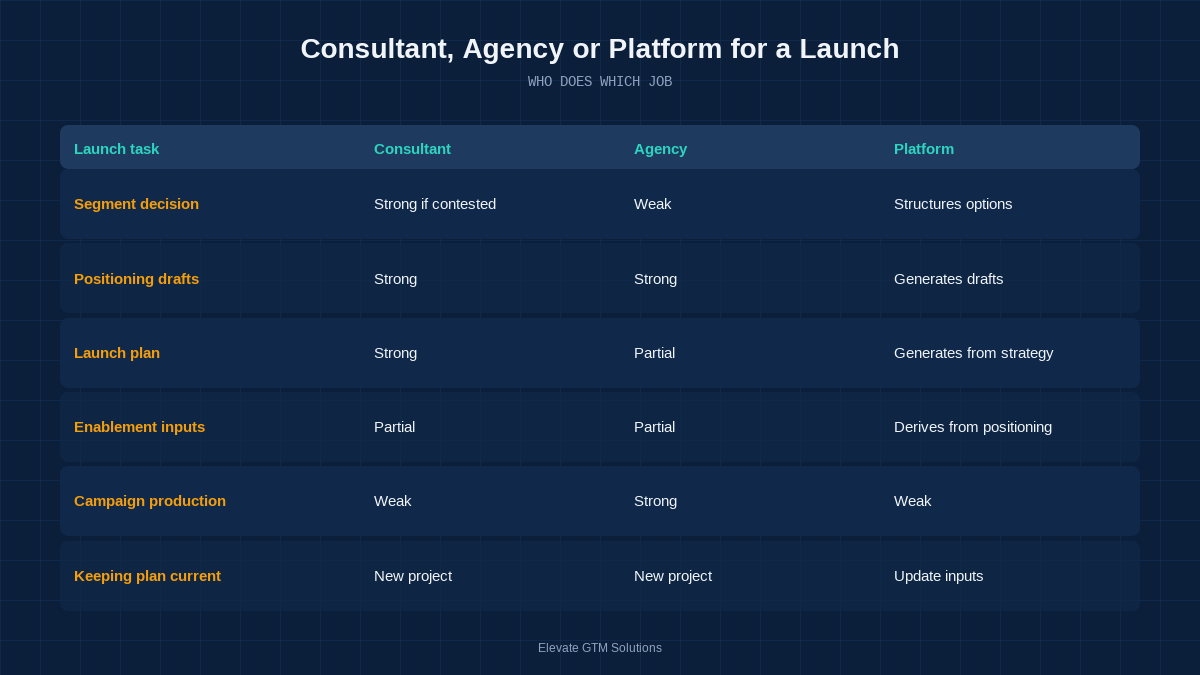
A launch needs a decision, a plan and assets. A platform is strongest at the second and helps with the first and third.
| Launch task | Consultant | Agency | Platform |
|---|---|---|---|
| Choosing the target segment | Strong when contested | Weak | Structures evidence and options |
| Positioning and messaging drafts | Strong | Strong | Generates structured drafts from inputs |
| Pricing and packaging logic | Strong | Weak | Structures logic, needs buyer evidence |
| Launch plan with owners and metrics | Strong | Partial | Generates from the strategy |
| Sales enablement inputs and talk tracks | Partial | Partial | Derives from agreed positioning |
| Campaign and content production | Weak | Strong | Weak |
| Facilitating a launch decision | Strong | Weak | Supports with shared outputs |
| Keeping the plan current after launch | Another engagement | Another project | Update inputs and review |
Two points stand out. First, the agency and the platform barely overlap, since one produces assets and the other structures strategy and plans. Second, the consultant and the platform overlap on drafting, which is where cost differences appear.
Elevate’s published plans start at USD 499 per month for Enable and USD 1,499 per month for Growth, billed annually, with custom Scale pricing; scopes, seats and revision cycles differ by plan. See the pricing page for details.
A sensible launch stack is a platform for the strategy and plan, an agency for production where needed, and a consultant only for the decision that requires an outside voice. Our guide to enterprise product launch readiness covers the evidence gates to test before release.
Compare two scopes through the first customer
Write two statements of work for the same launch
A decision-led scope might ask for approved buyer research, two offer options, a recommendation and a pilot outline. It should identify the sponsor and the decision date. Require a brief that gives downstream teams the segment, evidence, approved scope and assumptions they need. If implementation is included, describe what the provider will do with the first cohort.
An activation-led scope can start with the approved choices and ask for messaging, launch assets, enablement and measurement. The provider should receive clear acceptance criteria. A seller should be able to explain what the product does, find approved proof and handle one out-of-scope request. An internal owner should be able to update the source material when the offer changes. Count the work the launch needs rather than the number of pages in the deliverable.
If the same firm proposes both, ask for staffing and milestones by phase. Have the person responsible for launch execution attend the decision review. That reduces the chance of discovering late that the strategy depends on assets or proof that cannot be produced on time.
Take a launch scope to both kinds of firm
Put the same facts on the first page
Describe the product, date, buyer hypothesis, supported configurations and what leadership has already approved. Identify customer evidence, current sales coverage and available implementation hours. A firm can then price the work required rather than assuming the enterprise will supply evidence it does not have. When the market choice is still open, say what information would make the sponsor change it.
Ask both firms to split their proposal into decisions, work products and client responsibilities. A consultant might propose research and commercial design. A product marketing agency might propose interviews, messaging and field assets. The responses should show where they overlap and which outputs depend on an approved choice. A firm’s name is less useful than seeing who would do each part.
Include a date that can’t move and a scope that can
A conference, product announcement or customer commitment may set an external deadline. Ask what the enterprise can safely release by then. It may have enough evidence for a preview, a limited paid pilot or a launch for a defined cohort. Give both firms the freedom to propose a narrower scope and require them to explain what could be added later.
Identify any claim that depends on validation. A draft asset can describe intended functionality while an internal review is open. A published asset needs approved scope and evidence. Give the agency an approval owner and a deadline for claims. When the release changes, ask which materials and workflows must be updated before the field uses them.
Compare the proposed work in the order the buyer experiences it
Start with discovery and qualification
Take the first account the company expects to reach. Ask how the buyer will hear about the product, what will make them accept a conversation and what the seller needs to verify. A consulting team can help choose the cohort and design the route. An agency can help make the message understandable. The enterprise needs both pieces to describe the same customer and offer.
Use a buyer case with a plausible need and an unmet technical prerequisite to test each proposal. Ask what should happen next. A useful response may be to send the buyer to discovery rather than sell a pilot. The field asset should explain that distinction. If an agency recommends changing the offer based on the example, route the recommendation to the sponsor and check the evidence.
Verify what happens at the decision point
The buyer needs to know what it can purchase, what it costs under approved terms and what it can expect during implementation. Ask which party will define those details and who approves them. The strategy scope may cover the commercial decision. The agency may turn it into language and proof. Finance and delivery should verify that the published version matches what the company can support.
Use one representative opportunity to test the answer. A seller explains the scope. The buyer asks about a feature that works only in a supported configuration. The delivery lead confirms what can be promised. If the seller and delivery team give different answers, the enterprise has a problem to solve before adding more launch volume.
Follow the transaction into delivery
A message can attract the right account and still produce a poor experience if the handoff loses information. Include the buyer’s goal, verified prerequisites, agreed scope and delivery owner in the transfer. Ask the provider who helps design that workflow and who will run it after launch. A broader GTM scope may cover it. An activation scope can still support it if the client supplies the operating rules.
The receiving team should replay the same opportunity. Correct the claim or revisit the offer if a field asset promises a result the delivery team has never agreed to. Fix the distribution or workflow if the rules are sound but the teams cannot find them. The example should lead to the owner who can solve the issue.
Set launch gates and acceptance tests
Put three acceptance tests in the agreement
| Test | Who should perform it | What to verify |
|---|---|---|
| Buyer fit | Seller and specialist | They can classify an unfamiliar account using the agreed rule |
| Customer promise | Product marketing and delivery | They describe the same supported outcome and prerequisites |
| Field use | Seller and manager | The seller can find the correct asset and route a realistic exception |
The decision may still be ambiguous if the first test fails. The evidence or approval path may be incomplete if the second fails. The assets or rollout need work if the third fails. Have the receiving owner describe the failure and assign it to the person who can fix it. That makes the acceptance process more useful than a general round of revisions.
Give the launch two explicit decision gates
Gate one. Confirm the commercial design
Before the company commissions a broad set of launch materials, approve the target cohort, offer, route, supported scope and first investment. Record what evidence informed the choice and what remains provisional. When the sponsor has not yet decided, give the agency a narrower job such as researching buyer language or preparing internal drafts. Make the limits visible.
Ask what would stop the launch or narrow it. The enterprise may have sufficient evidence for a small pilot and insufficient evidence for a public offer. It can choose a scope that fits. The approved decision should tell product, sales and marketing what can be said and done on the intended date.
Gate two. Verify the work is usable
Once the offer is approved, check the assets, quote, eligibility process and delivery handoff. Have the actual users run one case. A complete folder of materials is useful if the field can find and apply the current version. Count readiness by the customer path the team can perform, not the number of deliverables.
Give managers a way to handle a last-minute change. A reference might be withdrawn or a configuration might slip. The launch owner should know who can approve a narrower scope and which assets have to change. The agency can support that update. The sponsor owns the customer promise.
Prepare a decision for a launch date that suddenly moves
Suppose the release moves up because of a customer event. The product owner can verify the first configuration but needs more time for the second. The agency should explain what materials can still be produced within the narrower scope. Ask the strategy or commercial lead whether the narrower offer has a credible buyer cohort. Bring both answers to the sponsor before committing to the date.
Be explicit about what prospects can do next if the enterprise chooses a preview. They may be able to see a demo, request a qualification call or join a later evaluation. Do not let an early campaign imply that all customers can buy or start immediately. Confirm what sales, support and partners will say when people respond.
An earlier date may reduce the amount of evidence the team can gather. Tell the sponsor what remains unknown and plan a review after the first cases. A credible launch can start with a narrower promise and a well-designed learning goal. The provider’s role is to help the enterprise support that choice rather than produce the same materials on a shorter calendar.
How a strategy team and an agency share a limited release
Map who does the work during a limited release
| Work | Internal lead | Possible outside scope | What to verify before release |
|---|---|---|---|
| Set eligibility | Sponsor and product owner | Research and recommendation | Sales and delivery apply the same rule |
| Approve claims | Product marketing with relevant approvers | Message development and proof review | Each claim has a source and defined scope |
| Build materials | Asset owner | Copy, design and enablement | The field can find the approved version |
| Check a transaction | Finance, RevOps and delivery | Rehearsal support | Quote, scope and onboarding match |
| Review first cases | Launch owner | Analysis and revisions | A named owner can act on each finding |
Include the first exception in the scope. An attractive account may need a configuration the company hasn't verified. Who can decide, what should the seller say in the meantime, and where will the decision be recorded? The proposed teams should know how they contribute without making an unauthorized promise. This example can expose a gap that neither a strategy deck nor a design review would reveal.
A detailed example of where the two firms should work together
Suppose a vendor wants to launch a supplier reporting capability to regulated customers. A strategy team interviews buyers and finds that procurement leaders need a reliable view of supplier exceptions. Sales wants to target large organizations with existing relationships. Product can support two data sources and delivery can begin only a few pilots at once. The sponsor approves a narrow release using the standard scope.
The product marketing agency uses the interviews to build a message around the buyer’s work. It prepares proof for the supported workflow and a qualification brief for sellers. During a rehearsal, a rep finds that the buyer expects an additional source to be included. The agency should not simply change the wording to promise it. Record the issue and decide whether the buyer is outside scope, whether discovery should continue or whether the sponsor will approve a separate feasibility review.
The consultancy can help reassess the offer if the issue recurs across qualified buyers. The agency can clarify materials if the problem is how the scope was explained. Delivery can verify whether the requested change is feasible. Those responsibilities can overlap in a useful way if the enterprise knows who can decide and who will update the field.
At the first operating review, compare which customers entered, how many met the rule and which questions prevented progress. Revise targeting or proof if the message drew the wrong accounts. Revisit the offer with the sponsor if the right accounts cannot buy under current terms. If buyers qualify but cannot start, examine capacity. This is where a strategy and agency handoff becomes visible.
Price rollout and transfer ownership
Price the work that needs to happen after launch
The first week can reveal problems the original scope could not predict. Decide whether each provider will help review evidence, update assets or support operating changes. Assign it internally if the work is excluded. A project that ends on the announcement date may be appropriate if the client has the staff to handle the next cases. It is less useful when the enterprise expects outside support through rollout.
Estimate client effort and access. An agency may need prompt review from product and legal owners. A consultant may need buyers or deal records to investigate a new finding. The receiving team needs time to use and maintain the work. Put those commitments beside the provider fee and compare proposals through the same milestone.
Avoid buying a second engagement solely because no one was named to maintain the first one. Give each output a custodian and a current source. The receiving owner should update one approved item before the provider leaves. If they need a new login, source or approval, handle it while the team is still available.
Choose how the relationship should end
A short project can conclude after a decision and a usable handoff. A launch engagement can conclude after the field can run the first workflow and the receiving owners accept the materials. A continuing relationship can be useful if the provider is expected to handle defined work after release. Give it a review date and an exit test so the company knows what it can do independently.
Ask whether the enterprise can continue with a different partner if needed. Confirm approved usage of evidence and assets. Check that the operating owner can find the current version and explain why choices were made. A handoff that preserves the reasoning gives the next team a way to adapt without reopening the entire launch.
Decide what goes into the launch brief and what stays in the strategy record
The launch brief should tell a seller what is available and what to do next. The strategy record should explain why the enterprise chose that scope and what would change it. Give the agency access to the information it needs for the assets, with approved treatment of sensitive inputs. Keep the rationale available to internal owners so they can maintain the brief later.
A buyer might ask why only two configurations are supported. The field response can explain the approved scope and route the request. The sponsor’s record can explain the capacity and evidence that drove the choice. Those documents have different audiences. Check that each contains what its users need and that neither creates a new promise if the agency builds them together.
Give the client one last comparison before signing
Compare both proposed scopes through a live customer case. Ask who chooses eligibility, who approves claims, who produces the assets and who will resolve the first exception. Put the provider’s work, client effort and outstanding approvals in the same view. Choose a lead and identify where the other team contributes if a job appears in both proposals.
The enterprise can make a sensible purchase even if some work remains open. It can approve a discovery phase now, commission provisional materials with clear limits, or reserve capacity for a later rollout. State which parts are authorized and which require another decision. At the next review, verify that the work the company bought has brought it closer to a launch the field can actually run.
Put that review date on the launch calendar and invite the person who can approve a narrower scope if the first cases expose a delivery limit.
Use the first customer review to choose the next step
Review the choice after the first customers
Bring one eligible customer, one unexpected request and one stalled opportunity to the review. Ask who owned each issue and what happened. The consultant may have helped set a usable rule. The agency may have helped the field explain it. The company may still need to fix a quoting or delivery step. Assign each finding to the person with authority to act.
A useful review ends with a choice about scope, materials or operating work. The sponsor can continue with the current cohort, revise the offer or test another channel. The agency can update approved material and the strategy owner can record the reasoning. The company has a better basis for its next purchase when the first phase showed which work actually mattered.
Write the two scopes so they can be compared
| Item | Decision-led engagement | Activation-led engagement |
|---|---|---|
| Inputs the enterprise supplies | Customer evidence, capacity, existing commitments and launch deadline | Approved buyer, offer, proof and claims review process |
| Work the provider owns | Diagnose the commercial gap, compare options and prepare a decision | Develop and test messaging, produce materials and prepare field use |
| First acceptance test | Sponsor can approve a defined scope and a first customer cohort | A seller can explain the scope and use approved proof |
| What the client retains | Authority over investment and customer commitments | Authority over claims and ongoing asset ownership |
| Trigger for more work | A new decision or implementation scope requires approval | A request changes the product promise or the agreed asset set |
Ask both providers to describe one thing they would explicitly leave out. A consultant might exclude asset production and still give the agency enough information to prepare it. An agency might exclude changes to pricing or product scope and still give the sponsor useful buyer feedback. Clear exclusions let the enterprise assign the remaining work instead of discovering it when teams are already moving toward the date.
Compare a scope change that looks like a wording change
Suppose the agency’s interviews find that buyers expect an export feature to work on a second data source. The product team verifies that the feature is available on the first source only. The agency can revise the claim to make that boundary easier to understand. If the target cohort needs the second source to achieve the desired outcome, the commercial owner has to decide whether to narrow the audience, change the offer or delay. Both responses can be appropriate, depending on what the evidence says.
The provider needs the actual asset and ask what it would change. A useful response should distinguish the wording from the decision and name who approves each. The launch owner can then see whether the provider understands its mandate. The field should receive one approved claim and one clear instruction for accounts that fall outside it.
Where Elevate fits before the launch
Elevate is an AI-native GTM operating system. It connects GTM context, intelligence, strategy, activation, execution and analytics, with 15 specialist modules plus Unified GTM Strategy and Elevate Pulse for recurring priorities. It helps your team settle the segment, positioning, messaging and plan before you brief an agency or an advisor, which shortens briefing and avoids paying for production against an undecided strategy. Elevate also offers Guided GTM and focused advisory engagements for launches that need outside support. See the platform page, the pricing page and GTM Platform vs GTM Consultant, or request a demo.
Frequently Asked Questions
Do I need a GTM consultant or an agency for a product launch?
A consultant helps with the commercial decision, and an agency produces assets and campaigns. If the decision is clear, you may need only production. If the decision is contested or high-stakes, a consultant or facilitator can help.
Can a GTM platform replace an agency?
No. A platform structures strategy, plans and handoff material, but it does not produce full creative campaigns or content at scale. It can reduce the briefing work an agency would otherwise bill for.
What should a launch plan include?
The target segment, positioning and messaging, pricing logic, a channel plan, enablement material, owners and dates, readiness gates and metrics for the first weeks after release.
Can an agency lead GTM strategy?
It can lead pieces of the work when it has the skills and access. Give it a named sponsor and make the decisions, evidence and execution responsibilities explicit.
Should you hire both firms?
Only if you need both scopes and the internal team cannot cover the difference. Define the handoff and avoid paying two teams to gather or interpret the same evidence.
What should you buy first?
Start with the decision that would change the launch. If the buyer, offer or scope is open, settle it before committing to a broad asset package. If those choices are sound, buy the work the field needs to execute.