
By the Elevate GTM Solutions Team · Updated November 10, 2026 · 20 min read
GTM Platform vs Marketing Automation: What Each Does and How They Work Together
Marketing teams buy marketing automation to send the right message to the right person at the right time without doing it by hand. Leadership teams buy a GTM platform to decide who the right person is, what the right message is and why. The two purchases sound adjacent, and companies often try to make one do the job of the other. A marketing automation platform asked to produce positioning ends up holding a pile of unreconciled email copy. A GTM platform asked to send nurture sequences does not exist as a product category.
This guide explains the difference, shows where the two connect, helps you decide which problem you have and offers a method for using them together. Elevate GTM Solutions makes a GTM strategy platform and is not a marketing automation product, so we are open about when automation software is the answer. Vendor descriptions come from public statements and your site's own HubSpot comparison page as of November 2026, and change often.
GTM Platform vs Marketing Automation: What Is the Difference?
Marketing automation software, such as HubSpot Marketing Hub, Marketo or Salesforce's marketing products, executes campaigns: email, forms, landing pages, nurture workflows, lead scoring and campaign reporting. A GTM platform, such as Elevate GTM Solutions, decides what those campaigns should say and to whom: ideal customer, segments, positioning, messaging pillars, pricing logic and channel priorities, kept consistent across teams. Marketing automation runs the program. A GTM platform sets the strategy the program follows. Most B2B companies that scale use both.
Do I need a GTM platform if I have marketing automation? If teams agree on customer and message and execution is the constraint, perhaps not. If messaging is inconsistent or campaigns reflect different ideas of the customer, a strategy layer helps.
Can marketing automation replace a GTM platform? No. It sends what you decide. It does not make the decision.
Two categories, side by side
| Marketing automation | GTM platform | |
|---|---|---|
| Core question | How do we reach and nurture people at scale? | Who should we reach, with what message and why? |
| Primary users | Demand generation, marketing operations, lifecycle marketers | Product marketing, strategy, marketing leadership, founders |
| Main objects | Contacts, lists, forms, emails, workflows, scores, campaigns | Customer definition, segments, positioning, messaging, pricing logic, plans |
| Rhythm | Daily and weekly | Monthly and quarterly, with updates when conditions change |
| Output | Emails sent, leads scored, campaigns reported | A strategy others use and keep current |
| AI role | Content drafts, send-time optimization, scoring, assistants | Structuring evidence, drafting strategy options, keeping outputs consistent |
| Depends on | A defined audience and message | Evidence, review and an owner |
| Typical failure | Many well-run campaigns saying inconsistent things | A strategy that never reaches the campaigns |
What marketing automation does
Marketing automation platforms are mature and varied. The core capabilities are similar.
| Capability | What it does |
|---|---|
| Email marketing | Design, send and measure email at scale |
| Forms and landing pages | Capture interest and route it |
| Nurture workflows | Trigger sequences from behavior or attributes |
| Lead scoring | Rank contacts by fit and engagement |
| Segmentation | Build lists from properties and behavior |
| Personalization | Vary content by attributes |
| Campaign reporting | Show opens, clicks, conversions and influenced pipeline |
| CRM integration | Pass leads and context to sales |
| Social and ads connectors | Coordinate channels |
| AI assistance | Draft copy, suggest segments, summarize performance |
HubSpot, for example, offers Marketing Hub as one of several Hubs built on a shared contact record, with an AI layer called Breeze. The architectural value is that campaigns, deals and service history all write to the same record. Our Elevate vs HubSpot page describes this.
What a GTM platform does
Elevate GTM Solutions describes itself as an AI-native GTM operating system. From the market, industry, product and segment context you provide, it builds connected outputs across 15 modules, including ICP and segmentation, competitive intelligence, positioning, messaging, pricing, customer acquisition, channels, marketing alignment, launch and execute, and measure and optimize. It supports workflows, weekly plans, task ownership and a recurring review rhythm, and lets you compare strategies side by side.
It does not send email, host landing pages or run nurture workflows.
Where they connect
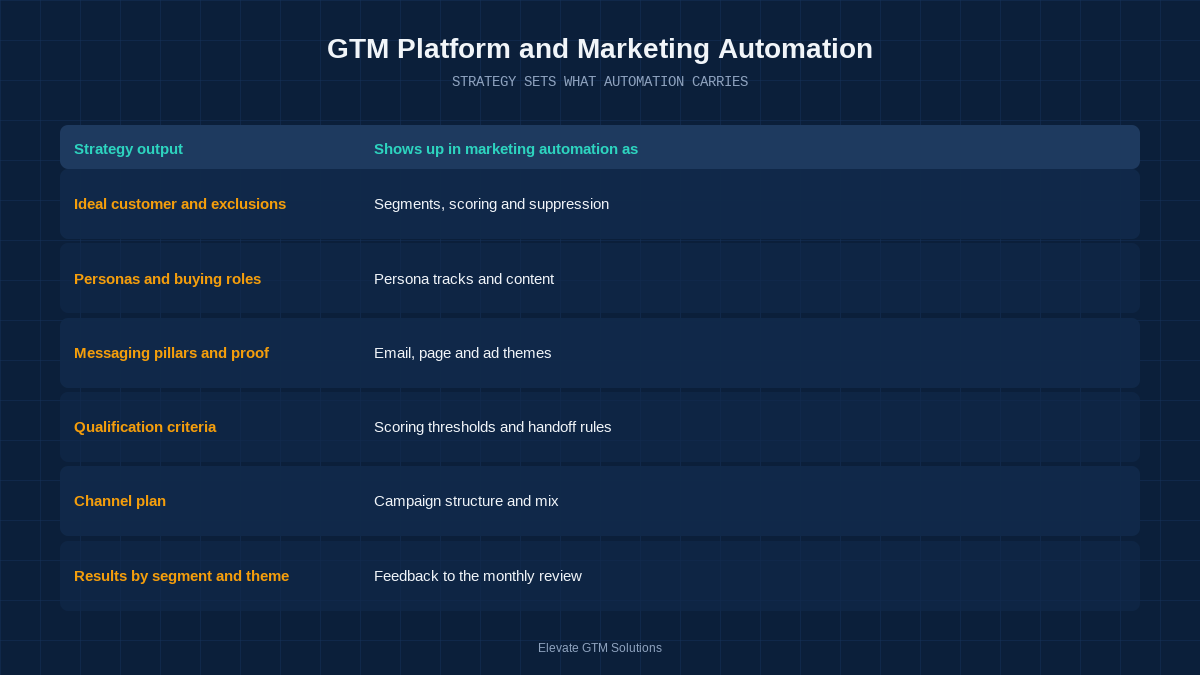
| Strategy output | How it shows up in marketing automation |
|---|---|
| Ideal customer and exclusions | Segmentation rules, scoring criteria and suppression lists |
| Segment priorities | Which audiences get campaigns first and how budget is split |
| Buying roles and personas | Persona properties, content tracks and email variants |
| Messaging pillars and proof | Email themes, landing page copy and ad copy |
| Forbidden claims | Brand and legal review rules |
| Channel plan | Campaign structure and channel mix |
| Qualification criteria | Lead scoring thresholds and handoff rules to sales |
| Launch plan | A coordinated campaign calendar |
| Feedback from marketing automation | Where it goes |
|---|---|
| Engagement by segment and theme | Messaging and positioning review |
| Conversion by source and segment | Channel plan and segment priorities |
| Lead acceptance by sales | Qualification criteria and alignment |
| Content that resonates | Proof points and pillars |
If the loop between these is missing, campaigns drift away from the strategy, and the strategy never learns from campaigns.
Signs you need a GTM platform
- Different campaigns describe the company differently.
- Marketing and sales disagree about lead quality.
- Segments in the automation platform do not match segments in strategy documents.
- Updating messaging across channels takes weeks.
- A launch or repositioning requires redoing campaign structure from scratch.
- You have several products or regions and no shared definitions.
Signs you need marketing automation
- Leads sit in spreadsheets and inboxes.
- Nurture is manual and inconsistent.
- You cannot see which campaigns influence pipeline.
- Scoring and routing are manual.
- Your team spends more time assembling reports than acting on them.
Using both: a practical pattern
- Settle the strategy. Customer, segments, personas, positioning, messaging pillars with proof, forbidden claims and qualification criteria.
- Translate to configuration. Segmentation, scoring, persona tracks, templates and reporting views.
- Build campaigns from the strategy. Each campaign states its segment, persona and pillar.
- Tag results. Make sure engagement and conversion can be cut by segment and theme.
- Review monthly. Bring results to the strategy review and decide what to change.
- Update both together. When a decision changes, update the strategy and then the configuration.
Common mistakes
| Mistake | What happens | Fix |
|---|---|---|
| Buying automation to fix a messaging problem | More messages with the same inconsistency | Settle message pillars first |
| Building segments by convenience | Segments reflect available fields, not the customer | Start from the customer definition |
| Letting every campaign owner write positioning | Inconsistent claims | Approved pillars and proof |
| Scoring by activity alone | Active but unfit leads reach sales | Include fit criteria from strategy |
| Not tagging themes | You cannot learn which message works | Tag by segment and theme |
| Treating AI copy as strategy | Fluent but generic | Provide positioning and proof in briefs |
| Ignoring sales feedback | Lead quality disputes continue | A shared definition and a monthly review |
How to evaluate each
Marketing automation
| Test | What to do | What to look for |
|---|---|---|
| Build a campaign | Create a nurture flow for one segment | Speed and clarity |
| Segmentation | Build a segment from your customer definition | Whether fields support it |
| Scoring | Set fit and engagement scoring | Flexibility and transparency |
| Reporting | Pull results by segment and theme | Whether you can cut the data |
| CRM sync | Connect your CRM | Fields and conflict handling |
| AI features | Draft copy from approved positioning | Specificity and accuracy |
| Cost | Estimate contacts, seats and add-ons over three years | Total cost |
GTM platform
| Test | What to do | What to look for |
|---|---|---|
| Specificity | Enter real context and evidence | Outputs name your customers, alternatives and proof |
| Change handling | Change the target segment | What updates and what you must fix |
| Comparison | Compare two segments side by side | Clarity of differences and reasons |
| Review | Have marketing and sales read the output | What they say is wrong or missing |
| Handoff | Produce messaging pillars and a customer profile | Match with the strategy |
| Integration | Check supported actions with your CRM | Automatic versus manual |
| Cost | Compare plans with your scope | Total including team time |
Cost shapes
| Element | Marketing automation | GTM platform |
|---|---|---|
| License | Often by contacts, seats and tiers | By scopes and users |
| AI | May be bundled or usage-based | Usually part of the plan |
| Implementation | Templates, integrations, training | Inputs, review, owners |
| Growth of cost | Rises with database size | Rises with scopes |
| Switching | Substantial: workflows, templates, history | Moderate: structured records |
For reference, Elevate GTM Solutions publishes Enable at USD 499 per month and Growth at USD 1,499 per month, billed annually, with custom Scale pricing and a free first strategy build. Prices of marketing platforms change often, so check each vendor.
Scenarios
| Situation | Direction |
|---|---|
| A startup with a list and a newsletter | A simple marketing automation tool, plus a one-page strategy |
| A company with automation and inconsistent messages | Add a strategy layer, keep the automation |
| A company launching a new product | Strategy first, then campaign configuration |
| A multi-region business with local marketing teams | Shared strategy layer with regional adaptations recorded |
| A team debating a platform migration | Test whether the problem is the platform or the brief |
A hypothetical example
This is an illustration, not a real company.
A company ran sophisticated nurture programs in its marketing automation platform. Open rates were healthy. Sales said the leads were weak. A review found that marketing's segments were built on company size and region, while closed deals clustered in two industries. Nurture emails emphasized features buyers in those industries rarely mentioned.
The company spent three weeks on strategy: it defined the two industries as priority segments, rewrote its message pillars from buyer language and set qualification criteria. It then rebuilt segments, scoring and nurture tracks in its automation platform around those definitions and tagged campaigns by segment and theme. Lead acceptance by sales rose, and marketing could see which themes produced meetings. The platform had not been the issue. The inputs had.
A campaign brief that carries the strategy
A short brief template keeps every campaign tied to the strategy. Require it before any campaign is built.
| Field | What to write |
|---|---|
| Campaign name and owner | |
| Segment | Which priority segment this is for, from the strategy |
| Persona | Which buying role, with the problem in their words |
| Message pillar | Which approved pillar the campaign carries |
| Proof | The evidence you can show, and where it is approved |
| Forbidden claims check | Confirmation that no forbidden claim is used |
| Offer and call to action | What we ask the audience to do |
| Channels | Where it runs and why |
| Success measure | The outcome that matters, not only opens and clicks |
| Qualification link | How responses are scored and handed to sales |
| Review date | When we will read the results with sales |
A campaign that cannot fill in the segment, persona and pillar fields is probably not ready to run.
Lead scoring: fit versus engagement
Scoring is where strategy and automation meet most directly. A good model separates two ideas.
| Dimension | What it measures | Where the criteria come from |
|---|---|---|
| Fit | Is this the kind of company and person we should sell to? | The strategy: ideal customer, exclusions and buying roles |
| Engagement | Is this person showing interest now? | Behavior in campaigns, site and product |
| Fit | Engagement | Interpretation | Action |
|---|---|---|---|
| High | High | Ready now | Route to sales quickly |
| High | Low | Right company, not yet interested | Nurture with relevant content |
| Low | High | Interested but a poor fit | Politely redirect or deprioritize |
| Low | Low | Not relevant | Suppress or ignore |
Many teams score only engagement, which sends active but unfit contacts to sales and creates the lead quality dispute. Build fit criteria from the strategy and review them whenever the strategy changes. Our guide on GTM metrics and KPIs covers measurement in more depth.
Marketing and sales agreement on handoffs
A shared definition of a qualified lead prevents arguments.
- Define each stage. Lead, marketing qualified, sales accepted, opportunity, customer. Write the criteria for each.
- Set response times. How quickly sales follows up on a qualified lead, and how marketing is told what happened.
- Record rejections. A short list of reasons when sales rejects a lead.
- Review monthly. Compare accepted and rejected leads by segment and source.
- Adjust criteria. Update fit and engagement thresholds based on outcomes.
The criteria should come from the strategy's qualification definitions, not from whichever system default was in place.
What to tag and report
| Tag | Why |
|---|---|
| Segment | Shows which audiences respond and convert |
| Persona | Shows which roles engage |
| Message theme | Shows which pillar works |
| Channel | Tests the channel plan |
| Offer | Tests what people want |
| Campaign objective | Separates awareness from conversion programs |
| Report | Question it answers |
|---|---|
| Engagement by segment and theme | Which messages resonate with whom? |
| Conversion from lead to opportunity by segment | Which segments are worth more investment? |
| Lead acceptance rate by source | Where is quality weakest? |
| Time to first sales response | Is handoff working? |
| Pipeline influenced by theme | Which pillars correlate with pipeline? |
Be cautious about attribution claims. Influence is not the same as cause, and timing alone does not prove a campaign produced a result.
A forty-five-day plan to connect strategy and automation
Days 1 to 10: audit. List current segments, scoring rules, nurture tracks and templates. Compare them with the strategy. Mark mismatches.
Days 11 to 20: align. Update segments and scoring to the customer definition. Define handoff criteria with sales. Add tags for segment, persona and theme.
Days 21 to 35: rebuild one program. Choose one segment and rebuild its nurture track around one persona and one pillar, with proof and a style check.
Days 36 to 45: measure and review. Compare engagement and acceptance with the previous program. Hold a review with sales. Decide what to change before extending to other segments.
Governing content in an AI-assisted marketing team
AI drafting is now common in marketing platforms. Governance keeps it consistent.
| Control | Practice |
|---|---|
| Source brief | Provide positioning, pillars, proof and forbidden claims for every draft |
| Human review | A person approves content before it goes live |
| Fact check | Verify any statistic or claim against a primary source |
| Style guide | Tone, terms to use and avoid |
| Version control | Keep approved copy in one place |
| Sampling | Read recent content monthly for drift |
| Disclosure | Follow your policies on disclosing AI use |
Terms used in this guide
| Term | Meaning |
|---|---|
| Marketing automation | Software that runs campaigns, nurture and scoring |
| Nurture | A series of messages that builds interest over time |
| Lead scoring | Ranking contacts by fit and engagement |
| MQL | Marketing qualified lead |
| SQL or sales accepted lead | A lead sales agrees to pursue |
| Persona | A description of a buying role and its concerns |
| Suppression | Excluding contacts from campaigns |
| Attribution | Assigning credit for outcomes to activities |
Building segments from the customer definition: a worked example
This is a hypothetical illustration. Property names and menus vary by platform.
The strategy output. The ideal customer is a field-service firm with ten to eighty technicians that schedules by spreadsheet. Exclusions are firms below ten technicians and firms that need deep invoicing. Buying roles are the owner or general manager and the dispatcher.
Step 1: check that the data exists. Does the platform hold industry, employee range and role for contacts? Where not, list how to capture or enrich them. A segment you cannot build is a segment you cannot target.
Step 2: create the segment rules.
| Rule | Condition |
|---|---|
| Industry | Field services and related industry values |
| Size | Employee count in the target range |
| Exclusion size | Employee count below the minimum |
| Exclusion need | A property or form answer that signals deep invoicing needs |
| Role | Titles for owner, general manager and dispatcher |
| Region | Regions where the company sells |
Step 3: create the personas. Two role-based tracks: the owner who feels the cost of missed appointments, and the dispatcher who uses the tool daily. Each has its own subject lines, content and proof.
Step 4: set fit scoring. Points for matching industry, size and role. Negative points or suppression for the exclusions.
Step 5: connect handoff. A contact moves to sales when fit is high and a defined engagement threshold is met, with a field recording the problem they named.
Step 6: tag. Segment, persona and theme tags on every campaign.
The test: pull a list of fifty contacts from the segment and ask a seller whether they would be glad to call each. If many are not, the rules need work.
Designing nurture from message pillars
A nurture program is a conversation over time. Design it around the pillars, not around a calendar.
| Stage of interest | Content | Goal | Pillar link |
|---|---|---|---|
| Aware of the problem | A short piece describing the situation in buyers' words | Recognition | The problem statement |
| Considering approaches | A comparison of ways to solve it, including doing nothing | Trust | Positioning against alternatives |
| Evaluating options | Proof: a customer story, a measured result you can cite | Confidence | Proof points |
| Ready to talk | A simple, specific invitation | Conversation | Qualification link |
Rules that keep nurture honest:
- Every email has a reason to exist beyond staying in touch.
- Claims have approved proof.
- Frequency respects the audience, and unsubscribes are easy.
- Behavior triggers messages only when relevant, so a person who has just booked a meeting does not receive a generic nurture email.
- A person reads a sample every month.
Personalization without losing the message
Personalization is easiest to get wrong when the core message is unsettled.
| Level | Example | Risk |
|---|---|---|
| Token | First name and company | Low value |
| Attribute | Industry or role-specific problem statement | Needs a good persona definition |
| Behavioral | Content based on pages viewed | Can feel intrusive if overdone |
| Account-level | Messaging based on a known situation | Needs reliable data |
| AI-generated | Drafted variants per account | Risk of invented facts or tone drift |
Keep the core claim, proof and forbidden claims fixed. Allow variation in examples, opening lines and industry context. For AI-generated variants, require sources for any specific claim about a company and a human sample review.
Operational questions for the marketing team
| Question | Why it matters |
|---|---|
| Who owns the segment definitions and when were they last updated? | Segments drift if no one owns them |
| Who approves new message themes? | Prevents inconsistency |
| Where is the approved proof stored? | Avoids unsupported claims |
| How are suppression lists maintained across tools? | Opt-outs must be honored |
| Which reports does sales trust? | Shared reporting prevents disputes |
| How do we handle regional variation? | Consistency with local adaptation |
| What is our review cadence? | The loop needs a rhythm |
| What happens when a person changes teams? | Knowledge should live in documents |
The relationship between marketing automation and the CRM
| Question | Typical answer |
|---|---|
| Which system holds the contact record? | The CRM, or the platform's own shared record in suites such as HubSpot |
| Which system owns lifecycle stages? | One system, with the other reading from it |
| Where is lead scoring done? | One place, documented |
| How does sales feedback return? | Through structured loss and rejection reasons |
| How do duplicates get resolved? | A defined rule and an owner |
| Who changes definitions? | The strategy owner with sales and marketing operations |
Separate systems can work well if ownership is clear. Duplicate truth is the main hazard.
What changes when AI enters the stack
AI features now appear in nearly every marketing platform: draft copy, subject lines, send-time suggestions, segment suggestions, performance summaries. A few principles apply.
- AI drafts are only as specific as the brief. Provide positioning, pillars and proof.
- Recommendations about segments should be checked against the customer definition.
- Performance summaries should be read against your baseline.
- Automation that acts without review should start small and have limits.
- Keep a record of which content was AI-assisted, if your policy requires it.
Three hypothetical stories
These are illustrations, not real companies.
The program with perfect opens and no pipeline. A company ran a polished nurture track and celebrated open and click rates. Pipeline did not move. When the team compared the contacts who clicked with the customers who bought, the overlap was small. The track targeted a broad audience with general educational content. The team defined two priority segments, rewrote content around the problems those buyers named and changed the scoring to weight fit. Open rates fell slightly. Meetings from nurture rose.
The platform migration that fixed nothing. A company moved to a new marketing platform expecting better results. Segments, scoring and content moved across unchanged. Three months later results matched the old platform. The team ran a strategy review, found that the segments had never matched the customer definition and rebuilt them. Results improved on the new platform, though the same improvement was available on the old one.
The regional team that rewrote the message. A company's regional marketers translated and adapted campaigns freely. After a year, the regional messages differed in claims and tone. The company published a shared set of pillars and proof, defined what could be adapted and added a monthly consistency check. Regional teams kept their freedom on examples and channels, and the claims aligned.
A short decision guide
- Can leaders describe the customer and message in the same words? If not, settle the strategy first.
- Does the platform hold the fields you need to build segments from the customer definition? If not, fix data capture first.
- Are campaigns tagged by segment, persona and theme? If not, you cannot learn which message works.
- Do marketing and sales share qualification definitions? If not, expect lead quality disputes.
- Is the constraint volume and consistency of execution? If yes, look at automation features.
- Is the constraint decisions across teams? If yes, look at a strategy layer.
Final thoughts
Marketing automation and GTM platforms are easy to mix up because both promise alignment. One aligns messages with audiences at scale. The other aligns people on who the audience is and what the message should be. Buying the first to solve the second produces polished campaigns that say different things. Buying the second to solve the first produces a good plan that never reaches the market. Most companies need both, with the strategy settled first, the configuration derived from it and a monthly review that carries evidence back. If you do nothing else, tag your campaigns by segment and theme and read the results with sales once a month.
Questions for demos of marketing automation platforms
Ask each vendor to show, with your data or a realistic sample:
- How do I build a segment from three attributes and an exclusion, and how long does it take?
- How do I score fit separately from engagement?
- How do I tag campaigns by segment, persona and theme, and report by those tags?
- How do I see which leads sales accepted or rejected, and why?
- How are suppression and opt-outs handled across channels?
- What does the AI draft, and how do I give it my positioning and forbidden claims?
- Which CRM fields sync, and what happens when records conflict?
- What does the contract say about contact limits and overage charges?
- How do I export my templates, workflows and history?
A quarterly health check of the marketing program
| Area | Questions | Healthy sign |
|---|---|---|
| Strategy link | Does every active campaign name its segment, persona and pillar? | Yes, for all campaigns |
| Segments | Do they match the current customer definition? | Reviewed this quarter |
| Scoring | Are fit criteria current, and does sales accept most routed leads? | Acceptance is stable and understood |
| Content | Are claims supported and consistent? | A sample review finds no unsupported claims |
| Reporting | Can you cut results by segment and theme? | Yes |
| Hygiene | Are suppression lists current and shared across tools? | Yes |
| Alignment | Do marketing and sales read results together monthly? | Meetings held, decisions recorded |
| Cost | Are you paying for contacts you do not use? | Database reviewed and cleaned |
| AI use | Are drafts reviewed and briefed with positioning? | Policy followed |
Score each as healthy, needs attention or at risk. Choose the two weakest areas as next quarter's focus.
What to do this week
Compare three recent campaigns: write down the customer each one assumes and the main claim it makes. If the answers differ, settle the strategy before adding automation. If they agree and execution is slow, look at automation.
Terms and short answers
| Question | Short answer |
|---|---|
| Is marketing automation the same as a CRM? | No. A CRM records customers and deals. Marketing automation runs campaigns. Some suites combine them |
| Is a GTM platform a marketing tool? | It supports marketing, sales and product by holding the strategy they share |
| Can one person run both? | In a small team, yes, with simple tools |
| What breaks first as you grow? | Consistency: segments, scoring and messages drift apart |
| What should I fix before buying a new platform? | Segment definitions, scoring criteria, tagging and handoff agreements |
A note on attribution and honesty
Marketing automation platforms produce attractive reports on influenced pipeline. Read them carefully. A campaign that touched a contact before a deal closed did not necessarily cause the deal. Compare cohorts, check timing against sales conversations and ask sellers what buyers say prompted them. Reports that mix influence with cause lead teams to scale programs that were merely present, and to cut programs that quietly did the work. A monthly conversation between marketing and sales, with real buyer stories next to the numbers, keeps the measurement honest.
Starting small
If your team is small, begin with three steps. Write the customer definition and three message pillars on a page. Tag every campaign by segment and pillar. Hold a thirty-minute monthly review with sales to read results and decide what to change. These steps need no new software and they make any platform you use more effective.
A quick reference
| If the question is | Look at |
|---|---|
| Who should we reach and what should we say? | A GTM platform or a strategy process |
| How do we reach them at scale and measure it? | Marketing automation |
| Why do campaigns disagree with each other? | Strategy and tagging |
| Why does sales reject our leads? | Fit criteria and handoff definitions |
| Why are results hard to read? | Tagging, segment cuts and consistent definitions |
In plain language
Marketing automation is the machinery that sends the right message to the right person at scale. A GTM platform is the thinking that decides who the right person is and what the right message is. Companies that buy the machinery without the thinking get polished campaigns that disagree with each other. Companies that do the thinking without the machinery get a good plan that never reaches the market. The practical path is simple: write the customer and message down, build segments and scoring from them, tag every campaign by segment and theme, and read results with sales every month. Do those four things and almost any platform will serve you well. Skip them and almost any platform will disappoint you, however capable it is.
Key takeaways
- Marketing automation runs campaigns. A GTM platform decides what they say and to whom.
- They are different layers and are usually used together.
- Translate strategy into segmentation, scoring, templates and tags, and review monthly.
- Fix inconsistent messaging with strategy, not with more automation.
- Compare cost across three years and include your team's time.
Where Elevate GTM Solutions fits
Elevate GTM Solutions is an AI-native GTM operating system for B2B companies. It builds structured strategy across 15 connected modules, supports workflows and a review rhythm, and connects to HubSpot, Salesforce, LinkedIn, Notion and Claude for supported actions. It is not a marketing automation product and does not send email or host landing pages. Published plans are Enable at USD 499 per month and Growth at USD 1,499 per month, billed annually, with custom Scale pricing and a free first strategy build.
For related reading, see What Is Elevate GTM Solutions?, GTM Platform vs CRM, Marketing Alignment and HubSpot Alternatives for GTM Strategy. See the pricing page, or request a demo.
Frequently Asked Questions
What is the difference between a GTM platform and marketing automation?
Marketing automation executes campaigns: email, forms, nurture, scoring and reporting. A GTM platform decides what those campaigns say and to whom: ideal customer, positioning, messaging, pricing logic and priorities.
Do I need both?
Most scaling B2B companies do. Settle the strategy, configure the automation from it and feed results back.
Can marketing automation replace a GTM platform?
No. It sends what you decide. It does not make the decisions.
Can a GTM platform send emails?
No. A GTM platform does not send email, host landing pages or run nurture workflows. Use marketing automation for that.
How do strategy outputs reach marketing automation?
Through segmentation rules, scoring criteria, persona tracks, templates and campaign tags, usually configured by a person or a supported connection.
What should I tag in my campaigns?
Segment, persona and message theme, so results can be cut by those dimensions and fed back into the strategy review.
What if sales says marketing leads are weak?
Compare the segments and message in campaigns with the customers who close. The cause is often targeting or qualification criteria.
Does HubSpot replace a GTM platform?
HubSpot runs marketing, sales and service. The strategy decisions behind them are made elsewhere, and a strategy layer can sit alongside HubSpot.
How do I compare costs?
Compare over three years: marketing platform licenses by contacts and seats, add-ons, implementation and team time, against strategy platform plans by scopes and users.
Where should a startup begin?
With a simple automation tool and a one-page strategy, then add structure as products, segments and people multiply.
How should lead scoring use strategy?
Separate fit from engagement. Build fit criteria from the ideal customer, exclusions and buying roles, and engagement criteria from behavior. Route high fit and high engagement to sales quickly, and nurture high fit with low engagement.
What should a campaign brief include?
Segment, persona, message pillar, proof, a forbidden claims check, the offer and call to action, channels, a success measure, the qualification link and a review date.
How do I stop marketing and sales arguing about lead quality?
Agree definitions for each stage, response times and rejection reasons, review accepted and rejected leads by segment monthly and update criteria from the strategy.
Can AI-written campaigns stay on message?
Yes, if each draft starts from approved positioning, pillars, proof and forbidden claims, and a person reviews it. Without a brief, drafts tend to be generic.
How long does it take to connect strategy and marketing automation?
A focused effort on one segment can take about forty-five days, including audit, alignment, a rebuilt program and a review. Extend one segment at a time.