
By the Elevate GTM Solutions Team · Updated November 10, 2026 · 21 min read
GTM Platform vs Sales Engagement Platform: Do You Need Both?
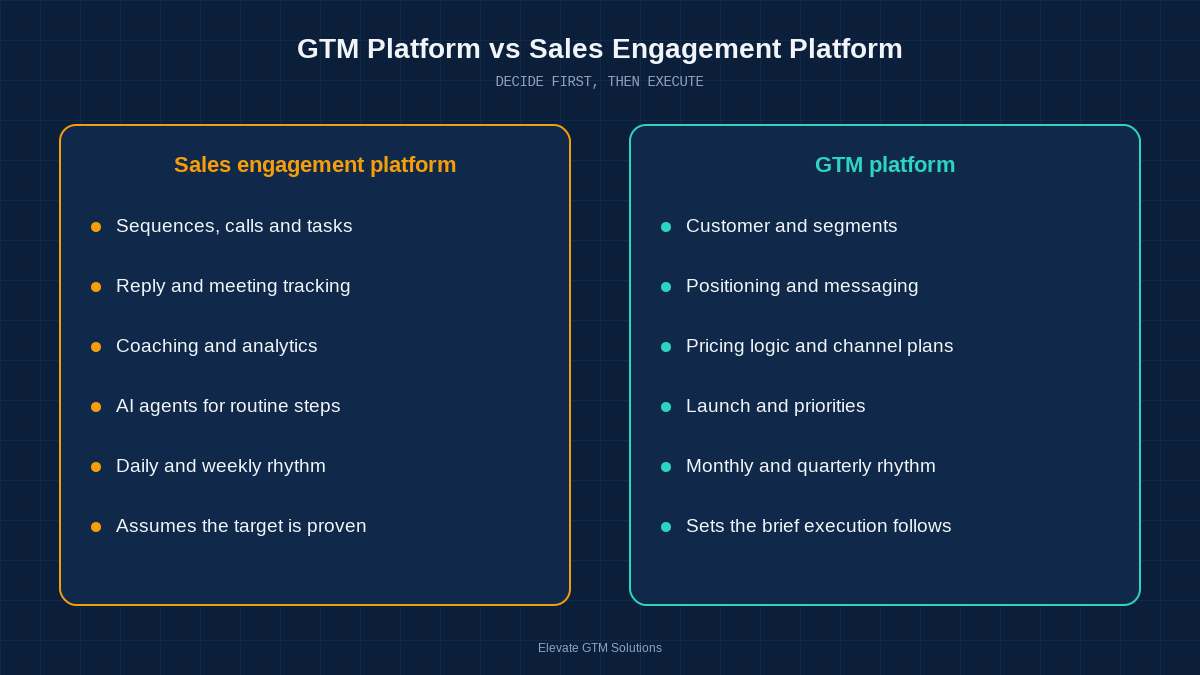
Two kinds of software promise to make go-to-market more effective, and buyers confuse them constantly. A sales engagement platform helps sellers execute: sequences, calls, tasks, tracking, coaching and increasingly AI agents. A GTM platform helps leaders decide: who the customer is, how to position, what to say and what to prioritize. One carries out a plan. The other produces and maintains it.
The confusion is understandable. Vendors on both sides use the phrase "AI-native GTM platform", and the buyer's own situation blurs the line. A frustrated sales leader sees weak outreach results and shops for a better engagement tool. A product marketer sees inconsistent messaging and shops for a strategy tool. Each might be solving the wrong problem. This guide separates the two categories, compares them on the dimensions that matter, explains when you need one, the other or both, and shows how they work together. Elevate GTM Solutions makes a GTM strategy platform, so we say plainly when an engagement platform is the better answer. Vendor descriptions reflect public statements as of November 2026 and change often, so confirm details before you buy.
GTM Platform vs Sales Engagement Platform: What Is the Difference?
A sales engagement platform, such as Outreach, Salesloft or Apollo, runs the seller's daily work: multichannel sequences, calling, scheduling, activity tracking, analytics and, increasingly, AI agents. A GTM platform, such as Elevate GTM Solutions, builds and maintains the strategy that work depends on: ideal customer, segments, positioning, messaging, pricing logic, channel plans and priorities across products and regions. Most companies that scale need both, in that order: decide first, then execute.
Which should I buy first? If your target and message are proven and you need more conversations, an engagement platform. If you cannot describe the customer and message consistently, a GTM platform.
Does one replace the other? No. They sit at different layers, and each is weak at the other's job.
The two categories in plain terms
| Sales engagement platform | GTM platform | |
|---|---|---|
| Core question | How do my sellers contact and manage buyers efficiently? | Who should we target, and what should we say and charge? |
| Main users | Sellers, SDRs, sales managers, sales operations | Product marketing, strategy, marketing leaders, founders, RevOps |
| Main objects | Contacts, sequences, tasks, calls, emails, meetings | Customer definition, segments, positioning, messaging, pricing logic, plans |
| Timescale | Daily and weekly | Monthly and quarterly, with updates when the market changes |
| Typical output | Messages sent, calls made, meetings booked | A strategy others use, kept consistent across teams |
| Where AI helps | Drafting, research, follow-up, call summaries, agents | Structuring evidence, drafting options, keeping outputs consistent |
| What it assumes | You know whom to target and what to say | You will test the draft with customers and decide |
| Failure mode | Efficient execution of the wrong plan | A strategy nobody uses or keeps current |
The middle rows show why they are not substitutes. One lives inside the seller's day. The other lives inside the leadership's decisions.
What sales engagement platforms do
The category has matured, and vendors have consolidated.
Outreach describes itself as an AI sales execution platform covering engagement, conversation intelligence, forecasting and AI agents for tasks such as prospecting and deal monitoring.
Salesloft is a revenue platform that completed its merger with Clari in December 2025 and adopted the Salesloft name for the combined company in September 2026, with the Clari forecasting product keeping its name. It covers engagement, conversation intelligence and forecasting.
Apollo combines a B2B contact database with sequencing, a dialer, conversation intelligence, deal management and an AI assistant, and offers a free plan.
Typical capabilities across the category:
| Capability | What it does |
|---|---|
| Sequences and cadences | Multistep email, call and social outreach with timing rules |
| Dialer and calling | Click-to-call, call logging and, in some, conversation recording |
| Email tracking | Opens, replies and bounces |
| Task management | Daily to-do lists driven by cadences |
| Scheduling | Meeting links and routing |
| Analytics | Activity, reply and meeting metrics by rep and sequence |
| Conversation intelligence | Transcripts, themes and coaching moments |
| Forecasting | Pipeline inspection and forecast views, in some platforms |
| AI assistance and agents | Drafting, research, summaries and, increasingly, autonomous steps |
| CRM sync | Logging activity to the system of record |
These tools are valuable. They are also indifferent to whether the plan they execute is a good one.
What GTM platforms do
A GTM platform operates at the layer above. Elevate GTM Solutions, for example, describes itself as an AI-native GTM operating system. You provide market, industry, product and segment context and it builds connected outputs across 15 modules: ICP and segmentation, competitive intelligence, positioning, messaging, pricing, channels, launch execution, measurement, enablement inputs, customer success and advocacy. It adds workflows, weekly plans, task ownership and a recurring review rhythm.
| Capability | What it does |
|---|---|
| Structured context | Holds market, segment, product and evidence in one place |
| Strategy outputs | Customer definition, positioning, messaging, pricing logic, channel plans |
| Connected outputs | Changing an input updates related outputs |
| Version comparison | Strategies for segments or regions side by side |
| Activation inputs | Customer profiles, talk tracks and launch plans derived from the strategy |
| Planning workflows | Weekly plans, owners and tracking |
| Review rhythm | Monthly updates and quarterly resets |
It does not send outreach, supply contacts or run a dialer.
Where the two meet
| Strategy decision | Where it shows up in an engagement platform |
|---|---|
| Ideal customer and exclusions | Targeting filters, list building rules, suppression lists |
| Segment priorities | Which lists get sequences first, and how reps are assigned |
| Buying roles | Titles targeted and personas used in messages |
| Messaging pillars and proof | Sequence themes, templates and talk tracks |
| Forbidden claims | A style guide and approval rules |
| Qualification criteria | Reply handling, meeting qualification questions and routing |
| Objection responses | Reply templates and coaching content |
| Priorities for the quarter | Rep targets and campaign focus |
| Feedback from the engagement platform | Where it goes in strategy |
|---|---|
| Reply themes and objections | Messaging and positioning updates |
| Meeting-to-opportunity conversion by segment | Segment priority review |
| Conversation insights | Evidence for the monthly strategy review |
| Win and loss reasons | Customer definition and competitive framing |
When this loop is missing, each side drifts. Reps improvise, and the strategy becomes a document that nobody revises.
When you need an engagement platform first
- Your ideal customer and message are proven in real conversations.
- The constraint is the volume or consistency of outreach.
- Sellers manage activity in spreadsheets or inbox folders.
- You need coaching and visibility into sequences and calls.
- You want AI to handle research and follow-up under rules.
When you need a GTM platform first
- Different leaders describe the customer differently.
- Outreach produces activity and weak conversations.
- You are launching, entering a market or repositioning.
- You have several products, segments or regions that need consistent strategy.
- Strategy updates take weeks and depend on one person.
When you need both
Most scaling companies reach this point. A pattern that works:
- Decide the customer, message and priorities in the strategy layer.
- Configure the engagement platform from them.
- Run outreach with review rules.
- Feed results back monthly.
- Update the strategy and the configuration together.
Common mistakes
| Mistake | What happens | Fix |
|---|---|---|
| Buying engagement software to fix a strategy problem | More messages, same weak results | Review wins and losses before buying |
| Buying strategy software to fix an execution problem | A good plan that is not carried out | Look at workflow, coaching and tooling |
| Treating AI agents as strategy | Agents follow the brief you give them | Give them a tested target and message |
| Letting reps write their own positioning | Inconsistent stories | Provide approved pillars and proof |
| Measuring activity | Volume looks like progress | Track meetings, opportunities and win rate |
| Ignoring feedback | Strategy goes stale | A monthly review with data from the platform |
How to evaluate each category
Evaluating a sales engagement platform
| Test | What to do | What to look for |
|---|---|---|
| Workflow | Build a real sequence and a daily task flow | Speed, clarity, ease of change |
| Data and CRM sync | Connect your CRM | Which fields sync, conflict handling |
| Controls | Check approvals, limits and logs | Ability to prevent mistakes |
| AI features | Draft from approved positioning | Specificity and accuracy |
| Reporting | Pull activity and outcome reports | Whether they show outcomes, not only activity |
| Coaching | Review calls or sequences with a manager | Whether managers can act on it |
| Cost | Estimate seats and usage over three years | Total cost |
Evaluating a GTM platform
| Test | What to do | What to look for |
|---|---|---|
| Specificity | Enter a real product and segment with real evidence | Outputs name your customers, alternatives and proof |
| Change handling | Change the target segment | What updates and what you must fix |
| Comparison | Compare two segments side by side | Clear differences and reasons |
| Review | Have a seller and a customer success person read it | What they say is wrong or missing |
| Handoff | Produce a customer profile and talk tracks | Match with the strategy |
| Integration | Check supported actions with your CRM | What is automatic and what is manual |
| Cost | Compare plan limits with your scope | Total cost including team time |
Cost shapes
Prices change and many are quote-based, so this describes shape.
| Element | Engagement platform | GTM platform |
|---|---|---|
| License | Per seat, often with tiers and add-ons | By scopes and users, with published plans for some vendors |
| AI features | May be bundled, or charged by usage or outcome | Usually part of the plan |
| Implementation | CRM integration, templates, training | Inputs, review, owners |
| Internal time | Managers coaching, reps following cadences | Owners updating inputs, reviewers testing outputs |
| Switching cost | Moderate: sequences and history | Moderate: structured outputs and records |
For reference, Elevate GTM Solutions publishes Enable at USD 499 per month and Growth at USD 1,499 per month, billed annually, with custom Scale pricing and a free first strategy build.
Scenarios
| Situation | Direction |
|---|---|
| Small team, proven niche, need meetings | An engagement platform, with a one-page strategy |
| Same team, unsure which niche works | Strategy first, then engagement |
| Mid-sized company, three products, inconsistent messaging | A GTM platform for decisions, existing engagement tools for execution |
| Enterprise with mature engagement stack, flat win rates | Review strategy and qualification before adding tools |
| Company adopting AI agents for outbound | Strategy brief first, then pilot with approvals |
| A company just merged with another | Settle positioning and customer definition before consolidating engagement tools |
A hypothetical example
This is an illustration, not a real company.
A software company with fifteen sellers used an engagement platform well: sequences ran on time, reports were tidy and managers coached from call recordings. Meetings were up, but opportunity conversion was falling. The head of sales asked for a better platform. The head of revenue operations suggested first reading the reasons behind lost deals.
The reasons showed that sellers were pitching three different stories, and that two of the three did not match what buyers cared about. The company spent three weeks on a strategy process: it settled on two priority segments, wrote messaging in buyers' words, listed forbidden claims and defined qualification questions. It then reconfigured sequences and reply templates in the existing engagement platform.
Six weeks later, meeting-to-opportunity conversion improved, and managers coached against a shared message. The engagement platform had not changed. What it carried had.
How the two layers show up in a working week
It helps to picture the same week from two seats.
A seller's week with an engagement platform. Monday morning, the platform shows a task list: send these emails, call these contacts, follow up on these replies. During the week the seller works through sequences, logs calls, books meetings and reads call summaries. A manager reviews activity and picks calls to coach. Everything is concrete and daily.
A strategy owner's week with a GTM platform. Early in the month, the owner adds new wins, losses and buyer quotes to the inputs, reviews what changed in the outputs and decides what to bring to the monthly review. In the review, regional leaders and product owners discuss whether a competitor's move changes positioning. The decisions are recorded and the handoff material is updated. Everything is deliberate and periodic.
The two weeks connect at two points: what the seller is told to say, and what the seller hears back. When the connection works, the seller's calls inform the strategy, and the strategy shapes the calls.
From strategy artifact to platform setting
A detailed map helps whoever configures the engagement platform.
| Strategy artifact | Typical configuration in an engagement platform |
|---|---|
| One-page customer profile | List filters, scoring inputs, a short briefing note on each sequence |
| Exclusions list | Suppression lists, excluded industries and size bands |
| Persona definitions | Title filters, persona tags on contacts, persona-specific templates |
| Message pillars with proof | Sequence themes, snippets or content blocks, approved proof lines |
| Forbidden claims | A style guide and a review step for new templates |
| Objection responses | Reply templates and call guidance |
| Qualification questions | Meeting notes templates and handoff rules |
| Segment priorities | Which lists are worked first, rep assignments and daily targets |
| Competitor framing | Competitive talk tracks and comparison snippets |
| Pricing guidance | Rules for what sellers may say about price in early messages |
| Quarterly priorities | Campaign calendar and focus accounts |
When something in the left column changes, the corresponding setting on the right should be reviewed. A monthly check linked to the strategy review keeps them aligned.
Designing sequences from the strategy
A sequence is a small piece of strategy applied to a specific audience. Good ones share traits.
One audience. Each sequence targets a defined role at a defined type of company, not a broad list.
One problem. The first message names a specific situation the buyer recognizes, drawn from customer language.
One proof point. A claim the company can support, stated plainly.
One ask. A question or a small next step, not a request for a meeting by default.
A reason to follow up. Later steps add something new: a customer story, a different angle or a relevant observation.
A clear stop. Rules for when to end a sequence, when to hand off to a person and when to suppress.
Review. A person reads messages before they are used widely, and samples afterward.
| Element | Weak version | Stronger version |
|---|---|---|
| Opening | "I wanted to reach out about our platform" | A specific situation buyers describe |
| Claim | "We help companies grow faster" | A claim with proof, such as a customer result you are allowed to cite |
| Ask | "Do you have fifteen minutes?" | "Is this a problem you are working on this quarter?" |
| Follow-up | "Just bumping this" | A new fact or story |
| Close | "Last chance" | A graceful exit |
A control framework for AI agents in engagement platforms
Vendors are adding agents that research, write, follow up and sometimes act on their own. Treat autonomy as something earned.
| Autonomy level | What the agent does | Required controls |
|---|---|---|
| Suggests | Proposes a message or next step | Seller reviews every suggestion |
| Drafts | Writes a message for approval | Approval before sending, sample audit |
| Sends within rules | Sends messages that match defined templates and limits | Volume caps, forbidden claims list, daily log review |
| Handles replies | Responds to common replies and books meetings | Escalation triggers, human review of sensitive topics, weekly sampling |
| Plans and acts | Chooses targets and actions toward a goal | Written brief, strict limits, full logs, periodic review of outcomes |
Move up a level only after quality has held for several review cycles. At every level, the agent's brief should come from a tested strategy.
What the platforms measure, and what strategy needs
| What the engagement platform reports | What the strategy review needs from it |
|---|---|
| Emails sent, calls made, tasks completed | Not much on its own |
| Reply rate and positive reply rate | By segment and by message theme |
| Meetings booked | By segment, with quality notes |
| Conversation themes | Objections, language and competitor mentions |
| Sequence performance | Which themes carry across segments |
| Rep-level metrics | Coaching, not strategy |
If the engagement platform cannot cut results by segment and message theme, ask whether you can tag them. Without that, the loop back to strategy is weak.
Procurement questions
| Topic | Question for an engagement vendor | Question for a GTM platform vendor |
|---|---|---|
| Scope | Which products are native, and which came from acquisitions? | Which modules are included in each plan? |
| AI | Which actions can agents take without approval? | What does the AI draft, and how do I review it? |
| Data | How is contact data sourced and consent handled? | How are my inputs stored and used? |
| Integration | Which CRM fields and actions are supported? | Which actions are supported with my CRM? |
| Exit | How do I export sequences and history? | How do I export inputs and outputs? |
| Change | What happens if products are merged or retired? | What happens if the company is acquired? |
| Cost | How does price change with seats, volume and add-ons? | How does price change with scopes and users? |
| Proof | Can I speak to a customer with a similar motion? | Can I run my own scenario live? |
Terms used in this guide
| Term | Meaning |
|---|---|
| Sales engagement | Tools that run outreach sequences and track replies |
| Cadence or sequence | A scheduled series of outreach steps |
| Conversation intelligence | Software that records and analyzes calls |
| Agent | AI that can carry out multi-step tasks |
| Suppression list | Contacts who must not be contacted |
| Strategy layer | A system that holds decisions such as customer definition and messaging |
| Qualification | Criteria deciding whether a lead is worth pursuing |
| Handoff | Passing a lead or deal between roles |
Three hypothetical company stories
These are illustrations, not real companies.
The startup that bought tools in the wrong order. A founder with four sellers purchased an engagement platform before writing down who the best customers were. Sequences ran and replies were thin. A week of win analysis found that two of five wins came from one industry. The team narrowed the lists, rewrote the first message around that industry's problem and cut sequence volume by half. Replies improved. The platform stayed; the brief changed.
The mid-sized company with excellent execution and a fuzzy story. A company of two hundred had a polished engagement setup and strong managers. Win rates varied widely by region. Regional leaders described the product differently, and regional sequences reflected those differences. The company introduced shared positioning and message pillars, with regions free to adapt proof points. Within two quarters the variation in win rates narrowed and managers coached to one story.
The enterprise that over-automated. A large company enabled agent features across its sales organization before defining claims and approvals. A message included a capability the product did not have, and a prospect pointed it out. The company paused autonomy, wrote forbidden and approved claim lists, required approval for any message mentioning product capabilities and restarted at the drafting level. Quality recovered, and autonomy returned in stages.
The pattern is the same in all three: execution tools amplify the brief, good or bad.
A sixty-day plan to connect strategy and engagement
Days 1 to 10: write down what exists. List the targeting rules, templates, themes and qualification criteria currently in the engagement platform. Collect the strategy documents. Note where they disagree.
Days 11 to 25: settle the strategy. For one segment, define the ideal customer, exclusions, buying roles, message pillars with proof, forbidden claims and qualification questions. Review with sellers.
Days 26 to 40: configure. Update filters, suppression lists, templates and reply handling to match. Add tags so results can be cut by segment and theme. Write a style guide.
Days 41 to 55: run and read. Run a controlled batch with review. Read every reply in the first week and a sample afterward. Track results by segment and theme.
Days 56 to 60: review and decide. Hold a monthly review with the data, update the strategy where the evidence supports it, adjust configuration and set the next date.
Repeat for the next segment. Teams that do one segment at a time usually learn faster than those who change everything at once.
A monthly review that links the two layers
Sixty minutes, with the strategy owner, a sales leader, a marketer and operations.
- Results by segment and theme (fifteen minutes). Replies, positive replies, meetings and conversion, with quality notes.
- What buyers said (fifteen minutes). Objections, language and competitor mentions from replies and calls.
- Decisions (fifteen minutes). What to change in positioning, messaging, targeting or qualification.
- Configuration (ten minutes). Which engagement settings must change to match, and who will change them.
- Next steps (five minutes). Owners, dates and the next review.
Record decisions and share a summary with the whole sales team within a day.
Final thoughts
The comparison between a GTM platform and a sales engagement platform is mostly a question about order of operations. Decide who to reach and what to say, then reach them efficiently, then learn from the results and decide again. Companies that skip the first step spend a long time optimizing the second. Companies that never build the second step have a strategy no one carries out. Whatever you buy, name an owner for the brief, review results by segment and message theme, and treat agents as fast executors of a plan that people have tested.
Questions sales leaders ask
"Will a strategy platform slow my reps down?" It should not. The output a rep sees is a short customer profile, message pillars and a few objection responses. Reps spend no time in the strategy platform unless they choose to give feedback.
"Do I let reps customize messages?" Allow adaptation of proof points, tone and opening lines. Keep the claims, the forbidden list and the core problem statement consistent. Review a sample weekly.
"How do I measure whether the message works?" Tag sequences by theme, compare reply quality and meeting-to-opportunity conversion and read replies. Treat a change in reply rate with small samples cautiously.
"What if my best rep disagrees with the strategy?" Listen. Your best rep may hold evidence the strategy lacks. Test their approach on comparable accounts and update the strategy if the evidence supports it.
"How do AI agents change my team?" They shift effort from manual research and follow-up toward reviewing outputs and handling conversations that matter. Plan for managers to spend time on quality review.
A readiness quiz
Answer yes or no. If you answer no to more than two of the first five, strengthen your strategy before expanding engagement tooling.
- Can three sellers describe the ideal customer in the same words?
- Do we have approved message pillars with proof?
- Are forbidden claims written down?
- Do we record loss reasons consistently?
- Do we tag sequences by segment and theme?
- Do we hold a monthly review of results with marketing and product?
- Does each AI feature we use have an owner and a review step?
- Can we export our sequences and history if we change vendors?
Reading the market: recent consolidation
The engagement and revenue platform market has consolidated, which affects what you are buying.
| Event | What it means for buyers |
|---|---|
| Clari and Salesloft completed their merger in December 2025 | The combined company uses the Salesloft name, with Clari's forecasting product keeping its name; ask which products are native today |
| Highspot and Seismic completed their merger in August 2026 | Relevant if you also buy enablement; the combined company operates as Seismic |
| Terminus joined DemandScience in 2024 | Relevant for account-based advertising and data |
Questions to ask any vendor that has merged: which products will I use, how do they connect, what is on the roadmap and what protections does my contract give me if a product is retired or repriced? Older comparison pages written before these dates may describe separate companies.
What to do this week
Write in one sentence what you expect a new platform to improve. Read your last ten lost deals. If the reasons mention the target or the message, hold the engagement purchase and spend the week on strategy. If the reasons are about follow-up speed or inconsistent cadence, an engagement platform may be the right next step.
A closing checklist
- I can state in one sentence what each platform is for in my company.
- The ideal customer, exclusions and message pillars exist in writing.
- Sequences carry approved claims and a style guide.
- Results are tagged by segment and theme.
- Agents have a written brief, limits and a review step.
- A monthly review links results to strategy decisions.
- Exit and export terms are known for both platforms.
Terms and short answers
| Question | Short answer |
|---|---|
| Is a sales engagement platform the same as a CRM? | No. The CRM records customers and deals. The engagement platform runs outreach and syncs activity to it |
| Is an AI SDR an engagement platform? | It can be part of one, or a standalone product built around an agent |
| Should marketing use the engagement platform? | Usually no. Marketing tends to use marketing automation, and the two should share definitions |
| What is the most common mistake? | Treating execution tools as strategy |
One more way to decide
If you are still unsure, ask your team a single question: when a deal is lost, do we argue about who we were talking to and what we said, or about how fast and consistently we followed up? Arguments about the target and the message point to the strategy layer. Arguments about speed and consistency point to the engagement layer. Most teams find both, and fix them in that order.
A quick reference
If you remember one line, remember this: the engagement platform decides how efficiently you carry out a plan, and the GTM platform decides whether it is the right plan.
In plain language
Engagement platforms help sellers do the work. GTM platforms help leaders decide the work. If you buy the first to fix a problem that belongs to the second, you will get more activity and the same results. If you buy the second to fix a problem that belongs to the first, you will get a better plan that is not carried out. Most companies that grow need both, in order: decide who to reach and what to say, configure the engagement tools from that decision, run with review rules, tag results by segment and theme and bring them back to a monthly review. AI agents make the loop faster, and they follow whatever brief you give them.
Key takeaways
- Engagement platforms run sellers' daily work. GTM platforms decide the strategy that work carries.
- They are not substitutes, and most scaling companies need both.
- Decide first, then execute: configure engagement tools from the strategy, and feed results back.
- Evaluate each with a real scenario and measure outcomes, not activity.
- AI agents execute the brief you give them. They do not replace the brief.
- Consolidation among vendors means checking what each product is today.
Where Elevate GTM Solutions fits
Elevate GTM Solutions is an AI-native GTM operating system for B2B companies. It connects GTM context, intelligence, strategy, activation, execution and analytics through 15 modules plus a unified strategy, and supports workflows, weekly plans and a recurring review rhythm. It connects to HubSpot, Salesforce, LinkedIn, Notion and Claude for supported actions. It does not run sequences, supply contacts or place calls, so teams pair it with an engagement platform.
For related reading, see Best AI-Native GTM Platforms for B2B Companies, AI Tools for GTM Execution and Alignment, Elevate vs Apollo and What Is Elevate GTM Solutions?. See the pricing page, or request a demo.
Frequently Asked Questions
What is the difference between a GTM platform and a sales engagement platform?
A sales engagement platform runs seller workflows: sequences, calls, tasks, tracking and coaching. A GTM platform builds and maintains the strategy those workflows carry: ideal customer, positioning, messaging, pricing logic and priorities.
Do I need both a GTM platform and a sales engagement platform?
Most scaling companies do. Decide the customer and message in the strategy layer, configure the engagement platform from them and feed results back.
Which should I buy first?
If your target and message are proven and you need more conversations, an engagement platform. If you cannot describe the customer and message consistently, start with strategy.
Can a sales engagement platform replace a GTM platform?
No. Engagement platforms execute a plan. They do not decide who to target, how to position or what to say, though AI features can help draft messages from a brief.
Can a GTM platform replace Outreach, Salesloft or Apollo?
No. A GTM platform does not send sequences, supply contacts or place calls.
Is Salesloft still separate from Clari?
Clari and Salesloft completed their merger in December 2025, and the combined company adopted the Salesloft name in September 2026, with Clari's forecasting product keeping its name. Check what you are buying today.
How do AI agents fit in?
Agents in engagement platforms carry out tasks such as prospecting and follow-up. They follow the target and message you give them, so a tested brief matters more as autonomy rises.
How do strategy outputs reach the engagement platform?
Through targeting filters, suppression lists, sequence themes, approved claims and reply templates, usually configured by a person or through supported connections. Confirm which actions each vendor supports.
What should I measure?
Meetings, meeting-to-opportunity conversion, win rate by segment and reply quality, not only emails sent or calls made.
How do I evaluate each category?
Run a real scenario in each: build a sequence and check CRM sync and controls for an engagement platform, and enter real context and change a segment for a GTM platform.
What does each category cost?
Engagement platforms are usually priced per seat with tiers and add-ons. GTM platforms are priced by scopes and users, and Elevate GTM Solutions publishes Enable at USD 499 per month and Growth at USD 1,499 per month, billed annually.
What if my outreach results are weak?
Read your lost deals first. If the reasons are about the target or the message, fix the strategy before changing platforms.
Can AI agents in Outreach or Salesloft replace a strategy?
No. Agents execute a brief. They do not know which segment is right or which claim persuades your buyers unless you tell them.
How should I brief an AI agent in an engagement platform?
Give it the target and exclusions, the buying roles, three message themes with proof, forbidden claims, tone, volume limits, approval rules and escalation triggers.
How often should strategy and engagement settings be reviewed together?
Monthly, as part of the strategy review. Check that targeting, themes, claims and qualification rules still match the current decisions.
What should an engagement platform report to support strategy?
Reply and meeting results by segment and message theme, plus conversation themes such as objections and competitor mentions.
Can a small team use both?
Yes, with light versions of each: a one-page strategy and a simple engagement tool, scaling the tools as the team and products grow.