
By the Elevate GTM Solutions Team · Updated November 10, 2026 · 20 min read
Elevate GTM Solutions vs Apollo: Strategy Platform or Sales Platform?
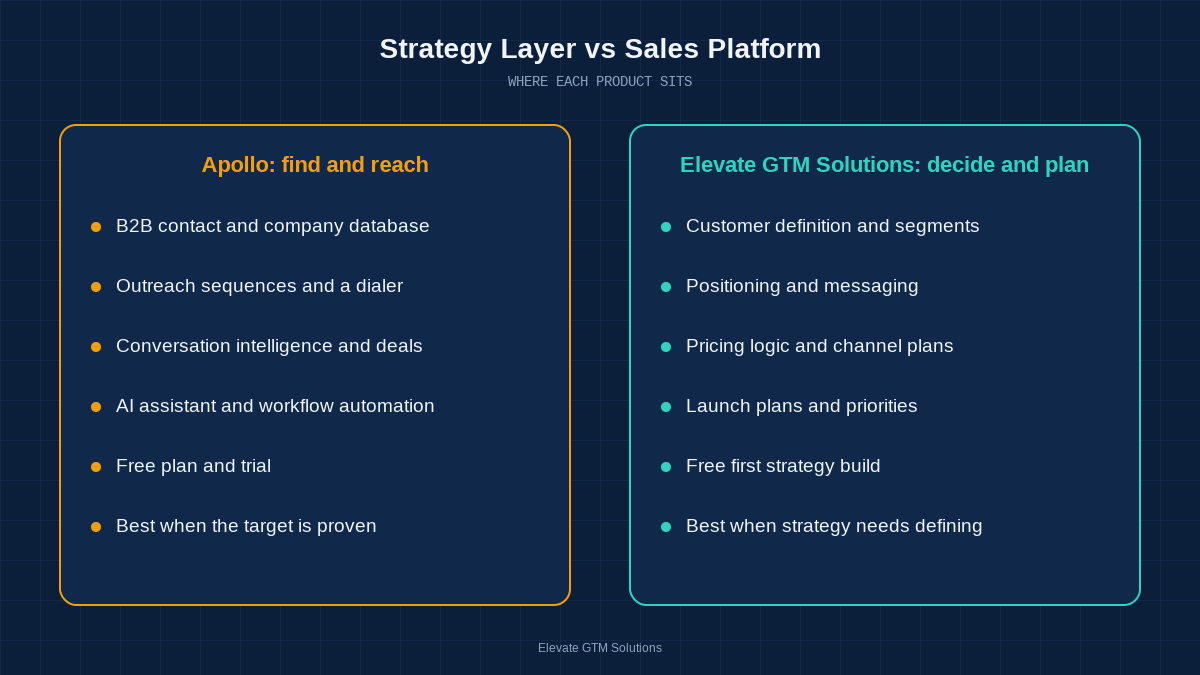
Apollo and Elevate GTM Solutions are often named in the same breath because both are described as AI platforms for B2B go-to-market. Put them side by side and the overlap is small. Apollo is built to find prospects and contact them: a large contact database, outreach sequences, a dialer and AI assistance in one place. Elevate GTM Solutions is built to decide the go-to-market strategy that outreach should carry: who the customer is, how to position, what to say and what to charge.
That difference decides what you buy first. A sales platform makes it easy to reach many people quickly. If you are reaching the wrong people with a generic message, it makes that easier too. This guide compares the two honestly: what each does, where they touch, how to choose, how teams use both and what to check before you commit. Elevate GTM Solutions makes one of these products, so we say plainly where Apollo is the better choice. Descriptions of Apollo reflect how it describes itself and what third-party sources report as of November 2026. Features, limits and pricing change often, so confirm current details with Apollo.
Elevate GTM Solutions vs Apollo: The Short Answer
Apollo is an AI sales platform that combines a B2B contact database with outreach sequencing, a dialer, conversation intelligence, deal management and workflow automation, with a free plan. Elevate GTM Solutions is an AI-native GTM operating system that builds and maintains strategy: ICP, positioning, messaging, pricing logic, channel plans and launch plans across 15 connected modules. Choose Apollo when you know your customer and message and need data and outreach in one tool. Choose Elevate GTM Solutions when you need to define or revise who you target and what you say. Many teams use both, with the strategy configuring the outreach.
Are they direct competitors? Not really. They share the label "AI go-to-market platform" and do different jobs.
Which should I start with? Strategy first, unless your target and message are already proven.
What Apollo is
Apollo describes itself as an AI-powered sales platform for finding, engaging and managing B2B buyers. According to its public descriptions and third-party reviews, it combines:
- A B2B contact and company database. Sources report figures from roughly 240 million to more than 275 million contacts. Treat any number as a vendor claim, and test accuracy in your own market.
- Search and enrichment. Filters for title, industry, size, location and technology, plus enrichment of existing records.
- Outreach sequences. Multichannel email and call steps, with A/B testing on email steps.
- A dialer. Built-in calling, with availability varying by plan and region.
- Conversation intelligence and deal management. Call insights and pipeline views with alerts.
- An AI assistant and research tools. Help with drafting, research and lead scoring, with limits that vary by plan.
- Workflow automation and integrations. Routing, scheduling and CRM connections.
- A free plan and trial. Apollo offers a free-forever plan with limits and a 14-day trial of paid features, according to its own page.
Apollo was founded in 2015 and is based in San Francisco. Third-party sources cite per-user paid plans and custom pricing for larger organizations. Prices and limits change, so use Apollo's current pricing page.
What Elevate GTM Solutions is
Elevate GTM Solutions is an AI-native GTM operating system and platform for B2B companies.
- Structured context. You enter market, industry, product and segment context.
- 15 modules plus a unified strategy. Market research, ICP and segmentation, competitive intelligence, account-based marketing, positioning, messaging, pricing, customer acquisition, distribution channels, marketing alignment, launch and execute, measure and optimize, sales enablement, customer success and customer advocacy.
- Workflows and a review rhythm. Weekly execution plans, task ownership, tracking and a recurring review called Elevate Pulse.
- Versions you can compare. For example, strategies for different segments or regions side by side.
- Published plans, billed annually. Enable at USD 499 per month, Growth at USD 1,499 per month, custom Scale, and a free first strategy build.
It does not hold a contact database, send outreach or run a dialer.
Apollo and Elevate GTM Solutions at a glance
| Apollo | Elevate GTM Solutions | |
|---|---|---|
| Category | AI sales intelligence and engagement platform | AI-native GTM operating system |
| Main job | Find prospects, run outreach, manage deals | Decide strategy and plan activation |
| AI role | Assistant for drafting, research and scoring | Drafts and structures strategy outputs for review |
| Typical buyer | Sales leaders, founders, SDR and RevOps teams | Marketing, product marketing, strategy and GTM leaders, founders |
| Core inputs | Target criteria, messaging, contact lists | Market, product and segment context, evidence |
| Core outputs | Lists, sequences, calls, pipeline | ICP, positioning, messaging, pricing logic, channel and launch plans, priorities |
| Contact data | Core product | Not provided |
| Outreach and dialer | Core product | Not its purpose |
| Strategy and positioning | Not its purpose | Core purpose |
| Free entry point | Free-forever plan with limits | Free first strategy build |
| Best fit | Teams with a proven target and message that need data and outreach | Teams that need to define or revise who they sell to and what they say |
The inputs row explains the rest. Apollo works from the target and message you give it. Elevate GTM Solutions helps produce them.
Where they touch, and where they do not
Where they touch. Both use AI. Both involve a target customer and a message. In Apollo, the target becomes search filters and the message becomes sequence content. In Elevate GTM Solutions, the target and message are defined and justified across segments.
Where they do not. Apollo supplies contacts, sequences and calls. Elevate GTM Solutions does not. Elevate GTM Solutions supplies positioning, pricing logic and planning. Apollo does not. A company that buys only one still needs the other job done, by a person, another tool or not at all.
What Apollo does best
Breadth in one tool. Database, sequencing, dialer and deal management in one subscription reduce the number of tools a small team must assemble.
A low barrier to start. A free plan lets individual sellers try the product and test data quality in their market before any procurement.
Speed to first outreach. A team with a clear target can find contacts and start a sequence quickly.
Pairing data with action. Prospecting and engagement history live in the same system.
Cost structure for smaller teams. Third-party reviews often position it as less expensive than enterprise engagement platforms, though you should compare current prices.
Where a sales platform may not be enough
These points apply to any sales intelligence and outreach platform, not only Apollo.
It cannot tell you whether your targeting is right. It searches by the criteria you give it.
It does not settle your message. AI assistance polishes copy. It does not know which claim persuades your buyers.
Data accuracy varies. Databases differ by region, industry and role. Test with a sample you know well.
Volume has risks. Poor targeting and repetitive messages can harm sender reputation and brand, and rules on contacting people differ by region. Review them with your legal advisers.
It is not a planning system. Pricing logic, positioning across segments, launch planning and cross-team alignment sit outside its purpose.
What Elevate GTM Solutions does best
Turning evidence into a connected strategy. Customer profile, positioning, messaging, pricing logic and channel plans stay consistent because they come from shared inputs.
Giving outreach tools a specification. A defined segment, a message with proof and ranked priorities make any sales platform more effective.
Keeping strategy current. You update inputs and review what changes.
Serving more than outbound. The modules touch marketing, product, sales enablement and customer success.
Where Elevate GTM Solutions may not be enough
It does not provide contacts or send outreach.
It does not replace customer conversations. Its outputs are structured drafts to test with buyers.
Its value depends on specific inputs. Vague context produces generic output.
It does not replace a CRM.
Who should choose Apollo first
Apollo may fit first if most of these describe you:
- You know your ideal customer and have a message that works.
- You need contacts and a way to reach them, not a strategy.
- A small team needs data, sequences and calling in one tool.
- You want to test a data-plus-outreach tool at low cost.
- Your buyers respond to direct outreach.
Who should choose Elevate GTM Solutions first
Elevate GTM Solutions may fit first if most of these describe you:
- You are unsure who your best customers are, or your definition has drifted.
- Outreach produces activity but weak conversations or conversions.
- You are launching a product, entering a market or repositioning.
- Teams describe the company and customers differently.
- You need planning across marketing, sales and product, not only outbound.
Using both together
- Define the strategy in Elevate GTM Solutions. Build ICP, segment priorities, positioning and messaging.
- Translate into Apollo filters. The ICP becomes search criteria and exclusions, the personas become titles, and the segment priorities become lists and owners.
- Turn messaging into sequences. Pillars become themes, proof points become allowed claims and objection responses become reply templates.
- Set review rules. Decide what sellers may send without review.
- Run outreach in Apollo.
- Bring results back. Reply rates, meetings and win and loss reasons feed the monthly strategy review.
- Update both.
This is a suggested way of working, not a described product integration. If you want data handoffs, ask both vendors which actions are supported.
Testing Apollo for your market
If outbound is your bottleneck, a trial is sensible. Run it as an experiment.
| Test | What to do | What to look for |
|---|---|---|
| Data accuracy | Take fifty accounts you know and check titles, emails and company details | Share of records that are correct and current |
| Coverage | Search for your ideal roles in your regions | Enough contacts to support your plan |
| Enrichment | Enrich a small sample of your CRM records | Accuracy and what it overwrites |
| Sequences | Run a small, reviewed sequence to a defined audience | Reply quality, bounces, unsubscribes |
| AI assistance | Draft messages from your approved positioning | Specificity and accuracy of claims |
| Integration | Connect your CRM | Which fields sync and how conflicts are handled |
| Controls | Check permissions, limits and logs | Ability to prevent mistakes |
| Cost | Estimate usage at your expected volume | Total cost over three years |
Compare results with your current process over the same period.
Testing Elevate GTM Solutions for your situation
| Test | What to do | What to look for |
|---|---|---|
| Specificity | Enter a real product and segment with real evidence | Whether outputs name your customers, alternatives and proof |
| Change handling | Change the target segment | What updates and what you must fix |
| Comparison | Compare two segments side by side | Whether differences and reasons are clear |
| Review | Have a seller and a customer success person read it | What they say is wrong or missing |
| Handoff | Produce a customer profile and talk tracks | Whether they match the strategy |
| Integration | Check supported actions with your CRM | What is automatic and what is manual |
| Export | Export outputs | Format and completeness |
| Cost | Compare the plan with your scope and seats | Total cost including your team's time |
Cost structure, qualitatively
| Element | Apollo | Elevate GTM Solutions |
|---|---|---|
| Entry | Free plan with limits | Free first strategy build |
| Paid | Per-user plans and custom organization pricing, subject to change | Published plans by scopes and users: Enable USD 499 and Growth USD 1,499 per month, billed annually, plus custom Scale |
| Usage-based elements | Credits and limits that vary by plan | Scopes and revision cycles by plan |
| Internal time | Setting up lists, sequences and reviews | Entering inputs and reviewing outputs |
| Risk cost | Reputation and compliance exposure if poorly controlled | Cost of acting on an untested strategy |
| What the money buys | Contacts and outreach capacity | Decisions and plans |
The two are not substitutes. Compare each with the problem it solves. If the problem is an unclear target, the cheapest outreach tool is still expensive.
Scenarios
| Situation | Direction |
|---|---|
| Proven target, small team, need more meetings | Start with a data and outreach platform such as Apollo, with review rules |
| Unclear ideal customer, flat results | Start with strategy, then configure outreach |
| Launching a new product into a new segment | Strategy first, outreach once the message is tested |
| Large team with mature outbound | Add strategy tooling only if win rates stall |
| Limited budget | Define the customer and message from evidence and conversations, then use a free plan to test outreach |
| Several products, inconsistent messages | A shared strategy layer, with outreach tools following it |
A hypothetical example
This is an illustration, not a real company.
A startup with six people bought a sales intelligence and outreach platform and began sequencing a broad list of mid-sized companies. The founders sent hundreds of messages a week. Replies were low, and the few meetings did not convert. The founder reviewed the company's four wins and found they were all logistics firms with a specific scheduling problem.
The team spent a week defining that segment from the wins and five buyer conversations, wrote a message in the buyers' own words and listed the types of companies to exclude. They then rebuilt their prospect lists with narrower criteria and replaced their sequence copy. Volume dropped by more than half, and the share of replies that were relevant rose. The platform had not been the problem. The brief given to it had been.
A data-quality test plan for any contact database
Contact data is the part of an outreach platform that most affects results and is hardest to judge from a demo. Test it before you commit, and repeat the test at renewal.
Step 1: build a truth set. Choose fifty accounts you know well. Include a mix of sizes, industries and regions you target. For each, list the roles that matter and, where you can, verified contact details from your own records or your sellers.
Step 2: search the platform. For each account, search for the same roles. Record whether the platform returns the right people, wrong people or none.
Step 3: check the details. For the returned contacts, check title currency, company, location and email format. Where permitted, verify a sample of emails with a validation process you trust.
Step 4: score.
| Measure | How to calculate | Why it matters |
|---|---|---|
| Coverage | Share of target roles found | You cannot reach people the database lacks |
| Accuracy | Share of returned contacts with correct title and company | Wrong titles waste effort and harm credibility |
| Deliverability | Bounce rate on a small, reviewed test send | Sender reputation depends on it |
| Freshness | Share of contacts changed jobs recently but not updated | Stale data produces awkward messages |
| Regional fit | Coverage and accuracy by region | Data quality varies by geography |
| Cost per usable record | Credits or fees divided by correct records | Real unit cost |
Step 5: compare. Run the same truth set through a second provider if you can, and compare. Differences are informative even if neither is perfect.
Step 6: decide with margins. A tool that is accurate for your core segment may be weak elsewhere. Decide whether it fits your plan.
Compliance and consent considerations for outbound data
Contacting people at scale brings legal and reputational questions. They are not unique to Apollo. The right answers depend on your regions, channels and industry, so review them with your legal advisers.
| Topic | Questions to ask |
|---|---|
| Lawful basis | What basis do we rely on to process and contact each person, in each region? |
| Source transparency | How does the vendor source its data, and what does it tell us? |
| Opt-outs | Can we suppress contacts across tools and honor opt-outs consistently? |
| Sensitive roles and regions | Are there regions or roles where we should not contact? |
| Recording and logging | If calls are recorded, what consent is needed? |
| Retention | How long do we keep contact data and how do we delete it? |
| Subprocessors | Which third parties handle data on the vendor's behalf? |
| Security | What certifications and controls does the vendor state, and can we see evidence? |
| Messaging claims | Do our messages avoid claims we cannot support? |
A third-party review states that Apollo is certified to SOC 2 and ISO 27001 and describes GDPR compliance. Treat that as a lead to verify, and ask Apollo for current documentation. The same applies to any vendor.
Turning strategy into sequences: a worked example
This is a hypothetical illustration.
A company sells scheduling software to field-service firms. Its strategy work produced the following outputs:
- Ideal customer: field-service firms with ten to eighty technicians that schedule using spreadsheets.
- Exclusions: firms below ten technicians and firms that need deep invoicing.
- Buying roles: the owner or general manager who feels the cost of missed appointments, and the dispatcher who uses the tool daily.
- Message pillars: start in days, simple on a phone, fewer missed appointments, each with its proof.
- Forbidden claims: "most accurate on the market" and any comparison it cannot support.
Here is how those become configuration in a sales platform:
| Strategy output | Configuration |
|---|---|
| Ideal customer | Search filters: industry, company size by employee count, technology cues, region |
| Exclusions | Excluded industries and size bands, and a suppression list of poor-fit accounts |
| Buying roles | Title filters for owners, general managers and dispatchers |
| Message pillars | Three sequence themes, one per pillar, each with a short proof line |
| Forbidden claims | A style sheet for anyone writing or approving messages |
| Qualification criteria | Reply handling rules and the questions sellers ask on a first call |
The sequence itself might have three steps: a short message naming the situation (missed appointments) and offering a specific proof point, a follow-up with a customer's words, and a brief close that asks whether the problem is relevant now. Each step is reviewed, and the claims are checked against the list.
The difference from a generic sequence is that every choice traces back to evidence. If results are weak, the team can ask which assumption failed.
Governing AI assistance in outreach
AI in outreach tools can draft messages, summarize accounts and suggest next steps. Govern it.
| Control | Practice |
|---|---|
| Brief | Give the assistant the positioning, proof and forbidden claims instead of a blank prompt |
| Review | A person approves messages until quality is proven |
| Samples | Read ten messages a week and note defects |
| Facts | Do not allow the assistant to state facts about a prospect's company without a source |
| Volume | Cap daily sends and ramp slowly |
| Logging | Keep a record of what was sent and when |
| Escalation | Define when replies move to a person |
| Review of rules | Update the style sheet monthly |
Metrics for an outbound pilot
| Metric | What it tells you | Watch for |
|---|---|---|
| Reply rate | Whether the message gets attention | Replies that are negative or irrelevant |
| Positive reply rate | Whether the audience is right | Low rates suggest targeting or message problems |
| Meetings booked per hundred contacts | Efficiency of the process | Quality of the meetings |
| Meeting-to-opportunity conversion | Whether the right people meet | Drop-off after the first call |
| Bounce rate | Data quality and deliverability | Rising bounces |
| Unsubscribe and complaint rate | Tolerance for the approach | Spikes |
| Time per meeting | Efficiency | Hidden manual effort |
| Cost per qualified meeting | Return on the tool and the time | Include your team's hours |
Compare with a baseline from the previous quarter and keep targets modest. A small reviewed pilot is more informative than a large uncontrolled one.
Apollo and Elevate GTM Solutions for different roles
| Role | How Apollo is useful | How Elevate GTM Solutions is useful |
|---|---|---|
| Founder | A way to start outbound with data and sequences in one tool | A way to settle the customer and message before spending on outreach |
| SDR manager | A system to run sequences, calls and reporting | Targeting criteria and talk tracks that make coaching specific |
| Head of sales | Pipeline activity and coaching signals | A customer profile that matches who closes |
| RevOps | Routing, enrichment and CRM connections | Inputs for scoring and qualification rules |
| Product marketer | A consumer of the message | The place the message is built and updated |
| Marketing leader | Data for campaigns and account lists | Consistent positioning across channels |
| Finance | A seat-based cost to compare with headcount | A subscription to compare with strategy time and rework |
Pitfalls specific to data and outreach platforms
| Pitfall | What happens | Prevention |
|---|---|---|
| Buying volume | Large lists and high send rates, low relevance | Narrow targeting and review |
| Trusting the database size | A big number hides weak accuracy in your niche | Test your own truth set |
| Copying a generic sequence | Messages sound like everyone else's | Build from buyer language and proof |
| Letting everyone send anything | Inconsistent claims and tone | A style sheet and approval for new themes |
| Ignoring deliverability | Sender reputation declines | Warm-up, limits and monitoring |
| Skipping consent checks | Legal and reputational exposure | Review regional rules with advisers |
| Measuring activity | Emails sent look like progress | Track meetings, opportunities and win rate |
| Leaving without an export | Lists and history are lost | Plan exits and keep data portable |
A thirty-day pilot plan
Week 1: define. Write the target, exclusions, buying roles, message themes and forbidden claims. Record a baseline of current replies and meetings.
Week 2: prepare. Build a truth set and test data. Configure filters and a small list. Draft sequences and have a seller review them.
Week 3: run. Send a small, reviewed batch. Read every reply. Track bounces and unsubscribes.
Week 4: review. Compare with the baseline, read a sample, list defects and decide: extend, change or stop. Update the strategy with what you learned.
Terms used in this comparison
| Term | Meaning |
|---|---|
| Sales intelligence | Data and tools that help find and qualify prospects |
| Sales engagement | Tools that run outreach sequences and track replies |
| Enrichment | Adding data to a record from other sources |
| Sequence | A scheduled series of outreach steps |
| Deliverability | Whether messages reach inboxes |
| Suppression list | Contacts who must not be contacted |
| Truth set | A sample you have verified, used to test data accuracy |
Questions to ask before you buy either
For Apollo
- How accurate is the data for my regions and roles, and how can I test it?
- How are contacts sourced, and how is consent handled for my regions?
- What are the limits and credits at each plan, and what happens when I hit them?
- What deliverability protections and controls exist?
- Which CRM fields sync and how are conflicts handled?
- What security certifications does the company state, and can I see evidence?
For Elevate GTM Solutions
- Can I enter my own product and segment and see the output live?
- What changes in the strategy if I change the target segment?
- What can I export, and who owns the outputs?
- What does each plan include, and what costs extra?
- What do I still need other tools for?
Questions from sales leaders, answered plainly
"Will a sales platform increase my pipeline?" It will increase activity. Whether activity becomes pipeline depends on the target, the message and the quality of the data. Measure meetings that become opportunities.
"Should I give reps a database and let them build lists?" It gives speed and autonomy and risks inconsistency. A shared definition of the ideal customer and a style sheet reduce the risk.
"Do I still need a strategy if I have good reps?" Good reps compensate for unclear strategy, at a cost. When they leave, the unwritten knowledge leaves with them. Writing the strategy down protects it.
"How do I know whether AI-assisted messages are working?" Read replies, track positive reply rate and meetings, and compare with human-written baselines on comparable accounts.
"What if the free plan is enough?" Then use it. A free plan can be enough to test data quality and basic sequencing. Upgrade when limits actually block you.
"How do I keep sellers from sending off-message emails?" Provide approved themes and proof, review a sample weekly and update the style sheet when you learn something new.
When to revisit the decision
Neither choice is permanent. Revisit your setup when:
- Reply quality falls even though volume is steady.
- Win rates differ sharply between segments and nobody can say why.
- You add a product, a region or a new segment.
- Your free plan limits start to block real work.
- Your outbound lists now include segments the strategy has deprioritized.
- A new competitor changes how buyers describe the problem.
- You are about to renew a contract.
At each point, review the strategy first, then the tools. A change in the market usually calls for a change in the brief before it calls for a change in the platform.
What to do this week
Read your last ten wins and ten losses. Write the customer and the message in one paragraph each and ask three colleagues whether they agree. If they do, and you need more conversations, test a data and outreach tool on a small, reviewed batch. If they do not, spend the week on strategy and buyer conversations first.
A quick guide to reading vendor claims
Sales platforms often cite large numbers: contacts, companies, customers, productivity gains. Read them with three questions. What is being counted, and how? Who measured it? Does it apply to my segment and region? A database of hundreds of millions of contacts says little about the few thousand that matter to you. Productivity claims depend on your baseline. Ask for evidence you can test, and run your own sample before relying on any number.
Key takeaways
- Apollo is an AI sales platform for data and outreach. Elevate GTM Solutions is an AI-native GTM operating system for strategy and planning.
- They do different jobs and are not direct substitutes.
- Choose Apollo first when your customer and message are proven and you need data and outreach.
- Choose Elevate GTM Solutions first when you need to define or revise who you target and what you say.
- If you use both, define strategy first and configure outreach from it, with review rules.
- Test data accuracy and consent handling before running outreach at volume.
Where Elevate GTM Solutions fits
Elevate GTM Solutions is an AI-native GTM operating system for B2B companies. It connects context, intelligence, strategy, activation, execution and analytics through 15 modules plus a unified strategy, and supports workflows and a recurring review rhythm. It connects to HubSpot, Salesforce, LinkedIn, Notion and Claude for supported actions. It does not supply contacts or run outreach, so many teams pair it with a data and outreach tool such as Apollo.
For related reading, see What Is Elevate GTM Solutions?, Best AI-Native GTM Platforms for B2B Companies, Elevate vs ZoomInfo and Elevate vs Artisan. See the pricing page, or request a demo.
Frequently Asked Questions
What is the difference between Elevate GTM Solutions and Apollo?
Apollo is an AI sales platform that combines a B2B contact database with outreach sequences, a dialer, conversation intelligence and deal management. Elevate GTM Solutions is an AI-native GTM operating system that builds and maintains strategy: ICP, positioning, messaging, pricing logic and plans.
Is Elevate GTM Solutions an alternative to Apollo?
Not directly. They do different jobs. Some teams use Elevate GTM Solutions to define strategy and Apollo to reach the people it identifies.
Does Elevate GTM Solutions have a contact database?
No. It does not supply contacts or run outreach. Teams use data and outreach tools for that.
Does Apollo help with GTM strategy?
Apollo is built for prospecting and outreach. It works from the targeting and message you provide and does not set your ICP, positioning or overall strategy.
Which should I buy first, Apollo or Elevate GTM Solutions?
If your target and message are proven and you need conversations, a data and outreach platform. If you are unsure who to target or what to say, or you are launching or repositioning, start with strategy.
Does Apollo have a free plan?
Apollo states that you can start free with no credit card and that it offers a free-forever plan after a 14-day trial of paid features. Limits and plan details change, so check its current pricing page.
How accurate is Apollo's data?
Accuracy varies by region, industry and role, like any contact database. Test a sample of fifty accounts you know well before relying on it.
Can I use Elevate GTM Solutions and Apollo together?
Yes. Use Elevate GTM Solutions to define the ICP, segments and messaging, then use them to set Apollo's filters, personas and sequence themes. Feed results back into the next strategy review. Confirm any data handoffs with both vendors.
How does pricing compare?
Elevate GTM Solutions publishes Enable at USD 499 per month and Growth at USD 1,499 per month, billed annually, with custom Scale pricing and a free first strategy build. Apollo offers a free plan and paid per-user and custom plans that change over time. Compare what each includes.
Is AI outreach risky?
It can be if poorly targeted or uncontrolled. Set review rules, volume limits and monitoring, and review consent and regional requirements with your legal advisers.
What if my outreach results are poor?
Check the target and message first. Review win and loss reasons and reply content. If those are unclear, strategy work will help more than changing outreach tools.
Where can I read about similar comparisons?
See Elevate vs Artisan, Elevate vs Clay and Elevate vs ZoomInfo for other data and outbound tools.
How should I test Apollo's data before buying?
Build a truth set of fifty accounts you know well, search for the same roles, check titles and details, run a small reviewed test send to measure bounces and compare coverage, accuracy and cost per usable record.
What compliance questions should I ask an outreach data vendor?
Ask how data is sourced, what lawful basis applies in your regions, how opt-outs are honored across tools, how long data is retained, which subprocessors are used and what security evidence the vendor can show.
How do strategy outputs become Apollo configuration?
The ideal customer becomes search filters, exclusions become suppression lists, buying roles become title filters, message pillars become sequence themes and forbidden claims become a style sheet for reviewers.
What metrics should I use in an outbound pilot?
Reply and positive reply rates, meetings per hundred contacts, meeting-to-opportunity conversion, bounce and unsubscribe rates, time per meeting and cost per qualified meeting, compared with a baseline.