
By the Elevate GTM Solutions Team · Updated November 10, 2026 · 11 min read
Elevate GTM Solutions vs Artisan: Which AI GTM Platform Is Right for You?
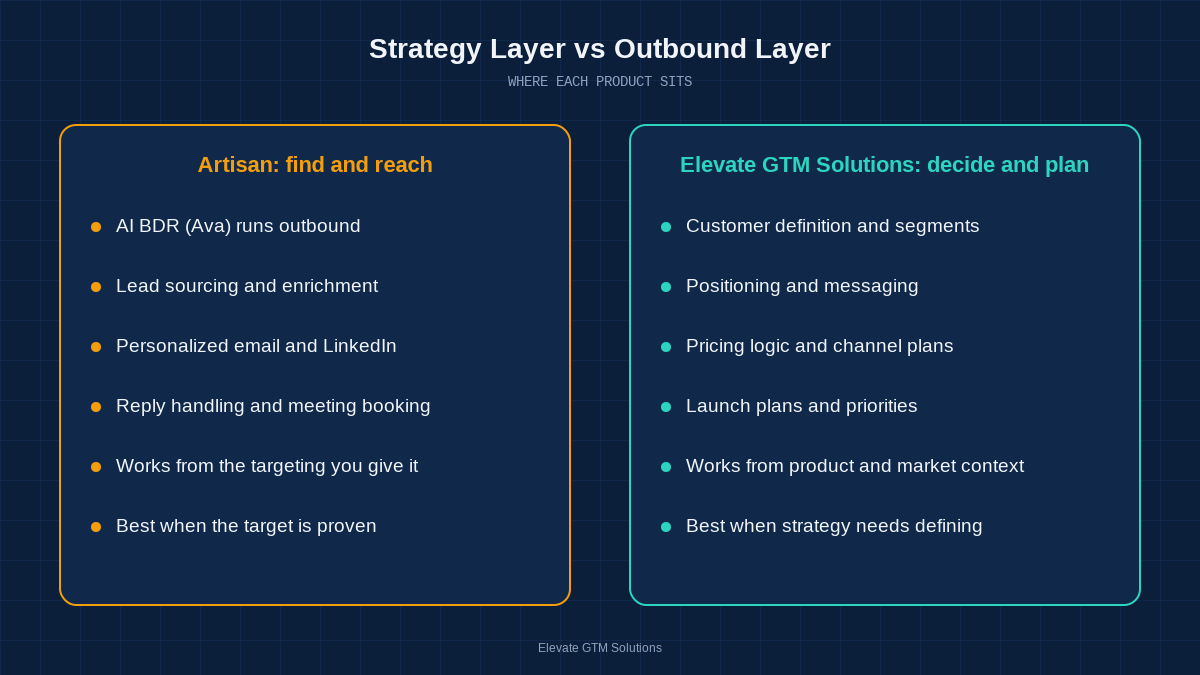
Artisan and Elevate GTM Solutions are both described as AI-native platforms for B2B go-to-market, and they appear in the same searches. They do almost opposite jobs. Artisan is built to run outbound sales: it finds leads, writes and sends outreach, handles replies and books meetings, using an AI agent it calls Ava. Elevate GTM Solutions is built to decide the go-to-market strategy that outbound runs on: who to target, how to position, what to say and what to charge.
That difference decides which one you need first. An autonomous outbound agent is very good at executing a plan quickly. If the plan is aimed at the wrong segment or uses a generic message, it executes that quickly too. This guide compares the two honestly: what each does, where they touch, how to decide, and how teams use both. Elevate GTM Solutions makes one of these products, so we say plainly where Artisan is the better choice. Descriptions of Artisan reflect how it describes itself and what third-party listings say as of November 2026. Features, limits and prices change often, so confirm current details with Artisan before you buy.
Elevate GTM Solutions vs Artisan: The Short Answer
Artisan is an AI-first outbound sales platform built around Ava, an autonomous AI BDR that sources leads, personalizes outreach, handles replies and books meetings. Elevate GTM Solutions is an AI-native GTM operating system that builds and maintains the strategy: ICP, positioning, messaging, pricing logic, channel plans and launch plans across 15 connected modules. Choose Artisan when you know your customer and message and want AI to run outbound. Choose Elevate GTM Solutions when you need to define or revise who you sell to and what you say. Many teams use both, with the strategy configuring the outbound.
Are they competitors? Only loosely, since both are called AI-native GTM platforms. They do different jobs.
Which comes first? Strategy, unless your targeting and message are already proven.
What Artisan is
Artisan describes itself as an AI-first platform for outbound sales, powered by Ava, an autonomous AI business development representative. According to Artisan's public descriptions, the platform combines several things:
- Lead sourcing and data. A B2B contact database (Artisan cites more than 300 million contacts) with enrichment and intent signals.
- Outreach. Personalized email and LinkedIn messaging, with sequencing and deliverability tools.
- Reply handling and meeting booking. Ava handles common replies and books meetings, and can escalate to a person under rules you set.
- A native dialer. Artisan states that Ava does not place calls herself, and that a dialer is included for human reps.
- Consolidation. Artisan positions the platform as replacing several separate outbound tools.
Artisan was founded in 2023 and is based in San Francisco. Reviews on third-party sites differ in sample size and rating, so read recent ones for your use case. Pricing has changed over time, so use Artisan's pricing page.
What Elevate GTM Solutions is
Elevate GTM Solutions is an AI-native GTM operating system and platform for B2B companies.
- Structured context. You enter market, industry, product and segment context.
- 15 modules plus a unified strategy. Market research, ICP and segmentation, competitive intelligence, account-based marketing, positioning, messaging, pricing, customer acquisition, distribution channels, marketing alignment, launch and execute, measure and optimize, sales enablement, customer success and customer advocacy.
- Workflows and a review rhythm. Weekly execution plans, task ownership, tracking and a recurring review called Elevate Pulse.
- Versions you can compare. For example, strategies for different segments or regions side by side.
- Published plans. Enable at USD 499 per month and Growth at USD 1,499 per month, billed annually, with custom Scale pricing and a free first strategy build. See the pricing page.
It does not hold a contact database, send outreach or book meetings.
Elevate GTM Solutions vs Artisan at a glance
| Artisan | Elevate GTM Solutions | |
|---|---|---|
| Category | AI outbound sales platform | AI-native GTM operating system |
| Main job | Find leads, run outreach, book meetings | Decide strategy and plan activation |
| AI agent | Ava, an autonomous AI BDR | AI that structures and drafts strategy outputs for review |
| Typical buyer | Sales leaders, founders, revenue operations | Marketing, product marketing, strategy and GTM leaders, founders |
| Core inputs | Your target criteria, messaging and rules | Your market, product and segment context |
| Core outputs | Leads, sent messages, replies, booked meetings | ICP, positioning, messaging, pricing logic, channel and launch plans, priorities |
| Contact data | Included | Not provided |
| Outreach at volume | Core | Not its purpose |
| Strategy and positioning | Not its purpose | Core purpose |
| Pricing | Quoted on Artisan's site and subject to change | Published Enable and Growth plans, custom Scale |
| Best fit | Teams with a proven target and message who want to scale outbound | Teams that need to define or revise who they sell to and what they say |
The row on inputs explains the rest. Artisan works from the targeting and message you provide. Elevate GTM Solutions helps produce them.
Where they touch, and where they do not
Where they touch. Both use AI and both involve messaging and a target customer. In Artisan, targeting becomes search criteria and messaging becomes outreach copy that Ava personalizes. In Elevate GTM Solutions, the target customer and the message are defined and explained across segments.
Where they do not. Artisan supplies contacts, sends messages and books meetings. Elevate GTM Solutions does not. Elevate GTM Solutions supplies strategy, positioning, pricing logic and planning. Artisan does not. A company that buys only one will still need the other job done, by a person, another tool, or not at all.
What Artisan does best
Scaling prospecting without adding headcount. For teams that know whom to reach, an AI agent that researches, writes and follows up can cover far more accounts than a small human team.
Consolidating outbound tools. Data, sequencing, deliverability and meeting booking in one place can reduce the number of subscriptions and integrations.
Speed to first outreach. A team with a clear target can start quickly.
Always-on follow-up. An agent does not forget to follow up or work only business hours.
Where an AI outbound agent may not be enough
These points apply to any autonomous outbound platform, not only Artisan.
It cannot tell you whether your targeting is right. It pursues the criteria you set. If the segment is wrong, it reaches the wrong people at scale.
It does not settle your message. Personalization works on top of a core message. If the core is generic, the personalization is cosmetic.
Outreach at scale carries risk. Poor targeting, repetitive messages and weak deliverability can harm sender reputation and brand. Rules on contacting people and on consent differ by region, so review them with your legal advisers.
Review matters. Decide which messages and replies need human approval, especially early on.
Data quality varies. Contact databases differ in accuracy by region and role, so verify for your market.
It supports outbound, not the rest of go-to-market. Pricing, packaging, launch planning, competitive positioning and cross-team alignment sit outside its main purpose.
What Elevate GTM Solutions does best
Turning context into a connected strategy. Customer profile, positioning, messaging, pricing logic and channel plans come from shared inputs and stay consistent.
Giving execution tools a specification. A defined segment, a message with proof and ranked priorities make any outbound platform more effective.
Keeping strategy current. You update inputs and review what changes, so the plan does not age between quarterly reviews.
Serving more than outbound. The modules touch marketing, product, sales enablement and customer success.
Where Elevate GTM Solutions may not be enough
It does not provide contacts or send outreach. You need an outbound tool for that.
It does not replace customer conversations. Its outputs are structured drafts to test against buyers.
Its value depends on specific inputs. Vague context produces generic output.
It does not replace a CRM.
Who should choose Artisan
Artisan may fit first if most of these describe you:
- You know your ideal customer and have a message that works.
- The constraint is the number of qualified conversations your team can start.
- You want AI to run outbound prospecting and follow-up with human oversight.
- You are comfortable setting review rules and monitoring quality.
- Your buyers respond to direct outreach.
Who should choose Elevate GTM Solutions
Elevate GTM Solutions may fit first if most of these describe you:
- You are unsure who your best customers are, or your definition has drifted.
- Outbound or marketing results are weak and you cannot tell if the cause is targeting, message or channel.
- You are launching a product, entering a market or repositioning.
- Teams describe the company and customers differently.
- You need planning across marketing, sales and product, not only outbound.
Can you use them together?
Yes, and the division of labor is simple.
- Define the strategy in Elevate GTM Solutions. Build the ICP, segment priorities, positioning and messaging for each segment.
- Configure Artisan from it. Use the ICP for targeting criteria, the personas for roles, and the messaging for outreach themes and rules.
- Set review rules. Decide what Ava can send alone and what needs approval.
- Run outbound in Artisan.
- Bring results back. Feed reply rates, meetings and win and loss reasons into the next strategy review.
- Update both.
This is a suggested way of working, not a described integration between the two products. If you want data handoffs, ask both vendors what is supported.
A hypothetical example
This is an illustration, not a real company.
A software company launched an AI outbound agent to book meetings with operations leaders at mid-sized companies. Volume rose and meetings did not. A review of the previous year's wins showed that most revenue came from logistics companies with a particular problem, while the agent's targeting spanned many industries with a general message.
The team used a strategy process to define the logistics segment and the problem, wrote messaging with a proof point from two customer calls, and set rules for the agent: target these accounts, use these themes, send nothing about unsupported claims, and route replies from larger accounts to a seller. Meetings per hundred contacts improved because the agent was now aimed at a specific buyer.
The agent had not been the problem. The brief it was given had been.
Questions to ask before you buy either
For Artisan
- Which exact actions can Ava take without approval, and how do I change that?
- How is contact data sourced, how fresh is it for my region and how is consent handled?
- What deliverability protections are included?
- How does pricing scale with contacts, messages or seats?
- Can I see recent reviews from teams like mine?
For Elevate GTM Solutions
- Can I enter my own product and segment and see the output live?
- What changes in the strategy if I change the target segment?
- What can I export, and who owns the outputs?
- What does each plan include?
- What do I still need other tools for?
Deliverability, consent and brand safety
Any platform that sends outreach at scale raises questions that matter before you sign.
| Topic | What to confirm |
|---|---|
| Deliverability | What protections exist for sending reputation, such as domain warm-up and volume limits |
| Consent and regional rules | How contacts are sourced and what rules apply in the regions you target |
| Approval controls | Which messages and replies need a person's approval |
| Escalation | When and how conversations are handed to a human |
| Content rules | What claims the agent may and may not make |
| Logging | Whether you can review what was sent and why |
These checks are not unique to Artisan. They apply to any AI outbound agent. A strategy that defines the audience and the allowed claims makes the rules easier to write.
Scenarios
| Situation | Direction |
|---|---|
| Proven target, small team, need more meetings | Consider an AI outbound platform, with approval rules |
| Unclear ideal customer, flat results | Start with strategy, then configure outbound |
| Launching a new product into a new segment | Strategy first, outbound once the message is tested |
| Large team with consistent outbound already | Look at strategy only if win rates stall |
| Limited budget | Define the customer and message first, then choose the lightest outbound tool that fits |
A 30-day pilot
Week 1. Define the segment and message in a structured form. Write the rules for the agent: target accounts, themes, forbidden claims and escalation triggers.
Week 2. Run a small batch with approval on every message. Read all replies.
Week 3. Loosen approval for message types that pass review. Track reply quality, not just volume.
Week 4. Review results by segment and message. Decide what to expand, change or stop. Feed learning into the strategy.
Decision checklist
- Can we name the customer and the message in one paragraph each?
- Do we have evidence from at least a handful of buyer conversations?
- Have we written approval and escalation rules?
- Have we checked consent and regional requirements?
- Do we have a baseline for replies and meetings?
- Who owns the agent's results?
If the answer to the first two is no, strategy comes first.
A closer look at how to evaluate Artisan
If outbound is your bottleneck and your target is proven, a trial of Artisan or a similar platform makes sense. Run it as an experiment, not a leap.
Prepare the brief. Write the target accounts and roles, the exclusions, the three themes the messages may use, the claims that are allowed and forbidden, the tone and the escalation triggers.
Start with approval on everything. Read every message the agent proposes for the first batch. Note what you change and why. Those edits become rules.
Watch replies as closely as sends. Look at who replies, what they say, who unsubscribes and what the agent does with objections. Reply quality tells you more than volume.
Check data in your region. Take a sample of contacts and verify that the roles and emails are right.
Check the controls. Can you cap volume? Can you pause one campaign? Can you see why the agent chose a prospect or wrote a sentence?
Check the handoff. When a prospect wants to talk, how does the conversation move to a person, and does the person see the history?
Measure against your baseline. Compare cost per meeting and meeting quality with your current process, over the same period and on comparable accounts.
Decide on evidence. At the end of the pilot, write down what to extend, change or stop.
A brief you can adapt for any AI outbound agent
| Field | What to write |
|---|---|
| Who to target | Industry, size, geography, roles, and a list of accounts to prioritize |
| Who to exclude | Segments, sizes and competitors, with the reason |
| The problem | The situation that makes them need us, in their words |
| Message themes | Three themes, each with the proof you can show |
| Allowed claims | Statements you can support |
| Forbidden claims | Anything you cannot prove, and comparisons you will not make |
| Tone | Plain, specific, no hype |
| Volume | A daily limit and a ramp-up plan |
| Approval | Which messages and replies need a person |
| Escalation | Triggers: pricing questions, legal topics, large accounts, complaints |
| Review | Who reads a sample each week |
This is the document that a strategy process produces. Without it, the agent fills the gaps with generic choices.
A closer look at the strategy side
Elevate GTM Solutions is useful when the brief above is the thing you do not yet have. A typical flow:
- Enter the context. Market, industry, product and segment, plus win and loss reasons and the alternatives buyers name.
- Review the outputs. Customer definition, segment priorities, competitive framing, positioning, messaging and pricing logic.
- Compare segments. Look at two candidate segments side by side and choose.
- Extract the brief. The customer profile becomes targeting criteria, the messaging pillars become themes, the proof points become allowed claims.
- Plan the work. Weekly execution plans assign owners and dates.
- Review monthly. Update inputs with reply data, win and loss reasons and market changes.
The outputs are structured drafts. People must check them against buyers, and the platform does not replace conversations.
The cost picture, qualitatively
Both products have costs beyond the price, and they differ in shape.
| Cost element | Artisan-style outbound platform | Elevate GTM Solutions |
|---|---|---|
| Subscription | Quoted by the vendor and subject to change | Published plans: Enable USD 499 per month, Growth USD 1,499 per month, billed annually; custom Scale |
| Usage-related cost | May scale with contacts, messages or seats | Scales with scopes and users |
| Internal time | Setting rules, reviewing messages and replies | Entering inputs and reviewing outputs |
| Risk cost | Reputation and compliance exposure if poorly controlled | Cost of acting on an untested strategy |
| What the money buys | Pipeline activity | Decisions and plans |
| Time to see results | Faster signals from outreach | Slower, as strategy is tested with buyers |
The two are not substitutes, so the right comparison is between each and the problem it solves. If the problem is a wrong target, the cheapest outbound platform will still be expensive.
Governing AI outbound alongside a strategy layer
| Principle | In practice |
|---|---|
| One source of truth for the target and message | The strategy document or platform, not scattered prompts |
| Changes flow downward | A new customer definition updates the agent's brief |
| Results flow upward | Reply themes and win and loss reasons feed the next review |
| People approve claims | Proof is required for every claim the agent may use |
| Logs are reviewed | Weekly sample reads and a monthly review |
| Autonomy is earned | Reduce approval only after quality holds |
A short decision tree
- Do you have a defined target and a message that has worked with real buyers?
- No: start with strategy. Define the customer, positioning and message, test them with buyers, then return to outbound.
- Yes: go to 2.
- Is the constraint the number of qualified conversations?
- No: look at conversion, onboarding or retention, which are different problems.
- Yes: go to 3.
- Are you ready to write approval and escalation rules and monitor quality?
- No: use a simpler tool with a person in each step.
- Yes: pilot an AI outbound platform narrowly.
- After the pilot, did results hold up against your baseline?
- Yes: extend carefully.
- No: return to the strategy and brief before spending more.
What to ask in a joint evaluation
If you plan to use both kinds of product, ask each vendor how it handles the handoff.
- Artisan: What inputs can I give Ava to carry the segment definition and message themes? Can I upload a brief? How are forbidden claims enforced?
- Elevate GTM Solutions: What outputs can I export, and in what form, to configure outbound tools? Which integrations exist and what exact actions do they support?
- Both: Who owns the data, how do I leave and what happens if the vendor is acquired?
What each product looks like to different roles
| Role | What they see in Artisan | What they see in Elevate GTM Solutions |
|---|---|---|
| Founder | A way to start outbound with less hiring | A way to settle who the customer is and what to say |
| Head of sales | An agent carrying prospecting work, with control rules | A customer profile and messaging for the team to use |
| SDR or BDR manager | Changes to the team's workload and quality review needs | Targeting criteria and talk tracks |
| Marketing leader | Outbound that shares themes with campaigns | Positioning and messaging consistent across channels |
| Product marketer | A consumer of the message | The place the message is built and updated |
| RevOps | A system to connect with the CRM and monitor | A system that produces the inputs for routing and scoring rules |
| Finance | A variable cost to compare with headcount | A subscription to compare with strategy time and rework |
| Legal and security | Consent, data handling and volume risk | Data handling for inputs and outputs |
If the people on this list want different things from the same purchase, name which problem comes first.
Three hypothetical stories
These are illustrations, not real companies.
The strong agent, the weak target. A company switched on an AI outbound agent and doubled the number of contacts reached. Meetings rose slightly and almost none converted. A review showed that the agent was targeting every mid-sized firm in a broad industry, while the company's best customers came from one niche. After the target and message were redefined, meetings fell in number and rose in quality.
The strategy that never reached the field. A company produced an excellent customer definition and messaging, shared as a document. Sellers kept using old decks and the outbound team used its own copy. When the company fed the definition into its outbound tool's targeting and themes, and added a monthly review, messages and conversations began to match.
The two-month detour. A founder bought an outbound platform before knowing who the best customer was. After two months of low replies, she spent a week on win and loss analysis and defined a segment she had not been targeting. The outbound platform was then configured for that segment. The detour cost time and subscription spend, but the platform worked once pointed at the right audience.
A joint timeline
If you use both, a reasonable sequence over about ninety days:
| Weeks | Strategy work | Outbound work |
|---|---|---|
| 1 to 2 | Gather evidence, define customer and exclusions | Prepare the brief template and approval rules |
| 3 to 4 | Draft positioning and messaging, test with a few buyers | Configure targeting and themes from the draft |
| 5 to 6 | Revise from feedback, record decisions | Run a small, fully approved batch |
| 7 to 8 | Compare segments and decide priorities | Review replies and quality, adjust the brief |
| 9 to 10 | Update the strategy from results | Loosen approval where quality holds |
| 11 to 13 | Quarterly review and reset | Decide whether to expand scope |
What if you can only afford one?
| Your situation | Likely first purchase |
|---|---|
| You do not know who your best customers are | Strategy work, even a free first build and customer interviews |
| You know them and lack conversations | An outbound platform with approval rules |
| You have both but are stuck on conversion | Neither: review the offer, pricing and sales process |
| You are launching a new product | Strategy first |
| You have a tight budget and a small team | Documents and customer calls first, then the lightest outbound tool that fits |
If in doubt, review your last ten lost deals. The reasons often tell you which problem you have.
Five buyer questions, answered in more depth
"If Ava can do prospecting, why do I need strategy?" Because Ava follows the targeting and message you provide. If those are wrong or vague, the agent scales the problem. Strategy work gives the agent a better brief: who to target, who to exclude and what claims are safe.
"Can Elevate GTM Solutions replace my SDR team?" No. It does not contact prospects. It helps define the customer and message that an SDR team, human or AI, uses.
"Which has more risk?" They carry different risks. Outbound at scale carries brand, deliverability and compliance risk. Strategy tooling carries the risk of acting on an untested draft. Both are managed by review: approval rules for outbound, and customer testing for strategy.
"Which is faster to show results?" Outbound shows signals quickly, in replies and meetings. Strategy shows results more slowly, as the message is tested and decisions flow through the team. The sensible comparison is time to a useful, tested brief for outbound, and time to qualified conversations once the brief is used.
"Can I use only one and still do well?" Sometimes. A company with a well-defined target and message may do well with an outbound platform alone. A company still deciding who to target may get more from strategy work first. Most teams that scale find they need both jobs done, by tools, people or a mix.
Questions to ask your own team first
Before comparing vendors, answer these internally. The answers often make the choice clear.
- When we last won a deal, who was the buyer, what triggered the search and what did they compare us with?
- When we lost, what did the buyer choose instead and why?
- Can three sellers describe our ideal customer in the same way?
- Which message has worked in real conversations, and what is the proof?
- How many qualified conversations do we need per month, and how many do we have?
- What does a good conversation look like, and who would a poor one come from?
- Who will review outbound messages and replies, and how often?
- What would we be willing to automate, and what must stay with a person?
- How will we know in thirty days whether this is working?
- Who owns the result?
If questions one to four are hard to answer, begin with strategy. If they are easy and question five shows a gap, outbound is a reasonable next step.
Key takeaways
- Artisan is an AI-first outbound platform built around an autonomous AI BDR called Ava. Elevate GTM Solutions is an AI-native GTM operating system for strategy and planning.
- They do different jobs and are not direct substitutes.
- Choose Artisan first when your customer and message are proven and you need more conversations.
- Choose Elevate GTM Solutions first when you need to define or revise who you target and what you say.
- If you use both, define the strategy first and configure the agent from it, with approval rules and a weekly review.
- Check consent, deliverability and volume controls before running any autonomous outreach.
What to do this week
Read your last ten lost deals and your last ten wins. Write the customer and the message in one paragraph each and ask three colleagues whether they agree. If they do, and you need more conversations, write an agent brief using the template above. If they do not, spend the week on strategy and customer conversations, then return to the outbound decision with a clearer brief.
Where Elevate GTM Solutions fits
Elevate GTM Solutions is an AI-native GTM operating system for B2B companies. It connects context, intelligence, strategy, activation, execution and analytics through 15 modules plus a unified strategy, and supports workflows and a recurring review rhythm. It connects to HubSpot, Salesforce, LinkedIn, Notion and Claude for supported actions. It does not supply contacts or run outreach, so teams often pair it with an outbound tool.
For related reading, see What Is Elevate GTM Solutions?, Best AI-Native GTM Platforms for B2B Companies, Elevate vs Clay and AI Tools for GTM Execution and Alignment. See the pricing page, or request a demo.
Frequently Asked Questions
What is the difference between Elevate GTM Solutions and Artisan?
Artisan is an AI-first outbound sales platform built around Ava, an autonomous AI BDR that sources leads, writes outreach, handles replies and books meetings. Elevate GTM Solutions is an AI-native GTM operating system that builds and maintains the strategy: ICP, positioning, messaging, pricing logic and plans.
Is Elevate GTM Solutions an alternative to Artisan?
Not directly. They do different jobs. Some teams use Elevate GTM Solutions to define strategy and Artisan to run outbound.
Does Elevate GTM Solutions have an AI SDR?
No. Elevate GTM Solutions does not run outreach or book meetings. It focuses on strategy, planning and workflow alignment. For AI-run outbound, teams use platforms such as Artisan.
Does Artisan help with GTM strategy?
Artisan is built for outbound sales. It works from the targeting and messaging you provide and does not set your ICP, positioning or overall strategy.
Which should I buy first?
If your target customer and message are proven and you need more conversations, an outbound platform. If you are unsure who to target or what to say, or are about to launch or reposition, start with strategy.
What is Ava?
Ava is Artisan's autonomous AI BDR. According to Artisan, she sources leads, writes personalized outreach, handles replies and books meetings, escalating to a person according to rules you set.
Is autonomous AI outreach risky?
It can be. Poor targeting and repetitive messages can harm reputation, and rules about contacting people differ by region. Set approval rules, monitor quality and review requirements with your legal advisers.
Can I use Elevate GTM Solutions and Artisan together?
Yes. Use Elevate GTM Solutions to define the ICP, segments and messaging, then configure Artisan's targeting, personas and themes from them. Feed results back into the next strategy review. Confirm any data handoffs with both vendors.
How does pricing compare?
Elevate GTM Solutions publishes Enable at USD 499 per month and Growth at USD 1,499 per month, billed annually, with custom Scale pricing. Artisan's pricing has changed over time, so use its pricing page. Compare what each includes.
How should I trial an AI SDR like Artisan?
Write a brief with targets, exclusions, themes, allowed and forbidden claims, tone, volume limits and escalation triggers. Approve every message at first, track reply quality as well as volume, and compare cost per meeting with your baseline.
What should an AI outbound brief contain?
Who to target and exclude, the problem in the buyer's words, three message themes with proof, allowed and forbidden claims, tone, volume limits, approval rules, escalation triggers and who reviews a sample each week.
Where do the outputs of Elevate GTM Solutions go when I use an outbound tool?
The customer profile informs targeting criteria, the messaging pillars become themes, and the proof points become allowed claims. This is a way of working, and any data handoff between products should be confirmed with both vendors.
Is an AI SDR cheaper than a human BDR?
Vendors make such comparisons, and results vary with your market, data quality and controls. Measure cost per qualified meeting against your own baseline over the same period.
What if my outbound results are poor?
Check the target and message first. Review win and loss reasons and reply content. If those are unclear, strategy work will help more than a different outbound tool.