
By the Elevate GTM Solutions Team · Updated November 10, 2026 · 21 min read
GTM Platform vs Revenue Intelligence Platform: Insight on Deals vs Decisions About Strategy
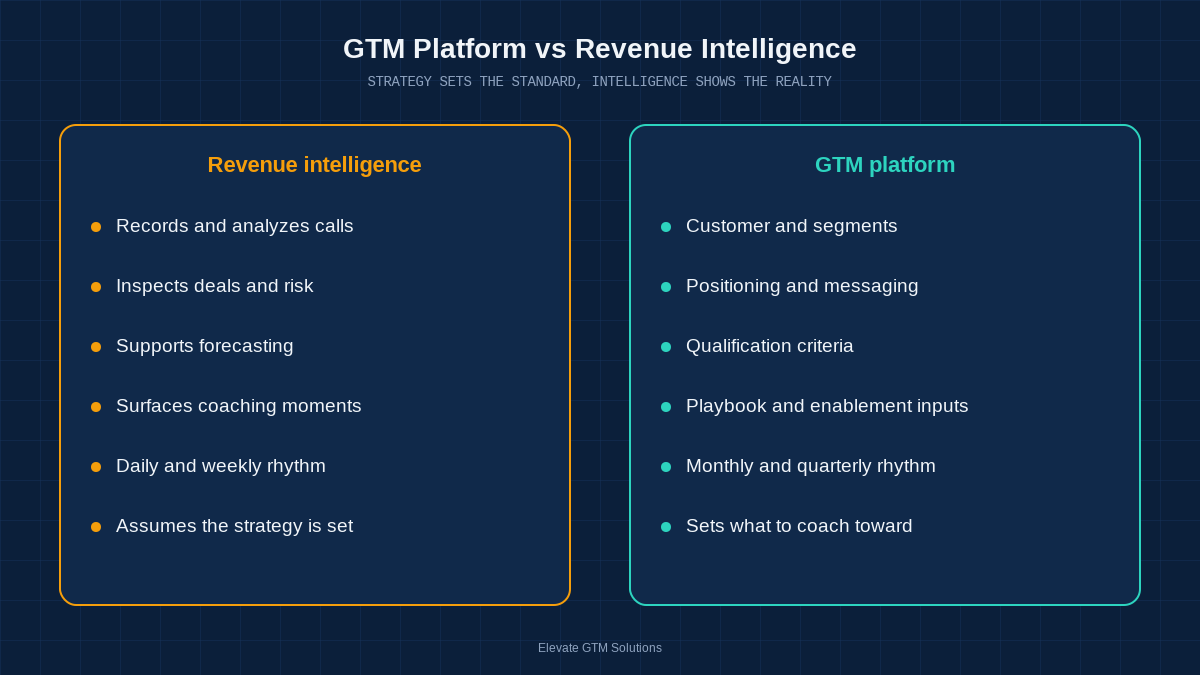
Revenue intelligence platforms watch what happens in sales: the calls, the emails, the movement of deals and the shape of the forecast. They turn that activity into insight for managers and sellers. A GTM platform sits earlier in the chain. It helps leadership decide who the company should sell to, how to position, what to say and what to prioritize, and it keeps those decisions consistent across teams. One tells you how the pipeline is behaving. The other helps you decide what the pipeline should be.
The two are often confused because both promise visibility and both use AI. A revenue leader frustrated by missed forecasts may shop for revenue intelligence. A product marketer frustrated by inconsistent messaging may shop for a GTM platform. Each may be shopping for the wrong thing. This guide separates the categories, compares them on the dimensions that matter, explains how they connect, lays out evaluation tests and shows how to use the findings from one to improve the other. Elevate GTM Solutions makes a GTM strategy platform, so we say plainly when a revenue intelligence platform is the better answer. Vendor descriptions reflect public statements and your site's own comparison pages as of November 2026, and the market has been consolidating, so confirm details before you buy.
GTM Platform vs Revenue Intelligence Platform: What Is the Difference?
A revenue intelligence platform, such as Gong or the forecasting and conversation products of Salesloft and Clari, captures and analyzes sales activity: calls, emails, deal progress and pipeline, to support coaching, deal inspection and forecasting. A GTM platform, such as Elevate GTM Solutions, builds and maintains the strategy sales runs on: ideal customer, segments, positioning, messaging, pricing logic and priorities. Revenue intelligence shows what is happening in deals. A GTM platform helps decide what should happen. They complement each other, and the findings of one feed the other.
Which should I buy first? If your strategy is clear and you need visibility into deals and coaching, revenue intelligence. If teams disagree on customer and message, a GTM platform.
Does one replace the other? No. They work at different layers and on different timescales.
The two categories side by side
| Revenue intelligence | GTM platform | |
|---|---|---|
| Core question | What is happening in our deals, and how do we improve it? | Who should we sell to, and what should we say? |
| Main users | Sales leaders, managers, sellers, revenue operations | Product marketing, strategy, marketing leaders, founders, RevOps |
| Main objects | Calls, emails, meetings, deals, forecasts | Customer definition, segments, positioning, messaging, pricing logic, plans |
| Data source | Sales activity and CRM data | Your context and evidence, structured |
| Timescale | Daily and weekly | Monthly and quarterly, updated when the market changes |
| Output | Call insights, deal risk, forecast views, coaching moments | A strategy others use, kept consistent |
| AI role | Transcription, summarization, risk detection, forecasting aids, agents | Structuring evidence, drafting strategy, keeping outputs consistent |
| Assumes | The strategy is set and the question is execution quality | You will test the draft and decide |
| Failure mode | Precise insight about a plan that is wrong | A strategy that is not used or not updated |
What revenue intelligence platforms do
The category grew from conversation recording into a broader set of capabilities.
| Capability | What it does |
|---|---|
| Conversation capture | Records and transcribes calls and meetings, and captures emails |
| Conversation analysis | Finds topics, objections, competitor mentions and talk patterns |
| Deal inspection | Shows activity, stakeholders involved and risk signals by deal |
| Forecasting | Aggregates pipeline into forecast views, with inspection and roll-ups |
| Pipeline analytics | Shows conversion, velocity and coverage |
| Coaching | Surfaces moments for managers to review and coach |
| Engagement | In some platforms, outreach sequences and workflow |
| AI assistance | Summaries, next steps, risk alerts and in some cases agents |
Gong describes itself as a revenue intelligence platform and is known for conversation analysis and deal insight. Our page Elevate vs Gong covers it in depth. Clari and Salesloft completed their merger in December 2025, and the combined company adopted the Salesloft name in September 2026, with the Clari forecasting product keeping its name. Outreach describes an AI sales execution platform with forecasting, conversation intelligence and agents. Capabilities and packaging change, so check each vendor's current descriptions.
What GTM platforms do
Elevate GTM Solutions describes itself as an AI-native GTM operating system. From the market, industry, product and segment context you provide, it builds connected outputs across 15 modules, including ICP and segmentation, competitive intelligence, positioning, messaging, pricing, channels, sales enablement inputs, launch and execution, and measurement. It supports workflows, weekly plans, task ownership and a recurring review rhythm, and it lets teams compare strategies side by side.
It does not record calls, inspect deals or produce forecasts.
How they connect
The most valuable link between the two runs in both directions.
| From revenue intelligence | To the GTM strategy |
|---|---|
| Themes in objections | Messaging and positioning updates |
| Competitors mentioned in calls | Competitive framing |
| Language buyers use | Message pillars and proof |
| Win and loss patterns by segment | Customer definition and segment priorities |
| Stakeholders present in won deals | Buying group guidance and qualification |
| Deal stalls and where they occur | Process, enablement and playbook changes |
| Questions asked about pricing | Pricing logic and packaging |
| From the GTM strategy | To revenue intelligence |
|---|---|
| Ideal customer and exclusions | Which deals to inspect first, and how to read forecast quality by segment |
| Message pillars and forbidden claims | What to listen for on calls, and what to coach |
| Qualification criteria | How to judge deal health |
| Competitive guidance | Topics and trackers to configure |
| Playbook sections | Coaching rubrics |
Without the first set, strategy ages in slides. Without the second, revenue intelligence measures activity against criteria nobody defined.
What conversation data can and cannot tell you
| It can tell you | It cannot tell you |
|---|---|
| What buyers said and asked on recorded calls | What buyers think privately between calls |
| How often competitors were mentioned | Whether mentions caused losses |
| Which objections arise and when | Whether your answers were the reason for outcomes |
| How sellers run calls | Whether the strategy behind the call was right |
| Which stakeholders appeared | Who actually decided |
| Patterns across many calls | Causation from patterns alone |
Treat conversation data as rich evidence, and pair it with buyer interviews and win-loss analysis. Our guide to the win-loss analysis framework covers learning directly from buyers.
Forecasting is not strategy
Forecasting predicts what will close. Strategy decides what you are trying to win. Mixing them leads to two familiar errors. Teams improve forecast accuracy while pursuing the wrong segment. Or they try to fix an inaccurate forecast with strategy changes when the cause is inconsistent stage definitions and stale data.
| Problem | More likely a forecasting problem | More likely a strategy problem |
|---|---|---|
| Forecast misses every quarter | Stage definitions, stale close dates, optimistic inputs | Rarely |
| Win rates differ widely by segment | Rarely | Targeting and positioning |
| Deals stall at the same step | Sometimes process | Often messaging, buying group or fit |
| Pipeline is large but low quality | Qualification discipline | Ideal customer definition |
| Sellers disagree about what to say | Rarely | Messaging and positioning |
Diagnose before buying. A tool that measures the problem well does not necessarily fix it.
Turning strategy into trackers and scorecards
This is an invented illustration of the configuration work after a strategy decision.
| Strategy decision | Configuration in a conversation platform |
|---|---|
| Three message pillars | Trackers for the key phrases and topics each pillar uses, and a report on how often sellers cover them |
| Forbidden claims | A tracker for risky phrases, with alerts for review |
| Qualification questions | A scorecard item for each question and whether it was asked |
| Competitors | Trackers for named alternatives, including non-obvious ones such as spreadsheets |
| Common objections | Trackers for objection topics, and links to approved responses |
| Buying group roles | A view of which roles joined calls |
| Next step discipline | A scorecard item for a specific agreed next step |
| Customer language | A saved collection of strong buyer phrases for messaging updates |
Review the trackers monthly. Delete those that produce noise, and add new ones when a new theme appears.
A coaching framework tied to the playbook
Coaching improves when managers coach to a shared standard.
| Step | Practice |
|---|---|
| 1. Pick a skill | One skill per period, such as discovery questions or handling pricing |
| 2. Define good | Describe it using examples from your best calls |
| 3. Find moments | Use the platform to pull examples from the team |
| 4. Review together | The seller and manager listen to a short clip |
| 5. Agree an action | One specific change to try |
| 6. Try it | The seller applies it on upcoming calls |
| 7. Check | Review a later call for the change |
| 8. Record | Note what worked to improve the playbook |
Avoid coaching on style preferences. Focus on behaviors that link to outcomes in your own data.
A deal inspection checklist
Managers can use the same questions across deals.
| Question | What a good answer looks like |
|---|---|
| Does the deal match the ideal customer? | Yes, with evidence |
| Has the problem been stated in the buyer's words and recorded? | Yes |
| Who is the champion, and what do they want? | Named, with a stated goal |
| Who decides, and have we spoken to them? | Named and engaged, or a plan to reach them |
| What alternatives are they considering? | Known, including doing nothing |
| What is the next step, and who agreed it? | Specific, dated and mutual |
| What could stop this deal? | Named risks with responses |
| Is the close date based on a buyer event? | Yes, such as a decision meeting or contract review |
| What does the buyer need to see? | Known and scheduled |
A deal that cannot answer several of these is probably earlier in the process than its stage suggests.
Forecast hygiene basics
Forecast accuracy depends on data discipline more than on algorithms.
| Practice | Why |
|---|---|
| Stage definitions with exit criteria | Stages mean the same thing to every seller |
| Close dates tied to buyer events | Reduces wishful dates |
| Regular updates | Stale deals distort the forecast |
| Segmented forecasts | Win rates differ by segment |
| A stated method | Weighted pipeline, rep judgment or a model, with its limits |
| A record of forecast against actual | Shows reliability over time |
| Ranges, not points | Honest about uncertainty |
| Separate commit and upside | Clarifies confidence |
AI-assisted forecasting can help find risks. Treat it as input, and compare it with your own track record.
Bringing call themes into the monthly strategy review
A simple template links conversation insight to strategy.
| Section | Content |
|---|---|
| Top objections | The five most frequent, with counts and example clips |
| Competitor mentions | Who appeared, in what context and with what claims |
| Buyer language | Ten phrases, with context |
| Questions about price | What was asked and how it was answered |
| Stakeholders | Roles involved in won and lost deals |
| Stall points | Where deals slowed |
| Pillar coverage | How often sellers used each pillar and whether it landed |
| Decisions | Changes to messaging, qualification, enablement or positioning, with owners |
Attach three short clips so decision makers hear buyers directly. Record decisions in the strategy log.
Roles and governance
| Role | Responsibility |
|---|---|
| Sales leader | Owns coaching and deal inspection practices |
| RevOps | Owns configuration, integrations, forecast process and data quality |
| Product marketing | Owns message pillars, competitive framing and the connection to call themes |
| Enablement | Turns insights into training |
| Legal and security | Reviews consent, retention and access |
| Executive sponsor | Resolves conflicts and approves changes |
Document who can view recordings, how long they are kept and what they may be used for. Be transparent with sellers about how conversation data is used.
Terms used in this guide
| Term | Meaning |
|---|---|
| Revenue intelligence | Software that analyzes sales activity to support coaching, inspection and forecasting |
| Conversation intelligence | Analysis of recorded calls and meetings |
| Tracker | A configured topic or phrase the platform looks for |
| Scorecard | A set of criteria for assessing a call or deal |
| Deal inspection | Reviewing the evidence behind a deal's stage and risk |
| Commit | Deals a seller is confident will close in the period |
| Pipeline coverage | Open pipeline divided by target |
| Stage exit criteria | What must be true to leave a stage |
When you need revenue intelligence first
- The strategy is clear and the question is execution quality.
- Managers cannot see what happens on calls and want to coach.
- Forecasts are unreliable and inspection is manual.
- You have enough calls and deals for patterns to mean something.
- You want shared visibility across sales, success and operations.
When you need a GTM platform first
- Teams disagree about who the customer is or what to say.
- Win rates differ by team or region for the same segment.
- You are launching, repositioning or entering a new market.
- Several products, segments or regions need consistent strategy.
- Coaching has nothing to coach toward because the message is not settled.
When you need both
Mid-sized and large sales organizations often do. A working pattern:
- Decide customer, message and qualification criteria in the strategy layer.
- Configure trackers, scorecards and deal criteria in the revenue intelligence platform from them.
- Coach against the playbook, not against individual styles.
- Bring themes, objections, competitor mentions and win and loss patterns to a monthly strategy review.
- Update the strategy and the configuration together.
How to evaluate each
A revenue intelligence platform
| Test | What to do | What to look for |
|---|---|---|
| Capture quality | Record a sample of real calls and review transcripts | Accuracy for your accents, terms and call types |
| Analysis | Configure topics and trackers for your competitors and objections | Precision of detection and ease of change |
| Deal inspection | Review a live pipeline | Whether it finds issues your managers confirm |
| Forecast | Compare forecast views with your current process | Transparency of method and inspection tools |
| Coaching | Run a coaching session from the platform | Time saved and quality of moments surfaced |
| Integrations | Connect the CRM and calendar | Fields synced and conflict handling |
| Consent and privacy | Review recording rules and data handling for your regions | Controls and documentation |
| AI controls | Check what agents may do and how outputs are logged | Safety |
| Cost | Estimate seats and add-ons over three years | Total cost |
A GTM platform
| Test | What to do | What to look for |
|---|---|---|
| Specificity | Enter real context and evidence | Outputs that name your customers and alternatives |
| Change handling | Change the target segment | What updates and what you must fix |
| Comparison | Compare strategies for two segments | Clarity of differences and reasons |
| Review | Have sellers and managers read the output | What they say is wrong or missing |
| Handoff | Produce messaging and a customer profile | Whether coaching can use them |
| Integration | Check supported actions with your CRM | What is automatic and what is manual |
| Cost | Compare plans with your scope | Total including team time |
Consent and privacy
Recording conversations raises legal and ethical questions that differ by country and by context. Before deploying call recording, work with your legal advisers on consent requirements, notices, retention and access, and be transparent with buyers about recording. Limit who can see recordings, and agree how long they are kept. These obligations apply to any conversation intelligence tool.
Cost shapes
| Element | Revenue intelligence | GTM platform |
|---|---|---|
| License | Typically per seat, with tiers and add-ons, often quote-based | By scopes and users, with published plans for some vendors |
| Storage and volume | May affect pricing as call volume grows | Not applicable |
| Implementation | CRM integration, tracker setup, training | Inputs, review and owners |
| Internal time | Managers coaching and reviewing, operations maintaining | Owners updating inputs and reviewers testing outputs |
| Switching | Moderate: recordings and configuration | Moderate: structured records |
For reference, Elevate GTM Solutions publishes Enable at USD 499 per month and Growth at USD 1,499 per month, billed annually, with custom Scale pricing and a free first strategy build. Ask revenue intelligence vendors for written quotes at your seat count and volume.
Mistakes to avoid
| Mistake | What happens | Fix |
|---|---|---|
| Buying revenue intelligence to fix messaging | Detailed visibility into inconsistent messages | Settle messaging first |
| Treating call volume as quality | More calls, same results | Measure outcomes by segment |
| Coaching without a shared standard | Different managers coach different things | Coach to the playbook |
| Over-trusting AI summaries | Errors enter the CRM | Sample against recordings |
| Mixing forecast fixes with strategy changes | The wrong remedy | Diagnose first |
| Ignoring consent rules | Legal and reputational risk | Review with advisers |
| Not feeding insights to strategy | Strategy stays static | Monthly review with call themes |
| Measuring individual reps with conversation scores alone | Gaming and distrust | Use scores as coaching input |
A hypothetical example
This is an illustration, not a real company.
A company with thirty sellers deployed a revenue intelligence platform to improve forecasting and coaching. Within a quarter, managers could see call themes and forecast accuracy improved a little. Win rates were unchanged, and win rates differed widely between two regions selling the same product.
The head of sales and the head of product marketing reviewed recorded calls from both regions. One region framed the product as a scheduling tool for small firms. The other framed it as an operations platform for mid-sized firms. Buyers in the first region frequently asked about features the product did not cover, and calls often ended without a next step.
The company settled the positioning with a strategy process: they chose the mid-sized segment as the priority, wrote message pillars with proof and defined qualification questions. They configured trackers for the new pillars and the common objections, and created a coaching scorecard from the playbook. Two quarters later, the regions' win rates had moved closer, managers coached to the same standard and the monthly review used call themes to update objection responses. The platform had shown them the difference. The strategy decision closed it.
A sixty-day plan for rolling out conversation intelligence
Days 1 to 10: prepare. Review consent and recording rules with legal advisers. Agree who can see recordings and how long they are kept. Tell sellers what the tool is for and what it is not for. Define two or three coaching goals.
Days 11 to 25: configure. Connect the CRM and calendar. Configure trackers for your pillars, competitors and objections. Build a scorecard from the playbook. Test on a small group.
Days 26 to 40: pilot. Run with one team. Hold weekly coaching sessions using clips. Collect feedback from sellers and managers. Fix noisy trackers.
Days 41 to 55: extend. Roll out to more teams. Train managers to coach from clips. Start a monthly review of call themes with product marketing.
Days 56 to 60: assess. Compare coaching time, ramp for new hires and call quality indicators with your baseline. Decide what to adjust.
If sellers feel monitored instead of supported, adoption will suffer. Be open about purpose and use the tool for coaching, not surprise discipline.
Seller concerns, and honest responses
| Concern | Response |
|---|---|
| "This is surveillance" | Explain the purpose, limit access, share what managers see and agree not to use the tool for punishment |
| "It adds admin" | Show time saved on notes and CRM updates, and remove duplicate work |
| "The AI summaries are wrong" | Sample summaries against recordings, correct errors and tell sellers how to flag them |
| "My calls are being judged on style" | Coach to behaviors linked to outcomes in your own data |
| "Buyers will not like being recorded" | Be transparent, follow consent rules and respect buyers who decline |
| "It will replace managers" | Position it as a way to focus coaching time on moments that matter |
Take the concerns seriously. They often point to design improvements.
Building a call library for onboarding
A curated set of calls helps new hires learn faster than a document alone.
| Category | What to include |
|---|---|
| Strong discovery | Calls where the seller uncovers the problem, cost and buying group |
| Objection handling | Examples of honest, effective responses to common objections |
| Competitive situations | Calls with named alternatives, handled well |
| Pricing conversations | Calls where price is discussed clearly |
| Next-step discipline | Calls that end with a specific, mutual next step |
| Lost deals | Calls that show where a deal went wrong, with context |
For each clip, add a note on what to listen for. Update the library quarterly, retire outdated clips and respect confidentiality, using only calls where permitted.
Final thoughts
Revenue intelligence tells you how selling is going. A GTM platform helps you decide what selling should be about. The two together create a loop in which call insights improve the strategy and the strategy sharpens coaching. If you can only do one first, look at your own recordings. If sellers describe the customer and the product in different ways, settle the message before investing in more analysis. If they agree and you cannot see what happens on calls, add visibility with care for consent and for how sellers feel about it.
What good looks like after six months
| Area | Signs it is working |
|---|---|
| Adoption | Managers use clips in coaching weekly, and sellers use summaries |
| Data quality | CRM fields filled from calls are accurate on sampling |
| Coaching | Coaching focuses on defined behaviors linked to outcomes |
| Forecasting | The method is documented and the track record is visible |
| Strategy loop | Monthly reviews include call themes and lead to changes |
| Onboarding | New sellers listen to the call library and ramp with a shared standard |
| Trust | Sellers describe the tool as helpful, not as surveillance |
| Compliance | Consent and retention rules are followed and reviewed |
If most of these are absent, the issue is usually process and ownership, not the tool.
Measuring a rollout
| Measure | Why |
|---|---|
| Share of managers coaching from clips each week | Adoption |
| Time managers spend on call review | Efficiency |
| Accuracy of summaries and CRM updates on sample | Quality |
| Time for new sellers to run a good discovery call | Onboarding speed |
| Coverage of message pillars in calls | Strategy reaching the field |
| Forecast accuracy over time, with method stated | Reliability |
| Seller satisfaction with the tool | Trust |
| Number of strategy changes that came from call insights | Whether the loop works |
Compare with a baseline taken before the rollout, and be careful about claiming that the tool caused changes in win rate.
Terms often confused
| Term | Meaning |
|---|---|
| Conversation intelligence | Analysis of recorded calls and meetings |
| Revenue intelligence | A broader category that adds deal inspection, forecasting and pipeline analytics |
| Sales engagement | Tools that run outreach sequences |
| Forecasting | Predicting revenue that will close in a period |
| Pipeline analytics | Measures of conversion, velocity and coverage |
| GTM platform | A system for the strategy decisions behind go-to-market |
| Playbook | A guide to carrying out the strategy repeatably |
Scenarios and directions
| Situation | Direction to explore |
|---|---|
| A small team with a clear message and few calls | Notes in the CRM and manual review may be enough, with a light tool later |
| A growing team where managers cannot listen to everything | Conversation intelligence with a coaching routine |
| A company with unreliable forecasts and messy stages | Fix stage definitions and data first, then consider forecasting tools |
| A company with big differences in win rates between regions | Review recorded calls for message differences, settle the strategy, then configure trackers |
| A company adopting AI agents for follow-up | Define a brief and controls, and use conversation data to check quality |
| A company after a merger with two sales methods | Settle the combined message and qualification criteria before choosing tooling |
Questions leaders ask
"Will this tell me why we lose?" It will show what was said and what happened in calls. Pair it with buyer interviews to learn why decisions were made.
"Can we use it to measure rep performance?" Use it carefully. Scores can mislead and can be gamed. Treat them as coaching inputs, with outcomes and context.
"How do we avoid drowning in data?" Choose a few trackers and scorecard items tied to your playbook, and review them monthly.
"What about calls with customers rather than prospects?" The same questions apply. Customer calls contain valuable evidence about value, expansion and risk, and consent and access rules apply as well.
"Who should see recordings?" Define roles. Many companies limit access to managers, enablement and a small group in product marketing, with clear retention periods.
"How do we connect this to strategy?" Hold a monthly review in which call themes, competitor mentions and win and loss patterns are brought to the strategy owner, with decisions recorded.
"How do we know the tool is accurate?" Sample summaries and detections against recordings every month, record error rates and fix configuration.
What to ask a revenue intelligence vendor in writing
| Topic | Question |
|---|---|
| Capture | Which meeting and call platforms are supported, and how are recordings stored? |
| Accuracy | How is transcription accuracy measured for our languages and accents? |
| AI features | What do summaries, risk alerts and agents do, and how are outputs logged? |
| Forecasting | What method does it use, and how can we inspect it? |
| Data use | Is our data used to train models, and can we opt out? |
| Retention | How long are recordings kept, and can we set our own periods? |
| Access | How are roles and permissions set? |
| Integration | Which CRM fields sync, and how are conflicts handled? |
| Pricing | How does price change with seats, storage and add-ons? |
| Exit | How can we export recordings and configuration? |
| Change | What happens if products are merged or retired? |
Keep the answers with the contract.
What to do this week
Listen to five recorded calls from different sellers. Write down how each describes the customer and the product. If they differ, settle the message before investing in more analytics. If they agree and you cannot see what happens on calls, evaluate revenue intelligence with a sample of your own recordings.
In plain language
Revenue intelligence tells you what is happening in deals and calls. A GTM platform helps you decide what should be happening. Use the first to coach, inspect deals and forecast with more honesty, and use the second to settle who you sell to and what you say, so coaching has a standard to coach toward. Connect them with a monthly review in which call themes, competitor mentions, buyer language and win and loss patterns update messaging, qualification and the playbook. Be open with sellers about how conversation data is used, follow consent rules for recording and sample AI summaries against recordings. Better visibility into a poor plan only produces a more detailed view of the same problem.
Key takeaways
- Revenue intelligence analyzes sales activity. A GTM platform decides the strategy sales runs on.
- They complement each other, and insights should flow in both directions.
- Forecasting is not strategy. Diagnose whether a problem is process, data or strategy before buying.
- Evaluate each with your own calls, deals and scenarios.
- Review consent, privacy and AI controls before deploying call recording and agents.
- Bring call themes and win and loss patterns to a monthly strategy review.
Where Elevate GTM Solutions fits
Elevate GTM Solutions is an AI-native GTM operating system for B2B companies. It holds the strategic decisions, including ICP and segmentation, competitive framing, positioning, messaging, qualification criteria and sales enablement inputs, across 15 modules, with workflows, weekly plans and a recurring review rhythm that can take in themes from calls and deals. It does not record calls, inspect deals or forecast. It connects to HubSpot, Salesforce, LinkedIn, Notion and Claude for supported actions. A free first strategy build is available, and published plans, billed annually, are Enable at USD 499 per month and Growth at USD 1,499 per month, with custom Scale pricing.
For related reading, see Elevate vs Gong, Win-Loss Analysis Framework, What Is a GTM Playbook? and GTM Metrics and KPIs. See the pricing page, or request a demo.
Frequently Asked Questions
What is the difference between a GTM platform and revenue intelligence?
Revenue intelligence captures and analyzes sales activity such as calls, emails, deals and pipeline to support coaching, inspection and forecasting. A GTM platform builds and maintains the strategy: ideal customer, segments, positioning, messaging, pricing logic and priorities.
Do I need both?
Mid-sized and larger sales organizations often do. Decide strategy first, configure trackers and scorecards from it and feed call themes and win and loss patterns back to a monthly review.
Which should I buy first?
If your strategy is clear and you need visibility into deals and coaching, revenue intelligence. If teams disagree on customer and message, a GTM platform.
Can revenue intelligence tell me what my strategy should be?
It provides evidence about what buyers say and how deals progress. It does not decide the ideal customer or the message, and patterns are not proof of causation.
What happened to Clari and Salesloft?
They completed their merger in December 2025. The combined company adopted the Salesloft name in September 2026, and the Clari forecasting product keeps its name.
Is forecasting a strategy tool?
No. Forecasting predicts what will close. Strategy decides what you are trying to win. Diagnose whether a forecast problem is about stage definitions and data or about targeting and positioning.
What should I test when evaluating revenue intelligence?
Capture quality on your calls, precision of topic and tracker detection, deal inspection quality, forecast transparency, coaching usefulness, CRM integration, consent and privacy controls, AI controls and cost.
How do call insights improve strategy?
Themes in objections, competitor mentions, buyer language, stakeholders in won deals and stalls by stage feed messaging, positioning, qualification and playbook updates.
Are there legal issues with recording calls?
Rules on consent, notices and retention differ by country and context. Work with your legal advisers and be transparent with buyers.
Does Elevate GTM Solutions replace Gong or Clari?
No. It covers strategy and planning and connects to other tools for supported actions. Call analysis, deal inspection and forecasting are done in revenue intelligence platforms.
How do I configure a conversation platform from my strategy?
Create trackers for message pillars, forbidden claims, competitors and objections, build scorecards from qualification questions and next-step discipline, and review them monthly.
How should managers coach with conversation data?
Pick one skill, define good using your best calls, pull example moments, review clips together, agree one action, check a later call and record what worked.
What is on a deal inspection checklist?
Fit with the ideal customer, the stated problem, the champion, the decision maker, alternatives, the next step, risks, a buyer-based close date and what the buyer needs to see.
How can I improve forecast accuracy?
Define stage exit criteria, tie close dates to buyer events, update regularly, segment forecasts, state the method, track forecast against actual and show ranges.