
By the Elevate GTM Solutions Team · Updated November 10, 2026 · 22 min read
GTM Strategy vs. Marketing Plan vs. Sales Strategy
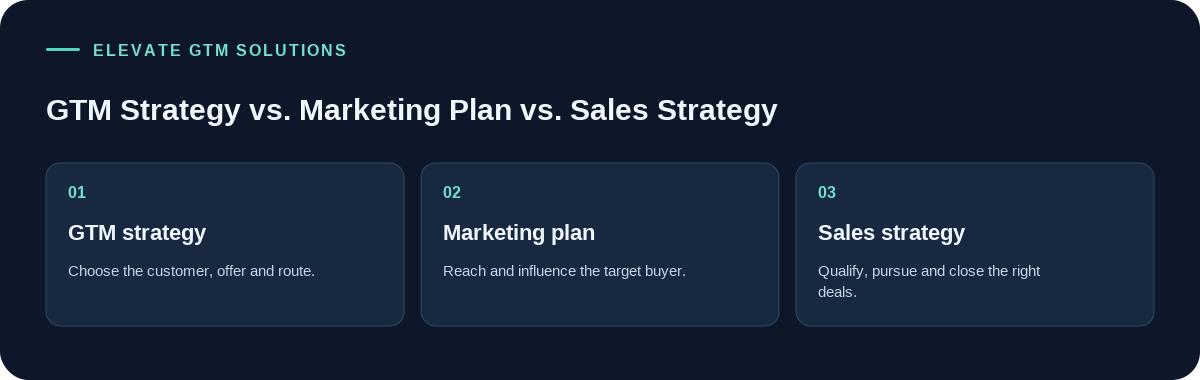
GTM strategy, marketing plans and sales strategies answer different questions. The GTM strategy identifies the buyers, offer, route to market and evidence that will justify more investment. The marketing plan specifies how the business will create demand for that offer. The sales strategy defines how sellers will qualify and close the right accounts. Review the three plans together before allocating budget. If each names a different buyer, the company still owes the teams a commercial decision.
For the definition and core components, see What Is a GTM Strategy?. This guide focuses on resolving ownership and conflicts across the three plans.
What the three plans decide
The decisions each plan owns
| Plan | Decisions it owns | What it needs from the other plans | What a good output looks like |
|---|---|---|---|
| GTM strategy | Priority segment, buying problem, offer, route to market, investment and evidence to continue | Customer evidence, sales constraints, delivery capacity and financial assumptions | A set of commercial choices and an accountable owner |
| Marketing plan | Audience access, message distribution, campaigns, channel spend and nurture | The commercial audience, offer, positioning, proof and capacity to follow up | A campaign and budget plan tied to buying progress |
| Sales strategy | Account coverage, qualification, buying-group access, opportunity progression and negotiation | The buying problem, approved commercial terms, delivery promises and available proof | A coverage and pursuit model with deal-level evidence requirements |
A practical test is to ask who else would have to change course if the choice were reversed. Changing a subject line may affect an email experiment. Changing the primary buyer can affect the product demo, reference requests, pricing justification, field training and who qualifies for the forecast. The second decision belongs in the GTM strategy. The distinction follows the consequence, not the department that first spotted the problem.
Enterprise teams also need to separate the choice of a sales motion from the design of the sales strategy inside that motion. Choosing direct enterprise sales for the first release is a GTM decision when it determines how the company allocates capital and delivers the offer. Assigning account executives, identifying executive sponsors and defining which deal evidence merits forecast inclusion are sales decisions within that choice.
One launch, three plans
Consider a hypothetical enterprise software vendor introducing an audit evidence product. Its current customers use a workflow platform sold by direct account teams. Leadership has capacity for a limited launch and wants to learn whether customers will pay for the new product as a separate line item.
The GTM strategy starts with existing customers in regulated industries that have an audit within nine months, an identified compliance owner and sufficient access to the systems that hold evidence. The initial offer is a paid, scoped pilot. The enterprise commits implementation capacity for a limited number of customers. The team agrees that expansion requires evidence that pilots can be delivered within the expected scope and that a buyer will fund a rollout after seeing the results.
The marketing plan translates the choice into outreach. It starts with the current customer account list and works with account teams to identify relevant compliance leaders. The first campaign uses a sample audit evidence map and a small peer session. Success is tracked through accounts that agree to a workflow review and can describe their current evidence collection problem. Registrations from people who never influence that decision are useful for learning about reach, but provide little evidence that the initial offer is working.
The sales strategy assigns the first set of accounts to teams with the right customer relationships. It asks reps to confirm the audit timeline, current evidence process, access constraints and who can approve a paid pilot. It gives reps a reason to bring a solutions specialist into a deal early. A verbal expression of interest can justify discovery. An opportunity reaches the forecast only when the team has a defined evaluation scope, a credible buyer and a path to a purchasing decision.
Those plans now reinforce each other. The marketing team can still choose which accounts to invite first. Sales can still adapt discovery to the customer. Both teams know which findings could reopen a strategic decision and where those findings go.
Two situations where the boundary shifts
In a product-led motion, product may own much of the route from first use to conversion. Marketing’s plan might focus on attracting the intended users and helping them get to a useful first experience. Sales may concentrate on larger accounts where users need procurement or security help. The GTM strategy still decides which customer and economic model the company is betting on, including when the account should receive assisted coverage. The roles change with the route to market.
In a partner-led motion, the company may rely on the partner for buyer access and early qualification. Marketing needs an agreed co-marketing plan and rules for sharing proof. Sales needs account ownership, deal registration and escalation rules. The GTM owner needs to decide whether the partner can deliver the promised outcome at the right economics and what happens if customer support crosses organizational boundaries. A channel choice changes who must coordinate. It does not remove the need for a shared plan.
For related planning models, Strategyzer explains how customer segments, value propositions and channels connect with the economics of a business. Salesforce’s sales planning guide covers sales-specific decisions such as territories and capacity. Strategyzer’s Business Model Canvas · Salesforce sales planning guide
Write the three plans
What belongs in the GTM strategy memo?
Take the business choice out of the launch deck and put it in a short memo. Begin with a sentence that can survive being read aloud. For the audit product, that sentence might be, “For the first release, we will offer paid audit evidence pilots to existing regulated enterprise customers with an audit in the next nine months, sold through their account teams and delivered with our two supported connectors.” It names a reachable segment, a trigger, an offer and a boundary. It also gives the team a way to identify a request that falls outside scope.
Follow it with the trade-offs that made the choice necessary. The company could have sold to net-new customers, for example, but the account relationship makes it easier to verify the workflow and understand which systems hold the evidence. That advantage comes with an important limitation. A pilot sold into the installed base does not tell leadership much about acquiring a new account from scratch. When the company later funds net-new acquisition, it should test that choice separately instead of copying the conversion rate from the installed-base pilot.
The memo needs an economic view. Describe what the buyer pays, what implementation costs the company, who supplies sales and support time, and where capacity comes from. Avoid pretending that every number is known. State which figures are measured, which are assumptions, and how the team plans to replace the assumptions. A priced pilot can reveal willingness to pay for a limited outcome. A signed annual contract is a stronger test of the full commercial offer. Keep those events separate in the forecast.
Finish with what leadership will decide at the next review. “Review pipeline” invites a status report. “Decide whether we can add a second cohort without exceeding the delivery capacity or changing the standard scope” tells the team what evidence to bring. The next review may authorize expansion, revise eligibility, adjust the offer, or stop. It should be clear which role owns that decision.
What belongs in the marketing plan?
The marketing plan begins with access. Can the team reliably identify the companies in the first segment, and does it know which people have a reason to act now? A target company list is helpful, but it does not identify an audit deadline or show who owns the work. The best source may be information already held by account teams. Build a way to combine that knowledge with a credible campaign without asking sellers to research every contact from scratch.
Decide which buying questions marketing can answer before a sales conversation. An audit lead might want to understand what counts as evidence, where the records live, and how the pilot changes preparation work. The economic buyer may ask whether the company can justify buying separate software when it already has a workflow platform. Those questions call for different assets. The audit evidence map earns a workflow conversation. An approved business-case example helps the champion explain the purchase internally. A single landing page can introduce both, but one message does not have to serve every moment.
Give each activity a clear follow-up. A peer session with strong attendance can create work the sales team has no capacity to handle. Before publishing the invite, agree on who reviews account fit, how interested participants book the next conversation, what happens to accounts outside scope, and who gets notified when a current customer responds. For an installed-base launch, bypassing the account owner can damage trust even if the outreach performs well.
Build a basic measurement plan into the campaign brief. Track reachable accounts, relevant people who engage, target accounts that accept a workflow conversation, and the outcome of that conversation. Include the source and time window. If awareness is part of the job, measure it separately. A campaign can do useful educational work without proving that the first paid offer is ready to expand.
An example of message and channel choices
Suppose marketing can choose between a broad paid campaign and a small invitation-only session. The broad campaign would generate more traffic and might surface new segments. The invitation-only session gives account teams more control over fit and follow-up. Choose the small session and give the participants a way to self-identify the audit trigger if the launch goal is to test a narrow paid pilot with limited delivery slots. A broader campaign makes more sense once leadership wants to test reach outside the account team and can support the resulting demand.
The first headline should reflect the customer’s problem and the evidence available. “See how to assemble an audit evidence map across approved systems” describes work the buyer can evaluate. A broad claim about reducing audit preparation by a specific percentage requires evidence the hypothetical company has yet to gather. Use that claim and keep the conditions visible if the product team can prove a narrower claim in a representative workflow. Marketing’s work is to make the promise intelligible and credible.
What belongs in the sales strategy?
Start with coverage. Decide which accounts go to which team, what specialist support is available, and how to handle requests from territories that lack trained sellers. In an installed-base launch, the existing account team may remain the relationship owner while a product specialist leads the technical discussion. Clarify who owns the opportunity, who sets the next step, and how to handle competing demands from a renewal or another product team.
Then specify what the seller needs to learn in discovery. A credible audit opportunity has a buying trigger, a defined workflow problem, a person who can lead an evaluation, and a route to approving paid work. It also needs a realistic technical path. An enthusiastic first call with a compliance analyst can justify a follow-up. It should not automatically become a forecast opportunity if nobody knows who can approve access or spend.
Create a simple evidence rubric for opportunity progression. At early discovery, a documented audit date and problem may be enough to continue. Before a proposal, confirm the economic buyer, implementation prerequisites, success criteria, and a decision date. Before including the deal in a committed forecast, ask whether the buyer has agreed to the next steps and what open condition could still stop the purchase. The exact definitions should match the company’s existing process. Introduce only the extra requirements the offer actually needs.
Agree on negotiation authority before the first exception. A buyer may ask to make the pilot free or to include a third connector at no charge. Those requests can change what the pilot is designed to learn and how much work the enterprise is committing. A seller should know which terms they can negotiate, what needs commercial approval, and how to explain an out-of-scope request without implying that engineering will deliver it.
Run the first 90 days
An illustrative 90-day calendar
| Window | Strategy owner | Marketing owner | Sales owner | Decision at the end |
|---|---|---|---|---|
| Days 1–15 | Confirm segment, offer and delivery boundary | Validate audience access and approve proof | Review account fit and technical prerequisites | Confirm the reachable first cohort |
| Days 16–35 | Review demand and capacity assumptions | Run first invitation and log account responses | Conduct discovery and document buyer objections | Decide whether to adjust targeting or invitation |
| Days 36–65 | Protect pilot scope and handle material exceptions | Produce proof that addresses recurring buyer questions | Scope paid pilots and confirm purchase paths | Decide whether pilots can start within capacity |
| Days 66–90 | Review commercial and delivery evidence | Document qualified response by account and trigger | Review conversion, open blockers and rollout readiness | Expand, revise the test or stop |
The windows are illustrative. A company with a long vendor review may finish the quarter with qualified evaluations and a handful of paid pilots, while annual contracts arrive later. The review should respect that delay. Shortening the reporting window does not shorten the customer’s buying process. The team can still learn whether the target accounts entered a real evaluation and what blocked their progress.
Account for dependencies in the calendar. If marketing needs a customer-approved proof point, schedule the approval before launch. If sales needs solutions engineering for discovery, reserve time before the first invitations go out. If support can onboard only four customers, give the commercial owner a way to prioritize or defer pilots. People should know which work is waiting on an approval and what will happen if the approval arrives late.
Where cross-functional decisions get stuck
If Finance pays but Compliance does the work, ask a rep to walk you through the last deal where the champion tried to get budget. Did Finance understand the cost of the existing process? Could Compliance show how the pilot would change it? The answer tells you whether to change the message, give the rep better proof, or rethink who the offer is designed for. Those are three different jobs.
The channel promises more than delivery can support. A reseller might want a broad launch because a large audience helps it justify enablement. The product team may know that only one connector can be deployed reliably. An enterprise can approve a narrow partner pilot with explicit technical requirements, or postpone the partner launch until coverage expands. Leaving both teams to “coordinate” preserves the disagreement and exposes prospects to different promises.
The sales plan absorbs an unpriced exception. Suppose a large account wants a custom audit integration before signing. A discount approval addresses price. The actual decision could consume engineering capacity, alter the standard offer or change the margin assumptions behind the launch. Route the exception to the people who own those trade-offs and record whether it is a one-off or the first signal of a product gap.
A decision-rights worksheet
| If the team wants to change… | Start with… | Escalate when… |
|---|---|---|
| Campaign format or creative | Marketing lead | The change requires a new offer, audience or material budget shift |
| Account assignment or discovery sequence | Sales lead | The new approach changes territory economics or partner obligations |
| Pilot eligibility or standard scope | GTM owner and delivery lead | It changes the offer, capacity plan or approved investment |
| Product promises or rollout geography | Product and commercial owners | Customers would receive a different commitment or commercial terms |
| The investment required to scale | GTM sponsor and Finance | The business case crosses the agreed downside or capacity boundary |
Use the worksheet for decisions that recur. Choose one recent example where two leaders believed the other had approved a change. Put the decision, consultation requirements and deadline in writing. Test the worksheet against the next disagreement and adjust it where the decision still lands in the wrong room.
How to resolve disagreements in one planning session
Send a one-page brief before the meeting. Put the customer, buying trigger, offer, route, coverage, delivery limit and review evidence in separate rows. Ask marketing, sales, product, delivery and finance to mark where they disagree with a choice or need more evidence. If a row is blank, clarify whether it was deliberately left to a function or whether the group never made the decision.
Use the meeting to settle the high-consequence differences. A disagreement about primary buyer is worth discussing if it affects reach, proof or the decision to buy. A debate over the wording of an invitation can move to the marketing team once the buyer and offer are fixed. Assign a time-boxed test and clarify the interim rule if the team lacks evidence. Treat silence as open, particularly where product, finance or delivery have authority to limit a promise.
Close by naming which working documents change. An approved eligibility change may require an update to the campaign list, discovery guide, CRM form and onboarding instructions. Assign an owner for each. Keep the old version available for context, but make the current rule easy to find. A rep working an opportunity that started under an earlier version needs to know which terms still apply.
The one-page reconciliation worksheet
| Question | GTM decision | Marketing implication | Sales implication |
|---|---|---|---|
| Who qualifies now? | Existing customers with a defined audit trigger and supported systems | Invite the agreed account list and ask about timing | Confirm trigger and technical prerequisites |
| What are we selling? | Paid, fixed-scope evidence pilot | Explain the output and show approved proof | Scope the pilot and agree success criteria |
| Who approves exceptions? | Commercial owner with delivery approval when scope changes | Route unexpected demand to the owner | Escalate through approved deal and delivery review |
| What would justify expansion? | Delivery within scope and evidence of paid rollout demand | Validate whether the audience and proof transfer | Review opportunity and conversion evidence by cohort |
Use the worksheet before drafting a long plan or when existing plans have diverged. If a team cannot explain how its work connects to a row, ask whether the task is an approved experiment, a dependency, or work that no longer belongs in the launch. A campaign or sales initiative can serve a legitimate goal outside this launch. Giving it a separate goal is better than stretching the launch plan to justify it.
Read results across the funnel
Read the same funnel without forcing the same KPI
Imagine the hypothetical team starts with 60 named accounts. Forty meet the initial criteria using the evidence available. Twenty-four have a reachable contact. Twelve accept a workflow conversation. Six confirm both a real audit trigger and the prerequisites. Four proceed to a paid pilot. Two of those pilots finish in the first review period, and one converts to an annual contract. These are sample counts for illustrating decisions, with no claim about typical conversion.
Marketing can reasonably report that twelve relevant accounts accepted a conversation. Sales can explain that six qualified for the offer and four agreed to buy a pilot. The strategy owner can see that only two pilots finished in the review window and that one converted. None of these counts replaces the others. Together they reveal where information was lost and where the team should look next.
Ask a different question at each transition. The gap between 40 eligible accounts and 24 reachable contacts may be a coverage problem. The gap between twelve conversations and six confirmed opportunities may reflect incomplete initial data or eligibility rules that were too broad. The gap between six opportunities and four pilots may come from timing, pricing or a decision against the offer. The gap between four starts and two completions could simply reflect pilot duration. A common funnel lets the company investigate the right stage instead of treating every gap as a demand problem.
Keep the records suitable for review. Agree on a cohort start date, how to handle multiple contacts at one account, and whether an opportunity can re-enter after a change in fit. Count the economic entity that matters. A large customer might have several business units with different audit schedules but a single contracting path. A clean denominator can make an apparent conversion change disappear, which is a better outcome than rebuilding a campaign around a reporting artifact.
Decide what can be inferred
One conversion from two completed pilots is a reason to examine what happened. It gives weak evidence for setting next year’s conversion forecast. Look at the original intent, the scope delivered, whether the buyer actually paid, and what differed between the two cases. The pattern can inform a targeting hypothesis for the next cohort if the account that converted had a deadline and an existing sponsor while the other had neither. It cannot establish a general rule without further evidence.
Assess the costs alongside the outcomes. Four pilots might keep the specialist team fully occupied. If the cases that move to annual contracts require the most custom work, expansion could make the business less profitable even if revenue grows. Measure delivery effort by account, distinguish approved scope from exceptions and make the trade-off visible at the same review where leaders discuss conversion.
Four signs that a problem belongs back in strategy
The company keeps finding attractive buyers it cannot serve. If otherwise suitable prospects repeatedly need a different integration or delivery model, the GTM owner should decide whether to narrow the segment, change the offer or fund the missing capability. Rewriting the message may make the promise clearer. It cannot make an unsupported deployment viable.
The buyer sees a use case but cannot find a budget. Marketing and sales can test different ways to explain the value. Repeated agreement about the problem with little willingness to fund the product may require a change to the commercial model, buyer or packaging. Check whether the issue affects one territory or the whole target group before redesigning the offer.
The route to market stops giving the company access. Account teams may have strong relationships with IT while the governance budget sits with risk or finance. A specialist partner may have better access but demand different terms. The change extends beyond sales tactics if the company needs to alter its coverage model or give a partner a role in implementation.
The economics change when the program works. A pilot may look attractive because specialists absorb effort without charging it to the launch. At scale the business may need a new team or a narrower product promise. Bring the real effort to the investment review. A successful pilot can be the moment the business discovers the offer must change before it can grow.
What to do when the first results disagree
A launch can meet its marketing targets and miss its sales goals for several reasons. A prospect may respond to a timely topic without having an approved project. An approved project may stall because procurement sees the pilot as a new vendor purchase. Sellers may spend their time on a different product because it carries an established quota and the pilot does not. Each explanation implies a different fix. Start with the most recent accounts that met the audience criteria and follow them through the actual buying steps.
Suppose twelve accounts booked the workflow review. On inspection, three had an audit in the approved window, five wanted help with a future audit and four could not use the supported connectors. Marketing delivered access to an audience with interest. The strategy did not yet have reliable information about account eligibility. Narrowing invitations to named accounts with verified prerequisites would improve the next test. Changing the positioning based on this cohort would mix the effect of audience quality with the effect of the message.
Now suppose ten of the twelve had a confirmed trigger and prerequisites, six scoped a pilot, and none received budget approval. The team should examine the reason for the budget decision, the timing and which alternatives buyers considered. Sales can test whether a clearer business case or earlier sponsor access changes the result. If buyers repeatedly choose an internal workaround despite seeing a credible offer, leadership may need to revisit the value or commercial model. The distinction becomes clearer when the working hypothesis and the next test are written down.
Review the third possibility. Buyers approve a paid pilot, but the enterprise cannot start on the date promised. Marketing may need to pause outreach and sales may need to revise customer commitments. The strategic question is how much to invest in the delivery bottleneck and whether the launch remains attractive at that cost. Treating the delay as a conversion issue would assign the problem to people who cannot fix it.
A short decision note for each correction
A useful correction note has six fields: the observed change, the cohort or accounts affected, the most likely explanation, the alternative explanation that still fits, the smallest test or change, and the decision owner. The owner should receive a review date and a rule for updating the related plans. When the action is small, the note can be a few lines. The purpose is to preserve enough context that a new leader can understand why the company changed course.
Keep active customer commitments visible during the correction. A company might change the standard offer while honouring earlier terms for two accounts. Sales, marketing and delivery need to know which version applies to each. The discipline that matters is straightforward. One shared commercial choice can produce three different working plans, and one approved revision should reach all three.
What buying-group research adds to the three plans
Forrester’s public summary of its 2026 State of Business Buying research describes a typical business purchase involving 13 internal stakeholders and nine external influencers. It also highlights the role of procurement and trials in validating purchases. Those figures describe research participants across buying situations. They cannot establish how many people will be involved in a particular opportunity.
A leader can use the research to check for a gap between the three plans. The GTM strategy can specify which buyers and offers justify a trial. The marketing plan can equip a champion with evidence they can share. The sales strategy can help the seller verify who will review the trial and what will count as success. An account team can prepare for these different decisions without treating a survey figure as a checklist.
Frequently asked questions
Can the marketing team own GTM strategy?
Yes, if its leader has a clear mandate to make cross-functional commercial choices and an agreed route to approval for investment, product scope and commercial risk. Product marketing often leads the synthesis because it works across market evidence, offer and messaging. The business still needs an accountable sponsor who can settle trade-offs when functions disagree.
Is a GTM plan the same as a GTM strategy?
Teams use the terms differently. A useful distinction is that the strategy contains the decisions and the reasoning behind them, while the GTM plan turns them into milestones, work and owners. One document can hold both. The strategy work is still open if the plan lists tasks but leaves the target buyer or offer ambiguous.
Who owns positioning?
Product marketing often leads positioning development, with evidence from product, sales, customers and the competitive landscape. Approval depends on the impact. Editing a message is usually a functional decision. Changing what the enterprise promises or which segment it is built to serve calls for approval from the commercial and product owners.
How often should the plans change?
Set a review cadence around how quickly relevant evidence can accumulate. A campaign test might warrant weekly decisions, while a long enterprise sales cycle may need a longer cohort window. Agree in advance which events require an immediate review, such as a withdrawn delivery capability or a meaningful change in customer eligibility.
What should we do when the three plans already exist?
Compare them on one page before asking for rewrites. Put the segment, buyer, problem, offer, channel, owner and success evidence side by side. Resolve the largest contradictions first. A shared definition of the first eligible customer may repair more downstream work than a broad planning reset.
Related reading
Read the broader GTM strategy guide and the GTM operating model guide for the underlying planning and governance.
Where Elevate fits when the plans disagree
Put the competing assumptions in front of the people who own the decision if the disagreement is about the target customer or offer. Elevate’s Unified GTM Strategy can help organize that work across segmentation, positioning, pricing and channels. For the audit product, I’d start with one segment and one paid offer, then use the output to check whether the campaign brief and sales qualification rules still describe the same launch. The commercial sponsor makes the call. Explore Elevate’s GTM Strategy workflow