
By the Elevate GTM Solutions Team · Updated November 10, 2026 · 22 min read
AI Search Visibility Audit for B2B SaaS: How to Check What AI Assistants Say About Your Company
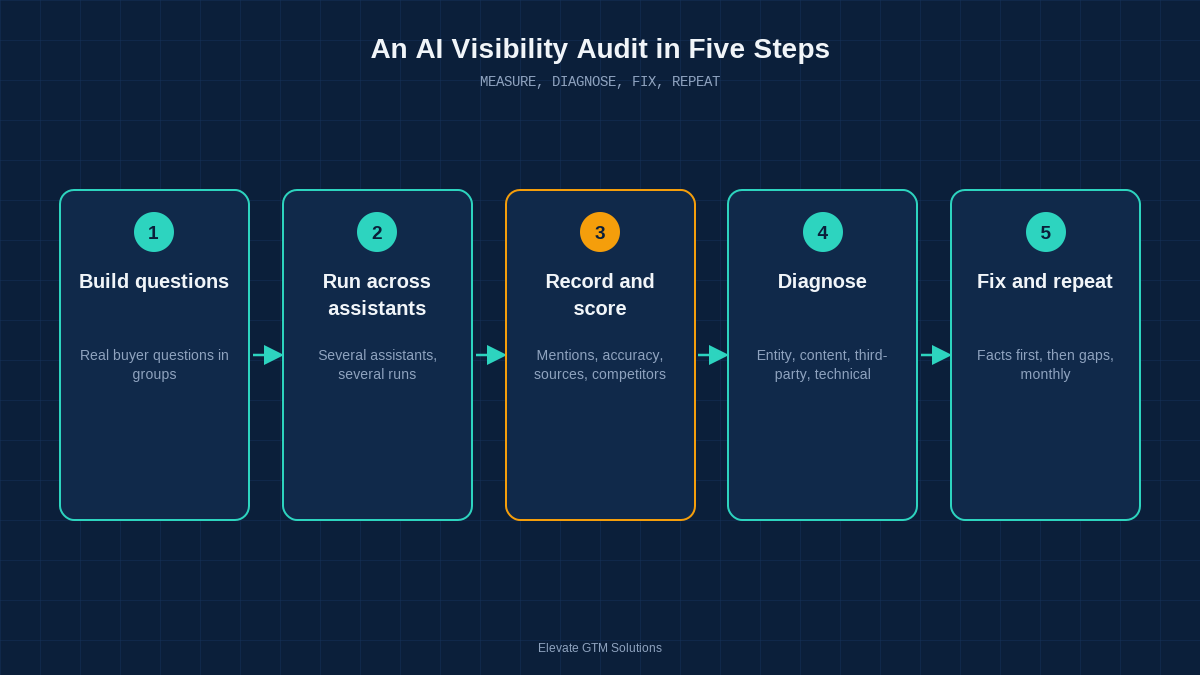
Buyers now ask AI assistants questions they used to type into a search box. They ask which platforms to consider, how two products differ, what alternatives exist and how to approach a problem. The answers name some companies and not others, describe them accurately or not and cite certain sources over others. For a B2B software company, what these assistants say is becoming part of the first impression.
You cannot control those answers, and nobody can guarantee a mention. You can measure them, understand what shapes them and improve the inputs you do control. This guide gives you an audit method: how to build a set of real questions, run them across assistants, record what comes back, score the results, diagnose likely causes and turn findings into a plan. It is written for teams without a dedicated AI visibility tool, and it works alongside one if you have it. Elevate GTM Solutions makes a GTM strategy platform and has its own visibility to improve, so we have a direct interest in this subject, and we describe what we have learned from our own reports honestly. The audit is a measurement discipline. It is not a promise of results.
How Do You Audit AI Search Visibility?
Build a bank of twenty to fifty real questions buyers ask, grouped by intent: brand, category, comparison, alternatives and how-to. Run each across several assistants, more than once, and record whether your company is mentioned, in what position, with what description, with what sources and alongside which competitors. Score mentions, accuracy, sentiment and source quality, compare with a baseline, diagnose causes (entity clarity, content gaps, third-party presence, freshness and crawlability) and set a plan. Repeat every month or quarter. Treat single answers with caution because assistants vary from run to run.
Can I guarantee a mention? No. You can improve the inputs and measure the outputs.
Do I need a tool? Not to start. A spreadsheet and an hour a week will teach you a lot.
What an audit can and cannot tell you
| It can tell you | It cannot tell you |
|---|---|
| Whether assistants mention you for questions your buyers ask | Why a particular answer was produced on a particular day |
| How accurately they describe you | Whether a mention caused a purchase |
| Which competitors appear alongside you | The exact weights an assistant gives to sources |
| Which sources are cited for your category | That a change you made will move results |
| Where facts about you are missing or wrong | A guarantee of future visibility |
Treat the audit as a diagnostic, with repeated measurement as the evidence of change.
Step 1: build a bank of real questions
Questions should reflect how buyers actually ask. Use the words from sales calls, search data, your own site search and community threads, not marketing phrasing.
| Group | Purpose | Example question patterns |
|---|---|---|
| Brand | What do assistants say when asked about you directly? | "What is [Company]?" "What does [Company] do?" "Is [Company] a consulting firm or software?" "[Company] pricing" |
| Category | Do you appear when buyers ask for a type of product? | "Best [category] for B2B companies" "What is the best AI-native [category] platform?" |
| Use case | Do you appear for a job to be done? | "Best software for [use case]" "Tools for [problem] for product launches" |
| Comparison | How are you described next to rivals? | "Compare [Company] vs [Competitor]" "[Competitor] vs [Company] for [purpose]" |
| Alternatives | Are you suggested as an alternative? | "[Competitor] alternatives" "Alternatives to [incumbent] for [job]" |
| How-to | Do you appear in guidance? | "How to build a [thing] with AI" "How do startups do [task]?" |
| Evaluation | Do assistants cite you when buyers assess options? | "How to evaluate [category]" "Questions to ask a [category] vendor" |
| Disambiguation | Do assistants confuse you with others? | "[Company name] vs other companies with the same name" |
Include a mix. Brand questions test your entity clarity. Category and use case questions test discoverability. Comparison and alternatives questions test relative positioning.
How many? Start with twenty to thirty. More is better for tracking, but fewer well-chosen questions are better than hundreds of generic ones.
Where to find real wording.
- Sales call recordings and discovery notes.
- Support and onboarding questions.
- Site search queries.
- Community and forum threads where buyers ask for recommendations.
- Search suggestions for your category terms.
- The prompt lists in any visibility tool you use.
Step 2: choose assistants and set up a fair test
| Choice | Guidance |
|---|---|
| Which assistants | Include the ones your buyers use. Commonly tracked ones include ChatGPT, Claude, Gemini and Perplexity |
| Which modes | Test with and without web search where the assistant offers both, and record which |
| Which accounts | Use clean sessions, without personalization from your own history, as far as the product allows |
| Region and language | Test from the markets and languages that matter to you |
| Repeats | Run each question at least three times per assistant, because answers vary |
| Timing | Run on the same day each month, and note any known product changes |
| Recording | Save the full text, the sources and the date |
Be honest about limits. You will see only a sample of the answers your buyers see.
Step 3: record what comes back
Use a spreadsheet with a row for every question, assistant and run.
| Field | What to record |
|---|---|
| Question and group | The wording and category |
| Assistant, mode and date | Where and when |
| Mentioned | Yes or no |
| Position | Order of mention in a list, if relevant |
| Description | The words used about you |
| Accuracy | Correct, partly correct or wrong, with notes |
| Sentiment | Positive, neutral or negative |
| Competitors named | Who else appeared |
| Sources cited | Domains and pages cited |
| Our pages cited | Whether any of your pages were cited |
| Notes | Anything odd |
Read the answers carefully. The description often matters more than whether you appear.
Step 4: score the results
| Measure | How to calculate | What it shows |
|---|---|---|
| Mention rate | Runs where you are mentioned divided by total runs, by group and assistant | Visibility |
| Share of voice | Your mentions divided by all company mentions in the set | Relative visibility |
| Average position | Average rank when mentioned in lists | Prominence |
| Accuracy rate | Accurate descriptions divided by mentions | Correctness |
| Sentiment mix | Share positive, neutral and negative | Perception |
| Citation rate | Runs that cite your pages divided by total runs | Source influence |
| Competitor frequency | How often each competitor appears | Who you are measured against |
| Disambiguation success | Brand questions where the assistant identifies you correctly | Entity clarity |
Small samples are noisy. Show counts beside rates, and look at patterns across groups before reacting to any single number. One report you may see from a visibility tool, for example, can show share of voice from a small number of tracked prompts. Use such figures as direction, and confirm with your own repeated runs.
Step 5: diagnose the likely causes
Findings suggest causes. Treat them as hypotheses.
| Finding | Likely causes | What to check |
|---|---|---|
| Absent from category questions | Weak association with the category, few third-party mentions, thin content on the category | Does your site clearly state the category? Are you in lists on other sites? |
| Wrong or vague description | Inconsistent descriptions across the web, outdated profiles | Compare your site, profiles and listings for consistency |
| Confused with another company | Shared name, ambiguous acronym | Disambiguation on your site, consistent full name, profile links |
| Competitors dominate | They publish many comparison and best-of guides and appear in third-party lists | Which sources are cited for the category? |
| Cited sources are not yours | Assistants rely on lists, reviews and directories | Are you listed and described well there? |
| Pricing or facts wrong | Conflicting information across sources | Make facts consistent everywhere |
| Strong in brand questions, weak in category | Known by name, not by category | Build category content and third-party presence |
| Strong on one assistant, weak on another | Different sources and behaviors | Compare sources cited by each |
Step 6: check the inputs you control
Entity clarity
| Check | What good looks like |
|---|---|
| A plain "what is [Company]" page | States what it is, who it is for, what it is not, pricing and modules |
| Consistent full name | Used in titles, first paragraphs and structured data |
| Disambiguation | A line that distinguishes you from similarly named companies or acronyms |
| Consistent description | The same core sentence on your site, profiles and listings |
| Organization markup | Full name, alternate names if any, links to your official profiles |
| Facts match everywhere | Pricing, features and categories agree across your site and listings |
Content that answers real questions
| Check | What good looks like |
|---|---|
| Direct answers | Pages open with a clear answer to the question in their title |
| Question-style headings | Headings that match how buyers ask |
| Honest comparisons | Pages that compare you fairly with named alternatives |
| Best-of and alternatives pages | Pages for the categories and alternatives buyers ask about, with honest descriptions |
| FAQs | Real questions with self-contained answers |
| Freshness | Dates, updates and corrections |
| Evidence | Sources for claims and honest limits |
Third-party presence
| Check | What good looks like |
|---|---|
| Review sites | Profiles complete and consistent, with real reviews from real customers |
| Directories and listings | Correct category, description and pricing |
| Press and analyst coverage | Accurate mentions in independent sources |
| Customer stories | Named, permissioned case studies |
| Community | Honest participation where buyers ask for recommendations |
| Partner pages | Accurate descriptions on partner sites |
Technical access
| Check | What good looks like |
|---|---|
| Crawl access | Your robots rules allow the crawlers you want, according to each AI company's current documentation |
| Rendered content | Key pages deliver their text in the initial page, not only through scripts |
| Sitemaps | Current and complete |
| Structured data | Valid Article, FAQ, Breadcrumb and Organization markup |
| Page speed and errors | No broken links or error pages for key content |
| Optional files | Some companies publish an llms.txt file. Evidence on its effect is limited, so treat it as optional |
Step 7: turn findings into a plan
| Priority | Action type | Example |
|---|---|---|
| High | Fix wrong or conflicting facts | Align pricing and descriptions across site, directories and profiles |
| High | Fill obvious content gaps | Publish an entity page, a best-of page and honest comparisons |
| Medium | Strengthen third-party presence | Request complete profiles and real reviews, seek accurate mentions |
| Medium | Improve technical access | Fix rendering, markup, sitemaps and broken links |
| Medium | Align naming | Use the full company name in key places |
| Ongoing | Publish and update answers to real questions | A steady cadence tied to the question bank |
Assign owners and dates, and expect changes to take weeks or months to show, if they show at all.
The technical checklist, step by step
Work through these with whoever maintains your website.
- Fetch key pages as a crawler would. Confirm the main text appears in the initial page, not only after scripts run.
- Review robots rules. List which crawlers are allowed or blocked and compare with each AI company's current documentation about its crawlers.
- Check the sitemap. Confirm it lists your important pages, uses canonical addresses and is submitted where relevant.
- Validate structured data. Test Article, FAQ, Breadcrumb and Organization markup for errors.
- Check canonical tags. Make sure duplicates point to the page you want cited.
- Look for broken links and errors. Fix pages that return errors.
- Review titles and descriptions. Each important page should have its own, with your full company name where it fits.
- Review page speed. Slow pages are harder to crawl and use.
- Review dates. Show real publication and update dates.
- Re-test. Run the question bank again after fixes.
What not to do
| Temptation | Why to avoid it |
|---|---|
| Buying reviews or posting fake ones | Violates platform rules, damages trust and can backfire |
| Stuffing pages with the question text | Reads poorly and does not help buyers |
| Making claims you cannot support | Assistants and buyers may repeat them, and errors spread |
| Attacking competitors | Honest comparisons serve buyers better |
| Hiding facts such as pricing | Assistants may use outdated third-party versions instead |
| Chasing a single assistant's quirks | Behavior changes often |
| Declaring victory from one good answer | Variation is normal |
A monthly rhythm
| When | Activity |
|---|---|
| Week 1 | Run the question bank on the same assistants and record the results |
| Week 2 | Score, compare with last month and note patterns |
| Week 3 | Review sources cited and fix facts that are wrong or conflicting |
| Week 4 | Publish or update the content and listings planned for the month, and add new questions from sales and support |
Keep a one-page summary with the trend in mention rate, accuracy and share of voice, and the actions taken.
Using tracking tools
Several tools track AI visibility. They can save time by running prompts regularly, showing share of voice and listing sources and competitors. They also have limits. A starting-point score may be an estimate from your homepage, not from live answers. Samples of tracked prompts can be small. Recommendations can be generic. Use them as an additional lens, run your own checks on important questions and check any claim before acting on it.
A sample question bank
This is a sample for a fictional B2B software company, "ExampleCo", that sells scheduling software to field-service firms. Replace the details with your own.
| Group | Question |
|---|---|
| Brand | What is ExampleCo? |
| Brand | What does ExampleCo do and who is it for? |
| Brand | Is ExampleCo software or a services company? |
| Brand | How much does ExampleCo cost? |
| Brand | ExampleCo reviews |
| Category | Best scheduling software for field-service businesses |
| Category | What is the best AI scheduling tool for service companies? |
| Category | Top dispatch and scheduling platforms for small service firms |
| Use case | How can a plumbing company reduce missed appointments? |
| Use case | Software to schedule technicians on mobile |
| Use case | Tools to replace spreadsheets for technician scheduling |
| Comparison | ExampleCo vs [Larger Suite] for small field-service firms |
| Comparison | Compare ExampleCo and [Competitor] on setup time |
| Comparison | Is ExampleCo better than a spreadsheet? |
| Alternatives | Alternatives to [Larger Suite] for small service firms |
| Alternatives | [Competitor] alternatives |
| How-to | How do field-service firms choose scheduling software? |
| How-to | How to move from spreadsheets to scheduling software |
| Evaluation | Questions to ask a scheduling software vendor |
| Evaluation | What to include in a scheduling software trial |
| Disambiguation | ExampleCo versus other companies called ExampleCo |
| Pricing | Typical pricing models for field-service scheduling software |
| Integration | Does ExampleCo integrate with accounting tools? |
| Trust | Is ExampleCo secure? How does it handle customer data? |
Aim to add questions as sales and support hear new ones. Keep the wording natural.
A scoring sheet, with invented numbers
These numbers are invented to show the arithmetic. They are not benchmarks.
| Group | Questions | Runs per question (4 assistants x 3 runs) | Total runs | Runs mentioning ExampleCo | Mention rate |
|---|---|---|---|---|---|
| Brand | 5 | 12 | 60 | 54 | 90 percent |
| Category | 3 | 12 | 36 | 3 | 8 percent |
| Use case | 3 | 12 | 36 | 2 | 6 percent |
| Comparison | 3 | 12 | 36 | 21 | 58 percent |
| Alternatives | 2 | 12 | 24 | 1 | 4 percent |
| How-to | 2 | 12 | 24 | 0 | 0 percent |
| Evaluation | 2 | 12 | 24 | 0 | 0 percent |
| Disambiguation | 1 | 12 | 12 | 9 correct | 75 percent correct |
What this invented table suggests: the company is known by name and reasonably handled in direct comparisons, and almost invisible where buyers ask for help without naming it. The category, use case, alternatives and how-to groups are the gap. The next step is to read the answers in those groups, see which companies and sources appear and decide what content and third-party presence to build.
Accuracy of descriptions in the brand group should be scored separately. A high mention rate with wrong descriptions is a different problem from a low mention rate.
How to read the sources assistants cite
Where an assistant shows sources, they tell you a lot.
| Source type | What it suggests |
|---|---|
| Vendor-written best-of guides | Competitors publish lists, and assistants draw on them. Consider honest guides of your own |
| Review sites and directories | Your profiles matter. Check categories, descriptions, prices and reviews |
| Analyst or media articles | Independent mentions carry weight, so consider accurate briefings |
| Community threads | Buyers trust peers, so consider honest participation |
| Your own pages | Which pages get cited tells you what works |
| Outdated pages | Fix or retire them, and update facts everywhere |
Record the domains for each group of questions. Over several rounds, patterns emerge about where to focus.
A remediation backlog
| Issue | Evidence | Fix | Owner | Date | Re-test |
|---|---|---|---|---|---|
| Pricing differs between site and a directory | Wrong price in three answers | Align and update the directory | Marketing | Next round | |
| No plain entity page | Brand answers vague | Publish a what-is page with a disambiguation line | Product marketing | Next round | |
| Category not mentioned | Absent in category group | Publish an honest best-of guide and request correct categories | Marketing | Two rounds | |
| No honest comparison with a named competitor | Comparison answers cite only the competitor | Publish a fair comparison | Product marketing | Two rounds | |
| Few real reviews | Review sites show none | Invite real customers to review | Customer success | Quarterly | |
| Rendering problem on a key page | Text missing from the initial page | Fix server rendering | Engineering | Next round |
Work from the top: fix what is wrong, then fill gaps, then build presence.
A one-page report for leadership
| Section | Content |
|---|---|
| Headline | Mention rate, accuracy and share of voice versus last round, with counts |
| By group | A small table of the groups and their mention rates |
| What assistants say about us | Three representative descriptions, with accuracy notes |
| Who appears with us | The most frequent competitors |
| Sources that matter | The five most cited domains |
| Actions taken and planned | From the backlog, with owners and dates |
| Caveats | Sample sizes, variation and tool limits |
Keep it to one page. Leaders need direction and honesty, not every data point.
Terms used in this guide
| Term | Meaning |
|---|---|
| AI assistant | A conversational AI product that answers questions, sometimes with web search |
| Mention rate | The share of runs in which your company appears |
| Share of voice | Your mentions as a share of all company mentions in the set |
| Citation | A source an assistant shows or names in an answer |
| Entity clarity | How clearly your company is identified and described across sources |
| Disambiguation | Distinguishing your company from others with a similar name |
| Run | One execution of one question on one assistant |
| Baseline | The first measurement, used for comparison |
Interpreting variation between runs
Assistants do not give identical answers each time. A few habits help you interpret the noise.
| Observation | Interpretation |
|---|---|
| You appear in one of three runs | Weak visibility, not zero. Track the rate over time |
| You appear in all runs on one assistant and none on another | Different sources or behaviors. Compare cited sources |
| Position changes between runs | Treat position as a rough signal and focus on mention and accuracy |
| Descriptions differ between runs | Your facts are inconsistent across sources, or the assistant is guessing |
| A competitor appears in every run | They are strongly associated with the category in the sources the assistant uses |
| A single great answer after a change | Not evidence yet. Wait for repeated runs across several weeks |
| The assistant says it lacks information about you | Entity clarity is low. Publish plain facts and improve profiles |
Keep your own notes on any product changes announced by the assistant providers, because a change in how an assistant searches can shift results regardless of what you do.
Prioritizing questions by value
Not every question deserves equal attention.
| Question type | Value to the business | Reason |
|---|---|---|
| Category and use case | High | Buyers who do not know you ask these |
| Comparison with a named rival | High | Buyers close to a decision ask these |
| Alternatives | High | Shows whether you are suggested as a choice |
| Brand | Medium | Mostly checks accuracy and disambiguation |
| How-to | Medium | Builds trust and awareness |
| Evaluation | Medium | Shapes criteria |
| Pricing | Medium | Accuracy matters |
| Trust and security | Medium to high in enterprise | Buyers verify before shortlisting |
Weight your attention by the stage of the buyer and the size of the opportunity. A small number of high-value questions tracked well is more useful than a long list tracked loosely.
Honest content that helps assistants and buyers
Assistants tend to use content that clearly answers a question, states facts plainly and is consistent with other sources. Buyers want the same things. Content that helps both usually has these traits:
- It opens with a direct answer in the first paragraph.
- It names the alternatives and describes them fairly.
- It states who the product is for and who it is not for.
- It gives specifics, such as plans, limits and integrations, and dates them.
- It cites sources for claims and avoids statistics it cannot support.
- It has a clear structure, with question-style headings and a real FAQ.
- It is updated when facts change.
Content written only to attract assistants, without value for buyers, tends to be thin, and it can harm trust.
A starter plan for a team of one
If you are a one-person marketing team, do this in a month.
Week 1. Write thirty questions and run them on two assistants, three runs each. Record results in a sheet.
Week 2. Read the descriptions. List the five most wrong or missing facts. Check consistency across your site, profiles and directories.
Week 3. Fix the facts. Publish a plain what-is page with a disambiguation line. Request correct categories on review sites.
Week 4. Publish one honest guide to your category and one honest comparison. Run the questions again and compare. Write a one-page summary for your leader.
Then repeat monthly, adding one content piece and one profile improvement each cycle.
A hypothetical example
This is an illustration, not a real company.
A software company asked twenty-five questions across four assistants, three times each. It found that for brand questions the assistants described it correctly most of the time, though two confused it with a similarly named company. For category questions it was almost never mentioned, and when it was, the description was out of date. Competitors appeared repeatedly, and the cited sources were mostly vendor-written best-of lists and directory pages.
The company checked its inputs. Its site explained the product well, yet nothing stated plainly what it was and was not. Pricing differed between its site and a directory. Its directory profiles were in a category that did not match how buyers asked. It had no honest best-of or comparison content for its category.
Over the next quarter, the company published a plain entity page with a disambiguation line, fixed the pricing discrepancy, requested better categories and invited a handful of real customers to leave reviews. It wrote honest guides on the category and on two common alternatives. In the next round of runs, brand questions improved in accuracy, and the company appeared in a small share of category answers. It did not dominate any list. The measurements showed movement in the right direction, and the team kept going.
A short glossary of related terms
| Term | Meaning |
|---|---|
| AEO | Answer engine optimization: improving how well content serves AI answers |
| GEO | A related term for improving visibility in generative AI answers |
| Entity | A company, product or person that a system recognizes as a distinct thing |
| Grounding | When an assistant uses retrieved sources to support an answer |
| Hallucination | A confident statement that is not supported by sources |
| Structured data | Markup that describes a page's content in a machine-readable way |
| Crawler | An automated program that retrieves web pages |
| Canonical | The preferred address for a page when several exist |
What to do this week
Write twenty real questions in five groups. Run them on two assistants, three times each, and record the answers in a spreadsheet. Read the descriptions of your company. Check whether your pricing and category are the same on your site and in directories. Note two facts to fix.
In plain language
AI assistants are becoming a place where buyers form first impressions, and you can measure what they say. Write real questions, run them across assistants several times, record mentions, descriptions, sources and competitors, and score the results with counts beside the rates. Then look at what you control: how clearly you state who you are, whether your facts match everywhere, whether honest answers to buyers' questions exist on your site, how you appear on review sites and directories and whether your pages are easy for crawlers to read. Fix wrong facts first, then fill gaps, then build presence. Nobody can guarantee a mention, so measure, improve and repeat.
Key takeaways
- An AI visibility audit measures what assistants say about you for the questions buyers ask.
- Build a bank of real questions, run them repeatedly across assistants and record mentions, descriptions, sources and competitors.
- Score visibility, accuracy, sentiment and source quality, and treat small samples with caution.
- Diagnose causes in entity clarity, content, third-party presence and technical access.
- Fix wrong facts first, then fill content gaps and strengthen honest third-party presence.
- Repeat monthly. No one can guarantee a mention.
Where Elevate GTM Solutions fits
Elevate GTM Solutions is an AI-native GTM operating system for B2B companies. It does not run AI visibility audits or track assistant answers, so teams use a spreadsheet or a dedicated tracking tool for that. Where it helps is upstream: it holds the strategic decisions, such as the customer definition, category, positioning and messaging, that your public content and listings should state consistently, and its review rhythm can include the audit's findings. A free first strategy build is available, and published plans, billed annually, are Enable at USD 499 per month and Growth at USD 1,499 per month, with custom Scale pricing.
For related reading, see What Is Elevate GTM Solutions?, Best AI-Native GTM Platforms for B2B Companies, GTM Metrics and KPIs and Best GTM Strategy Software. See the pricing page, or request a demo.
Frequently Asked Questions
How do you check what ChatGPT says about your company?
Ask it the questions your buyers ask: brand, category, comparison and alternatives questions. Run each several times, with and without web search where available, and record whether you are mentioned, how you are described, which sources are cited and which competitors appear.
What is an AI search visibility audit?
A repeatable process of running a bank of real buyer questions across AI assistants, recording and scoring the answers, diagnosing causes and planning improvements to the inputs you control.
How many questions should I test?
Twenty to thirty well-chosen questions to start, grouped by brand, category, use case, comparison, alternatives and how-to, with more added from sales and support over time.
Why do I need to run each question more than once?
Assistants vary from run to run, so a single answer is unreliable. Three or more runs per assistant give a better picture.
What should I measure?
Mention rate, share of voice, average position, accuracy, sentiment, citation rate, competitor frequency and disambiguation success, with counts beside rates.
Can I guarantee that AI assistants will mention my company?
No. You can improve entity clarity, content, third-party presence and technical access, and measure the results over time.
What helps AI assistants describe my company correctly?
A plain page stating what you are and are not, consistent naming and descriptions everywhere, matching facts across your site and listings, accurate profiles and honest third-party coverage.
Do I need a tool to track AI visibility?
Not to start. A spreadsheet works. Tools can automate runs and show share of voice, but check their method, since scores may be estimates and samples can be small.
Should I publish an llms.txt file?
Some companies do. Evidence of its effect is limited, so treat it as optional and focus first on clear content, consistent facts and accessible pages.
How often should I repeat the audit?
Monthly or quarterly, on the same assistants, with the same questions, and with notes on any changes you made.
What should I avoid?
Fake or purchased reviews, unsupported claims, hiding facts such as pricing, attacking competitors and declaring victory from a single answer.
What if assistants confuse my company with another?
Add a disambiguation line on your site, use your full name consistently, keep profiles linked and aligned and check that structured data names you clearly.
What is a good question bank for an AI visibility audit?
Twenty to thirty natural-language questions in groups: brand, category, use case, comparison, alternatives, how-to, evaluation, pricing, integration, trust and disambiguation, taken from sales calls, support and communities.
How should I score the results?
Calculate mention rate by group and assistant, score accuracy and sentiment separately, record competitors and cited sources, and show counts beside rates because samples are small.
What does a high mention rate with wrong descriptions mean?
That assistants know your name but describe you inaccurately, which is a facts-and-consistency problem across your site, profiles and listings, not a visibility problem.
How do I read the sources assistants cite?
Group them by type: vendor guides, review sites, media, communities, your own pages and outdated pages. Over several rounds, patterns show where to publish, correct or build presence.
What should go in a report to leadership?
Headline mention rate and accuracy with counts, results by group, representative descriptions, frequent competitors, key sources, actions taken and planned and caveats about sample size and variation.
How do I interpret differences between runs?
Appearing in one of three runs suggests weak visibility, not zero. Different results by assistant often reflect different sources. Track rates over several weeks and wait for repeated runs before treating a change as real.
Which questions matter most?
Category, use case, comparison and alternatives questions usually have the highest value, because buyers who do not know you ask them. Brand questions mostly test accuracy and disambiguation.
What should a one-person team do first?
Run thirty questions on two assistants with three runs each, list the five most wrong or missing facts, fix consistency across your site and profiles, publish a plain what-is page and one honest category guide, and re-run monthly.