
By the Elevate GTM Solutions Team · Updated November 10, 2026 · 22 min read
The Enterprise GTM Business Case for a CFO
A GTM investment case should let Finance trace the forecast back to decisions it can verify. Start with the spend you want approved, the seller and delivery capacity available, and the point at which the company can stop. Separate the expected customer outcome from the evidence you still need to collect.
Define the investment and build the model
Start with the investment decision
Ask for something Finance can approve today. “Reserve two specialist days a week and fund a paid pilot with six eligible accounts” gives the CFO a real choice. Put the alternative next to it. If those specialists would otherwise protect a renewal or unblock another launch, show what gets displaced. The market-size slide can wait until you’ve made that trade visible.
Estimate demand from the selling and delivery path. Begin with reachable eligible accounts, the share that can enter a qualified evaluation, the share that can convert within the decision horizon and the ability to onboard them. Market size can explain why the opportunity is worth exploring. The capacity-constrained model shows what the enterprise can plausibly do.
Build a simple commercial model
| Input | What to define | Where to check it |
|---|---|---|
| Eligible accounts | Accounts with the right profile, buying trigger and technical prerequisites | CRM segment review and field sampling |
| Qualified evaluations | Opportunities that satisfy the same criteria and enter within the period | Sales process and comparable cohorts |
| Paid customers | Expected closed customers in the modeled period | Historical conversion, decision timelines and pipeline evidence |
| Contract value | Value and timing of initial committed contracts | Approved price and expected discount |
| Delivery and support | Incremental work caused by each customer | Capacity estimates and cost rates |
| Incremental program spend | Dedicated sales, marketing, tooling and launch effort | Budget owners and vendor proposals |
| Timing | When bookings, revenue, cash and cost appear | Finance-approved accounting and billing assumptions |
Keep bookings, recognized revenue and cash distinct. A contract can be signed late in the year and recognized over the service term. It may be billed annually or on different terms. An investment memo should say which measure it uses and why. The example below uses first-year contract value and illustrative direct costs. A finance team should adapt it to its own recognition and cash rules.
Worked example. A paid expansion pilot
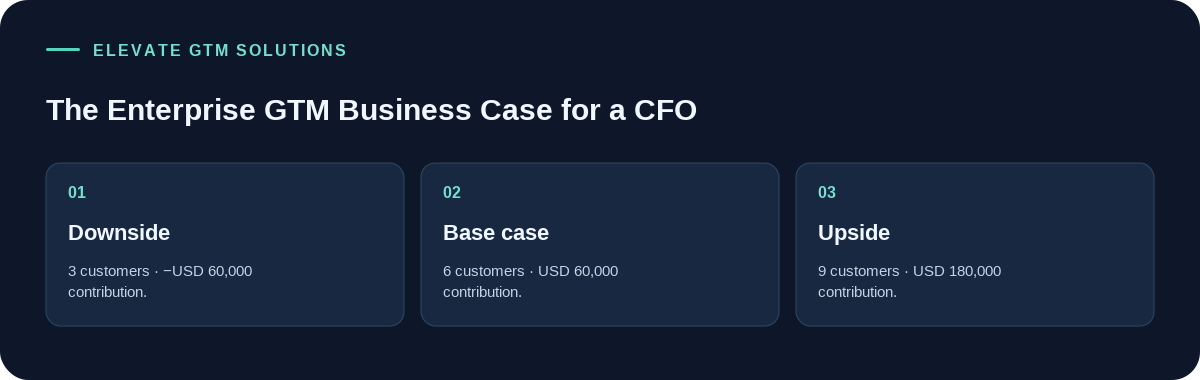
Suppose a SaaS vendor can qualify 24 accounts for a new product in the planning period. At a 25% conversion rate it expects six customers. Each first-year contract is USD 50,000. For comparison, assume USD 10,000 in incremental delivery and support cost per customer and USD 180,000 in program spend. These figures are hypothetical.
| Scenario | Customers | First-year contract value | Direct delivery and support | Program spend | Illustrative contribution after program spend |
|---|---|---|---|---|---|
| Downside | 3 | USD 150,000 | USD 30,000 | USD 180,000 | −USD 60,000 |
| Base | 6 | USD 300,000 | USD 60,000 | USD 180,000 | USD 60,000 |
| Upside | 9 | USD 450,000 | USD 90,000 | USD 180,000 | USD 180,000 |
At the assumed price and cost, each customer contributes USD 40,000 toward program spend. The model reaches break-even on this measure at five customers. That threshold moves if price, discount or cost changes. At USD 45,000 per contract and USD 15,000 direct cost, each customer contributes USD 30,000 and six customers are needed to break even. If bookings slip into the next period, the timing of value and spend changes even when the unit economics hold.
The table should invite questions. Can the company actually deliver nine customers? Would getting there require more spend? Do three customers represent weak demand, a slower cycle or a deliberately narrower pilot? Use the scenario model to make those questions explicit. An upside case that ignores capacity is a forecast of what the company cannot deliver.
Distinguish the investment case from the operating forecast
The investment case asks whether the business should commit money and capacity to an initiative. The forecast asks which outcomes the business expects in a particular period based on current evidence. Both use commercial assumptions. They serve different decisions and should be updated on different triggers. An attractive opportunity over two years can still produce little revenue in the first quarter. A strong first-quarter forecast can still rely on work the enterprise cannot sustain at scale.
In the first memo, identify the period in which leadership can realistically evaluate the proposal. A launch can show paid demand before it shows renewals. A market-entry project may show that the enterprise can reach the buyer and contract in the market before it has repeatable acquisition economics. Choose an evidence horizon that fits the decision. Show what the business can know earlier and which commitments are reversible if the proposal asks for a year of spending.
Maintain a view of commitments already made. That cost should remain visible when evaluating the program overall if the company signed a contract for research. The next investment decision still needs to focus on the choices available today. Ask what additional spending is required, what benefit it can create and what the enterprise could do with the same resources. A past commitment should inform the record without forcing the business to fund the next phase.
Build the model from a reachable market
A segment estimate becomes useful when the enterprise can connect it to accounts and an acquisition path. Begin with a set of accounts that could use the product. Apply practical exclusions such as unsupported requirements, geography, channel access or insufficient budget. Then estimate how many the team can reach and evaluate within the period. The difference between a large market and a feasible sales plan often appears in those exclusions.
Write down where the account count comes from. A database may count subsidiaries that share procurement or include companies using a product configuration the enterprise cannot serve. Review a sample with field and delivery teams. When the estimate changes materially after the review, update the model and note the reason. Avoid replacing one opaque number with another. The useful result is a count the company can revisit as its product and coverage change.
The next limit is commercial capacity. If each qualified evaluation requires four specialist hours and the team can provide only forty hours, the enterprise can support at most ten such evaluations in the period under that assumption. The actual number may be lower if specialist time is uneven or shared with active customers. Add the delivery limit separately. A company can have capacity to sell eight pilots and capacity to start only four. A credible forecast respects both constraints.
Treat conversion as a series of decisions. A customer can accept a meeting, qualify for a pilot, approve payment and convert after implementation. Applying a single rate to the entire account list can hide where evidence is weak. Use separate assumptions where they change the decision. Explain the time between stages. A quarter with new evaluations may create future bookings rather than near-term recognized revenue.
Example. What happens if reach is overstated?
Suppose the original plan assumes a team can qualify 24 accounts during the period. After reviewing its target list, the company learns that only 16 accounts can be reached and qualified with the available specialist time. Holding the 25% modeled conversion rate constant yields four customers. At the original USD 40,000 contribution per customer, the plan produces USD 160,000 before program spending. With USD 180,000 in program spend, the illustrative contribution after that spending is negative USD 20,000.
That change may be enough to alter the requested investment. The team could narrow the initial program to reduce spend, make additional coverage available, or postpone expansion until there is evidence that a higher share of accounts can qualify. The point is to decide which constraint the company will change and what it will cost. Raising the conversion assumption to preserve the original case would hide the problem.
Now suppose delivery capacity is four customers even if sales can close six. The model should treat the additional two according to their actual timing and commitments. If their contracts can begin in the next period, separate the commercial result from the current delivery and recognition assumptions. Do not include them as feasible starts if the company cannot make an acceptable customer commitment. Verify this treatment with Finance and delivery before approving the plan.
Include the cost of creating and servicing demand
Create a cost view by owner and stage. Early spending may include research, campaign preparation, partner onboarding or sales training. Opportunity costs may include account team time and specialist capacity. Delivery can include configuration, support and any variable costs tied to active customers. The case should show which items are incremental cash spending, which represent existing capacity and which require a later decision.
Use two views if needed. A funding view can show the cash required, including vendor payments and hiring. An economic view can show the resources consumed even where salaries are already budgeted. Both can inform the decision. The near-term cash cost may be low if a launch requires support from a team with spare capacity. The economic trade-off may be material if the same people would otherwise protect a high-value renewal.
Avoid assuming all costs scale smoothly. One extra account might fit in the current delivery team’s schedule. The fifth could require another specialist or a new support arrangement. Model the point at which the cost changes and ask how certain the estimate is. When a large step in cost sits close to the upside scenario, the business may choose a narrower initial cohort until it has enough evidence to justify the next commitment.
The estimate should make its scope explicit. A decision about a pilot can use the costs needed to run it. A decision about general availability should consider the broader cost to sell, operate and maintain the offer. A pilot’s apparent margin may be high because a product manager handles customer exceptions without recording time. That approach may be acceptable while learning. It should not become the default cost assumption for scale.
Test the assumptions and cash timing
Expose the assumptions that can change the decision
Most business cases do not need a larger spreadsheet. They need sharper sensitivity tests. Change one assumption at a time to see where the decision turns. Then test combinations that could happen together, such as a slower evaluation cycle and higher support burden. A target buyer that requires more security review may affect both conversion timing and delivery effort.
Separate assumptions supported by evidence from decisions the company has already approved. Historical conversion in the same segment carries more weight than a rate borrowed from a different product. A capacity estimate supplied by the person who runs onboarding is a useful input, but it may depend on hiring or release timing. Record the date, owner and evidence next to each high-impact assumption.
Look for double counting. Shared headcount may already be in the budget, but its time still has a competing use. A partner commission should be included consistently with the revenue or margin definition. Paid pilot revenue and a converted annual contract should be modeled in a way that reflects the actual credit or contract structure. Finance should be able to reproduce the numbers from the definitions.
Stress-test the three assumptions that matter most
Ask Finance to identify the assumptions with the largest effect on the decision. For a new product, they could be paid conversion, expected discount and implementation cost. For a partner motion, partner-sourced demand, commercial terms and support exposure might matter more. The right variables are the ones that could change whether the enterprise should proceed.
Set a reasonable range for each and explain its source. A previous launch may provide a starting point, but only if the buyer, offer and motion are comparable. A small number of buyer interviews can suggest a range of willingness to pay. A pilot with signed commitments provides stronger evidence about payment under that scope. Give each assumption an owner and a way to replace it with observed information.
Test a threshold as well as a scenario. Using the example above, if the company needs five customers to cover program spend on the chosen contribution measure, ask how many qualified evaluations and how much delivery capacity that requires. At a 25% conversion rate, five customers imply 20 qualified evaluations in expectation. The business should also examine uncertainty around that result. The threshold tells leaders where a modest change in performance could alter the case.
Show correlated downside
A finance reviewer may ask what happens if price and cost both move in an unfavorable direction. Consider whether they could be linked. A more complex customer might need extra support and qualify for a discount because the enterprise wants a reference. A slower sales cycle might create extra presales effort while shifting cash receipts later. Modeling variables independently can understate a plausible downside.
In a separate illustrative case, assume four customers pay USD 45,000 each, direct delivery costs USD 15,000 per customer and program spend stays at USD 180,000. Contract value totals USD 180,000. Direct costs total USD 60,000. Contribution after program spend is negative USD 60,000 on the stated measure. If spending can be staged, the enterprise can limit how much it commits before it sees whether the factors are moving together.
Write a response for the downside. A team may narrow eligibility to reduce implementation complexity, change pricing or reduce the size of the first rollout. Each response has different consequences for learning. Narrowing the scope could improve delivery economics but leave demand in the broader market unanswered. The model should help leaders choose which uncertainty to test next.
Guard against three common approval mistakes
Funding a target instead of a plan. A revenue goal can motivate the enterprise, but it does not tell the team how to reach buyers or how much delivery it can support. Require an operating path and the evidence that supports it. If one assumption drives nearly all the value, make the first phase a test of that assumption.
Presenting upside without the extra investment it requires. Higher demand can require more seller, partner or delivery capacity. Model how the company would support the additional customers. If expansion requires a new hire, a tooling change or a different support model, show when that commitment becomes necessary and what happens if it is delayed.
Leaving the stop decision to a later meeting. It is hard to stop a program once people have organized around its success. Set the conditions for revising or ending the work when the first investment is approved. Define which evidence would justify an extension and how much the company will spend to obtain it if a result is inconclusive.
A CFO-ready case can remain concise at the decision level even when the underlying work is detailed. State what needs approval, show why the proposed scale fits the evidence, and make the next gate explicit. That gives the business room to learn while retaining control of the commitment.
A second case. The timing of cash changes the decision
Consider a hypothetical rollout where the enterprise expects six customers to sign annual contracts. Three will pay before implementation begins and three are expected to pay after an acceptance milestone. The same total contract value can produce different cash needs depending on how early the company pays for vendor work, reserves specialists and incurs deployment expenses.
Separate the timing from the commercial value. Build a simple period-by-period view showing when commitments are signed, when customer invoices are expected, when receipts are due and when the company needs to spend. Let Finance decide how to model the relevant accounting treatment. The purpose is to identify the period where spending may exceed receipts and whether the enterprise can fund that gap.
Stress-test the acceptance milestone. Payment tied to acceptance might move even when the customer remains committed if a customer needs additional time to supply data. The program could also use more specialist time than expected while waiting. Record the plausible delay and ask which expense can be deferred or staged. The enterprise may decide to support a smaller first cohort or change the proposed commercial terms through the approved process.
Do not treat faster billing as an automatic solution. It may affect buyer willingness to sign or require a different offer. A finance-ready recommendation explains the commercial and operational trade-offs rather than assuming every issue can be solved in the spreadsheet. Make that part of the first phase if the result depends on terms the company has yet to test.
Measure incremental value when the company already sells to the account
Installed-base expansion is often modeled as entirely incremental. Look more closely at what would happen if the company did not run the initiative. Some customers might buy a related product through the existing team. Some might receive a discount to move from one package to another. The new offer can create value while displacing some existing revenue or capacity.
Write the comparison scenario explicitly. If the enterprise expects the new offer to improve retention, state which customers it affects, how the baseline was estimated and when a renewal decision will be observable. Check whether the same contracts would have been signed through another program if the company expects additional product sales. The goal is to avoid attributing all observed activity to the proposed investment.
A bounded comparison can make the evidence better. Track outcomes for eligible accounts that received the offer and similar accounts that did not, where the enterprise can do so fairly and reliably. Document differences in customer mix, relationship and timing. Describe what can be inferred if the comparison is small or the accounts were selected for reasons that affect the outcome. The sponsor may still have enough evidence to approve another test without claiming a precise lift.
Review the costs of displaced work too. A specialist assigned to the expansion pilot may have less time for onboarding or renewal. The opportunity cost may be low if the enterprise has unused capacity. The cost can be material if the same specialist protects a major customer commitment. Identify the alternatives and let the sponsor decide how to allocate the resource.
Fund the work in stages
Design the investment as a series of decisions
Approve the portion needed to resolve them if the full proposal depends on unknowns. A staged case might release enough budget for buyer validation and a limited paid pilot, then require evidence of willingness to pay and delivery effort before funding sales capacity. Agree on the evidence and the review date when the first budget is approved.
Set continuation conditions with outcomes the program can observe. For example, continue if qualified buyers accept the standard pilot terms, delivery meets the agreed cost boundary and the team can show a repeatable buying path. A raw target for meetings does not establish those conditions. Meetings help explain whether the team is reaching the audience. Paid commitment and successful delivery answer different questions.
Include stop and revise options. If customers want the outcome but implementation cost is too high, narrow eligibility or redesign the deployment before adding sellers. If delivery works but buyers resist a paid pilot, validate the offer before treating the result as a demand failure. If both demand and delivery evidence are weak, the enterprise can release capacity to another use.
Track the model during the pilot
A short assumption log helps the program track what changed. Record the original value, current estimate, owner, evidence and date. Add a note when a metric definition changes. This can prevent the program from appearing to improve merely because different customers entered the denominator or because a pilot was reclassified. Finance should be able to see which results came from new information and which came from a change in the model.
Review a small number of cases at the first checkpoint. Look for buyers who accepted the commercial terms, qualified buyers who declined and customers who could not be supported at the planned cost. Ask what changed their outcome and whether the original model anticipated it. A repeated discrepancy may justify updating a key assumption. A one-off exception may be important to the customer while telling the business little about the whole cohort.
The next decision should connect observed evidence with a specific commitment. If the initiative is attractive but capacity is uncertain, approve only the work required to validate the next cohort. If willingness to pay is strong and delivery costs meet the expected boundary, expand within an explicit limit. If neither commercial nor operational evidence supports the case, free the capacity for an alternative use and document what would make the enterprise reconsider later.
Report early indicators without confusing them with revenue
Pipeline, signed pilots, booked recurring value, recognized revenue and cash can all be useful, but the metrics answer different questions. Report the appropriate one for each claim. An offer can generate substantial pipeline while none of the opportunities have committed to buy. A signed paid pilot can demonstrate willingness to pay without proving a long-term subscription. A large order can shift recognized revenue and cash into later periods.
Use an evidence ladder in the memo. The first indicators show that the team can reach qualified buyers. The next show that buyers accept a real evaluation or purchase path. Later evidence shows realized delivery, collected cash or renewal behaviour as relevant. The enterprise can make a bounded decision at each stage if it understands what has and has not yet been established.
Prepare the finance and board reviews
A sample CFO review conversation
The commercial sponsor asks to release spending for the second phase. The CFO asks how many opportunities are qualified under the original definition and what it cost to deliver the first customers. RevOps says that six opportunities reached evaluation, four approved paid pilots and three have started. Delivery says that two starts fit the expected effort and one required custom work. The team can now decide whether the exception represents the future market or an avoidable scope choice.
The sponsor proposes tightening eligibility and running the next cohort with standard terms. Finance asks whether narrowing scope changes the number of reachable accounts and whether the resulting value still justifies the investment. Product confirms that the excluded case is outside the supported deployment. The team agrees to release a smaller amount for a bounded test, with a stop condition if the remaining demand does not support it.
This discussion works because the original model can be revised without being discarded. The enterprise can compare the old and new assumptions, identify the risk it is taking and explain why the next commitment is smaller. If the team had reported only aggregate pipeline, leadership would have had little basis for deciding whether to scale.
The business-case workbook, in five tabs
| Tab | What to include | Who should review it |
|---|---|---|
| Decision and alternatives | Requested approval, competing uses of resources, decision date | Sponsor and Finance |
| Demand and coverage | Eligible accounts, reachable accounts, stage progression, time horizon | Commercial and RevOps |
| Costs and capacity | Direct cost, fixed spend, staffing, delivery limits and approval rules | Delivery, Finance and operations |
| Scenarios and sensitivities | Base, downside, upside, thresholds and correlated risks | Finance and sponsor |
| Evidence and review gates | Assumption owners, sources, measured outcomes, next decision | Program lead and affected teams |
A workbook can be smaller than this if the decision is simple. The important feature is traceability. A reviewer should be able to start with a conclusion, find the inputs that drive it and see what the company plans to test. Color and charts can help show material changes. Keep the underlying definitions readable so a future owner can reproduce the result.
When the model is ready, ask one person outside the project to reconstruct a scenario and explain the decision it supports. If they cannot do that, tighten the definitions and eliminate unnecessary complexity. A financial model earns its place in the business case by making the choice clearer, not by making the argument look precise.
Prepare the board-level version of the case
A board or investment committee often needs less detail than the program team and clearer evidence of exposure. Open with the requested decision and explain why it needs to be made now. Show the base case, the most plausible downside, the maximum initial commitment and the evidence that would unlock the next phase. State which assumptions leadership can independently verify.
Use one short model summary. Include the financial measure the board cares about, the biggest drivers and the capacity or cash boundary. Do not make the reader reconcile several definitions of revenue across pages. Put supporting calculations and assumptions in an appendix. Make it easy to compare the proposed investment with an alternative use of the same capital or people.
Explain what happens if the case succeeds. A strong pilot can create demand that the enterprise cannot yet support. Show which investment would be needed to expand and whether it is already included. Also explain what happens if the result is inconclusive. An extension can be justified if a specific question remains and the additional cost is bounded. An indefinite extension makes it hard for leadership to govern the program.
Finish with the review commitment. Name the executive who returns with results, the expected date and the evidence the board will see. Include a stop condition the company can enforce before committing further spending. That turns the business case into a clear agreement about how leadership will learn and decide.
Ask what the company can learn before the next fixed cost
Before approving additional headcount or a long vendor commitment, identify the remaining uncertainty and the least expensive way to reduce it. A short paid evaluation might clarify whether the buyer will fund the outcome. A delivery rehearsal might show whether a new support model is needed. If neither result would change the investment decision, explain why the cost must be committed now. This keeps the stage gate focused on a decision rather than a calendar date.
How to read a published composite ROI case
A Forrester Total Economic Impact study commissioned by Salesforce models costs and benefits for a composite manufacturer based on customer interviews. The model gives readers a way to inspect assumptions. It does not represent one manufacturer’s realized return or provide an estimate for another company.
A finance team can use the study to ask better questions about its own case. Which teams will change their workflow? What integration and training will the work require? How much benefit depends on adoption across several business units? Keep the study alongside the model as a source of hypotheses. Use the company’s own costs and pilot evidence for the numbers it expects to defend. The GAO cost estimating guide is a separate methodological reference for documenting assumptions and testing sensitivity.
Frequently asked questions
Should a GTM business case use ARR or cash flow?
Use the measures relevant to the decision and define them. An ARR view can help assess contracted recurring value. Cash flow matters for funding and timing. Contribution measures show what remains after the agreed costs. Finance should reconcile the measures for the same scenario.
How should we value existing team time?
Identify capacity that must be diverted, work that will be displaced and whether additional hiring is required. The enterprise may account for existing salaries differently in its budget, but the decision still consumes finite specialist and leadership time.
Can we make a case when we have no prior conversion data?
Use an explicit range, show the break-even threshold and fund a test designed to improve the estimate. Avoid treating a number borrowed from another company or segment as if it were local evidence.
When should we revisit the case?
Revisit it when a major assumption changes or at the agreed investment gate. A new price, lower technical eligibility or a slower decision cycle can alter the case well before a revenue report reflects the problem.
Related reading
For related operating measures, see Measure and Optimize and the GTM Operating Model.
Where Elevate fits before Finance reviews the case
Use Elevate’s GTM Strategy workflow to organize the market, segment, offer and channel assumptions behind the proposal. Then bring the inputs into the model your Finance team trusts. If the case turns on delivery cost or payment timing, have the people who own those numbers validate them before the review. A cleaner strategy helps the CFO see where the figures come from. The financial case still needs the company’s own evidence. Explore Elevate’s GTM Strategy workflow