
By the Elevate GTM Solutions Team · Updated November 10, 2026 · 23 min read
GTM Experimentation Framework: How to Test Messages, Channels, Segments, and Pricing Without Fooling Yourself
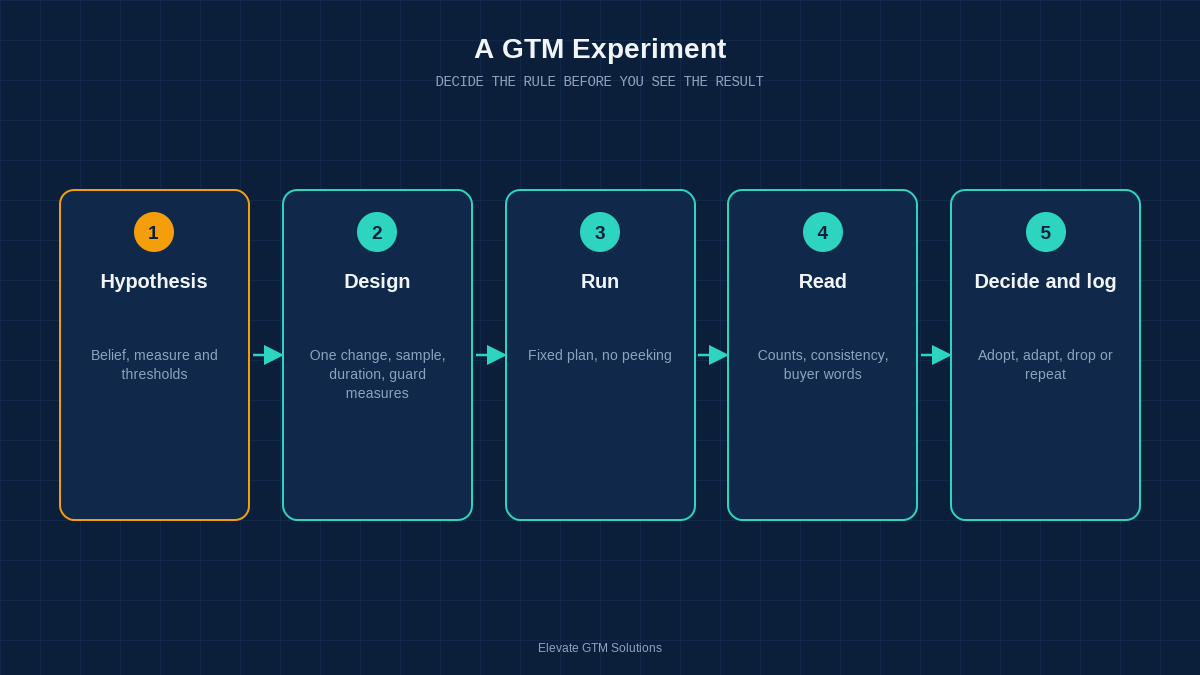
Go-to-market teams run experiments all the time and rarely call them that. A new subject line is tried. A different channel is funded for a quarter. A seller changes the discovery script. A price is raised for one customer. Results come back, someone declares a win and the change spreads. Months later, no one can say whether the change worked, because nothing was written down beforehand about what "worked" meant, the sample was tiny and the timing coincided with three other changes.
Experimentation in go-to-market is harder than in a product with millions of users. Samples are small, sales cycles are long, buyers are few and many things change at once. That is not a reason to give up on testing. It is a reason to be disciplined about what you test, how you design it, how much you trust the result and what you do next. This guide gives you a framework: how to write a hypothesis, which kinds of experiment suit which questions, how to design a test with thresholds, how to read results honestly when the numbers are small, how to prioritize a backlog, how to keep a log and how to avoid common traps. It uses worked examples with invented numbers. Elevate GTM Solutions makes a GTM strategy platform whose review rhythm supports recording and acting on test results, and it does not run experiments for you or provide statistical analysis, so we say plainly where other tools and skills matter. Nothing here guarantees that a test will give a clear answer.
What Is a GTM Experimentation Framework?
A GTM experimentation framework is a structured way to test beliefs about your market: which message resonates, which channel produces qualified conversations, which segment converts, how buyers react to a price or a process change. Each experiment states a hypothesis, defines who sees the change and how long it runs, sets success and failure thresholds in advance, measures a small number of outcomes, reads results with attention to sample size and records what was decided. The aim is to learn faster and more reliably than opinion allows, while being honest about what small samples can and cannot show.
Can small teams run meaningful experiments? Yes, if they choose questions that large effects can answer and treat results as evidence, not proof.
How many experiments should we run at once? Few, and on separate questions, so that you can tell what caused what.
Why GTM experiments are different
| Feature | Consequence |
|---|---|
| Small samples | Results are noisy, so only large effects show up clearly |
| Long sales cycles | Outcomes arrive months later, so leading measures matter |
| Few buyers per segment | Tests can use up the audience |
| Many simultaneous changes | Causes are hard to separate |
| Human variation | Different sellers produce different results |
| External events | Seasonality, competitors and news affect results |
| Brand and relationship effects | A bad test can harm reputation |
| Compliance constraints | Contacting people and pricing differently have rules |
The right response is to test fewer things more carefully, prefer questions with potentially large effects, use leading measures with a plan to check them against outcomes and keep a record.
From belief to hypothesis
A hypothesis is a specific, testable statement.
| Part | Example |
|---|---|
| Belief | Owners respond more to a message about missed appointments than to one about efficiency |
| Hypothesis | If we lead outreach with a missed-appointments message, the positive reply rate among field-service owners will be higher than with the efficiency message |
| Audience | Owners of field-service firms with ten to forty technicians |
| Change | The opening line and first claim |
| Measure | Positive replies per hundred delivered messages |
| Threshold for success | A clear difference in favor of the new message across the test, beyond what the spread between batches suggests |
| Threshold for failure | No difference, or a worse result |
| Duration and sample | Four weeks, an equal number of contacts in each group |
| Decision if it succeeds | Adopt the message in the next outreach round and test a second variation |
| Decision if it fails | Keep the current message and test a different angle |
Writing the decision in advance prevents the common habit of reading any result as support for what you already wanted.
Types of experiment
| Type | Typical question | Example change | Typical measure |
|---|---|---|---|
| Message | Which claim or framing resonates? | Headline, opening line, pillar | Reply quality, meetings, page engagement |
| Channel | Does this channel start qualified conversations? | A community, a partner, a new event type | Qualified conversations, cost per conversation |
| Segment | Is this segment worth pursuing? | Outreach to a new industry or size band | Reply rate, meeting to opportunity rate |
| Offer | Which next step do buyers prefer? | Demo, trial, audit or assessment | Conversion to conversation |
| Pricing and packaging | How do buyers react to price or structure? | A price level, a tier, a limit | Acceptance, objections, discount requests |
| Process | Does a change in the sales or onboarding process help? | A walkthrough with the owner earlier | Stage conversion, cycle length, time to first value |
| Qualification | Do new criteria improve outcomes? | An added question | Win rate in qualified deals |
| Content | Does a content piece start conversations? | A new guide or comparison page | Qualified inquiries that mention it |
Match the type to the question. Pricing tests, for instance, involve fairness, contract, communication and legal considerations, and should be designed carefully.
Designing an experiment
| Element | Practice |
|---|---|
| Unit | Decide what is being compared: contacts, accounts, sellers, weeks or segments |
| Control | A comparison group that does not get the change, or the previous period if that is all you have, with caution |
| Assignment | Random where possible, or balanced by segment and seller |
| One change at a time | Alter one variable per test |
| Sample | As large as you can reasonably reach, and fixed in advance |
| Duration | Long enough to see the measure, and fixed in advance |
| Measures | One primary measure and a few guard measures |
| Guard measures | Things that must not get worse: complaints, opt-outs, brand, win rate |
| Thresholds | Success and failure, set in advance |
| Ethics and compliance | Check rules on contact, pricing and consent |
| Owner | One named person |
| Review date | A date to decide, not to drift |
Choosing the measure
Sales outcomes take too long for most tests. Use a leading measure that plausibly predicts the outcome, and check later.
| Question | Leading measure | Check later with |
|---|---|---|
| Does this message resonate? | Positive reply rate | Meeting to opportunity rate |
| Does this channel work? | Qualified conversations per unit of effort | Opportunities and wins from that source |
| Is this segment promising? | Reply and meeting rates | Win rate and cycle length |
| Does this process change help? | Stage conversion | Win rate and retention |
| Does this offer convert? | Share who take the next step | Opportunities |
Do not declare victory on a leading measure that has not been validated against outcomes.
Reading results when the numbers are small
Small samples tempt people to overread.
| Rule | Practice |
|---|---|
| Show counts, not only percentages | Ten replies out of a hundred is different from one hundred out of a thousand |
| Do not peek and stop early | Decide the sample and duration in advance and wait |
| Look at consistency | Do results point the same way across weeks, sellers and segments? |
| Compare with natural variation | How much do batches vary when nothing changes? Use past data to estimate |
| Prefer large effects | If a change matters, the difference is often clear. If you need a statistician to see it, it may be too small to matter |
| Read the qualitative evidence | Replies, objections and conversation notes explain numbers |
| Watch guard measures | A win on replies with a rise in complaints is not a win |
| Repeat important results | A second test is worth more than a single large claim |
A small illustration with invented numbers
| Group | Contacts | Positive replies | Rate |
|---|---|---|---|
| Current message | 200 | 6 | 3 percent |
| New message | 200 | 14 | 7 percent |
The difference looks large, and the counts are small. A reasonable team would read it as encouraging, check that the groups were comparable, look at the replies, check that quality held and then repeat the test in the next batch before changing everything. It would not claim that the new message "doubles reply rates" for all audiences.
Prioritizing a backlog
You will have more ideas than capacity. A simple scoring approach helps.
| Idea | Impact if it works (1 to 5) | Confidence it will (1 to 5) | Effort (1 to 5, lower is easier) | Score |
|---|---|---|---|---|
| Lead with missed appointments | 4 | 3 | 1 | Impact times confidence divided by effort |
| Add owner walkthrough step | 5 | 3 | 3 | |
| Try a partner channel | 3 | 2 | 4 | |
| Test a lower entry price | 4 | 2 | 4 |
Use the scores as a conversation, not a verdict. Favor experiments that are cheap, reversible and capable of large effects. Avoid experiments whose answer would not change what you do.
An experiment log
| Field | Entry |
|---|---|
| ID and name | A short label |
| Owner | Who ran it |
| Hypothesis | The statement above |
| Design | Audience, change, control, sample, duration, measures, thresholds |
| Dates | Start and end |
| Results | Counts and rates, with notes on anomalies |
| Qualitative findings | What buyers said |
| Decision | Adopt, adapt, drop or repeat |
| Next steps | Follow-up experiments or changes |
| Confidence | High, medium or low |
Keep the log in one place and review it at the monthly strategy review. The log is how learning outlasts the people who ran the tests.
Making experiments part of the rhythm
| Cadence | Activity |
|---|---|
| Weekly | Check running tests for problems, not results |
| Monthly | Review completed tests, decide and choose the next ones |
| Quarterly | Review the log for patterns, retire old assumptions and set the experiment themes for the next quarter |
| Annually | Review the experimentation process itself |
Give experiments a small, protected share of time and budget. Without protection, urgent work crowds them out.
Ethics, compliance and trust
| Topic | Practice |
|---|---|
| Contacting people | Follow the rules on consent, opt-outs and frequency, and review with legal advisers |
| Pricing tests | Be careful about offering different prices to similar customers, and review contract, fairness and legal implications |
| Claims | Do not test claims you cannot support |
| Data | Use customer and prospect data according to your commitments |
| Brand | Avoid tests that could embarrass the company or mislead buyers |
| Transparency | Do not misrepresent what a test is when asked |
A test that damages trust costs more than it can teach.
Three experiment designs, filled in
These are invented examples of complete designs.
A message test
| Field | Entry |
|---|---|
| Hypothesis | Leading with missed appointments will produce more positive replies than leading with efficiency among field-service owners |
| Audience | Owners of firms with ten to forty technicians, from the verified list |
| Change | Opening line and first claim only |
| Control | The current message |
| Assignment | Contacts split evenly and randomly by list order, balanced by region |
| Sample and duration | Two hundred contacts per group, four weeks |
| Primary measure | Positive replies per hundred delivered messages |
| Guard measures | Opt-outs and complaints |
| Success | Higher positive reply rate in at least three of four weeks, with replies that name a real problem |
| Failure | No difference or a worse result |
| Decision | Adopt and test a second variation, or keep the current message |
A channel test
| Field | Entry |
|---|---|
| Hypothesis | Contributing to an owner community will start qualified conversations |
| Audience | The community's members who match the profile |
| Change | Two helpful contributions a week for eight weeks, with no promotion |
| Control | Prior eight weeks without community activity |
| Primary measure | Qualified conversations that mention the community |
| Guard measures | Time spent per week, community feedback |
| Success | A stated minimum number of qualified conversations and a plan for time per conversation |
| Failure | Few conversations, or high time cost |
| Decision | Continue, change the format or stop |
A process test
| Field | Entry |
|---|---|
| Hypothesis | Holding the owner walkthrough before the proposal will raise win rate |
| Audience | New opportunities in the priority segment |
| Change | Add an owner walkthrough as an exit criterion for the evaluation stage |
| Control | Opportunities in the prior quarter, and deals handled by sellers not yet using the step |
| Primary measure | Stage conversion from evaluation to proposal, then win rate |
| Guard measures | Cycle length, seller feedback |
| Success | Higher stage conversion without longer cycles, then a later check of win rate |
| Failure | Longer cycles with no gain |
| Decision | Adopt, adjust or drop |
Guard measures
A guard measure protects against winning on one measure by harming another.
| Experiment | Possible guard measures |
|---|---|
| Message test | Opt-outs, complaints, reply sentiment |
| Channel test | Time cost, brand feedback |
| Segment test | Support load, early retention |
| Pricing test | Discount requests, deal cycle, customer feedback |
| Process test | Cycle length, seller satisfaction |
| Offer test | Quality of conversations, no-show rates |
| AI-assisted outreach test | Error rate, complaints, brand concerns |
Set a limit for each guard measure in advance. If a limit is crossed, pause the test.
Variation without the math
You do not need advanced statistics to be careful. A few intuitions help.
| Intuition | What to do |
|---|---|
| Results bounce around even when nothing changes | Look at several batches with the same message to see the usual spread |
| A difference smaller than the usual spread is not evidence | Wait for a larger effect or a larger sample |
| One big win can be luck | Repeat the test |
| Rates from tiny groups swing wildly | Show counts, and avoid reading too much into ten replies |
| If groups differ before the test, results are unreliable | Balance groups by segment, region and seller |
| Many small tests can produce a few false winners | Run fewer tests and repeat important ones |
| Averages can hide different effects in different segments | Look at results by segment, with care for small counts |
If a decision is important and the result is ambiguous, gather more evidence from buyer conversations before changing course.
Running experiments with sellers
| Practice | Why |
|---|---|
| Explain the purpose | Sellers cooperate when they understand the question |
| Keep the change simple | Complicated changes are applied inconsistently |
| Provide the materials | A clear template or script |
| Check adherence | Sample calls or messages |
| Share results | Show what was learned, and credit participants |
| Avoid cherry-picking | Include all assigned accounts in the analysis |
| Do not punish tests that fail | Learning needs safety |
| Respect their time | Limit the number of concurrent tests |
Quarterly experiment themes
Choose a few themes each quarter instead of a random list.
| Quarter | Theme | Example experiments |
|---|---|---|
| Q1 | Message resonance in the priority segment | Two opening lines, two proof points, one new pillar |
| Q2 | Channel mix | A community, a partner introduction, a targeted event |
| Q3 | Process and qualification | An earlier walkthrough, a new qualification question |
| Q4 | Pricing and packaging | Buyer conversations about price, a packaging test with a small group |
Align themes with the strategy's riskiest assumptions. If you do not know which they are, list the guesses in your plan and rank them.
Questions teams ask about experiments
"We do not have enough volume to test anything." Choose questions with large potential effects, run buyer conversations as evidence and use sequential tests over longer periods. Treat results as hints, and repeat.
"Our sales cycle is six months. How do we learn?" Use leading measures such as stage conversion and reply quality, and check them against outcomes as deals close.
"What if a test needs a different price for different customers?" Review fairness, contract and legal implications first, and consider conversations or opt-in offers instead.
"How do we stop people declaring victory too soon?" Write thresholds first, fix the duration and review results in a scheduled meeting.
"Should we test everything?" No. Test the assumptions that are risky and cheap to check, and decide others on evidence from buyers.
"Who should own the experimentation program?" A named person in marketing, product marketing or revenue operations, with a sponsor and a monthly review.
Terms used in this guide
| Term | Meaning |
|---|---|
| Hypothesis | A specific, testable statement |
| Control | The comparison group or period |
| Primary measure | The outcome the test is designed to move |
| Guard measure | A measure that must not get worse |
| Threshold | A pre-agreed result that triggers a decision |
| Leading measure | An early signal of a later outcome |
| Sample | The number of units in the test |
| Replication | Repeating a test to check a result |
AI and experimentation
| Task | How AI helps | Caution |
|---|---|---|
| Generating variations | Produces many message options | Select a few with real differences |
| Summarizing replies | Groups themes | Check against the replies |
| Drafting designs and logs | Speeds writing | Review for validity |
| Analysis | Calculates rates and summarizes | Verify numbers, and avoid overclaiming |
| Agents that run tests | Send variants automatically | Need limits, approvals and logs |
AI makes it easy to test twenty variants at once and impossible to learn from that if the sample is small. Generate many, test few.
Common mistakes
| Mistake | What happens | Fix |
|---|---|---|
| No hypothesis | Results cannot be interpreted | Write it first |
| Changing several things at once | Cause unknown | One change per test |
| No thresholds | Any result reads as support | Set thresholds beforehand |
| Stopping early on a good result | False wins | Fix duration and sample |
| Reading percentages without counts | Overconfidence | Show counts |
| Using only leading measures | Rewarding the wrong thing | Check against outcomes |
| Testing trivial changes | No impact | Prefer large potential effects |
| No log | Learning lost | Keep one |
| Running too many tests | Confusion and overlap | Few, separate questions |
| Ignoring guard measures | Harm to brand or retention | Monitor them |
| Skipping compliance | Legal and trust risk | Review first |
A hypothetical example
This is an illustration, not a real company.
A company selling scheduling software to field-service firms believed that its outreach message, which led with efficiency, was underperforming. The head of marketing proposed testing a message about missed appointments, drawn from five customer interviews. She wrote a hypothesis, chose positive replies per hundred delivered messages as the measure, set an equal number of contacts per group from the same list, chose a four-week duration and agreed with sales that a difference would count only if it appeared in each of the four weeks. She added guard measures: opt-outs and complaints.
The new message produced more positive replies in each of the four weeks, with no change in opt-outs. Buyers' replies mentioned specific appointment problems. She treated the result as encouraging, adopted the message for the next batch and designed a second test on the call to action. She also checked, two months later, whether meetings from the new message turned into opportunities at the same rate. They did, roughly. She entered all of it in the log.
A second test, on a lower entry price, was inconclusive: only a few buyers reacted, and their comments varied. She did not change the price. She wrote down what she had learned, and planned a series of buyer conversations about pricing instead. A test that gives a clear answer is useful. A test that tells you the question needs different evidence is useful too.
What to do this week
Write one belief about your market as a hypothesis, with a measure, thresholds, a sample and a duration. Decide what you will do if it succeeds and if it fails. Start a log and record the design before you begin. Ask sales whether they agree the measure matters.
Designing a pricing conversation test
Pricing tests deserve extra care, and conversations can teach a great deal before any live price changes.
| Step | Practice |
|---|---|
| 1. State the question | For example, whether buyers see value at a given price for a given package |
| 2. Choose buyers | A mix of prospects and customers in the target segment |
| 3. Prepare a neutral script | Describe the package, ask what they would expect to pay, then reveal a reference price and ask for their reaction |
| 4. Record reactions | Quotes, hesitation, comparisons and what they would need to see |
| 5. Look for patterns | Which parts of the package drive value, which objections recur |
| 6. Avoid leading | Do not defend the price or sell during the conversation |
| 7. Decide the next step | A small, reviewed price pilot, a packaging change or more conversations |
Treat the findings as evidence about perceived value, not as a price list. A live price test needs separate review of fairness and contract implications.
Experiments on content and search presence
Content tests can be slow but valuable.
| Question | Test | Measure |
|---|---|---|
| Does a plain what-is page improve how assistants describe us? | Publish and re-run the question bank after several weeks | Accuracy and mention in sampled answers |
| Does an honest comparison page bring qualified inquiries? | Publish one comparison, track inquiries that mention it | Qualified inquiries per month |
| Does fixing a pricing mismatch improve accuracy in listings? | Align pages and directories, then re-check | Consistency across sources |
| Does a guide for a segment start conversations? | Share with that segment and track replies | Qualified conversations |
Results arrive over weeks or months. Record the date of each change so that you can connect later effects to causes with appropriate modesty. Our guide to the AI search visibility audit shows how to measure presence.
Experiments on onboarding and customer success
| Question | Test | Measure |
|---|---|---|
| Does a first-week checklist speed time to first value? | Offer it to alternate new customers | Time to first value |
| Does an early call with the owner improve adoption? | Assign owner calls to a random half | Adoption at thirty days |
| Does a sample dataset help new users? | Provide it to a random half | Activation |
| Does a health-check email reduce churn risk? | Send to a matched group | Response and usage changes |
Guard against harming the customer experience. Do not withhold help from customers in a way that could cause real harm.
A short guide for running experiments in a small team
| Habit | Practice |
|---|---|
| One experiment at a time per question | Avoid overlapping tests on the same audience |
| A single owner | Someone responsible for the design, run and log |
| A weekly five-minute check | For problems, not results |
| A monthly decision meeting | Review results and choose next tests |
| A visible log | Everyone can see what has been tried |
| A bias toward cheap and reversible | Start with tests that cost little to undo |
| A habit of talking to buyers | Qualitative evidence explains numbers |
In plain language
Testing in go-to-market is mostly about being honest. Say what you believe, say how you will know, say what you will do either way and write it down. Change one thing at a time, keep the sample and duration fixed, watch the things you do not want to harm and repeat anything important. Expect numbers to be small and noisy, rely on buyers' words to interpret them and treat each test as one piece of evidence. A team that learns steadily from small, careful tests will outpace one that makes confident changes on a hunch.
A second hypothetical: a test that said no
This is another invented illustration.
A company believed that a free assessment offer would start more conversations than a demo offer. The team wrote a hypothesis, split a list evenly and ran the test for six weeks. The assessment offer drew slightly fewer replies and a lower rate of meetings, and replies mentioned that buyers were unsure what an assessment involved. The guard measures showed no harm.
The team did not conclude that assessments never work. It recorded the result, noted the buyers' comment, rewrote the offer to describe exactly what the assessment included and scheduled a second, smaller test. It also ran three buyer conversations to ask what they would want from an offer. The second test, with the clearer description, produced results close to the demo offer. The team kept the demo as the default, kept the assessment as an option for a segment that preferred it and logged both tests.
A test that does not confirm a hypothesis still teaches something, especially when the buyers' words are collected alongside the numbers.
Quick reference
| Question | Short answer |
|---|---|
| What is a hypothesis? | A specific, testable belief, with a measure and thresholds |
| How many changes per test? | One |
| What protects against harm? | Guard measures with limits |
| How to read small samples? | Show counts, look for consistency and repeat |
| What measure to use? | A leading measure, checked later against outcomes |
| Where to keep results? | A shared experiment log |
Final thoughts
The point of experimenting is not to prove ideas right. It is to find out sooner and more cheaply which beliefs about your market are wrong. A small, honest test with written thresholds, a guard against harm and a decision rule is worth far more than a confident change made on a hunch. Keep tests few, keep the log, talk to buyers and treat every result as one piece of evidence.
A checklist before launching a test
- The belief is written as a hypothesis with a measure.
- One change is being tested.
- The audience, control and assignment are defined.
- The sample and duration are fixed.
- Success and failure thresholds are written, and the decision for each outcome is agreed.
- Guard measures and their limits are set.
- Compliance and ethics were checked.
- An owner and a review date are named.
- The test is entered in the log before it starts.
- Sellers or channel owners understand what to do.
A sample monthly experiment review
Forty-five minutes, with the program owner, sales, marketing and product marketing.
| Time | Topic |
|---|---|
| 0 to 10 minutes | Completed tests: results with counts and thresholds |
| 10 to 20 minutes | What buyers said in replies and conversations |
| 20 to 30 minutes | Decisions: adopt, adapt, drop or repeat |
| 30 to 40 minutes | The next tests: hypotheses, designs and owners |
| 40 to 45 minutes | Update the log and share a summary |
Share a one-page summary within a day so that the whole team sees what was learned.
Summary for busy leaders
If you remember three things: write the hypothesis, thresholds and decision rule before the test starts; change one thing, fix the sample and duration and watch guard measures; and read small samples with humility by showing counts, looking for consistency and repeating anything important. Keep a log so that learning outlasts the people who ran the tests, and talk to buyers so that numbers have explanations.
Questions to ask when a result arrives
- Did the result meet the threshold we wrote down, or are we reading it differently now?
- How large are the counts behind each rate?
- Is the result consistent across weeks, sellers and segments?
- Did any guard measure move?
- What did buyers say that explains the numbers?
- What is the cheapest next test?
Key takeaways
- GTM experiments are harder than product experiments, because samples are small, cycles are long and many things change at once.
- Write a hypothesis, set thresholds in advance and decide what you will do with each result.
- Change one thing at a time, fix the sample and duration and add guard measures.
- Show counts, avoid peeking, look for consistency and repeat important results.
- Use leading measures and check them against outcomes later.
- Keep a log, review it monthly, and respect ethics and compliance.
Where Elevate GTM Solutions fits
Elevate GTM Solutions is an AI-native GTM operating system for B2B companies. Its Measure and Optimize module and its recurring review rhythm support defining what you want to learn, recording assumptions and results and feeding them into updated strategy, and its unified strategy connects test findings to positioning, messaging, channel plans and priorities across 15 modules. It supports workflows, weekly plans and task ownership. It does not run experiments, send messages or perform statistical analysis, and it connects to HubSpot, Salesforce, LinkedIn, Notion and Claude for supported actions. A free first strategy build is available, and published plans, billed annually, are Enable at USD 499 per month and Growth at USD 1,499 per month, with custom Scale pricing.
For related reading, see Measure and Optimize, GTM Metrics and KPIs, GTM Planning Template and What Is Elevate GTM Solutions?. See the pricing page, or request a demo.
Frequently Asked Questions
What is a GTM experiment?
A structured test of a belief about your market, such as which message resonates or which channel produces qualified conversations, with a hypothesis, a defined audience and duration, success and failure thresholds, measures and a recorded decision.
How do I write a good hypothesis?
State the belief, the change, the audience, the measure, the thresholds for success and failure, the sample and duration and what you will do with each result.
Can small teams run meaningful experiments?
Yes, if they choose questions that large effects can answer, fix sample and duration in advance, show counts and treat results as evidence, not proof.
How big does a sample need to be?
As large as you can reasonably reach. With small samples, only large differences show clearly, so focus on changes with large potential effects and repeat important tests.
What should I measure?
One primary measure, usually a leading measure such as positive replies or qualified conversations, plus guard measures such as opt-outs and complaints, then check later against outcomes such as opportunities and wins.
How do I avoid fooling myself with results?
Set thresholds beforehand, do not stop early, show counts, look for consistency, read the qualitative evidence, watch guard measures and repeat important results.
How should I prioritize experiments?
Score ideas on impact, confidence and effort, favor cheap, reversible tests with large potential effects and skip tests whose answer would not change what you do.
Are pricing experiments safe?
They need care. Review fairness, contract terms and legal implications, and consider buyer conversations before or instead of price tests.
How does AI affect experimentation?
AI can generate variants, summarize replies and draft designs. Testing many variants with a small sample teaches little, so generate many and test few.
What belongs in an experiment log?
The hypothesis, design, dates, results with counts, qualitative findings, decision, next steps and confidence.
What does a complete experiment design look like?
A hypothesis, audience, one change, a control, assignment, sample and duration, a primary measure, guard measures, success and failure thresholds and the decision for each outcome.
What are guard measures?
Measures that must not get worse while you test, such as opt-outs, complaints, cycle length, support load or seller satisfaction, with limits set in advance.
How do I think about variation without statistics?
Look at the usual spread between batches, treat differences smaller than that as weak evidence, show counts, balance groups, repeat important tests and avoid running many tests that produce false winners.
What if our sales cycle is too long to learn from?
Use leading measures such as stage conversion and reply quality and check them against outcomes as deals close, and supplement with buyer conversations.