
By the Elevate GTM Solutions Team · Updated November 10, 2026 · 21 min read
GTM Platform vs Sales Enablement Platform: Where Strategy Ends and Equipping Begins
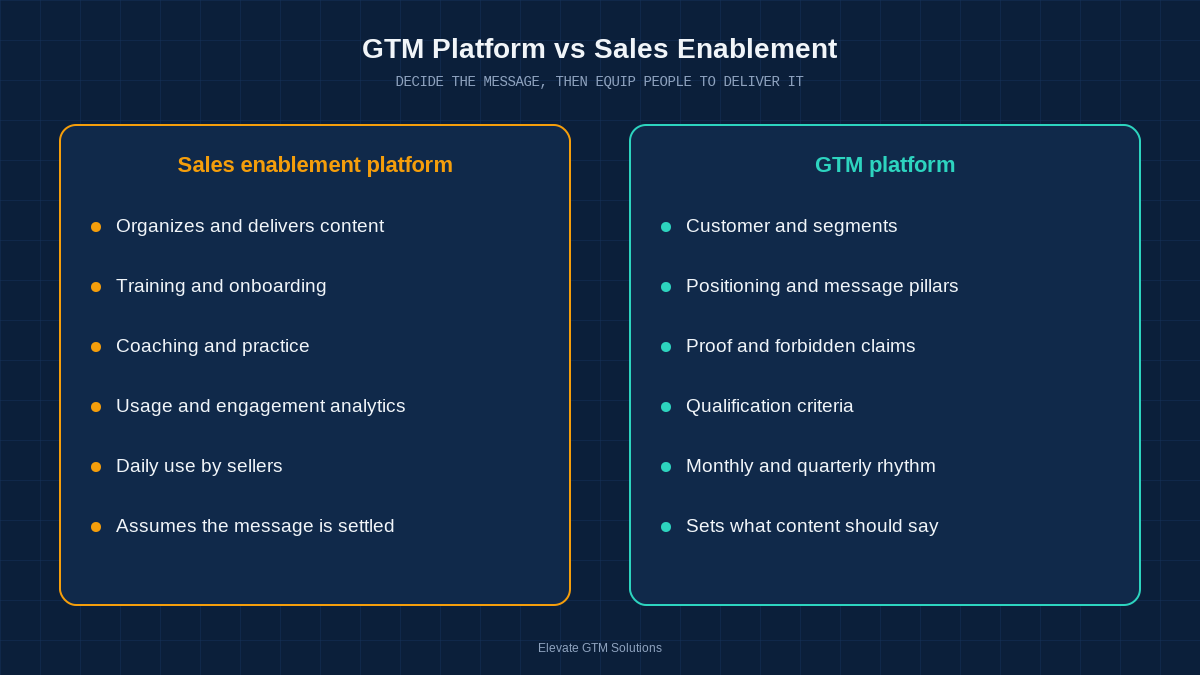
Sales enablement platforms exist to solve a real problem. Sellers need the right content at the right moment, training that sticks and coaching that improves their conversations, and none of that works if material lives in scattered folders and nobody can tell what is current. The category matured into software that organizes content, delivers training, supports coaching and reports on what is used.
A GTM platform sits upstream of that. It helps decide what the content should say in the first place: who the customer is, how to position, what the message pillars are and what proof supports them. When the two are confused, companies buy enablement software to fix a messaging problem and end up with a well-organized library of inconsistent material. This guide separates the categories, compares them honestly, explains how they connect, shows how to evaluate each and discusses the recent consolidation in the enablement market. Elevate GTM Solutions makes a GTM strategy platform, so we say plainly when an enablement platform is the better answer. Vendor descriptions reflect public statements and your site's comparison pages as of November 2026, and they change often. Confirm details before you buy.
GTM Platform vs Sales Enablement Platform: What Is the Difference?
A sales enablement platform, such as Seismic (which now includes Highspot), organizes and delivers sales content, training and coaching, and measures how they are used. A GTM platform, such as Elevate GTM Solutions, builds and maintains the strategy that content should reflect: ideal customer, segments, positioning, messaging pillars with proof, pricing logic and priorities. Enablement equips sellers to carry out the strategy. A GTM platform decides it. Most growing B2B companies need both, in that order: decide the message, then equip people to deliver it.
Which should I buy first? If the message is settled and the problem is finding, using and learning from it, enablement. If teams disagree about the customer and message, a GTM platform.
Does one replace the other? No. Enablement platforms distribute and measure. GTM platforms define and align.
The two categories side by side
| Sales enablement platform | GTM platform | |
|---|---|---|
| Core question | Do sellers have the right content, training and coaching when they need it? | What should the content say, and for whom? |
| Main users | Enablement, sales leaders, sellers, marketing | Product marketing, strategy, marketing leaders, founders, RevOps |
| Main objects | Content, playbooks, training courses, coaching sessions, usage data | Customer definition, segments, positioning, messaging, pricing logic, plans |
| Timescale | Daily and weekly use, with periodic content updates | Monthly and quarterly, with updates when conditions change |
| Output | Findable content, trained sellers, coaching records, engagement analytics | A strategy others use, kept consistent |
| AI role | Content search, summaries, role-play practice, recommendations | Structuring evidence, drafting strategy, keeping outputs consistent |
| Assumes | The strategy and message exist | You will test the draft and decide |
| Failure mode | A tidy library of inconsistent or outdated content | A strategy that never reaches the field |
What sales enablement platforms do
| Capability | What it does |
|---|---|
| Content management | Stores, tags and surfaces sales content |
| Content recommendations | Suggests material by deal stage, role or situation |
| Digital sales rooms | Shares content with buyers and tracks engagement |
| Training and onboarding | Delivers courses and tracks completion |
| Practice and role-play | Lets sellers rehearse pitches, in some platforms with AI |
| Coaching | Supports feedback on calls and practice |
| Playbooks | Guides sellers through steps for a situation |
| Analytics | Shows what content is used and how it relates to outcomes |
| CRM integration | Surfaces content inside the seller's workflow |
| AI assistance | Searches content, drafts summaries and answers questions |
Seismic and Highspot announced a merger that completed on 18 August 2026, and the combined company operates as Seismic, with the Highspot product described as Highspot by Seismic. Packaging, product names and roadmap for renewals can change after a merger, so ask each vendor which products you would use, how they connect and what protections your contract gives you if a product is retired or repriced. Our page Gong vs Seismic after the Highspot merger covers procurement questions. Other products serve parts of the category, so check current options.
What GTM platforms do
Elevate GTM Solutions describes itself as an AI-native GTM operating system. From the market, industry, product and segment context you provide, it builds connected outputs across 15 modules, including ICP and segmentation, competitive intelligence, positioning, messaging, pricing, sales enablement inputs, launch and execution, and measurement. It supports workflows, weekly plans, task ownership and a recurring review rhythm, and lets teams compare strategies side by side.
Its sales enablement module produces inputs for enablement: customer profiles, talk tracks, objection responses and qualification questions. It does not host a content library, run training courses, deliver coaching or track content usage.
Where the two meet
| Strategy output | How it shows up in an enablement platform |
|---|---|
| Ideal customer and exclusions | The customer profile page and qualification guidance |
| Buying group and personas | Role-based content and talk tracks |
| Positioning statement | The core pitch, in onboarding and role-play |
| Messaging pillars and proof | Decks, one-pagers and battlecards |
| Forbidden claims | Content review rules and a style guide |
| Objection responses | Playbook cards and training scenarios |
| Competitive guidance | Battlecards |
| Qualification questions | Discovery guides and call scorecards |
| Launch plans | Launch kits and training |
| Feedback from enablement | Where it goes in strategy |
|---|---|
| Content that sellers actually use | Messaging that resonates |
| Content nobody opens | Pillars that may not land |
| Questions sellers ask the enablement team | Gaps in message or proof |
| Practice results | Where the pitch is hard to deliver |
| Buyer engagement with shared material | Interest by theme |
When the loop works, enablement turns decisions into practice and strategy learns from usage. When it does not, enablement teams write content from scratch and the strategy drifts.
The content problem enablement cannot solve alone
| Symptom | Likely cause | Remedy |
|---|---|---|
| Hundreds of decks, none trusted | No approved message or owner | Settle pillars and proof, then retire the rest |
| Sellers build their own slides | Official material does not fit their conversations | Learn from their best calls and update |
| Different regions tell different stories | No shared positioning or exception process | Decision rights and a common set of pillars |
| New hires take long to ramp | Material is scattered and contradictory | A short playbook and a call library |
| Content is current but unused | Hard to find, or not useful | Fix findability, and ask sellers what they need |
| Battlecards disagree | No owner for competitive framing | A single owner and review rhythm |
Enablement software can organize and surface content. It cannot decide which version is right. Our guide to what a GTM playbook is explains how to write the playbook enablement delivers.
When you need an enablement platform first
- The message is settled and sellers cannot find or use current material.
- You have enough sellers, and enough content, that folders and shared drives no longer work.
- Training and onboarding are inconsistent.
- Managers want to coach with practice and recordings.
- You want to see which content is used and how buyers engage with it.
When you need a GTM platform first
- Leaders disagree about who the customer is or what to say.
- Content contradicts itself across teams or regions.
- You are launching, repositioning or entering a new market.
- Several products, segments or regions need consistent strategy.
- Enablement has no source of truth to build from.
When you need both
Companies with larger sales teams usually reach this point. A pattern that works:
- Decide customer, message, proof, forbidden claims and qualification criteria in the strategy layer.
- Turn them into a short playbook and approved content.
- Load, tag and deliver them through the enablement platform.
- Train and coach to the playbook.
- Bring usage, questions and practice results to a monthly strategy review.
- Update the strategy and the content together.
How to evaluate each
A sales enablement platform
| Test | What to do | What to look for |
|---|---|---|
| Findability | Ask a seller to find the right asset for a realistic scenario | Speed and clarity |
| Content governance | Check ownership, versions, expiry and approvals | Whether outdated material is flagged |
| CRM integration | Connect your CRM | What appears in the seller's workflow |
| Training | Build a short onboarding path | Ease of authoring and tracking |
| Coaching and practice | Run a role-play and review | Quality of feedback and effort required |
| Analytics | Review usage and engagement reports | Whether they show outcomes, not only views |
| AI features | Test search and summaries on your content | Accuracy and sources |
| Admin effort | Estimate the people needed to maintain it | Realistic upkeep |
| Merger and roadmap | Ask what changed after consolidation | Clarity on products and terms |
| Cost | Estimate seats, modules and add-ons over three years | Total cost |
A GTM platform
| Test | What to do | What to look for |
|---|---|---|
| Specificity | Enter real context and evidence | Outputs that name your customers and alternatives |
| Change handling | Change the target segment | What updates and what you must fix |
| Comparison | Compare strategies for two segments | Clarity of differences and reasons |
| Review | Have sellers and enablement read the output | What they say is wrong or missing |
| Handoff | Produce customer profile, talk tracks and objection responses | Match with the strategy |
| Integration | Check supported actions with your CRM | What is automatic and what is manual |
| Cost | Compare plans with your scope | Total including team time |
Cost shapes
| Element | Enablement platform | GTM platform |
|---|---|---|
| License | Typically per seat, with modules and tiers, often quote-based | By scopes and users, with published plans for some vendors |
| Implementation | Content migration, taxonomy, integrations, training | Inputs, review and owners |
| Internal time | Enablement staff maintaining content, sellers learning | Owners updating inputs and reviewers testing outputs |
| Content production | Marketing and product marketing time | Not applicable |
| Switching | Moderate to high: content, history and training | Moderate: structured records |
For reference, Elevate GTM Solutions publishes Enable at USD 499 per month and Growth at USD 1,499 per month, billed annually, with custom Scale pricing and a free first strategy build. Ask enablement vendors for written quotes at your seat count.
Measuring enablement honestly
Enablement teams are often asked to prove impact. The hard part is causation.
| Measure | What it tells you | Caution |
|---|---|---|
| Content usage | What sellers open and share | Usage does not equal impact |
| Buyer engagement | What buyers read | Interest, not intent |
| Time to first deal for new sellers | Ramp speed | Many factors affect it |
| Training completion | Participation | Not skill |
| Practice and coaching scores | Skill signals | Can be gamed |
| Message consistency in calls | Strategy reaching the field | Needs call review |
| Win rate by segment and content used | Possible links | Selection effects |
| Seller feedback | Usefulness | Subjective |
Compare against baselines, use cohorts of new hires where possible and be modest about claims. Our guide to GTM metrics and KPIs gives definitions.
A content governance model
Enablement fails quietly when content has no owner. A light governance model keeps a library trustworthy.
| Element | Practice |
|---|---|
| Ownership | Every asset has a named owner and a backup |
| Source of truth | Claims and proof come from the approved pillars and proof list |
| Approval | New or changed assets are reviewed for accuracy, forbidden claims and legal requirements |
| Expiry | Each asset has a review date, and expired assets are flagged or hidden |
| Versioning | One current version is visible, old versions are archived |
| Regional variants | Adaptations are recorded with reasons and approved |
| Requests | A simple way for sellers to ask for content, with a visible queue |
| Retirement | A quarterly sweep removes unused and outdated assets |
| Audit | A sample of live assets is checked against the current strategy each quarter |
Governance is dull and decisive. A library that is current and trusted will be used. One that is stale will be bypassed.
A tagging scheme that sellers can use
Search and recommendations depend on tags. Keep them few and meaningful.
| Tag type | Examples |
|---|---|
| Persona | Owner, dispatcher, operations leader, finance approver |
| Segment | Field service, logistics, distribution |
| Stage | Qualification, evaluation, validation, negotiation, onboarding |
| Pillar | Fast start, simple on a phone, fewer missed appointments |
| Type | One-pager, deck, case story, battlecard, template, demo script |
| Competitor | Named alternatives, including spreadsheets |
| Region and language | Where it applies |
| Status | Approved, draft, expiring |
Test findability: ask three sellers to find the right asset for a realistic scenario and time them. If they cannot, simplify tags before adding more content.
Designing an onboarding path
A good onboarding path teaches the strategy, not only the product.
| Week | Focus | Activities |
|---|---|---|
| 1 | The customer and the problem | Read the customer profile, listen to five strong discovery calls, review the positioning |
| 2 | The message and proof | Learn the pillars and the proof behind each, practice a thirty-second pitch, review forbidden claims |
| 3 | Discovery and qualification | Study the discovery guide, role-play with a manager, shadow live calls |
| 4 | Objections and competitors | Practice the common objections, study battlecards, run a mock evaluation |
| 5 | Process and tools | Learn stage criteria, CRM habits and the enablement platform |
| 6 | Supervised practice | Run calls with a coach and receive feedback on specific behaviors |
| 7 to 12 | Independent work with coaching | Build pipeline with regular reviews |
Measure the path by milestones, such as the first unsupervised discovery call and the first qualified opportunity, and ask new hires what was unclear.
A battlecard template
A battlecard helps sellers handle a named alternative honestly.
| Section | Content |
|---|---|
| Alternative | Name and category |
| How buyers describe it | In their words, from calls |
| What it does well | An honest summary |
| Where we differ | Specific differences that matter to our customer |
| Questions to ask the buyer | To uncover whether the difference matters |
| Proof | Evidence we may cite, with sources |
| When to recommend it instead | Cases where we are not the best fit |
| What not to say | Claims we cannot support, comparisons to avoid |
| Last reviewed | Date and owner |
A battlecard that attacks a competitor or claims what you cannot prove costs trust. Keep one owner and review it when the competitor changes.
A practice program
Practice improves delivery when it focuses on specific skills.
| Element | Practice |
|---|---|
| Skills | Choose one at a time, such as discovery questions, objection handling or a pricing conversation |
| Scenarios | Based on real calls, with realistic buyers |
| Format | Short role-plays, with a peer or manager, or AI practice with calibration |
| Feedback | Specific, against a rubric tied to the playbook |
| Repetition | Repeat until the behavior is natural |
| Transfer | Review a later real call to check the change |
| Recording | Note what works to improve the playbook |
AI role-play can provide volume, and humans should calibrate it against real buyer conversations.
The enablement team and its rhythm
| Role | Responsibility |
|---|---|
| Head of enablement | Owns programs, measures and the link to strategy |
| Content specialist | Maintains the library and taxonomy |
| Trainer or coach | Runs onboarding and practice |
| Product marketing partner | Owns message pillars, proof and battlecards |
| Sales leader partner | Sets priorities and coaches |
| RevOps partner | Integrates with the CRM and reports |
| Cadence | Activity |
|---|---|
| Weekly | Content requests, seller feedback, onboarding check-ins |
| Monthly | Usage and feedback review, strategy review with product marketing, content sweep |
| Quarterly | Audit assets against strategy, review onboarding outcomes, plan programs |
Terms used in this guide
| Term | Meaning |
|---|---|
| Sales enablement | Content, training and coaching that equip sellers |
| Battlecard | A short guide for handling a named competitor |
| Digital sales room | A shared space where sellers and buyers access content |
| Taxonomy | The tags and structure used to organize content |
| Playbook | A guide to carrying out the strategy repeatably |
| Content governance | Rules for owning, approving and retiring content |
| Ramp | Time for a new seller to reach productivity |
AI in enablement
| Task | How AI helps | Caution |
|---|---|---|
| Content search | Answers questions from your approved content | Check sources and currency |
| Summaries | Condenses long material | Verify accuracy |
| Role-play practice | Simulates a buyer for rehearsal | Calibrate against real buyers |
| Drafting | Produces first drafts of content | Needs positioning and proof as input |
| Recommendations | Suggests content for a deal | Treat as input |
| Tagging | Organizes content | Review for errors |
AI search over a library of inconsistent content returns inconsistent answers faster. Clean the source first.
Common mistakes
| Mistake | What happens | Fix |
|---|---|---|
| Buying enablement to fix messaging | A tidy library of mixed messages | Settle the message first |
| Migrating everything | Old content comes along | Retire before you migrate |
| No content owners | Material goes stale | Name owners and expiry dates |
| Measuring views | Usage looks like impact | Pair with outcome and feedback measures |
| Building training before the playbook | Teaching an unsettled pitch | Write the playbook first |
| Ignoring regions | Local versions diverge | Decision rights and exceptions |
| Skipping seller input | Content nobody uses | Co-create with top sellers |
| Not asking about consolidation | Surprises at renewal | Ask in writing |
A hypothetical example
This is an illustration, not a real company.
A company with sixty sellers bought an enablement platform and migrated all its content. Within a quarter, search worked and usage reports looked healthy. Sellers still built their own decks, and new hires took longer than expected to ramp. The head of enablement reviewed top-performing sellers' calls and found that they told a different story from the official deck.
The head of enablement and the head of product marketing settled the positioning with a strategy process, wrote message pillars with proof, set qualification questions and produced a six-page playbook from the best calls. They retired two thirds of the library, tagged the rest by pillar and persona, set owners and expiry dates, and built an onboarding path around the playbook. They agreed to bring usage and seller questions to the monthly strategy review.
Two quarters later, new hires reached their first discovery calls faster, official decks matched what top sellers said and the monthly review changed two objection responses based on questions in the platform. The software had not changed. The content it held had.
Scenarios and directions
| Situation | Direction to explore |
|---|---|
| A small team with few assets and a shared drive that works | Keep it, and write the playbook before buying software |
| A growing team that cannot find current material | Retire content, build taxonomy and consider an enablement platform |
| A company with strong content and weak ramp | Build a structured onboarding path and call library |
| A company with inconsistent regional messaging | Settle shared pillars and exceptions before distributing content |
| A company after an enablement vendor merger | Ask about product names, packaging and contract protections, and plan for change |
| A company launching a product | Produce a launch kit from the strategy, train sellers and review in thirty days |
Questions teams ask
"Do we need a platform to start?" Not always. A well-organized shared folder with owners and expiry dates can serve a small team. Platforms help when volume and complexity grow.
"How do we get sellers to use the library?" Build it from their best material, make it easy to find, remove clutter and ask them what is missing.
"How do we know content works?" Combine usage, buyer engagement, seller feedback and, carefully, outcomes. Be modest about causation.
"What should enablement report to leadership?" Ramp milestones, message consistency, content health, coaching activity and examples of strategy changes that came from field feedback.
"How do enablement and product marketing divide the work?" Product marketing owns the message, proof and competitive framing. Enablement owns delivery, training, coaching and measurement. Both own the loop.
"What happens when strategy changes?" Update the pillars, then the affected assets, flag outdated ones and brief sellers. A change log and expiry dates help.
A launch kit, from strategy to field
| Item | Source | Notes |
|---|---|---|
| One-page customer profile | Strategy | Who the launch is for, with exclusions |
| Positioning statement | Strategy | One sentence a seller can repeat |
| Three message pillars with proof | Strategy | Proof must be approved |
| Forbidden claims | Strategy | A short list |
| Talk track | Product marketing | How to open, ask and explain |
| Objection responses | Calls and product marketing | Honest answers |
| Battlecards | Competitive framing | One per major alternative |
| Demo script | Product and enablement | Tied to the pillars |
| Customer story | Marketing | With permission |
| Training session | Enablement | Practice, not only slides |
| Readiness check | Enablement and sales leaders | A short test before release |
| Feedback channel | Enablement | A simple way to send questions and field findings |
In plain language
Enablement platforms make sure sellers have the right material and skills at the right moment. A GTM platform decides what that material should say. If the message is unsettled, software only tidies the confusion. If the message is settled, enablement turns it into practice: content people can find, training that sticks, coaching tied to a playbook and usage data that flows back to the strategy. Retire old content before you migrate, give every asset an owner and an expiry date, ask sellers what they need and hold a monthly review in which what sellers ask and use changes what the strategy says.
A starter checklist
- The positioning, pillars, proof and forbidden claims are written and approved.
- A short playbook exists for one audience.
- The library has been pruned, and every asset has an owner and an expiry date.
- Tags are few, and three sellers can find the right asset quickly.
- Onboarding follows the playbook and ends with a supervised call.
- Coaching uses a rubric tied to the playbook.
- Usage and seller questions go to a monthly strategy review.
- Contract terms cover product changes, exit and data export.
Questions to ask sellers about content
Short interviews with sellers reveal more than usage reports.
- Which three assets do you use most, and why?
- Which assets do you avoid, and why?
- What do you create yourself because the library lacks it?
- What question do buyers ask that we have no good answer for?
- What do you wish new hires knew in their first week?
- How do you find content when you need it?
- What would make a battlecard useful to you?
Compare answers across new and experienced sellers, and across regions.
Quick reference
| Question | Short answer |
|---|---|
| What does enablement do? | Delivers content, training and coaching, and measures their use |
| What does a GTM platform do? | Decides the strategy the content should reflect |
| Which comes first? | Decide the message, then equip people |
| What fails most often? | A tidy library of inconsistent content |
| What should be retired before migration? | Outdated, unused and contradictory assets |
| What should be asked of vendors after mergers? | Product names, packaging, roadmap and contract protections |
A second hypothetical: a small team without a platform
This is another invented illustration.
A company with twelve sellers kept sales material in a shared drive with about two hundred files. Sellers complained that they could not find current decks, and a manager proposed buying an enablement platform. The head of product marketing suggested a short experiment first. She and the sales leader chose the ten assets that top sellers used most, rewrote them to match one set of pillars and proof, archived the rest and gave each remaining asset an owner and a review date. They organized the folder by persona and stage, and wrote a four-page playbook.
Within a month, sellers reported that they could find what they needed and that the story in the decks matched what top sellers said. The company still bought an enablement platform nine months later, when the team had doubled and wanted coaching and analytics. By then, the content, the playbook and the owners were ready to move across, and the migration took days instead of weeks.
The lesson is not that software is unnecessary. It is that the strategy and the content come first, and the platform amplifies them.
Questions to ask yourself before buying
- Can three top sellers tell me the positioning in the same words?
- Do we have fewer than fifty assets we would stand behind?
- Does every asset have an owner and a date?
- Do we have a short playbook for one audience?
- Do we know what sellers need that the library lacks?
- Can we explain what the platform will measure and how we will use it?
- Are we prepared to maintain it?
If the answer to most is no, spend a month on the foundations. If the answer to most is yes, evaluate platforms with your own content and scenarios.
What to do this week
Count your live decks and one-pagers on your main product. Ask three top sellers which ones they use. Compare how each describes the customer and the main claim. If they differ, settle the message before moving anything to a new platform.
A weekly rhythm for an enablement team of one
| Day | Activity |
|---|---|
| Monday | Review requests and seller questions. Choose the week's priority |
| Tuesday | Update one asset or section of the playbook from field feedback |
| Wednesday | Run a short practice session or coach one seller on a call clip |
| Thursday | Sweep expiring and unused content. Check one onboarding milestone |
| Friday | Write a short note: what sellers asked, what changed, what product marketing should hear |
Hold a monthly meeting with product marketing so that field questions reach the message owner.
Final thoughts
Enablement is where strategy meets daily work. It does well when the strategy is clear enough to teach, and when the field's questions are heard by the people who own the message. The software helps a great deal, and it cannot replace decisions about who the customer is and what to say. Settle those, keep content owned and current, train and coach to a shared standard and let usage and questions flow back into a monthly review. That loop is worth more than any feature list.
Summary for busy leaders
If you remember three things: settle the message before you buy software to distribute it; give every asset an owner and an expiry date, and retire content before you migrate it; and make sure what sellers ask and use flows back to whoever owns the strategy each month. Be honest about what usage reports can and cannot tell you, ask vendors in writing about consolidation and contract protections and keep a short playbook that new hires can learn in a week. Small, current and trusted beats large and tidy.
Key takeaways
- Enablement platforms organize and deliver content, training and coaching. GTM platforms decide what the content should say.
- They complement each other: decide, then equip, then learn from usage.
- Retire old content before migrating, and give every asset an owner and an expiry date.
- Measure enablement with several views and be modest about causation.
- Ask enablement vendors about consolidation, product names and contract protections in writing.
- AI search over inconsistent content produces inconsistent answers, so clean the source first.
Where Elevate GTM Solutions fits
Elevate GTM Solutions is an AI-native GTM operating system for B2B companies. Its sales enablement module and its positioning, messaging, competitive intelligence and ICP modules produce the inputs enablement platforms deliver: customer profiles, talk tracks, objection responses, qualification questions and battlecard content, across 15 modules, with workflows, weekly plans and a recurring review rhythm. It does not host a content library, run courses, deliver coaching or track content usage, so teams pair it with an enablement platform. It connects to HubSpot, Salesforce, LinkedIn, Notion and Claude for supported actions. A free first strategy build is available, and published plans, billed annually, are Enable at USD 499 per month and Growth at USD 1,499 per month, with custom Scale pricing.
For related reading, see Gong vs Seismic After the Highspot Merger, What Is a GTM Playbook?, Sales Enablement and What Is Elevate GTM Solutions?. See the pricing page, or request a demo.
Frequently Asked Questions
What is the difference between a GTM platform and a sales enablement platform?
A sales enablement platform organizes and delivers content, training and coaching and measures their use. A GTM platform builds and maintains the strategy the content should reflect: ideal customer, positioning, messaging, pricing logic and priorities.
Do I need both?
Companies with larger sales teams usually do. Decide the message first, then equip people to deliver it, and bring usage and seller questions back to a monthly strategy review.
Which should I buy first?
If the message is settled and the problem is finding and using it, enablement. If teams disagree on customer and message, a GTM platform.
Can an enablement platform fix inconsistent messaging?
No. It can organize and surface content. It cannot decide which version is right, so settle the message and retire old content first.
What happened with Seismic and Highspot?
They announced a merger that completed on 18 August 2026. The combined company operates as Seismic, with the Highspot product described as Highspot by Seismic. Ask which products and terms apply to your renewal.
How do strategy outputs reach an enablement platform?
Through customer profiles, role-based content, talk tracks, objection cards, battlecards, discovery guides and call scorecards, usually produced by people and loaded into the platform.
How should I measure sales enablement?
Use content usage, buyer engagement, ramp time for new sellers, training completion, coaching signals, message consistency and seller feedback, with baselines and modest claims about causation.
Does AI help enablement?
It helps with content search, summaries, role-play practice, drafting and tagging. AI search over inconsistent content returns inconsistent answers, so clean the source first.
Does Elevate GTM Solutions replace Seismic or Highspot?
No. It produces the inputs enablement delivers, and it does not host content, run training or track content usage.
What should I do before migrating content?
Retire outdated material, name an owner and expiry date for each asset, tag by pillar and persona and build from the playbook.
What is content governance in sales enablement?
Rules for ownership, approval, expiry, versioning, regional variants, requests, retirement and audit, so that the library stays current and trusted.
How should enablement content be tagged?
By persona, segment, stage, pillar, type, competitor, region and status, kept few, and tested by timing sellers as they find the right asset for a realistic scenario.
What should a sales onboarding path include?
The customer and problem, the message and proof, discovery and qualification, objections and competitors, process and tools, supervised practice and independent work with coaching, measured by milestones.
What belongs on a battlecard?
The alternative, how buyers describe it, what it does well, where you differ, questions to ask, proof, when to recommend it instead, what not to say and a review date.