
By the Elevate GTM Solutions Team · Updated November 10, 2026 · 21 min read
In-House AI vs GTM Consultant vs GTM Platform: Who Should Build Your Strategy?
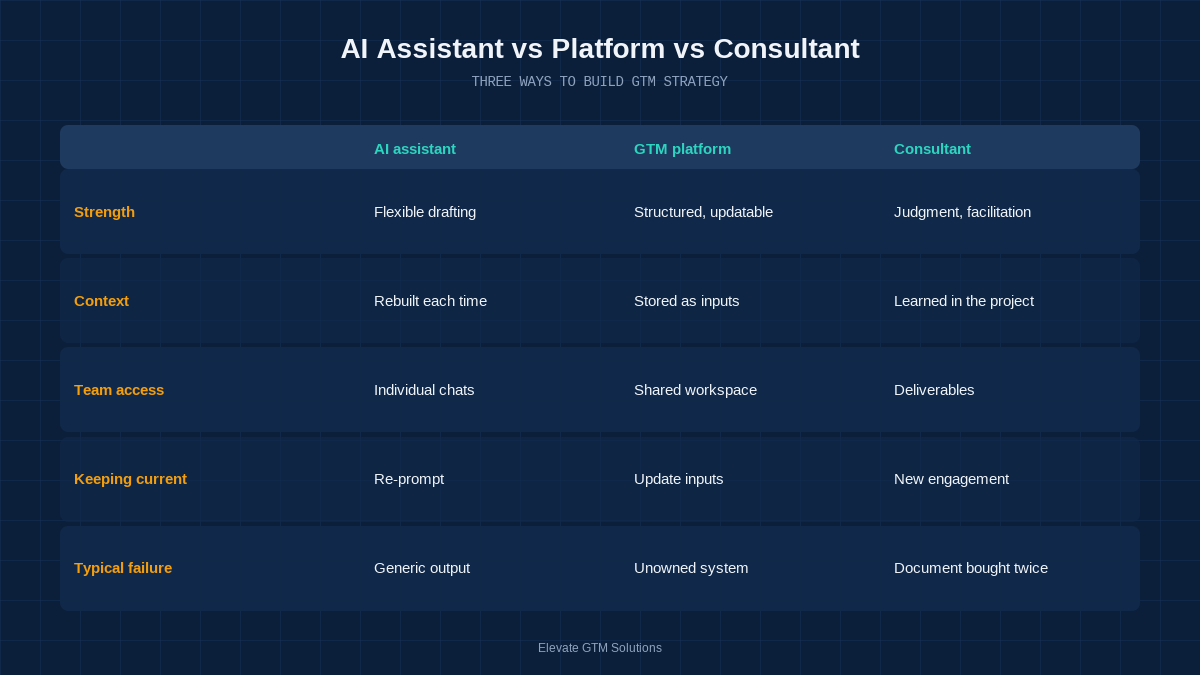
There are now three realistic ways to build go-to-market strategy: an internal team using general AI tools, an outside consultant, and a purpose-built GTM platform. Each has a different cost structure, a different kind of strength and a different way of failing. The first decision is not which to buy, but which work needs help and who owns the result.
This guide uses two published AI studies to frame what AI can and cannot do for knowledge work, then compares the three options on evidence, effort, speed and ownership. Elevate sells a GTM platform and a limited advisory practice, so we have an interest in one of the three. We have tried to describe each fairly.
Should You Build GTM Strategy In-House With AI, Hire a Consultant, or Use a GTM Platform?
Use general AI tools for exploration and drafting, a consultant for independent judgment, facilitation and evidence you cannot gather, and a GTM platform for the structured, recurring work of building and updating strategy. General AI assistants are flexible but do not keep a shared, connected strategy. Consultants add outside experience but are priced by the day and deliver a point-in-time document. A platform keeps the strategy structured and updatable but does not replace judgment. Most companies mix them.
Which is cheapest? For recurring work, usually a platform with an internal owner. For one decision, a short engagement.
Which carries the most risk? Any option used without a named decision owner and real customer evidence.
What two AI studies show about the sourcing decision
A Harvard Business School field experiment involving 758 consultants found that AI helped on certain tasks and reduced performance on a task outside the tool’s capability. In a different setting, a Quarterly Journal of Economics study reported higher average issues resolved per hour after introducing an assistant to customer-support agents, with substantially different effects by worker experience and skill.
Neither study compares an enterprise GTM team with an outside consultancy. The narrower lesson is that performance depends on the task and the person doing it. An internal team can test assisted synthesis of call notes against a reviewed baseline. It should evaluate buyer access, commercial judgment and implementation capacity separately. The company can then buy help for a specific gap and keep ownership of the decision.
Where a GTM platform sits between an AI assistant and a consultant
The comparison most guides make is two-way: in-house with AI, or a consultant. A platform adds a third path with its own profile.
| General AI assistant | GTM platform | GTM consultant | |
|---|---|---|---|
| Strength | Flexible drafting and exploration | Structured, connected, updatable strategy | Independent judgment and facilitation |
| Context | Rebuilt in each conversation | Stored as structured inputs | Learned during the engagement |
| Consistency across outputs | Manual | From shared inputs | Depends on the team |
| Keeping strategy current | Re-prompt manually | Update inputs and review | New engagement or retainer |
| Team access | Individual chats | One shared workspace | Deliverables and meetings |
| Outside view | None | None | Core strength |
| Cost shape | Low, often already available | Subscription | People-days |
| Typical failure | Generic output from thin context | Unowned system that goes stale | Document that is bought again |
The practical reading is that the three options solve different problems. An assistant helps an individual think and draft. A platform helps a team keep one structured strategy. A consultant helps leaders decide and gives an outside view. GTM Platform vs GTM Consultant compares the second and third in detail.
Elevate’s published plans start at USD 499 per month for Enable and USD 1,499 per month for Growth, billed annually, with custom Scale pricing; scopes, seats and revision cycles differ by plan. See the pricing page for current terms.
Choose a sourcing model based on evidence and capacity
Compare the three models on the same decision
| Decision factor | In-house AI | Outside GTM consulting | Hybrid |
|---|---|---|---|
| Evidence access | Strong when internal owners can approve and explain the right sources | Depends on access, buyer recruitment and what can be shared | Internal owners prepare evidence and external specialists test agreed questions |
| Independence | Requires a reviewer who can challenge the internal brief | An outside perspective can help if the mandate allows disagreement | Set a clear role for the outside challenge |
| Capacity | Useful where staff have time to review and implement | Can add named capacity for research or delivery | Assign work by phase and make the handoffs explicit |
| Execution | Internal teams already know the operating environment | Verify whether the provider will stay through rollout | Keep implementation ownership visible from the start |
| Time | Fast to prepare an initial view when data is ready | Timing depends on staffing, access and approvals | Often workable when internal and external tasks can proceed in parallel |
The models aren’t substitutes for clear sponsorship. An outside firm may prepare a sound recommendation and still have no one on the client side who can approve it. An AI workflow may summarize evidence quickly and still have no one who can check the claims. Name both roles before choosing the model.
Use a decision brief to divide the work
| Work | Internal owner | Outside or AI-assisted contribution |
|---|---|---|
| Define the decision | Executive sponsor sets scope and date | A specialist can challenge whether it’s the right decision |
| Gather evidence | Data and customer owners approve use | A firm can recruit buyers and a tool can organize approved material |
| Compare alternatives | Commercial lead checks implications | Specialists or AI can help develop scenarios for review |
| Approve the change | Named leader approves within authority | External contributors provide evidence and limitations |
| Operate and review | Receiving team updates workflow and measures | Outside support can help a defined rollout or handoff |
For each line, specify what the other party needs in order to do its work. A specialist can’t recruit comparable buyers without a useful profile. An analyst can’t reproduce a summary if the source was never recorded. A field lead can’t implement a narrower offer if the new rule arrives without treatment for open deals. Make those dependencies visible while the team can still choose a different approach.
Work out where uncertainty enters the decision
Evidence the company can produce itself
An internal team often knows which account records can be trusted, which opportunities are comparable and which customer commitments are already in place. Give that team the job of explaining the evidence and its limits. An AI-assisted workflow can help organize material and draft alternatives. The reviewer still needs to check whether the source supports the conclusion and whether the same definition applies to each case.
Start with the smallest question that can change a choice. If the sponsor wants to know whether a pilot should be narrower, inspect recent qualified opportunities and their deployment requirements. Avoid asking for a broad market analysis when the decision turns on a specific technical boundary. A focused question makes both human and AI-assisted work easier to evaluate.
Evidence the company may need from outside
A buyer who chose a competitor may be reluctant to talk directly to the vendor. A specialist may have a better way to recruit relevant interviewees or ask neutral questions. Ask what access is realistic and who will verify the sample. Outside research should add evidence the client cannot obtain easily, rather than repeating information already available internally.
An outside advisor can also test assumptions that are hard to challenge from inside the business. Give the advisor permission to disagree and a route to the decision-maker. Ask how the firm will distinguish evidence from interpretation. An independent perspective is useful only if the sponsor is willing to consider what it finds.
Set evidence and access requirements
Check data access before paying for speed
List the sources required for the decision. Verify which records can be used, who can interpret them and which tools or providers may access them if the team needs to compare lost opportunities. A proposed workflow that depends on restricted recordings may need a different evidence plan. Solve that during scope design, when you can still choose another method.
Use a small, traceable sample. Ask an analyst to follow each material conclusion back to its source. Compare dates, segment definitions and contradictory examples. An AI-assisted summary can help organize the review. It can also make weak evidence sound decisive. Define which claims need direct review and who can send an output back for correction.
External work needs the same scrutiny. Ask how the firm will recruit interview participants and handle evidence it cannot share broadly. If it uses technology or subcontractors, verify the proposed workflow with the appropriate internal owners. The level of access should match the actual work, with an agreed route for exceptions. NIST Generative AI Risk Management Profile
Set up a comparison the sponsor can audit
Build an evidence pack before choosing the delivery model
Put the decision, approved sources and current assumptions in one place. Include the last version of the offer, the relevant customer or opportunity definitions and the people who can verify the records. Identify who can speak to prospective buyers and what restrictions apply. The sponsor should know which evidence is available internally, which might be obtained externally and which remains out of reach.
Give each sourcing option the same task. For example, decide whether to narrow the first offer to customers using a supported deployment. The internal team should explain what it can learn from existing opportunities and approved buyer interviews. The external firm should explain what additional evidence it could bring. Ask what the hybrid handoff would look like. The comparison should show which choice resolves the uncertainty most reliably.
Include a contradiction. One seller says the offer is too expensive, while delivery records show several prospects could not meet technical prerequisites. Ask each proposed team how it would investigate both explanations. A plausible synthesis is a starting point. The sponsor needs to know what would support a price test and what would support a narrower eligibility rule.
Keep AI output separate from verified findings
An AI-assisted analysis might group reasons opportunities stalled or summarize several approved sources. Have an analyst check the underlying records. Look for inconsistencies in time windows, missing information and unusual deals that change the interpretation. Calculate it from governed data rather than treating generated prose as the calculation if the workflow uses a numerical comparison.
Give reviewers a way to mark an item as open. An apparent competitor change may refer to a different product or geography. The analyst can preserve it as a question for research without allowing it to become an approved recommendation. This makes the output more useful when the available evidence is incomplete.
Verify the high-consequence claims first. If a recommendation would change the offer, pricing or customer commitment, ask for the original evidence and a plausible alternative. The person who approves the choice should understand what the evidence can support. A brief that is quick to produce can still be a poor basis for a decision if reviewers cannot reproduce the reasoning.
Decide which work should remain independent
Some decisions benefit from an outside view even when the internal team can do the analysis. A pricing review may involve people whose targets depend on the current model. A decision about a new market may be championed by an executive who wants to launch. An independent reviewer can challenge the assumptions if they have access and an explicit mandate to surface contrary evidence.
Use independence for a defined purpose. The outside team should evaluate the evidence, check how the alternatives were framed and describe what would change its recommendation. Keep investment and customer decisions with the authorized owners. Make that interest visible and evaluate the next phase separately if the firm also wants to sell the implementation.
The company can preserve internal knowledge while buying outside challenge. An internal owner can maintain the decision record and explain company constraints. The external reviewer can inspect a bounded question and show the evidence behind its response. This makes it possible for the enterprise to take over without losing the benefit of an independent check.
A hybrid test for a paid offer that keeps stalling
Run the hybrid model on a paid evaluation
A hypothetical company wants to learn whether a paid pilot is priced correctly. Internal analysts can identify similar opportunities and confirm the current terms. An independent researcher can speak to buyers who decided against it. The sponsor wants to know whether the company should test different pricing, narrow eligibility or change the offer.
Start with a common definition of a qualified opportunity. Give the outside researcher a sample description and agree on who can speak to participants. The internal team should review which deals were actually eligible and where they stalled. The two streams can run in parallel if they use comparable questions and record limitations.
Suppose the researcher finds buyers were willing to pay but expected more implementation than the offer included. Internal records show that the longest delays occurred where prerequisites were discovered late. The evidence suggests a test of clearer eligibility and scope. Finance and delivery can estimate the impact. The internal sponsor owns the decision and the external specialist can explain what findings should not be generalized.
Decide what you would do with a contradictory result
Take the offer example and suppose the internal analysis points to pricing while the outside interviews point to deployment. Both may be accurate for different groups. Check who was included, what offer they received and whether the cases were comparable. Ask whether a price change would have mattered to buyers who could not meet the prerequisites. Then ask whether deployment changes would matter to qualified buyers with an unresolved budget objection.
Design the next test around the distinction. The enterprise could hold price constant and apply a clearer eligibility rule to a small cohort. It could separately test a commercial option with customers who can already deploy. Keep the results separate and give the sponsor a review date. This makes the next decision easier to explain, even if the evidence remains inconclusive.
Use this exercise in provider selection. An external firm should be able to explain what would disprove its recommendation. An internal team should be able to distinguish an AI-generated pattern from what the records show. A hybrid team should be able to combine the two sources without losing their limitations. It can support a better review than one that assumes the answer will be obvious if a proposed workflow can handle conflicting evidence.
Compare client effort, schedule and the quality of the answer
Compare the options in a second example
A hypothetical software vendor wants to expand into another industry. The product team believes the new buyers will accept the same configuration. The sales team has a few warm contacts but little access to the person with budget. The internal analysts can review current customer patterns and estimate capacity. They cannot establish buying access by extrapolating from the existing market.
The sponsor could use an internal AI-assisted approach to prepare the questions and organize approved evidence. It could buy outside interviews to test access, then ask the internal team to estimate delivery. A broader consulting engagement might help if the company also lacks someone to lead the commercial decision or execute the first cohort. Compare the scopes based on the missing evidence and the work each team can actually own.
Suppose the outside interviews show interest from users while the economic buyers prefer an internal workaround. The sponsor can ask the team to test whether an approved outcome changes the budget decision before funding sales capacity. The enterprise should assess that cost and scope if the firm instead finds that buyers would pay but need a different delivery model. Neither finding requires the same next phase.
Compare cost and schedule through the same outcome
Count the internal work in each option
An internal approach needs people to prepare data, verify sources, interpret customer evidence and run the decision review. An external approach needs internal access, approvals and a receiving owner. A hybrid approach has both responsibilities and a handoff. Estimate who does the work and when rather than comparing a software subscription with a broad consulting fee.
Distinguish cash spending from scarce staff time. An internal analyst may be available within the budget but already committed to a launch. The external provider may add research capacity and still require a delivery owner to act on the result. Give both options an honest picture of what the enterprise can supply. Where a resource cannot be moved, change the plan before selecting a model.
Check which work can run in parallel
An internal team can prepare approved opportunity data while an outside researcher recruits buyers. The two streams should agree on the population and questions first. Otherwise the company may receive two credible analyses that describe different problems. Set a review before either side draws its final conclusion.
Check what depends on a sponsor. A provider can deliver research before a decision date and still wait for leadership to approve the pilot. An internal AI workflow can prepare the options faster while the same approval remains the constraint. Put the decision path and schedule next to each sourcing proposal. The fastest research method may not produce the earliest usable result.
Run a small trial with a clear owner
Define the expected outcome
The first phase might need an explanation for low pilot conversion and a proposed test. The output should identify which accounts were examined, what the evidence says, what it does not establish and how to validate the recommendation. The sponsor should receive a date to choose the next step. The enterprise should know which scope it is approving and which decisions stay open.
A hypothetical trial could compare two explanations using a small set of similar opportunities. Internal staff verify eligibility and progression. An outside specialist interviews a few qualified buyers who declined. AI can help organize the approved notes and highlight contradictions. A reviewer checks the sources and a sponsor decides which explanation is worth testing. The company can see what each contribution added.
Compare the trial with the internal baseline
Ask what the company could have produced using its current process. Use the same question and a comparable set of cases. A hybrid approach may improve the depth of evidence while taking longer. An internal approach may reach a reliable answer quickly when the evidence is already available. Choose based on the decision’s urgency and exposure rather than assuming one result should always win.
Record useful differences in a simple table. Which sources were available, which claims could be verified, how much internal time was used and what action followed? If the methods reached similar recommendations, ask which produced a result the enterprise could operate and maintain. If the results differ, find out which evidence or assumption explains the difference before selecting an approach.
Design the handoff, then test it
Decide how the company will operate the result
Give every part of the work an owner
The internal owner should know where the decision and sources live, how to update the strategy and who can approve a change. The outside team should know what work it must transfer and which evidence it can share. If AI helped prepare the analysis, keep the source path and approval record available. The next owner should not have to recreate the analysis from a summary.
The receiving team should perform one follow-up. Have a rep apply the revised eligibility rule, a delivery owner check the same account and the analyst reproduce a small result. The handoff needs work if the teams need the provider to explain basic assumptions. Decide whether to narrow the pilot or make an approved implementation change if the system cannot represent a scope decision.
Compare the options again after the first phase
The initial model may change. An outside specialist might have supplied evidence the business can now collect itself. An internal AI workflow may prove useful for preparing reviews while the company continues to buy independent research for consequential decisions. A hybrid approach is justified when each part has a clear purpose and the handoff is reliable.
Review evidence quality, client effort, speed and the work required to implement the next choice. Include the cost of any recurring external support. Choose the model that improves the decision the business actually faces. A purchase should make the workflow easier to operate, with accountability for the approved result.
Design a hybrid workflow around two handoffs
From the company to the outside specialist
Provide an approved brief with the decision, relevant definitions, known constraints and the access the specialist can use. The specialist should receive a contact who understands the records. If information is restricted, agree on what the company can share and which questions may need another source. Keep the handoff small enough to verify.
The specialist should restate the question before beginning. They should be able to explain the alternatives and what evidence would help the sponsor decide. If they describe the scope differently, settle it before the first interview. A disagreement at this point is easier to resolve than a final report that answers a different question.
From the specialist back to the operating team
Require findings the receiving owner can trace and use. The provider can describe its method, limitations and recommendation, while the internal team determines which strategy or field decisions follow. Give delivery, sales and Finance a chance to test implications. When the recommendation changes scope, record who approves it and how the field will see it.
Let the internal owner lead the next review. They should be able to explain the source of a material finding, identify what remains uncertain and update the decision record. If they still depend on the provider for ordinary interpretation, the handoff needs more detail or continuing support that the enterprise deliberately buys.
Work through a failed handoff before the project goes live
Imagine the provider sends a strong recommendation to narrow the offer, but the receiving team cannot tell which buyer cases support it. The field receives a summary without the effective date or handling for open deals. The analysis may be useful while the operating decision remains unclear. The team should receive a chance to recover during the pilot rather than discovering the problem in production.
The provider should deliver a source record, the recommendation and known limitations. Have the internal owner specify which policy changes and who approves it. Then give a manager an actual case and ask them to apply the new rule. Name the approved person who can verify it if a particular source cannot be transferred. This makes the handoff testable even where access is limited.
Treat a failed handoff as information about the sourcing model. The company might need a more capable internal owner, a better provider deliverable or a narrower integration. Fix the part that failed and run the case again. Extending the engagement without changing the responsibility may add cost without improving the next decision.
Make the receiving team responsible for a real change
Have the internal owner update one approved decision while the provider is still available. Ask a seller and delivery lead to apply it to the same example. If they use different rules, fix the source or approval path and retest. The goal is to learn whether the organization can operate the decision without depending on the person who prepared the original analysis.
A clean handoff can change what the company buys next. It may need another research phase but no outside support for routine decisions. It may want more help with implementation if the new workflow is difficult to maintain. Use the result to shape a narrower scope and give the sponsor a choice. The enterprise can adjust the delivery model as its capability changes instead of renewing the original arrangement by default.
Decide which capability to keep internally
Make a decision about what to build internally
The first engagement can reveal a capability worth developing. If buyer research frequently changes important decisions, the company may want a repeatable research process. If internal teams can analyze customer evidence but need a periodic independent challenge, retain that narrow external role. Identify who can maintain the workflow and verify its outputs if the work depends on an ongoing tool.
Give leadership three options at the next review. Keep the internal approach, buy a defined external contribution, or continue a hybrid model with clear handoffs. State the work each option can accomplish, the expected cost and the condition that would change the choice. The team should be able to adapt as it gains evidence and capacity.
What the sponsor should be able to explain afterward
The sponsor can state which decision was made, why the chosen sources were credible and who owns implementation. They can explain what the AI-assisted workflow contributed, what people verified and where an outside specialist added something the company could not obtain. They can also identify the assumptions the team will review again. That is a useful decision record regardless of which sourcing model the enterprise chooses.
A sourcing matrix for a decision with three evidence gaps
Consider a hypothetical cybersecurity software company deciding whether to launch a managed service alongside its product. It needs to verify willingness to pay, understand whether its team can operate the service and determine what the new offer would displace. Those questions can require different approaches. Assign each to the team that can produce reliable evidence under the constraints.
| Question | First source to use | Where to bring in help |
|---|---|---|
| Do qualified buyers want a managed offer? | Existing account and lost-deal evidence, reviewed under approved rules | Independent recruiting if the vendor cannot reach buyers who chose alternatives |
| Can the company deliver the scope? | Time records, service owners and a rehearsal using representative cases | A specialist if the team lacks experience with a required workflow |
| What does the investment displace? | The internal budget and capacity model | Independent challenge if the assumptions are contested |
| What should the field test? | An approved offer and clear eligibility rules | Outside support if the team cannot run the test or transfer the work |
The company can ask AI to organize approved interview notes and compare cases. An analyst can trace the conclusions to the source and mark questions the evidence cannot resolve. An independent researcher can test willingness to pay with buyers the company cannot reach directly. Delivery and Finance still need to establish which promise the enterprise can make and what it costs. Keeping those responsibilities distinct helps the sponsor know why the combined result is credible.
Suppose the first interviews suggest demand from organizations that need more support than the company can provide. The sponsor could approve a narrowly scoped service for customers with standard requirements, defer the offer or fund a more capable delivery model. A provider should explain which evidence supports each choice. The internal team should verify the implications with product and delivery before changing the plan.
Score the sourcing option after a real decision
At the review, ask whether the work improved evidence, decision quality or time to action. An internal workflow might win on speed because approved sources were available. An outside specialist might add value because they reached buyers the company could not interview. A hybrid approach might cost more and still be preferable if it combines both with a workable handoff. Compare what each did against the question it was supposed to answer.
Add a condition for reconsidering the arrangement. It may reduce external scope if the enterprise builds a credible buyer research process. It may want an independent review again if a consequential decision involves conflicting internal incentives. A sourcing model is a choice the enterprise can revisit as evidence and capability change.
Where Elevate fits in a hybrid model
Elevate is an AI-native GTM operating system. It connects GTM context, intelligence, strategy, activation, execution and analytics, with 15 specialist modules plus Unified GTM Strategy and Elevate Pulse for recurring priorities. It gives your team a structured place to hold inputs, strategy and activation work while a specialist can still conduct interviews or challenge the commercial assumptions. Put those findings through the same review and decide who updates the plan. If you want delivery help, evaluate Guided GTM against the same brief. See the platform page, the pricing page and Can a GTM Platform Replace GTM Consulting?, or request a demo.
Frequently Asked Questions
Should I use AI, a consultant or a GTM platform?
Use AI assistants for exploration and drafting, a consultant for independent judgment and facilitation, and a platform for the structured, recurring work of building and updating strategy. Most companies combine them and keep a named decision owner.
What is the difference between a general AI assistant and a GTM platform?
An assistant is a flexible conversation partner whose context you rebuild each time. A platform stores structured inputs, connects outputs for customer definition, positioning, messaging and plans, and gives the team one shared workspace.
Can AI replace a GTM consultant?
AI can speed up structured drafting and analysis, but it does not provide independent judgment, primary customer research or facilitation. Published field studies show AI helps on some tasks and hurts on others, so outputs need review.
Can an internal team run the whole strategy with AI assistance?
It can if it has buyer access, time to verify evidence and leaders who can decide. Test one change end to end before expanding the process.
When does an independent advisor add the most value?
When internal incentives are shaping the answer, or when an important skill or source is missing. Give the advisor a bounded question and a mandate to surface contrary evidence.
What’s the first thing to test in a hybrid model?
Test the handoff of one finding. The outside team should show the evidence, the internal owner should be able to act on it, and the receiving team should know which version is approved.