
By the Elevate GTM Solutions Team · Updated November 10, 2026 · 23 min read
What GTM Consulting Includes, and Which Parts a Platform Can Cover
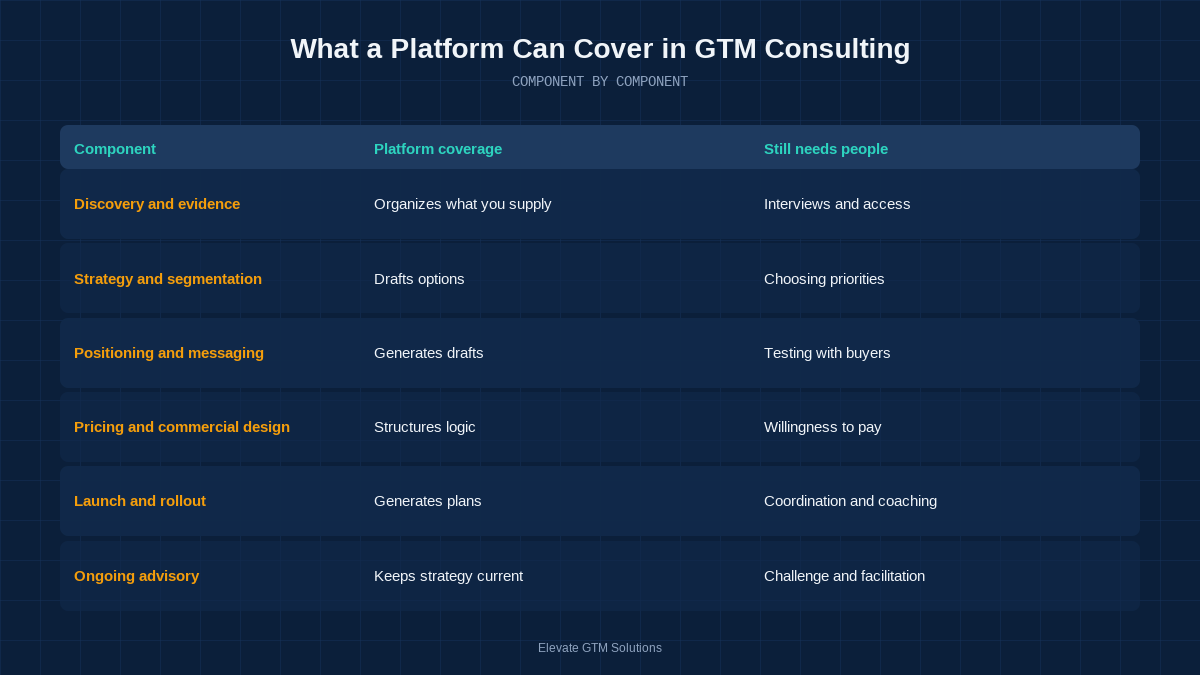
GTM consulting is sold as a bundle: discovery, strategy, messaging, assets, rollout and advice. When the bundle is vague, buyers cannot tell what they are paying for, and cannot tell which parts could be done another way. This guide breaks the bundle into its components, compares five common engagement types, and shows which parts a GTM platform can cover and which still need people.
It also shows how to scope an engagement so the work, the deliverables and the handoff are clear. Elevate sells a GTM platform and a limited advisory practice, so we have an interest in the platform side of the comparison. The scoping advice applies whichever way you buy.
What Does GTM Consulting Include?
GTM consulting typically includes discovery and evidence gathering, strategy and segmentation, positioning and messaging, pricing and commercial design, launch support, enablement and rollout, and ongoing advisory. A GTM platform can cover much of the structured drafting, planning and updating within these, but it does not replace independent judgment, primary customer research, facilitation or change management.
Which parts are most replaceable? Structured drafting from inputs you hold and keeping the strategy current.
Which parts need people? Interviews, neutral facilitation, change management and external validation.
Choose the engagement
Five engagement types and where they fit
| Engagement | Hire it to answer | Expect to receive | What to ask before signing |
|---|---|---|---|
| Diagnostic | Where is the current commercial system breaking? | Evidence map, prioritized constraints and tests to verify the diagnosis | Can you show how you will distinguish symptoms from causes? |
| Market entry or product strategy | Which market, buyer and offer should we pursue? | Segment options, market assumptions, competitive evidence and investment gates | Which evidence will you collect directly and what gaps might remain? |
| Commercial design | How should the company cover, sell to and serve the chosen market? | Coverage options, route to market, operating model and migration risks | Who will model impacts on sales capacity and the customer experience? |
| Launch or rollout support | How do we get the decision into the field and verify adoption? | Activation plan, training and asset ownership, pilot scorecard and handoff | Who will work with our teams during rollout, and what can they approve? |
| Embedded advisory | How do we keep making good commercial decisions while our team builds capacity? | Defined cadence, named advisor, decision record and escalation boundaries | Is the advisor accountable for recommendations, delivery, or line management? |
The boundaries can move during discovery. A vendor asked to redesign territories may find that customer segmentation and routing definitions are inconsistent. That finding can justify a scoped change. The consultant should explain what can be completed under the original agreement, what requires a new decision and what the client can do internally. The contract should give both teams a way to handle new facts without starting the engagement again.
A worked example of choosing scope
A hypothetical SaaS company has two product lines and plans to sell a new governance capability into its installed base. Its executive team believes it needs a GTM transformation because the previous release generated interest but few paid deployments. Three internal conversations expose more precise issues. Account owners do not know which customers qualify. Security reviews begin late. The delivery team cannot reliably estimate implementation time.
A broad market study is unlikely to answer those questions quickly. The first useful engagement is a diagnostic limited to recent opportunities, the eligibility rules and the deployment path. The partner should review a stratified sample of deals, speak with sellers and implementation staff, and produce an evidence map. The deliverable should distinguish a buyer problem, an offer problem and an internal execution problem, with remaining uncertainties visible.
The second phase should redesign eligibility and the pilot if the review finds that the underlying use case is valuable but technical access blocks progress. If customers consistently reject the value proposition after the technical objections are addressed, the second phase should revisit the offer or the target audience. Those choices have different owners and require different specialists. Buying both in advance reduces the client’s ability to act on discovery.
The company can make the contract easier to manage by authorizing diagnosis first, with an option to scope the next phase. It should still agree on the evidence required for the next decision, otherwise an open-ended second phase may become the default outcome.
Decide whether you need outside help at all
Write down what the internal team would do if the company did not hire a firm. If product marketing can already reach the right buyers, sales leadership can resolve coverage decisions, and RevOps can model the effects, the outside team may add little to a straightforward planning cycle. A short review of the assumptions can be enough. A more substantial engagement makes sense when the company needs a specialist it cannot hire in time, independence in a contested decision, or the capacity to do work that would displace something more valuable.
The counterfactual also makes the scope easier to defend internally. Suppose the company is considering a new vertical. Its internal team can estimate demand and interview current customers, but it has little access to noncustomers in that industry. Buy the research access and an independent assessment of the offer. Keep decisions about investment and product readiness with the people who will own them afterward. This scope is easier to evaluate than paying for a complete strategy that repeats internal work.
Ask whether the engagement solves a temporary constraint or an ongoing operating problem. A temporary shortage of launch staff can justify a defined execution team through release. A persistent lack of authority over cross-functional decisions usually needs a sponsor or a change to the operating model. An advisor can help design that change. The company should still say who will own it after the engagement ends.
How the scope changes by decision
A new vertical calls for evidence about access and fit
Start by identifying what must be true for the enterprise to win and serve customers in the vertical. Is the buyer reachable with existing channels? Can the product meet the technical and service expectations? What alternatives does the buyer already have, including internal workarounds? Which commitments would change the cost to serve? The consultant can then gather evidence against these questions rather than building a broad landscape that never resolves whether the business should enter.
Request a short list of segments with inclusion and exclusion rules. A segment such as “regulated industries” may combine buyers with very different approval paths and technical constraints. A useful deliverable narrows the scope to a first set of buyers the enterprise can actually reach and support. It should show what remains unknown, including whether the customers interviewed can represent the broader market.
Include a decision about how to validate the answer. A market entry project might end with a clear choice and a paid pilot design. If leadership needs to know whether prospects will buy on the proposed terms, an interview program can only take it part of the way. Make the next validation step a named activity with an owner and a budget boundary.
Coverage redesign calls for an operational model
A coverage project begins with the current sales motion, performance by segment, seller and partner capacity, and the enterprise’s commitments to existing customers. Changing how accounts are assigned is more than drawing new territories. It can alter compensation, renewal ownership, access to specialists and the quality of customer service during the change.
A comparison from the firm should apply the same definitions to each coverage option. A shift from direct to partner coverage may reduce one cost and increase another. Forecasting may become harder while the company learns how partners qualify opportunities. A model should show how the organization would handle active deals, accounts with multiple buying entities, and partners who already have a relationship with those accounts.
Plan the migration as part of the engagement. Test the assignment rules on a sample of real records before using them across the whole company. Identify the exceptions and ask who will resolve them. The consultant can model the transition and facilitate the decision. The client needs an internal owner who can approve account changes and address disputes after rollout.
Launch support calls for work products the field can use
A launch engagement should identify what the external team will help the enterprise do on the date it starts selling. Will it build the qualification guide, prepare the first onboarding cohort, run enablement sessions, or facilitate weekly reviews? “Launch support” is too broad to answer those questions. Put the expected work products, scope and delivery timing in the proposal.
Ask how the launch team will know whether the work reached the field. Sending a playbook to a distribution list is an activity. Seeing whether a seller can qualify an unfamiliar account using the playbook is an acceptance test. Invite representatives of sales, RevOps, marketing and delivery to a realistic rehearsal. Use the rehearsal to check which assumptions are still implicit.
Decide what the firm will support after the first launch. A market can produce unexpected demand from a different segment or expose a problem with the offer. A defined transition period can help the internal team learn from those signals. Set an end date and conditions for extended support so responsibility can transfer predictably.
Which parts of GTM consulting a platform can cover
Mapping the components of a typical engagement to what a platform can do helps you decide what to buy from whom.
| Consulting component | What it involves | Platform coverage | Still needs people |
|---|---|---|---|
| Discovery and evidence | Interviews, data review, competitor scan | Organizes evidence you supply and flags gaps | Running interviews, gaining access |
| Strategy and segmentation | Customer definition, priorities | Drafts and structures options | Choosing and defending priorities |
| Positioning and messaging | Narrative, claims, role variants | Generates and compares drafts | Testing with buyers and sellers |
| Pricing and commercial design | Value metric, packaging, coverage | Structures logic and scenarios | Willingness-to-pay evidence, negotiation |
| Launch support | Plan, owners, readiness | Generates plans from the strategy | Coordinating teams and dates |
| Enablement and rollout | Talk tracks, battlecard inputs, training | Derives inputs from positioning | Training and coaching people |
| Ongoing advisory | Challenge, facilitation, updates | Keeps strategy current from updated inputs | Independent challenge and facilitation |
Reading the table, the platform column is strongest on drafting, planning and updating, and the right-hand column is strongest on interviews, facilitation, coaching and challenge. Many companies now buy the platform column as a system and keep the right-hand column as a small, targeted advisory spend.
Elevate’s published plans start at USD 499 per month for Enable and USD 1,499 per month for Growth, billed annually, with custom Scale pricing; scopes, seats and revision cycles differ by plan. See the pricing page. For a fuller view of when outside help is still the right call, read When You Still Need a GTM Consultant.
Write a scope the team can deliver
What good discovery looks like
The consultant should start with one decision you can still change. If compensation is locked for the year and the partner agreement is still open, there’s little value in spending the first two weeks redesigning incentives. Have the firm show how it would use the time to test the partner route, and which facts might send it in a different direction.
Discovery also depends on access. A team cannot credibly diagnose a win-rate problem if it sees only four selected success stories and one month of aggregated CRM metrics. Define a comparison window and give the consultant access to the people who own definitions, including the person who knows why deals disappear from a report after they move to a new territory. A project can use restricted, aggregated or de-identified data where appropriate. The important step is explaining which questions the approved evidence can answer and which it cannot.
Customer evidence deserves its own plan. Ask how many conversations are included, who recruits participants, which buyers are relevant and whether the project covers lost deals or only reference accounts. Five well-chosen interviews might reveal a recurring hypothesis. They cannot establish how common that pattern is across a market. Ask what the consultant will do when customer interviews and CRM evidence point in different directions.
What should come out of the work
A strategy engagement should produce a record of the choices and the facts that support them. A useful decision memo gives the recommendation, alternatives, relevant evidence, uncertainty, cost and a review trigger. If leadership decides to prioritize one vertical, the memo should show what would make it reverse that decision. That makes the investment easier to govern and gives the internal team a way to update it as new evidence arrives.
An operating design should show the practical path from the current state to the proposed one. When the design moves small accounts from direct sales to a partner, it needs to explain which renewals are in scope, how disputes are handled, how compensation changes and who informs customers. An attractive future-state chart cannot resolve those decisions.
An implementation engagement should leave the company with operational ownership. Ask which deliverables arrive in editable form, where source research is stored, who can alter the assets after handoff and which team has authority to maintain the new workflow. Include acceptance criteria. A playbook can be delivered on schedule and still fail acceptance if an account manager cannot tell which part applies to a customer.
What the enterprise must supply
A decision-maker with time. Assign a sponsor who can choose between conflicting priorities. A sponsor who is only available for the final readout usually learns about disagreements after the project team has worked around them.
People who own the data. Give the engagement an analyst or RevOps contact who can explain how records were created and where definitions have changed. Dashboard access helps with exploration. Reliable interpretation takes context.
An implementation owner. Name the person who can take over assets, plan the rollout and ask product, marketing, sales and delivery to change how they work. An advisory firm can help that owner succeed. It cannot create internal authority without an explicit mandate.
A realistic approval path. Decide upfront whether procurement, privacy, security or regional stakeholders need to approve an approach before data moves or customers are contacted. Build the review time into the schedule. Asking the project team to meet an immovable deadline by bypassing approvals usually creates a larger delay later.
A practical statement of work
| Section | What to write | Why it matters |
|---|---|---|
| Decision and sponsor | Specify the commercial decision, sponsor and approval date | The engagement can focus on evidence the sponsor can act on |
| Scope and exclusions | List the products, regions, buyer groups and workstreams included | Both parties know how to handle a request outside the brief |
| Access and evidence | Name approved sources, owners, recruitment approach and limitations | The team can flag evidence gaps before they threaten the decision |
| Deliverables | Describe the output, intended user and acceptance criteria for each phase | A completed task can be evaluated for practical use |
| Staffing | Name the workstream leads, allocation and rules for substitution | The buyer knows who will do the work |
| Governance | Set decision meetings, escalation path and change approval | New findings can change the plan without informal commitments |
| Handoff | List editable assets, access rights, training and receiving owners | The client can use and maintain the work after closeout |
Use the table to clarify trade-offs early. If the scope includes two countries but the research budget only covers one, choose whether to concentrate the work, add access, or treat the second market as a separate question. Do that while the plan can still change. Leaving the problem open encourages a thin assessment of both markets and a recommendation based on uneven evidence.
Make the relationship between milestones and deliverables explicit. A workshop date can be useful for scheduling. It may say little about whether enough evidence is available to make a choice. Agree on what happens if access arrives late or the interviews produce an unanticipated result. The sponsor can narrow the question, extend the phase, use the evidence available with stated limits, or pause. A timeline should account for these options.
Example acceptance criteria
For an opportunity diagnostic, require a clear cohort definition, the date range, an explanation of which records were omitted, and a distinction between findings and hypotheses. One useful check is whether the RevOps owner can reproduce a selected figure. Require a proposed action and a way to tell whether it changed the problem. A report that cannot be reproduced may still contain a useful observation, but its limitations need to travel with the recommendation.
For a segment recommendation, require a definition the sales team can apply to an account, an explanation of what would exclude it, and evidence of both demand and deliverability. Ask product and delivery to review the offer. Ask an account owner to apply the rule to a handful of customers they know. The consultant should explain any segment boundary the team repeatedly interprets differently.
For a rollout plan, require a named owner for each critical handoff, dates that reflect dependencies, a way to pause the rollout, and an agreed set of evidence for the next decision. Rehearse one standard case and one exception. If the handoff relies on information only the consultant has, add that information to the operating material before acceptance.
Price the work beyond the fee
What the internal team should budget besides fees
Client time is often the largest hidden constraint. Someone must grant access, explain data, recruit customer participants, resolve conflicting priorities and decide when a recommendation should move forward. Ask each provider to estimate internal effort by role and phase. A consulting proposal can be feasible on its own staffing plan and infeasible on the client side.
Availability needs to match the schedule. An operations lead may be able to spend an hour each week during discovery and need several focused days during rollout. A finance approver may be available monthly. Reserve the decision date at the start and set an interim rule for questions that arrive earlier if the recommendation depends on a rapid decision.
Include the downstream costs of acting. A coverage redesign might require CRM changes, training and a transition plan. A new offer might require updated product identifiers, contracts, seller proof and delivery capacity. The strategy work can still be worthwhile if these costs are material. Comparing proposals on consulting fees alone leaves the buyer with an incomplete view of the investment.
Protect capacity in a way the operating leaders recognize. If sellers must spend time on interviews or pilot design, work with their managers to identify what can move. If the project needs a delivery specialist, reserve their time before making a promise. Otherwise the same resource can appear in a project plan, a renewal plan and a product launch, with three managers expecting the work to happen.
Make evidence rights and access part of the brief
Separate access to data from permission to use or share it. A project may require analysis of CRM records, customer interviews and sales materials. Each can carry different approvals and access restrictions. The consulting team needs a named data owner it can turn to when questions arise. Agree on where work products will be stored and what can be moved into the client’s environment when the engagement ends.
Ask which inputs can be shared with subcontractors or used with software or AI tools. The answer should be grounded in the provider’s proposed workflow and the client’s approval process. Set requirements before the team receives information. Projects that begin with broad data access and later try to reconstruct what happened are harder to govern and harder to hand off.
Plan for restricted sources without overstating the evidence. The firm may be able to work with aggregated opportunity data and selected recordings, with additional context from a client analyst. If that access makes certain comparisons impossible, note the limitation and decide which other evidence can reduce uncertainty. A good engagement can be useful even if the provider never gets access to raw records. It needs a clear account of what its findings can support.
Decide what happens to work products containing sensitive material. A broad team may need the decision and the reasons behind it. A smaller set of people may have access to the underlying account-level evidence. Give future owners an approved route to verify or revisit the recommendation. Editable outputs alone do not guarantee that a team can maintain the work.
Select the provider and manage the phases
Common warning signs in proposals
The answer is already fixed. A provider may have a strong hypothesis based on experience. Ask what evidence would change it. If the recommendation is independent of the evidence, the client is paying for implementation or endorsement, and the scope should reflect that.
The deliverables are defined by format. “One strategy deck and three workshops” describes volume. Ask which decisions the workshop will resolve and which artifacts the internal team will use afterward. A short decision memo and a reliable model can be more useful than an extensive presentation that leaves accountability open.
The transition is described as a handover meeting. Ask who will take over each responsibility, what system will hold the source materials, and how the team will demonstrate it can use them. One meeting can close an engagement after the work has transferred. It is a weak substitute for transfer.
The firm claims responsibility for outcomes it cannot control. A firm can commit to staffing, research and a documented implementation scope. Commercial outcomes also depend on buyer decisions, product readiness, client execution and market conditions. Ask which drivers the firm can influence and how the work will be measured. A credible outcome discussion makes those boundaries visible.
Every change is treated as a fresh project. Large changes may reasonably require a new scope. Smaller adjustments are normal when a team discovers new information. Agree on who can approve changes, when they affect fees or schedule, and how both parties will see the consequences before committing.
Compare two proposals on a common basis
Imagine the governance company receives two hypothetical proposals. One firm offers a short diagnostic and an offer recommendation. The other proposes diagnosis, offer design and participation through the first rollout. Their fee totals are different, but subtracting one total from the other does not tell the sponsor what it costs to reach the same result. The first proposal may be sufficient if the company already has a launch owner with capacity. The second may be better suited if the enterprise needs outside staffing to work through the first cases.
Give each proposal the same end state for comparison. For example, two account teams can qualify a real customer, a delivery lead can estimate scope using the proposed rules, and an internal owner can run the first review. List the work required to reach that state. Assign each item to the consultant, the client or an approved third party. Then compare expected client effort, dependencies and risks alongside the fee. If the two firms take different routes to the end state, ask which approach is easier to verify and sustain.
Check what triggers a change request. If the firm includes ten interviews and the client can recruit only six relevant participants, can the remaining time be spent on lost deals or market evidence? If scope is fixed to two products and the third product shares the same account teams, can the project test the shared coverage assumption without expanding the mandate? These questions reveal where the price is firm and where the scope depends on the first findings.
Use references to check delivery, not reputation
Pick one concern before each reference conversation. A finance sponsor might ask about the quality of the commercial model. A sales leader might ask whether managers used the resulting tools. An operations owner might ask how the firm handled data constraints. A general question about satisfaction rarely produces the detail a buying group needs.
Ask what the firm did when new evidence contradicted the original brief. Then ask how much internal work the client supplied and who kept the operating materials current afterward. The answers can tell you whether the provider operated as a facilitator, a delivery partner or a temporary extension of the leadership team. Those differences matter even when the reference had a good experience.
A reference may have worked with a different team or under a different scope. Compare the conditions rather than copying the conclusion. Ask which people from that engagement would be involved in the proposed project. Where a firm cannot provide a directly comparable reference, an anonymized work sample and a conversation with the proposed lead can still help the buyer test the approach.
Decide what success looks like at 30, 60 and 90 days
For a phased engagement, use these as illustrative checkpoints and adapt them to the buying cycle. At the first checkpoint, look for evidence that the team has isolated a credible constraint and made the open questions visible. At the next, check whether leadership has approved the relevant design and the receiving team can use it. At the third, ask what the rollout has taught the business and whether there is enough evidence to widen it.
Avoid assigning a revenue target to a period that ends before customers can complete evaluation. Early checks can still be commercial. Confirm whether suitable buyers accept the offer, whether the client can deliver the promised scope and whether the sales team can reproduce the process. Track booked revenue when the decision cycle makes it observable. The useful sequence is evidence, approved change, observed execution and commercial result.
Manage the engagement in phases
The first phase should answer the question that reduces the most uncertainty. For a new vertical, that might be whether an accessible buyer has a problem the company can solve with the current product. For a missed launch, it might be where suitable customers stop progressing. The goal is to learn enough to choose the next investment. A diagnostic that lists every conceivable issue leaves the sponsor with the same problem in a longer document.
Use the next phase to turn evidence into alternatives. A provider should be able to show how each alternative changes requirements for sales, marketing, delivery and finance. If the company is considering a channel partner, the alternatives might include direct coverage, partner sourcing with internal delivery, and partner-led delivery with a scoped support model. The decision should follow actual differences in economics, control and execution.
The implementation phase should work against the approved choice. Have the receiving owners lead a rehearsal and identify what remains hard to do. Confirm how the company will see early signs that the strategy is drifting. If execution stops for an approval gap, record the path to resolve it. A useful implementation plan makes the work easier for the teams who inherit it.
Close with an explicit handoff. Request the decision history, what remains open, the editable assets and the names of owners who have accepted them. Assign a review date and explain when the company should bring the provider back into the work. Even if advisory continues, the enterprise should understand what it can operate itself.
A phased plan for the governance launch
In the hypothetical company from the earlier example, the diagnostic can compare opportunities that moved to a paid evaluation with similar accounts that stalled. The team reviews whether each account met the same eligibility criteria, had a named buyer and received the same offer. It checks whether security became an issue because the product lacked a requirement or because the seller discovered the requirement too late. The two explanations call for different work.
The next phase can be limited to two design choices. First, define the prerequisites that identify an account that can be onboarded at the expected cost. Second, revise the evaluation offer so the buyer and delivery team agree on what the pilot proves. A consultant might draft the design and facilitate the approvals. The account owner still needs authority to schedule a pilot, and the delivery owner needs authority to reject work outside the supported scope.
For the first rollout, give two experienced teams the revised materials and ask them to use the same qualification standard. Record why any account receives an exception. When the first cohort closes, compare the time to reach a scoped evaluation, the effort required to support it and the reasons accounts did or did not convert. The company can then decide whether to broaden the pilot, address a product gap or revisit demand. The value of the engagement is easier to assess because the client can see the specific decisions the work changed.
Where Elevate fits in the engagement
Elevate is an AI-native GTM operating system. It connects GTM context, intelligence, strategy, activation, execution and analytics, with 15 specialist modules plus Unified GTM Strategy and Elevate Pulse for recurring priorities. It is designed to carry the structured drafting, planning and updating components described above, while Guided GTM and focused advisory engagements cover the parts that need people. Pricing is separate for the platform and for guided services, so you can compare each component on its own line. See the platform page, the pricing page and Can a GTM Platform Replace GTM Consulting?, or request a demo.
Frequently Asked Questions
What does GTM consulting include?
Usually discovery and evidence gathering, strategy and segmentation, positioning and messaging, pricing and commercial design, launch support, enablement and rollout, and ongoing advisory. Scopes vary, so ask for deliverables and exclusions in writing.
Which parts of GTM consulting can a platform cover?
A platform can cover much of the structured drafting, planning and updating. It does not replace primary customer research, independent challenge, facilitation or change management.
How should I scope a GTM consulting engagement?
Start from the decision, list deliverables with acceptance tests, name the people and their time, state exclusions, and agree how the work will be handed off and updated.
Is GTM consulting the same as marketing consulting?
Marketing consulting can be part of the work. A broader GTM engagement can also change segment selection, sales coverage, pricing, channel economics and implementation. The contract should specify where authority and deliverables sit because providers use the same label for different scopes.
Can a consultant implement the strategy?
Some providers offer implementation support and others stop at advisory. Ask what they can directly deliver, which platforms or teams they can work in, who manages approvals and how the work transfers after the engagement. “Hands-on” is too broad to settle those points.
How do we know the recommendation is credible?
Ask which data was used, which assumptions are doing the most work, how contradictory evidence was handled and what would change the recommendation. An output can be credible even when evidence is incomplete, provided the recommendation and its limits are clearly explained.
Should a first engagement cover the whole company?
Start with the decision that needs action and include the functions that can affect it. An enterprise-wide redesign may be justified when a shared issue crosses regions or products. A narrower pilot can expose operating constraints with less disruption before the company commits to a larger change.