
By the Elevate GTM Solutions Team · Updated November 10, 2026 · 22 min read
What Does a GTM Manager Do? Responsibilities, Skills, Metrics, and How the Role Differs From Neighboring Roles
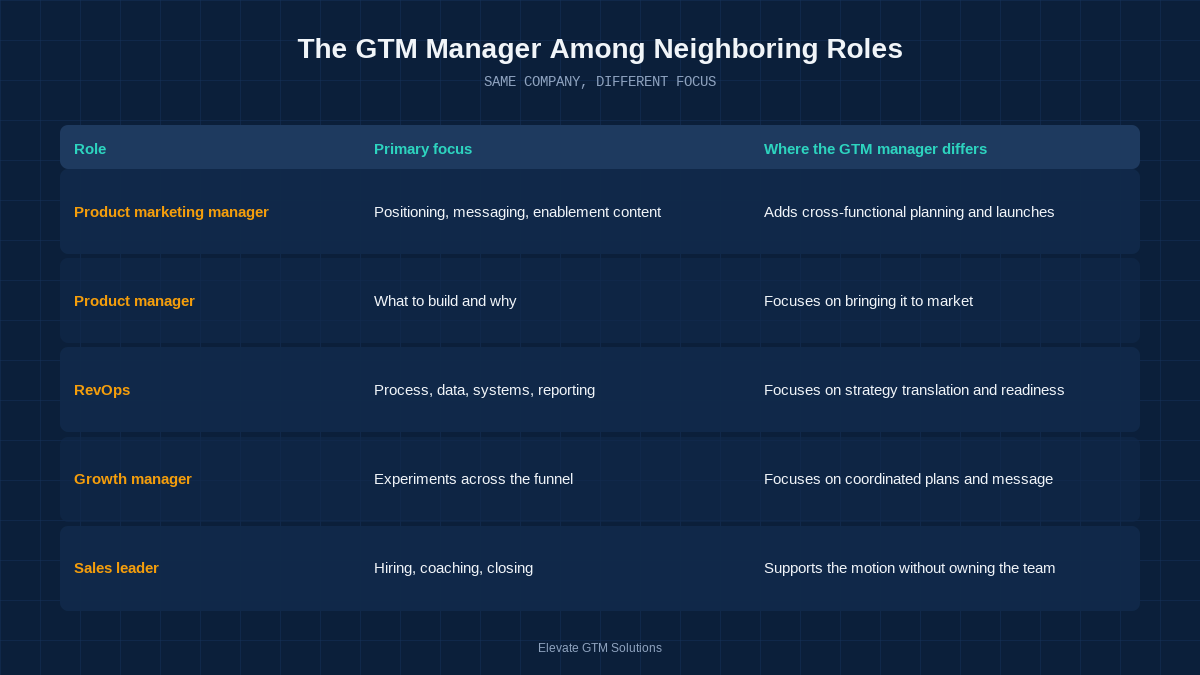
Job titles in go-to-market are slippery. A "GTM manager" at one company runs product launches. At another, the same title belongs to someone who owns a regional sales plan, or who sits between marketing and sales and keeps them aligned, or who is effectively a product marketing manager with a wider brief. Candidates and hiring managers both struggle, because the title does not tell you what the job is.
This guide describes what a GTM manager typically does, why the role exists, how it differs from the roles around it, what skills it needs, how to hire for it, how to measure it and how to set up the first ninety days. It describes common practice, not a standard, so treat it as a menu to adapt. Elevate GTM Solutions makes a GTM strategy platform that GTM managers often use to hold the decisions they coordinate, and it does not replace the people who make and carry out those decisions, so we say plainly where judgment matters. We include no salary data, because figures vary widely and we cannot verify them.
What Does a GTM Manager Do?
A GTM manager coordinates the decisions and work that bring a product or offer to market and keep it growing: they help define who the customer is and what the message is, plan and run launches and campaigns across marketing, sales, product and customer success, equip the field, gather and share market and customer insight, and measure whether the plan is working. They own coordination and follow-through more than any single function. The title varies, so what matters is what the role owns, who decides what and how success is measured.
Is a GTM manager the same as a product marketing manager? The roles overlap. Product marketing usually owns positioning, messaging and enablement content, while a GTM manager often adds cross-functional planning and execution.
Is it a senior role? It can be junior, mid or senior depending on scope. A single product launch is a smaller job than a company-wide GTM operating rhythm.
Why the role exists
| Problem | How a GTM manager helps |
|---|---|
| Teams work from different assumptions | Maintains a shared plan, customer definition and message |
| Launches slip or land flat | Coordinates readiness across product, marketing, sales and success |
| Strategy does not reach the field | Translates decisions into material, training and handoffs |
| Feedback from the field is lost | Collects it and brings it to the people who decide |
| Several products or segments compete for attention | Sequences priorities and manages cross-sell rules |
| Nobody owns the seams between functions | Takes responsibility for the handoffs |
The role is a response to coordination costs. The more products, segments and teams a company has, the more it needs someone to hold the connecting work.
Typical responsibilities
| Area | What it involves |
|---|---|
| Strategy translation | Turning customer, positioning and pricing decisions into plans others can act on |
| Planning | Building and maintaining the GTM plan for a product, segment or region |
| Launches | Running launch readiness, timelines, communication and reviews |
| Cross-functional coordination | Running regular syncs across product, marketing, sales, success and operations |
| Enablement inputs | Ensuring sellers and success teams have the customer profile, talk tracks and training they need |
| Market and customer insight | Gathering win and loss evidence, buyer conversations and competitor changes |
| Pricing and packaging support | Providing evidence and coordinating decisions with finance and product |
| Measurement | Defining measures, reporting on progress and leading reviews |
| Experimentation | Proposing and tracking tests of messages, channels and segments |
| Governance | Keeping records of decisions, exceptions and owners |
| Stakeholder communication | Keeping leadership and teams informed |
No one does all of these equally well. Companies emphasize the ones that matter most for their stage.
How the role differs from neighbors
| Role | Primary focus | Where a GTM manager differs |
|---|---|---|
| Product marketing manager | Positioning, messaging, competitive framing, enablement content | A GTM manager adds planning, coordination and launch execution across functions |
| Product manager | What to build and why | A GTM manager focuses on bringing it to market |
| Marketing manager | Campaigns and channels | A GTM manager spans marketing, sales and product |
| Sales operations or RevOps | Process, data, systems and reporting for revenue teams | A GTM manager focuses on strategy translation and launch planning, with RevOps carrying out configuration |
| Growth manager | Experiments across acquisition, activation and retention, often in product | A GTM manager is more about coordinated plans and message than experiments in the product |
| Sales leader | Hiring, coaching and closing | A GTM manager supports the sales motion without owning the team |
| Chief revenue officer | Accountable for revenue across functions | A GTM manager supports the plan and coordination under such leaders |
| Strategy lead | Company-level direction | A GTM manager works at the level of products, segments and launches |
Where a company has a product marketing team and a RevOps team, a GTM manager often sits between them. Where it does not, the GTM manager may do parts of both. Our guide to who owns GTM strategy covers decision rights, and What Is Revenue Operations? covers the neighboring function.
A week in the role, illustrated
This is an invented sample week for a GTM manager responsible for one product line.
| Day | Activity |
|---|---|
| Monday | Review last week's pipeline themes and customer questions with sales leaders. Update the plan's risks |
| Tuesday | Run the cross-functional sync: launch readiness status, blockers, owners. Update the timeline |
| Wednesday | Interview two customers and a lost prospect. Add notes to the evidence log |
| Thursday | Work with product marketing on a revised objection response. Brief sellers on a competitor's change |
| Friday | Prepare the weekly summary for leadership with measures and decisions needed. Plan next week |
Notice how much of the week involves listening, coordinating and recording, and how little involves producing assets alone. In many companies, the GTM manager's value lies in making sure the right people have what they need at the right time.
Skills the role needs
| Skill | What it looks like in practice |
|---|---|
| Customer understanding | Runs good interviews and turns them into clear definitions |
| Structured thinking | Writes plans and decisions that others can follow |
| Communication | Explains trade-offs briefly to executives and sellers alike |
| Influence without authority | Aligns teams without being their manager |
| Project management | Tracks dependencies, dates and owners |
| Commercial judgment | Understands pricing, sales process and economics |
| Analytical ability | Reads funnel and segment data with caution |
| Writing | Produces clear messages, briefs and summaries |
| Facilitation | Runs decisions meetings that end in decisions |
| Honesty | Reports what the evidence says, including when it is unwelcome |
| Product literacy | Understands how the product works well enough to explain it |
| Comfort with AI tools | Uses them for drafts and analysis with review |
Hiring: what to look for and how to test
| Criterion | What to test | How |
|---|---|---|
| Customer insight | Can they learn from buyers? | Ask them to describe how they would interview five customers and what they would do with the notes |
| Planning | Can they structure a launch? | A case: plan a launch for a feature with these constraints |
| Cross-functional skill | Can they align people? | Ask about a time they resolved a disagreement between sales and product |
| Writing | Can they be clear? | A short written brief on a given scenario |
| Judgment | Do they make trade-offs? | Ask them to prioritize among competing requests |
| Measurement | Do they choose sensible measures? | Ask what they would track after a launch and why |
| Integrity | Do they report honestly? | Ask about a plan that did not work and what they said |
| Fit with scope | Do they match the level you need? | Compare their past scope to yours |
Interview questions that work
- Describe a launch that did not land. What did you learn?
- How do you decide what goes in the message and what stays out?
- Tell me about a time sales and product disagreed. What did you do?
- How would you find out why we lose deals?
- What would you measure in the first month after a launch?
- How do you keep a plan alive after the launch meeting?
- How do you use AI tools in your work, and how do you check them?
The first ninety days
Days 1 to 30: listen and map. Meet leaders in product, marketing, sales, success and operations. Read the strategy, the playbook and recent launch material. Listen to calls. Interview customers. Write down where people disagree about the customer, the message and the plan.
Days 31 to 60: settle and plan. Hold a working session to settle the customer definition, message pillars and priorities for one product or segment. Write a one-page plan with owners and dates. Set up the cross-functional sync and the evidence log.
Days 61 to 90: run and review. Run the plan. Hold the first monthly review with results and decisions. Publish what changed and why. Propose the next quarter's priorities.
Aim for visible wins early: a shared one-page plan, a regular meeting that people find useful and a decision log that shows what was settled.
A launch readiness checklist
A GTM manager often owns this check. Run it two to three weeks before release.
| Area | Question | Owner |
|---|---|---|
| Customer | Is the target customer defined, with exclusions? | Product marketing |
| Positioning | Can two sellers repeat it in their own words? | Product marketing |
| Messaging | Does each pillar have proof or a label saying it is untested? | Product marketing |
| Pricing | Is pricing decided, documented and entered in tools? | Finance and product |
| Product | Are known limitations documented honestly? | Product |
| Enablement | Have sellers and success staff been briefed, with practice? | Enablement |
| Assets | Are the deck, one-pager, demo script and FAQ approved? | Marketing |
| Channels | Does each channel have an owner and a goal? | Marketing |
| Support | Is support ready with documentation and escalation? | Support |
| Measurement | Are measures defined, tagged and tracked? | Operations |
| Communication | Is the plan for customers, partners and the field set? | GTM manager |
| Risks | Are the top risks listed with responses? | GTM manager |
| Decision | Go, narrow or hold, and who decides? | Executive sponsor |
A launch that cannot answer several rows is probably not ready.
A stakeholder map and communication plan
| Stakeholder | What they care about | What they need from the GTM manager | Cadence |
|---|---|---|---|
| Executive sponsor | Outcomes, risks, resources | A one-page status with decisions needed | Weekly or biweekly |
| Product leader | What ships, for whom and when | Market evidence and launch implications | Weekly |
| Sales leaders | Quota, enablement, clarity | Customer profile, message, training and timing | Weekly |
| Marketing leaders | Campaigns and pipeline | Message, priorities and measures | Weekly |
| Customer success | Customer promises and adoption | Briefings and feedback paths | Biweekly |
| Finance | Pricing, forecast, budget | Evidence and assumptions | Monthly |
| Regional leaders | Local fit | A clear standard and an exception process | Monthly |
| Support | Volume and clarity | Early notice and documentation | Before and after launch |
Keep messages short, specific and honest about what is undecided.
A decision log
A decision log is the GTM manager's most useful artifact.
| Field | Entry |
|---|---|
| Date | When the decision was made |
| Decision | What was decided |
| Options considered | The alternatives |
| Evidence | What supported the choice |
| Decider | Who decided |
| Dissent or open questions | What remains uncertain |
| Review date | When to revisit |
| Impact | What changes as a result |
Share the log with the people affected. It prevents repeated debates and helps new hires understand why things are as they are.
Sample deliverables in the first ninety days
| Deliverable | What it contains |
|---|---|
| Landscape summary | Who decides what, where teams disagree, what evidence exists |
| One-page plan | Customer, message, priorities, owners and dates for one product or segment |
| Evidence log | Interviews, win and loss notes, competitor observations |
| Decision log | The first five decisions with reasons |
| Launch readiness checklist | Adapted to your company |
| Review calendar | Weekly sync, monthly review and quarterly reset |
| Feedback loop | A simple route for field questions to reach the message owner |
| First review pack | Results, learning and next priorities |
The loop with sellers and success teams
| Practice | How it helps |
|---|---|
| Monthly seller conversation | Learn what buyers say and what material works |
| Call listening | Hear the message in practice |
| Success team check-in | Learn what customers were promised and what they struggle with |
| Quick feedback channel | A place for questions, with visible answers |
| Credit | Tell people when their feedback changed something |
| Retire what does not work | Remove outdated material |
The role depends on trust with the field. Visible responsiveness builds it.
Paths into and out of the role
| Direction | Typical routes |
|---|---|
| Into the role | Product marketing, sales or marketing operations, customer success, consulting, product management, strategy |
| Out of the role | Head of product marketing, head of GTM or strategy, revenue operations leadership, product leadership, general management |
The mix of skills is broad, and many people in the role grow into leadership because they understand how the functions fit together.
Terms used in this guide
| Term | Meaning |
|---|---|
| GTM manager | A role that coordinates the decisions and work that bring an offer to market |
| Launch readiness | A check of whether the company is prepared to release |
| Decision log | A record of decisions with reasons and owners |
| Evidence log | A record of customer and market evidence |
| Go, narrow or hold | The release decision options |
| Cross-functional sync | A regular meeting across teams |
How to measure the role
Measuring a coordinating role is hard, because outcomes depend on many people. Use a mix.
| Level | Example measures |
|---|---|
| Outcomes the plan targets | Qualified conversations, pipeline, win rate and adoption for the product or segment |
| Launch quality | Readiness checklist completion, on-time delivery, early signals after release |
| Alignment | Message consistency across site, deck and emails, seller recall, time to update material after a change |
| Cadence | Share of planned reviews held and decisions recorded |
| Learning | Win and loss interviews completed, changes made from evidence |
| Stakeholder feedback | Short surveys of sellers, success and product leaders on usefulness |
Be careful about claiming that the role caused business outcomes. Show the process and alignment improvements and link them to outcomes with modest language.
Decision rights and common friction
| Decision | Typically decided by | The GTM manager's role |
|---|---|---|
| Product roadmap | Product | Brings market evidence, flags launch implications |
| Positioning and message | Product marketing, with leadership | Facilitates, tests and records |
| Pricing and packaging | Finance, product and leadership | Provides evidence and coordinates |
| Sales process and compensation | Sales leadership | Advises and aligns the plan |
| Launch timing | Product with GTM readiness input | Owns the readiness assessment and recommendation |
| Budget | Functional leaders and finance | Proposes priorities |
Friction arises when the role has responsibility without authority. Write down decision rights, name an executive sponsor and agree escalation paths. Our guide to the GTM planning template offers a format for the plan.
Tools a GTM manager uses
| Need | Tool types |
|---|---|
| Plans and decisions | Documents, a strategy platform such as Elevate GTM Solutions, project tools |
| Customer evidence | Interview notes, call recordings, win-loss records |
| Pipeline and results | CRM and dashboards |
| Coordination | Shared workspaces and project tracking |
| Enablement | An enablement platform or a shared library |
| AI assistance | Assistants for synthesis, drafting and analysis |
The tools matter less than the habits: a decision log, a shared plan and a regular review.
AI and the GTM manager
| Task | How AI helps | Caution |
|---|---|---|
| Synthesizing interviews and call notes | Structures themes and quotes | Check against sources |
| Drafting plans and briefs | Produces first drafts | Add specifics and remove generic text |
| Competitor tracking | Summarizes public changes | Verify |
| Scenario analysis | Tests assumptions | Depends on inputs |
| Status reporting | Summarizes progress | Check numbers |
| Preparing meetings | Drafts agendas and pre-reads | Keep ownership of decisions |
A GTM manager who uses AI well spends less time assembling and more time deciding and aligning.
Common mistakes
| Mistake | What happens | Fix |
|---|---|---|
| Responsibility without authority | Frustration and stalled work | Define decision rights and sponsor |
| A role defined as "everything between teams" | Unclear priorities | Choose three outcomes for the first year |
| No evidence habit | Plans based on opinion | Regular buyer conversations |
| Producing assets instead of aligning | Busy work, little change | Focus on decisions and handoffs |
| Too many launches | Thin effort | Tier launches and say no |
| No measures | Role value is unclear | Agree measures at the start |
| Hiding bad news | Surprises later | Report risk early |
| Ignoring the field | Plans that sellers ignore | Include sellers in design and review |
A hypothetical example
This is an illustration, not a real company.
A software company with three products and two regions hired a GTM manager. In the first month, she found that each product team had a plan in a different format, regional sales leaders described the same product differently and launches reached sellers a week after release. She listened to calls and interviewed customers, and wrote down three disagreements: the ideal customer for the main product, the claim that led the message and who owned cross-sell rules.
She ran a working session with product, marketing and sales leaders, settled the first two and escalated the third to the executive sponsor, who decided. She introduced a one-page plan template, a weekly launch sync and a decision log. For the next launch she ran a readiness check two weeks before release, which found that sellers had not seen the customer profile. They received it, with a short training, before launch.
After two quarters, sellers described the product consistently, a regional launch had its material on day one and leaders could see which decisions had been made and why. The GTM manager had not written all the content herself. She had made sure the right people shared the same plan and the same facts.
What to do this week
If you are hiring, write the three outcomes the role should own in its first year and the decisions it will and will not make. If you are in the role, list the three biggest seams between teams and one fix for each. Start a decision log if you do not have one.
A role charter template
If you are creating the role, write a short charter. It protects the person from being everything to everyone.
| Section | Content |
|---|---|
| Purpose | One sentence on why the role exists |
| Outcomes for the first year | Three outcomes, with measures |
| Scope | Products, segments or regions covered |
| Owns | Plans, launch readiness, decision log, review rhythm |
| Contributes to | Positioning, pricing, enablement, forecasting |
| Does not own | Product roadmap, compensation, individual sales conversations |
| Decision rights | Decisions made, decisions advised and decisions escalated |
| Sponsor | The executive who resolves conflicts |
| Cadence | Meetings the role runs and attends |
| Review | When the charter will be reviewed |
Scenarios and directions
| Situation | Direction to explore |
|---|---|
| A startup considering a first GTM hire | Define the three outcomes, and consider a product marketer with launch experience |
| A company with several launches a year and late briefings | A GTM manager who owns readiness and communication |
| A company with a strong product marketing team and weak operations | Strengthen RevOps before adding a GTM manager |
| A multi-region company with divergent messages | A GTM manager with a shared message process and exception log |
| A company with unclear role boundaries | Write the charter and decision rights before hiring |
| A company adopting AI tools across teams | A role that coordinates governance with RevOps |
Questions leaders ask about the role
"Do we need a GTM manager, or just better meetings?" If the problem is coordination and follow-through across several teams, a person who owns it can help. If the problem is unclear strategy, settle that first.
"How is success visible?" Through a shared plan people use, launches that land on time with readiness checks, consistent messages, regular reviews that end in decisions and field feedback that changes things.
"What if the person lacks authority?" Give them a sponsor, written decision rights and a mandate to convene. Authority comes from clear rights and visible support.
"Should it be a junior or senior hire?" Match the level to scope. One product line may suit a mid-level hire. Several products, regions and executives suggest a senior hire.
"How do we avoid the role becoming a project manager only?" Keep it anchored in customer evidence and decisions. Project coordination supports that work and is not the whole of it.
"Can AI replace this role?" AI can draft, summarize and track, and the role depends on judgment, relationships and honest reporting, which AI does not provide.
What good looks like after six months
| Area | Signs |
|---|---|
| Plan | A one-page plan that leaders and sellers can describe |
| Launches | Readiness checks run, briefings on time, early signals reviewed |
| Alignment | Message consistent across site, deck and emails, sellers can state the positioning |
| Evidence | Regular buyer conversations and a growing evidence log |
| Rhythm | Weekly syncs and monthly reviews held, decisions recorded |
| Trust | Sellers and success staff say the role makes their work easier |
| Learning | Changes made from field feedback, with credit given |
In plain language
A GTM manager makes sure the right people share the same plan and facts. They listen to customers and the field, translate decisions into material and handoffs, run launches with a readiness check, keep a record of decisions and report honestly on results. The title varies, so define the outcomes, the decision rights and the sponsor. Hire for customer insight, structured thinking and the ability to influence without authority. Measure alignment and learning as well as outcomes, and be modest about what any one role causes.
A second hypothetical: a multi-product role
This is another invented illustration.
A company with four products and a shared sales team hired a GTM manager after two launches in a row landed unevenly. Sellers were unsure which product to lead with for which customer, and marketing and product disagreed about who owned the launch message. The new GTM manager began by mapping where customers overlapped: about a third of accounts used two products. She convened product leaders and sales leaders to write rules: which product leads for which customer type, how cross-sell is introduced and who owns the account when more than one product is involved.
She introduced a simple tiering of launches so that major launches received full readiness checks and smaller ones received a short checklist, and created a calendar so launches did not collide. Within two quarters, sellers described a clear lead product for each customer type, cross-sell conversations started earlier in the customer's life and fewer launches were late. She did not write much content herself. She made decisions visible and kept people coordinated.
An interview exercise for candidates
Give candidates a short case and thirty minutes.
| Part | Prompt |
|---|---|
| Situation | A company is launching a new feature for an existing segment in six weeks. Sales is skeptical, product is behind and marketing has a campaign planned |
| Task | Write a one-page plan: the customer, the message, the readiness steps, owners, risks and how you would decide whether to go, narrow or hold |
| Discussion | Walk through the plan and the trade-offs. What would you cut if the date were fixed and the product late? |
Look for evidence-based thinking, clear priorities, honest risk statements and attention to the field. Ignore polish. A strong candidate asks what is known about customers and who decides.
A development plan for someone growing into the role
| Skill | How to build it |
|---|---|
| Customer insight | Run and write up ten customer or lost-deal interviews, and present the themes to sales and product |
| Launch management | Shadow a launch, then own a small one with a readiness check and a retrospective |
| Commercial judgment | Sit in on pricing and forecasting discussions, and learn the sales process by listening to calls |
| Analytics | Learn to cut funnel data by segment, and practice presenting counts with caveats |
| Influence | Practice running a decision meeting with a pre-read and a recorded outcome |
| Writing | Produce a one-page plan and a monthly update, and ask for editing feedback |
| Facilitation | Run a working session to settle one definition |
| Product literacy | Spend time with support and success teams, and use the product as a customer would |
Ask a mentor in sales and one in product to review your work. The role rewards people who can see both sides.
Quick reference
| Question | Short answer |
|---|---|
| What does the role own? | Coordination, planning, launch readiness, the decision log and the review rhythm |
| What does it not own? | The product roadmap, pricing decisions, compensation and individual sales conversations |
| What skills matter most? | Customer insight, structured thinking, influence without authority and honesty |
| How is it measured? | Outcomes, launch quality, alignment, cadence, learning and stakeholder feedback |
| What goes wrong? | Responsibility without authority, no evidence habit and producing assets instead of aligning |
| How do you start? | Listen and map, settle the plan, run it and review |
In plain language
The GTM manager is the person who makes sure the plan is shared, the launch is ready, the field has what it needs and the lessons come back. The title is slippery, so write down what the role owns, what it advises on and who the sponsor is. Hire for the ability to learn from customers and align people, and measure alignment and learning as well as outcomes.
Questions candidates should ask when considering the role
| Question | Why it matters |
|---|---|
| What are the three outcomes this role should own in the first year? | Clarifies scope |
| Who is the executive sponsor, and what authority does the role have? | Tests whether the role can act |
| Which decisions will I make, advise on and escalate? | Avoids responsibility without authority |
| How do sales and product leaders view this role? | Reveals support or resistance |
| What evidence exists about customers, and what is missing? | Shows the starting point |
| What did the last launch look like, honestly? | Reveals culture and process |
| How will success be measured? | Prevents vague expectations |
| What does the company do with bad news? | Reveals honesty |
Key takeaways
- A GTM manager coordinates the decisions and work that bring an offer to market and keep it growing. The title and scope vary.
- The role overlaps with product marketing, product management, RevOps and growth, and differs in focus on cross-functional planning and follow-through.
- Core skills are customer understanding, structured thinking, influence without authority, project management and honest communication.
- Hire with cases and interviews that test customer insight, planning and alignment.
- Measure outcomes, launch quality, alignment, cadence and learning, with modest claims of causation.
- Write down decision rights and name an executive sponsor.
Where Elevate GTM Solutions fits
Elevate GTM Solutions is an AI-native GTM operating system for B2B companies. For a GTM manager, it is a place to hold the decisions being coordinated: ideal customer and segments, positioning, messaging with proof, pricing logic, channel plans, launch and execution plans and measurement, across 15 modules, with workflows, weekly plans, task ownership and a recurring review rhythm. It lets teams compare strategies for products, markets and segments side by side. It does not replace the person who aligns people, interviews customers and makes judgments, and it connects to HubSpot, Salesforce, LinkedIn, Notion and Claude for supported actions. A free first strategy build is available, and published plans, billed annually, are Enable at USD 499 per month and Growth at USD 1,499 per month, with custom Scale pricing.
For related reading, see Who Owns GTM Strategy?, What Is Revenue Operations?, GTM Planning Template and What Is Elevate GTM Solutions?. See the pricing page, or request a demo.
Frequently Asked Questions
What does a GTM manager do?
Coordinates the decisions and work that bring an offer to market and keep it growing: translating strategy into plans, running launches, aligning product, marketing, sales and success, equipping the field, gathering market and customer insight and measuring progress.
What is the difference between a GTM manager and a product marketing manager?
They overlap. Product marketing usually owns positioning, messaging and enablement content, while a GTM manager often adds cross-functional planning, coordination and launch execution.
What skills does a GTM manager need?
Customer understanding, structured thinking, communication, influence without authority, project management, commercial judgment, analytical ability, writing, facilitation, honesty, product literacy and comfort with AI tools.
How do you measure a GTM manager?
By the outcomes the plan targets, launch quality, alignment, cadence of reviews, learning from evidence and stakeholder feedback, with modest claims about causation.
Where does a GTM manager sit in the organization?
It varies. Common placements are within marketing, product marketing, revenue operations or a strategy team, with a clear executive sponsor.
What should a GTM manager do in the first ninety days?
Listen and map in the first month, settle the customer, message and priorities and write a one-page plan in the second, and run the plan, hold a first review and propose next priorities in the third.
How do I interview for a GTM manager?
Use cases and questions on customer insight, launch planning, cross-functional conflict, writing, prioritization, measurement and honesty about plans that failed.
Does a GTM manager own pricing?
Usually not. Pricing is decided by finance, product and leadership, with the GTM manager providing evidence and coordinating.
How does AI affect the role?
AI helps with synthesis, drafting, competitor tracking and reporting. The role's value lies in judgment, alignment and follow-through.
Is GTM manager a junior or senior role?
It can be either, depending on scope. A single launch is a smaller job than a company-wide GTM rhythm across products and regions.
What should a launch readiness check cover?
Customer definition, positioning, messaging and proof, pricing, product limitations, enablement, assets, channels, support, measurement, communication, risks and a go, narrow or hold decision.
What is a decision log and why keep one?
A record of decisions with options, evidence, decider, open questions and review date. It prevents repeated debates and helps new people understand why things are as they are.
How does a GTM manager work with sellers?
Through monthly conversations, listening to calls, a visible feedback channel, credit when feedback changes something and retiring material that does not work.
Where do GTM managers go next?
Often to head of product marketing, head of GTM or strategy, revenue operations leadership, product leadership or general management.