
By the Elevate GTM Solutions Team · Updated November 10, 2026 · 21 min read
What Is Revenue Operations (RevOps)? Definition, Responsibilities, Structure, and How It Relates to GTM Strategy
Revenue operations, usually shortened to RevOps, started as a response to a familiar problem. Marketing, sales and customer success each had their own tools, their own data, their own definitions and their own reports, and the company could not get a single reliable answer to simple questions about how revenue was made. RevOps is the function that tries to fix that by aligning the processes, data, systems and measurement behind the whole customer lifecycle.
The term is used loosely. Some companies mean a sales operations team with a new name. Others mean a strategic function that owns the entire revenue engine. This guide defines RevOps in plain terms, compares it with sales operations, marketing operations and GTM strategy, lists what a RevOps team does, shows how teams are structured, explains the tools involved, describes how to measure success and gives a practical way to start. Elevate GTM Solutions makes a GTM strategy platform that RevOps teams often use alongside their CRM, so we have an interest. We say plainly what RevOps owns and what it does not. Descriptions reflect common practice, which varies by company.
What Is Revenue Operations?
Revenue operations is the function that aligns the processes, data, systems and measurement across marketing, sales and customer success so the company can run and improve its revenue engine as one system. Typical responsibilities are CRM and data governance, lead and opportunity process, routing, forecasting, reporting, tool management, and the operating rhythm that links strategy to execution. RevOps does not usually decide who the customer is or what the positioning should be. It makes sure the decisions made by GTM strategy are carried out consistently and measured honestly.
Is RevOps the same as sales operations? No. Sales operations focuses on the sales team. RevOps spans marketing, sales and customer success.
Does RevOps own GTM strategy? Usually not. It enables and measures it. In some small companies one person does both.
The problem RevOps addresses
| Symptom | What is going on |
|---|---|
| Marketing and sales report different numbers | Separate systems and definitions |
| Leads are routed late or to the wrong person | Rules are unclear or manual |
| Forecasts miss | Stages are inconsistent and data is stale |
| Customer handoffs lose context | Information lives in people's heads |
| Tools multiply and overlap | No one owns the stack |
| Strategy changes do not reach the field | No process links decisions to configuration |
| Reports take days to assemble | Data is scattered |
Each symptom points to a lack of shared process, data and ownership across the customer lifecycle. RevOps exists to supply them.
RevOps compared with neighboring functions
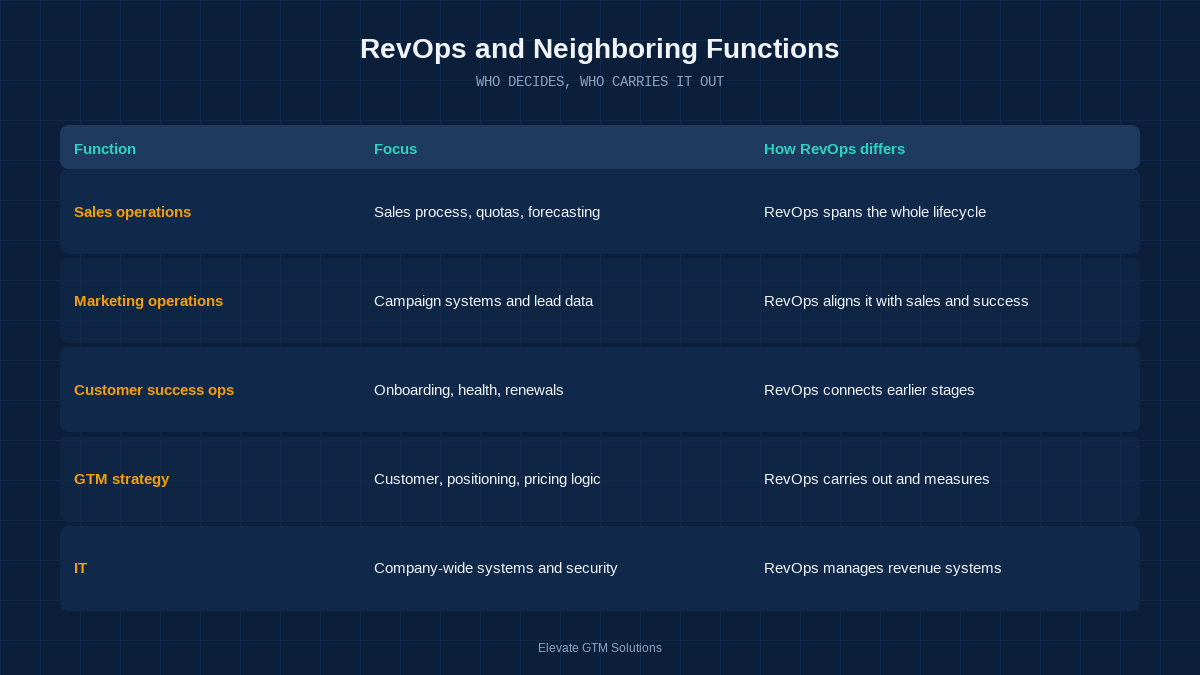
| Function | Focus | Typical owners of | Where RevOps differs |
|---|---|---|---|
| Sales operations | Sales process, territories, quotas, forecasting, sales tools | CRM for sales, compensation plans | RevOps spans beyond sales |
| Marketing operations | Campaign systems, lead management, marketing data | Marketing automation, campaign reporting | RevOps aligns it with sales and success |
| Customer success operations | Onboarding, health, renewals, success tools | Customer success platforms | RevOps connects it to the earlier stages |
| GTM strategy and product marketing | Customer, positioning, messaging, pricing logic, priorities | Strategy decisions and messaging | RevOps carries out and measures them |
| Finance | Budgets, revenue recognition, planning | Financial reporting | RevOps supplies operational data |
| IT | Infrastructure, security, enterprise systems | Company-wide systems | RevOps manages revenue systems within IT guardrails |
In small companies, these roles blur, and one person may hold several.
What a RevOps team does
| Area | Typical activities |
|---|---|
| Process | Define lifecycle stages, qualification, handoffs and deal stages |
| Data | Maintain data quality, ownership, definitions, enrichment rules and deduplication |
| Systems | Administer the CRM and connected tools, evaluate and retire tools |
| Routing and territories | Assign leads, accounts and opportunities by agreed rules |
| Forecasting | Maintain forecast process and inspect pipeline health |
| Reporting and analytics | Build and own dashboards, run analysis by segment, cohort and source |
| Enablement of process | Train teams on process and tools, document playbooks of how work flows |
| Compensation and planning support | Provide data for quotas, territories and compensation design |
| Governance | Manage access, change control and audit trails |
| Operating rhythm | Run recurring reviews that link strategy, results and decisions |
What RevOps does not usually own
- The decision about who the ideal customer is.
- The positioning and messaging pillars.
- Pricing strategy, though it supplies data and implements rules.
- Product direction.
- Individual sellers' conversations.
When RevOps is asked to decide these, it can become a bottleneck or a source of unhappy compromises. When nobody owns them, RevOps ends up implementing unclear decisions. A clear division helps: strategy owners decide, RevOps carries out and measures, and both review together.
How RevOps and GTM strategy fit together
| Strategy decision | RevOps implementation | Feedback to strategy |
|---|---|---|
| Ideal customer and exclusions | Account fields, scoring, routing, suppression | Win and loss by segment |
| Segment priorities | Territory design, ownership, views | Pipeline and conversion by segment |
| Qualification criteria | Required fields, stage definitions, handoff rules | Acceptance and rejection reasons |
| Messaging and proof | Templates and content tags in tools | Reply and conversion by theme |
| Pricing logic | Product catalogs, discount approvals | Deal size and discount patterns |
| Channel plan | Source and campaign structure, attribution rules | Results by channel |
| Quarterly priorities | Dashboards, targets, review calendar | Progress against priorities |
When the loop between these columns works, strategy changes reach the field within days and results return as evidence. When it does not, strategy lives in slides and operations drift.
Common structures
| Structure | Description | Fits |
|---|---|---|
| One person | A single operations generalist covering CRM, reporting and process | Startups |
| Small team | A RevOps lead with a systems administrator and an analyst | Growing companies |
| Centralized function | RevOps reports to a head of revenue operations, serving marketing, sales and success | Mid-sized companies |
| Embedded model | Operations specialists sit within each function with a shared leader and standards | Larger companies |
| Federated with a center of excellence | Regional teams with shared standards and tools | Global enterprises |
The right structure depends on size, complexity and how much consistency you need. Whatever the model, assign a single owner for definitions and data.
The tools RevOps typically manages
| Layer | Examples of tool types | Notes |
|---|---|---|
| System of record | CRM such as HubSpot or Salesforce | The center of the stack |
| Marketing automation | Campaign and lead management platforms | Often part of a suite |
| Sales engagement | Sequencing and calling tools such as Outreach, Salesloft or Apollo | Executes outreach |
| Data and enrichment | Data providers and enrichment tools such as ZoomInfo or Clay | Needs governance |
| Account intelligence | Platforms such as Demandbase or 6sense | For account-based motions |
| Conversation intelligence | Call analysis tools such as Gong | Insight for coaching and strategy |
| Enablement | Platforms such as Seismic, which now includes Highspot | Content and training |
| Analytics | Reporting and attribution tools | Needs agreed definitions |
| Strategy and planning | A system for decisions, such as Elevate GTM Solutions or Ignition | Keeps strategy consistent |
| Orchestration | Workflow tools such as Zapier, n8n and Make | Connects systems |
RevOps owns the integration among these, and the question "which tool does which job" more than any single tool. Our guide to best GTM automation tools covers the categories.
Measuring RevOps
RevOps is measured by how well the revenue engine runs, not only by its own activity.
| Area | Example measures |
|---|---|
| Data quality | Share of records with required fields, duplicate rate, ownership coverage |
| Process | Lead response time, stage conversion consistency, handoff completeness |
| Forecasting | Forecast accuracy over time, with the method stated |
| Efficiency | Time to produce reports, tool cost versus use |
| Alignment | Lead acceptance rate, agreement on definitions, time to update configuration after a strategy change |
| Stack health | Overlap between tools, integration failures, usage |
| Business outcomes | Win rate and cycle length by segment, pipeline coverage, retention |
Be careful about claiming that RevOps caused business outcomes, because many things affect them. Show the process and data improvements and link them to outcomes with care. Our guide to GTM metrics and KPIs covers definitions.
AI in revenue operations
AI is changing parts of RevOps work.
| Task | How AI helps | What to watch |
|---|---|---|
| Data cleanup and enrichment | Suggests fixes and fills gaps | Errors spread quickly, so sample and approve |
| Reporting | Drafts summaries and answers questions about data | Check against definitions |
| Forecast inspection | Highlights risky deals | Treat as input, not verdict |
| Routing and scoring | Proposes rules and adjustments | Review fairness and results |
| Workflow building | Drafts automations | Test before deploying |
| Call and email summaries | Saves time | Sample for accuracy |
| Agents | Perform multi-step tasks | Need limits, logs and approvals |
RevOps is often the team that governs AI use across go-to-market, which makes written policies and review habits part of the job. Our guide to AI tools for GTM execution and alignment covers controls.
Getting started
If you do not have RevOps today, begin small.
- Write definitions. Lead, qualified lead, opportunity, stage criteria and customer, agreed by marketing, sales and success.
- Name data owners. Every account and contact has an owner, and rules exist for reassigning.
- Clean the essentials. Deduplicate and fill the fields that drive routing and reporting.
- Capture loss reasons. A short list, required at close.
- Draw the stack. List tools, jobs, owners and integrations.
- Create a monthly review. Results by segment, handoff quality and decisions.
- Connect to strategy. Make sure changes in the customer definition and messaging reach configuration.
A maturity model for RevOps
| Level | What it looks like | Typical next step |
|---|---|---|
| 1. Ad hoc | Separate tools and definitions per team, reports assembled by hand | Write shared definitions and name data owners |
| 2. Defined | Shared lifecycle stages, basic routing and one CRM, with inconsistent upkeep | Clean data, require loss reasons, document the tool map |
| 3. Managed | Governance, change control, reliable reporting and a monthly review | Connect strategy decisions to configuration and measure segments |
| 4. Integrated | Strategy, process and data move together, with feedback from results to decisions | Govern AI use and extend to customer success and expansion |
| 5. Optimizing | Experiments, forecasts and planning use consistent data, and changes are evidence-led | Keep the loop honest and simplify what is no longer needed |
Most companies are at level one or two. Moving up usually means fixing definitions and ownership, not buying tools.
A ninety-day plan for a first RevOps hire
Days 1 to 30: listen and map. Interview leaders in marketing, sales and customer success. Draw the customer lifecycle and the tool map. List the ten reports people ask for most and note where the numbers come from. Identify the three definitions that cause the most arguments.
Days 31 to 60: define and clean. Run a definitions workshop. Agree lead, qualified lead, opportunity, stage criteria and customer. Clean ownership and duplicates. Require loss reasons. Retire an obviously unused tool.
Days 61 to 90: connect and rhythm. Build one shared report. Start a monthly review with strategy owners. Document how strategy changes become configuration changes. Present a plan for the next two quarters with measures.
Resist the urge to rebuild everything. Early credibility comes from fixing a few visible problems and making numbers trustworthy.
A definitions workshop
Bring marketing, sales, customer success, finance and operations together for two hours.
| Step | Activity |
|---|---|
| 1. Show the disagreement | Display three reports that disagree and ask where the difference comes from |
| 2. Draw the lifecycle | Agree the stages from first contact to renewal |
| 3. Define each stage | Entry criteria, exit criteria and owner |
| 4. Define the handoffs | What must be true to pass a lead or customer, and response times |
| 5. Define the measures | How win rate, cycle, pipeline and retention are calculated |
| 6. Define exceptions | Who may override a rule, and how it is recorded |
| 7. Assign owners | For each definition and for the data behind it |
| 8. Publish and date | One page, versioned, shared where people work |
Review the definitions each quarter, and whenever the strategy changes.
Data governance basics
| Rule | Practice |
|---|---|
| Every record has an owner | Assignment rules and a process for reassigning when people leave |
| One definition per field | A data dictionary listing each field, its meaning and allowed values |
| Required fields at key moments | For example, a loss reason when closing a deal |
| Duplicates are prevented and merged | Matching rules and a regular cleanup |
| Enrichment is controlled | Which sources may overwrite which fields |
| Consent and source are recorded | How and when each contact was added |
| Access is limited | Roles for viewing, editing and exporting |
| Changes are logged | A change log for configuration and rules |
| Quality is measured | A monthly report on completeness, duplicates and ownership |
A week of governance work often removes a month of reporting arguments.
Forecasting basics
Forecasting is where many RevOps teams earn or lose trust.
| Element | Practice |
|---|---|
| Clear stages | Stages reflect buyer actions and have exit criteria |
| Consistent inputs | Close dates and amounts are updated on a schedule |
| Method stated | Whether the forecast uses stage weighting, rep judgment or a combination |
| Inspection | Regular pipeline reviews that ask what has changed |
| History | Track forecast against actual over time |
| Humility | Show ranges and note assumptions |
| Segmentation | Forecast by segment, because win rates differ |
Do not present a forecast as precise. Show the method, the range and the track record.
Hiring and skills
| Role | Typical skills |
|---|---|
| RevOps lead | Process design, stakeholder management, systems thinking, analytics, communication |
| Systems administrator | CRM and tool configuration, data modeling, integrations |
| Analyst | Reporting, statistics, segmentation, data storytelling |
| Enablement of process | Documentation and training |
| Automation specialist | Workflow building, APIs and testing |
Soft skills matter as much as technical ones. The role requires persuading several functions to agree on definitions and follow shared rules.
Questions RevOps leaders ask
"How do we say no to constant report requests?" Offer a small set of shared dashboards, publish definitions and train people to use them. Add a simple request process with priorities.
"How do we handle a tool the sales team loves and marketing hates?" Compare the job each tool does, who uses it and what it costs. Decide with data and keep the decision visible.
"Who owns the customer definition?" Strategy or product marketing, with RevOps implementing it and feeding back evidence.
"What if leadership wants a number we cannot trust?" Explain what would make it trustworthy, show the data issues and agree a plan. Avoid producing precision the data does not support.
"How do we show value?" Choose measures such as time to produce reports, data completeness, lead response time and time to update configuration after a strategy change, and link them to outcomes carefully.
RevOps at different company sizes
| Stage | Typical situation | What RevOps looks like | Priorities |
|---|---|---|---|
| Startup | A few sellers, one marketer, a simple CRM | One generalist, often part-time | Definitions, clean CRM, a basic dashboard |
| Growth | Dozens of staff, multiple segments | A lead with an administrator or analyst | Routing, forecasting, data governance, tool map |
| Mid-sized | Several teams and products | A small function reporting to a leader of revenue | Shared lifecycle, reporting by segment, strategy-to-configuration loop |
| Enterprise | Many regions and business units | A center of excellence with regional specialists | Standards, governance, integration, AI policy |
In each case, begin with definitions and ownership. Tools and headcount follow.
Common RevOps projects, in a sensible order
- Definitions and stage criteria. Agreement on lead, qualified lead, opportunity and customer.
- Data cleanup. Ownership, duplicates and required fields.
- Loss reasons and close process. A short list, required at close.
- Routing and territories. Clear rules and response times.
- Reporting pack. One source for each core number.
- Forecast process. A stated method and a record of accuracy.
- Tool map and audit. Jobs, owners and overlaps.
- Strategy-to-configuration loop. A route from decisions to settings and from results back to decisions.
- AI governance. Policies and controls for AI use.
- Lifecycle extension. Include onboarding, renewal and expansion.
Resist doing all at once. Each project should end with a visible improvement.
Questions to ask when engaging outside RevOps help
If you bring in a consultant or agency for revenue operations, ask:
- What will you do that my team cannot, and what will remain with us?
- Who will do the work, and how much senior time is included?
- What do you need from us, and how many hours is that?
- What will we have at the end, and in what form?
- How will you document what you build so that we can maintain it?
- How will you handle our data and access to our systems?
- What does the first ninety days look like?
- What would make you recommend stopping?
Prefer short, scoped engagements with clear acceptance criteria, and insist on documentation. Our guide to when you still need a GTM consultant covers scoping.
Hiring a RevOps lead: a scorecard
| Criterion | What to look for | How to test |
|---|---|---|
| Systems thinking | Sees the lifecycle end to end | Ask them to draw the customer lifecycle for your business |
| Process design | Writes clear definitions and rules | Ask for a short definition they have written |
| Data judgment | Spots quality problems and prioritizes fixes | Give a sample dataset with errors |
| Stakeholder skill | Can bring marketing, sales and success to agreement | Ask about a time they resolved a definition dispute |
| Analytics | Cuts data by segment and explains limits | Ask how they would investigate a flat win rate |
| Tool fluency | Knows the CRM and common integrations | A practical exercise |
| Pragmatism | Chooses small wins over big rebuilds | Ask what they would do first in ninety days |
| Honesty about data | Willing to say what the numbers cannot tell | Ask about a time they pushed back on a request |
A sample RevOps charter
| Section | Content |
|---|---|
| Mission | Align process, data, systems and measurement across the customer lifecycle |
| Scope | CRM and connected revenue tools, lifecycle definitions, routing, forecasting process and reporting |
| Not in scope | Deciding the ideal customer, positioning or pricing strategy, which belong to strategy owners |
| Principles | One definition per term, one source per number, documented rules, small reversible changes |
| Services | Reporting pack, request process, training and a monthly operating review |
| Measures | Data quality, process consistency, alignment and stack health |
| Governance | Change control, access and a quarterly review with leadership |
A short charter prevents the function from becoming a service desk for every request.
More questions about RevOps
"Do we need RevOps if we have a good CRM administrator?" An administrator keeps the system running. RevOps also owns definitions, process, measurement and the link to strategy. In a small company, one person may do both, and the distinction matters when the work grows.
"Where should RevOps report?" Common choices are the chief revenue officer, the chief operating officer or finance. Choose a place that gives neutrality across marketing, sales and success.
"Will RevOps slow us down?" It can if it becomes a gatekeeper for every change. A clear charter, small reversible changes and a request process keep it useful.
"How do we decide which tool to retire?" Compare the jobs, owners, usage, cost and data overlap. Retire the tool whose job another tool covers, and move data carefully.
"What is the first report to build?" One shared funnel report by segment with published definitions, which gives marketing, sales and success the same numbers for the first time.
"How does RevOps help with AI?" By setting policies, approving tools, reviewing outputs, keeping logs and measuring results against baselines, so teams can use AI with controls.
"How do we measure the value of RevOps?" Show improvements in data quality, speed of reporting, lead response time, acceptance rates and time to update configuration after a strategy change, and link to outcomes carefully.
A hypothetical example
This is an illustration, not a real company.
A software company of about a hundred people had marketing, sales and customer success each using different definitions. Marketing counted leads by form fills. Sales counted them by accepted meetings. Customer success measured retention in a separate tool. The chief executive asked for one revenue report and received three that disagreed.
The company hired a head of revenue operations. In her first month she gathered the three teams to write one set of definitions and stage criteria. She cleaned account ownership and duplicates, required loss reasons at close and drew the tool map, finding two overlapping outreach tools and an unused data subscription. She set up a monthly review in which strategy decisions were translated into configuration changes, and results by segment returned to the strategy owner.
After two quarters, the company could produce one report, lead acceptance was steadier and a change in positioning reached the field in days. Win rates did not jump. The company could see them clearly for the first time, and make decisions with confidence.
A tool stack audit
An audit is one of the first things RevOps does. Use a table like this.
| Tool | Job | Owner | Users | Cost | Last review | Overlaps with | Decision |
|---|---|---|---|---|---|---|---|
| Keep, change or retire |
For each tool, ask:
- What job was it bought to do, and is that job still needed?
- Who uses it weekly?
- What data does it hold, and where does that data also live?
- How does it connect to the CRM, and who maintains the connection?
- What does it cost, including time to administer?
- What happens if we leave, and can we export?
Retire tools that overlap or are unused, and note the owner of each remaining tool.
An outline for an AI governance policy in go-to-market
RevOps often writes the first version.
| Section | Contents |
|---|---|
| Purpose | Use AI to speed structured work while people remain accountable for decisions and customer relationships |
| Approved tools | A named list, with a process for requests |
| Data rules | What may be entered, and what may not, including customer personal data |
| Human review | Which outputs require approval, especially customer-facing ones |
| Claims | Approved and forbidden claims, and a requirement for sources |
| Limits | Volume caps, topics and channels |
| Logging | What is recorded and for how long |
| Incidents | How to report, pause and review a problem |
| Ownership | A named owner for each automation or agent |
| Review | Quarterly, and after any incident |
Have legal and security advisers review the policy before adoption.
Territories and routing basics
Routing decides who gets which lead or account. Clear rules prevent disputes.
| Element | Practice |
|---|---|
| Basis | Choose a basis, such as region, industry, size or named accounts, that matches the strategy |
| Rules | Write them down in order of priority, with tie-breakers |
| Speed | Define response times and what happens if they are missed |
| Fairness | Review whether distribution is balanced and whether rules favor certain people |
| Exceptions | Define who may override and how it is recorded |
| Changes | Review territories when the strategy changes, and communicate in advance |
| Testing | Test rules on a sample before switching them on |
When the strategy changes segment priorities, routing and territories are among the first things to review.
A RevOps reporting pack
| Report | Question | Cadence |
|---|---|---|
| Funnel conversion by segment | Where do deals move or stall? | Monthly |
| Pipeline created and coverage | Is there enough, and from where? | Weekly |
| Win rate and cycle by segment | Are we winning where we should? | Monthly and quarterly |
| Lead response and acceptance | Is handoff working? | Weekly |
| Forecast versus actual | How reliable is the forecast? | Quarterly |
| Data quality | Are records complete and owned? | Monthly |
| Stack usage and cost | Are tools used and worth it? | Quarterly |
| Retention and expansion | Do customers stay and grow? | Quarterly |
Publish definitions with each report, and keep one source for each number.
Terms used in this guide
| Term | Meaning |
|---|---|
| RevOps | Revenue operations |
| Lifecycle stage | A label showing where a contact or account is in the customer journey |
| Routing | Assigning leads, accounts or deals to owners by rule |
| Territory | The set of accounts or leads assigned to a seller or team |
| Data dictionary | A list of fields, their meanings and allowed values |
| Forecast | A prediction of revenue for a period |
| Governance | Rules and routines that keep systems and data trusted |
Final thoughts
Revenue operations is less about tools than about agreement: on definitions, on ownership, on how information flows and on how the company learns. The teams that do it well write things down, keep them current and connect them to the strategy. If your company argues about numbers, loses context between handoffs or cannot get a strategy change into the field quickly, RevOps is a good place to begin, even if it starts as one person with a clear mandate and a shared page of definitions.
What to do this week
Write five definitions: lead, qualified lead, opportunity, won and lost. Ask marketing, sales and success whether they agree. List your revenue tools with an owner for each. If the answers differ or the owners are missing, you have found where RevOps would begin.
In plain language
Revenue operations exists because companies kept getting different answers to the same question from marketing, sales and customer success. It puts process, data, systems and measurement under shared definitions and clear ownership, so that the company can run and improve its revenue engine as one system. It does not choose your customer or your message. It makes sure those choices are carried out consistently and measured honestly, and it brings results back so the strategy can change. Start small: agree definitions, name data owners, capture loss reasons, draw the tool map and hold a monthly review. Those steps deliver most of the value, whatever the size of the team.
Key takeaways
- RevOps aligns process, data, systems and measurement across marketing, sales and customer success.
- It differs from sales operations by spanning the whole lifecycle, and from GTM strategy by carrying out decisions rather than making them.
- Core work: definitions, data governance, routing, forecasting, reporting, tool management and the review rhythm.
- A feedback loop between RevOps and strategy owners keeps strategy current.
- Measure data quality, process, alignment and outcomes, and be cautious about claiming causation.
- AI adds speed and risk, so RevOps often owns the policies and controls.
Where Elevate GTM Solutions fits
Elevate GTM Solutions is an AI-native GTM operating system for B2B companies. For RevOps teams, it is a place to hold the strategic decisions that configuration should reflect: customer definition, segments, positioning, messaging, qualification criteria and priorities, across 15 modules, with workflows, weekly plans and a recurring review rhythm. It connects to HubSpot, Salesforce, LinkedIn, Notion and Claude for supported actions. It does not replace the CRM, forecasting, data or outreach tools RevOps manages. Published plans, billed annually, are Enable at USD 499 per month and Growth at USD 1,499 per month, with custom Scale pricing and a free first strategy build.
For related reading, see What Is Elevate GTM Solutions?, Who Owns GTM Strategy?, GTM Strategy Handoff and GTM Platform vs CRM. See the pricing page, or request a demo.
Frequently Asked Questions
What is revenue operations?
The function that aligns the processes, data, systems and measurement across marketing, sales and customer success so the company can run and improve its revenue engine as one system.
What does a RevOps team do?
It defines lifecycle stages and handoffs, governs data, administers the CRM and connected tools, manages routing and territories, supports forecasting, builds reporting, trains teams on process and runs the operating rhythm.
What is the difference between RevOps and sales operations?
Sales operations focuses on the sales team. RevOps spans marketing, sales and customer success and aims at one aligned process and view of data.
What is the difference between RevOps and GTM strategy?
GTM strategy decides who the customer is, how to position and what to say. RevOps carries out those decisions in process and systems and measures the results.
Does RevOps own the CRM?
Usually RevOps administers the CRM and owns its configuration and data governance, with input from the functions that use it.
When does a company need RevOps?
When teams disagree on definitions and numbers, handoffs lose context, forecasts miss, tools multiply without an owner or strategy changes do not reach the field. Small companies often start with one person covering the work.
How is RevOps structured?
Common models are a single generalist, a small team, a centralized function, an embedded model and a federated model with a center of excellence. The right one depends on size and complexity.
How is RevOps measured?
By data quality, process consistency, forecast accuracy over time, efficiency, alignment and business outcomes such as win rate and cycle length by segment, with care about claiming causation.
How does AI affect RevOps?
It speeds data cleanup, reporting, forecasting inspection and workflow building, and it adds risk. RevOps often governs AI use with policies, approvals and logs.
How do RevOps and GTM strategy work together?
Strategy owners decide, RevOps configures and measures, and a monthly review feeds results back into strategy.
What should RevOps do first?
Write shared definitions, name data owners, clean essential fields, capture loss reasons, draw the tool map and start a monthly review.
What is a RevOps maturity model?
A way to see where you are: ad hoc, defined, managed, integrated and optimizing. Most companies are at the first two levels, and progress comes mostly from definitions, ownership and governance.
What should a first RevOps hire do in ninety days?
Listen and map the lifecycle and tools in the first month, run a definitions workshop and clean essential data in the second, and build one shared report and a monthly review in the third.
What is a definitions workshop?
A session with marketing, sales, success, finance and operations to agree lifecycle stages, entry and exit criteria, handoffs, measure calculations, exceptions and owners, then publish them on one versioned page.
How should RevOps handle forecasting?
With clear stages, consistent inputs, a stated method, regular inspection, a record of forecast against actual, ranges instead of false precision and segmentation.