
By the Elevate GTM Solutions Team · Updated November 10, 2026 · 22 min read
What Is a Market Entry Strategy? Options, Evidence, Risks, and a Step-by-Step Plan for B2B Companies
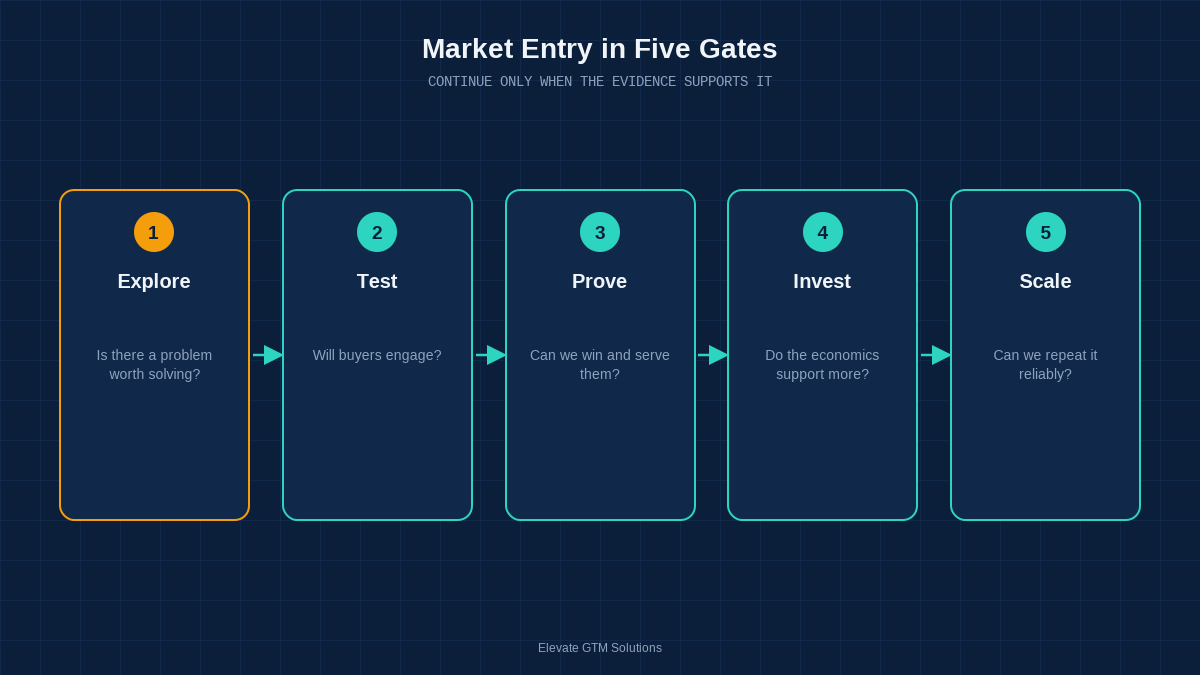
Entering a new market looks easier from a distance than it is up close. A company that wins in one country assumes the next will be similar, and finds that buyers there use different words, trust different references, pay in different ways and expect different support hours. A company that wins in one segment assumes the adjacent one will buy the same product, and finds that the buying group is different. A new product category can be even harder, because buyers may not yet recognize the problem.
A market entry strategy is the set of decisions that reduces these surprises: which market to enter, why, how, in what order, with what evidence and with what limits on the downside. This guide defines market entry in plain terms, separates the three kinds of entry, lays out the main entry modes, shows how to assess a market with evidence, describes how to design a pilot with stage gates, covers localization and regulatory questions at a general level and explains which decisions should stay global. Elevate GTM Solutions makes a GTM strategy platform with modules for market research, segmentation and positioning, and it does not replace local knowledge, legal advice or a local team, so we say plainly where those matter. The guidance is general, and every market differs.
What Is a Market Entry Strategy?
A market entry strategy is a plan for starting to sell in a market where you do not yet have a position, whether that is a new country or region, a new customer segment or a new product category. It covers why this market, who the first customers are, how you will reach and serve them (directly, through partners or through self-serve), what you will keep the same and what you will adapt, how you will test before committing, and what evidence would tell you to continue, adjust or stop. Good entry plans are built on buyer evidence, begin with a bounded pilot and set stage gates that limit risk.
How long does market entry take? It varies by market and motion. A pilot may take a quarter or two, and building a lasting position usually takes longer.
Should we enter several markets at once? Usually not. Sequential entry teaches more and costs less per lesson.
Three kinds of market entry
| Kind | What changes | Typical surprises |
|---|---|---|
| New geography | Country or region, language, regulation, payment, culture, competitors | Buying norms, references, data rules, support expectations |
| New segment | Industry, company size or use case within your existing geography | Different buying group, different language, different proof |
| New category or product | A new kind of offer, or a category buyers do not yet recognize | Education burden, unclear budget, different competitors |
Many entries combine two or three. A company selling the same product to a new industry in a new country faces changes in segment and geography at once, which is why a bounded pilot matters.
Why enter, and why not yet
| Reason to enter | Questions to test it |
|---|---|
| Buyers there already contact us | How many, from where and with what need? |
| Our best customers are growing there | Can we follow them, and do they want us to? |
| Our home market is saturated or slowing | Is it truly saturated, or is the real issue message or segment? |
| A partner offers access | What would the partner provide and expect? |
| Competitors are there | Are they succeeding, and what would we do differently? |
| Strategic reasons | What is the specific benefit, and how will we know it is real? |
| Reasons to wait |
|---|
| The home market still has strong, underexplored segments |
| Win rates at home are uneven and the message is unsettled |
| The product needs work to meet local requirements |
| The team cannot support another motion |
| The evidence of demand is thin |
Entering a new market to escape a problem at home usually brings the problem along.
Entry modes
How you enter shapes cost, speed and control.
| Mode | How it works | Strengths | Cautions |
|---|---|---|---|
| Direct, remote | Sell from home to the new market without local staff | Low cost, fast to test | Limits trust and local support |
| Direct, local team | Hire people in the market, possibly with a local entity | Control and proximity | Cost, management, legal and tax complexity |
| Channel partners or resellers | Partners sell and sometimes support | Local access and credibility | Dependence, margin, quality control |
| Distributors | A distributor holds relationships and may handle logistics | Reach in fragmented markets | Less direct customer contact |
| Marketplaces and ecosystems | Sell through platforms that buyers already use | Discovery and trust | Fees, rules and limited control |
| Self-serve and product-led | Customers adopt the product directly | Scales cheaply | Needs a product that supports it, and localization |
| Co-selling with technology partners | Partners introduce you to their customers | Warm introductions | Needs mutual benefit |
| Acquisition | Buy a local company | Immediate position | Cost, integration and risk |
| Joint venture or licensing | Share or license rights | Local knowledge | Complexity and control |
For many B2B software companies, a sensible path starts with remote selling and partners, adds a small local team when evidence supports it and considers heavier modes later.
Assessing a market with evidence
Start with the questions, and use several sources.
| Question | Sources |
|---|---|
| Who are the buyers, and how many could we realistically reach? | Bottom-up counts of target accounts, not top-down estimates |
| Do they have the problem, and what does it cost them? | Interviews with buyers in the market |
| What do they use today? | Interviews, competitor review and partner input |
| Who competes, and how do they position? | Competitor sites, reviews and buyer descriptions |
| How do buyers find and evaluate vendors? | Interviews, local communities and review sites |
| What do they pay, and how? | Competitor pricing, buyer conversations and payment norms |
| What rules apply? | Local advisers on data, tax, employment, contracts and procurement |
| What will it take to serve them? | Language, support hours, integrations and references |
Bottom-up sizing, with invented numbers
A top-down estimate such as "the market is a very large number" tells you little. A bottom-up estimate counts the companies you could serve.
| Step | Illustrative value |
|---|---|
| Companies in the target industry in the new market | 4,000 |
| Share in your size range | 30 percent, so 1,200 |
| Share that match your ideal customer criteria | 25 percent, so 300 |
| Share you could realistically reach in the first two years | 20 percent, so 60 |
| Expected win rate on reached accounts | 20 percent, so about 12 customers |
| Average annual contract value | 30,000 |
| Revenue potential in the period | About 360,000 |
Use ranges and show assumptions. If the numbers do not support the cost of entry, the model has told you something valuable early.
What to keep the same and what to adapt
Global consistency and local fit pull in opposite directions. Decide in advance.
| Decision | Usually keep global | Often adapt locally |
|---|---|---|
| Ideal customer logic | Core criteria | Local sizing and industry definitions |
| Positioning | The core claim and differentiation | Examples, language and proof |
| Message pillars | The structure | Wording and emphasis |
| Pricing logic | The value metric and tiers | Currency, price presentation and local competitor reference |
| Product | The core | Integrations, languages, compliance features |
| Sales process | Stage definitions and qualification | Buying steps and timing |
| Support | Quality standards | Hours and language |
| Brand | Identity | Tone and imagery |
Our guide on global vs local GTM decisions covers this in depth, and who owns GTM strategy covers decision rights.
Localization beyond language
| Area | Questions |
|---|---|
| Language | Which materials need translation, and who checks quality? |
| Currency and invoicing | What currency, taxes and payment methods do buyers expect? |
| Legal and contracts | What contract norms and data requirements apply? |
| Data residency and security | Do buyers require local storage or certifications? |
| Support | Which hours and languages? |
| References | Do buyers want references from their own country or industry? |
| Channels | Where do buyers research and talk? |
| Events and communities | Which matter locally? |
| Naming and claims | Do names or claims have different meanings or legal limits? |
| Integrations | Which local systems must the product connect with? |
Consult local advisers on legal, tax and regulatory questions. The right answers depend on the market and the business.
Designing an entry pilot
A bounded pilot reveals whether the market works before you commit heavily.
| Element | Practice |
|---|---|
| Scope | One country or segment, one product, a defined buyer |
| Duration | A fixed period, such as two quarters |
| Team | A small, named group with a clear owner |
| Target | A list of accounts and a goal for qualified conversations and pilots |
| Message | Adapted from the home message with local evidence |
| Evidence plan | Buyer interviews, replies, objections and win and loss reasons |
| Measures | Qualified conversations, meetings to opportunity, early customers, cycle length, support effort |
| Thresholds | What counts as continue, adjust or stop, written in advance |
| Budget | A cap, with a plan for what you would stop |
| Review | Monthly, with a decision at the end |
Stage gates, with illustrative content
| Gate | Question | Evidence required |
|---|---|---|
| 1. Explore | Is there a problem worth solving here? | Fifteen buyer conversations, a bottom-up model and a list of competitors |
| 2. Test | Will buyers talk to us and engage? | A reviewed outreach test, partner conversations and a few pilots |
| 3. Prove | Can we win and serve customers? | Early customers, a repeatable message, support that works |
| 4. Invest | Does the economics support a larger commitment? | Acquisition cost and payback estimates from real data, a staffing plan |
| 5. Scale | Can we repeat this reliably? | Playbook, local ownership and governance |
If the evidence at a gate is weak, stop or extend the test. Do not move forward because the plan said you would.
Risks and how to limit them
| Risk | What it looks like | Mitigation |
|---|---|---|
| Overestimating demand | Plans built on top-down numbers | Bottom-up counts and buyer interviews |
| Underestimating localization | Product or message that does not fit | A local review and a pilot |
| Legal and tax surprises | Late discovery of requirements | Early advice and a checklist |
| Over-hiring early | Cost before evidence | Start with partners or a small team |
| Channel dependence | A partner controls the relationship | Clear terms and direct contact with customers |
| Distraction from the core | The home market suffers | Protect the core, and cap the entry team |
| Slow learning | Waiting for perfect data | Short cycles and early thresholds |
| Reputation risk | A weak launch harms the brand | Start small and fix problems before scaling |
| Misaligned incentives | Local and global teams optimize differently | Shared goals and decision rights |
Measuring entry
| Measure | Why |
|---|---|
| Qualified conversations by account tier | Early signal of fit |
| Meeting to opportunity rate | Message and targeting quality |
| Win rate and cycle length compared with home | Whether the motion transfers |
| Early customers' time to first value | Whether you can serve them |
| Support effort per customer | Cost to serve |
| Acquisition cost and payback estimates | Economics |
| Share of replies that mention local factors | Where adaptation is needed |
| Partner-sourced pipeline and quality | Channel value |
Compare with your home market, and be careful with small samples.
An interview guide for buyers in a new market
Conversations in the new market are the most valuable evidence you can gather. Aim for fifteen or more, and include buyers, users and people who chose competitors.
| Theme | Example questions |
|---|---|
| Situation | How does this part of your work happen today? Which tools and people are involved? |
| Problem | What goes wrong? How often? What does it cost? |
| Triggers | What would make you look for a new solution? What has changed recently? |
| Alternatives | What do you use now? What have you tried? What do peers use? |
| Buying | Who decides? How long does a purchase take? What approvals are needed? |
| Discovery | Where do you look for vendors? Which sites, communities or people do you trust? |
| References | Would you want to speak to a customer in your country or industry? |
| Requirements | What must a product do or document before you could buy? |
| Price and payment | How do you buy software, and how do you pay? |
| Support | What hours and language do you expect? |
| Reaction | What do you think of what we do, and what is missing? |
Record the exact phrases buyers use for the problem. They will shape your local message. Compare with your home market to see what transfers and what does not.
Choosing and structuring partners
Partners can shorten entry, and they can also create dependence.
| Question | What to look for |
|---|---|
| Does the partner already serve your ideal customer? | Overlap in customers and credibility with them |
| What will they actually do? | Introductions, selling, implementation, support |
| What do they expect from you? | Training, margin, leads, exclusivity |
| How will you protect the customer relationship? | Direct contact, shared records, clear ownership |
| How will you measure them? | Qualified introductions, pipeline, win rate, customer satisfaction |
| What happens if it does not work? | Exit terms and transition |
| Do they work with competitors? | Conflicts and neutrality |
| Is exclusivity requested? | Avoid it early, or limit it by time and results |
Start with a small pilot agreement, a defined scope and a review date. Review contract terms with legal advisers.
Framing the entry budget
| Element | Question |
|---|---|
| Cap | What is the maximum we will spend before the next gate? |
| People | Who is dedicated, and what else do they stop doing? |
| Programs | Which channels and events, and what do they cost? |
| Localization | Translation, review, legal and compliance work |
| Partners | Fees, margin and enablement costs |
| Travel and local presence | The minimum needed to learn |
| Contingency | A margin for surprises |
| What we will stop | The decision rule if thresholds are missed |
Write the cap down, and decide in advance what happens if the pilot ends without meeting its thresholds.
A competitor review for the new market
| Field | Entry |
|---|---|
| Competitor | Name, origin and size, as they describe themselves |
| Customers and segments | Whom they say they serve |
| Positioning | How they describe the problem and themselves |
| Pricing and packaging | What is public, and how it compares |
| Local presence | Offices, partners, language support |
| Strengths | Honest summary, from buyer comments and reviews |
| Gaps | Where buyers are underserved |
| How buyers describe them | In buyers' words, from interviews |
| What we would say honestly | The difference that matters to the target buyer |
Include non-obvious alternatives, such as spreadsheets, in-house tools and local consultants.
A localization checklist by function
| Function | Items |
|---|---|
| Marketing | Website pages, key content, review-site profiles, local examples, community presence |
| Sales | Local references, pricing and currency, contract templates, discovery questions adapted to local buying norms |
| Product | Language support, local integrations, compliance features, data location options |
| Customer success | Onboarding in the right language and time zone, local training materials |
| Support | Hours, language and escalation |
| Finance | Invoicing, tax handling and payment methods |
| Legal | Contracts, data processing terms and regulatory requirements, with local advice |
| Operations | CRM fields, routing and reporting for the new market |
Assign an owner and a date to each item you decide matters for the pilot.
A stage-gate review meeting
Sixty minutes, with the entry owner, regional or partner representatives, sales, marketing, product and finance.
| Time | Topic |
|---|---|
| 0 to 10 minutes | The thresholds set at the last gate, and the evidence collected |
| 10 to 25 minutes | Buyer evidence: quotes, objections, competitor findings |
| 25 to 40 minutes | Results against thresholds, with counts and caveats |
| 40 to 50 minutes | Risks: legal, product, partner and team |
| 50 to 60 minutes | Decision: continue, adjust or stop, with owners, budget and the next gate |
Record the decision and the reasons in a log. Share a one-page summary with leadership.
Terms used in this guide
| Term | Meaning |
|---|---|
| Market entry | Starting to sell in a market where you have no position |
| Entry mode | The way you enter: direct, partner, distributor, marketplace, self-serve and others |
| Stage gate | A decision point with defined evidence for continuing |
| Bottom-up sizing | Estimating the market by counting reachable customers |
| Localization | Adapting product, message and operations to a market |
| Pilot | A bounded test of the entry |
| Threshold | A pre-agreed result that triggers continue, adjust or stop |
A dashboard for an entry pilot
| Measure | Why | Cut by |
|---|---|---|
| Buyer conversations held | Evidence base | Segment, role |
| Qualified conversations from outreach and partners | Early fit | Entry mode, tier |
| Reply quality and objections | Message fit | Theme |
| Meetings and opportunities | Conversion | Source |
| Paid pilots and early customers | Willingness to pay | Segment |
| Time to first value for early customers | Ability to serve | Customer |
| Support effort per customer | Cost to serve | Language, time zone |
| Spend against the cap | Discipline | Category |
| Home-market indicators | Protect the core | Segment |
Review monthly, with counts and caveats, and keep the stage-gate thresholds on the first page.
Legal, tax and regulatory questions to raise with advisers
This is a list of topics, not advice. Rules differ by country and business, so take professional advice.
| Topic | Questions |
|---|---|
| Entity and presence | Do we need a local entity, or can we sell remotely? |
| Tax | What taxes apply to our sales and presence? |
| Contracts | What terms and governing law are expected? |
| Data | What rules apply to personal and business data, including transfers and storage? |
| Employment | What applies if we hire or contract locally? |
| Marketing and outreach | What rules apply to contacting prospects and advertising claims? |
| Procurement | Are there public-sector or industry procurement rules? |
| Export and sanctions | Are there restrictions on selling to certain places or parties? |
| Intellectual property | What protections and risks apply? |
Raise these early, because discovering them late can change the economics.
How AI helps and where it does not
| Task | How AI helps | Caution |
|---|---|---|
| Desk research | Summarizes market information and competitors | Verify with primary sources and local advisers |
| Translation and localization drafts | Produces first drafts | Native review is essential |
| Interview synthesis | Structures themes from notes | Check against the source |
| Account list building | Suggests target accounts | Verify data accuracy |
| Scenario modeling | Tests assumptions | The model is only as good as the inputs |
| Drafting plans | Speeds writing | The decisions remain yours |
AI cannot tell you what buyers in a market will do. Talk to them.
Common mistakes
| Mistake | What happens | Fix |
|---|---|---|
| Entering several markets at once | Thin effort and unclear learning | Enter sequentially |
| Top-down sizing | Overconfidence | Bottom-up counts |
| Copying the home playbook | Misfit | Adapt with local evidence |
| Skipping local advice | Legal and tax surprises | Engage advisers early |
| Hiring before evidence | Fixed costs without results | Pilot with partners or a small team |
| No stage gates | Escalating commitment | Set gates and thresholds |
| Ignoring support and references | Customers are won and poorly served | Plan for service |
| Letting the pilot drift | No decision | Fixed duration and a decision date |
A hypothetical example
This is an illustration, not a real company.
A software company selling scheduling software to field-service firms in one country considered entering a neighboring country. Inbound inquiries from there were rising, and a payments partner offered introductions. The head of strategy built a bottom-up model, which suggested a modest but real opportunity, and arranged fifteen conversations with owners of firms there. Buyers described the same problem in different words, expected invoices in the local currency, preferred references from local firms and used a payments product that the software did not yet integrate with.
The company chose a six-month pilot with the partner and a founder-led outreach effort, no local hires, and set thresholds: a defined number of qualified conversations, a number of paid pilots and an acceptable support load. It adapted its message with the buyers' words, added the local currency and began work on the integration. After three months, conversations were strong and pilots were fewer than hoped because of the missing integration. The team extended the pilot until the integration shipped.
At the review, it met two of the three thresholds. It decided to continue with a part-time local seller, review the economics at the next gate and keep the home market as the priority. It had not committed to a large investment on the strength of a hunch.
What to do this week
List the markets you are considering and the evidence for each. Build a rough bottom-up estimate for the top candidate. Book five buyer conversations in that market. Write the thresholds that would make you continue, adjust or stop.
A ninety-day entry pilot, step by step
Days 1 to 15: learn. Write the questions you need answered. Build the bottom-up model. Book fifteen buyer conversations. Review three competitors. Meet two possible partners. Check legal and tax questions with advisers.
Days 16 to 35: decide the pilot. Choose the segment, the entry mode and the target list. Adapt the one-page strategy using buyer language. Set thresholds for continue, adjust and stop. Agree the budget cap and the team.
Days 36 to 70: test. Run a reviewed outreach test and partner conversations. Offer paid pilots to a few buyers. Record every reply and objection. Fix localization gaps that block deals.
Days 71 to 90: review. Compare results with thresholds. Read the buyer evidence. Decide whether to continue, adjust or stop. If continuing, plan the next gate and what to add.
Keep the home market as the priority throughout, and cap the number of people on the pilot.
Scenarios and directions
| Situation | Direction to explore |
|---|---|
| A company with rising inbound from a new country | Interview those buyers, test remote selling and partners before hiring |
| A company with a strong segment and an adjacent one | Interview the adjacent segment, adapt the message and run a bounded pilot |
| A company launching a new product category | Invest in education, find early adopters and set modest thresholds |
| A company with an acquisition option | Test demand independently and model integration risk before committing |
| A company with limited resources | One market at a time, partners first |
| A company with a global enterprise customer base | Follow existing customers, with local support and references |
Questions teams ask
"How do we know when to stop?" Set thresholds before the pilot and review them honestly. If conversations are weak after fixes, or economics do not work, stop or adjust. Sunk cost is not evidence.
"Can we sell remotely in the new market?" Often at first. Check buyer expectations on trust, language and support, and move to local presence when evidence supports it.
"How do we avoid hurting the home market?" Cap the entry team, protect core resources and review the effect on home metrics monthly.
"Do we need a local entity?" It depends on legal, tax, employment and contract requirements. Take advice before deciding.
"How do we handle pricing in a new market?" Keep the pricing logic and adapt presentation and level using local evidence and competitor references.
"Who should lead entry?" A named owner with authority to decide within the cap, with a sponsor in leadership and input from regional experts.
In plain language
Market entry is a series of small, evidence-led bets, not a leap. Start by learning from buyers in the market, size it from the bottom up and choose the lowest-commitment way to test. Keep what must stay the same, adapt what must change, set thresholds in advance and review honestly. Take legal and tax advice early. Protect the home market. If the evidence supports it, add commitment in stages. If it does not, stopping early is a good result, because it saved you from a larger mistake.
A short checklist before you commit
- We have at least fifteen buyer conversations in the target market.
- We have a bottom-up estimate with stated assumptions.
- We have chosen the lowest-commitment entry mode that can teach us.
- We know what stays global and what adapts, and who decides.
- Legal, tax and regulatory questions have been reviewed with advisers.
- We have thresholds for continue, adjust and stop, and a budget cap.
- The home market is protected, and the entry team is capped.
- We have a review date and a named owner.
Final thoughts
Entering a market is easier when you treat it as learning with a budget. Talk to buyers, count what you can reach, start small, adapt only what you must and decide in advance what evidence will move you forward or stop you. Companies that do this tend to make smaller mistakes earlier and larger commitments later, with better information.
Patterns in entries that go wrong
These are generalized, invented patterns, not accounts of real companies.
The enthusiastic hire. A company hired a local leader before testing demand. The leader worked hard, and the market had few buyers matching the profile. The company absorbed fixed costs for a year before facing the evidence it could have gathered in a quarter.
The borrowed playbook. A company copied its home message and process. Buyers in the new market did not recognize the problem in those words, and replies were thin until the team rewrote its message from local interviews.
The distracted core. A company moved its best people to the new market. Home win rates slipped, and the entry itself suffered when leaders turned back to repair the core.
The dependent partner. A company relied on one partner for all introductions. When priorities at the partner changed, pipeline stopped, and the company had no direct relationships with customers.
Each pattern has the same remedy: gather evidence first, start small, protect the core and keep direct contact with buyers.
In plain language
Start with buyers, not with plans. Count what you can reach, test the cheapest way to reach it, adapt only what the evidence says must change and agree in advance what result would make you continue, adjust or stop. Take legal and tax advice early, protect the home market and keep direct contact with customers. If the pilot works, add commitment in stages. If it does not, you have bought information cheaply.
Measures to treat with caution
| Measure | Why caution |
|---|---|
| Website visits from the new market | Curiosity is not demand |
| Event attendance alone | Attendance is not intent |
| Partner promises | Intentions are not introductions |
| Top-down market size | It says little about what you can reach |
| One large early deal | It may not be repeatable |
Prefer qualified conversations, paid pilots and repeatable patterns.
Key takeaways
- Market entry covers new geographies, new segments and new categories, and often combines them.
- Choose an entry mode that matches the evidence, and start with the lowest-commitment mode that can teach you.
- Assess with bottom-up counts and buyer interviews, not only top-down estimates.
- Decide what stays global and what adapts, and record exceptions.
- Run a bounded pilot with stage gates and thresholds set in advance.
- Consult local advisers on legal, tax and regulatory questions.
Where Elevate GTM Solutions fits
Elevate GTM Solutions is an AI-native GTM operating system for B2B companies. Its Market Research and Market Segmentation modules help structure what you know about a new market, its ICP and competitive intelligence modules turn evidence into customer definitions and framing, and its positioning and messaging modules help adapt the message with proof. It supports comparing strategies for different scopes, such as markets or segments, side by side, with workflows, weekly plans and a recurring review rhythm. It does not replace local knowledge, legal advice, translation review or a local team, and it connects to HubSpot, Salesforce, LinkedIn, Notion and Claude for supported actions. A free first strategy build is available, and published plans, billed annually, are Enable at USD 499 per month and Growth at USD 1,499 per month, with custom Scale pricing.
For related reading, see Global vs Local GTM Decisions, Market Research, Market Segmentation and What Is Elevate GTM Solutions?. See the pricing page, or request a demo.
Frequently Asked Questions
What is a market entry strategy?
A plan for starting to sell in a market where you have no position yet, covering why this market, who the first customers are, how you will reach and serve them, what stays the same and what adapts, how you will test and what evidence would tell you to continue, adjust or stop.
What are the types of market entry?
New geography, new segment and new category or product, often combined.
What are the main market entry modes?
Direct remote selling, a local team, channel partners or resellers, distributors, marketplaces, self-serve, technology partner co-selling, acquisition and joint ventures or licensing.
How do I size a new market?
Use bottom-up counts: companies in the target industry, the share in your size range, the share matching your ideal customer criteria, the share you could reach and your expected win rate, shown with assumptions and ranges.
What should stay global and what should adapt?
Usually the core ideal customer logic, positioning claim, pricing logic and process stay global, while examples, language, currency, integrations, proof and support hours adapt. Record exceptions.
How do I run a market entry pilot?
Choose one scope, set a fixed duration, assign a small team, define targets, adapt the message with local evidence, set thresholds for continue, adjust or stop in advance and review monthly.
Should we enter several markets at once?
Usually not. Sequential entry teaches more and costs less per lesson.
What are the biggest risks of market entry?
Overestimating demand, underestimating localization, legal and tax surprises, over-hiring early, channel dependence, distraction from the core market and slow learning.
How can AI help with market entry?
It can speed desk research, draft translations and plans and structure interview notes, with verification, native review and local advice. It cannot tell you what buyers will do.
Who should I talk to before entering?
Buyers in the market, partners, local advisers on legal, tax and regulatory questions and people who have entered similar markets.
How many buyer conversations do I need before entering?
Aim for fifteen or more in the target market, including buyers, users and people who chose competitors, and look for repeated stories.
How should I choose a partner for a new market?
Look for overlap with your ideal customers, clarity on what they will do and expect, protection of the customer relationship, measurable results, exit terms and a limit on exclusivity, starting with a small pilot agreement.
How should I set an entry budget?
Write a cap before the next gate, name who is dedicated and what they stop doing, include localization, partners and contingency, and decide in advance what happens if thresholds are missed.