
By the Elevate GTM Solutions Team · Updated November 10, 2026 · 22 min read
B2B SaaS Go-to-Market Explained: Strategy, Motions, Pricing, Metrics, and Stages
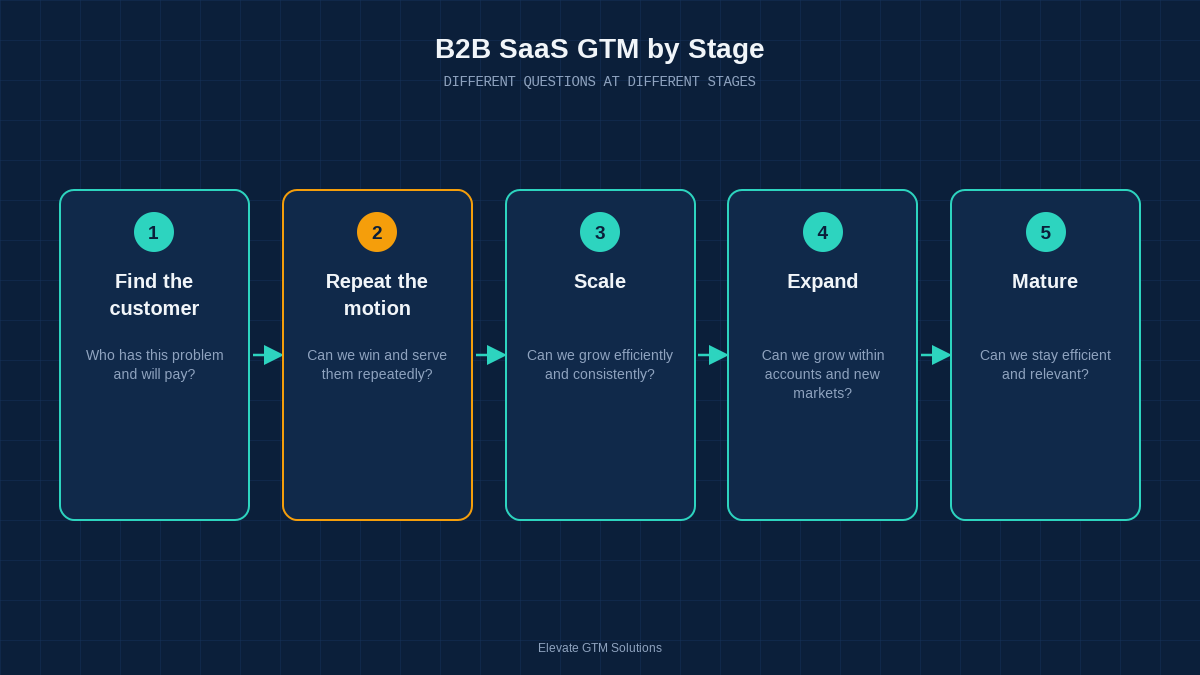
B2B software companies have a distinctive go-to-market problem. They sell something intangible, often by subscription, to organizations in which several people have a say. Revenue arrives over time, so the first sale is only the start, and the economics depend on whether customers stay and grow. A good product is necessary and nowhere near sufficient. Plenty of strong products have stalled for lack of a clear customer, a sharp message, a motion that fits how buyers buy or a pricing model that matches value.
This guide explains B2B SaaS go-to-market in plain terms: what the pieces are, how they fit together, how the right choices change by stage, which motions and pricing models are common, which metrics matter and how AI is changing the picture. It is an overview, and links point to deeper guides. Elevate GTM Solutions makes a GTM strategy platform for B2B companies, so we have an interest, and we say plainly where other tools and people matter. The guidance is general, quotes no benchmark figures and does not guarantee results.
What Is B2B SaaS Go-to-Market?
B2B SaaS go-to-market is the set of decisions and activities by which a software company reaches business customers, wins them, onboards them and grows them over time. It covers the ideal customer, the problem and positioning, pricing and packaging, the motion (product-led, sales-led or hybrid), the channels, the team, the tools and the metrics. Because revenue is recurring, it must connect acquisition with retention and expansion, and because buyers are organizations, it must account for buying groups. The right mix depends on the product, the price, the market and the stage of the company.
Is GTM only marketing and sales? No. Product, customer success, finance and operations all shape it.
When should a startup start thinking about GTM? Before building much, by finding who has the problem. It continues for the life of the company.
The pieces and how they connect
| Piece | The question it answers |
|---|---|
| Customer | Who is the ideal customer, and who is not? |
| Problem | What situation makes them need this, and what does it cost them? |
| Alternatives | What do they do today, including doing nothing? |
| Positioning | Why should they choose us over the alternatives? |
| Messaging | What do we say, and what proof backs it? |
| Pricing and packaging | What do we charge for, and how do customers choose plans? |
| Motion | How do customers find, try and buy: product-led, sales-led or both? |
| Channels | Where do we reach them? |
| Team | Who does the work, and how are they organized? |
| Onboarding and success | How do customers reach value and stay? |
| Expansion | How do accounts grow? |
| Metrics | How do we know it is working? |
| Governance | Who decides, and how do decisions stay consistent? |
Weakness in one piece shows up in the others. An unclear customer produces vague messaging, scattershot channels and unhappy customers. Our guide to the GTM planning template shows how to write the pieces on a page.
What makes B2B SaaS different
| Feature | Why it matters |
|---|---|
| Subscription revenue | Retention and expansion drive the economics |
| Buying groups | Several roles influence a purchase, with different concerns |
| Time to value | Customers must see results soon enough to renew |
| Integration needs | Fit with existing systems affects adoption |
| Security and compliance reviews | Larger buyers require evidence before purchase |
| Product changes often | The message and the product evolve together |
| Free trials and plans | Buyers may expect to try before buying |
| Reviews and comparisons | Buyers research on review sites, peers and increasingly AI assistants |
| Ongoing relationship | Customer success is part of go-to-market |
Stages and what changes
| Stage | Main question | Typical focus | Typical mistake |
|---|---|---|---|
| Finding the customer | Who has this problem and will pay? | Conversations, a one-page strategy, a narrow first customer | Building tools and a team before learning |
| Repeating the motion | Can we win and serve this customer repeatedly? | A tested message, a first process, early hires | Scaling outreach before the message works |
| Scaling | Can we grow efficiently and consistently? | Segments, team structure, enablement, governance | Copying a larger company's playbook |
| Expanding | Can we grow within accounts and into new markets? | Expansion plays, new segments, regions or products | Losing the core while chasing new ground |
| Mature | Can we keep growth efficient and relevant? | Portfolio decisions, efficiency, platform effects | Letting strategy go stale |
Our guide to GTM strategy for startups covers the earliest stage in detail, and What Is a Market Entry Strategy? covers expansion into new markets.
Choosing a motion
| Motion | How it works | Typical fit |
|---|---|---|
| Product-led | Users try and adopt the product, and upgrade through it | Easy to try, quick value, broad audience |
| Sales-led | Sellers guide buyers through evaluation and purchase | Complex or high-value products, committees |
| Hybrid | Self-serve for small accounts with sales assist for larger ones | Mixed customer base |
| Partner-led | Partners introduce, sell or implement | Where partners already serve the customer |
| Community-led | A community creates awareness and trust | Developer and practitioner products |
| Founder-led | Founders sell personally | The earliest stage |
Most companies change motion as they grow. Our guides on What Is Product-Led Growth?, What Is Sales-Led Growth? and Product-Led vs Sales-Led GTM cover the choice.
Reaching buyers
| Path | Description | Guide |
|---|---|---|
| Outbound | Starting conversations with defined prospects | Outbound vs Inbound GTM |
| Inbound and demand generation | Creating and capturing interest | What Is Demand Generation? |
| Signal-based timing | Acting on events that suggest readiness | What Is Signal-Based Selling? |
| Account-based programs | Coordinated efforts for named accounts | GTM Platform vs ABM Platform |
| Partners and marketplaces | Borrowed trust and reach | Entry mode choices |
| Reviews and directories | Where buyers shortlist | Keep profiles accurate |
| AI assistants | Where more buyers ask for recommendations | AI Search Visibility Audit |
Pricing and packaging
Pricing is part of the strategy, not an afterthought.
| Model | How it works | Strengths | Cautions |
|---|---|---|---|
| Per seat | Price per user | Simple, predictable | Can discourage adoption |
| Usage-based | Price by consumption | Aligns with value | Unpredictable bills |
| Tiered plans | Packages with increasing capability | Clear upgrade path | Needs careful limits |
| Platform fee plus usage | A base fee with usage on top | Predictable base | Complexity |
| Per outcome | Price tied to a result | Aligns closely with value | Hard to measure and agree |
| Custom enterprise | Negotiated terms | Fits large accounts | Needs discount governance |
Questions to ask: what is the unit in which customers feel value? What do alternatives cost, including doing nothing? How does price scale as customers grow? Is it clear on your website? Conflicting prices in directories and listings hurt trust and confuse AI assistants that summarize them, so keep them aligned.
Metrics that matter
Definitions are standard, and published benchmarks vary widely, so use your own baseline.
| Measure | Definition | Why it matters |
|---|---|---|
| Annual or monthly recurring revenue | Normalized subscription revenue | Scale |
| New, expansion, contraction and churned recurring revenue | Components of change | Where growth comes from |
| Gross revenue retention | Starting revenue minus churn and contraction, divided by starting revenue | Durability |
| Net revenue retention | Starting revenue plus expansion minus churn and contraction, divided by starting revenue | Growth within the base |
| Customer acquisition cost | Sales and marketing cost divided by new customers | Efficiency |
| CAC payback | Acquisition cost divided by monthly gross profit per customer | Months to recover cost |
| Win rate and cycle length | Won divided by won plus lost, days to close | Sales effectiveness |
| Activation and time to value | Share reaching a first meaningful result, and how fast | Early retention |
| Pipeline created and coverage | Value of new opportunities, and open pipeline divided by target | Future revenue |
| Message consistency and time to update strategy | Alignment indicators | Strategy health |
Cut by segment. A company-wide average can hide a strong segment and a weak one. Our guide to GTM metrics and KPIs gives definitions and traps.
The team and operating system
| Element | What to have |
|---|---|
| Owners | A named owner for the customer definition, message, pricing logic, process and data |
| Rhythm | Weekly sync, monthly strategy review, quarterly reset |
| Playbook | A short guide that people use |
| Enablement | Onboarding and coaching for new hires |
| RevOps | Shared definitions, clean data, reporting |
| Evidence | Regular buyer conversations and win and loss learning |
| Governance | Decision rights and a record of decisions |
Our guides on how to structure a GTM team and what a GTM playbook is cover these elements.
The tool stack by job
| Job | Tool types |
|---|---|
| System of record | CRM |
| Strategy and decisions | Documents or a strategy platform |
| Contacts and data | Data and enrichment providers |
| Outreach | Engagement and sequencing tools |
| Marketing | Marketing automation and content tools |
| Account programs | ABM platforms |
| Calls and coaching | Conversation or revenue intelligence |
| Enablement | Content, training and coaching tools |
| Product analytics | Usage and activation analytics |
| Orchestration | Workflow and integration tools |
Keep the stack small and owned. Our guide to the best GTM tools for startups shows how to choose by bottleneck.
GTM by buyer size
| Buyer | Typical purchase | Motion tendency | What matters |
|---|---|---|---|
| Small business | One decision maker, quick | Product-led or inside sales | Fast start, clear price, simple support |
| Mid-market | A department leader and a budget owner, a few weeks | Hybrid or sales-led | Demonstration, a trial, integration clarity |
| Enterprise | A buying committee, security and procurement, months | Sales-led with solutions support | Security documentation, references, implementation plan |
| Strategic accounts | Executive sponsorship, custom terms | Account-based teams | Long relationships, custom value cases |
A company may serve more than one, and each needs its own playbook, stage criteria and pricing rules.
Security and procurement readiness
Larger buyers expect evidence before they buy, and preparing early shortens cycles.
| Item | What to prepare |
|---|---|
| Security overview | A plain document describing practices, with current evidence on request |
| Data handling | Where data is stored, who can access it and how it is deleted |
| AI use | How AI features use customer data, and how to opt out where relevant |
| Contract terms | Standard terms, a data processing agreement and a process for exceptions |
| Reference customers | Permissioned references in relevant industries |
| Implementation plan | A typical timeline and responsibilities |
| Support | Hours, languages and escalation |
| Integrations | A list of supported connections with plain descriptions |
Treat this as part of go-to-market. Sellers should know where the documents are and who answers questions.
Customer success and expansion
In a subscription business, growth comes as much from existing customers as from new ones.
| Moment | What matters |
|---|---|
| Handoff | Goals, stakeholders and promises recorded |
| Onboarding | A plan with milestones, owners and a target for first value |
| Adoption | Usage reviews and education |
| Expansion | Signals such as new teams, growing usage and new needs, with a conversation led by the right person |
| Renewal | A planned process well before the date |
| Advocacy | Respectful requests for references and reviews |
| Feedback | Customer insight returned to strategy and product |
Measure gross and net revenue retention by segment, and treat low retention in a segment as a strategy signal.
Partners, marketplaces and ecosystems
| Path | What it offers | Cautions |
|---|---|---|
| Technology partners | Integrations and joint customers | Mutual benefit and clear roles |
| Resellers and implementation partners | Local access and services | Quality and margin |
| Marketplaces | Discovery and simplified buying | Fees and limited control |
| Ecosystem communities | Trust among practitioners | Time to build |
Choose partners with overlap in your ideal customers, and measure qualified introductions and customer satisfaction.
A ninety-day plan for a company with a product and a few customers
Days 1 to 15. Write the six pieces of your GTM in a sentence each. Mark evidence and guesses. Interview five customers and three lost prospects.
Days 16 to 40. Settle customer, problem, alternatives and positioning. Write three message pillars with proof. Check your price against how customers describe value.
Days 41 to 70. Run a small, reviewed test of the motion and channels you chose. Track qualified conversations, meetings to opportunity and early retention signals.
Days 71 to 90. Review with sales, product and success. Decide what to extend, change or stop. Update the one-page strategy and set the next quarter's priorities.
Scenarios and directions
| Situation | Direction to explore |
|---|---|
| A product with fast value and many potential users | Product-led, with sales assist for larger accounts |
| A complex product for mid-sized firms | Sales-led with a guided trial |
| A company selling to enterprises | Prepare security and procurement material early |
| A company with strong churn | Review fit, onboarding and promises before spending more on acquisition |
| A company with flat growth in its home market | Review segments and message before entering new markets |
| A company adding AI features | Revisit positioning, pricing and data-use messaging |
Terms used in this guide
| Term | Meaning |
|---|---|
| SaaS | Software delivered by subscription |
| ARR and MRR | Annual and monthly recurring revenue |
| NRR and GRR | Net and gross revenue retention |
| CAC | Customer acquisition cost |
| Payback | Months to recover acquisition cost from gross profit |
| Activation | The first meaningful result a user reaches |
| Land and expand | Starting small in an account and growing over time |
| Buying group | The people involved in a purchase decision |
What AI changes in B2B SaaS go-to-market
| Area | What changes | Consideration |
|---|---|---|
| Product | AI features reshape what the product does | Positioning must explain the real benefit, not the technology |
| Pricing | Cost to serve can rise with usage | Credits, limits and usage-based models need clear communication |
| Buying | Buyers ask AI assistants for recommendations | Clear, consistent, honest public information matters |
| Sales and marketing | Drafting, research, summaries and agents speed work | More sameness and more need for review |
| Competition | Many competitors announce similar AI features | Differentiation needs depth and proof |
| Trust | Buyers ask how AI uses their data | Be ready with plain answers and documentation |
| Operations | AI helps with data and reporting | Definitions matter more |
AI raises the speed of every step and leaves the basic questions in place: who is the customer, what is the problem, why us and how will we know.
Common mistakes
| Mistake | What happens | Fix |
|---|---|---|
| Building before talking to customers | A product for no one in particular | Conversations first |
| Scaling spend before the message works | Expensive learning | Prove the pitch |
| Copying another company's motion | Misfit with buyers | Test from evidence |
| Ignoring retention | Leaky growth | Measure retention from the start |
| Pricing by guess and never revisiting | Misaligned with value | Test and review |
| No owner for message and definitions | Inconsistency | Name owners |
| Treating customer success as cost | Poor expansion | Treat it as part of go-to-market |
| Over-tooling | Cost and confusion | Buy for bottlenecks |
| Believing every competitor's AI claims | Overreaction | Evaluate evidence |
A hypothetical example
This is an illustration, not a real company.
A company building scheduling software for field-service firms followed the path many B2B SaaS companies do. In the first six months, the founders interviewed twenty owners, found that firms of ten to forty technicians scheduling in spreadsheets felt the problem most and wrote a one-page strategy. They sold the first dozen customers themselves, learned the objections and set a price hypothesis per technician.
In the next year, they hired two sellers, wrote a short playbook, added a customer success role after two early customers struggled with setup and introduced a self-serve path for the smallest firms. They tracked win rate and time to first value by segment, and discovered that firms with an owner present at the walkthrough converted at a much higher rate. They moved the walkthrough earlier in the process.
At the scaling stage, they added product marketing to keep the message consistent, RevOps to align definitions and a monthly strategy review. They moved into a neighboring segment with a bounded pilot. At each stage, they chose a motion and a structure that matched what the evidence showed, and they kept the one-page strategy current.
What to do this week
Write the six pieces of your go-to-market in a sentence each: customer, problem, alternatives, positioning, motion and pricing. Mark which you can support with evidence and which are guesses. Pick the biggest guess and design a test. Compare your retention and acquisition cost by segment.
A one-page B2B SaaS GTM plan, filled in
This invented example shows how the pieces fit on a page, for a company selling scheduling software to field-service firms.
| Piece | Entry |
|---|---|
| Customer | Field-service firms with ten to forty technicians scheduling in spreadsheets. Not a fit: below ten technicians, firms needing deep invoicing |
| Problem | Owners learn about missed appointments when customers call. Cost: lost repeat business and refunds |
| Alternatives | Spreadsheets, a larger suite, doing nothing |
| Positioning | For field-service owners who lose appointments to scheduling errors, scheduling a team can start in days and technicians can use on a phone, unlike spreadsheets or heavy suites |
| Messaging | Start in days. Simple on a phone. Fewer missed appointments, labeled as early evidence |
| Pricing | Monthly per technician, three tiers, a free trial |
| Motion | Founder-led, with a self-serve path for firms of up to fifteen technicians and sales assist above |
| Channels | Direct outreach to a defined list, an owner community and a payments partner |
| Team | Two account executives, one customer success manager, a part-time operations owner |
| Metrics | Qualified conversations, win rate by segment, time to first value, gross and net retention |
| Governance | Weekly review, monthly strategy review, one named owner for message and definitions |
| Assumptions to test | Dispatchers will adopt it. Partner introductions convert |
Questions founders and leaders ask
"Should we focus on one segment or several?" One at first. A narrow segment teaches faster and sharpens the message. Add segments when you can win the first repeatedly.
"When should we hire the first seller?" When you can describe what works well enough to write it down, and the founders' time is the bottleneck.
"How do we think about free plans?" As a way to reach value quickly. Define activation, check free users' cost to serve and design limits so users can succeed and upgrade at the moment of need.
"How much should we spend on marketing?" Start from the goal and your own conversion history, reserve a share for experiments and review monthly. Treat published percentages cautiously.
"What if our growth is good and retention is weak?" Look at fit, onboarding and promises. Growth that leaks is expensive.
"How do we handle competitors adding AI features?" Write positioning around the customer's problem and your proof, not around technology labels, and watch buyer language.
"What should we measure first?" Qualified conversations by segment, win rate, time to first value and early retention.
What good looks like after a year
| Area | Signs |
|---|---|
| Customer | A written definition that sellers and marketers share, tested against wins and losses |
| Message | Consistent across site, deck and emails, with proof |
| Motion | Chosen from evidence, with clear handoffs |
| Pricing | Understood by customers, consistent across listings |
| Team | Named owners, decision rights and a review rhythm |
| Metrics | Segment-level retention, payback and win rate, reviewed monthly |
| Learning | Win and loss interviews feeding strategy changes |
| Reputation | Accurate listings, real reviews and accurate descriptions in AI assistants |
In plain language
B2B SaaS go-to-market is the work of finding a customer who feels a problem, saying something specific and true to them, choosing a way of selling that fits how they buy, pricing in a way that matches value and then keeping and growing the customers you win. The pieces must agree with each other, the choices change as the company grows and the evidence that guides them comes from customers and results, not from fashion. Start narrow, write it down, test the biggest guess and review often.
A second hypothetical: a company with churn
This is another invented illustration.
A software company grew quickly through outbound and reached a respectable number of customers, but retention was weak. The head of customer success reviewed churn reasons and listened to onboarding calls. Many churned customers had been sold on a capability that required integration work the customer had not planned for, and most were in a segment the company had added after a successful quarter.
Instead of spending more on acquisition, the company rewrote its qualification to include integration readiness, added honest language about setup to its message, built a short implementation guide and removed the weak segment from its priority list. Over two quarters, new customers were fewer in the weak segment and retention in the priority segments improved. Growth was lower for a time and healthier afterward.
The lesson is common in B2B SaaS: go-to-market includes who you sell to and what you promise, and both affect retention more than most acquisition tactics.
A pricing page checklist
| Item | Check |
|---|---|
| Plans | Each plan is described by the problem it solves |
| Unit | The charging unit is obvious |
| Limits | Limits are stated plainly |
| Trial or free path | It is clear how to start |
| Enterprise | A route for custom needs is offered |
| Billing | The billing period and any discount for annual billing are stated clearly |
| Consistency | Directories, review sites and sales quotes match the page |
| Updates | Date or version noted, and reviewed with each change |
Buyers and AI assistants summarize pricing from public sources. Conflicting information reduces trust.
A monthly update for leadership or investors
| Section | Content |
|---|---|
| Customers and pipeline | Qualified conversations, opportunities and wins by segment, with counts |
| Retention | Gross and net revenue retention by segment, with causes of churn |
| Efficiency | Acquisition cost and payback by segment, with assumptions |
| Learning | What buyers said, what changed in the strategy and why |
| Risks | Top risks and responses |
| Next tests | The riskiest assumptions and the cheapest tests |
Keep it to a page. Leaders respond to honest numbers and clear learning more than to polished narrative.
Positioning AI features honestly
Many B2B software products now include AI features, and buyers are skeptical of vague claims.
| Practice | Why |
|---|---|
| Describe the benefit in the customer's terms | Buyers care about outcomes, not the technology |
| State what the AI does and does not do | Builds trust |
| Explain how customer data is used | A common buyer question |
| Show evidence | Examples, demonstrations or measured results you can cite |
| Avoid "AI-powered" as the only differentiator | Many competitors say the same |
| Be clear on cost | Usage limits, credits and pricing |
| Offer a way to review and correct outputs | Control matters |
| Keep claims current | Features and limits change |
Summary for busy leaders
If you remember three things about B2B SaaS go-to-market: the pieces must agree with each other, from customer to price to motion; the right choices change with stage, so revisit them; and retention is part of go-to-market, because acquisition that leaks is expensive. Write the one-page strategy, mark guesses as guesses, test the biggest one and review monthly with honest numbers by segment.
Quick reference
| Question | Short answer |
|---|---|
| What are the pieces? | Customer, problem, alternatives, positioning, messaging, pricing, motion, channels, team, onboarding, expansion, metrics and governance |
| What changes by stage? | The main question: learn, repeat, scale, expand |
| How to choose a motion? | From evidence about time to value, price, buyer and buying group |
| What to measure? | Retention, payback and win rate by segment, plus activation and strategy-health measures |
| What is distinctive about SaaS? | Recurring revenue makes retention and expansion central |
| What is the most common mistake? | Scaling spend before the customer, message and motion are proven |
Where to read next
If you are at the earliest stage, read GTM Strategy for Startups. If you are choosing a motion, read Product-Led vs Sales-Led GTM. If you are building a team, read How to Structure a GTM Team. If you are measuring, read GTM Metrics and KPIs. If you are entering new ground, read What Is a Market Entry Strategy?.
Questions buyers ask software vendors, and how to prepare
Buyers research before they talk to you. Preparing for their questions is part of go-to-market.
| Question | How to prepare |
|---|---|
| What exactly does it do, and for whom? | A plain page stating what the product is and is not, and who it fits |
| How much does it cost? | Public pricing or clear ranges, consistent across listings |
| How long to get value? | An honest typical timeline and what the customer must do |
| How does it integrate with our tools? | A list of supported integrations with descriptions |
| How is our data handled, including by AI features? | A short, plain document and a contact for details |
| Who else like us uses it? | Permissioned references and stories |
| What happens if we leave? | Export and exit terms |
| How does it compare with alternatives? | Honest comparison content |
| What do reviewers say? | Complete profiles and real reviews |
| What does support look like? | Hours, channels and escalation |
Check what AI assistants say when asked these questions about your product. Wrong or outdated answers usually trace back to inconsistent public information.
Acquisition and retention: where to invest first
B2B SaaS companies often ask whether to spend the next unit of effort on winning new customers or on keeping and growing the ones they have. A few questions help.
| Question | If the answer is yes |
|---|---|
| Is gross retention weak in the segments we sell to? | Fix fit, onboarding and promises before spending more on acquisition |
| Do customers expand easily when they are happy? | Invest in expansion plays and customer success |
| Is our win rate low in a segment? | Revisit the message, qualification and fit for that segment |
| Do we win but struggle to deliver value quickly? | Invest in onboarding and time to first value |
| Is the pipeline thin in our best segment? | Invest in reaching that segment, with a tested message |
| Does one segment have strong retention and fast cycles? | Concentrate there |
Look at the numbers by segment. Retention, payback and win rate usually point to one or two places where effort will matter most. Avoid spreading effort evenly across everything.
A short example of reading the numbers, with invented figures
| Segment | Win rate | Time to first value | Gross retention | Reading |
|---|---|---|---|---|
| Field service, ten to forty technicians | Strong | Fast | Strong | Concentrate acquisition here |
| Logistics, mid-sized | Moderate | Slow | Moderate | Improve onboarding before scaling |
| Small retail | Weak | Slow | Weak | Reduce effort or exclude |
| Other | Mixed | Mixed | Mixed | Treat as exploratory |
The same company-wide average could hide these differences. Segment cuts turn numbers into decisions.
Key takeaways
- B2B SaaS go-to-market connects acquisition with retention and expansion, and accounts for buying groups.
- The pieces are customer, problem, alternatives, positioning, messaging, pricing, motion, channels, team, onboarding, expansion, metrics and governance.
- The right choices change by stage: learn, repeat, scale, expand.
- Choose a motion from evidence about how buyers buy, and revisit it as you grow.
- Measure retention, payback and win rate by segment, with your own baseline.
- AI speeds every step and leaves the basic questions in place.
Where Elevate GTM Solutions fits
Elevate GTM Solutions is an AI-native GTM operating system for B2B companies, including software companies. It connects GTM context, intelligence, strategy, activation, execution and analytics through 15 modules plus a unified strategy: market research, ICP and segmentation, competitive intelligence, account-based marketing, positioning, messaging, pricing, customer acquisition, distribution channels, marketing alignment, launch and execute, measure and optimize, sales enablement, customer success and customer advocacy. It supports workflows, weekly plans, task ownership and a recurring review rhythm, and lets teams compare strategies side by side. It does not replace a CRM, data provider, outreach tool, product analytics or customer conversations, and it connects to HubSpot, Salesforce, LinkedIn, Notion and Claude for supported actions. A free first strategy build is available, and published plans, billed annually, are Enable at USD 499 per month and Growth at USD 1,499 per month, with custom Scale pricing.
For related reading, see What Is a GTM Strategy?, What Is Elevate GTM Solutions?, GTM Strategy for Startups and Best GTM Strategy Software. See the pricing page, or request a demo.
Frequently Asked Questions
What is B2B SaaS go-to-market?
The decisions and activities by which a software company reaches business customers, wins them, onboards them and grows them: the ideal customer, problem, positioning, pricing, motion, channels, team, tools and metrics.
How is B2B SaaS GTM different from other GTM?
Revenue is recurring, so retention and expansion drive the economics, buyers are organizations with buying groups, time to value affects renewal and buyers research on review sites, with peers and increasingly with AI assistants.
What are the stages of B2B SaaS go-to-market?
Finding the customer, repeating the motion, scaling, expanding and maturity, each with a different main question and typical mistake.
Which GTM motion should a B2B SaaS company choose?
It depends on time to value, price, buyer and buying group. Product-led, sales-led and hybrid are common, and many companies change motion as they grow.
How should B2B SaaS pricing be set?
Choose the unit in which customers feel value, compare with alternatives including doing nothing, consider how price scales with growth, keep plans clear and keep listings consistent. Treat early prices as hypotheses.
What metrics matter most?
Recurring revenue and its components, gross and net revenue retention, acquisition cost and payback, win rate and cycle length, activation and time to value, pipeline and strategy-health measures, cut by segment.
How does AI change B2B SaaS go-to-market?
It reshapes products and pricing, changes how buyers research, speeds sales and marketing work and raises the need for differentiation, honest positioning and clear answers on data use.
When should a SaaS company hire a GTM manager or RevOps?
When several products, segments or launches need coordination, or when definitions, data and handoffs cause disagreements and strategy changes do not reach the field.
What is the biggest GTM mistake in B2B SaaS?
Scaling spend before the customer, message and motion are proven, followed closely by ignoring retention.
Where should I start?
With a one-page strategy based on customer conversations, an honest list of what you know and what you are guessing and a test for the biggest guess.
What should B2B SaaS companies prepare for enterprise buyers?
A security overview, data handling and AI-use descriptions, standard contract terms and a data processing agreement, references, an implementation plan, support details and a list of integrations.
How does go-to-market differ by buyer size?
Small businesses tend toward fast, self-serve or inside sales. Mid-market blends demonstration and trials. Enterprise involves committees, security review and longer cycles. Strategic accounts use account-based teams.
How do partners and marketplaces fit?
Technology partners, resellers, implementation partners, marketplaces and ecosystems can provide reach and trust, with attention to roles, margin, fees and customer ownership.
How should customer success fit into go-to-market?
As part of it: record promises at handoff, plan onboarding and first value, review adoption, spot expansion signals, run planned renewals and feed customer insight back to strategy.