
By the Elevate GTM Solutions Team · Updated November 10, 2026 · 21 min read
What Is Signal-Based Selling? Signals, Plays, Tools, and How to Avoid Noise
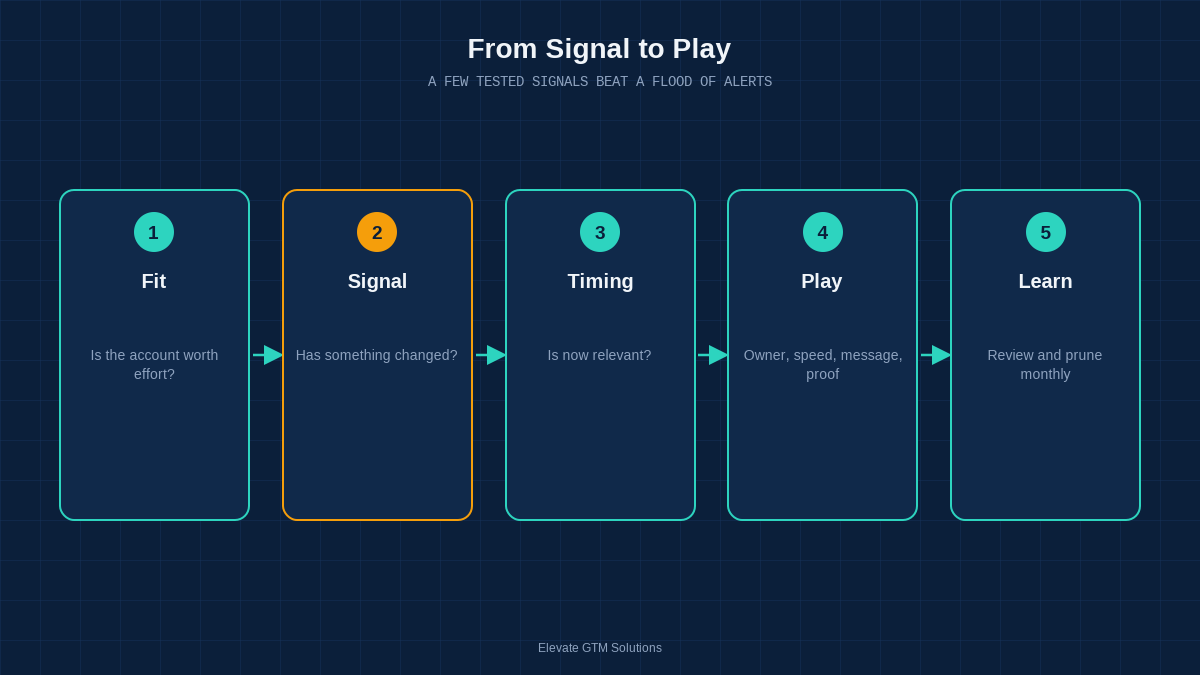
Most outreach arrives at the wrong time. A seller sends a message to a company that has no problem to solve this quarter, and the message is ignored. A week later the same company hires a head of operations, announces a new warehouse and starts looking at tools, and nobody notices. Signal-based selling is the practice of watching for events that suggest a company may be ready to buy, and acting on them quickly with something relevant to say.
The idea is simple and its execution is easy to get wrong. Teams buy tools that produce thousands of alerts, sellers learn to ignore them, and "signals" become another source of noise. This guide defines signal-based selling, describes the main types of signals and where they come from, shows how to decide which signals matter, how to design a response for each, how to measure results, how to handle privacy and compliance and where AI helps. Elevate GTM Solutions makes a GTM strategy platform that defines the customer and message that plays carry, and it does not detect signals or send outreach, so we say plainly where other tools matter. The guidance is general, and signals are evidence, not certainty.
What Is Signal-Based Selling?
Signal-based selling is a prospecting approach in which sellers and marketers prioritize and time outreach based on observable events that suggest buying interest or readiness, such as a leadership change, hiring for a relevant role, funding, a technology change, a visit to key pages, product usage or a former customer joining a new company. It combines a clear ideal customer (fit) with timely triggers (timing), and responds with specific, relevant messages. Its value depends on choosing signals that actually predict outcomes in your market, and on acting on them quickly and respectfully.
Is a signal the same as intent data? Intent data is one type of signal. Signals also include events, behavior and relationship changes.
Does signal-based selling replace outbound? No. It changes whom you contact and when, and what you say.
Fit, signals and timing
| Concept | Question | Source |
|---|---|---|
| Fit | Is this the kind of company we serve best? | Ideal customer definition and scoring |
| Signal | Has something happened that suggests readiness? | Events, behavior and relationships |
| Timing | Is now a good moment to reach out? | The signal and its freshness |
| Message | What can we say that is relevant to the signal? | Positioning and evidence |
| Action | Who contacts whom, how, and how quickly? | The play |
A signal from a poor-fit account is a distraction. Our guide to the ICP scoring framework covers rating fit, and signals work best as a layer on top of it.
Types of signals
| Category | Examples | What it may suggest | Cautions |
|---|---|---|---|
| Company events | Funding, acquisition, expansion, a new location, a product launch | Change creates needs | Verify relevance to your product |
| Leadership and hiring | A new executive, hiring for a role related to your category | New priorities and budget | A job posting is not a purchase |
| Technology changes | Adoption or removal of a tool, a migration | Fit or opportunity | Data is often incomplete |
| Website and content behavior | Visits to pricing or comparison pages, repeat visits, downloads | Active research | Anonymous traffic is hard to attribute |
| Intent data | Research on topics related to your category across the web | An account may be in market | Often noisy and general |
| Product usage | Sign-ups, activation, team growth, limit hits | Readiness to upgrade or expand | Needs instrumentation |
| Relationship changes | A past champion or customer joins a new company | A warm path into a new account | Respect relationships |
| Community and social | Questions about your category in forums, comments, posts | Interest or a problem | Participate honestly, not intrusively |
| Customer signals | Support tickets, usage decline, renewal dates | Risk or expansion | Combine with context |
| Competitive signals | A competitor's price change, outage or acquisition | A reason to reconsider | Handle respectfully and accurately |
Not every signal is worth acting on. Choose a few that your own data suggest predict meetings and wins.
How to decide which signals matter
Evidence beats intuition. Test each signal against your history.
| Step | Practice |
|---|---|
| 1. List candidate signals | From interviews, wins and seller experience |
| 2. Find historical examples | Did your best customers show this signal before buying? |
| 3. Compare with non-buyers | How often did accounts that never bought show the same signal? |
| 4. Estimate lift | Did accounts with the signal convert more often, with counts? |
| 5. Check lead time | How long between signal and purchase, and how long does the signal stay relevant? |
| 6. Check reliability | How often is the signal wrong or stale? |
| 7. Keep the useful few | Retire signals that do not separate outcomes |
A worked example with invented numbers
| Signal | Accounts with signal | Became opportunity within 90 days | Rate | Accounts without signal | Became opportunity | Rate |
|---|---|---|---|---|---|---|
| Hired a head of operations | 40 | 9 | 23 percent | 400 | 28 | 7 percent |
| Visited pricing page twice | 60 | 12 | 20 percent | 380 | 25 | 7 percent |
| Posted a job for a dispatcher | 25 | 3 | 12 percent | 415 | 34 | 8 percent |
| Funding announced | 30 | 2 | 7 percent | 410 | 35 | 9 percent |
In this invented example, the first two signals appear to separate outcomes. The job posting for a dispatcher has a smaller effect, and funding shows none, so the team keeps the first two and monitors the third. With small counts the team treats these as hypotheses and re-tests each quarter.
Designing plays
A signal needs a response. A play defines it.
| Element | What to define |
|---|---|
| Trigger | The signal and any conditions, such as fit tier and freshness |
| Owner | Who acts: a seller, a development rep or marketing |
| Speed | How quickly to respond |
| Channel | Email, call, social message, advertising or a partner introduction |
| Message | A relevant, specific opening tied to the signal, with approved claims |
| Proof | Evidence you may show |
| Next step | A small, clear ask |
| Stop rule | When to stop or hand off |
| Measure | What counts as success |
Examples of plays, invented
| Signal | Play |
|---|---|
| A new head of operations at a tier A account | A short note from a seller within two days, referencing a problem new operations leaders commonly report, with a relevant customer story and an offer of a short conversation |
| Two visits to the pricing page from a known account | A marketing email with a clear pricing explanation, plus an alert to the account owner who sends a brief offer to help |
| A past champion joins a new tier A company | A personal message from the seller who knew them, congratulating them and offering to share what worked before, if appropriate |
| A trial account adds a second user | An in-product prompt, and a seller note offering help with team setup if the account matches the profile |
| A competitor announces a major price change | An accurate, respectful note to relevant accounts offering a comparison on request |
Plays should feel useful to the recipient. A message that shows unsettling knowledge of a person's activity reduces trust.
A process for handling signals
| Step | Practice |
|---|---|
| Collect | Bring signals into one place, such as the CRM or a signals tool |
| Filter | Remove accounts that are not a fit |
| Score | Combine fit and signal strength |
| Route | Send high-priority signals to the right owner with context |
| Act | Follow the play within the agreed time |
| Record | Log what was done and the outcome |
| Review | Monthly, check which signals led to conversations and wins |
| Prune | Retire signals and plays that do not work |
Keep the number of active signals small. Five good ones beat thirty noisy ones.
Tools
Several categories of tools surface signals.
| Category | What it does | Examples that describe themselves in the category |
|---|---|---|
| Account intelligence and intent | Identifies in-market accounts and research behavior | Demandbase, 6sense |
| Contact and company data providers | Provides firmographic, hiring and technology data | ZoomInfo, Apollo, Clay |
| Signal-based prospecting tools | Detects events and triggers outreach | Unify, UserGems, Common Room |
| Product analytics | Shows usage signals | Many tools |
| CRM and sales engagement | Holds and acts on signals | HubSpot, Salesforce, Outreach, Salesloft |
| Workflow tools | Connect signals to actions | Zapier, n8n, Make |
Our comparison pages cover several: Elevate vs Unify, Elevate vs UserGems, Elevate vs Common Room, Elevate vs ZoomInfo and Elevate vs Demandbase. Evaluate with your own accounts: how accurate, fresh and actionable are the signals for your segment?
Privacy, consent and compliance
Signals often involve information about people and companies. Be careful.
| Topic | Practice |
|---|---|
| Lawful basis and consent | Review the rules for contacting people in each region with your legal advisers |
| Source transparency | Understand where each signal comes from |
| Sensitive data | Avoid using signals that touch sensitive personal information |
| Opt-outs | Honor them across tools |
| Retention | Keep only what you need, for as long as you need it |
| Tone | Do not reveal tracking that would feel intrusive |
| Accuracy | Verify account-specific claims before sending |
Rules on personal data, tracking and unsolicited messages differ by country. Take advice before building programs that depend on person-level tracking.
Measuring signal-based selling
| Measure | Why it matters |
|---|---|
| Signals acted on within the agreed time | Speed |
| Reply and positive reply rate by signal | Relevance |
| Meetings per hundred signals acted on | Efficiency |
| Meeting to opportunity rate by signal | Quality |
| Win rate and cycle for signal-sourced deals | Outcome |
| False positive rate | How often a signal did not mean what you thought |
| Seller time per signal | Cost |
| Share of signals ignored | Noise and trust |
Compare signal-based outreach with your baseline on similar accounts, and watch for selection effects. Accounts with signals may have been easier anyway.
A signal inventory
Before buying tools, list the signals you could use and evaluate each. A simple inventory keeps the program focused.
| Signal | Source | Fresh for | Evidence it predicts outcomes | Owner of the play | Status |
|---|---|---|---|---|---|
| New operations leader | Public announcements, professional networks, data providers | About 90 days | Tested on history, with counts | Account owner | Active |
| Repeat pricing-page visits | Website analytics matched to accounts | About 7 days | Tested | Marketing and account owner | Active |
| Past champion joins a new company | Relationship tracking | About 90 days | Anecdotal, test in progress | Seller who knew them | Pilot |
| Funding announced | News | About 60 days | Not shown | None | Retired |
| Competitor price change | Public sources | About 30 days | Not tested | Product marketing | Watch |
Review the inventory quarterly. Move signals between active, pilot, watch and retired as evidence changes.
Combining fit and signal strength, with invented numbers
A simple approach scores each account on fit and on signal strength, then ranks by both.
| Account | Fit score (0 to 36) | Fit tier | Signals this week | Signal strength (0 to 10) | Priority |
|---|---|---|---|---|---|
| Account A | 34 | A | New operations leader, pricing visits | 9 | Contact today |
| Account B | 30 | A | None | 0 | Watch |
| Account C | 22 | B | Pricing visits | 6 | Marketing nurture, light seller touch |
| Account D | 12 | C | New operations leader, pricing visits | 9 | Do not prioritize, poor fit |
| Account E | 28 | A | Past champion joined | 8 | Warm outreach from the seller who knew them |
Rules that follow from this table: fit sets whether an account is worth effort, and signal strength sets when. A high signal on a poor-fit account stays low priority. A high-fit account with no signal stays on a watchlist. Our guide to the ICP scoring framework explains how to score fit.
Routing and response time
Signals decay. A message sent a week after a leadership change is less relevant than one sent in two days.
| Priority | Target response | Who acts | Channel |
|---|---|---|---|
| Contact today | Same working day | The account owner | Direct message or call, tied to the signal |
| This week | Within three working days | The account owner or development rep | Email or social message |
| Nurture | Next scheduled touch | Marketing | Relevant content |
| Watch | None | Operations | Monitor for changes |
Make response times visible and review misses. If alerts routinely go unanswered, there are too many signals or too few people.
Messages that work, and messages that do not
| Situation | A message that helps | A message that backfires |
|---|---|---|
| New operations leader | A short note about a problem such leaders often report, a relevant customer story and an offer to talk | "Congratulations on the new role, can I have fifteen minutes?" followed by a product pitch |
| Pricing page visits | A clear explanation of pricing and an offer of help | "I saw you visited our pricing page three times" |
| Past champion at a new company | A personal note congratulating them, no pressure | A mass message using the relationship as leverage |
| Competitor change | An accurate, respectful offer of a comparison | An attack on the competitor |
| Funding or growth news | A note about what growth stage often brings, with a specific idea | A generic congratulation |
The principle: use the signal to choose relevance, not to display surveillance. Never reveal tracking that the recipient would find intrusive.
Governance
| Question | Practice |
|---|---|
| Who owns the signal list? | A named person in revenue operations or marketing |
| Who approves a new signal or play? | The owner, with sales and marketing input, recorded in a change log |
| How is quality checked? | Monthly review of false positives and outcomes |
| How are sellers protected from noise? | A cap on active signals and alerts per seller |
| How are privacy and compliance handled? | A review with legal advisers before new person-level signals |
| How do we retire a signal? | When it fails to separate outcomes for two reviews |
| How do we share learning? | A monthly summary with examples and numbers |
A thirty-day plan to start
Week 1. List candidate signals. Pull the last year of wins and non-buyers. Test each signal with counts.
Week 2. Choose two or three. Write a play for each with owner, speed, message and proof.
Week 3. Configure alerts, even if manual. Brief sellers with examples of good and bad messages.
Week 4. Run and review. Read every message sent. Record replies, false positives and sellers' feedback. Decide what to keep.
Start with a small group of sellers who will give honest feedback.
Signals for existing customers
Signals are also useful after the sale.
| Signal | What it may suggest | Response |
|---|---|---|
| Usage grows quickly | Expansion potential | A conversation about additional use cases |
| Usage drops | Risk | A check-in to understand what changed |
| A champion leaves | Risk | Build a relationship with a replacement |
| New leadership at the customer | Review of tools | A helpful reintroduction and a business review |
| Support tickets increase | Risk or confusion | A proactive review with the customer |
| Renewal approaching | Decision point | A planned renewal conversation |
| A new team adopts the product | Expansion | Support and a conversation with their leader |
Customer success and account management teams can use the same discipline: a few well-tested signals, a defined response and a monthly review.
Terms used in this guide
| Term | Meaning |
|---|---|
| Signal | An observable event suggesting buying interest or readiness |
| Intent data | Signals of research behavior on topics related to your category |
| Play | A defined response to a signal |
| Fit | How closely an account matches the ideal customer |
| False positive | A signal that did not mean what you expected |
| Freshness | How long a signal stays relevant |
| Alert fatigue | Ignoring alerts because there are too many |
A worked play, end to end
This is an invented illustration of one signal from detection to learning.
Signal. A tier A account announces a new head of operations.
Detection. The signal appears in the team's signals view the same day, with the account's fit tier and its owner.
Routing. The account owner is notified, with the account history and the recommended play.
Message, within two working days. The seller writes a short note. It does not mention tracking. It says that new operations leaders often inherit scheduling problems they did not create, offers a short story about a similar firm, with permission, and asks whether it would be useful to compare notes in a few weeks.
Follow-up. If there is no reply in a week, the seller sends a brief, helpful resource about the first ninety days for operations leaders and then stops.
Recording. The seller logs the signal, the message, the response and any conversation.
Review. At the monthly meeting, the team counts how many such signals led to replies and meetings and reads three messages that did not. It adjusts the message and the timing.
Learning. After three months, the data show that replies came more often when the note arrived within three days and referenced a specific problem. The team adds that to the play.
The loop is the point: a defined trigger, a prompt and relevant response, a record and a review that changes the play.
Mistakes that creep in over time
| Mistake | How it shows up | Fix |
|---|---|---|
| Signal drift | A signal that once predicted buying stops doing so | Re-test quarterly |
| Seller shortcuts | Messages become templates that ignore the signal | Review a sample each month |
| Overlap | Several teams contact the same account on the same signal | A single owner per account |
| Volume creep | More signals added without retiring any | Cap the active list |
| Data decay | Contacts and roles become outdated | Refresh and verify |
| Tool-led programs | Alerts follow whatever the tool can detect | Start from the signals you tested |
| Neglecting existing customers | Signals focus on new accounts only | Add customer signals |
| Ignoring seller feedback | Sellers stop trusting the program | A monthly feedback loop |
Questions teams ask
"Do we need a dedicated tool?" Not to start. Many teams begin with a few manual checks and a shared sheet, and add tools when the plays prove valuable and volume grows.
"How do we avoid seeming creepy?" Use signals to choose relevance. Refer to public events and reasons, not to private behavior that the recipient does not expect you to see.
"How do we handle intent data of uncertain quality?" Test it against your outcomes, treat it as a weak signal unless proven otherwise and combine it with fit.
"What if a signal predicts well but reaches only a few accounts?" Keep it. A small number of high-quality opportunities is valuable, and you can add others over time.
"Who should own the signals program?" A person in revenue operations or marketing with a mandate to work with sales, with a sponsor in sales leadership.
"How do we show value to leadership?" Report meetings per hundred signals acted on, conversion by signal and false positive rates, compared with a baseline, with honest caveats.
A starter signal list for B2B software
These are examples to test, not to copy.
| Group | Candidate signals |
|---|---|
| Leadership | New executive in the buying function, a promotion of a champion |
| Hiring | Roles that imply the problem you solve, a surge in hiring in a relevant team |
| Technology | Adoption or removal of a tool you integrate with or replace |
| Growth | Funding, a new office, a new product launch |
| Behavior | Repeat visits to pricing or comparison pages, a trial sign-up, a return after a gap |
| Relationships | A past champion or customer joining a new company |
| Customer | Usage growth, a new team adopting, a champion leaving, a renewal date |
| Competitive | A competitor's price change, outage or acquisition |
Test each against your history and keep only those that separate outcomes.
Where AI helps and where it does not
| Task | How AI helps | Caution |
|---|---|---|
| Collecting and summarizing signals | Brings together news, hiring and activity | Verify accuracy |
| Prioritizing | Suggests which accounts to contact first | Explain the reasons, and test against outcomes |
| Drafting messages | Produces drafts tied to a signal | Review for accuracy and tone |
| Agents | Monitor accounts and act on triggers | Require limits, approvals and logs |
| Pattern finding | Finds combinations of signals that predict outcomes | Needs enough data |
AI can raise the volume of alerts faster than a team can respond. Limit the number of active signals to what people can act on well.
Common mistakes
| Mistake | What happens | Fix |
|---|---|---|
| Treating every signal as buying intent | Irrelevant outreach | Test signals against outcomes |
| Ignoring fit | Time on poor-fit accounts | Score fit first |
| Too many signals | Alert fatigue | Keep a few good ones |
| Slow response | The moment passes | Agree response times |
| Creepy personalization | Loss of trust | Use signals subtly and helpfully |
| Generic message after a signal | Wasted opportunity | Write plays tied to each signal |
| No feedback loop | Signals never improve | Monthly review and pruning |
| Skipping compliance | Legal and reputational risk | Review with advisers |
A hypothetical example
This is an illustration, not a real company.
A company selling scheduling software to field-service firms bought a tool that produced hundreds of alerts a week. Sellers ignored most of them. The head of revenue operations tested five signals against twelve months of history. Two separated outcomes: a new operations leader at a firm of the right size, and repeat visits to pricing and comparison pages from known accounts.
The team kept those two, wrote a play for each and set response times of two working days and one working day. For new operations leaders, the play was a short note referencing a problem such leaders commonly report and a relevant customer story. For pricing visits, it was an email explaining pricing plainly with an offer of help. The team turned off the other alerts.
After a quarter, meetings per hundred signals acted on rose compared with the previous approach, and sellers reported fewer wasted messages. The team added one new signal, a past champion changing jobs, after finding that three of its best deals had followed that event. The lesson was not that signals are magic. It was that a few well-chosen ones, acted on quickly and honestly, beat a flood of alerts.
Scenarios and directions
| Situation | Direction to explore |
|---|---|
| A small team with a defined target list | Watch a handful of signals manually, and write a play for each |
| A team drowning in alerts | Cut to the two or three signals that predict outcomes |
| A company with a strong product-led funnel | Use usage signals with a sales-assist play for fit accounts |
| A company with many customers and little expansion | Use customer signals, such as usage growth and new teams |
| A company starting with a signals tool | Test on a small group, and measure before rolling out |
| A company with strict compliance needs | Limit person-level signals and review with advisers |
In plain language
Signal-based selling is about timing and relevance. Decide who is worth pursuing by fit, then watch for a few events that suggest readiness, and respond quickly with something genuinely useful. Test each signal against your own history, keep only the ones that separate buyers from non-buyers, write a play for each and review the results every month. Be careful with privacy and tone, and never let a flood of alerts replace judgment. A short list of well-chosen signals, acted on promptly and respectfully, beats a large dashboard that nobody trusts.
A starter checklist
- The ideal customer is defined and accounts are scored for fit.
- Five to ten candidate signals are listed, with sources.
- Each signal has been tested against a year of history, with counts.
- Two or three signals are chosen, each with a play, an owner and a response time.
- Messages have been reviewed for relevance and tone.
- Privacy and consent have been reviewed with advisers.
- Sellers know how to record outcomes.
- A monthly review is scheduled to prune and improve.
Quick reference
| Question | Short answer |
|---|---|
| What is a signal? | An observable event suggesting buying interest or readiness |
| How do I choose signals? | Test them on your own history and keep the few that separate outcomes |
| How do signals and fit work together? | Fit decides who, signals decide when |
| What is a play? | A defined response with owner, speed, message, proof and next step |
| How many signals? | A few well-chosen ones |
| What should I avoid? | Intrusive personalization, slow response, alert overload and skipped compliance |
What to do this week
List five signals you believe predict buying. Check each against your last year of wins and non-buyers. Keep the best two or three and write a play for each, with an owner and a response time. Turn off the alerts you will not act on.
Final thoughts
Signals are clues, not verdicts. They tell you that something changed at an account and that a conversation might be welcome. Whether it is depends on fit, timing and the quality of what you say. The teams that benefit keep a short list of signals tested against their own history, respond quickly with something relevant, treat people's attention with respect and review the results often enough to retire what stops working. The teams that struggle buy volume and hope. Choose a few signals, write a good play for each and learn.
Terms and short answers
| Term or question | Meaning or answer |
|---|---|
| Signal | An event or behavior suggesting readiness |
| Trigger | A signal that starts a play |
| Play | A defined response |
| Freshness | How long a signal stays useful |
| Is more always better? | No. More signals usually means more noise |
| Do signals replace judgment? | No. They inform it |
A second hypothetical: customer signals
This is another invented illustration.
A software company noticed that expansion deals were rare and arrived late. The head of customer success listed customer signals and tested them on the past year: usage growth in a second team, a new executive at the customer and a rise in a particular feature's use. Two predicted expansion within a quarter in a meaningful share of cases.
The team wrote plays: when usage in a second team passed a threshold, the customer success manager reached out to that team's leader to offer help getting started; when a new executive joined, the account owner offered a short business review. They set response times, reviewed outcomes monthly and kept the plays honest and helpful, not pushy. Expansion conversations started earlier, and several customers said the outreach arrived when they were already wondering about next steps.
The same discipline applied to customers as to prospects: few signals, tested, with a prompt and useful response.
Key takeaways
- Signal-based selling times and prioritizes outreach using events that suggest readiness, layered on top of fit.
- Test candidate signals against your own history, and keep the few that separate outcomes.
- Define a play for each signal: owner, speed, channel, message, proof, next step and stop rule.
- Keep signals few, respond quickly and keep messages useful, not intrusive.
- Review privacy, consent and compliance with advisers.
- Measure by relevance and outcomes, including false positives.
Where Elevate GTM Solutions fits
Elevate GTM Solutions is an AI-native GTM operating system for B2B companies. It helps define what signals should be attached to: the ideal customer and segments, positioning and messaging pillars with proof, qualification criteria and priorities, across 15 modules, with workflows, weekly plans and a recurring review rhythm for pruning plays. It does not detect signals, identify visitors or send outreach, so teams pair it with signal and engagement tools. It connects to HubSpot, Salesforce, LinkedIn, Notion and Claude for supported actions. A free first strategy build is available, and published plans, billed annually, are Enable at USD 499 per month and Growth at USD 1,499 per month, with custom Scale pricing.
For related reading, see ICP Scoring Framework, GTM Platform vs ABM Platform, Best GTM Automation Tools and What Is Elevate GTM Solutions?. See the pricing page, or request a demo.
Frequently Asked Questions
What is signal-based selling?
A prospecting approach that prioritizes and times outreach using observable events suggesting buying interest, such as leadership changes, hiring, funding, technology changes, page visits, product usage and a former customer joining a new company.
What are examples of buying signals?
Company events, leadership and hiring changes, technology changes, website and content behavior, intent data, product usage, relationship changes, community activity, customer signals and competitor changes.
Is intent data the same as a signal?
Intent data is one type of signal. Signals also include events, behavior and relationship changes.
How do I know which signals matter?
Test each against your history: did your best customers show it before buying, how often did non-buyers show it, what was the conversion difference with counts and how fresh and reliable is it? Keep the few that separate outcomes.
What is a play?
A defined response to a signal: the trigger, owner, speed, channel, message, proof, next step, stop rule and measure.
How many signals should a team use?
Few. Five good signals acted on well beat thirty noisy ones that cause alert fatigue.
How should I measure signal-based selling?
Response time, reply and positive reply rate by signal, meetings per hundred signals, meeting to opportunity rate, win rate and cycle for signal-sourced deals and the false positive rate.
Does signal-based selling raise privacy issues?
Yes. Review lawful basis and consent, source transparency, opt-outs, retention and tone with your legal advisers, and avoid intrusive personalization.
Where does AI help?
Collecting and summarizing signals, prioritizing, drafting messages and finding patterns, with review, limits and logs, and care that alert volume does not exceed what the team can act on.
Does signal-based selling replace outbound?
No. It changes whom you contact, when and what you say, and it works best layered on a clear ideal customer.
How do I combine fit and signals?
Score each account on fit and on signal strength, and rank by both: fit decides whether an account is worth effort, and signals decide when. A strong signal on a poor-fit account stays low priority.
How quickly should I respond to a signal?
Quickly for high-priority signals, often the same working day for top accounts, because relevance decays. Set response times and review misses.
What should a signal-based message avoid?
Revealing tracking the recipient would find intrusive, generic congratulations and product pitches that ignore the signal. Use the signal to choose relevance.
Can signals be used for existing customers?
Yes, such as usage growth, usage decline, a champion leaving, new leadership, support tickets and renewals, each with a defined response.