
By the Elevate GTM Solutions Team · Updated November 10, 2026 · 22 min read
How to Structure a GTM Team: Models, Roles, Hiring Order, and Decision Rights by Company Stage
Most go-to-market organizations are shaped by accident. A founder sells, then a marketer is hired, then a salesperson, then a customer success hire after a bad renewal, then an operations person after the reports stop agreeing. Each hire solved the last problem. After a few years, the structure reflects the order of crises, not a design, and people spend a lot of effort working around boundaries that no one chose.
Designing a GTM team on purpose does not mean drawing a perfect organization chart. It means deciding what the company needs the team to do at its current stage, choosing a model that fits, hiring in a sensible order, setting decision rights and handoffs, aligning metrics and incentives and revisiting the structure as the company changes. This guide covers each. It contains no benchmark headcounts or ratios, because published figures vary widely by company, product and market, and we cannot verify them for yours. Elevate GTM Solutions makes a GTM strategy platform that holds the decisions a team works from, and it does not replace organization design or management, so we say plainly where those matter. The guidance is general and every company differs.
How Should You Structure a GTM Team?
Start from the work that must be done at your stage: learning who the customer is, reaching them, selling, onboarding and expanding, and keeping strategy and operations coherent. Choose a model that matches your product, buyers and size: functional teams for focus, segment or pod teams for customer alignment, product-aligned teams for multi-product companies or regional teams for geographic markets. Hire in the order your bottleneck dictates, write down decision rights and handoffs, align metrics and incentives across functions and review the structure at least annually. Structure should follow strategy, and change when the strategy changes.
What should a startup's first GTM hires be? Often the founders sell, then a first seller or a combined marketer-seller, then success and operations roles as volume grows.
How often should the structure change? Review it annually and after major strategy changes, but avoid frequent reorganizations.
What a GTM team has to do
| Job | What it means |
|---|---|
| Understand the customer | Interviews, win and loss learning, segment and competitor evidence |
| Decide the strategy | Ideal customer, positioning, messaging, pricing logic, priorities |
| Create demand | Content, channels, community, events, partners |
| Start conversations | Outbound and inbound handling, qualification |
| Sell | Discovery, evaluation, negotiation, closing |
| Onboard and support | Implementation, adoption and first value |
| Retain and expand | Success management, renewals and expansion |
| Equip | Content, training, coaching |
| Operate | Process, data, systems, reporting and forecasting |
| Govern | Decision rights, handoffs, reviews and records |
A structure is a way of grouping these jobs and assigning owners. Different groupings favor different things.
Structure models
| Model | How it groups people | Strengths | Cautions | Typical fit |
|---|---|---|---|---|
| Functional | Marketing, sales, success, operations as separate teams | Depth of skill, clear career paths | Handoff friction, local optimization | Early and mid-sized companies with one main product |
| Segment-based or pods | Cross-functional pods around a segment, with a seller, marketer and success owner | Customer focus, faster learning | Duplicated effort, harder to share practice | Companies with distinct segments |
| Product-aligned | Teams around each product or product line | Product depth | Overlapping customers, inconsistent messages | Multi-product companies |
| Regional | Teams by geography | Local fit | Divergent practice | International companies |
| Matrix | Combination, for example functional with regional or product overlays | Balance | Complexity and unclear ownership | Larger companies |
| Account-based | Teams around named accounts, with dedicated resources | Depth for strategic accounts | Cost and narrow reach | Enterprise sales |
| Center of excellence with embedded teams | Central standards and operations, embedded specialists in business units | Consistency with local fit | Governance effort | Large organizations |
No model is best. Each trades one kind of friction for another. A company with a single product and one dominant buyer may be well served by a functional structure with good handoffs. A company with several distinct segments may benefit from pods.
Choosing a model: questions to ask
| Question | If yes, consider |
|---|---|
| Do different segments buy in very different ways? | Segment pods or segment teams |
| Do products serve overlapping customers? | Shared account ownership and a common message layer |
| Are regions meaningfully different? | Regional teams with global standards |
| Is the buying process long and complex? | Specialized roles such as sales engineers and deal support |
| Is learning speed the main need? | Smaller, cross-functional groups |
| Is consistency the main need? | Central operations and enablement with strong governance |
| Are strategic accounts a large share of revenue? | Account-based teams |
Write down what you are optimizing for. If the answer is "everything," it is time to choose.
Roles and their purpose
| Role | Purpose | Typical stage added |
|---|---|---|
| Founder or GTM leader | Sets direction, sells early, owns learning | From the start |
| First seller or account executive | Carries the pitch to buyers | After the founders can describe what works |
| Marketer or demand lead | Builds awareness and inbound | Early, often combined with product marketing |
| Product marketing | Positioning, messaging, enablement content | When several people need a shared message |
| Sales development | Starts conversations, qualifies | When outbound volume justifies it |
| Sales engineer | Supports technical evaluation | When evaluations slow deals |
| Customer success | Onboarding, adoption, renewals | When churn or onboarding becomes a constraint |
| RevOps or sales operations | Process, data and tools | When reporting and routing break |
| Enablement | Training and coaching | When ramping new hires becomes slow |
| GTM manager | Cross-functional planning and launches | When several products, segments or launches need coordination |
| Partnerships | Channel and technology partners | When partners are a real path |
| Finance partner | Pricing, planning and metrics | As complexity grows |
Our guide on what a GTM manager does covers one coordinating role, and What Is Revenue Operations? covers another.
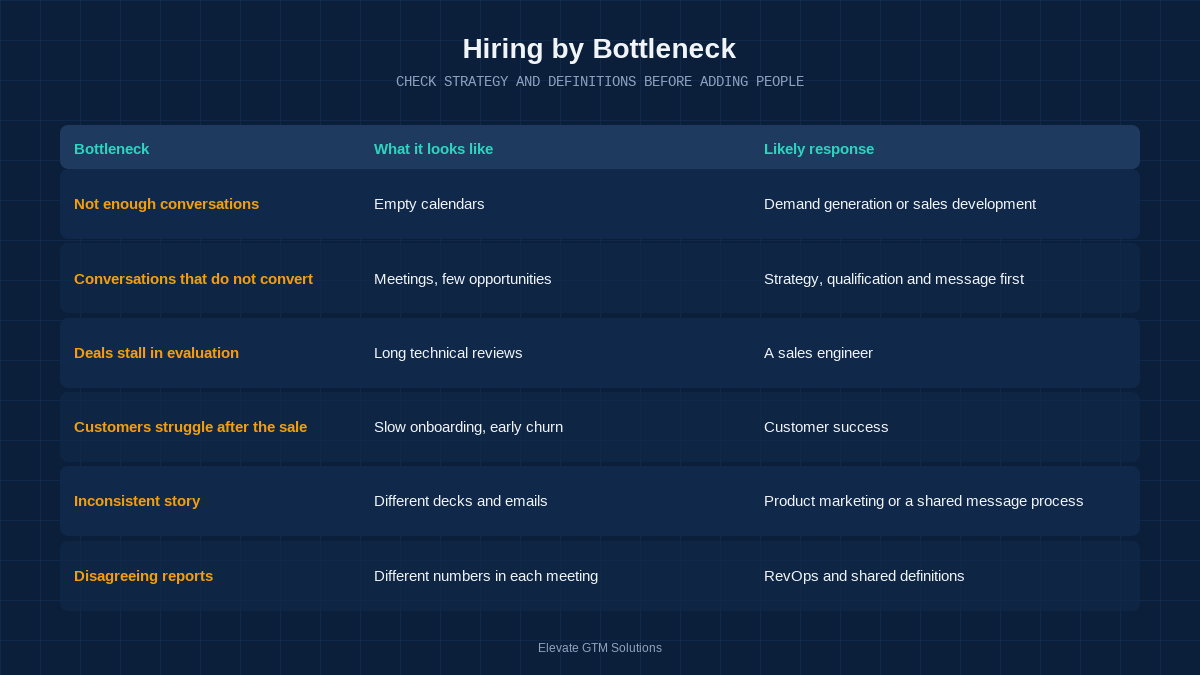
A hiring order driven by bottlenecks
| Bottleneck | What it looks like | Likely next hire or change |
|---|---|---|
| Not enough conversations | Sellers have empty calendars | Demand generation or sales development |
| Conversations that do not convert | Meetings with no opportunities | Strategy work, qualification and message, before more hires |
| Deals stall in evaluation | Long technical reviews | A sales engineer |
| Deals are won and customers struggle | Slow onboarding, early churn | Customer success or implementation |
| Everyone describes the product differently | Inconsistent decks and emails | Product marketing or a shared message process |
| Reports disagree | Different numbers in each meeting | RevOps and shared definitions |
| New sellers take long to ramp | Slow time to first deal | Enablement and a playbook |
| Launches land flat | Late briefings, unclear owners | A GTM manager or a launch process |
Hiring does not fix a problem of strategy, process or definition. Check whether the cause is something other than headcount before you add people.
Stage by stage
Founder-led stage
What to do. Founders sell, interview customers and write the one-page strategy. Tools are few.
Structure. No formal teams. One person owns each outcome: learning, outreach and delivery.
Watch for. Founders who delegate selling before the pitch is proven.
Early team
What to do. Add a first seller or two, a marketer and a part-time operations function. Write a short playbook.
Structure. Small team with a single leader, regular weekly reviews and a shared plan.
Watch for. Unclear ownership of leads and customers.
Growth stage
What to do. Add sales development, success, product marketing and RevOps. Define stages, handoffs and metrics.
Structure. Functional teams with named handoffs, or pods if segments differ sharply.
Watch for. Handoff friction and inconsistent definitions.
Scale stage
What to do. Add enablement, a GTM manager or equivalent, regional or segment teams and stronger governance.
Structure. Functional with segment or regional overlays, with a center of excellence for operations and enablement.
Watch for. Divergent local practice and duplicated tools.
Multi-product or international stage
What to do. Decide what is global and what is local, set decision rights, align metrics across units and create a shared strategy layer.
Structure. Matrix or center of excellence with embedded teams.
Watch for. Conflicting messages and cross-sell conflicts. Our guide to global vs local GTM decisions covers this.
Decision rights
Unclear decision rights are a common cause of friction in GTM teams.
| Decision | Candidate owner | Must be consulted | Final approver |
|---|---|---|---|
| Ideal customer definition | Strategy or product marketing | Sales, success, product | GTM leader |
| Positioning and message | Product marketing | Sales, product, success | GTM leader |
| Pricing and packaging | Finance and product | Sales, marketing | Executive |
| Sales process and stage criteria | Sales leader | RevOps, success | GTM leader |
| Territories and routing | RevOps | Sales leaders | Sales leader |
| Compensation | Sales leader and finance | HR and legal | Executive |
| Channel plan and budget | Marketing leader | Sales, finance | GTM leader |
| Launch timing | Product with GTM readiness input | Marketing, sales, success | Executive |
| Regional exceptions | Regional leader | Strategy owner | GTM leader |
Fill in the table for your company and share it. Our guide to who owns GTM strategy goes deeper.
Handoffs
Most GTM failures happen at the seams.
| Handoff | What must pass | Risk if it does not |
|---|---|---|
| Marketing to sales | Qualified interest, with context and the buyer's words | Leads rejected, mutual blame |
| Sales development to account executive | Qualification notes and next step | Buyers repeat themselves |
| Sales to customer success | Goals, stakeholders, promises, timelines | Broken expectations |
| Success to product | Customer feedback and requests | Lost insight |
| Product to marketing and sales | What is shipping, for whom, and the message | Late and inconsistent launches |
| Field to strategy | Win and loss evidence, objections and competitor changes | Strategy goes stale |
For each handoff, define the standard in one page: what is passed, in what form, by when and who confirms receipt. Review disputes monthly.
Metrics and incentives that align
| Function | Typical metric | Alignment risk | Fix |
|---|---|---|---|
| Marketing | Qualified conversations and pipeline | Volume over fit | Share definitions and measure acceptance |
| Sales development | Meetings and meeting quality | Meetings that never convert | Pair with meeting to opportunity |
| Sales | New revenue | Ignoring retention and fit | Add retention or quality elements |
| Success | Retention and expansion | Promises made in sales | Shared records of what was promised |
| Operations | Data quality and process consistency | Becoming a gatekeeper | Clear charter and service levels |
| Product marketing | Message adoption and win rate by segment | Producing assets nobody uses | Seller feedback and usage |
Pair metrics so that no function can look good by harming another. Review them together monthly.
An operating rhythm
| Cadence | Meeting | Purpose |
|---|---|---|
| Weekly | Pipeline and launch sync | Status, blockers and handoffs |
| Weekly | Team standup or check-in | Coordination |
| Monthly | Strategy and metrics review | Results by segment, evidence, decisions |
| Monthly | Exception review | Regional or product departures from standards |
| Quarterly | Reset | Revisit customer definition, positioning, priorities and structure |
| Annually | Structure review | Whether the organization still fits the strategy |
A rhythm is cheap and powerful. Write the agenda, keep records and end each meeting with decisions and owners.
Common structural mistakes
| Mistake | What happens | Fix |
|---|---|---|
| Hiring to fix a strategy problem | More effort, same results | Settle the strategy first |
| Overlapping responsibilities | Duplicated work and turf conflict | Clear owners |
| Gaps nobody owns | Seams fail | Name an owner for each handoff |
| Too many direct reports per manager | No coaching | Plan spans of control for coaching |
| Frequent reorganizations | Lost momentum | Review annually and change deliberately |
| Misaligned incentives | Local optimization | Paired metrics and shared goals |
| Copying a larger company's structure | Wrong fit | Design for your own stage |
| Separate tools and definitions by team | Disagreement on numbers | RevOps and shared definitions |
A pod design, worked through
This is an invented illustration of a segment pod for a company with two priority segments.
| Element | Entry |
|---|---|
| Purpose | Win and serve field-service firms of ten to forty technicians |
| Members | One account executive, one development rep, one customer success manager, one marketer who splits time with another pod, a part-time sales engineer |
| Shared goal | Qualified opportunities, win rate, time to first value and retention in the segment |
| Shared standards | One customer profile, message pillars, stage criteria and handoff rules set centrally |
| Local freedom | Channels, examples, proof points and call cadence within the standards |
| Rhythm | Weekly pod sync, monthly review with the strategy owner |
| Governance | A recorded exception log, and a quarterly review of whether the pod structure still fits |
| Risks | Duplicated effort across pods, uneven practice, unclear coverage of accounts that fit two segments |
| Mitigations | A central enablement and operations function, a rule for overlapping accounts and a shared call library |
Pods work best when standards are central and tactics are local. If every pod invents its own message and process, you have built several small companies.
Spans of control and manager time
Coaching takes time, and structure should protect it.
| Question | Guidance |
|---|---|
| How many people can a manager coach? | Few enough that the manager can review calls, inspect deals and hold regular one-to-ones. Test this against how much coaching actually happens |
| What else does the manager do? | Hiring, forecasting, reporting and meetings all compete with coaching |
| What helps? | Enablement and operations support, a shared call library and clear priorities |
| What hurts? | Managers who also carry a quota or large accounts without support |
| How do you check? | Ask sellers how often they received specific feedback in the last month |
If coaching is thin, adding sellers will not help. Adding manager capacity or support may.
Compensation alignment
| Principle | Practice |
|---|---|
| Reward the outcome the strategy needs | If priority segments matter, reward them |
| Include retention or quality | Avoid rewarding only bookings |
| Make it understandable | A seller can calculate their pay |
| Avoid conflicts between teams | Agree how shared accounts and handoffs are credited |
| Review annually | Strategy and markets change |
| Involve finance, legal and HR | For accuracy and compliance |
| Communicate changes early | Surprises damage trust |
When teams fight over credit, the structure and the incentives are usually telling you the same thing.
Onboarding people into the structure
| Period | Focus |
|---|---|
| Before day one | Access, a welcome note and a first-week plan |
| Week 1 | The customer, strategy and message. Org chart and decision rights |
| Weeks 2 to 4 | Process, tools, handoffs and shadowing |
| Weeks 5 to 8 | Supervised work with feedback |
| Months 3 to 6 | Independent work with coaching and clear goals |
Give every new hire the decision-rights table and the handoff standards. Ask what is unclear and fix the documents.
A structure review checklist
Run annually, and after major strategy changes.
- Does the structure match the strategy: segments, products, regions and motions?
- Does every key decision have an owner and an approver?
- Are the biggest handoffs defined and working?
- Do metrics and incentives align across functions?
- Is coaching time protected?
- Are there duplicate tools or processes?
- Do people know whom to ask?
- Are there gaps nobody owns?
- What would we change if we started again, and what is the smallest step toward it?
Remote, regional and hybrid teams
| Consideration | Practice |
|---|---|
| Time zones | Plan overlap hours for handoffs and reviews |
| Documentation | Write decisions and standards down, since hallway conversations are limited |
| Meetings | Fewer, with clear agendas and recorded outcomes |
| Local leadership | Give regional leads decision rights within standards |
| Culture | Invest in shared language and examples |
| Tools | Use shared systems for strategy, pipeline and enablement |
| Onboarding | Provide structured paths and buddies |
Scenarios and directions
| Situation | Direction to explore |
|---|---|
| A startup with five people in go-to-market | Stay informal, with named owners and a weekly review |
| A growth company with rejected leads and finger-pointing | Shared definitions, a handoff standard and paired metrics |
| A company with two distinct segments | Consider pods with central standards |
| A company with several products selling to overlapping customers | Shared account ownership rules and a common message layer |
| An international company | Regional teams with global standards and an exception process |
| A company adopting AI agents | Assign owners, limits and review for each automation |
Terms used in this guide
| Term | Meaning |
|---|---|
| Functional structure | Teams organized by function, such as marketing and sales |
| Pod | A cross-functional team around a segment or product |
| Matrix | Overlapping structures, such as function and region |
| Center of excellence | A central team that sets standards and supports others |
| Span of control | The number of people a manager supervises |
| Decision rights | Who owns, advises and approves each decision |
| Handoff standard | What must pass between teams and in what form |
How AI affects team structure
| Area | Effect | Consideration |
|---|---|---|
| Research and preparation | Faster | Reduces some manual work |
| Content and outreach drafting | Faster | Raises the need for review and governance |
| Operations and reporting | Faster | Raises the importance of data definitions |
| Coaching | More data from calls | Needs human judgment |
| Agents | Perform multi-step tasks | Need owners, limits and logs |
| Role boundaries | Shift | Review roles as workflows change |
AI may change how many people a task needs. It does not remove the need for owners, decision rights and review.
A hypothetical example
This is an illustration, not a real company.
A company with sixty people in go-to-market had marketing, sales, success and operations teams, each with its own plan and tools. Leads were rejected, handoffs lost context and each team described the product differently. The head of GTM wrote down what the company needed from the team for the next year: win in two priority segments, reduce time to first value and keep messaging consistent. She chose to keep a functional structure and add three things: a decision-rights table, a one-page handoff standard for each seam and a monthly strategy review.
She added a product marketing hire to own message and proof, moved one seller and one success manager to focus on each priority segment as a lightweight pod and reassigned a part-time operations role to a full-time RevOps owner. She paired metrics: marketing was measured on qualified conversations accepted by sales, success on first value and retention, and sales on revenue with a retention component.
After two quarters, lead rejection fell, handoffs included the buyer's words and the team described the product in the same way. The company had not reorganized dramatically. It had made the boundaries explicit and the incentives consistent.
What to do this week
Write what the company needs the GTM team to do in the next twelve months. Fill in the decision-rights table for five decisions. Pick the handoff that causes the most friction and write its standard on one page. Check whether any metric rewards a function for harming another.
Questions leaders ask about structure
"Should marketing and sales report to one leader?" Often helpful at a certain size, since it aligns goals and removes handoff friction. It needs a leader who understands both and respects the different skills.
"Where should customer success sit?" Companies place it under sales, a separate leader or a combined revenue organization. The choice matters less than shared records of promises, aligned metrics and clear handoffs.
"When should we split sales into segments?" When segments differ enough in buyer, process and product fit that one playbook serves none of them well, and when you have enough volume to support separate teams.
"How do we handle a seller who wants to sell everything?" Clear segment and account rules, a fair exception process and compensation that rewards priority segments.
"Should RevOps report to sales, marketing or finance?" Choose a place that gives neutrality across functions. Whatever the reporting line, give RevOps a charter and a seat in strategy reviews.
"How do we reorganize without losing momentum?" Change as little as the problem demands, explain why, set a transition plan and review after a quarter.
What good structure looks like
| Area | Signs |
|---|---|
| Clarity | People can say who owns each decision and handoff |
| Alignment | Metrics reward shared outcomes, and teams describe the customer the same way |
| Learning | Field evidence reaches strategy owners monthly |
| Coaching | Managers have time to review calls and deals |
| Efficiency | Few duplicate tools, processes or meetings |
| Adaptability | The structure is reviewed and changed deliberately |
| Trust | Disputes are resolved by documented rules, not by escalation alone |
Communicating a structure change
| Step | Practice |
|---|---|
| Explain why | Tie the change to strategy and evidence |
| Be specific | Who reports to whom, who owns what, from when |
| Address concerns | Hold a Q and A, and follow up in writing |
| Provide a transition plan | Handoffs, account moves and timing |
| Update documents | Decision rights, handoff standards and the org chart |
| Review | Check after a quarter whether the change solved the problem |
In plain language
A good GTM structure makes it clear who does what, who decides what and how work passes between teams. Choose a model that fits your stage and buyers, hire to your bottleneck, write down decision rights and handoffs, pair your metrics so no team wins by hurting another and protect coaching time. Review the structure each year, change it carefully and avoid reorganizing to solve a problem that is really about strategy or definitions.
A second hypothetical: an early team finding its shape
This is another invented illustration.
A software company with eleven people in go-to-market had grown by adding whoever seemed needed: two sellers, a marketer, a success manager and an operations person who also did finance reporting. Leads were disputed and the success manager complained that sellers promised features the product lacked. The founder asked what the company needed the team to do over the next year: win in one priority segment, reduce time to first value and keep the story consistent.
They kept a functional structure and made four changes: wrote a one-page handoff standard between sales and success that recorded promises, agreed a definition of qualified lead with marketing, gave the operations person a full-time RevOps role and appointed one seller as the owner of the priority segment's playbook. They set a weekly sync and a monthly review. They did not hire anyone for two quarters. Complaints about promises fell, and the team could describe its customer in the same words.
Often the first step in structuring a team is not a hire. It is naming who owns what and how work passes.
Signals that the structure is working
| Signal | What it tells you |
|---|---|
| New hires reach their first qualified conversation faster | Onboarding and clarity are working |
| Disputes between teams are rare and resolved by documented rules | Decision rights are clear |
| Managers coach regularly | Spans are workable |
| Marketing and sales agree on lead quality | Definitions and incentives align |
| Customers describe consistent promises and experiences | Handoffs work |
| Strategy changes reach the field in days | The operating rhythm works |
Structure pitfalls specific to startups
| Pitfall | What happens | Fix |
|---|---|---|
| Titles that promise more than the role | Confusion and attrition | Write a short role charter |
| Hiring senior specialists too early | Cost without leverage | Hire generalists who can learn, then specialize |
| Founders who never let go of selling | Bottleneck | Document the pitch and hand it over gradually |
| Copying a famous company's org chart | Wrong fit | Design for your stage |
| No owner for definitions | Disputes about numbers | Name one |
Design principles
| Principle | What it means |
|---|---|
| Strategy first | Structure follows what the company is trying to win |
| Clear owners | Every decision and handoff has one owner |
| Shared definitions | Customer, lead, opportunity and customer mean the same thing everywhere |
| Paired incentives | No function wins by harming another |
| Protected coaching | Managers have time to coach |
| Small and cross-functional where learning matters | Pods around segments can learn faster |
| Central where consistency matters | Standards, operations and enablement benefit from a center |
| Written down | Decision rights, handoffs and charters are documents, not folklore |
| Reviewed | Annually and after major changes |
| Simple | Add layers only when a problem requires them |
Questions to ask yourself
- What is the most expensive friction in our GTM team today?
- Is it caused by structure, by definitions, by incentives or by strategy?
- Which handoff loses the most information?
- Which decision is made differently by different people?
- Who owns the answer, and do they know it?
- What is the smallest change that would fix the worst problem?
- How will we know in a quarter whether it worked?
Write the answers down and share them with the leaders who can change the structure.
Quick reference
| Question | Short answer |
|---|---|
| What first? | Decide what the team must do at this stage |
| Which model? | The one whose friction you can live with: functional, pods, product, regional, matrix or account-based |
| Who to hire first? | Whoever removes the current bottleneck, after checking it is not a strategy or definitions problem |
| What must be written down? | Decision rights, handoff standards and definitions |
| What aligns people? | Paired metrics and shared goals |
| How often to review? | Annually, and after major strategy changes |
In plain language
A GTM structure is a set of choices about who does what, who decides what and how work passes between people. It should follow the strategy, be as simple as the stage allows and be written down. Most problems that look like structure problems are really about definitions, incentives or handoffs, and many can be fixed without a single new hire. Review it each year, change it deliberately and protect the time managers need to coach.
Suggested first changes by company size
These are starting points to adapt, not rules.
| Company situation | A sensible first change |
|---|---|
| A handful of people, founders still selling | Name one owner per outcome and hold a weekly review |
| Ten to thirty people, disputed leads | Agree one definition of qualified and a handoff standard |
| Several products, overlapping customers | Write account ownership rules and a shared message layer |
| Several regions with divergent messages | Publish global standards and an exception process |
| Large sales team, slow ramp | Invest in enablement, a playbook and a call library |
| Many tools and conflicting reports | Create a RevOps charter and shared definitions |
| New segment with different buyers | A small pod with central standards |
In each case, make the smallest change that addresses the worst friction and review after a quarter.
Final thoughts
The best GTM structures are ones people can explain in a minute: who owns what, who decides what and how work moves. Start from the strategy, keep the structure as simple as your stage allows, write it down, align incentives and review it often. If a problem feels like a structure problem, check first whether it is really about definitions, handoffs or incentives. Fixing those is cheaper than reorganizing, and it makes any later reorganization work better.
Key takeaways
- Structure should follow strategy: decide what the team must do at this stage, then choose a model.
- Models include functional, segment pods, product-aligned, regional, matrix, account-based and center of excellence, and each trades one friction for another.
- Hire in the order of your bottleneck, and check whether the cause is strategy, process or definitions before adding headcount.
- Write down decision rights and handoff standards.
- Pair metrics and incentives across functions.
- Run a regular operating rhythm and review the structure annually.
Where Elevate GTM Solutions fits
Elevate GTM Solutions is an AI-native GTM operating system for B2B companies. It holds the decisions a team works from: ideal customer and segments, positioning, messaging with proof, pricing logic, channel plans, qualification criteria, launch and execution plans and measurement, across 15 modules, with workflows, weekly plans, task ownership and a recurring review rhythm. It works across scopes such as products, markets and segments, and lets teams compare strategies side by side, which helps when segment pods or regional teams need shared standards. It does not design organizations, manage people or replace judgment, and it connects to HubSpot, Salesforce, LinkedIn, Notion and Claude for supported actions. A free first strategy build is available, and published plans, billed annually, are Enable at USD 499 per month and Growth at USD 1,499 per month, with custom Scale pricing.
For related reading, see What Does a GTM Manager Do?, Who Owns GTM Strategy?, What Is Revenue Operations? and What Is Elevate GTM Solutions?. See the pricing page, or request a demo.
Frequently Asked Questions
How should I structure a GTM team?
Start from the work needed at your stage, choose a model that fits your product, buyers and size, hire in the order of your bottleneck, write decision rights and handoffs, align metrics and incentives and review the structure annually.
What are the common GTM team structures?
Functional teams, segment-based pods, product-aligned teams, regional teams, matrix structures, account-based teams and a center of excellence with embedded specialists.
Which GTM roles should a startup hire first?
Often the founders sell first, then a first seller or combined marketer-seller, then success and operations roles as volume grows. Hire to the bottleneck.
When should I add RevOps?
When reports disagree, routing and handoffs break, tools multiply without an owner or strategy changes do not reach configuration.
When should I add product marketing?
When several people need a shared message and proof, and sellers describe the product in different ways.
How do I decide between functional and pod structures?
Ask whether segments buy very differently and whether learning speed or depth of skill matters more. Pods favor customer focus and learning. Functional teams favor depth and career paths.
What are decision rights and why do they matter?
They state who owns, who must be consulted and who approves each decision. Unclear decision rights cause friction, especially across functions and regions.
How do I align incentives across functions?
Pair metrics so that no function looks good by harming another, such as marketing measured on qualified conversations accepted by sales and sales including a retention element.
How often should I reorganize?
Review annually and after major strategy changes. Frequent reorganizations cost momentum.
How does AI change GTM team design?
It speeds research, drafting, reporting and coaching and changes some task boundaries, and it raises the need for owners, limits, logs and review.
How do pods work in a GTM team?
A pod is a small cross-functional team around a segment or product with a shared goal. They work best when standards such as customer profile, message and stage criteria are central and tactics are local.
How do I protect coaching time?
Plan manager capacity for coaching, avoid loading managers with quotas or large accounts without support, provide enablement and operations support and check with sellers how often they received specific feedback.
How do I review the structure?
Annually and after strategy changes: check fit with segments, products and regions, decision rights, handoffs, incentive alignment, coaching time, duplicate tools and unowned gaps.