
By the Elevate GTM Solutions Team · Updated November 10, 2026 · 21 min read
Product-Led vs Sales-Led GTM: How to Choose a Motion, and When to Combine Them
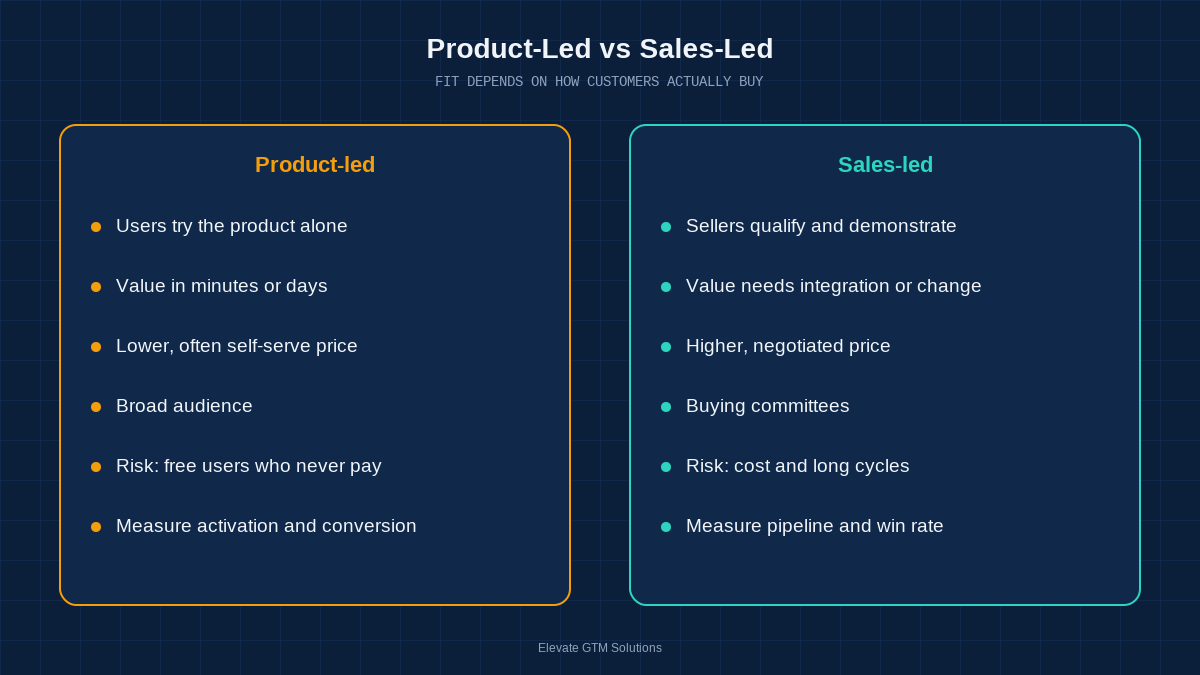
Every software company has to answer a question that sounds simple: how will customers find us, decide and buy? There are two classic answers. In a product-led motion, the product does most of the work: people try it, reach value on their own and upgrade. In a sales-led motion, people do most of the work: sellers find, qualify, demonstrate, negotiate and close. Most companies end up somewhere between the two, and the choice shapes pricing, hiring, metrics and the product itself.
The debate is often framed as a fashion contest, with product-led growth presented as modern and sales-led as old-fashioned. That framing causes expensive mistakes. A company with a complex, high-value product that adopts a self-serve model may attract users who never convert. A company with a simple product that insists on a demo for every sign-up may lose people who wanted to try it. This guide compares the two motions fairly, gives you a way to choose based on your product, buyer and price, explains hybrid models, shows what changes in each function and covers how to move from one to the other. Elevate GTM Solutions makes a platform that helps teams define and compare strategies, and we have no stake in which motion you pick. Guidance here is general and does not guarantee results.
Product-Led vs Sales-Led GTM: Which Is Better?
Neither is better in general. A product-led motion fits when users can reach value alone quickly, the product is understandable without a demo, price points are low to moderate and the audience is broad. A sales-led motion fits when value depends on integration or change management, purchases involve buying committees, deal sizes are large and buyers expect guidance. Many companies combine them: self-serve for individuals and small teams, and a sales team for larger accounts. Choose based on how your customers actually buy, and revisit the choice as your product, price and market change.
Can I run both? Yes, as long as you define who owns which accounts and when a seller enters.
What if I choose wrong? Motions can change, but pricing, product and team structure take time to change with them, so test before you commit.
The two motions in plain terms
| Product-led | Sales-led | |
|---|---|---|
| Who does the persuading | The product | Sellers |
| First experience | Hands-on use | A conversation or demo |
| How customers start | Sign up and try | Evaluate, negotiate and sign |
| Who decides | Users and team leads, later a budget owner | Executives and buying committees |
| Typical price | Lower, often self-serve | Higher, often negotiated |
| Typical sales cycle | Days to weeks | Weeks to months |
| Main cost | Product, design, data and support | Sellers, managers and marketing |
| Main risk | Free users who never pay | Cost of selling and long cycles |
| Typical scaling constraint | Activation and conversion | Number and productivity of sellers |
Dimension by dimension
Product complexity and time to value
If a new user can get a real result within a session or two, self-serve works. If value requires data migration, integration with core systems, training or a change in how a team works, a guided path helps. The question to ask is not how clever the product is but how long a newcomer needs before something good happens.
Price and deal size
Low price points make self-serve possible, because the cost of a seller would exceed the revenue. High deal sizes justify human effort, and buyers often want assurance before committing large sums. Between them is a zone in which a hybrid motion works well.
Buyer and buying group
Individuals and small teams can decide quickly. Larger organizations involve security, procurement, finance and executives. A product-led motion can win the first user and still have to navigate the committee when the account grows. Our guide at What Is Product-Led Growth? covers the path from user to buyer.
Market size and awareness
Self-serve acquisition needs enough potential users to find the product. A narrow, well-known market is easier to approach with direct outreach.
Competition
If competitors offer free plans and quick starts, buyers may expect the same. If competitors sell through sellers and complex contracts, a self-serve option can be a differentiator, provided the product supports it.
Cost and efficiency
| Cost element | Product-led | Sales-led |
|---|---|---|
| Acquisition | Content, search, community and product-driven referral | Outbound, advertising, events and sellers |
| Conversion | Product design and in-app prompts | Demonstrations, proposals and negotiation |
| Onboarding | Self-serve guidance and support | Implementation and customer success |
| Fixed costs | Product and growth teams, instrumentation | Sales headcount and management |
| Variable costs | Support and cost of serving free users | Commissions and travel |
Compare over several quarters, with acquisition cost and payback by segment. Our guide to GTM metrics and KPIs gives the definitions.
A decision framework
Score each statement for your company from one (not true) to five (very true). Add up each column.
| Statement | Points toward product-led | Points toward sales-led |
|---|---|---|
| A stranger can reach a meaningful result alone within a session or two | Yes | No |
| Setup or integration is light | Yes | No |
| The first user can try without approval from others | Yes | No |
| Average price is low to moderate | Yes | No |
| The target audience is broad and many people could use it | Yes | No |
| Buyers expect to talk to someone before purchasing | No | Yes |
| Purchases involve security review and procurement | No | Yes |
| Deal sizes are large and negotiated | No | Yes |
| Implementation changes how teams work | No | Yes |
| Competitors in the segment sell through sellers | No | Yes |
Use the totals as a discussion starter. If the scores are close, you probably need a hybrid motion. If they are strongly one-sided, consider the corresponding motion first, and test it with a small experiment before changing the company.
Hybrid motions
Most mature companies blend. The question is how.
| Pattern | Description | Example trigger for sales involvement |
|---|---|---|
| Self-serve plus sales assist | Users start alone, sellers join strong accounts | Team size, usage thresholds or a request for help |
| Self-serve for small, sales for large | Different segments get different paths | Company size or deal value |
| Sales-led with a free trial | Sellers qualify, then offer hands-on evaluation | After a qualified conversation |
| Land and expand | Small initial deal, growth over time with sellers | Expansion signals within an account |
| Partner-led plus self-serve | Partners bring customers to a self-serve path | A partner introduction |
| Inside sales for mid-market | A light-touch team handles mid-sized accounts | Account score and engagement |
Rules for a healthy hybrid
- Define who owns an account at each stage, so a self-serve user and a seller do not collide.
- Agree what signals bring a seller in, based on evidence from converted accounts.
- Give sellers visibility into product usage, and give product and growth teams feedback from sellers.
- Make pricing and packaging consistent between self-serve and sales-assisted purchases, or explain the difference clearly.
- Protect the self-serve experience from sales processes that add friction.
What changes by function
| Function | Product-led emphasis | Sales-led emphasis |
|---|---|---|
| Product | Onboarding, activation, in-product guidance, self-serve billing, instrumentation | Depth for complex needs, integration, admin and security features |
| Marketing | Search, content, community, product-led referral, lifecycle messaging | Demand generation, account-based programs, events, sales material |
| Sales | Assist and expansion for high-potential accounts | Prospecting, qualification, demonstrations, negotiation |
| Customer success | Scalable onboarding and education | Implementation, adoption plans and executive relationships |
| Pricing | Clear tiers, free allowance, usage or seat scaling | Negotiated packages, discounts and contract terms |
| Data | Product analytics, activation and conversion models | CRM, pipeline and forecast |
| Leadership | Shared goals across product, growth and sales | Revenue targets and sales management |
Metrics for each motion
| Motion | Headline measures |
|---|---|
| Product-led | Sign-up to activation rate, time to value, free-to-paid conversion, product-qualified leads, expansion, retention by cohort |
| Sales-led | Qualified conversations, meeting to opportunity rate, win rate, sales cycle length, pipeline coverage, acquisition cost and payback |
| Hybrid | Both sets, plus the handoff: share of accounts that move from self-serve to sales, conversion of sales-assisted accounts, and time to handoff |
Be wary of comparing the two on a single measure. A product-led company with a high conversion rate may have a low average deal size. A sales-led company with a long cycle may have high retention.
Pricing and packaging implications
| Question | Product-led answer | Sales-led answer |
|---|---|---|
| How is price shown? | Publicly, with clear tiers | Often on request, with ranges |
| What can be bought without a person? | Everything up to a certain tier | Little or nothing |
| How are limits designed? | To let users reach value, then prompt upgrade | To align with contract scope |
| How do discounts work? | Rarely, with standard terms | Common, with approval rules |
| How do customers expand? | By adding seats or usage in the product | By renewals and add-on deals |
Whichever you choose, make sure the pricing story matches the motion. A public price with a hidden enterprise tier is common. A self-serve plan that undercuts your own sales deals is a design problem.
Moving from one motion to another
From sales-led toward product-led elements
- Identify who could start alone. Look at customers who adopted quickly with little help.
- Simplify the first session. Reduce setup and reach a meaningful result early.
- Build a self-serve path for that segment. Pricing, billing and onboarding that do not need a seller.
- Instrument the product. Measure activation and behavior.
- Keep sellers for the complex accounts. Redefine their role as assist and expansion.
- Watch for channel conflict. Clear rules on ownership.
From product-led toward sales assistance
- Study accounts that converted and expanded. Find the signals.
- Define product-qualified accounts. Evidence, not guesses.
- Hire or assign a small assist team. Start with a few people.
- Give them visibility. Usage data and context in the CRM.
- Agree handoffs. Who calls whom, and when.
- Protect self-serve. Keep the quick path quick for small customers.
Seller roles in a hybrid motion
When sales joins a product-led company, the roles matter. A few patterns are common.
| Role | What they do | When they engage |
|---|---|---|
| Sales assist | Helps accounts that show readiness signals, answers questions, supports upgrades | When product signals cross a threshold |
| Account executive for larger accounts | Leads evaluations with committees, handles security and contracts | When an account is large or complex |
| Inside sales | Handles mid-sized accounts with a light-touch process | When accounts are between self-serve and enterprise |
| Customer success manager | Drives adoption and expansion | After purchase, especially for larger accounts |
| Solutions engineer | Supports technical evaluation and integration | During complex evaluations |
| Partner manager | Works with partners who bring or serve customers | When partners are in the path |
Define each role's entry criteria, what they own and how they work with the user who started the account. A seller who treats a self-serve champion as a lead to be reassigned will lose that champion.
A handoff design, worked through
This is an invented illustration of the questions to answer.
| Question | Example answer |
|---|---|
| What signals trigger sales involvement? | An account with three or more active users, twenty or more technicians, or a request for security documentation |
| Who sees the signal? | The assigned sales assist owner, through an alert in the CRM with product usage details |
| What is the first move? | A short message to the champion offering help, not a sales pitch |
| What does the champion see? | A consistent experience and no sudden change in who they deal with |
| What does the seller know? | Who the champion is, what they have done in the product and what they asked for |
| What if the account declines help? | They stay self-serve, with a record of the decision |
| Who owns billing questions? | The self-serve path, unless the account moves to a contract |
| How is credit assigned? | By rules agreed in advance and reviewed quarterly |
| How do we review the handoff? | Monthly, looking at conversion, time to handoff and satisfaction |
Write the rules on one page and share them with product, growth, sales and success.
Questions to ask customers about how they buy
Evidence about how customers actually buy beats opinion. In interviews, ask:
- How did you first find us, and what made you try?
- What did you do in the first week?
- Who else got involved, and when?
- What did you need before you could pay?
- What nearly stopped you?
- Did you talk to anyone from our team, and was it helpful?
- What would have made buying easier?
- If we had insisted on a demo first, what would you have done?
- If we had no sales team, what would have been missing?
Compare answers by segment. Small firms often describe a different path from large ones, which is the reason for a hybrid.
An eight-week experiment to test a self-serve path
Before you commit, try a small, bounded test for one segment.
| Weeks | Activity |
|---|---|
| 1 | Choose the segment. Define activation and the success threshold. Record a baseline |
| 2 | Build the minimum self-serve path: pricing page, sign-up, simple setup and billing |
| 3 | Open it to a small share of the segment. Watch sessions and support questions |
| 4 | Fix the biggest drop-off |
| 5 to 6 | Widen access and measure activation, conversion and support load |
| 7 | Interview ten users, including those who did not convert |
| 8 | Decide: extend, adjust or stop, and write the reasons |
Set a failure threshold in advance. If activation or conversion stays below it after fixes, treat that as information.
Incentives and organizational friction
Motion changes expose how people are rewarded.
| Issue | What happens | Mitigation |
|---|---|---|
| Sellers paid only on new deals | They ignore self-serve accounts that could expand | Reward expansion and assist |
| Growth teams measured on sign-ups | Low-quality sign-ups | Measure activation and revenue |
| Product measured on features shipped | Onboarding is neglected | Shared goals on activation |
| Customer success measured on tickets | Little incentive for proactive adoption | Measure retention and expansion |
| Marketing measured on leads | Leads sales does not want | Measure qualified conversations and pipeline |
Align goals across functions before changing the motion. Many hybrid failures are incentive failures.
Terms used in this guide
| Term | Meaning |
|---|---|
| Motion | The repeatable way a company wins customers |
| Self-serve | Buying or starting without talking to a person |
| Sales assist | A seller helping accounts that show signals |
| Land and expand | Starting small and growing over time |
| ACV | Annual contract value |
| Buying committee | The group of people involved in a purchase decision |
| Activation | The first meaningful result a user reaches |
| PQL | Product-qualified lead |
Motion choices for different kinds of product, illustrated
These are invented illustrations to show the reasoning, not claims about real companies.
| Product | Observations | Reasonable starting point |
|---|---|---|
| A note-taking and sharing tool for small teams | Value in minutes, free to try, spreads between colleagues | Product-led with team upgrades |
| A developer tool that integrates into a codebase | Technical users evaluate hands-on, a community shares tips, buyers appear later | Product-led for developers, sales assist for companies |
| A financial planning platform for mid-sized companies | Data connections needed, finance leaders and auditors involved, higher price | Sales-led with a guided trial |
| A compliance platform for regulated industries | Security review and legal terms are required, long evaluation | Sales-led, with clear documentation |
| A scheduling product for small service firms | Quick to start, owners buy, price moderate | Product-led with assist for larger firms |
| An analytics platform with heavy implementation | Months to deliver value, executive sponsor needed | Sales-led, with implementation support |
Notice that the product's nature and the buyer's situation, not the company's ambition, set the starting point.
Public pricing and hybrid motions
If you run both motions, your pricing communication has to serve both.
| Principle | Practice |
|---|---|
| Show what can be bought alone | Publish self-serve tiers with clear limits |
| Show where to talk | Offer a route for larger teams or special needs |
| Keep terms consistent | Align list prices across paths, or explain the differences |
| Avoid contradictions | Make sure the pricing page, in-product prompts and sales quotes agree |
| Be honest about enterprise | State that custom terms exist, even if numbers are on request |
| Keep third-party listings aligned | Directories and review sites can show outdated prices that conflict with yours |
Buyers, and AI assistants that summarize your product, rely on clear public information. Conflicting prices across sources reduce trust.
A customer research script for choosing a motion
Interview eight to twelve recent customers across sizes and ask:
- How did you first hear about us?
- What did you do in your first hour with the product?
- When did you first want to talk to someone, and why?
- Who else was involved before you paid?
- What did you need to see before buying?
- How long from the first look to the first payment?
- What nearly stopped you?
- If you could have bought without talking to us, would you have?
- If we had asked you to do a demo first, what would you have done?
Group answers by company size and product use. If small customers describe quick solo starts and large customers describe committees, you have the shape of a hybrid.
Risks of changing motion, and exit criteria
| Risk | What it looks like | Mitigation |
|---|---|---|
| Cannibalization | Self-serve sign-ups take deals that would have been larger | Define segments and protect enterprise paths |
| Support overload | Free users create demand for help | Self-serve education and clear limits |
| Sales friction | Sellers chase low-value accounts | Clear signals and thresholds |
| Pricing confusion | Self-serve and sales prices differ | Align and communicate |
| Product strain | Onboarding and billing are not ready | Test with a small segment first |
| Morale | Sellers fear for their roles | Redefine roles around assist and expansion |
Set exit criteria before the experiment. For example: if activation stays below a threshold after three rounds of fixes, or if support cost per free user exceeds a limit, pause and rethink. Writing the thresholds down prevents sunk-cost thinking.
What to do by score
If you used the decision framework earlier, here is one way to read the result.
| Pattern in your scores | Suggested next step |
|---|---|
| Strongly product-led | Test self-serve with one segment, define activation and set limits |
| Strongly sales-led | Strengthen discovery, qualification and a guided trial, and consider small self-serve elements for small customers |
| Mixed | Segment customers by size or use case and design a hybrid |
| Unclear | Run customer interviews and a small experiment before deciding |
Revisit the scores each year or after a major change in product, price or market.
AI and the choice of motion
AI changes some assumptions without removing the basic questions.
| Question | Consideration |
|---|---|
| Does AI shorten time to value? | If so, self-serve may become viable for products that previously needed help |
| Does AI raise cost to serve free users? | If so, limits and usage pricing matter |
| Can AI help sellers scale? | Drafting, research and follow-up can raise seller productivity, so check quality and controls |
| Can AI support onboarding? | In-product assistants can guide users at scale |
| Are buyers using AI to evaluate vendors? | Clear, honest public information helps in both motions |
Test claims in your own data and treat AI as an input to the decision, not a reason to adopt a motion.
Scenarios
| Situation | Direction to explore |
|---|---|
| A simple tool for individuals, with a broad audience | Product-led, with strong activation work |
| A workflow product for teams, moderate price | Product-led with sales assist for larger teams |
| A product that needs integration with core systems | Sales-led or sales-assisted, with a guided trial |
| An enterprise product with security and compliance needs | Sales-led, with a clear evaluation path |
| A developer or technical product with an active community | Product-led or community-led, with a commercial path for teams |
| A small startup unsure of its customer | Founder-led conversations first, then choose |
| A mid-sized company with both small and large customers | Hybrid with clear segment rules |
Common mistakes
| Mistake | What happens | Fix |
|---|---|---|
| Choosing a motion because it is fashionable | A mismatch with how customers buy | Decide from evidence about buyers |
| Adding a free plan without activation work | Sign-ups with no revenue | Define and improve activation |
| Forcing a demo on every user | Lost small customers | Offer a self-serve path where it fits |
| Letting sellers chase every free user | Poor use of time, annoyed users | Use product-qualified signals |
| Unclear account ownership | Conflict and duplicated outreach | Written rules |
| Inconsistent pricing between paths | Confusion and distrust | Align or explain |
| Ignoring the buying group | Strong usage, stalled revenue | Plan the move from user to buyer |
| Measuring one motion with the other's metrics | Wrong conclusions | Use suitable measures plus handoff measures |
A hypothetical example
This is an illustration, not a real company.
A company sold scheduling software to field-service firms through a small sales team. Deals closed in about six weeks, and acquisition cost was rising. The head of growth noticed that a quarter of customers had signed after a trial with almost no help. She tested a self-serve path for firms of up to fifteen technicians, with public pricing and a simplified setup. Larger firms continued through sales.
In the first quarter, self-serve sign-ups were high and conversion was low for firms that skipped a key setup step. The team improved the first session and added a prompt to invite a dispatcher. It defined product-qualified accounts as those with three scheduled jobs and two users, and gave sellers an alert for accounts above twenty technicians.
After two quarters, small firms converted at a lower cost than before, sellers spent more time on larger accounts, and the company wrote down the rules for ownership. The final motion was a hybrid built from evidence about which customers could start alone.
Presenting the decision to leadership
A motion decision affects budget, hiring and product priorities, so present it clearly.
| Part | Content |
|---|---|
| The question | Which motion, or mix, should we use for which segments? |
| Evidence | Customer interviews, activation and conversion data, sales cycle data and competitor behavior |
| Options | Product-led, sales-led and hybrid, with the costs and risks of each |
| Recommendation | One option, with the reasons and the segments it applies to |
| Experiment | A bounded test with success and failure thresholds |
| Resources | People, tools and time required |
| Risks | What could go wrong and how you will notice |
| Review date | When you will decide whether to extend, adjust or stop |
Be honest about uncertainty. Leaders respond well to a plan that shows what you know, what you do not and how you will learn.
Quick reference
| Question | Short answer |
|---|---|
| Which motion fits quick-to-value, understandable, lower-priced products? | Product-led |
| Which fits complex, higher-priced products sold to committees? | Sales-led |
| What do most mature companies do? | A hybrid with clear ownership and handoffs |
| What should I test first? | One segment, with defined activation and thresholds |
| What measures change? | Product-led adds activation and conversion, sales-led adds pipeline and win rate, hybrids add handoff measures |
A closing checklist
- We have described, with evidence, how our customers actually buy.
- We have timed how long a stranger needs to reach value.
- We have scored the decision framework and discussed the result.
- We know which segments might start alone and which need help.
- We have defined ownership and handoff rules for any hybrid.
- Our pricing and listings tell one consistent story.
- We have set an experiment with success and failure thresholds.
- Our incentives reward the behavior the motion needs.
What to do this week
Score your company on the decision framework. Time how long a stranger needs to reach a meaningful result. List five recent customers and note how each one bought and who was involved. If the evidence is mixed, design a small experiment for one segment instead of changing everything.
In plain language
The choice between product-led and sales-led is not a contest between modern and old-fashioned. It is a question about how your customers actually buy. If they can start alone, reach value quickly and pay with little approval, let the product lead. If they need integration, guidance and committee approval, let people lead. If both are true for different customers, build a hybrid with clear rules about who owns an account and when a seller joins. Test with one segment, define success and failure thresholds in advance and align incentives so each function rewards the motion you chose. Review the decision each year, because products, prices and markets change.
Key takeaways
- Neither motion is better in general. Fit depends on time to value, price, buyer, market and competition.
- Hybrid motions are common, and they need clear rules for ownership and handoffs.
- Product, marketing, sales, success, pricing and data all change with the motion.
- Use motion-appropriate measures, plus handoff measures in a hybrid.
- Move gradually: test with one segment, learn and then extend.
Where Elevate GTM Solutions fits
Elevate GTM Solutions is an AI-native GTM operating system for B2B companies. It helps teams decide and document their motion: ideal customer, segments, positioning, messaging, pricing logic, channel plans and priorities across 15 modules, and it lets teams compare strategies for different segments side by side, which is useful when one segment is product-led and another is sales-assisted. It does not provide product analytics, in-product onboarding or sales engagement. It connects to HubSpot, Salesforce, LinkedIn, Notion and Claude for supported actions. A free first strategy build is available, and published plans, billed annually, are Enable at USD 499 per month and Growth at USD 1,499 per month, with custom Scale pricing.
For related reading, see What Is Product-Led Growth?, What Is a GTM Playbook?, GTM Strategy for Startups and What Is a GTM Strategy?. See the pricing page, or request a demo.
Frequently Asked Questions
What is the difference between product-led and sales-led GTM?
In a product-led motion the product does most of the persuading: users try it, reach value alone and upgrade. In a sales-led motion sellers find, qualify, demonstrate, negotiate and close.
Which GTM motion is better?
Neither in general. Product-led fits quick-to-value, understandable, lower-priced products with broad audiences. Sales-led fits complex, higher-priced products sold to committees. Many companies combine them.
Can a company be both product-led and sales-led?
Yes. Common hybrids are self-serve with sales assist, self-serve for small accounts and sales for large ones, and sales-led with a free trial. Define ownership and handoff rules.
How do I choose between PLG and sales-led?
Assess time to value, setup effort, price, buyer and buying group, market size and competitor behavior, score your company against a decision framework and test a small experiment.
What is product-led sales?
A hybrid in which sellers engage accounts that show readiness signals in the product, such as team growth or heavy usage.
How do metrics differ between the motions?
Product-led teams track activation, time to value, free-to-paid conversion, product-qualified leads, expansion and cohort retention. Sales-led teams track qualified conversations, win rate, cycle length, pipeline coverage and payback. Hybrids track both and the handoff.
How do I move from sales-led to product-led?
Identify customers who started alone, simplify the first session, build a self-serve path for that segment, instrument the product, keep sellers for complex accounts and set clear ownership rules.
How do I add sales to a product-led company?
Study accounts that converted and expanded, define product-qualified accounts from evidence, start with a small assist team, give them usage visibility and agree handoffs while protecting the self-serve path.
Does AI change the choice?
AI can shorten time to value, raise cost to serve free users and boost seller productivity. Test its effects in your data before changing the motion.
What are common mistakes?
Choosing a motion for fashion, adding a free plan without activation work, forcing demos on everyone, unclear account ownership, inconsistent pricing and ignoring the buying group.
How long does it take to change motions?
It depends on product, pricing and team changes. Start with one segment, measure for a few quarters and extend as results support.
What roles do sellers play in a hybrid motion?
Sales assist for accounts showing signals, account executives for large or complex accounts, inside sales for mid-sized accounts, customer success for adoption and expansion, solutions engineers for technical evaluation and partner managers where partners are involved.
How should I design the handoff from self-serve to sales?
Define the signals that bring a seller in, who sees them, what the first message says, what the seller knows, what happens if the account declines, who owns billing and how credit is assigned, and review the process monthly.
How can I test a self-serve path before committing?
Run an eight-week experiment for one segment with a defined activation event, a minimal path, a baseline, a success threshold and a failure threshold, then interview users and decide whether to extend.
Why do hybrid motions fail?
Often because of incentives: sellers paid only on new deals, growth measured on sign-ups, or product measured on features. Align goals across functions first.
How do I research which motion fits my customers?
Interview eight to twelve recent customers across sizes about how they found you, what they did first, when they wanted help, who else was involved, what they needed before paying and what nearly stopped them, then group answers by size and use case.
How should pricing work in a hybrid motion?
Publish self-serve tiers with clear limits, offer a route for larger teams, keep terms consistent across paths and keep third-party listings aligned with your own pages.
What exit criteria should I set for a motion change?
Define thresholds in advance, such as activation below a level after several rounds of fixes or support cost per free user above a limit, and pause to rethink if they are crossed.
What are the main risks of adding self-serve?
Cannibalization, support overload, sales friction, pricing confusion, product strain and morale. Mitigate with clear segments, education, thresholds, aligned pricing, a small first test and redefined roles.