
By the Elevate GTM Solutions Team · Updated November 10, 2026 · 22 min read
What Is Product-Led Growth (PLG)? Definition, How It Works, Metrics, and When It Fits
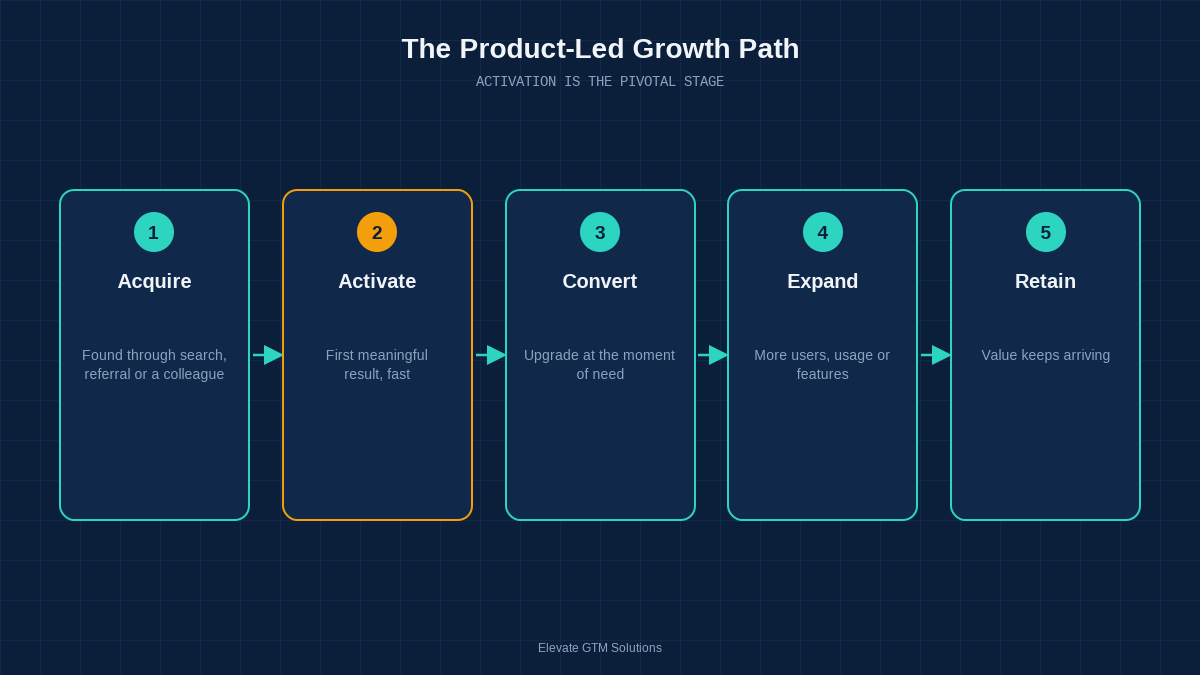
Some software companies win customers mostly through the product itself. A person signs up without talking to anyone, gets something useful in minutes, invites a colleague, hits a limit and pays. Others win customers through a seller who qualifies, demonstrates and negotiates. The first pattern is called product-led growth, usually shortened to PLG, and it has become one of the most discussed ideas in software go-to-market.
The term is used loosely. Some people mean a free plan. Some mean a self-serve checkout. Some mean a whole company strategy in which the product is the main way customers are acquired, converted and expanded. This guide defines PLG in plain terms, explains how it works step by step, describes the common models, shows the measures that matter, says honestly when it fits and when it does not, and explains how it relates to sales-led and hybrid motions. Elevate GTM Solutions makes a GTM strategy platform that helps teams choose and plan a motion, and does not provide product analytics, so we say plainly where other tools matter. The definitions are standard and the guidance is general. Every company's situation differs, and nothing here guarantees results.
What Is Product-Led Growth?
Product-led growth is a go-to-market approach in which the product itself drives most of the acquisition, conversion and expansion of customers. Users try the product with little or no human help, reach value quickly, and move to paid plans or wider use because of what they experience in the product. It usually involves a free plan or trial, self-serve onboarding and pricing, in-product prompts for upgrade and sharing, and measures such as activation, time to value and product-qualified leads. Many companies combine it with a sales team that helps larger accounts, which is often called product-led sales.
Is PLG the same as freemium? No. Freemium is one pricing model. PLG is a broader approach to how customers are won and grown.
Does PLG mean no salespeople? Not necessarily. Many PLG companies add sales for larger or more complex accounts.
How PLG works, step by step
| Stage | What happens | What the product must do |
|---|---|---|
| Acquire | A person discovers the product through search, word of mouth, content, a community or a colleague's invitation | Be easy to find and understand, with a clear promise |
| Sign up | They create an account with little friction | Ask for as little as possible at the start |
| Activate | They reach the first moment of real value | Guide them to a meaningful result quickly |
| Habit | They return and use it again | Fit into regular work, with reasons to come back |
| Convert | They move to a paid plan, or their team does | Show the value of upgrading at the moment of need |
| Expand | More users, more usage or more features are adopted | Make sharing and collaboration natural |
| Retain | They keep using and paying | Keep delivering value as needs change |
The critical word in the middle is activate. Many products attract sign-ups and lose most of them before they experience value. PLG companies obsess over the path between sign-up and the first meaningful result.
The common PLG models
| Model | How it works | Typical fit | Watch for |
|---|---|---|---|
| Freemium | A free plan with limits, and paid plans with more | Broad audiences, low cost to serve free users | Free users who never convert, and support costs |
| Free trial | Full or partial access for a limited time | Products where value takes a few days to see | Trials that end before value arrives |
| Reverse trial | Start with paid features, then drop to a free plan | Products that want users to feel the best version first | Confusion at the downgrade |
| Usage-based | Pay for what you use, often with a free allowance | Products with measurable consumption | Unpredictable bills for customers |
| Open source or community-led | Free software with paid hosting or features | Developer products with active communities | Complexity of the commercial model |
| Self-serve checkout | Buy directly with a card, no free plan | Low-priced, clear products | Buyers who need reassurance |
These models are not mutually exclusive, and many companies mix them. The right choice depends on how fast value appears, what each free user costs to serve and who makes the buying decision.
What PLG needs in order to work
PLG is not a pricing tactic you can add to any product. It depends on several conditions.
| Condition | Why it matters |
|---|---|
| Fast time to value | If it takes weeks to see a result, self-serve users give up |
| Understandable without a demo | People must grasp the product alone |
| Low risk to try | Buyers will not try what is hard to set up or risky to data |
| A broad enough audience | Self-serve acquisition needs many potential users |
| Natural expansion paths | Collaboration, sharing or growing usage create paid upgrades |
| Pricing that scales with value | Customers should pay more as they get more |
| In-product measurement | The team needs to see what users do to improve the path |
| Cross-functional ownership | Product, growth, design, data and support must work as one team |
If several of these are missing, a sales-led or hybrid motion may serve you better. That is not a failure. It is a fit question.
Product-qualified leads
In PLG, a useful idea is the product-qualified lead, or PQL: a user or account whose behavior in the product suggests they are ready for a paid plan or a sales conversation.
| Element | Description |
|---|---|
| Behavior signals | Actions that predict conversion, such as inviting teammates, reaching a usage threshold or using a key feature |
| Fit signals | Whether the user's company matches your ideal customer |
| Timing | How recently and intensely they acted |
| Handoff | How the signal reaches a seller or an automated upgrade prompt |
Defining PQLs well requires evidence: look at the behavior of customers who converted and compare with those who did not. A PQL definition based on guesses sends the wrong accounts to sales. Our guide to ICP scoring covers fit signals.
Measuring PLG
Standard definitions, with no benchmark numbers, since published figures vary widely by product and audience.
| Measure | Definition | Why it matters |
|---|---|---|
| Sign-up to activation rate | Users who reach the defined activation event divided by sign-ups | Shows whether onboarding works |
| Time to value | Time from sign-up to the first meaningful result | Shorter usually means better retention |
| Free-to-paid conversion | Paid conversions divided by eligible free users over a period | Shows whether the model monetizes |
| Product-qualified leads | Count and conversion rate of accounts meeting the PQL definition | Shows quality of signals |
| Expansion rate | Growth in seats or usage among existing customers | Shows organic growth |
| Retention by cohort | Share of a sign-up cohort still active over time | Shows durable value |
| Gross and net revenue retention | Recurring revenue kept, with and without expansion | Shows commercial health |
| Acquisition cost and payback | Cost to win a customer and months to recover it | Shows efficiency |
| Support load per free user | Support effort relative to free users | Shows the cost of free |
Cut each measure by segment and source. A flat free-to-paid rate can hide one segment that converts strongly and another that never does. Our guide to GTM metrics and KPIs covers the definitions in more depth.
PLG, sales-led and hybrid
| Product-led | Sales-led | Hybrid (product-led sales) | |
|---|---|---|---|
| Main acquisition path | Self-serve through the product | Outbound and inbound handled by sellers | Self-serve plus sales assist |
| Typical price | Lower, often per seat or usage | Higher | Both |
| Typical buyer | Individuals and teams | Executives and buying committees | Teams that grow into committees |
| First touch | The product | A conversation | The product, then a conversation |
| Sales role | Minimal or later | Central | Focused on high-potential accounts |
| Main risk | Free users who never pay | Cost and cycle length | Confusion about who owns the account |
Hybrid models are common. A seller joins when a team or account shows signals of readiness, or when security, procurement or customization questions arise. Our guide to product-led vs sales-led GTM compares the motions in depth.
When PLG fits, and when it does not
| It tends to fit when | It tends to fit less when |
|---|---|
| Users can reach value alone in minutes or days | Value depends on integration, data migration or training |
| The product serves individuals or small teams first | Purchases are made by committees from the start |
| Price points are low to moderate | Deal sizes are large and negotiated |
| Collaboration or sharing spreads usage | Usage is isolated and rarely shared |
| You can measure behavior in the product | You cannot instrument the product |
| Free users are cheap to serve | Each trial has high setup or support cost |
| The market is large and varied | The market is small and well known |
Many companies are somewhere in between. A useful test: could an informed stranger get a real result from your product within a session or two, without help? If yes, PLG elements may help. If no, consider where a guided start or a seller can improve the path.
Product-led growth and the buying group
Even in PLG, a company's purchase often needs approval beyond the user. A tool adopted by an engineer or a marketer may later need budget, security review and procurement. That changes the motion as accounts grow.
| Account stage | Who matters | What helps |
|---|---|---|
| Individual user | The user | A great first experience |
| Team | A team lead | Collaboration features and a clear value story |
| Department | A budget owner | Evidence of results, admin controls, a business case |
| Company | Security, IT and procurement | Security documentation, support, contract flexibility |
A PLG company that ignores this transition may find strong usage and stalled revenue. Planning for it means defining when a seller enters, what they offer and how they work with the user who started it.
AI and product-led growth
AI features raise new questions for PLG.
| Topic | Consideration |
|---|---|
| Time to value | AI features can shorten setup, or lengthen it if outputs need heavy correction |
| Cost to serve | Free users who consume AI resources can be expensive, so many companies set usage limits |
| Pricing | Usage-based or credit-based models are common, so make costs predictable |
| Trust | Users need to see how outputs are produced and how to correct them |
| Measurement | Track whether AI features improve activation and retention, not only usage |
| Differentiation | Many products add similar AI features, so positioning matters |
Treat AI as one more thing to test against activation and retention, not as proof that a product is product-led.
Designing the activation path: a worked example
This is an invented illustration of the thinking, not a template to copy.
The product. Scheduling software for small field-service firms.
Step 1: define the activation event. The team looked at customers who stayed after three months and asked what they had done in their first week. Most had scheduled at least three jobs and seen them on a phone. That became the activation event: three jobs scheduled and viewed on a mobile device within seven days.
Step 2: map the path. Sign up, name the business, add technicians, add a job, assign it, view on phone, repeat. They timed ten new users. The median user needed twenty-five minutes to reach the first assigned job, and about a third stopped at "add technicians."
Step 3: remove friction. The team allowed a single sample technician, pre-filled a sample job and let users add real technicians later. The first assigned job took about six minutes.
Step 4: add guidance. A short checklist in the product listed the next steps, and an email after two days asked whether the user had scheduled a job on a phone, with a link to do so.
Step 5: measure. The team tracked the share of sign-ups reaching activation, the median time to the first job and the share who invited a second user. It compared cohorts before and after.
Step 6: learn. Cohorts that invited a dispatcher within three days converted more often. The team added a prompt to invite a dispatcher during setup.
What stands out is that most improvements came from removing steps and showing the next one, not from new features.
An experiment plan for improving activation
| Step | Activity |
|---|---|
| 1. Baseline | Measure sign-up to activation, time to value and drop-off points for the last eight weeks |
| 2. Hypothesis | Choose one change, such as removing a setup step, and state the expected effect |
| 3. Design | Decide who sees the change, how long it runs and what counts as success |
| 4. Run | Show the change to a random share of new users |
| 5. Read | Compare activation and early retention, with counts and a note on sample size |
| 6. Decide | Keep, adjust or drop the change, and record the result |
| 7. Repeat | Choose the next biggest drop-off |
Run one change at a time on a given step, or you will not know what worked. Treat results from small samples as hints.
Designing free limits
Free plans work when limits let users reach value and prompt an upgrade at the moment of need.
| Design choice | Guidance |
|---|---|
| What is free | Enough to complete the core job once, and to feel the benefit |
| What is limited | Things that scale with value, such as seats, projects, history or advanced features |
| Where limits appear | At the point of need, with a clear explanation of the upgrade |
| What is paid | Collaboration, administration, security and higher usage are common candidates |
| How limits change | Test them, and communicate changes clearly |
| Abuse prevention | Plan for misuse of free resources |
| Cost of free | Estimate what each free user costs to serve, including support and any AI usage |
A common failure is to put the limit on the first thing a user needs, which prevents activation. Another is to put it so far out that nobody needs to pay.
Onboarding patterns that help
| Pattern | What it does | Caution |
|---|---|---|
| Sample data | Lets users see value before entering their own | Make it clear which is sample |
| Checklist | Shows the next steps and progress | Keep it short |
| Templates | Start users from a useful example | Choose templates for the main use cases |
| Progressive setup | Ask for details only when needed | Avoid long forms up front |
| Welcome messages | Explain the first action | Use plain language |
| Contextual tips | Guide at the moment of use | Avoid overwhelming |
| Invitations | Make adding colleagues easy | Respect privacy and consent |
| Human help for strong accounts | Offer a call to accounts with signals | Do not force it on everyone |
Test each with real new users, watching where they hesitate.
Teams and rituals for PLG
PLG works best when several functions share responsibility.
| Role | Responsibility |
|---|---|
| Product | The path to value, features and instrumentation |
| Growth | Experiments on acquisition, activation and conversion |
| Design and research | Understanding users and reducing friction |
| Data | Analytics, cohorts and PQL models |
| Marketing | Content, search, community and lifecycle messaging |
| Sales assist | Conversations with accounts that show signals |
| Customer success | Education and adoption for larger accounts |
| Support | Help for free and paid users, and feedback to product |
| Ritual | Cadence | Purpose |
|---|---|---|
| Funnel review | Weekly | Look at activation and conversion by cohort and segment |
| Experiment review | Weekly or biweekly | Decide what to keep, change or drop |
| User conversations | Weekly | Hear from recent users |
| PQL review | Monthly | Check that signals match outcomes |
| Strategy review | Monthly or quarterly | Revisit segments, pricing and the role of sales |
Terms used in this guide
| Term | Meaning |
|---|---|
| PLG | Product-led growth |
| Activation | The first meaningful result a user reaches in the product |
| Time to value | Time from sign-up to activation |
| PQL | Product-qualified lead, an account whose behavior suggests readiness to buy |
| Freemium | A free plan with paid upgrades |
| Reverse trial | Paid features first, then a free plan if no upgrade |
| Cohort | A group of users who signed up in the same period |
| Land and expand | Starting small in an account and growing over time |
| Product-led sales | Sellers engaging accounts that show readiness signals |
PLG across different kinds of product
The same principles show up differently depending on what the product does.
| Product type | What activation tends to look like | Typical expansion path | Watch for |
|---|---|---|---|
| Collaboration or workflow tools | A first shared project or task completed with a colleague | More teams and seats | Single-user usage that never spreads |
| Developer tools | A first successful integration or deployment | Usage growth and team adoption | Complex setup that stalls users |
| Analytics and data tools | A first useful chart or report from real data | More data sources and users | Data connection friction |
| Design and content tools | A first finished piece | Shared libraries and teams | Free users who export and leave |
| Communication tools | A first conversation with a teammate or customer | Company-wide adoption | Network effects that depend on others joining |
| Business operations tools | A first completed process, such as a scheduled job | More processes and locations | Compliance and integration needs at scale |
When describing your own path, write the activation event in the user's terms, not in your internal terms.
Principles for a PLG pricing page
| Principle | Practice |
|---|---|
| Show the path | Make it clear how a person starts free or buys |
| Make tiers understandable | Describe each tier by the problem it solves |
| Explain limits plainly | State what is limited and why |
| Show the metric | Make the charging unit obvious |
| Offer a way to talk | Provide a route for larger teams to contact sales |
| Be consistent | Keep the pricing page, in-product prompts and sales terms aligned |
| Avoid surprises | State what happens at the end of a trial or when a limit is reached |
| Keep it current | Review it with each packaging change |
Buyers, and AI assistants that summarize your product, rely on clear public pricing and plan descriptions. Out-of-date third-party listings can contradict your own page, so keep them aligned.
Questions to ask users to improve the path
Short conversations with recent users are among the best sources of improvement.
- What were you trying to do when you signed up?
- What did you do first, and what happened?
- Where did you hesitate or get stuck?
- What did you expect to see that you did not?
- Who else did you want to involve, and did you?
- What would have made you pay sooner, or at all?
- If you stopped, what was the reason?
- What would you tell a colleague about it?
Talk to people who activated, people who did not and people who paid. Compare their stories to find where the path loses people.
How to assess whether PLG fits your company
Run a short assessment over thirty days.
Week 1: map the path. Write the steps from first visit to first value to paid. Time them in a test with someone who has never seen the product.
Week 2: look at data. Measure sign-up to activation, time to value and where users drop. Compare converted and unconverted users to find behaviors that predict conversion.
Week 3: listen. Talk to ten recent users, including some who did not convert. Ask what they tried, where they got stuck and who else was involved in a purchase.
Week 4: decide. Choose whether to invest in self-serve, add guided help or add sales assist. Write the motion and its measures on a page, and set a review date.
Common mistakes
| Mistake | What happens | Fix |
|---|---|---|
| Treating a free plan as PLG | Sign-ups with no activation or conversion | Define and improve activation first |
| Giving away too much | Free users never need to upgrade | Align limits with value |
| Giving away too little | Users cannot reach value | Make the first result achievable on the free plan |
| No PQL evidence | Sales chases the wrong accounts | Define PQLs from conversion data |
| Ignoring the buying group | Strong usage, stalled revenue | Plan the move from user to buyer |
| Measuring sign-ups | Vanity growth | Measure activation, retention and payback |
| Siloed ownership | Product, growth and sales pull in different directions | Shared goals and owners |
| Copying another company's model | A model that does not fit your product | Test your own path |
A hypothetical example
This is an illustration, not a real company.
A company sold scheduling software to small field-service firms. Sign-ups were high, but few firms paid. A review of the path showed that new users had to enter a long list of technicians and jobs before seeing anything useful. Most stopped after the first screen. The team simplified the first session so that users could schedule one job and see it on a phone within ten minutes, and it defined activation as scheduling three jobs in the first week.
Activation rose, and the team looked at which behaviors predicted payment. Firms that invited a dispatcher within three days were much more likely to convert. The team added a prompt to invite a dispatcher, defined a PQL as an account with three scheduled jobs and a second user, and set up an alert so that a seller could offer help to PQLs with more than twenty technicians.
Over two quarters, free-to-paid conversion improved in the target segment and stayed flat in the others, which led the team to narrow its marketing. Sales time focused on accounts that showed signals. The change came from understanding the path, not from adding a free plan.
Questions about PLG limits
"Can a complex enterprise product be product-led?" Elements can help, such as a guided trial, a sandbox or a free tier for evaluation. The full motion usually includes sellers and implementation support.
"Do we need a free plan to be product-led?" No. Some companies use trials, usage-based pricing or self-serve checkout. What matters is that the product leads the experience of value.
"What if our free users do not convert?" Check activation first, then fit, then whether free is giving away too much. Interview users who did not convert.
"Will PLG cannibalize our sales team?" It can change what the team does. Many companies move sellers toward assist and expansion. Define roles and incentives early.
"How long before PLG shows results?" It depends on traffic, activation work and sales cycles. Look at leading measures such as activation and cohort retention before revenue.
Final thoughts
Product-led growth is neither a magic formula nor a pricing trick. It is a decision to let the product do much of the work of acquiring, converting and expanding customers, which is only wise if the product can do that work. If a stranger can reach value alone, if the audience is broad and if you can measure and improve the path, the approach can be powerful. If not, a guided or sales-assisted motion may serve customers better. Test with real users, measure activation and retention, and keep the choice open as your product and market change.
Quick reference
| Question | Short answer |
|---|---|
| What is PLG? | The product drives acquisition, conversion and expansion |
| What matters most? | Activation: reaching the first meaningful result quickly |
| What is a PQL? | An account whose behavior and fit suggest readiness to buy |
| When does it fit? | Quick value, understandable alone, broad audience, expansion paths, measurable behavior |
| What do many companies do? | Combine PLG with sales assist for larger accounts |
| What should I measure? | Activation, time to value, conversion, retention by cohort, expansion and payback |
A closing checklist
- We can state the activation event in one sentence, in the user's terms.
- We have timed the path from sign-up to first value with someone new.
- We know where users drop and why, from data and conversations.
- Our free limits let users reach value and prompt upgrade at the moment of need.
- We have defined PQLs from the behavior of customers who converted.
- We have a plan for the move from user to buyer in larger accounts.
- We measure activation, retention and payback by segment.
- Product, growth, sales and support share goals and review the funnel weekly.
What to do this week
Time how long it takes a stranger to reach your product's first meaningful result. Write the activation event in one sentence. List three behaviors you suspect predict payment and check them against your data. Ask five recent users where they got stuck.
In plain language
Product-led growth is a decision to let the product do much of the work of winning and growing customers. It works when a newcomer can reach something valuable alone, when the audience is wide enough for self-serve discovery and when the team can see what users do and improve the path. The key idea is activation: the first meaningful result. Define it from the behavior of customers who stayed, remove every step that stands between sign-up and that result, and measure how many people get there. Add sellers where larger accounts need help, define when they enter and keep pricing and promises consistent. If a stranger cannot reach value alone, a guided or sales-led approach may serve customers better, and that is a legitimate choice.
Key takeaways
- PLG means the product itself drives acquisition, conversion and expansion, usually through a free plan or trial and self-serve onboarding.
- It is a fit question: it works when value is quick, the product is understandable alone, the audience is broad and expansion paths exist.
- Activation is the pivotal stage. Define it, measure it and improve the path to it.
- Define product-qualified leads from evidence and plan the transition from user to buyer.
- Many companies run hybrid motions, with sales assisting larger accounts.
- Measure activation, retention, conversion and payback by segment, not sign-ups.
Where Elevate GTM Solutions fits
Elevate GTM Solutions is an AI-native GTM operating system for B2B companies. It helps teams decide and document the motion: the ideal customer, segments, positioning, messaging, pricing logic and channel plans, across 15 modules, with workflows and a recurring review rhythm. For a team weighing product-led, sales-led or hybrid approaches, it supports comparing strategies for different segments side by side. It does not provide product analytics, in-product onboarding or a free-plan engine, and it does not replace the instrumentation a PLG team needs. It connects to HubSpot, Salesforce, LinkedIn, Notion and Claude for supported actions. A free first strategy build is available, and published plans, billed annually, are Enable at USD 499 per month and Growth at USD 1,499 per month, with custom Scale pricing.
For related reading, see Product-Led vs Sales-Led GTM, What Is a GTM Playbook?, GTM Strategy for Startups and What Is Elevate GTM Solutions?. See the pricing page, or request a demo.
Frequently Asked Questions
What is product-led growth?
A go-to-market approach in which the product itself drives most of the acquisition, conversion and expansion of customers, usually through a free plan or trial, self-serve onboarding and in-product prompts to upgrade and share.
What is the difference between PLG and freemium?
Freemium is one pricing model, a free plan with paid upgrades. PLG is a broader approach to how customers are won and grown, and it can use several models.
Does PLG mean you do not need a sales team?
Not necessarily. Many PLG companies add sales for larger or more complex accounts, often called product-led sales.
What is a product-qualified lead?
A user or account whose behavior in the product, combined with fit signals, suggests readiness for a paid plan or a sales conversation. Define it from evidence about who converted.
What metrics matter for PLG?
Sign-up to activation rate, time to value, free-to-paid conversion, product-qualified leads, expansion rate, retention by cohort, gross and net revenue retention, acquisition cost and payback, and support load per free user.
When does PLG work best?
When users can reach value alone in minutes or days, the product is understandable without a demo, price points are low to moderate, collaboration spreads usage, behavior can be measured and free users are cheap to serve.
When is PLG a poor fit?
When value depends on integration or training, purchases are made by committees from the start, deal sizes are large and negotiated, or the market is small and well known.
What is a reverse trial?
A model in which users start with paid features for a period and then move to a free plan if they do not upgrade, so they experience the best version first.
How does AI affect PLG?
AI can shorten or lengthen time to value, raises cost to serve for free users and affects pricing. Test it against activation and retention instead of assuming it makes a product product-led.
What is product-led sales?
A hybrid in which a seller engages accounts that show signals of readiness in the product, such as team growth, heavy usage or security and procurement questions.
How do I know if PLG fits my company?
Time how long it takes a stranger to reach a meaningful result, examine activation and conversion data, interview recent users and decide whether to invest in self-serve, guided help or sales assist.
What is the most common PLG mistake?
Treating a free plan as a strategy. Without a defined, measured path to activation and conversion, sign-ups do not become revenue.
How do you define the activation event?
Look at customers who stayed after a few months, find what they did in their first week, and choose the action that most clearly separates them from those who left. Test the definition against later retention.
How should free plan limits be designed?
Let users reach value on the free plan, limit things that scale with value, such as seats or usage, show limits at the moment of need and estimate what each free user costs to serve.
What team does PLG need?
Product, growth, design and research, data, marketing, sales assist, customer success and support working toward shared goals, with regular funnel and experiment reviews.
How do you test changes to onboarding?
Measure a baseline, change one thing for a random share of new users, compare activation and early retention with counts and decide whether to keep, adjust or drop the change.