
By the Elevate GTM Solutions Team · Updated November 10, 2026 · 21 min read
Outbound vs Inbound GTM: How to Choose, How to Combine, and What Each Really Costs
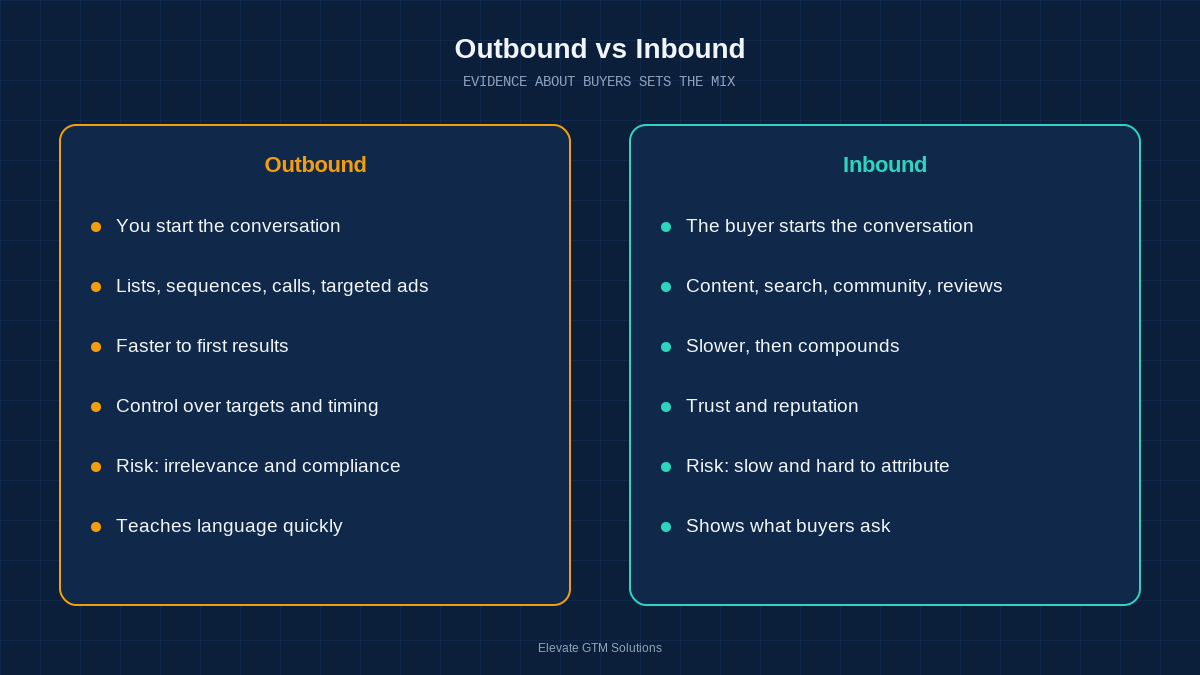
Every B2B company has to decide how it will start conversations with buyers. One path is to go to them: build a list, reach out and earn attention through direct contact. The other is to let them come to you: publish useful material, show up where buyers research, build a reputation and answer when they raise their hand. These are outbound and inbound, and the debate over which is better has run for years.
The honest answer is that it depends on your market, your price, your product and your stage, and that most companies need both in some proportion. The mistakes are usually about imbalance: all outbound with no reputation to support it, or all inbound with no way to reach buyers who are not searching. This guide defines each approach, compares them on the dimensions that matter, explains what each costs and how to measure them, describes how they combine, and shows how to decide where to put effort. Elevate GTM Solutions makes a GTM strategy platform that defines the customer and message both approaches carry, and it does not run either, so we say plainly where other tools matter. The guidance is general, and no approach guarantees results.
Outbound vs Inbound GTM: What Is the Difference?
Outbound go-to-market starts conversations by contacting defined prospects directly, through email, calls, social messages, advertising and events. Inbound go-to-market attracts buyers who are already researching, through content, search, community, reviews, referrals and a strong reputation, so that they come to you. Outbound gives control over whom you reach and when, and costs effort per contact. Inbound compounds over time and builds trust, and it takes longer and depends on buyers who are searching. Most B2B companies use both, with the mix set by market size, price, sales cycle and how buyers actually find vendors.
Which is better for a startup? Often outbound first, because it is faster and teaches you the language. Inbound builds over time and becomes valuable as your content and reputation grow.
Can I do both? Yes, and they reinforce each other when the message is consistent.
The two approaches side by side
| Outbound | Inbound | |
|---|---|---|
| Who starts the conversation | You | The buyer |
| Typical activities | Lists, sequences, calls, social outreach, targeted advertising, events | Content, search, community, reviews, referrals, partner content |
| Control | High over targets and timing | Lower, depends on buyer behavior |
| Speed to first results | Faster | Slower, then compounds |
| Cost pattern | Ongoing effort per contact, people and data | Upfront investment, then lower marginal cost |
| Scalability | Limited by people and list size | Can scale with reputation and content |
| Best for | Defined target lists, high-value deals, new markets | Educated buyers, larger markets, categories people search for |
| Main risk | Irrelevant outreach, brand and compliance harm | Slow to build, hard to attribute, dependent on search behavior |
| What it teaches you | Language, objections and fit, quickly | What buyers ask and read |
| Role of the product | Sometimes secondary | Often central, in product-led companies |
What counts as outbound
| Activity | Description | Notes |
|---|---|---|
| Email and call outreach | Direct messages to named people | Requires a good list and message |
| Social outreach | Direct messages and engagement on professional networks | Relationship-based |
| Account-based outreach | Coordinated plays for named accounts | Needs tiering and alignment |
| Targeted advertising | Ads shown to defined audiences | Paid, with a defined list |
| Event outreach | Inviting target accounts to events | Needs follow-up |
| Partner introductions | Asking partners to introduce you | Needs mutual benefit |
| Signal-based outreach | Contacting accounts after events that suggest readiness | See What Is Signal-Based Selling? |
What counts as inbound
| Activity | Description | Notes |
|---|---|---|
| Search content | Pages that answer questions buyers search | Compounds, needs quality |
| Educational content | Guides, research, tools and webinars | Needs real insight |
| Comparison and alternatives pages | Honest pages for buyers weighing options | High value, requires honesty |
| Community | Participation where buyers ask questions | Trust built over time |
| Review sites and directories | Accurate, complete profiles and real reviews | Often decisive for shortlists |
| Referrals and word of mouth | Customers and partners recommending you | Depends on customer success |
| Product-led entry | A free plan or trial that spreads | Needs a product that supports it |
| Answers in AI assistants | Clear, consistent public information that assistants can use | See the AI search visibility audit |
Costs and economics
Neither approach is free. The costs fall differently.
| Cost element | Outbound | Inbound |
|---|---|---|
| People | Development reps, sellers, list builders | Content, search, community and design roles |
| Data and tools | Contact data, sequencing and calling tools | Content tools, search tools, analytics |
| Media | Targeted advertising | Paid amplification, if used |
| Time to results | Weeks | Months, then compounding |
| Marginal cost per extra contact | Roughly constant | Falls as assets accumulate |
| Risk cost | Sender reputation, brand and compliance exposure | Wasted effort if content is generic |
| Measurement cost | Easier to attribute | Harder to attribute |
Compare over several quarters, using acquisition cost and payback by segment rather than one number. Our guide to GTM metrics and KPIs gives definitions.
When outbound fits best
- The target market is small, defined and reachable by name.
- Deal values justify direct effort.
- You are entering a new market or segment and need fast learning.
- Buyers do not search for solutions in your category yet.
- You have a clear message and the discipline to review it.
- Your sales process is built for qualified conversations.
When inbound fits best
- The market is large, and many buyers research before contacting vendors.
- Buyers search for solutions and compare options.
- Your category has strong search demand or active communities.
- You can produce content with a genuine point of view.
- You want durable, compounding assets.
- Deal values are lower, so direct effort per contact is expensive.
Combining them
The strongest programs use each to support the other.
| Pattern | How it works |
|---|---|
| Inbound credibility for outbound | Outreach lands better when the recipient finds useful content, reviews and a clear website when they check |
| Outbound learning for inbound | Replies and objections from outreach show what content to write |
| Shared message | The same positioning, proof and forbidden claims across both |
| Shared targeting | Both use the same ideal customer and tiers |
| Retargeting and nurture | People reached by outbound who engage with content receive relevant follow-up |
| Capturing handraisers | Inbound inquiries are routed quickly to sellers |
| Signals | Inbound behavior can trigger outbound plays for fit accounts |
A frequent failure is to run the two as separate teams with different stories. Prospects notice.
How to decide the mix
Use evidence about how your customers actually found you and decided.
| Question | How to answer |
|---|---|
| How did our best customers first hear of us? | Interview them, and review CRM sources critically |
| What did they do before contacting us? | Ask what they searched, read and asked peers |
| How many potential buyers exist, and can we name them? | Size the target list |
| What does a deal cost to pursue, and what is it worth? | Compare cost and value |
| How long can we wait for results? | Consider runway and goals |
| What capabilities do we have? | People, skills and tools |
| What do competitors do? | Review how buyers see them |
Small, defined markets with high-value deals lean outbound. Large markets with educated buyers lean inbound. Most are mixed.
A simple allocation approach
| Step | Practice |
|---|---|
| 1. Start from the goal | Qualified conversations or pipeline by segment |
| 2. Estimate each path's yield | From your history, with ranges |
| 3. Choose a starting split | For example, more outbound early and more inbound as assets build, adjusted to your case |
| 4. Reserve an experiment share | A small portion for testing |
| 5. Review monthly | Compare cost per qualified conversation and quality by path |
| 6. Move effort toward what works | With care for lags in inbound |
| 7. Protect compounding work | Do not cut content at the first dip |
Do not adopt a published split as a rule. Markets, stages and motions differ.
Measuring both honestly
| Measure | Outbound | Inbound |
|---|---|---|
| Reach | Contacts reached in the target list | Visits and engagement from target accounts |
| Engagement | Reply and positive reply rate | Time on key pages, return visits, community interactions |
| Conversion | Meetings per hundred contacts | Inquiries and trials from content and search |
| Quality | Meeting to opportunity rate | Inquiry to opportunity rate |
| Outcome | Win rate and cycle for outbound-sourced deals | Win rate and cycle for inbound-sourced deals |
| Efficiency | Cost per qualified meeting | Cost per qualified inquiry, over time |
Cut by segment. Ask buyers how they found you, because CRM source fields are often wrong or oversimplified. A buyer who replied to an email may have been persuaded by an article they read last month.
Roles and ownership
| Role | Outbound | Inbound |
|---|---|---|
| Sales development | Primary | Follows up inquiries |
| Account executives | Work qualified outbound meetings | Work qualified inbound meetings |
| Marketing | Provides targeting, content and air cover | Primary |
| Product marketing | Message and enablement | Message and content strategy |
| RevOps | Lists, routing, data and reporting | Attribution, routing and reporting |
| Founders | Often start outbound personally | Often write early content |
Building a target list for outbound
Outbound quality starts with the list.
| Step | Practice |
|---|---|
| 1. Start from the ideal customer | Use the definition and exclusions from your strategy |
| 2. Build the universe | Companies that match basic criteria such as industry, size and region |
| 3. Score fit | Prioritize with simple criteria |
| 4. Identify roles | The people who feel the problem and the people who decide |
| 5. Verify data | Sample contacts for accuracy before sending at scale |
| 6. Tier | A small top tier for custom effort, a larger middle for shared themes, and a base for light touch |
| 7. Exclude | Customers, competitors, opt-outs and poor fits |
| 8. Refresh | Update on a schedule because data decays |
A smaller list with accurate contacts and a strong reason to reach out usually beats a large list with weak targeting.
Designing outbound messages
| Element | Weak version | Stronger version |
|---|---|---|
| Opening | "I wanted to introduce our platform" | A specific situation the recipient likely faces |
| Reason for contact | Generic | A clear link to their role, company or a recent event |
| Claim | "We help companies grow" | A specific claim with proof you may cite |
| Evidence | None | A short customer story or a measured result, with permission |
| Ask | "Do you have fifteen minutes?" | A small, easy question or next step |
| Length | Long | Short enough to read at a glance |
| Follow-up | "Just bumping this" | A new fact, story or angle |
| Close | Pressure | A graceful exit |
Read every message as the recipient. Would you reply? Provide approved pillars and forbidden claims to everyone who writes outreach, including AI tools.
An inbound content roadmap
Inbound compounds when content answers real questions. A roadmap by quarter keeps it manageable.
| Quarter | Focus | Examples |
|---|---|---|
| 1 | Foundations | A plain page stating what you are and are not, accurate review-site profiles, a pricing explanation |
| 2 | Core questions | Guides for the five most common buyer questions, one honest comparison with the most common alternative |
| 3 | Depth | Customer stories with permission, an evaluation guide, a guide for each priority segment |
| 4 | Authority | Original research you can support, community contributions, partner content |
Update existing pieces, not only new ones. Retire what is outdated or wrong. Our guide to the AI search visibility audit shows how to find gaps.
Handling inbound inquiries
Inbound interest is fragile. Speed and relevance matter.
| Element | Practice |
|---|---|
| Qualification | A short form and a quick check against the ideal customer |
| Routing | Send qualified inquiries to a named owner immediately |
| Speed | Agree a target response time and measure it |
| First response | Answer the question asked, not a template |
| Disqualification | Politely redirect poor fits, with a useful resource |
| Self-serve options | Offer a trial or demo path where it exists |
| Recording | Log the source and what prompted the inquiry, in the buyer's words |
| Review | Check monthly which inquiries became opportunities and why others did not |
Inbound inquiries often arrive from buyers who have already compared you with others. A slow or generic reply wastes the effort that produced the inquiry.
A reputation audit: look yourself up as a buyer
Before investing more in either path, check what a buyer sees.
| Check | What to look at |
|---|---|
| Your website | Does it say plainly what you do, for whom and at what price range? |
| Search results | What appears for your company name and category? |
| Review sites | Are profiles complete, accurate and consistent with your site? |
| Comparison content | Do others describe you correctly, and do you offer an honest comparison yourself? |
| Social presence | Is it active and consistent? |
| AI assistants | What do they say when asked about you and your category? |
| Customer references | Can you offer a relevant one? |
| Pricing consistency | Do third-party listings match your own page? |
Fix wrong facts first. Outbound lands better when the recipient's check finds a clear, consistent picture.
A review rhythm
| Cadence | Outbound | Inbound |
|---|---|---|
| Weekly | Reply quality, meetings, messages read | Inquiries, response time |
| Monthly | Results by segment and message theme, list quality | Content performance, qualified inquiries, listing accuracy |
| Quarterly | Win rate and cycle by source, cost per qualified meeting | Pipeline from inbound, content roadmap, reputation audit |
At each review, decide what to change, extend or stop, with owners and dates.
Terms used in this guide
| Term | Meaning |
|---|---|
| Outbound | Starting conversations by contacting defined prospects |
| Inbound | Attracting buyers who are already researching |
| Sequence | A scheduled series of outreach steps |
| Speed to lead | Time between an inquiry and the first response |
| Qualified inquiry | An inquiry that meets criteria for fit and interest |
| Compounding | Assets that keep producing results as they accumulate |
| Reputation audit | A check of what buyers see when they research you |
Where AI fits
| Area | Outbound | Inbound |
|---|---|---|
| Research | Account summaries and call briefs | Topic and question research |
| Drafting | Messages from approved positioning | Content drafts with a point of view |
| Personalization | Varying messages by segment or signal | Variants for different audiences |
| Automation | Sequences and agents | Distribution and updates |
| Measurement | Summaries of results | Summaries of performance |
| Risk | Volume without relevance, accuracy of claims, compliance | Generic content that adds nothing |
Give AI tools your positioning, proof and forbidden claims and keep review in place. Both approaches are eroded by sameness.
Common mistakes
| Mistake | What happens | Fix |
|---|---|---|
| Choosing by fashion | A mismatch with how buyers find vendors | Decide from evidence |
| Outbound with no reputation | Prospects check you and find little | Build a clear website, content and reviews |
| Inbound with no direct reach | Waiting for buyers who are not searching | Add targeted outreach |
| Different stories in each channel | Confusion | One message |
| Measuring volume | Activity looks like progress | Measure qualified conversations and pipeline |
| Cutting inbound too early | Lose compounding assets | Protect long-term work |
| Ignoring compliance | Legal and reputational risk | Review rules with advisers |
| Treating CRM source fields as truth | Misattribution | Ask buyers |
A hypothetical example
This is an illustration, not a real company.
A company selling scheduling software to field-service firms had been entirely outbound. Replies were low and sellers felt they were interrupting people. Interviews with recent customers showed that most had looked the company up before replying, and several had read an owner community post about missed appointments, found a competitor's comparison page instead of the company's own and almost did not reply.
The team kept a small, targeted outbound program with a sharper message and added three inbound pieces: a plain explanation of what the product was and who it was for, an honest comparison with spreadsheets and a larger suite, and a guide to reducing missed appointments. It updated its profiles on review sites and fixed a pricing mismatch. It joined the owner community as a participant, not an advertiser.
After a quarter, reply rates improved and sellers reported that prospects arrived better informed. Inbound inquiries were a small share of pipeline at first. The mix was not a formula. It was a response to what buyers did.
Scenarios and directions
| Situation | Direction to explore |
|---|---|
| A small team selling high-value deals to a few hundred named companies | Mostly outbound, with account-based plays, plus a strong website and references |
| A company with a broad market and a product people search for | Inbound content and listings first, with targeted outbound for priority accounts |
| A startup with no reputation yet | Founder-led outbound to learn, then content built from what buyers ask |
| A company with a mature inbound engine and flat growth | Add outbound to reach buyers who are not searching, in priority segments |
| A product-led company with growing free usage | Inbound and product-led signals, with sales assist for signals from fit accounts |
| A company entering a new region | Outbound for fast learning and partner introductions, with local content over time |
A first ninety days for each path
Outbound
Days 1 to 15. Define the ideal customer and exclusions, and write three message pillars with proof. Build a small list of fifty to a hundred accounts and verify contacts.
Days 16 to 45. Send a small, reviewed batch by hand. Read every reply. Revise messages weekly.
Days 46 to 75. Add a second segment or a second channel. Track meetings per hundred contacts and meeting to opportunity rate.
Days 76 to 90. Review with sales. Keep what works, and write down what you learned for content.
Inbound
Days 1 to 15. Audit your website, listings and what assistants say. Fix wrong facts. Publish a plain what-is page.
Days 16 to 45. Write guides for the five most common buyer questions, using the language from calls.
Days 46 to 75. Publish an honest comparison, improve review-site profiles and join one community.
Days 76 to 90. Review traffic quality, qualified inquiries and what buyers say about how they found you. Plan the next quarter.
Questions teams ask
"Is outbound dead?" No. Poor outbound is. Targeted, relevant, respectful outreach still works for many B2B companies, especially with defined markets.
"Is inbound too slow?" It is slower at first and cheaper per contact later. Companies with long runways and educated buyers often benefit.
"How do we attribute pipeline fairly?" Use several views, ask buyers how they found you and what prompted them to act, and avoid over-trusting a single field.
"Should marketing own inbound and sales own outbound?" Ownership can split by function, and the message, targeting and review should be shared.
"How do we avoid spamming prospects?" Tight targeting, frequency caps, relevant messages, honoring opt-outs and review by a person.
"Does AI change which is better?" It lowers the cost of drafting and research for both and raises the bar for relevance and distinctiveness.
Compliance basics for outbound
| Topic | Practice |
|---|---|
| Rules by region | Check requirements for contacting people by email, phone and social channels with your legal advisers |
| Consent and opt-out | Provide a clear opt-out and honor it everywhere |
| Data sourcing | Understand where contact data comes from |
| Records | Keep records of opt-outs and suppressions |
| Claims | Make only claims you can support |
| Recording and calling | Follow rules for calls and recording |
| Sensitive roles and regions | Avoid contacting where rules or norms forbid it |
Build compliance into the process, not as an afterthought.
In plain language
Outbound is you going to the buyer. Inbound is the buyer coming to you. Both need the same foundation: a clear customer, a specific message and honest proof. Use outbound to learn quickly and reach buyers who are not searching. Use inbound to build trust that compounds and to be there when buyers do search. Check what a buyer finds when they look you up, fix wrong facts, keep one story and measure qualified conversations and pipeline by segment. Ask buyers how they found you, and let the answer shape the mix.
Converting replies into conversations
A reply is the start of the work.
| Situation | Practice |
|---|---|
| A positive reply | Respond quickly, answer the question asked, propose a specific next step |
| A neutral reply, such as "send more information" | Ask one question about what would be most useful, then send something specific |
| A "not now" | Ask what would change that, note it and follow up at a relevant time |
| A "not me" | Thank them, ask who might be the right person and record the referral |
| A negative reply | Honor it, record the reason and learn from it |
| An out-of-office | Follow up after the return date |
Record the reply in the CRM with the buyer's words. Reply themes are the best input for improving messages and for deciding what content to write.
A dashboard for both paths
| Measure | Why | Cut by |
|---|---|---|
| Qualified conversations | The shared outcome | Segment, source, message theme |
| Meeting to opportunity rate | Quality | Source and segment |
| Win rate and cycle by source | Outcomes | Segment |
| Cost per qualified conversation | Efficiency | Path |
| Reply quality and positive replies | Outbound relevance | Message theme |
| Qualified inquiries and response time | Inbound health | Source |
| Share of target accounts engaged | Reach | Tier |
| Listing and profile accuracy | Reputation | Site |
Show counts and caveats. Review monthly with sales and marketing.
A closing checklist
- We know how our best customers found us and what they did before replying.
- Our website, profiles and listings tell one clear, consistent story.
- Outbound lists are scored, verified and refreshed.
- Outbound messages are specific, short and reviewed.
- Inbound content answers real questions and is kept current.
- Inquiries are routed fast, with a named owner.
- Both paths share the same message, proof and forbidden claims.
- We review results by segment monthly and decide what to change.
- Compliance has been reviewed with advisers.
A second hypothetical: inbound-heavy, adding outbound
This is another invented illustration.
A software company selling analytics to distribution businesses had built strong search content and a healthy flow of inquiries over three years. Growth flattened. Most inquiries came from smaller firms that were easy to win and slow to expand, while the company's best customers were large distributors that rarely searched for solutions and ignored generic content.
The head of marketing and the head of sales agreed to add a small outbound program for about two hundred large distributors. They scored accounts for fit, identified operations and finance leaders, and wrote messages from the company's best customer stories. The inbound team wrote two guides aimed at large distributors, and the outreach pointed to them as a useful next step. Replies and meetings were modest at first. Over two quarters, the large-account segment grew as a share of pipeline, and inbound inquiries from large firms rose, apparently because buyers who had received outreach searched for the company's name and found content that matched.
The team did not abandon inbound. It added a path that reached buyers inbound could not, and it used one message for both.
What to measure in the first ninety days
| Measure | Outbound | Inbound |
|---|---|---|
| Learning | Reply themes, objections, language | Questions asked, pages read |
| Activity quality | Share of messages that were relevant by review | Share of content that answers a real question |
| Conversion | Meetings per hundred contacts | Qualified inquiries per hundred visits from target accounts |
| Quality | Meeting to opportunity rate | Inquiry to opportunity rate |
| Cost | Hours and data cost per qualified meeting | Hours per piece and per qualified inquiry |
| Reputation | Complaints and opt-outs | Review-site and assistant accuracy |
At day ninety, write down what you learned, even if numbers are small, and decide what to extend, change or stop.
What to do this week
Interview five recent customers about how they first heard of you and what they did before replying or signing up. Look yourself up as a buyer would. Check your website, reviews and what an AI assistant says. Decide which path needs strengthening first.
A weekly rhythm for a small team doing both
| Day | Outbound | Inbound |
|---|---|---|
| Monday | Review replies and choose the week's accounts | Review inquiries and what people searched or asked |
| Tuesday | Send a small, reviewed batch | Write or update one piece of content |
| Wednesday | Follow up replies and book meetings | Check listings and community questions |
| Thursday | Read messages that failed and revise | Distribute content to sellers and partners |
| Friday | Record learning and decisions | Record which content is helping and what is missing |
Share the week's learning in a short note so that outbound replies shape inbound content and inbound questions shape outbound messages.
Quick reference
| Question | Short answer |
|---|---|
| Which starts conversations by contacting defined prospects? | Outbound |
| Which attracts buyers who are already researching? | Inbound |
| Which is faster? | Outbound |
| Which compounds? | Inbound |
| What do they share? | The customer, message, proof and forbidden claims |
| What should be measured? | Qualified conversations, pipeline, win rate and cost by segment and source |
Final thoughts
The best answer to outbound versus inbound is usually a question about your buyers: how do they find vendors, and what do they do before they reply? Let the answer set the mix. Use outbound to learn fast and to reach people who are not searching. Use inbound to build the trust and the assets that make every conversation easier. Keep one story, check what a buyer sees when they look you up, and measure qualified conversations and pipeline, not activity.
Summary for busy leaders
If you remember three things: let evidence about how your buyers find vendors set the mix, not fashion; use outbound to learn quickly and reach people who are not searching, and inbound to build trust and assets that compound; and keep one message, one ideal customer and one set of approved claims across both. Check what a buyer sees when they look you up, fix wrong facts first and measure qualified conversations and pipeline by segment. Review monthly and protect long-term work from short-term dips. When results disappoint, look at the target and the message before changing the channel, and ask buyers what they noticed first. Small, honest experiments teach more than large, unexamined programs.
Key takeaways
- Outbound starts conversations by reaching defined prospects. Inbound attracts buyers who are already researching.
- Outbound is faster and controlled. Inbound compounds and builds trust.
- Most B2B companies need both, with the mix set by market size, price, cycle and how buyers actually find vendors.
- Keep one message across both, and use outbound learning to guide inbound content.
- Measure qualified conversations and pipeline by segment, and ask buyers how they found you.
- Do not cut compounding inbound work at the first dip.
Where Elevate GTM Solutions fits
Elevate GTM Solutions is an AI-native GTM operating system for B2B companies. It builds the strategy both approaches carry: ideal customer and segments, positioning, messaging with proof, channel plans, customer acquisition planning and measurement, across 15 modules, with workflows, weekly plans and a recurring review rhythm. It does not run outreach, content, advertising or search, and it connects to HubSpot, Salesforce, LinkedIn, Notion and Claude for supported actions. A free first strategy build is available, and published plans, billed annually, are Enable at USD 499 per month and Growth at USD 1,499 per month, with custom Scale pricing.
For related reading, see What Is Demand Generation?, What Is Sales-Led Growth?, Best GTM Tools for Startups and Customer Acquisition. See the pricing page, or request a demo.
Frequently Asked Questions
What is the difference between outbound and inbound GTM?
Outbound starts conversations by contacting defined prospects directly. Inbound attracts buyers who are already researching through content, search, community, reviews and referrals.
Which is better, outbound or inbound?
Neither in general. Outbound is faster and controlled, which suits small defined markets and high-value deals. Inbound compounds and builds trust, which suits larger markets with educated buyers. Most companies use both.
Which should a startup start with?
Often outbound, because it is faster and teaches you the buyers' language, then add inbound as content and reputation build.
How do outbound and inbound work together?
Inbound credibility helps outreach land, outbound learning guides content, both share one message and targeting, and inbound behavior can trigger outbound plays.
How do the costs compare?
Outbound has ongoing effort per contact and results in weeks. Inbound has upfront investment, takes months and then costs less per extra contact. Compare acquisition cost and payback by segment over several quarters.
How do I decide the mix?
Use evidence about how your best customers found you, how many potential buyers you can name, deal value, time horizon and capabilities, and review monthly.
How should I measure each?
Outbound by reply quality, meetings per hundred contacts and win rate. Inbound by qualified inquiries, engagement from target accounts and outcomes, with buyers asked how they found you.
Does AI change the choice?
AI helps with research, drafting and reporting for both, and raises the risk of sameness, so provide positioning and proof and keep review.
What are the most common mistakes?
Choosing by fashion, outbound with no reputation, inbound with no direct reach, different stories in each channel, measuring volume and cutting inbound too early.
Does inbound include product-led growth?
Yes, when the product itself brings buyers in through a free plan or trial. See What Is Product-Led Growth?
How should I build an outbound target list?
Start from the ideal customer and exclusions, build the universe, score fit, identify roles, verify data on a sample, tier the list, exclude customers and poor fits and refresh on a schedule.
What makes an outbound message effective?
A specific situation, a clear reason for contact, a supported claim with proof, a small ask, a short length, a follow-up that adds something new and a graceful close.
What should an inbound content roadmap include?
Foundations such as a plain what-is page and accurate profiles first, then guides for the main buyer questions, honest comparisons, customer stories and later original research and community contributions.
How should I handle inbound inquiries?
Qualify quickly, route to a named owner, respond within an agreed time with an answer to the question asked, redirect poor fits politely and record what prompted the inquiry.