
By the Elevate GTM Solutions Team · Updated November 10, 2026 · 22 min read
What Is Sales-Led Growth? How the Motion Works, What It Needs, and When It Fits
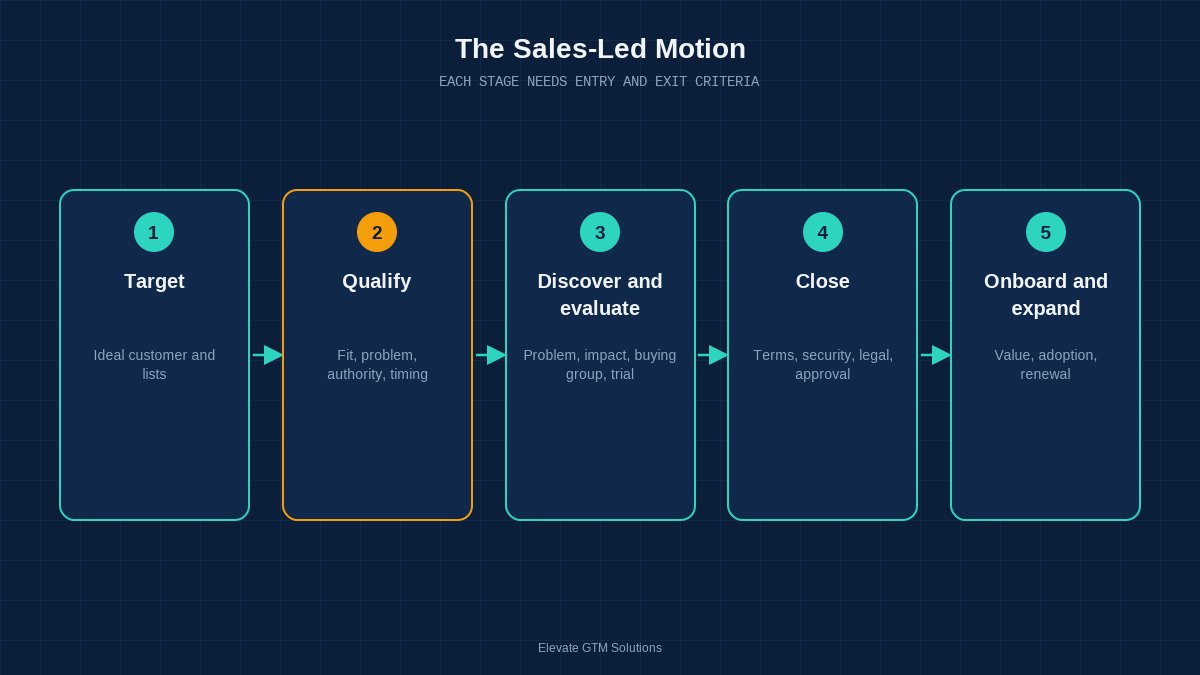
Some companies grow because people sell. A seller finds a prospect, understands the problem, shows how the product helps, works with the buyer's colleagues, handles objections, negotiates terms and closes. After the sale, another person makes sure the customer succeeds and expands. This is sales-led growth: a go-to-market motion in which human sellers are the primary way customers are won.
The term is often used as the opposite of product-led growth, which can make it sound old-fashioned. It is not. For products that are complex, high-value, risky to adopt or sold to committees, a sales-led motion is often the right one, and many of the best-known software companies were built that way. This guide explains what sales-led growth is, how it works stage by stage, which roles and processes it needs, how to plan capacity, what to measure, when it fits and when it does not, how AI changes it and how to improve it. Elevate GTM Solutions makes a GTM strategy platform that helps teams define the customer, message and priorities a sales team works from, and it does not replace a sales team or a CRM, so we say plainly where other tools matter. The guidance is general, and nothing here guarantees results.
What Is Sales-Led Growth?
Sales-led growth is a go-to-market motion in which salespeople are the main way customers are found, qualified, persuaded and signed. Sellers run discovery conversations, demonstrations, evaluations and negotiations, usually supported by marketing, sales development, sales engineering and customer success. It suits products with complex or high-value purchases, longer cycles, several stakeholders and buyers who expect guidance. It is measured by pipeline, conversion, win rate, cycle length and acquisition cost, and it depends on a clear ideal customer, a consistent message, a defined process and well-supported sellers.
Is sales-led growth the same as outbound? No. Sales-led describes who persuades. Leads can come from outbound, inbound, partners or referrals.
Can a sales-led company have a free trial? Yes. Many sales-led companies offer guided trials after a qualified conversation.
The motion, stage by stage
| Stage | What happens | Typical owner |
|---|---|---|
| Target | Define the ideal customer and build lists | Strategy, marketing and sales operations |
| Generate interest | Outbound outreach, inbound inquiries, events, partners and referrals | Marketing, sales development and partners |
| Qualify | Confirm fit, problem, authority and timing | Sales development and sellers |
| Discover | Understand the situation, impact and buying group | Account executive |
| Demonstrate and evaluate | Show how the product solves the problem, run a trial or proof of concept | Account executive and sales engineer |
| Build the case | Align stakeholders, quantify value, address risk | Account executive with the champion |
| Negotiate and close | Terms, security, legal and procurement | Account executive and deal desk |
| Onboard | Implementation and first value | Customer success and services |
| Expand and renew | Additional use cases, seats and renewals | Customer success and account management |
Each stage has entry and exit criteria in a mature process. Without them, pipeline stages mean different things to different sellers, and forecasts suffer.
The roles in a sales-led team
| Role | What they do | Typical skills |
|---|---|---|
| Sales development representative | Starts conversations and qualifies leads | Research, concise outreach, listening |
| Account executive | Owns the deal from discovery to close | Discovery, positioning, negotiation, stakeholder management |
| Sales engineer or solutions consultant | Supports technical evaluation and demonstrations | Product depth, integration knowledge, clarity |
| Customer success manager | Drives adoption, retention and expansion | Relationship building, onboarding, analysis |
| Account manager | Manages existing accounts and renewals | Relationship management, commercial skill |
| Sales operations or revenue operations | Runs process, data, tools and reporting | Systems, analysis, governance |
| Enablement | Trains and equips sellers | Teaching, content, coaching |
| Sales manager | Coaches, inspects deals and forecasts | Coaching, judgment, communication |
| Marketing | Builds demand, content and sales material | Positioning, messaging, campaigns |
Small companies combine roles. A founder often sells alone for the first customers, then adds an account executive, then development and success roles as volume grows.
What sales-led growth needs in order to work
| Requirement | Why it matters |
|---|---|
| A clear ideal customer | Sellers spend limited time, so they need to pursue the right accounts |
| A consistent message with proof | Inconsistent stories confuse buyers and weaken credibility |
| A defined sales process | Stages, criteria and handoffs make forecasting and coaching possible |
| Qualification discipline | Avoids wasted effort on poor-fit deals |
| Enough deal value | The cost of selling must be justified by revenue |
| Sales enablement | New sellers must ramp quickly |
| Good data | Pipeline, forecast and coaching depend on it |
| Management capacity | Coaching and inspection require attention |
| Alignment with marketing and success | Leads, promises and onboarding must connect |
| Honest buyer feedback | Win and loss learning improves the motion |
If several are missing, the problem is rarely the sellers. It is usually the system around them.
When sales-led growth fits, and when it does not
| It tends to fit when | It tends to fit less when |
|---|---|
| The product is complex or needs integration | A newcomer can reach value alone in minutes |
| The purchase involves a buying committee | Individuals buy with a card |
| Deal sizes justify human effort | Prices are low and volume is high |
| Buyers expect guidance and assurance | Buyers expect to try before talking |
| Security, legal and procurement review are required | There is little review |
| The market is defined and reachable by direct outreach | The audience is very broad |
| Implementation changes how a team works | Adoption is individual and quick |
Many companies sit in between, and combine sales-led with product-led elements. Our guide to product-led vs sales-led GTM compares the two, and What Is Product-Led Growth? covers the other motion.
Sources of pipeline in a sales-led motion
Sales-led describes who persuades, not where leads come from.
| Source | Description | Notes |
|---|---|---|
| Outbound | Sellers or development reps reach out to defined accounts | Needs a strong target, message and discipline |
| Inbound | Prospects arrive through content, search, events or referrals | Needs reputation and useful content |
| Partners | Referrals and co-selling through partners | Needs clear rules and mutual benefit |
| Customer referrals and expansion | Existing customers introduce others or buy more | Often the best source, and depends on success |
| Events | Meetings at conferences and webinars | Needs follow-up discipline |
| Account-based programs | Coordinated campaigns to named accounts | Needs tiering and alignment |
Our guide to outbound vs inbound GTM compares the first two sources in detail.
Capacity planning: a simple model
Sales leaders must decide how many sellers they need. A basic model uses the following, with invented numbers for illustration.
| Input | Illustrative value | How to find yours |
|---|---|---|
| Revenue target for the period | 4,000,000 | From the plan |
| Average deal size | 40,000 | Closed-won history |
| Deals needed | 100 | Target divided by deal size |
| Win rate | 25 percent | Closed-won divided by won plus lost |
| Opportunities needed | 400 | Deals divided by win rate |
| Opportunities one seller can work in the period | 40 | History and process |
| Sellers needed at full productivity | 10 | Opportunities divided by capacity |
| Ramp time for new sellers | Several months | Observed ramp |
| Attainment assumption | Not every seller hits target | Past distribution |
Real models add seasonality, ramping sellers, attrition and different segments, and they are sensitive to the win rate. A change from 25 to 20 percent raises the number of opportunities needed by a quarter. Revisit assumptions each quarter and use ranges, not single numbers.
Measuring sales-led growth
| Measure | Definition | Why it matters |
|---|---|---|
| Qualified conversations | Conversations meeting your qualification criteria | An early indicator of pipeline |
| Meeting to opportunity rate | Opportunities created divided by first meetings held | Shows meeting quality |
| Pipeline created | Value of new opportunities in a period | Shows future capacity |
| Pipeline coverage | Open pipeline divided by target | Shows risk, interpreted with win rate |
| Win rate | Won divided by won plus lost | Shows conversion, cut by segment |
| Sales cycle length | Days from opportunity creation to close, median and mean | Shows velocity |
| Average deal size | Won value divided by number of wins | Shows scale of deals |
| Quota attainment distribution | Share of sellers at various attainment levels | Shows health of the team |
| Ramp time | Time for a new seller to reach productivity | Shows enablement quality |
| Acquisition cost and payback | Cost to win a customer and months to recover it | Shows efficiency |
| Forecast accuracy | Forecast compared with actual over time | Shows reliability |
Cut by segment, source and seller cohort. Our guide to GTM metrics and KPIs gives the definitions.
The playbook that holds the motion together
A sales-led motion depends on a playbook that sellers use. It usually includes the ideal customer and exclusions, buying group guidance, positioning and message pillars with proof, qualification questions, a discovery guide, objection handling, competitive guidance, pricing guidance, stage definitions and next-step discipline. Our guide to what a GTM playbook is explains how to build one.
Qualification: the discipline that saves time
Qualification decides which deals deserve effort. Teams use various frameworks, with different letters. Whatever the label, they ask similar questions.
| Question | Why |
|---|---|
| Does the account match the ideal customer? | Avoids poor-fit deals |
| Is there a real problem with a cost? | Problems without cost rarely get budget |
| Who feels it, and who decides? | Identifies the champion and the economic buyer |
| Is there a reason to act now? | Timing and triggers |
| What alternatives are being considered, including doing nothing? | Positions the conversation |
| What would a decision process look like? | Reveals steps and stakeholders |
| What does success look like for the buyer? | Aligns the proposal |
Qualification is not interrogation. The best sellers ask these questions as part of helping the buyer think.
Coaching and inspection
| Practice | How it helps |
|---|---|
| Weekly pipeline review | Look at what changed in each deal, not only the stage |
| Deal inspection questions | Check champion, decision maker, alternatives, next step and risk |
| Call review | Listen to real calls and coach one behavior at a time |
| Win and loss review | Learn from buyers, not only from CRM fields |
| Ramp plans | Set expectations and milestones for new sellers |
| Peer learning | Let strong sellers share what works |
Sales managers need time for this. A manager with too many direct reports cannot coach. Plan spans of control with that in mind.
Discovery: the conversation that decides the deal
Discovery is where sellers learn whether there is a real problem and whether they can help. Good discovery feels like help, not interrogation.
| Theme | Example questions |
|---|---|
| Situation | How does this part of your work happen today? Who is involved? What tools do you use? |
| Trigger | What prompted you to look at this now? When did it become a priority? |
| Problem | What goes wrong? How often? Who notices first? |
| Impact | What does it cost in time, money, customers or risk? Who feels it most? |
| Alternatives | What have you tried? What are you considering, including doing nothing? |
| Decision | Who else will be involved? What does the process look like? What could stop it? |
| Success | What would a good outcome look like in three months? How would you know? |
| Next step | What would be most useful to do next, and when? |
Sellers should write down the problem and impact in the buyer's words and use them in later conversations. A proposal that repeats the buyer's own language is more persuasive than one that repeats product features.
A sales process with stage criteria, worked through
This invented example shows how entry and exit criteria make a pipeline meaningful.
| Stage | Entry criterion | Exit criterion | Common failure |
|---|---|---|---|
| 1. Qualified conversation | The account fits the profile and a person responded | A problem and its impact are recorded in the buyer's words | Moving deals forward on enthusiasm alone |
| 2. Evaluation | The buyer agreed to see the product and named who else should attend | A walkthrough has been held with the champion and a decision maker | Skipping the decision maker |
| 3. Validation | The buyer wants to test the product or review a proposal outline | A trial or proof of concept has run with a defined success measure | Trials with no success measure |
| 4. Proposal | Success measure met, or the buyer is satisfied without a trial | Written proposal delivered and discussed | Sending a proposal without a conversation |
| 5. Negotiation and approval | The buyer has reviewed the proposal | Terms agreed, security and legal complete | Late security review |
| 6. Closed won or lost | A signature or a clear no | Reasons recorded from the buyer's view | Vague loss reasons |
Pipeline inspections become sharper when every stage can be tested against its criteria. A deal in stage three with no decision maker engaged is probably in stage two.
Forecasting and the weekly pipeline review
| Practice | Why |
|---|---|
| Update close dates from buyer events | Dates tied to a meeting or contract review are more reliable than hopeful ones |
| Review changes, not only status | Ask what changed since last week |
| Use inspection questions | Champion, decision maker, alternatives, next step and risk |
| Separate commit from upside | Clarifies confidence |
| Segment the forecast | Win rates differ by segment |
| Track forecast against actual | Builds a record |
| Show ranges | Honest about uncertainty |
A thirty-minute weekly review of the top deals, with a short list of questions, usually finds more risk than a long meeting that reads every deal aloud.
Compensation and incentives
Compensation shapes behavior, and design mistakes are expensive.
| Principle | Practice |
|---|---|
| Reward what you want more of | If you want expansion and retention, include them |
| Keep it understandable | A seller should be able to calculate their pay |
| Align with the strategy | If you want priority segments, reward them |
| Avoid single-metric traps | Pair volume with quality, such as retention or margin |
| Protect new sellers during ramp | Set realistic expectations |
| Review annually | Markets and products change |
| Involve finance and legal | For accuracy and compliance |
Conflicts between teams often come from incentives. If sales is paid on bookings and customer success on retention, agree what is promised before the sale.
A ramp plan for new sellers
| Period | Focus | Outputs |
|---|---|---|
| Days 1 to 30 | Learn the customer, message and product. Listen to calls. Shadow conversations | Can state the positioning and ideal customer from memory, passes a product walkthrough |
| Days 31 to 60 | Run supervised discovery and demonstrations. Start building pipeline | First qualified opportunities, call reviews with a manager |
| Days 61 to 90 | Work an independent pipeline with coaching. Practice negotiation and stakeholder mapping | A full set of active opportunities and a forecast |
| Months 4 to 6 | Build consistency and refine | Approaching expected productivity |
Measure ramp by milestones, not only by revenue. A call library and playbook shorten it.
Building the team: a hiring sequence
| Stage | Typical first hires | Notes |
|---|---|---|
| Founder-led | None, the founders sell | Learn the pitch and the buyers |
| Early | One or two account executives | Give them a written playbook |
| Growing | Add a development rep, a sales engineer and a manager | Split roles as workload demands |
| Scaling | Add enablement, operations and success | Support the system around sellers |
| Mature | Segment teams, regional teams and specialists | Governance and consistency |
A scorecard for hiring helps compare candidates.
| Criterion | What to look for |
|---|---|
| Discovery | Asks good questions and listens |
| Structured thinking | Explains a deal in a clear way |
| Coachability | Responds well to feedback |
| Integrity | Honest about what a product can and cannot do |
| Resilience | Handles setbacks |
| Fit with the motion | Experience with comparable buyers and deal sizes |
Terms used in this guide
| Term | Meaning |
|---|---|
| Sales-led | Sellers are the main way customers are won |
| SDR | Sales development representative |
| AE | Account executive |
| Sales engineer | A technical specialist who supports evaluation |
| Win rate | Won opportunities divided by won plus lost |
| Pipeline coverage | Open pipeline divided by target |
| Ramp | The time a new seller takes to reach productivity |
| Commit | Deals a seller is confident will close in the period |
How AI changes sales-led growth
| Area | How AI helps | Caution |
|---|---|---|
| Research and preparation | Summarizes accounts and prepares call briefs | Check facts and sources |
| Outreach drafting | Produces drafts from approved messaging | Review for accuracy and tone |
| Call notes and CRM updates | Transcribes and summarizes | Sample for accuracy |
| Deal risk | Flags stalled deals or missing stakeholders | Treat as input, not verdict |
| Forecasting | Aggregates signals | Understand the method |
| Coaching | Surfaces moments from calls | Coach to behaviors tied to outcomes |
| Agents | Perform multi-step tasks | Require limits, approvals and logs |
AI can raise seller productivity, and it does not replace the need for a clear target, an honest message and a good process. Our guide to AI tools for GTM execution and alignment covers controls.
Common mistakes
| Mistake | What happens | Fix |
|---|---|---|
| Hiring sellers before the message is proven | Expensive improvisation | Prove the pitch with founder-led sales first |
| Pursuing every account | Wasted effort | Score fit and tier accounts |
| No stage criteria | Unreliable forecasts | Define entry and exit criteria |
| Too many direct reports per manager | No coaching | Plan spans of control |
| Weak enablement | Long ramp times | Playbook, call library and coaching |
| Ignoring buyer feedback | Repeating errors | Win-loss interviews |
| Pushing demos too early | Buyers disengage | Understand the problem first |
| Misaligned incentives | Gaming and short-term behavior | Reward quality and expansion, not only new deals |
A hypothetical example
This is an illustration, not a real company.
A software company sold workflow software to mid-sized logistics firms. The founders sold the first twelve customers themselves and learned a pattern: the strongest customers were operators with fifty to two hundred staff who scheduled in spreadsheets, and the owner was always involved. They wrote this down in a one-page strategy and a short playbook with a discovery guide and objection responses.
They hired two account executives and one sales development representative, gave them the playbook and listened to their first calls together. Stage criteria were defined, with exit criteria such as "problem and impact recorded" and "owner has seen a walkthrough." The head of sales held a weekly pipeline review and asked the same inspection questions of every deal.
After two quarters, pipeline was healthier, win rates were consistent, and the team could see which objections arose and which responses worked. They added a sales engineer when technical evaluations began to slow deals. They did not need a new strategy. They needed the strategy written in a form that sellers could use.
Sales motions by segment
Sales-led is not one thing. The shape changes with the size of the customer.
| Segment | Typical buyer | Typical process | Team shape |
|---|---|---|---|
| Small business | An owner or manager | Short, often one or two calls | Inside sales with high volume, or a hybrid with self-serve |
| Mid-market | A department leader with a budget owner | A few weeks, a walkthrough and a trial or proposal | Account executives with support from sales engineering |
| Enterprise | A buying committee with security, legal and procurement | Months, multiple stakeholders, proof of concept | Senior account executives, solutions engineers, executive sponsors |
| Strategic accounts | Executives at a small number of major accounts | Long relationship building and custom proposals | Named teams with account plans |
Each segment needs its own playbook, stage criteria and metrics. A single process applied to all of them usually fits none.
Pricing and discount governance
Sellers negotiate, and without rules, discounts erode both revenue and trust.
| Element | Practice |
|---|---|
| List price | Published or documented, with clear packaging |
| Discount authority | Defined levels of approval by size and reason |
| Reasons for discounts | A short list, recorded in the CRM |
| Value conversation first | Sellers establish value before discussing price |
| Terms | Standard terms, with a process for exceptions |
| Review | Monthly review of discount patterns by segment and seller |
| Feedback to pricing | Patterns inform packaging and pricing logic |
Persistent discounting in one segment may signal that the price or the value story is wrong for that segment, which is a strategy question, not only a negotiation one.
Customer success and expansion in a sales-led company
Sales-led growth depends on what happens after the signature.
| Moment | What matters |
|---|---|
| Handoff | The customer's goals, stakeholders and promises are passed on in writing |
| Onboarding | A plan with milestones and owners |
| First value | A defined result and a date |
| Adoption | Regular check-ins and usage review |
| Expansion | Signals such as growth in usage or new teams, with a conversation led by the right person |
| Renewal | A planned process well before the date |
| Advocacy | Respectful requests for references and reviews |
| Feedback | Customer insight returned to strategy and product |
Promises made during the sale should be recorded, and sellers should avoid promising what the product or services cannot deliver.
Scenarios and directions
| Situation | Direction to explore |
|---|---|
| A startup with founder-led sales working | Document the pitch and process before hiring |
| A team with sellers but inconsistent results | Review message, qualification and stage criteria before adding headcount |
| A mid-market company with long cycles | Add mutual action plans and stakeholder mapping, and track stall points |
| An enterprise with security-heavy deals | Prepare security documentation early, and involve security in evaluation |
| A company with high discounting | Review value story, packaging and approval rules |
| A company adding product-led elements | Define who owns which accounts and when a seller joins |
In plain language
Sales-led growth works when the product is complex or valuable enough that buyers want a person to guide them, and when the company has done the unglamorous work around the sellers: a clear customer, a consistent message, defined stages, honest qualification, enablement, coaching and careful handling after the sale. Without that system, adding sellers adds cost and variation. With it, sellers can focus on understanding buyers and helping them decide. Prove the pitch before you scale, measure by segment, listen to buyers and keep the strategy and the playbook current.
An account plan template
For larger deals, an account plan keeps the team aligned.
| Section | Content |
|---|---|
| Account and goal | Who they are, and what we want to achieve with them this year |
| Situation and problem | In the buyer's words, with evidence |
| Stakeholders | Names, roles, concerns, relationship strength and next step for each |
| Alternatives | What they might do instead, including nothing |
| Value case | The impact in their terms, with the evidence behind it |
| Mutual plan | Dated steps both sides agree, including security, legal and procurement |
| Risks | What could stop the deal, with responses |
| Resources | Who from our team is needed and when |
| Next three actions | With owners and dates |
Review it in pipeline meetings. If the plan has no named decision maker or no date for the next step, the deal is earlier than its stage suggests.
Questions sales leaders ask
"How many opportunities should a seller carry?" It depends on deal size and cycle. Look at your history for when quality drops, and avoid loading sellers so heavily that discovery suffers.
"When should we hire a sales engineer?" When technical evaluations begin to stall deals or take up too much of account executives' time.
"How do we reduce deal slippage?" Tie close dates to buyer events, inspect champion and decision maker, and use mutual plans.
"How do we keep sellers honest about forecasts?" Reward accuracy, review track records and make it safe to report risk early.
"Should marketing generate all leads?" Not necessarily. Pipeline can come from outbound, partners, referrals and expansion. Agree targets by source and review them.
"How do we know our message is the problem?" Listen to calls and ask buyers. If sellers describe the product differently, or buyers misunderstand it, the message needs work.
What to do this week
Write the ideal customer and exclusions in a paragraph. Define the exit criterion for each pipeline stage. Listen to three recent calls and note how each seller describes the product. Ask five recent buyers what nearly stopped them. If your answers vary, settle the message and process before adding headcount.
Quick reference
| Question | Short answer |
|---|---|
| What is it? | Sellers are the main way customers are won |
| When does it fit? | Complex or high-value products, committees, longer cycles, buyers who want guidance |
| What does it need? | A clear customer, consistent message, defined stages, qualification, enablement and coaching |
| What should be measured? | Qualified conversations, conversion, win rate, cycle, payback and forecast accuracy by segment |
| What goes wrong? | Hiring before the pitch is proven, no stage criteria, weak coaching and misaligned incentives |
Final thoughts
Sales-led growth is a system, and the sellers are one part of it. The companies that do it well write down who the customer is and what they say, define what each stage means, qualify honestly, coach with real calls and treat what happens after the signature as part of the sale. They measure by segment, learn from buyers and keep the playbook current. If you are considering this motion, prove the pitch yourself first, then build the system the sellers will work in.
A second hypothetical: fixing a sales-led team without adding headcount
This is another invented illustration.
A company with eight account executives had missed its number for three quarters. The instinct was to hire more sellers. The head of sales reviewed forty closed-lost deals and listened to twenty recorded calls. She found that sellers described the product in four different ways, that many deals had no decision maker engaged until late and that discounting was common in one segment where the value story was weak.
The company wrote one set of message pillars, defined stage exit criteria that required a decision maker walkthrough, set discount approval rules and refocused two sellers on the segments where win rates were strongest. It began weekly pipeline reviews using the same inspection questions for every deal. No one was hired for two quarters. Win rates in the priority segments rose, average discounts fell and forecasts became more reliable.
Adding sellers to a system with these problems would have multiplied them.
Summary for busy leaders
If you remember three things: sellers can only be as good as the system around them, so define the customer, the message and the stage criteria first; capacity depends on win rate, so plan with ranges and recheck each quarter; and coaching with real calls beats long meetings about pipeline status. Build the pitch yourself before you scale it, protect time for managers to coach and keep asking buyers what nearly stopped them.
Key takeaways
- Sales-led growth means sellers are the main way customers are won, and it suits complex, higher-value purchases sold to committees.
- It depends on a clear ideal customer, a consistent message, a defined process, qualification discipline and good enablement.
- Capacity planning is sensitive to win rate, so use ranges and revisit assumptions.
- Measure qualified conversations, conversion, win rate, cycle length, acquisition cost and forecast accuracy by segment.
- AI can raise seller productivity, with limits, approvals and review.
- Prove the pitch before scaling headcount.
Where Elevate GTM Solutions fits
Elevate GTM Solutions is an AI-native GTM operating system for B2B companies. It builds and maintains the strategy a sales-led team runs on: ideal customer and segments, competitive framing, positioning, messaging with proof, pricing logic, sales enablement inputs and launch plans, across 15 modules, with workflows, weekly plans and a recurring review rhythm. It does not replace a CRM, a sales engagement tool or a sales team, and it connects to HubSpot, Salesforce, LinkedIn, Notion and Claude for supported actions. A free first strategy build is available, and published plans, billed annually, are Enable at USD 499 per month and Growth at USD 1,499 per month, with custom Scale pricing.
For related reading, see Product-Led vs Sales-Led GTM, GTM Platform vs Sales Engagement Platform, Win-Loss Analysis Framework and What Is Elevate GTM Solutions?. See the pricing page, or request a demo.
Frequently Asked Questions
What is sales-led growth?
A go-to-market motion in which salespeople are the main way customers are found, qualified, persuaded and signed, supported by marketing, sales development, sales engineering and customer success.
What is the difference between sales-led and product-led growth?
In sales-led growth, sellers do most of the persuading. In product-led growth, the product does, through free plans or trials and self-serve onboarding. Many companies combine them.
When does sales-led growth work best?
For complex or high-value products, longer cycles, buying committees, security and procurement review and buyers who expect guidance.
What roles does a sales-led team need?
Sales development, account executives, sales engineers, customer success, account management, sales operations, enablement, sales managers and marketing, combined in small companies.
How do you plan sales capacity?
Divide the revenue target by average deal size to get deals needed, divide by win rate to get opportunities needed, then divide by the opportunities one seller can work, and adjust for ramping, attrition and seasonality.
What metrics matter in a sales-led motion?
Qualified conversations, meeting to opportunity rate, pipeline created and coverage, win rate, cycle length, average deal size, ramp time, acquisition cost and payback and forecast accuracy.
Is sales-led the same as outbound?
No. Sales-led describes who persuades. Leads can come from outbound, inbound, partners, referrals and events.
How does AI change sales-led growth?
AI helps with research, drafting, call notes, deal risk, forecasting and coaching, and agents can perform multi-step tasks. Use review, limits and logs.
What are the most common sales-led mistakes?
Hiring before the message is proven, pursuing every account, no stage criteria, too many direct reports per manager, weak enablement, ignoring buyer feedback and misaligned incentives.
How do I start building a sales-led motion?
Prove the pitch with founder-led sales, write the ideal customer and message, define stage criteria, build a short playbook and hire sellers who will use it.
What should discovery cover?
The buyer's situation, trigger, problem, impact, alternatives, decision process, definition of success and a specific next step, recorded in the buyer's words.
How should sales stages be defined?
With entry and exit criteria for each stage, such as problem and impact recorded, decision maker engaged, success measure agreed and terms and security complete.
How long does it take a new seller to ramp?
It varies by product and market, often a few months. Measure ramp by milestones such as passing a walkthrough, running supervised discovery and building a full pipeline, and shorten it with a playbook and call library.
How should sales compensation be designed?
Make it understandable, align it with the strategy, reward what you want more of, avoid single-metric traps and review it annually with finance and legal.