
By the Elevate GTM Solutions Team · Updated November 10, 2026 · 21 min read
What Is Demand Generation? Definition, Channels, Measurement, and How It Differs From Lead Generation
Demand generation is one of those marketing terms that everyone uses and few define the same way. To some, it means running ads. To others, it means producing content, or filling the funnel, or everything marketing does before sales gets involved. The confusion matters, because teams that disagree about what demand generation is will disagree about what it should produce, how to measure it and how much to spend.
This guide offers a plain definition, separates demand generation from lead generation, brand marketing and account-based marketing, describes the main channels and content types, explains how to measure it honestly, shows how it works with sales, offers a way to plan budget and a ninety-day starting plan, and explains where AI helps. Elevate GTM Solutions makes a GTM strategy platform that defines the customer, message and priorities demand programs carry, and it does not run campaigns, so we say plainly where other tools matter. The guidance is general and does not promise results.
What Is Demand Generation?
Demand generation is the set of marketing activities that create awareness of a problem and of your solution among the people most likely to buy, and build enough interest and trust that they seek you out or respond when you reach them. It includes content, search, community, events, partnerships, advertising, email and programs for named accounts. Its goal is qualified demand that sales can convert, not only a count of contact details. It differs from lead generation, which focuses on capturing contact information, though the two overlap.
Is demand generation the same as lead generation? No. Demand generation builds interest and trust. Lead generation captures contacts, usually at a point of existing interest.
How is success measured? By qualified conversations, opportunities and pipeline by segment, with honest caveats about attribution.
Demand generation compared with neighboring terms
| Term | Focus | Typical output | Relationship to demand generation |
|---|---|---|---|
| Brand marketing | Recognition and reputation over time | Familiarity and preference | Builds the ground demand generation works on |
| Demand generation | Creating and capturing interest among likely buyers | Qualified conversations and pipeline | The core |
| Lead generation | Capturing contact details | Leads | A part of demand generation, often too narrowly emphasized |
| Account-based marketing | Programs for named accounts | Engagement and progression in target accounts | A focused form of demand generation |
| Product marketing | Positioning, messaging and enablement | Message and sales material | Supplies the message demand programs carry |
| Growth marketing | Experiment-driven improvement across the funnel, often with product | Conversion and retention improvements | Overlaps, especially in product-led companies |
| Content marketing | Useful content for an audience | Attention and trust | A channel for demand generation |
| Sales development | Direct outreach and qualification | Meetings | Works with demand generation, often as a different channel |
Use the terms consistently inside your company, and write down what each means for you.
Creating demand and capturing demand
A useful distinction is between two jobs.
| Job | What it means | Examples |
|---|---|---|
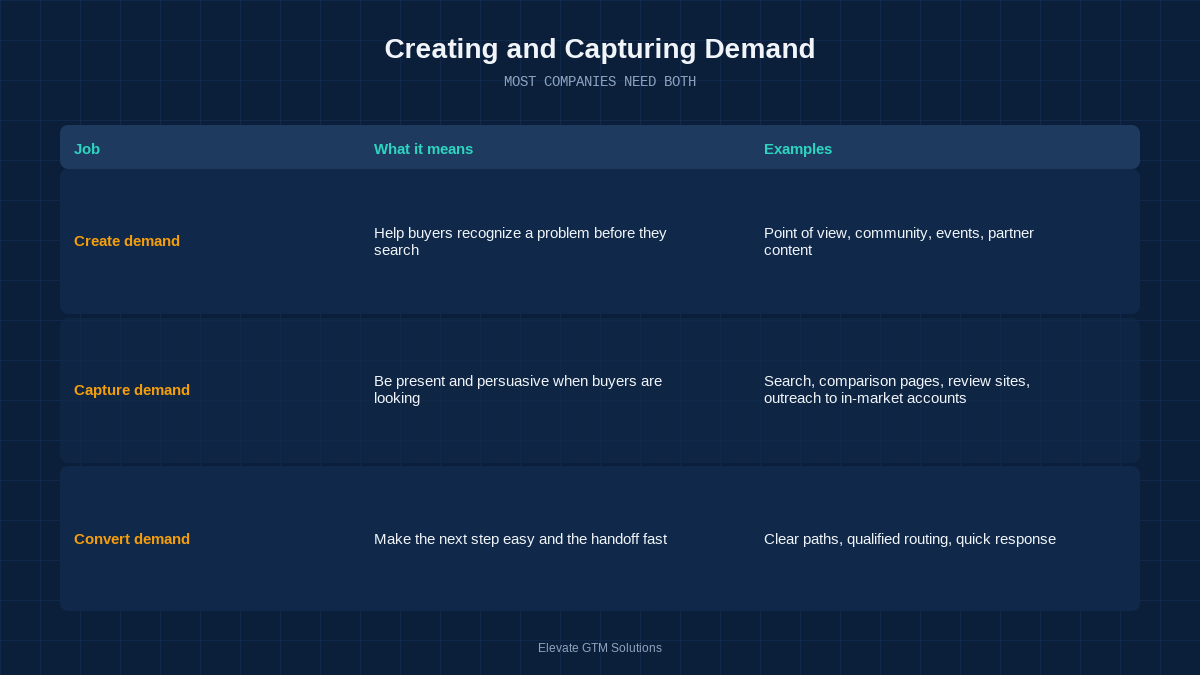
| Creating demand | Helping people recognize a problem and consider your category before they are searching | Original perspectives, community presence, events, partner content, thought leadership |
| Capturing demand | Being present and persuasive when people are already looking | Search, comparison pages, review sites, retargeting, direct outreach to in-market accounts |
Teams that only capture demand compete for the same limited pool of active buyers and pay more over time. Teams that only create demand may build awareness without conversion. Most need both, in proportion to their market and stage.
The building blocks
| Block | What it is | Questions to answer |
|---|---|---|
| Strategy | The customer, problem, positioning and message | Who are we trying to reach and what do we say? |
| Content | Material that educates, builds trust and answers questions | What do buyers want to know at each stage? |
| Channels | Where the audience pays attention | Where do they research and decide? |
| Programs | Coordinated campaigns with goals | What outcome is each program for? |
| Conversion paths | How interest becomes a conversation | What is the next step, and is it easy? |
| Handoff | How qualified interest reaches sales | What counts as qualified and who follows up? |
| Measurement | How you tell what works | Which outcomes matter and how are they tracked? |
| Operations | Tools, data and process | Who maintains them? |
A program missing the first block, strategy, produces activity without direction. Our guide to the GTM planning template shows how to write the strategy on a page.
Channels, and what each is for
| Channel | Mostly creates or captures | Strengths | Cautions |
|---|---|---|---|
| Search, organic | Captures, and creates through educational content | Compounds over time, trusted | Slow to build, needs consistent quality |
| Search, paid | Captures | Fast and measurable | Cost rises with competition |
| Content and thought leadership | Creates | Builds trust and a point of view | Needs real insight |
| Social media | Creates and captures | Reach and conversation | Attention is fragmented |
| Email and newsletters | Creates and captures | Direct and owned | Needs permission and relevance |
| Events and webinars | Creates and captures | Depth and relationships | Cost and follow-up discipline |
| Communities | Creates | Trust among peers | Needs genuine participation |
| Partnerships | Creates and captures | Borrowed trust and reach | Dependence on partners |
| Review sites and directories | Captures | Buyers consult them | Needs accurate listings and real reviews |
| Advertising, display and social | Creates and captures | Targeting and scale | Needs strong creative and measurement |
| Account-based programs | Both | Focus on named accounts | Needs tiering and sales alignment |
| Product-led | Both | The product itself spreads | Needs a product that supports it |
Choose few channels that match where your buyers actually research and decide. Interviews and win-loss conversations reveal that. Our guide to the win-loss analysis framework shows how to ask.
Content by buyer question
Content works when it answers what buyers actually ask. Think in questions, not in funnel labels.
| Buyer question | Content that helps |
|---|---|
| "What is going on, and is it a problem?" | Explanations of the situation, diagnostic checklists, original data you can support |
| "What are my options?" | Honest overviews of approaches, including doing nothing and building in-house |
| "How do I choose?" | Evaluation guides, scorecards, question lists |
| "How do you compare with others?" | Fair comparison pages, alternatives guides |
| "Will it work for someone like me?" | Customer stories with permission, examples by segment |
| "What will it cost and take?" | Clear pricing information and implementation timelines |
| "Can I trust you?" | Security information, references, reviews and honest limits |
| "How do I get started?" | A simple next step and a guide to the first weeks |
AI assistants and search engines both reward content that answers real questions plainly. Our guide to the AI search visibility audit shows how to check what assistants say.
Measuring demand generation honestly
Demand generation has long lead times and imperfect attribution, so measurement needs care.
| Level | Example measures | Notes |
|---|---|---|
| Reach | Audience size among target accounts, share of target accounts engaged | Do not count raw impressions |
| Engagement | Quality of replies, time on key pages, event attendance by target accounts | Prefer depth to volume |
| Conversion | Qualified conversations, demo requests, trial starts | Define qualified |
| Pipeline | Opportunities created, pipeline by segment and source | Cut by segment |
| Outcome | Win rate, cycle length and revenue by source and segment | Long lags |
| Efficiency | Cost per qualified conversation, acquisition cost and payback | Include people and media |
Attribution, honestly
| Method | What it shows | Limit |
|---|---|---|
| First touch | How people first found you | Ignores later influence |
| Last touch | What prompted a conversion | Ignores earlier influence |
| Multi-touch | Credit across touches | Rules are arbitrary |
| Self-reported | What buyers say influenced them | Memory and bias |
| Cohort comparison | Differences between exposed and unexposed groups | Needs careful design |
| Experiments | Controlled tests | Not always possible |
Use several views, ask buyers how they found you and what prompted them to act, and be modest about causation. Our guide to GTM metrics and KPIs covers definitions.
Working with sales
Demand programs that sales ignores fail. A few practices help.
| Practice | How |
|---|---|
| Shared definitions | Agree what lead, qualified, accepted and opportunity mean |
| Shared target | Use the same ideal customer and tiers |
| Response commitments | Agree how quickly qualified interest is followed up |
| Feedback loop | Record why leads are rejected and review by segment |
| Joint review | A monthly meeting on results by segment, theme and source |
| Shared language | Use buyer words from calls and interviews |
| Content from the field | Capture common questions and objections and answer them publicly |
Planning budget without false precision
Budgets are hard because results lag. A simple approach helps.
| Step | Practice |
|---|---|
| 1. Start from the goal | Qualified conversations or pipeline by segment |
| 2. Estimate conversion | From your history, with ranges |
| 3. Allocate by role | Part to capturing demand, part to creating it, part to experiments |
| 4. Keep an experiment share | A small portion for testing new channels |
| 5. Include people | Staff and agency costs are part of the cost |
| 6. Review often | Monthly, with reallocation rules |
| 7. Protect compounding work | Content and community take time, so avoid cutting them at the first dip |
Treat any benchmark percentage from a report with caution, because company stage, market and sales motion vary widely. Your own history, measured consistently, is a better guide.
A ninety-day starting plan
Days 1 to 15: ground it. Write the ideal customer, problem and message. Interview five buyers about how they researched and decided. Agree definitions with sales.
Days 16 to 40: choose and build. Pick two or three channels. Produce the core content that answers the main buyer questions. Fix the conversion path and handoff.
Days 41 to 75: run. Launch the programs. Hold a weekly check on engagement and qualified conversations. Read replies and sales feedback.
Days 76 to 90: review. Compare with your baseline, cut by segment and decide what to extend, change or stop. Update the strategy and message.
Roles in a demand generation team
| Role | What they do |
|---|---|
| Head of demand generation | Owns goals, strategy and budget |
| Content lead | Plans and produces content |
| Channel specialists | Run search, social, email, events or partnerships |
| Marketing operations | Manages systems, data and measurement |
| Product marketing | Supplies positioning and messaging |
| Sales development | Works qualified interest and outbound |
| Analyst | Reads results and cuts by segment |
Small companies combine them. A founder may be the content lead, channel specialist and analyst for the first year.
Programs by goal, with invented examples
A program is a coordinated effort with a goal, an audience, a message and a measure. These illustrations show the pattern.
| Goal | Program | Audience | Message | Measure |
|---|---|---|---|---|
| Build awareness of a problem | A series of short articles and a community presence about missed appointments | Owners of field-service firms | Missed appointments are common and fixable | Qualified conversations that mention the content |
| Capture comparison shoppers | Honest comparison and alternatives pages, accurate review-site profiles | Buyers evaluating tools | Who the product is for and who it is not for | Qualified inquiries from comparison pages |
| Support a launch | A launch campaign with a webinar, customer story and sales briefing | Existing customers and target accounts | What is new, for whom and why it matters | Attendance by target accounts, qualified conversations, early adoption |
| Warm up target accounts | Account-based plays for tier one and two | Named accounts | Specific value for their situation | Engagement and meetings from target accounts |
| Re-engage lost deals | A nurture track with new proof and an update | Past opportunities that stalled | What has changed since we last spoke | Reopened conversations |
| Grow through partners | Co-marketing with a payments provider | The partner's customers | Joint value | Introductions and qualified conversations |
Write the program on a page before you start: goal, audience, message, channel, owner, budget, measure and review date.
A content approach with a quality bar
Content is the backbone of many demand programs. A calendar that fills slots with generic pieces produces sameness.
| Step | Practice |
|---|---|
| 1. Start from questions | List what buyers and sellers ask, from calls, support and communities |
| 2. Choose a point of view | Decide what you believe that others in the category do not say |
| 3. Include evidence | Use your own data, customer stories with permission and cited sources |
| 4. Write for one reader | A specific role with a specific problem |
| 5. Answer directly | State the answer near the top |
| 6. Keep it current | Review and date |
| 7. Connect to a next step | A useful, optional invitation |
A quality bar before publishing:
- Would a buyer find this useful if they never bought from us?
- Is there something here they could not get from a search summary?
- Are the claims supported and honest about limits?
- Does it match our positioning and avoid forbidden claims?
- Would a seller send it to a prospect?
Events and webinars
Events create depth that other channels cannot, and they fail without follow-up.
| Element | Practice |
|---|---|
| Purpose | One goal per event: learning, relationships, a launch or pipeline |
| Audience | Target accounts and personas, not everyone |
| Content | A topic buyers care about, with a real speaker or customer |
| Promotion | Direct invitations to target accounts, partners and community |
| Registration | Short forms, with a clear reason to attend |
| Follow-up | Within days, with a relevant resource and a clear next step, and a seller touch for fit accounts |
| Measurement | Attendance by target accounts, conversations started and opportunities created |
| Recording | Reuse as content, with attention to consent |
Count quality, not registrations. Fifty target-account attendees with five conversations afterward can be worth more than five hundred registrants.
Review sites and listings as a demand channel
Many buyers consult review sites and directories before contacting vendors, and AI assistants often draw on them.
| Task | Practice |
|---|---|
| Claim and complete profiles | Accurate description, category, pricing, features and screenshots |
| Choose categories carefully | Match how buyers search and how assistants describe your product |
| Keep facts consistent | Pricing and features should match your own site |
| Invite real reviews | From real customers, honestly, without incentives that break platform rules |
| Respond to reviews | Professionally, including critical ones |
| Monitor | Check quarterly for outdated or conflicting information |
Conflicting prices and descriptions across listings reduce trust and confuse assistants that summarize them.
A monthly demand review
Sixty minutes with marketing, sales, product marketing and operations.
| Time | Topic |
|---|---|
| 0 to 10 minutes | Definitions and data checks |
| 10 to 25 minutes | Qualified conversations and pipeline by segment, source and theme |
| 25 to 40 minutes | What buyers said: replies, questions and objections |
| 40 to 50 minutes | Channel performance and cost per qualified conversation |
| 50 to 60 minutes | Decisions: what to change, extend or stop, with owners |
A one-page summary with counts and caveats goes to leadership.
Experiments for channels
| Step | Practice |
|---|---|
| Hypothesis | A specific belief, such as "owner community posts will start conversations" |
| Design | A small, time-boxed test with a defined audience |
| Threshold | What would count as success and failure, set in advance |
| Run | For long enough to learn, usually several weeks |
| Read | Counts and quality, not only rates |
| Decide | Extend, change or stop, and record why |
Reserve a small share of time and budget for experiments, and review them monthly.
Terms used in this guide
| Term | Meaning |
|---|---|
| Demand generation | Marketing that creates and captures interest among likely buyers |
| Lead generation | Capturing contact information |
| Qualified conversation | A conversation meeting your criteria for fit and interest |
| Attribution | Assigning credit for outcomes to activities |
| Program | A coordinated effort with a goal, audience, message and measure |
| Nurture | A series of messages that builds interest over time |
| Capture and create | Reaching people already looking versus building interest earlier |
How AI changes demand generation
| Area | How AI helps | Caution |
|---|---|---|
| Research | Summarizes buyer questions and competitor content | Verify |
| Drafting | Produces first drafts of content and emails | Generic output without specific input |
| Personalization | Varies messages by segment | Accuracy and tone |
| Optimization | Suggests variants and timing | Interpret with care |
| Reporting | Summarizes performance | Check against definitions |
| Search and answer engines | Buyers ask assistants for recommendations | Clear, honest, consistent public information helps |
Give AI tools your positioning, proof and forbidden claims, and have a person review. Content written to fill a calendar usually sounds the same as everyone else's.
Common mistakes
| Mistake | What happens | Fix |
|---|---|---|
| Counting leads as success | Volume without quality | Measure qualified conversations and pipeline by segment |
| Only capturing demand | Rising costs for the same buyers | Invest in creating demand too |
| Too many channels | Thin effort everywhere | Choose two or three |
| Generic content | No point of view, no trust | Use real insight and buyer questions |
| No agreement with sales | Leads rejected, mutual blame | Shared definitions and a monthly review |
| Over-trusting attribution | Cutting programs that quietly work | Use several views and ask buyers |
| Ignoring review sites and listings | Wrong facts in buyers' view | Keep profiles accurate |
| Cutting content at the first dip | Losing compounding assets | Protect long-term work |
A hypothetical example
This is an illustration, not a real company.
A company selling scheduling software to field-service firms measured its demand generation by form fills. The numbers were healthy, and sellers said the leads were weak. A review showed that most form fills came from a downloadable template aimed at a broad audience, while customers came from firms that searched for solutions to missed appointments.
The team interviewed five recent customers and learned that they had researched on search, in an owner community and through a payments partner. It stopped promoting the template, wrote three guides in the owners' language about missed appointments and spreadsheet scheduling, answered common comparison questions honestly and joined the community as a helpful participant. It set a new measure: qualified conversations with owners of firms with ten to eighty technicians.
Form fills dropped. Qualified conversations rose after a quarter, and sellers' acceptance of marketing-sourced meetings improved. The team had not found a better trick. It had aimed the programs at the buyers who actually bought.
Different plans for different situations
| Situation | Emphasis |
|---|---|
| Early-stage startup | Founder-led content and conversations, a few channels, rapid learning |
| A new category | Create demand: explain the problem and the approach, build community and a point of view |
| A crowded category | Capture demand with honest comparisons and strong profiles, and differentiate with a clear segment focus |
| A small defined market | Account-based programs and direct outreach, supported by reputation |
| A large market with search demand | Search content, listings and paid capture, with creation in priority segments |
| A product-led company | Content, community and in-product loops that bring users in |
| An enterprise with several products | A shared message with segment-specific programs and regional adaptation |
Brand and demand together
Brand and demand generation are sometimes set against each other, and they work as a pair.
| Question | Brand answers | Demand answers |
|---|---|---|
| Will buyers recognize us when they research? | Familiarity and trust | Presence in the places they look |
| Will they prefer us when comparing? | Reputation and perceived quality | Clear, honest comparison and proof |
| Will they act? | Confidence | A simple next step |
| What compounds? | Memory and reputation | Content, listings and community |
A company with strong demand programs and no brand may pay more for each conversation. A company with brand and no programs may be admired and not found. Choose a balance that fits your stage and measure both with honest, modest methods.
A content distribution checklist
Publishing is not distribution. Before and after you publish, check:
- Is it on your site with a clear title, summary and updated date?
- Have you shared it with sellers, with a note on when to use it?
- Is it in relevant newsletters, communities and partner channels?
- Is it linked from related pages?
- Does it have structured data and a clear heading structure that search engines and assistants can read?
- Is there a useful next step?
- Have you noted the question it answers, so you can see whether it works?
- When will you review and update it?
Scenarios and directions
| Situation | Direction to explore |
|---|---|
| Leads are plentiful and sales rejects them | Redefine qualified with sales and tighten targeting |
| Cost per conversation is rising | Check whether you are only capturing demand, and invest in creating it and in listings |
| Content gets traffic and no conversations | Check match between content and buyer questions, and the next step |
| A launch has little pull | Check readiness: customer, positioning, proof and sales briefing |
| Results are strong in one segment and weak in another | Cut by segment and move effort |
| Leadership wants a number for brand | Use modest, qualitative and cohort evidence, and avoid false precision |
In plain language
Demand generation is what makes the right buyers aware, interested and ready to talk. It is more than collecting contact details. It means choosing a few channels where your buyers actually look, answering their real questions honestly, building trust through content, community and reputation, and making the next step easy. Measure qualified conversations and pipeline by segment, ask buyers how they found you and review results with sales every month. Create demand as well as capture it, protect the work that compounds and keep your message consistent across every channel.
Questions leaders ask
"How do we know demand generation is working?" Look for rising qualified conversations in priority segments, buyers who mention your content and reputation, and improving conversion from conversation to opportunity.
"Why did leads go up and pipeline stay flat?" Probably volume without fit. Check which segments the new leads come from and whether sales accepts them.
"How long before content pays off?" Often several months. Look at leading signs such as search visibility, engagement from target accounts and buyer mentions.
"Should we gate content?" Consider the trade-off: gating captures contacts and reduces reach. Many companies keep most useful content open and gate a few high-value assets, and test the effect on qualified conversations.
"How do we compete with bigger budgets?" Narrow the segment, publish distinctive and honest content, be present in communities and keep listings accurate.
"What should we stop doing?" Programs that produce activity without qualified conversations after a fair trial, and content that no buyer or seller uses.
Checks for a demand report
Before sharing a report, check:
- Are the definitions stated?
- Are counts shown beside percentages?
- Are results cut by segment?
- Is the time window long enough to be meaningful?
- Are attribution limits noted?
- Does it include what buyers said?
- Does it end with decisions and owners?
A starter checklist
- The ideal customer, problem and message are written down.
- Five recent buyers have told you how they researched and decided.
- Definitions of qualified and accepted are agreed with sales.
- Two or three channels are chosen, each with an owner and a goal.
- Core content answers the main buyer questions.
- Listings and profiles are accurate and consistent.
- A monthly review is in the calendar.
- A small share of effort is reserved for experiments.
A second hypothetical: a new category
This is another invented illustration.
A company selling a new kind of workflow software found that few buyers searched for its category, because the category was not yet named. Search content on obvious terms drew little traffic. The team interviewed customers and learned that they described the problem in everyday language, in terms of chasing information across spreadsheets and messages, and that they discovered the product through peers and a few trusted newsletters.
The team stopped writing for category terms and wrote about the problem in customers' own words. It started a small peer roundtable series with customers as speakers, contributed to two newsletters that its buyers read and kept its listings and website clear about what the product was. It measured qualified conversations that mentioned a roundtable, a newsletter or a peer introduction.
Search traffic stayed small. Qualified conversations grew, and the company noticed that its category name began to appear in buyers' own questions. The demand it created later became demand it could capture.
What to do this week
Write what demand generation means in your company in one paragraph. Ask five recent customers how they researched and decided. Compare their answers with your current channels. Agree one definition of qualified with sales.
A weekly rhythm for a small team
A team of one to three people can run demand generation with a simple weekly pattern.
| Day | Activity |
|---|---|
| Monday | Review last week's qualified conversations, replies and questions from sales. Choose the week's priorities |
| Tuesday | Write or update one piece of content that answers a real buyer question |
| Wednesday | Distribute it: sellers, newsletter, community and partners. Check listings and profiles |
| Thursday | Run one small experiment, such as a new message or channel test, and note the hypothesis |
| Friday | Read what buyers said, update the tracking sheet and record one decision |
Once a month, add the sixty-minute demand review with sales.
Quick reference
| Question | Short answer |
|---|---|
| What is demand generation? | Marketing that creates and captures interest among likely buyers |
| How is it different from lead generation? | It builds interest and trust, while lead generation captures contacts |
| What should it produce? | Qualified conversations and pipeline by segment |
| Where does it go wrong? | Counting leads, too many channels, generic content and no agreement with sales |
| What compounds? | Content, community, listings and reputation |
Final thoughts
Demand generation is patient work. It rewards teams who know their buyers, answer their questions honestly, show up where they look and measure with humility. It punishes teams who chase volume, copy competitors and cut what compounds. Start with a clear customer and message, choose a few channels, agree definitions with sales, read what buyers say and keep improving. The goal is not more contact details. It is more of the right conversations.
Summary for busy leaders
If you remember three things: measure qualified conversations and pipeline by segment, not leads; create demand as well as capture it, and protect the work that compounds; and agree definitions with sales so that marketing's best leads are the ones sellers want. Ask buyers how they researched, answer their questions plainly and keep your listings, website and content telling one consistent story. Treat attribution as evidence, not a verdict, and review results together every month.
Key takeaways
- Demand generation builds interest and trust among likely buyers. Lead generation captures contacts, and is only part of it.
- Create demand and capture demand, in proportion to your market and stage.
- Choose few channels that match where buyers actually research, and answer their real questions.
- Measure qualified conversations and pipeline by segment, and be modest about attribution.
- Agree definitions with sales and review results together monthly.
- Use AI to draft and analyze, with positioning, proof and review.
Where Elevate GTM Solutions fits
Elevate GTM Solutions is an AI-native GTM operating system for B2B companies. It builds the strategy demand programs carry: ideal customer and segments, positioning, messaging pillars with proof, channel plans, customer acquisition planning and measurement, across 15 modules, with workflows, weekly plans and a recurring review rhythm. It does not run campaigns, send email, host content or manage advertising. It connects to HubSpot, Salesforce, LinkedIn, Notion and Claude for supported actions. A free first strategy build is available, and published plans, billed annually, are Enable at USD 499 per month and Growth at USD 1,499 per month, with custom Scale pricing.
For related reading, see GTM Platform vs Marketing Automation, Customer Acquisition, GTM Metrics and KPIs and What Is Elevate GTM Solutions?. See the pricing page, or request a demo.
Frequently Asked Questions
What is demand generation?
The marketing activities that create awareness and interest among likely buyers and build enough trust that they seek you out or respond, producing qualified demand sales can convert.
What is the difference between demand generation and lead generation?
Demand generation builds interest and trust. Lead generation captures contact information, usually at a point of existing interest. Lead generation is a part of demand generation.
What channels does demand generation use?
Search, content, social media, email, events and webinars, communities, partnerships, review sites, advertising and account-based programs, chosen to match where buyers research and decide.
What is the difference between creating and capturing demand?
Creating demand helps people recognize a problem before they search. Capturing demand reaches people who are already looking. Most companies need both.
How do you measure demand generation?
Use qualified conversations, opportunities and pipeline by segment, win rate and cycle by source, and efficiency measures, with several views of attribution and caution about causation.
How should marketing and sales work together on demand?
Agree definitions, use the same ideal customer, commit to response times, record rejection reasons, review results monthly and bring field questions into content.
How much should I spend on demand generation?
Start from your goal and your own conversion history, allocate across creating demand, capturing demand and experiments, include people costs, and review monthly. Treat published benchmarks cautiously.
How does AI affect demand generation?
It helps with research, drafting, variants and reporting, and buyers increasingly ask AI assistants for recommendations, so clear, honest, consistent public information matters.
What are common demand generation mistakes?
Counting leads, only capturing demand, too many channels, generic content, no agreement with sales, over-trusting attribution and cutting compounding work at the first dip.
How do I start?
Define the customer and message, interview buyers about how they researched, choose two or three channels, produce content that answers their questions and agree definitions with sales.
What is a demand generation program?
A coordinated effort with a goal, audience, message, channel, owner, budget, measure and review date, such as an educational series for a specific persona or an account-based play.
How do I make content that is not generic?
Start from real buyer questions, choose a point of view, include evidence, write for one reader, answer directly and check against a quality bar before publishing.
How should I use events and webinars for demand?
Give each one a single goal, invite target accounts, choose a topic buyers care about, follow up within days and measure quality such as conversations started.
Why do review sites matter for demand generation?
Many buyers and AI assistants consult them. Keep profiles complete, categories right and facts consistent with your own site, and invite real reviews honestly.