
By the Elevate GTM Solutions Team · Updated November 10, 2026 · 22 min read
Account Tiering Framework: How to Decide Which Accounts Deserve Which Level of Effort
Every go-to-market team has more accounts than attention. A seller can only research so many companies, an account-based program can only personalize so many plays and a marketing budget can only reach so many buyers with real effort. The question is not whether to prioritize. It is how, and whether the priorities are explicit or accidental. Without a method, effort follows whoever shouts loudest, whichever account is easiest to reach or last month's anecdote.
Account tiering is the practice of grouping accounts by how much effort they deserve, and then matching programs, people and budget to each group. It turns an ideal customer profile into a working plan. This guide gives you a framework: how to choose the criteria, how to score, how to set tiers and sizes, what to do at each tier, how to move accounts between tiers, how to govern the list with sales and marketing, how to measure whether tiers predict outcomes and how to avoid the common traps. It uses worked examples with invented numbers. Elevate GTM Solutions makes a GTM strategy platform that defines the ideal customer and segments, which is the input to tiering, and it does not run account-based advertising or outreach, so we say plainly where other tools matter. The method works in a spreadsheet or a CRM. Nothing here guarantees results.
What Is Account Tiering?
Account tiering groups target accounts into levels, commonly three or four, according to how well they fit your ideal customer, how much value they could bring, how strategic they are and how reachable they are, and assigns each level a different intensity of effort. A small top tier may receive custom research, executive involvement and tailored content. A middle tier may receive shared themes with some customization. A large base tier may receive scaled programs. A watch list receives monitoring only. Tiering works when criteria come from evidence, effort per tier is defined in advance and the list is reviewed regularly.
How many tiers should I have? Often three active tiers plus a watch list. More than that is hard to run.
Is tiering only for account-based marketing? No. Sales teams, partner teams and customer success teams also use it to allocate effort.
Why tier at all
| Without tiering | With tiering |
|---|---|
| Effort follows noise or convenience | Effort follows stated priorities |
| Every account gets the same treatment | Different accounts get different treatment, on purpose |
| Top accounts are under-served | The best opportunities receive real attention |
| Marketing and sales disagree about priorities | They share one list and one definition |
| Budget is spread thin | Budget is concentrated where evidence supports it |
| Results are hard to interpret | You can compare outcomes by tier |
| New sellers do not know where to focus | The list shows where to focus |
Tiering also forces an honest conversation about capacity. A list of five hundred "top" accounts is not a tier. It is a wish.
The inputs to a tier
Tiering combines several kinds of evidence. Keep them separate before you combine them.
| Input | Question | Typical source |
|---|---|---|
| Fit | Does this account match the ideal customer? | ICP score, from evidence about wins and losses |
| Potential value | How large could the relationship become? | Size, number of teams or locations, expansion potential |
| Strategic importance | Does the account matter beyond its direct revenue? | Reference value, entry to a segment, partner relationship |
| Access | Can we reach the right people? | Existing relationships, known contacts, partner paths |
| Timing and signals | Is there a reason to act now? | Events and behavior that suggest readiness |
| Competitive position | Are we already strong or weak here? | Current vendor, past losses, relationships |
Our guide to the ICP scoring framework covers fit, and What Is Signal-Based Selling? covers timing. Tiers should be decided mainly by fit and potential value. Timing decides who within a tier to contact first.
A scoring approach
A simple model scores each account on a few dimensions and combines them.
| Dimension | Weight | Scale |
|---|---|---|
| Fit | 3 | 0 to 3 from the ICP score |
| Potential value | 2 | 0 to 3 from expected annual value bands |
| Strategic importance | 1 | 0 to 3 from a short rubric |
| Access | 1 | 0 to 3 from the strength of relationships |
A worked example with invented numbers
| Account | Fit (x3) | Value (x2) | Strategic (x1) | Access (x1) | Total (max 21) | Tier |
|---|---|---|---|---|---|---|
| Account A | 3 x 3 = 9 | 3 x 2 = 6 | 3 | 2 | 20 | One to one |
| Account B | 3 x 3 = 9 | 2 x 2 = 4 | 1 | 1 | 15 | One to few |
| Account C | 2 x 3 = 6 | 3 x 2 = 6 | 0 | 0 | 12 | One to few |
| Account D | 2 x 3 = 6 | 1 x 2 = 2 | 0 | 1 | 9 | One to many |
| Account E | 1 x 3 = 3 | 1 x 2 = 2 | 0 | 0 | 5 | Watch |
Thresholds in this example: 18 and above is one to one, 11 to 17 is one to few, 7 to 10 is one to many and below 7 is watch. Set your own from the distribution of accounts and your capacity, then test them against outcomes. Include disqualifiers that override the score, such as a requirement you cannot serve.
Tiers and what each receives
| Tier | Typical size | Treatment | Owner |
|---|---|---|---|
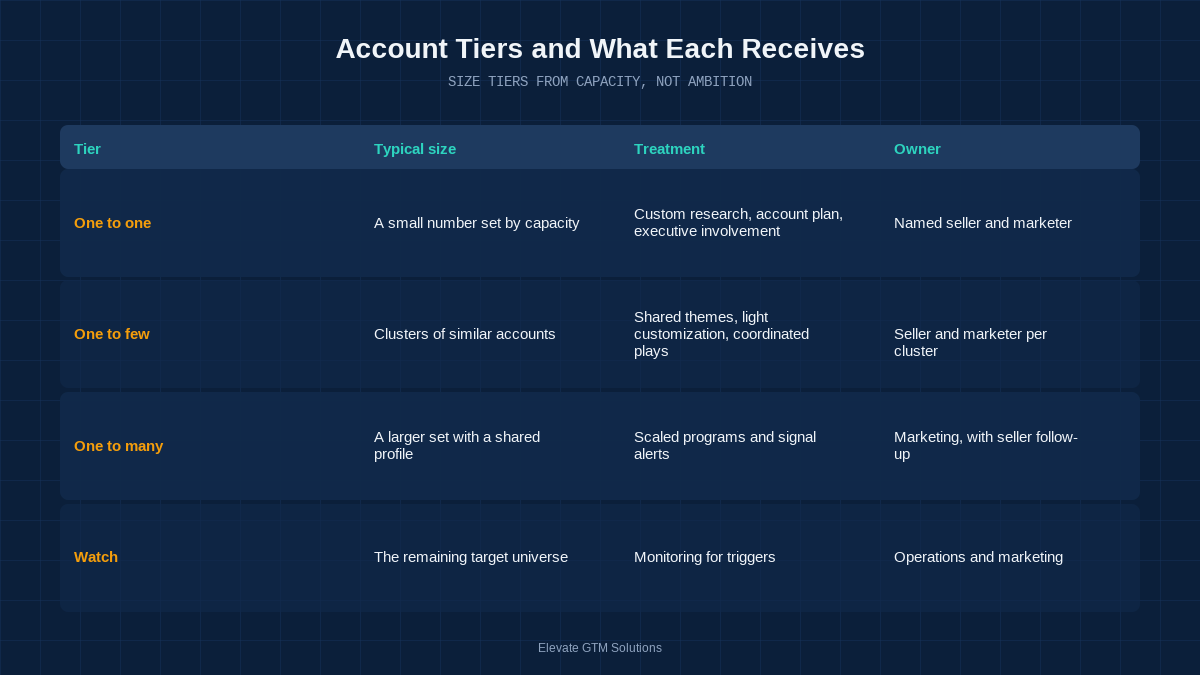
| One to one | A small number, set by capacity | Custom research, a written account plan, executive involvement, tailored content and a coordinated sales and marketing plan | A named seller and marketer |
| One to few | A modest number grouped in clusters of similar accounts | Cluster themes, shared content with some customization, coordinated plays, regular review | A seller and a marketer per cluster |
| One to many | A larger set sharing a profile | Scaled programs, programmatic advertising and email, signal alerts to sellers | Marketing, with seller follow-up on signals |
| Watch | The remaining target universe | Monitoring for triggers, brand content, no active outreach | Operations and marketing |
The labels vary between companies. What matters is that each tier has a defined treatment and an owner.
Sizing the tiers from capacity
Tier sizes should come from what your team can actually do.
| Step | Practice |
|---|---|
| 1. Estimate effort per account | How many hours per quarter does a good one-to-one plan take? A one-to-few cluster play? |
| 2. Count available hours | How many hours do named sellers and marketers have for this work? |
| 3. Divide | Hours available divided by hours per account gives a realistic count |
| 4. Round down | Capacity is rarely as large as hoped |
| 5. Review | Check after a quarter whether the plans were actually delivered |
An illustration with invented numbers
| Item | Illustrative value |
|---|---|
| Hours per one-to-one account per quarter, across sales and marketing | 30 |
| Hours available for one-to-one work per quarter | 300 |
| Realistic one-to-one count | 10 |
| Hours per one-to-few cluster per quarter | 60 |
| Hours available for clusters per quarter | 360 |
| Realistic clusters | 6, with perhaps 8 to 12 accounts each |
If your list of one-to-one accounts is much larger than capacity allows, the tier will exist on paper only.
Plays by tier
| Tier | Example plays |
|---|---|
| One to one | A research note about the account's situation, an introduction through a shared connection, an executive briefing, a tailored proposal outline, a customer reference conversation |
| One to few | A roundtable for a cluster, a cluster-specific case story, coordinated outreach to the buying group, a shared event |
| One to many | Targeted advertising with a specific message, triggered emails on engagement, alerts to sellers when signals appear |
| Watch | Brand content, community presence, trigger monitoring |
Document each play: goal, audience, content, owner, timing and measure. Messages should carry approved pillars with proof and avoid forbidden claims. Our guide to the GTM platform vs ABM platform covers tools for running plays.
Moving accounts between tiers
Tiers are not permanent.
| Move | Trigger | Practice |
|---|---|---|
| Up | New evidence of fit, a signal, a new relationship, a stronger business case | Request through a short form, reviewed at the monthly meeting |
| Down | Lost evidence of fit, no engagement after a fair period, a competitor lock-in | Review quarterly and move down with a reason |
| Out | Poor fit confirmed, customer status changed, a request to stop contact | Suppress across tools |
| Over | An account fits better in another segment | Reassign and record |
Cap the number of upward moves per quarter to protect capacity. If every account request to move up is approved, the top tier loses meaning.
Governance with sales and marketing
| Question | Practice |
|---|---|
| Who owns the list? | A named person in revenue operations or marketing, with sales co-owning the top tiers |
| Who approves tier changes? | A monthly review with sales and marketing leads |
| How are conflicts resolved? | Written rules for overlapping accounts and territories |
| How is the list shared? | One current list in the CRM, with the tier visible |
| How are definitions kept consistent? | A one-page definition of each tier and its treatment |
| How is it reviewed? | Monthly for movement, quarterly for criteria |
| How are exceptions handled? | A recorded exception with a reason and an end date |
Without shared ownership, marketing runs programs on one list while sales works another.
Measuring tiers
| Measure | What it tells you | Caution |
|---|---|---|
| Coverage of the right contacts per account | Whether plays can reach the buying group | Contacts must be accurate |
| Engagement by tier | Whether accounts respond to treatment | Interest is not intent |
| Meetings and opportunities by tier | Whether plays create conversations | Quality matters |
| Account progression through stages | Movement over time | Define stages |
| Win rate and cycle by tier | Whether tiers predict outcomes | Show counts |
| Average deal value by tier | Whether potential value was real | Outliers |
| Cost per engaged account and per opportunity by tier | Whether effort is efficient | Include people time |
| Retention and expansion by tier | Whether the best accounts stay and grow | Long lags |
Back-testing the tiers, with invented numbers
| Tier at first contact | Opportunities | Won | Win rate | Median cycle in days |
|---|---|---|---|---|
| One to one | 12 | 6 | 50 percent | 120 |
| One to few | 30 | 9 | 30 percent | 90 |
| One to many | 55 | 7 | 13 percent | 60 |
| Watch, later promoted | 10 | 1 | 10 percent | 70 |
If win rate does not fall as tier falls, or if the top tier shows no advantage, revisit the criteria. Small counts mean these are hints, not proof.
Building the account list, step by step
| Step | Practice |
|---|---|
| 1. Define the universe | Companies that match basic criteria such as industry, size range and region, taken from your ICP definition |
| 2. Collect the fields | Name, segment, size, number of sites or teams, current method if known, relationships, signals and owner |
| 3. Deduplicate | Choose the entity level you sell at, and merge parent and subsidiary records |
| 4. Score fit | Apply the ICP scorecard |
| 5. Estimate value | Use bands based on size and expected use |
| 6. Add strategic notes | Reference value, partner relationships, entry to a segment |
| 7. Check access | Known contacts and relationships |
| 8. Assign tiers | From the combined score, with exceptions recorded |
| 9. Assign owners | A seller and marketer for the top tiers |
| 10. Load into the CRM | One list, visible to everyone, with the tier as a field |
Fields worth having in the CRM
| Field | Purpose |
|---|---|
| Tier | One to one, one to few, one to many, watch |
| Cluster | For one-to-few accounts, the group they belong to |
| Fit score and date | Traceability |
| Value band | For prioritization and reporting |
| Strategic flag | With a note |
| Account owner and marketing owner | Accountability |
| Last tier review | Freshness |
| Exception reason | Transparency |
A one-to-one account plan
A top-tier account deserves a short written plan, reviewed regularly.
| Section | Content |
|---|---|
| Account and goal | What we want from this account in the next year |
| Situation | What we know about their business and the problem we can help with, with sources |
| Buying group | Names, roles, concerns, relationship strength and next step for each |
| Alternatives | What they use today and what else they might do |
| Value case | The impact in their terms, with evidence we may cite |
| Plays | Three to five planned actions with dates, such as an introduction, a research note, an executive briefing |
| Content | The pillars and proof most relevant to them |
| Risks | What could stop progress |
| Support needed | People from product, success or leadership |
| Measures | Engagement, meetings, progress and next review |
Keep it to one or two pages. A plan that is never reviewed is shelfware.
Designing a one-to-few cluster play
A cluster groups similar accounts so you can create relevant material once and use it with variations.
| Step | Practice |
|---|---|
| 1. Choose the cluster | Accounts that share an industry, a problem, a technology or a situation |
| 2. Write the theme | The shared problem and the point of view you offer |
| 3. Build the content | A short guide, a case story, a roundtable invitation, a comparison |
| 4. Add light customization | A relevant example or sentence per account |
| 5. Coordinate outreach | A seller and a marketer reach the buying group on the same theme |
| 6. Offer a useful next step | A conversation, a workshop or an assessment |
| 7. Measure | Engagement, meetings and progression for the cluster |
| 8. Learn | Update the theme from what you hear |
Clusters work when the shared theme is real. Forcing unlike accounts into one cluster produces generic messages.
Tiering for customer success and expansion
Tiering applies after the sale too.
| Tier | Customer treatment | Examples |
|---|---|---|
| Strategic | Named success owner, executive relationship, regular business reviews | Large or reference accounts |
| Core | Success manager with scheduled check-ins and adoption plans | Mid-sized customers |
| Scaled | Programmatic education, community and in-product guidance | Smaller customers |
| At risk | Extra attention regardless of size | Declining usage, a departed champion |
Use health signals and expansion potential to move customers between tiers, just as you do with prospects.
A tier governance meeting
Sixty minutes, monthly, with sales and marketing leads and operations.
| Time | Topic |
|---|---|
| 0 to 10 minutes | The numbers: accounts by tier, movement since last month |
| 10 to 25 minutes | Requests to move accounts up, with evidence |
| 25 to 35 minutes | Accounts to move down or out, with reasons |
| 35 to 45 minutes | Play performance by tier |
| 45 to 55 minutes | Capacity: are plans being delivered? |
| 55 to 60 minutes | Decisions and owners |
Record the decisions, and update the list the same day.
Scenarios and directions
| Situation | Direction to explore |
|---|---|
| A startup with a few hundred possible accounts | Two tiers: priority and the rest, with named owners for the priority list |
| A growth company with a long list and thin coverage | Size tiers from capacity and concentrate effort |
| A company with strategic reference accounts | A strategic flag with a defined review |
| A company with a partner-led motion | Tier partner-sourced accounts with the partner's plan |
| A company with expansion potential in customers | Tier customers as well as prospects |
| A company with a new segment | Place the segment's accounts on a watch list until evidence supports a higher tier |
Terms used in this guide
| Term | Meaning |
|---|---|
| Account tiering | Grouping accounts by the effort they deserve |
| One to one, one to few, one to many | Levels of customization in account-based programs |
| Watch list | Accounts monitored without active outreach |
| Cluster | A group of similar accounts treated with a shared theme |
| Potential value | Expected size of the relationship |
| Strategic importance | Value beyond direct revenue, such as reference or entry to a segment |
| Capacity | The effort the team can actually deliver |
Where AI helps and where it does not
| Task | How AI helps | Caution |
|---|---|---|
| Account research | Summarizes public information | Verify facts and sources |
| Enrichment | Fills missing fields | Errors spread, so sample |
| Cluster analysis | Groups similar accounts | Review the groupings |
| Signal monitoring | Flags events | Test relevance |
| Drafting account plans and messages | Produces first drafts | Review, and avoid unsettling personalization |
| Prioritization | Suggests ranking | Keep criteria explainable |
AI can produce an impressive account plan for any company. That does not make the account a good one to pursue. Fit and value come first.
Common mistakes
| Mistake | What happens | Fix |
|---|---|---|
| Too many top-tier accounts | Plans exist on paper only | Size from capacity |
| Tiering by company size alone | Big accounts that do not fit | Use fit and potential value |
| Mixing fit and intent | Hot but poor-fit accounts rise | Score separately |
| One list per team | Conflicting priorities | One shared list |
| No treatment defined | Tiers are labels only | Define plays and owners |
| Never moving accounts | The list goes stale | Review monthly and quarterly |
| Ignoring contacts and buying groups | Plans cannot reach decision makers | Map roles |
| No measurement by tier | No evidence tiers work | Back-test and track |
| Personalization that feels like surveillance | Loss of trust | Use public, relevant information |
A tiering template
| Field | Entry |
|---|---|
| Account | Name and segment |
| Fit score | From the ICP scorecard |
| Potential value band | From expected annual value |
| Strategic note | Reference value, entry to a segment or partner link |
| Access | Known relationships and contacts |
| Tier | One to one, one to few, one to many, watch |
| Owner | Seller and marketer, where applicable |
| Plays | Planned plays and dates |
| Signals | Recent events and notes |
| Last reviewed | Date |
| Next review | Date |
| Exceptions | Reasons for overriding the score |
A hypothetical example
This is an illustration, not a real company.
A company selling scheduling software to logistics operators had a target list of nine hundred accounts and a belief that all of them were priorities. Sellers worked whichever accounts felt promising, and marketing ran the same campaign to everyone. The head of revenue operations scored each account on fit, potential value, strategic importance and access, using the company's ICP scorecard and a simple value band based on the number of depots.
She estimated that the team could support about fifteen one-to-one accounts and six clusters of eight to ten accounts. She applied thresholds, and the resulting list had fourteen top accounts, fifty-five in clusters, four hundred and eighty in the scaled tier and the rest on a watch list. Sellers argued about three accounts, and she added them as recorded exceptions with end dates.
Each tier received a defined treatment. The top accounts received account plans and executive outreach. Clusters received themed roundtables. The scaled tier received targeted advertising and signal alerts. After two quarters, the team back-tested tiers against early outcomes and found that win rates were higher in the top two tiers, and that two accounts in the scaled tier had behaved like cluster accounts. She moved them up, moved four stalled top accounts down with reasons and kept the monthly review. Tiering had not made the accounts better. It had made the effort deliberate.
What to do this week
List your top fifty accounts and score them for fit, potential value, strategic importance and access. Estimate how many accounts your team can truly give custom attention to. Compare that number with the number you call top tier. Write what each tier will receive, and who owns each.
Questions teams ask about tiering
"Should every seller have the same mix of tiers?" Not necessarily. Match sellers to accounts by skill and relationships, and balance workload so no one has more top-tier accounts than they can serve.
"How do we handle accounts that sales loves and the model scores low?" Allow a recorded exception with an end date, and use patterns in exceptions to improve the model.
"Do we need to tell customers about tiers?" No. Tiers are internal planning. Treat everyone with respect.
"How do we tier partners?" Use criteria suited to partners, such as overlap with your ideal customers, reach and commitment, and a play for each tier.
"What if our top tier is too small to matter?" Check whether the criteria are too strict, whether value bands are realistic and whether a larger one-to-few tier would serve better.
"How often should the list be rebuilt?" Refresh the data on a schedule, review tier movement monthly and revisit criteria quarterly.
"Can AI build the list?" It can help find and enrich accounts. People should check fit and make tier decisions, with explainable criteria.
Quick reference
| Question | Short answer |
|---|---|
| What is tiering? | Matching effort to accounts by fit, value, strategy and access |
| How many tiers? | Three active tiers plus a watch list |
| What decides tier? | Mainly fit and potential value |
| What decides timing? | Signals |
| How to size tiers? | From capacity |
| How to check it works? | Back-test win rate, cycle and value by tier |
| What goes wrong? | Too many top accounts, mixed fit and intent, no defined treatment, a stale list |
In plain language
Tiering is an honest way of saying that you cannot treat every account the same. Choose criteria from evidence, score fit and potential value, decide how many accounts you can truly serve at each level and write down what each level receives and who owns it. Use signals to decide who to contact first. Move accounts as evidence changes, review the list monthly with sales and marketing together and check whether the tiers predict outcomes. Keep the top tier small enough that its plans exist in practice and not only on paper.
A second hypothetical: tiering customers for expansion
This is another invented illustration.
A software company had four hundred customers and three customer success managers. Expansion was uneven: some customers added teams on their own, and others never did. The head of customer success scored customers on fit with the ideal profile, expansion potential (the number of teams that could use the product), health signals and relationship strength, and grouped them into four tiers.
She found that forty customers accounted for most of the expansion potential, and gave them named owners and plans. About a hundred and twenty received scheduled adoption reviews, and the rest received programmatic education and in-product guidance. At-risk customers, defined by declining usage and champion changes, received extra attention at any size. After two quarters, expansion conversations started earlier in the top two tiers and fewer at-risk customers churned without warning. She also found that eight accounts scored low on potential but were strong references, and added a strategic flag with a review date.
The same logic that decides where to spend effort on prospects works for customers.
Mistakes specific to cluster plays
| Mistake | What happens | Fix |
|---|---|---|
| Clusters built only on industry | Accounts with different problems get the same message | Cluster by shared problem or situation |
| Too many clusters | The team cannot build content for each | Limit to what capacity supports |
| No owner per cluster | Plays stall | Name a seller and marketer |
| Theme written by marketing alone | Sellers do not recognize it | Co-write with sales using call evidence |
| Never retiring clusters | Stale themes | Review quarterly |
Final thoughts
Tiering is as much a discipline as a model. It forces teams to say which accounts matter most and to back that statement with plans and people. The model can be simple. What matters is that the criteria come from evidence, the treatment is defined, the top tier is small enough to serve and the list is reviewed together by sales and marketing. Done well, tiering turns a long list into a plan, and it shows quickly when the plan is wrong.
A checklist before launching tiers
- The ideal customer definition and fit scorecard exist and have been back-tested.
- Value bands are defined from realized contract values.
- Tier criteria and thresholds are written, with disqualifiers.
- Tier sizes were set from capacity, not ambition.
- Each tier has a defined treatment, owner and measure.
- Sales and marketing agreed on one list, held in the CRM.
- A monthly review and a quarterly criteria review are scheduled.
- Exceptions are recorded with reasons and end dates.
- Contact data for the top tiers has been checked for accuracy.
- Messaging for each tier uses approved pillars and proof.
A capacity worksheet
| Input | Your number |
|---|---|
| Sellers available for account plans | |
| Hours per seller per quarter for plans | |
| Marketers available | |
| Hours per marketer per quarter | |
| Hours per one-to-one account per quarter | |
| Hours per cluster per quarter | |
| Realistic one-to-one count | Hours available divided by hours per account, rounded down |
| Realistic clusters | Hours available divided by hours per cluster, rounded down |
Examples of exclusion criteria
| Exclusion | Reason |
|---|---|
| Requirements we cannot meet | Poor fit and low retention |
| Companies below a minimum size | Cost of serving exceeds value |
| Competitors and their close affiliates | Confidentiality and conflict |
| Existing customers, for new-business plays | Different owner and plan |
| Accounts that asked not to be contacted | Respect and compliance |
| Regions we cannot serve yet | Legal or support limits |
Write exclusions down and share them. They stop effort from leaking to accounts that will not become good customers.
Summary for busy leaders
If you remember three things: tiers should reflect fit and potential value, and be sized from the effort your team can actually deliver; each tier needs a written treatment and a named owner; and the list should be one shared list, reviewed monthly, with accounts moved on evidence. Keep fit separate from intent, back-test the tiers against outcomes and protect the top tier from becoming a wish list. If you cannot name the owner of a top-tier account's plan, it is not a top-tier account yet.
Questions to ask in the first review
- How many accounts did we place in each tier, and did capacity support that?
- Which top-tier accounts have a written plan and a date for the next action?
- Which accounts were promoted or demoted, and what evidence moved them?
- Where do sales and marketing still disagree about the list?
- What did the early results by tier tell us about the criteria?
Quick reference
| Question | Short answer |
|---|---|
| What decides a tier? | Fit and potential value, with strategic importance and access as modifiers |
| What decides timing? | Signals and events |
| How big should the top tier be? | As many as your team can truly give written plans to |
| What does each tier get? | A defined treatment and a named owner |
| How do accounts move? | On evidence, through a monthly review, with a cap on upward moves |
| How do you know it works? | Win rate, cycle and value improve as tier improves, with counts |
Key takeaways
- Account tiering groups accounts by how much effort they deserve, and matches programs, people and budget to each level.
- Decide tiers mainly by fit and potential value, and use timing to decide who to contact first.
- Size tiers from capacity, not from ambition.
- Define treatment and ownership for each tier, and share one list across sales and marketing.
- Move accounts between tiers with evidence, and back-test whether tiers predict outcomes.
- Use AI for research and drafting with review, and avoid intrusive personalization.
Where Elevate GTM Solutions fits
Elevate GTM Solutions is an AI-native GTM operating system for B2B companies. Its ICP and segmentation module defines the ideal customer, segments and exclusions that tiering starts from, its account-based marketing module supports planning which accounts to prioritize and what each tier needs, and its positioning and messaging modules provide the pillars and proof that plays carry. It supports workflows, weekly plans, task ownership and a recurring review rhythm for reviewing tier movement, and lets teams compare strategies for different segments side by side. It does not provide account data, intent signals or advertising, and it connects to HubSpot, Salesforce, LinkedIn, Notion and Claude for supported actions. A free first strategy build is available, and published plans, billed annually, are Enable at USD 499 per month and Growth at USD 1,499 per month, with custom Scale pricing.
For related reading, see ICP Scoring Framework, GTM Platform vs ABM Platform, Account-Based Marketing and What Is Elevate GTM Solutions?. See the pricing page, or request a demo.
Frequently Asked Questions
What is account tiering?
Grouping target accounts into levels, commonly three or four, by fit, potential value, strategic importance and access, and assigning each level a different intensity of effort, such as custom plans for the top tier and scaled programs for the base.
How many tiers should I use?
Often three active tiers plus a watch list. More than that is hard to run and explain.
How do I decide which accounts go in the top tier?
Score fit, potential value, strategic importance and access, apply thresholds, size the tier from your real capacity and record exceptions with reasons.
How many one-to-one accounts can a team support?
It depends on the effort each plan takes and the hours available. Estimate hours per account, count available hours, divide and round down, then check after a quarter.
What is the difference between fit and intent in tiering?
Fit shows whether an account matches the ideal customer. Intent and signals show timing. Use fit and value to set tiers and signals to decide who to contact first.
How do accounts move between tiers?
Upward on new evidence of fit, a signal or a relationship, through a monthly review, and downward when fit evidence weakens or engagement stalls, with reasons recorded and a cap on upward moves.
How do I measure whether tiering works?
Back-test: compare win rate, cycle length, deal value and retention by tier, show counts and check that outcomes improve with tier.
Who should own the tiered account list?
A named person in revenue operations or marketing, with sales co-owning the top tiers, one shared list in the CRM and a monthly review.
Is tiering only for account-based marketing?
No. Sales, partner and customer success teams use tiering to allocate effort too.
What are the common mistakes?
Too many top-tier accounts, tiering by size alone, mixing fit and intent, separate lists per team, undefined treatment, never moving accounts and no measurement by tier.
What fields should the CRM have for tiering?
Tier, cluster, fit score and date, value band, strategic flag, account owner and marketing owner, last tier review and an exception reason.
What goes in a one-to-one account plan?
The goal, situation, buying group, alternatives, value case, planned plays with dates, relevant content, risks, support needed and measures, in one or two pages reviewed regularly.
How do I design a one-to-few cluster play?
Choose accounts with a shared problem or situation, write the theme, build shared content, add light customization, coordinate outreach by a seller and a marketer, offer a useful next step and measure the cluster.
Can I tier existing customers?
Yes. Customer success teams use tiers such as strategic, core, scaled and at risk to allocate attention, with health signals and expansion potential moving customers between them.