
The GTM Maturity Model
A five level model for assessing how close a GTM motion actually is to running as a continuous, self-improving system, versus how close it feels based on how many tools are in the stack.
Published 2026-07-25
Ask a GTM leader how mature their operation is, and the answer usually comes from an intuitive, somewhat unreliable source: how many tools are in the stack, how big the RevOps team is, how sophisticated the dashboards look. None of those are bad signals exactly, but none of them directly measure the thing that actually matters, which is how close the underlying GTM motion is to running as a continuous, self-improving system rather than a collection of manually coordinated parts.
The GTM Maturity Model offers a more precise alternative: five levels, defined not by tool count or headcount, but by how signal, scoring, action, and feedback actually connect to each other. This piece defines each level specifically, shows how to assess where a real organization actually sits using five concrete dimensions, and addresses honestly why most companies sit lower on this model than their stack's apparent sophistication would suggest.
This distinction, between apparent sophistication and actual operating maturity, is the central problem this model is built to solve. A company running a dozen well regarded GTM tools can look, from the outside and often from the inside, considerably more mature than a company running a leaner stack with a genuinely closed feedback loop. Tool count and vendor reputation are visible and easy to compare. The actual connective architecture underneath, whether scoring updates continuously, whether action triggers automatically, whether outcomes feed back into future decisions, is invisible from a features list and requires a more deliberate, evidence based assessment to see accurately, which is exactly what this framework is designed to provide.
The Five Levels, Defined
Each level in this model represents a qualitatively different relationship between signal, decision, and action, not simply more of the same capability.
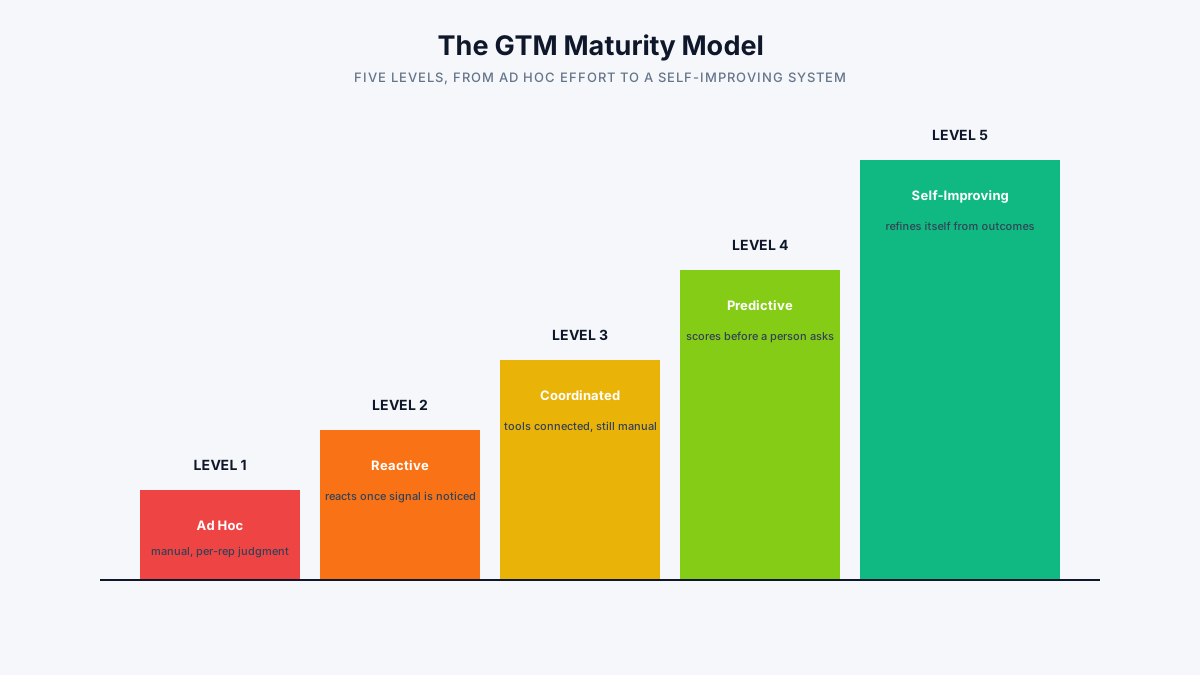
Level 1, Ad Hoc. Signal exists but is not systematically captured or used. Prioritization happens through individual judgment, whoever notices a signal first decides what to do about it, with no consistent scoring logic and no shared view of what matters across the team. Organizations at this level often have real, valuable signal available somewhere, a rep's personal notes, an individual's email inbox, a spreadsheet someone maintains privately, but that signal is not systematically captured or shared, which means its value depends entirely on whichever individual happens to hold it.
Level 2, Reactive. Signal gets captured, usually in the CRM, but scoring is static, a rule configured once and rarely revisited, and action happens manually, after a person notices and interprets what the score means. The system reacts to what already happened rather than continuously prioritizing what to do next. This is where a large share of organizations with a reasonably mature looking CRM implementation actually sit, since having consistent data capture is a real, meaningful improvement over Level 1, even though the scoring and action layers built on top of that data remain largely static and manually operated.
Level 3, Coordinated. Multiple signal sources are connected, scoring rules exist and get reviewed on a regular cadence, and action follows defined rules rather than pure individual judgment. Coordination between systems still depends heavily on manual configuration and periodic human review, but the pieces are genuinely connected rather than operating in isolation. This level typically corresponds to an organization that has invested meaningfully in RevOps process and discipline, with clear, documented rules for scoring and routing, even though those rules still require a person to notice when they have become outdated and manually update them.
Level 4, Predictive. Most relevant signal sources are unified continuously, scoring uses a model that updates more frequently than a quarterly review, and action triggers automatically based on defined thresholds rather than requiring a person to notice and manually initiate it. The system anticipates what deserves attention before a person would have caught it independently. This is the level at which the architectural distinction described elsewhere in this content series, between feature addition and genuine closed loop operation, becomes clearly visible, since reaching this level typically requires purpose built infrastructure rather than incremental process improvement alone.
Level 5, Self-Improving. Every relevant signal source feeds a continuously updating model, action executes automatically with risk based escalation to a person only when warranted, and outcomes feed back into the scoring model automatically, closing the loop described elsewhere in this content series as the Continuous GTM Loop. The system does not just react and predict, it improves its own judgment over time without requiring a person to notice a pattern and manually retrain it. Very few organizations currently operate fully at this level across their entire GTM motion, and it is worth treating this level as an aspirational, architecturally demanding target rather than a realistic near term expectation for most teams.
| Level | Name | Defining trait |
|---|---|---|
| 1 | Ad Hoc | No consistent scoring, prioritization by individual judgment |
| 2 | Reactive | Signal captured, static scoring, manual action after the fact |
| 3 | Coordinated | Multiple sources connected, rules reviewed periodically |
| 4 | Predictive | Continuous scoring, action triggers automatically |
| 5 | Self-Improving | Outcomes automatically refine the scoring model itself |
Why a Staged Maturity Model Is a Useful Shape
The five level, staged structure used here is not a new invention specific to GTM. It draws on a well established tradition of maturity models used across other operational disciplines, and understanding that tradition helps explain both why the staged shape works and where its known limitations lie.
The most direct ancestor is the Capability Maturity Model, developed originally for software engineering organizations, which similarly defines a small number of discrete levels, from an unpredictable, individually dependent process at the lowest level to a quantitatively managed, continuously improving process at the highest. That model, and the broader family of maturity models it inspired across IT operations, data management, and other technical disciplines, established a durable and still widely used pattern: assess a small number of independent dimensions, define what qualitatively distinguishes each level rather than simply measuring more of the same thing, and expect the jump between higher levels to require deeper, more architectural investment than the jump between lower ones.
This lineage matters for two reasons. First, it means the staged approach used here has already been tested extensively in adjacent disciplines and found useful enough to remain in active use decades after its original development, which is a reasonable basis for confidence in applying the same basic shape to GTM. Second, it means the known limitations of this style of model, an inherent tendency to oversimplify continuous progress into discrete jumps, a risk of self-assessment bias, a temptation to treat the highest level as automatically the right target for every organization, are also well documented in that broader tradition, and this piece addresses each of them directly in the objections section below rather than treating this framework as somehow exempt from limitations that apply to the entire family of models it belongs to.
The Five Dimensions Used to Assess Each Level
A single overall maturity label is useful shorthand, but it hides real variation, since most organizations are not uniformly at one level across every part of their GTM motion. A more precise assessment scores five specific dimensions independently.
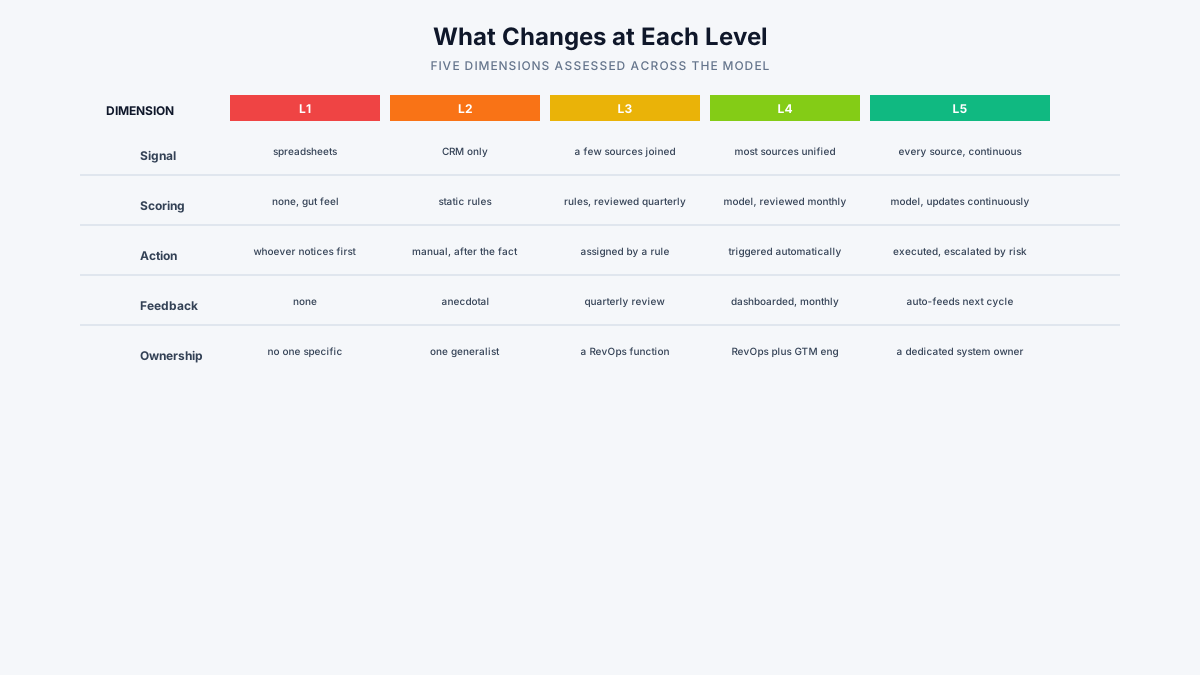
Signal asks how comprehensively and how continuously data actually gets captured, from spreadsheets and individual memory at Level 1, to every relevant source unified continuously at Level 5. Scoring asks how prioritization logic gets built and maintained, from pure gut feel, to static rules, to a model that updates itself continuously. Action asks what actually triggers a next step, from whoever happens to notice a signal first, to fully automated execution with risk based escalation. Feedback asks what happens to the outcome of a past action, from nothing at Level 1, to an automatic input into the next cycle's scoring at Level 5. Ownership asks who is actually accountable for the system working, from no one specifically, to a dedicated system owner whose job is explicitly to maintain and improve it.
Scoring these five dimensions independently, rather than assigning a single overall level, is more useful in practice because it is common, even typical, for an organization to be meaningfully ahead in one dimension while lagging in another. A team with excellent signal unification but no automated feedback loop is not accurately described by a single overall number, and the gap between its strongest and weakest dimension is often exactly where the most valuable next investment should go.
Comparing Two Levels Directly
It is useful to see two levels compared side by side across the same five dimensions, since the difference between levels is often more about which specific dimensions have advanced than about uniform progress across all of them.
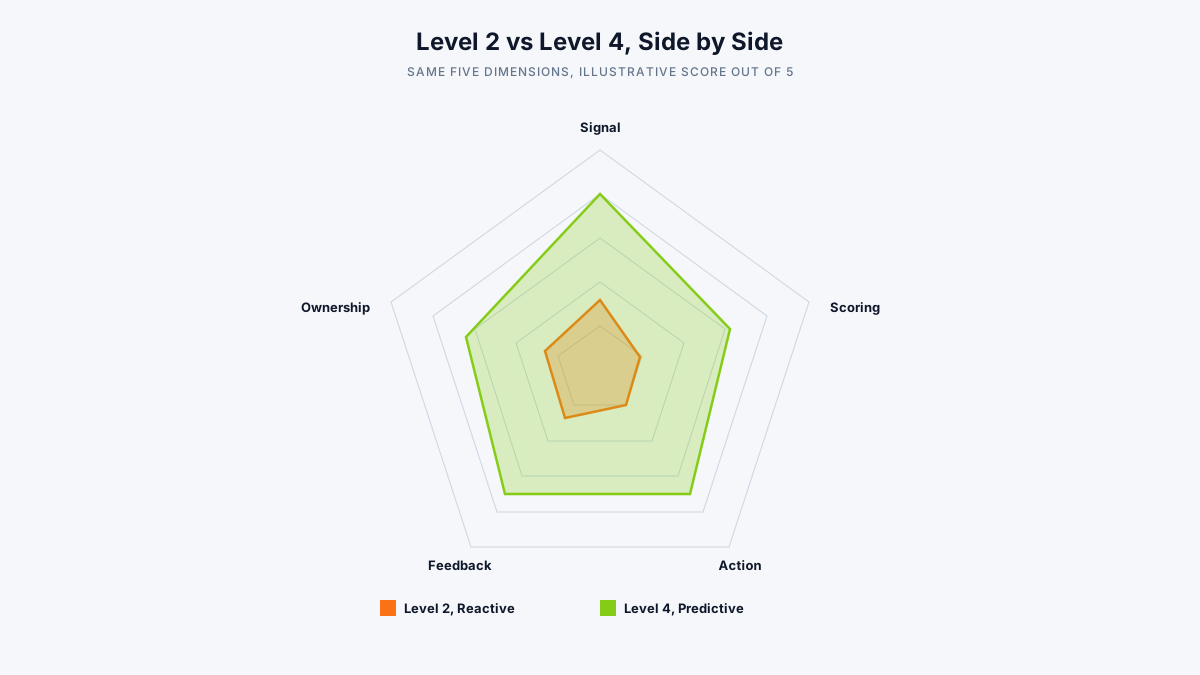
A Level 2 organization typically shows meaningfully constrained scores across all five dimensions, reflecting the reactive, largely manual character of that level. A Level 4 organization shows substantially stronger scores in signal, scoring, and action specifically, since those are the dimensions most directly tied to the predictive, automated capability that defines Level 4, while its feedback and ownership scores, though improved, often still lag behind the other three, since the fully closed feedback loop and dedicated system ownership that define Level 5 typically arrive later in an organization's maturity progression than the more immediately visible gains in signal and action.
Where Most Companies Actually Sit
It is worth being honest, using available evidence, about where most organizations actually fall on this model, since the distribution is considerably lower than most GTM leaders' informal self-assessment would suggest.
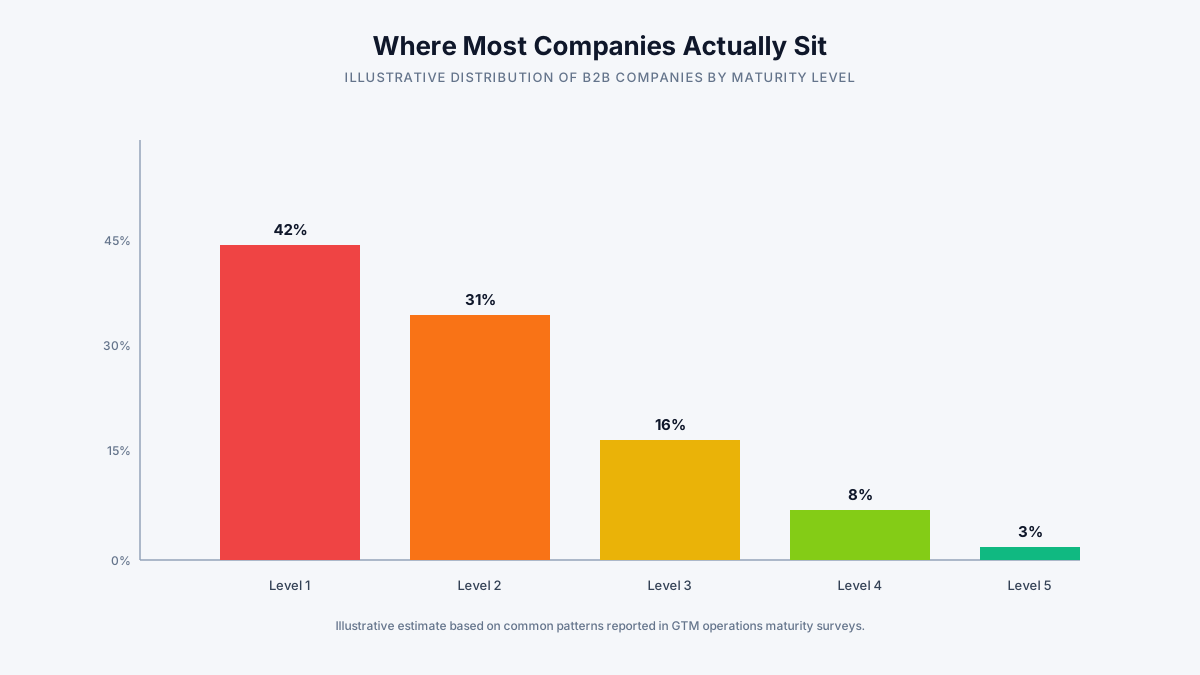
Illustrative patterns from GTM operations surveys and maturity assessments suggest that a large majority of B2B companies currently sit at Level 1 or Level 2, meaning prioritization still depends heavily on individual judgment or static, infrequently revisited scoring rules, despite often having a reasonably sophisticated looking tool stack. Only a small minority reach Level 4 or Level 5, where the system genuinely anticipates and, in the case of Level 5, improves its own judgment over time. This distribution is a useful corrective against the common assumption that adopting a modern, well regarded set of tools automatically implies a correspondingly modern GTM operating maturity, a gap this content series has examined in more depth elsewhere specifically in the context of individual point solutions.
Why Progress Slows at Higher Levels
The time required to advance from one level to the next is not uniform, and understanding why is useful for setting realistic expectations about the effort involved.
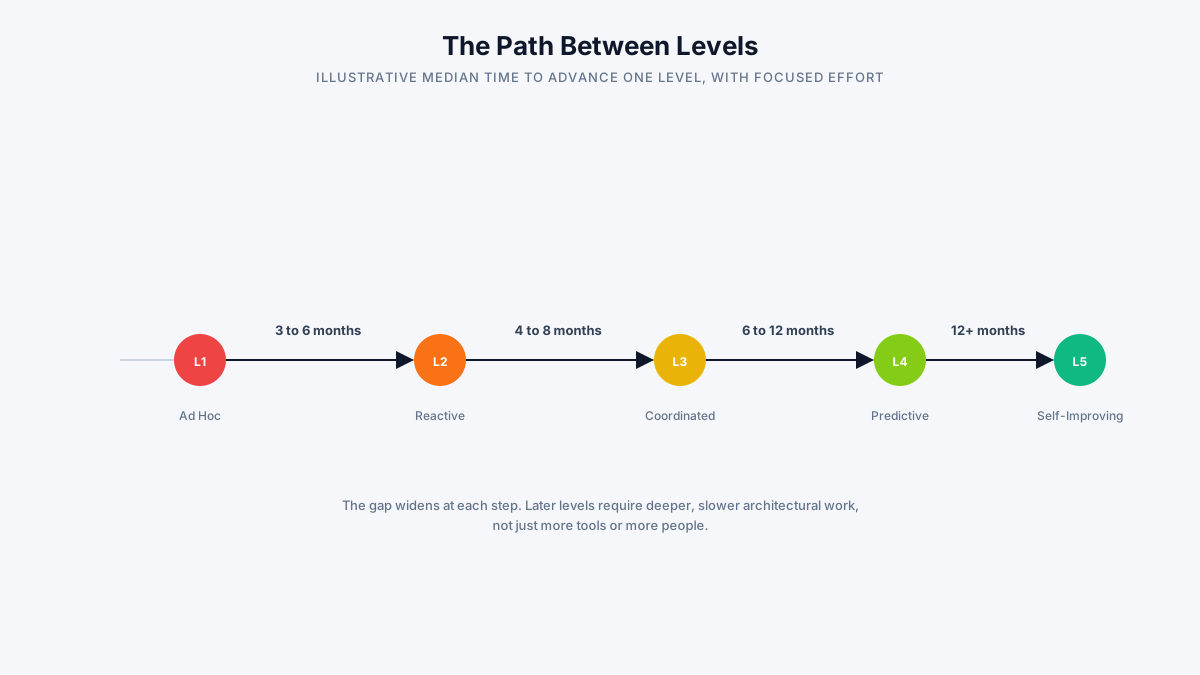
Advancing from Level 1 to Level 2 mostly requires consistent tool adoption and basic process discipline, a relatively fast, well understood kind of organizational change. Advancing from Level 3 to Level 4 requires a genuinely different kind of investment, building or adopting a system capable of continuous, automated scoring and triggered action, which is a deeper architectural undertaking than simply adding more disciplined process on top of existing tools. Advancing from Level 4 to Level 5 requires building the specific, automated feedback connection described elsewhere in this content series as the most commonly missing piece in current GTM systems, which is frequently the hardest single step in the entire model precisely because it requires the system to act on its own outcomes without a person manually interpreting and adjusting the logic each time.
This pattern, where progress slows and requires deeper investment at higher levels, is common across maturity models in other disciplines as well, and it is a useful expectation to set explicitly with any team using this framework: the last two levels are not simply more of the same effort that produced progress through the first three, they require a different, more architecturally significant kind of investment.
Objections and Counterarguments
"A five level model oversimplifies what is actually a much more continuous, gradual kind of progress." This is a fair critique of maturity models generally, and it applies here as much as to any comparable framework. The five levels are a useful, memorable simplification of what is, in reality, a more continuous spectrum, and an organization's honest position within a given level, closer to the level below or closer to the one above, often matters as much as which discrete level it gets assigned. The value of the discrete levels is primarily in giving teams a shared, memorable vocabulary for describing roughly where they stand and roughly what the next meaningful step looks like, not in claiming that real organizational progress moves in five clean, distinct jumps. This is the same limitation acknowledged directly in the discussion of the model's lineage earlier in this piece, and it is a known, accepted tradeoff of this entire family of frameworks rather than a flaw unique to this specific application of it.
"Assessing maturity across five independent dimensions is more complex and harder to communicate than a single overall score." This is true, and it is a deliberate tradeoff this framework makes in favor of accuracy over simplicity. A single overall score is easier to communicate but hides exactly the kind of uneven, dimension specific progress described earlier in this piece, which is often the most actionable information a maturity assessment can provide. Teams that want a single number for simpler external communication can reasonably average or otherwise combine the five dimension scores, but the internal planning value of this framework comes specifically from looking at the five dimensions separately rather than collapsing them prematurely, since a single number, once communicated, tends to obscure the dimension specific gaps that actually determine what a team should invest in next.
"This model assumes higher maturity is always the right goal, when in practice a lower level may be perfectly adequate for a smaller or simpler organization." This is an important qualification, consistent with a point made elsewhere in this content series regarding right sized coordination layers for earlier stage companies. Not every organization needs to reach Level 4 or Level 5, and a smaller team with modest signal complexity may be entirely well served operating at Level 2 or Level 3 indefinitely. This model is a tool for accurately assessing current position and understanding what a higher level would require, not a mandate that every organization should be racing toward Level 5 regardless of whether their actual signal complexity justifies that investment. A team should read the appropriate target level as a genuine, open question determined by their own circumstances, not as a predetermined answer this framework assumes in advance.
"Self-assessment against a model like this is unreliable, since organizations tend to overrate their own maturity." This is a well founded concern, and it is worth taking seriously as a limitation of how this framework typically gets applied in practice. The most reliable way to counter this tendency is to assess the five dimensions using specific, concrete evidence, a recent example of how a real signal actually got scored and acted on, rather than a general, favorable impression of the team's overall sophistication. A team assessing itself using vague, aspirational descriptions of its own capability is likely to overrate its position on this model in exactly the way this objection describes, while a team assessing itself against specific, recent, concrete examples tends to produce a considerably more accurate and often more humbling result. An external, less invested perspective, whether a consultant, an advisor, or simply a colleague from a different function without a stake in how the assessment turns out, can also meaningfully reduce this bias when available.
What This Means for Teams Using the Model
Assess each of the five dimensions independently and honestly, using specific recent examples. Resist the temptation to assign a single, favorable overall level based on general impression. For each dimension, identify a specific, recent example, how a particular signal actually got scored, how a particular action actually got triggered, and let that concrete evidence determine the score rather than an aspirational sense of the team's overall capability. A useful practice is running this assessment with more than one person independently scoring the same dimensions before comparing notes, since disagreement between assessors is often itself a useful signal about where the team's actual practice is less consistent than any single person assumed.
Identify your weakest dimension, and prioritize it over your strongest. Because overall maturity is often constrained more by the weakest dimension than by the average of all five, a team with strong signal capture but no automated feedback loop typically gains more from investing in feedback than from further strengthening signal, even though the signal investment might feel more familiar or comfortable to continue building on. This mirrors a general principle in systems thinking, that the weakest link in a connected system usually determines more of the overall outcome than strengthening an already strong link does, and it is worth resisting the natural organizational tendency to keep investing in whatever dimension already has visible momentum and an established owner.
Set realistic expectations for how long higher level progress actually takes. As described in this piece, the jump from Level 3 to Level 4, and especially from Level 4 to Level 5, requires deeper architectural investment than earlier progress did, and teams that plan for the same pace of progress across all five levels are likely to be disappointed by how much slower the later transitions feel, even when real, meaningful progress is genuinely being made. Communicating this explicitly to stakeholders and leadership in advance, rather than after progress has already slowed and needs explaining, tends to produce considerably more patience and support for the work required at the higher levels.
Use the model to set an intentional target, not just to measure current position. A maturity assessment is most useful when it feeds directly into a deliberate decision about which level actually makes sense as a target, given the organization's actual signal complexity and stage, rather than being used purely as a diagnostic exercise disconnected from any resulting action. A team that completes an honest five dimension assessment but does not translate it into a specific, prioritized set of next investments has done half the useful work this framework offers.
Revisit the assessment on a regular cadence, not as a one-time exercise. An organization's actual maturity, as measured by this model, tends to shift meaningfully over the course of a year or two, both because deliberate investment moves it forward and because organizational change, turnover, new tools, shifting priorities, can quietly erode gains that were made previously. Building a habit of reassessing the five dimensions periodically, using the same evidence based approach described above, is a more reliable way to track real progress than assuming a single assessment remains accurate indefinitely.
Where Elevate Fits on This Model
This framework is easiest to apply concretely against a real system, and Elevate GTM Solutions is a useful reference point for what Level 4 and Level 5 capability actually looks like in practice, since it was built from the outset around the higher end of this model rather than retrofitted toward it.
Elevate is the AI-native GTM platform and GTM operating system designed to help enterprises build, activate, and execute go-to-market strategy continuously, across markets, products, and industries. Mapped against the five dimensions in this piece, Elevate is built to unify GTM context continuously rather than through a periodic manual refresh, to keep strategy, positioning, and messaging logic current as market and competitive context changes rather than locked into a document from the last planning cycle, to tie execution directly to that strategy through structured GTM workflows rather than leaving execution to live in disconnected tools, and to keep visibility and operating logic connected so that insight about what is working feeds back into the next iteration of strategy rather than sitting in a static report.
This does not mean adopting Elevate automatically places an organization at Level 5 across every part of its GTM motion, since maturity, as this piece has argued throughout, is a function of how an organization actually uses a system, not just which system it has adopted. What a platform built around this architecture does provide is the underlying infrastructure that makes the higher levels of this model achievable without a large, custom internal engineering effort, which is the more common barrier this piece has identified for organizations trying to progress past Level 3 on their own.
Conclusion
The GTM Maturity Model offers a more precise way to answer a question most GTM leaders currently answer through instinct and stack sophistication rather than through direct evidence: how close is our GTM motion actually to running as a continuous, self-improving system. The five levels, assessed across five independent dimensions using specific, concrete evidence rather than general impression, tend to produce a considerably more accurate, and often more humbling, picture than most organizations' informal self-assessment would suggest.
This is not a framework designed to make every organization feel they need to race toward Level 5 regardless of actual need. It is a tool for accurate diagnosis, paired with a realistic understanding of what progress actually requires at each stage, deeper and more architecturally significant investment the higher a team climbs. The distribution data referenced earlier in this piece, showing the large majority of companies still concentrated at the first two levels, is worth sitting with directly rather than treating as a minor detail: a genuinely mature, closed loop GTM motion remains rare, not because most teams lack ambition or skill, but because the architecture required to reach it is a harder, later stage undertaking than the visible sophistication of a modern tool stack tends to suggest.
Used honestly, with concrete evidence rather than aspirational impression, this model gives a GTM team a shared, precise vocabulary for a question that most organizations have historically only been able to answer vaguely, and a clearer sense of exactly which specific dimension, not just which general direction, deserves the next investment. That specificity, knowing not just that more maturity would help but precisely which of five concrete dimensions is the actual constraint, is the practical value this framework is built to deliver.
Contents
Related Frameworks
GTM Frameworks
Explore frameworks for assessing, structuring, aligning, and evolving go-to-market.
View Framework Library →