
AI GTM Technology Landscape
A market map of the AI-native GTM technology stack: category sizing, vendor concentration, the consolidation wave, and where AI has genuinely re-platformed each category versus where it remains a bolt-on feature.
Published 2026-08-01
1. Executive Summary
The GTM technology market in 2026 is defined by a contradiction that shows up in nearly every source reviewed for this report: the number of available tools has never been higher, yet the market is consolidating faster than at any point in the past decade. More than 15,384 martech solutions now exist, a hundredfold increase since 2011, while the average marketer uses only 49 percent of the capability they have already purchased. Both facts are true simultaneously, and understanding why is the starting point for any GTM technology investment decision in 2026 and 2027. Every prior asset in this series has touched some part of this landscape from a different angle: Asset 1 established the pace of AI platform spending, Asset 2 examined the interoperability standards reshaping how these platforms connect, and Asset 3 quantified the functional adoption gaps within organizations using them. This asset is the missing piece that maps the supply side of that story, the vendor landscape itself.
This asset maps the GTM technology landscape as it actually stands today: what each major category is worth, who holds the concentrated share within it, how suites are absorbing point solutions faster than headline merger and acquisition counts suggest, and which categories have genuinely re-platformed around AI agents versus which remain built on pre-agentic architecture with AI features layered on top. The global martech market alone was valued at approximately 198 billion dollars in 2025 and is projected to more than double by the early 2030s, but that growth is increasingly concentrated in fewer, larger platforms rather than spread across the long tail of specialized point tools that drove the category's proliferation over the prior decade.
The core finding threaded throughout this report is that category boundaries themselves are dissolving. CRM platforms now routinely include marketing automation and sales engagement. Marketing automation platforms are absorbing customer data platform functionality. Customer platforms are absorbing support and service. This is not simply vendors adding features opportunistically; it reflects a structural shift in what buyers are willing to manage, and it has direct implications for how GTM leaders should evaluate build versus buy decisions, vendor consolidation opportunities, and where genuine AI-native architecture exists versus where it is a marketing claim layered onto a legacy platform.
The sections that follow build this map in stages. Section 3 establishes category-level market sizing and vendor concentration as they stand today. Section 4 details six trends explaining how and why the landscape is consolidating. Section 5 compares how Gartner, Chief Martec, and industry trackers each explain the consolidation wave from different vantage points. Section 6 presents Elevate's own synthesis, including a proprietary index of which categories have genuinely re-platformed around AI agents. Sections 7 through 9 translate that analysis into vendor evaluation recommendations, executive takeaways, and a forward view of where the next wave of category disruption is most likely to occur.
2. Research Methodology
This asset follows the same Elevate research asset formula used throughout this series: analyst research, public data, proprietary analysis, and Elevate perspective, applied consistently for comparability across all 30 assets.
Sources synthesized
This report draws on category-level market sizing from Fortune Business Insights and Gartner, martech tool census data from Chief Martec and MartechTribe's long-running Marketing Technology Landscape research, CRM market share data from IDC's Worldwide Semi-Annual Software Tracker, public earnings disclosures from Salesforce and HubSpot, sales engagement and revenue orchestration category data including Gartner's 2025 formalization of the Revenue Action Orchestration category, and vendor-level adoption and review data from G2 and 6sense used to cross-check market share claims against independently observed customer counts.
How Elevate adds value
Technology landscape mapping is a category where source data is unusually inconsistent, because different research firms draw category boundaries differently: one firm's marketing automation market size includes customer data platform functionality, while another treats them as separate categories entirely, and vendor-reported customer counts frequently do not distinguish between free-tier users and paying enterprise customers. Elevate's research platform uses a large language model, OpenAI's models, as its reasoning and synthesis engine, paired with a pattern intelligence layer built to reconcile exactly this kind of category-boundary inconsistency before presenting any comparative figure in this report.
Where this report presents a single category-level market size, that figure reflects Elevate's synthesis of the most comparable framing across multiple sources, with the underlying boundary decisions noted rather than hidden. Where sources diverge too substantially to reconcile responsibly, such as differing CRM market share figures that range from roughly 20 to 26 percent for the same vendor depending on how the underlying software category is scoped, this report presents the range and its likely explanation rather than selecting a single number that implies more precision than the underlying data supports.
3. Current Market Landscape
The scale of the GTM technology market varies enormously by category, and mapping that variation is the necessary first step before any consolidation or AI-native maturity analysis makes sense. Marketing automation and the broader martech suite category represent the largest pool of spend, with the global martech market estimated at approximately 198 billion dollars in 2025, growing toward more than 220 billion dollars in 2026 alone. CRM platforms represent a more concentrated but still substantial category, with the global CRM market estimated at roughly 126 billion dollars in 2026. Sales engagement and the newly formalized revenue orchestration category are smaller in absolute dollar terms but disproportionately important strategically, since this is the category where AI agent capability has advanced furthest, a pattern examined in more depth later in this report.
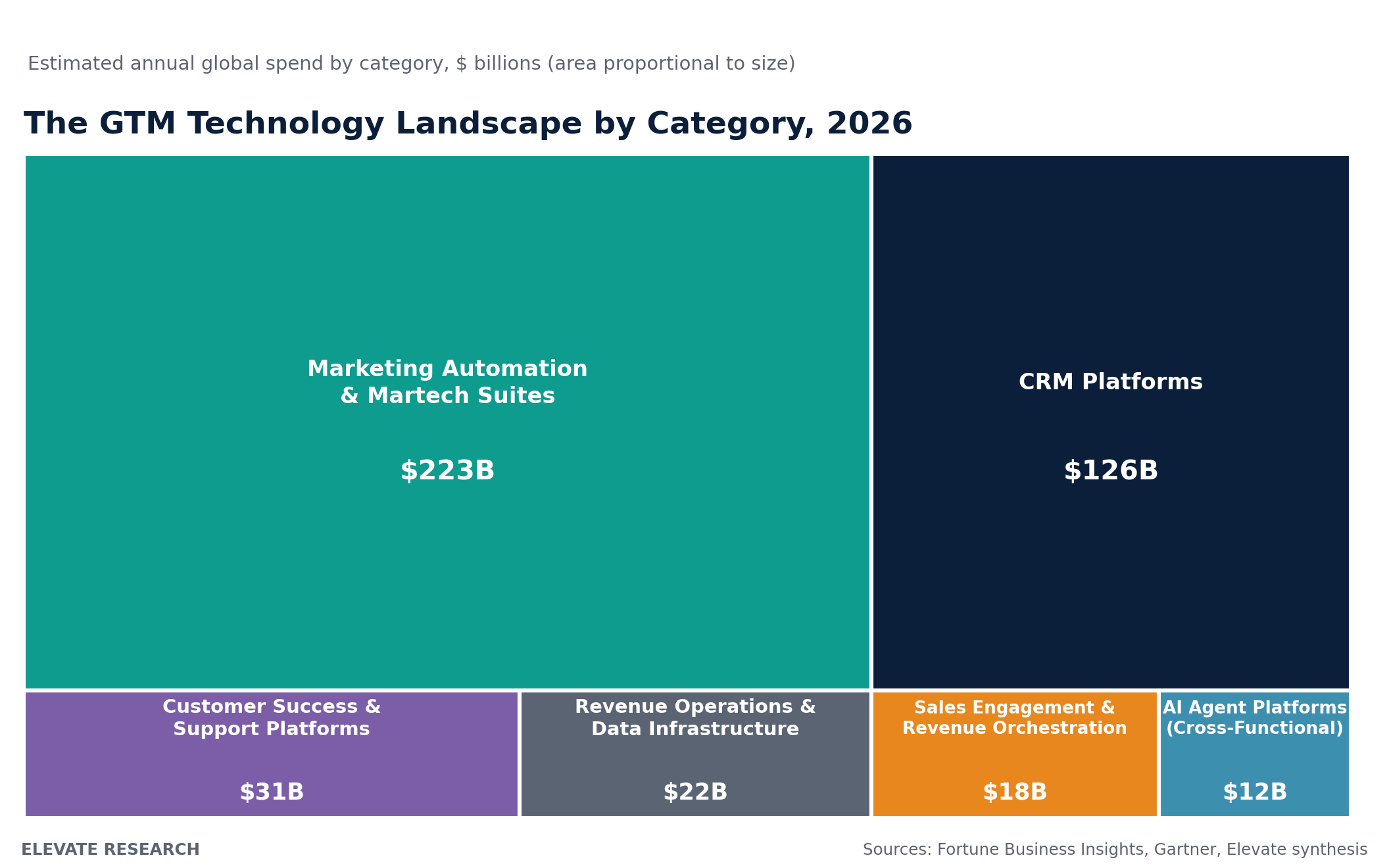 Figure 1. Estimated annual global spend by GTM technology category, 2026.
Within CRM specifically, the market is more concentrated than the broader martech category but still meaningfully fragmented beneath the leader. Salesforce holds approximately 20.7 percent share according to IDC's Worldwide Semi-Annual Software Tracker, a figure larger than its next four competitors combined, with Microsoft, HubSpot, Oracle, SAP, and Adobe each holding mid-single-digit share. HubSpot's growth trajectory is the more consequential story within this figure: the company reported 299,458 paying customers and 3.45 billion dollars in annual recurring revenue in its first quarter of 2026, with revenue up 23 percent year over year, making it the fastest-growing major CRM vendor by customer count even as its overall dollar share of the market remains in the mid-single digits.
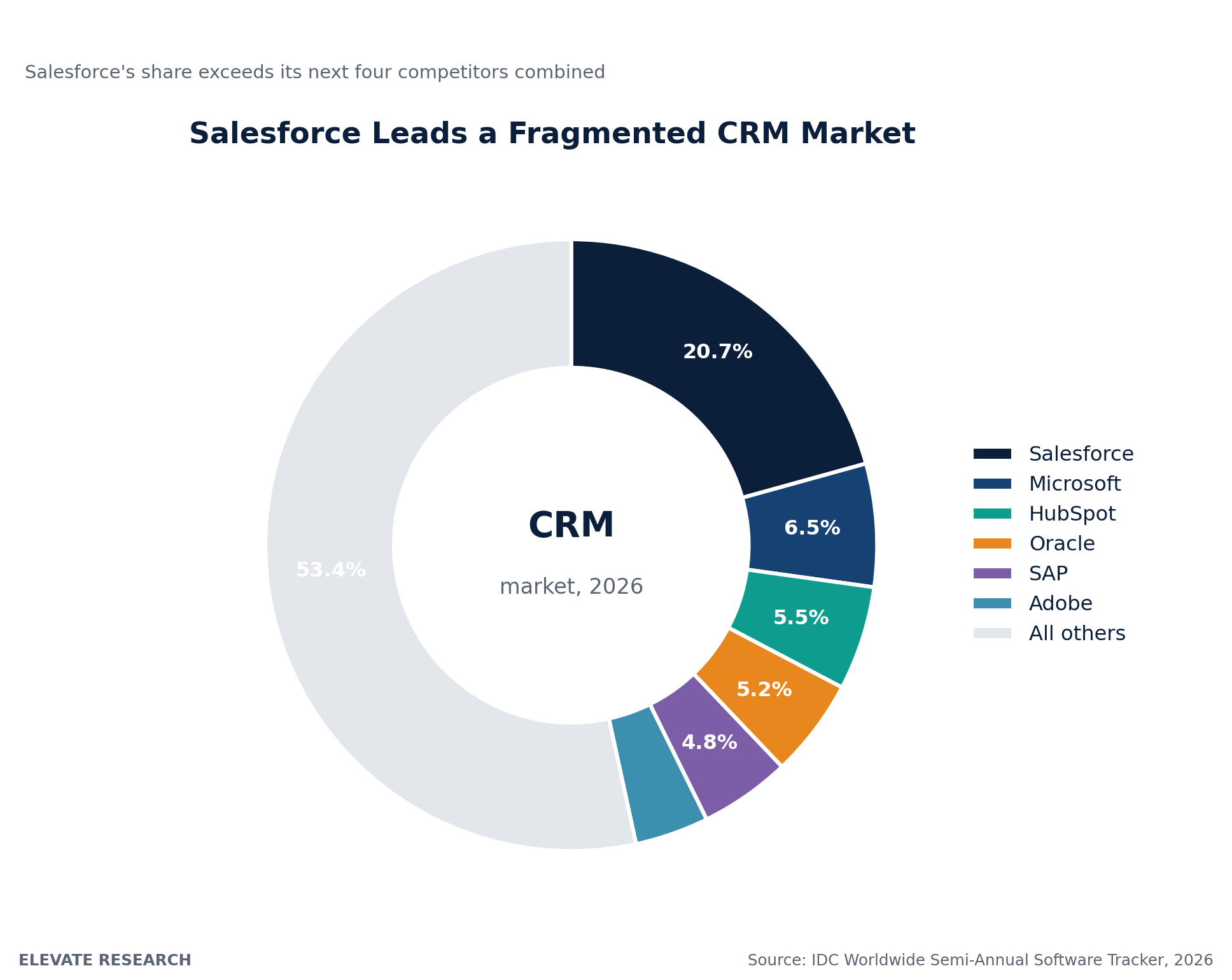 Figure 2. Global CRM market share by vendor, 2026.
15,384 martech solutions are available in 2026, a hundredfold increase since 2011, while average marketers use only 49 percent of the capability they have already purchased. Source: Chief Martec / MartechTribe Marketing Technology Landscape, Gartner, 2026
The sales engagement category has undergone the most significant structural redefinition of any GTM technology segment in the past eighteen months. Gartner formally established the Revenue Action Orchestration category in 2025, explicitly merging what had previously been treated as separate sales engagement platforms with conversation intelligence, forecasting, and deal management capability. This is not a cosmetic renaming; it reflects Gartner's own assessment that standalone sales engagement platforms, exemplified by the earlier generation of tools built primarily around multichannel outreach sequencing, are being absorbed into broader, AI-native revenue platforms faster than any other GTM technology category, a pattern this report returns to in Section 4.
Vendor pricing and go-to-market motion within each category tell a complementary story to the market sizing figures above. Entry-level, self-serve platforms with transparent, low-friction pricing continue to drive the broadest grassroots adoption within a category, evidenced by review-volume leaders in the sales engagement space achieving adoption momentum through free tiers and rapid self-serve deployment measured in days rather than the six to twelve month enterprise deployment timelines typical of platform-fee vendors. This bifurcation, fast, self-serve adoption at the entry tier and slower, higher-commitment adoption at the enterprise platform tier, is consistent across nearly every category examined in this report and shapes how a GTM buying committee should read vendor market share figures: a vendor with a large self-serve user base and a vendor with a smaller but more deeply embedded enterprise customer base are not directly comparable on user count alone.
Customer success and support platforms round out the category landscape with a distinct dynamic worth noting separately. This category has historically been treated as adjacent to, rather than integrated with, the core GTM motion, but the absorption pattern described throughout this report is pulling it steadily into the same consolidated suites as CRM and marketing automation. The practical effect for GTM leaders is that customer success technology decisions increasingly cannot be made in isolation from core CRM platform decisions, since the two are converging toward the same governed data layer inside the leading platform vendors' suites.
4. Key Trends
Six trends define how the GTM technology landscape is restructuring in 2026.
1. Suite absorption is outpacing what merger and acquisition data alone would suggest
Vendors including Salesforce, Adobe, and HubSpot continue to acquire specialized point tools to fill capability gaps, but the more consequential consolidation pattern is organic feature absorption rather than acquisition. CRM platforms now routinely ship native marketing automation, sales engagement, and enablement functionality; marketing automation platforms are expanding into customer data platform territory; and customer platforms are absorbing support and service capability. Industry tracking data notes that this pattern is easy to undercount from the outside, since an acquired tool's tracking signature can fade from independent technology detection within six to twelve months of a deal closing, well before the acquisition shows up in a headline count of martech mergers and acquisitions.
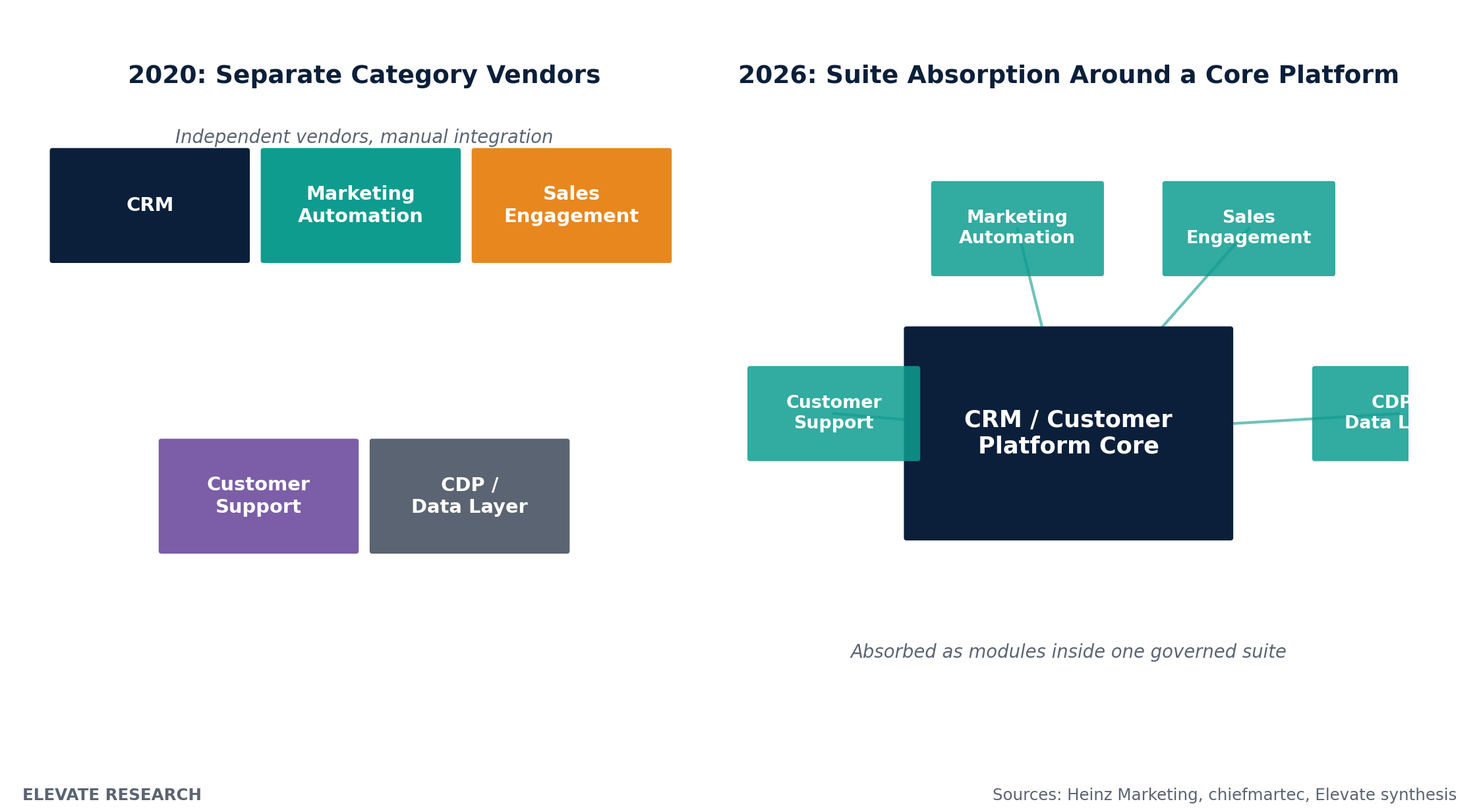 Figure 3. The shift from independently operated GTM technology categories to modules absorbed inside a governed suite core.
2. Tool proliferation and usable capability are moving in opposite directions
The martech landscape's growth to more than 15,384 solutions represents continued innovation at the long tail of the market, but the buyer-side experience of that growth is increasingly negative: average capability utilization has fallen from an estimated 58 percent in 2019 to roughly 33 percent in 2026, according to Gartner's own tracking. This is the clearest quantified evidence available that tool count and delivered value have decoupled, and it is the direct market condition driving the consolidation trend described above.
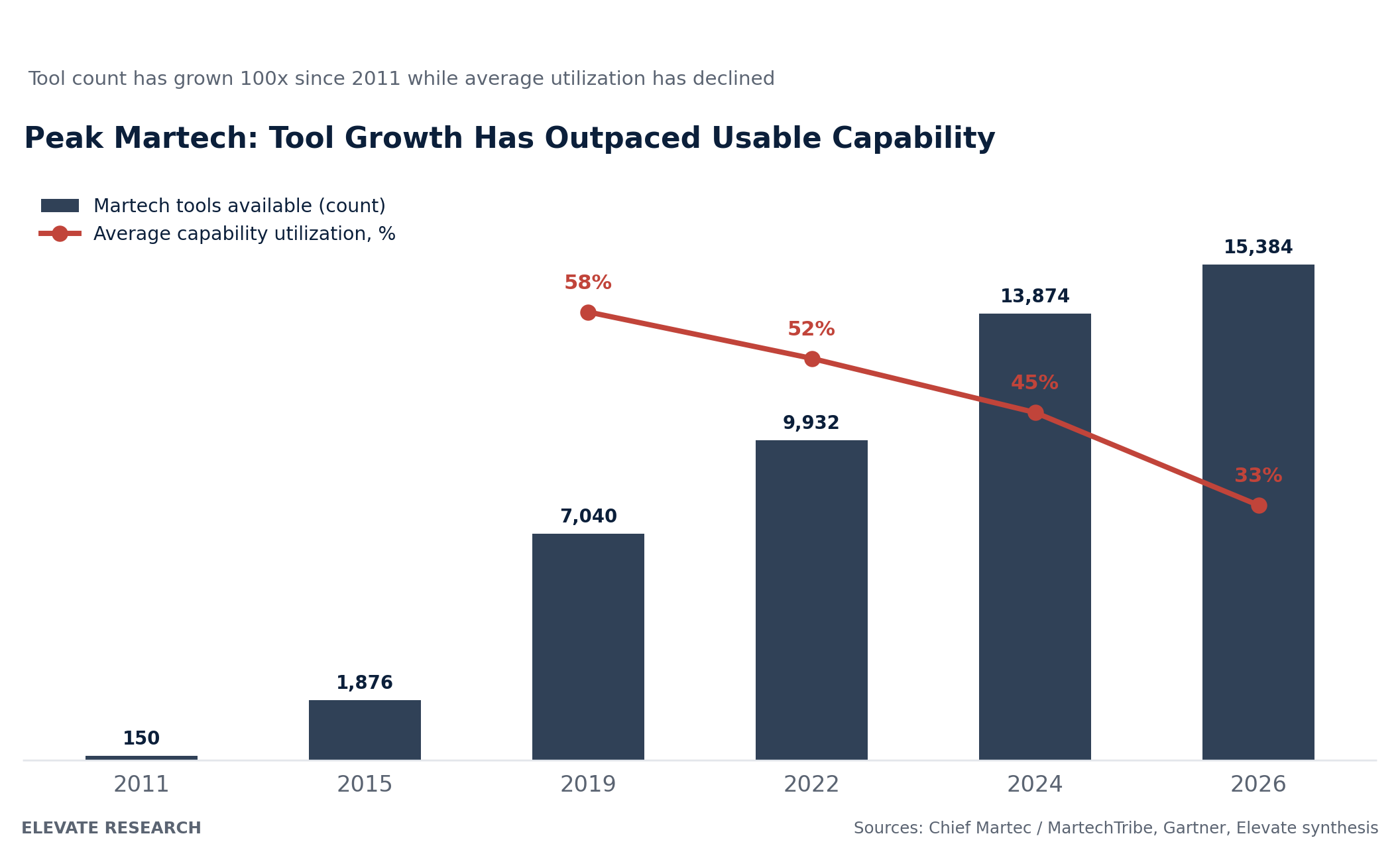 Figure 4. Martech tool count growth since 2011 alongside declining average capability utilization.
3. AI-native re-platforming is uneven across categories, not uniform
Sales engagement and revenue orchestration platforms have re-platformed around AI agents furthest and fastest, reflecting both the category's natural fit for agentic automation and the intensity of competitive pressure within a smaller, faster-moving vendor set. CRM platforms follow closely behind, driven by the scale of investment from Salesforce and Microsoft specifically. Revenue operations and data infrastructure tooling, along with content and creative tools, lag furthest behind, a pattern directly consistent with the functional adoption gap identified in Asset 3 of this series. This unevenness has a practical consequence for technology roadmapping: a GTM organization sequencing its own AI investment by category, rather than treating the whole stack as a single upgrade project, can prioritize categories where vendor capability is genuinely ready over categories where it is still catching up.
4. Composable and headless architecture is gaining share at the enterprise tier
Gartner estimates that 60 percent of B2B commerce organizations will have adopted composable architecture by 2026, up from 25 percent in 2023, with headless commerce adoption among B2B companies growing from 24 percent in 2022 to 46 percent in 2025. This trend runs in parallel with, rather than in contradiction to, the suite consolidation trend described above: enterprise buyers are consolidating vendor relationships while simultaneously demanding more modular, API-first architecture within those consolidated relationships, a combination that favors platforms built on genuinely composable technical foundations over platforms that have grown through acquisition-driven bundling alone.
5. Private equity is accelerating consolidation at the mid-market tier
Industry tracking identifies private equity firms as active acquirers of mid-market martech companies with predictable recurring revenue, a distinct consolidation mechanism from the platform-vendor suite absorption described above. This has the effect of removing viable standalone mid-market options from the competitive landscape even when no major platform vendor is directly involved, further concentrating the practical vendor choice set available to a typical GTM buying committee.
6. Category-specific vendor concentration is increasing even as overall tool count grows
The apparent contradiction between rising tool count and rising market concentration resolves once the tool count figure is understood correctly: the vast majority of the more than 15,000 tracked martech solutions serve narrow, long-tail use cases with minimal individual market share, while the categories that matter most for GTM buying decisions, CRM, marketing automation suites, and revenue orchestration platforms specifically, show increasing concentration among a handful of leading vendors even as the long tail continues to grow.
7. The gap between category leaders and fast-follower challengers is widening, not narrowing
Within nearly every category examined in this report, the pattern is the same: a small number of leading vendors, typically the ones investing most aggressively in genuine agentic re-platforming, are pulling away from a larger group of challengers still competing primarily on price or feature parity. This mirrors the broader AI leaders-versus-laggards gap identified in Asset 1 of this series at the level of individual companies, now visible at the level of vendors within a technology category. For GTM buyers, this means the cost of choosing a lagging vendor within a category is no longer just a near-term feature gap; it is increasingly a bet that the vendor can close a widening architectural gap against better-capitalized, faster-moving category leaders.
5. Analyst Perspectives
The major research firms and industry trackers reviewed for this report largely agree on the direction of consolidation while offering different explanations for its underlying cause.
Gartner's own utilization research provides the most direct evidence for why consolidation is occurring: buyers are not abandoning point tools because those tools lack capability, but because they have more capability than most organizations can operationally absorb, evidenced by the 49 percent average utilization figure. Gartner's parallel formalization of the Revenue Action Orchestration category in 2025 is itself a piece of analyst-market evidence, since analyst firms generally only formalize a new category once vendor and buyer behavior has already shifted enough to make the previous category boundary obsolete.
Chief Martec's long-running Marketing Technology Landscape research, the most established longitudinal tracker of martech tool count, frames 2026 explicitly as a possible inflection point, describing it as "peak martech achieved, maybe" while noting that continued tool-count growth does not contradict consolidation at the level that matters most to enterprise buyers. Its research emphasizes that AI is reshaping the landscape less through outright category elimination and more through a shift in what context engineering requires: the quality of an AI-native GTM experience depends less on model capability alone and more on what enterprise context, tools, and governed data an agent can actually access, a finding that echoes the unified context layer argument introduced in Asset 1 of this series from an entirely independent research tradition.
Industry commentary tracking martech mergers and acquisitions adds a methodological caution directly relevant to how this report's own consolidation claims should be read: headline acquisition counts understate real consolidation, because acquired tools continue to appear in landscape graphics and technology detection crawls for six to twelve months after a deal closes, while their independent commercial and technical identity has already been absorbed into the acquiring platform. Any reader benchmarking their own vendor landscape against a public martech acquisition tracker should treat that tracker as a lagging indicator of consolidation that has already happened, not a real-time signal.
Taken together, these perspectives describe a market that is easy to misread from any single vantage point. Reading only the tool-count data suggests a market still expanding without limit. Reading only the CRM concentration data suggests a market already dominated by one or two winners. Reading only the acquisition tracker data suggests consolidation is slower than it actually is. The accurate picture, and the one this report's synthesis in Section 6 builds on, requires holding all three data sets simultaneously: continued innovation at the long tail, increasing concentration in the categories that matter most, and a pace of real consolidation that outstrips what any single public tracking mechanism captures on its own.
6. Elevate Analysis
The individual market-sizing and consolidation data points reviewed above are, on their own, a description of a market. What they do not do on their own is tell a GTM buyer what to actually do with a technology budget in 2027. Elevate's synthesis is built around that translation.
The market trend: buyers are consolidating around governed context, not around vendor size alone
Reading the consolidation data in this report alongside the interoperability trend identified in Asset 2 of this series surfaces a pattern that is easy to miss if either data set is read in isolation: the vendors winning the consolidation wave are not simply the largest incumbents by revenue, they are the vendors that can credibly offer a governed, shared context layer across multiple previously separate categories. Salesforce's and HubSpot's growth in this report's CRM data is driven substantially by their ability to absorb marketing automation and sales engagement functionality into a single governed data model, not merely by brand recognition or sales force scale.
ELEVATE PERSPECTIVE This reframes the build versus buy and vendor consolidation decision most GTM leaders are currently facing. The question worth asking in a 2027 technology planning cycle is not "which vendor has the most features" or even "which vendor is largest," but "which vendor's context layer will still be the one my future AI agents depend on in three years." A consolidation decision made purely on feature checklist or price in 2026 risks locking an organization into a platform whose context layer becomes a constraint precisely as agentic capability across the wider GTM stack matures.
Why the AI-native maturity gap by category should change vendor evaluation criteria
Elevate's pattern intelligence synthesis of the category-level AI-native maturity data in this report, cross-referenced against the functional adoption findings in Asset 3 of this series, surfaces a specific evaluation risk: because sales engagement and CRM platforms have re-platformed around AI furthest, GTM buying committees evaluating those categories are more likely to be comparing genuinely AI-native architecture across vendors. In revenue operations, data infrastructure, and content tooling, however, a materially larger share of vendor AI marketing claims reflect features added on top of pre-agentic architecture rather than genuine re-platforming, meaning the evaluation bar buying committees apply needs to be substantially more rigorous in these lagging categories, where the gap between AI marketing claims and AI architectural reality is widest.
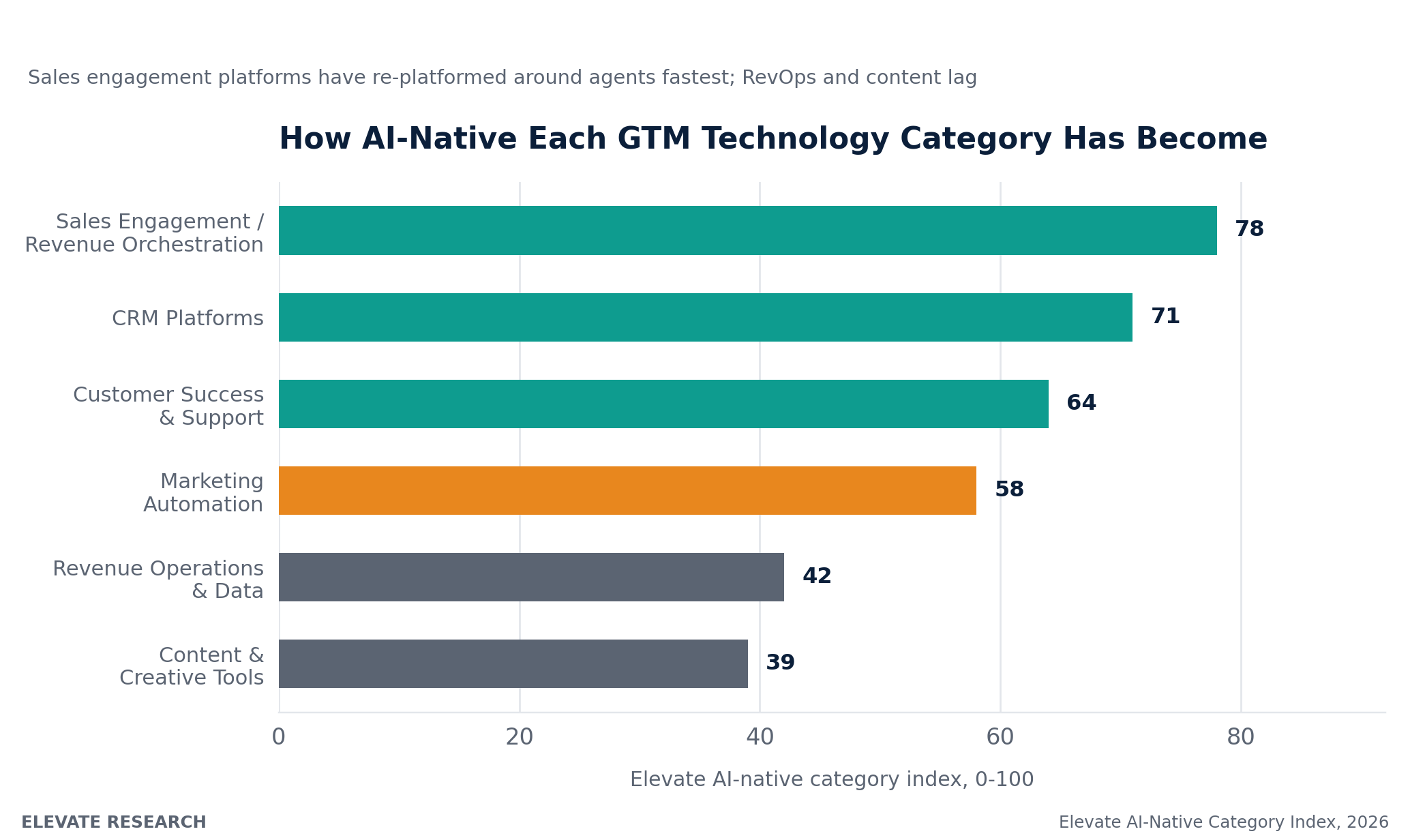 Figure 5. Elevate's AI-native category index, scoring each major GTM technology category on genuine agentic re-platforming versus feature-layer AI additions.
Why the utilization gap is a governance finding, not just a procurement finding
The 49 percent average capability utilization figure central to this report's consolidation narrative is typically discussed as a procurement or vendor management issue. Elevate's synthesis, cross-referencing this figure against the governance and data-readiness findings from Asset 1 and Asset 3 of this series, treats it as a governance finding instead: an organization that cannot operationally absorb the capability it has already purchased is very unlikely to have the data foundation and governance maturity required to deploy AI agents responsibly on top of that same underutilized stack. The consolidation decision and the AI governance decision are, in practice, the same decision viewed from two different angles, which is why this report's recommendations in the next section treat them as a single workstream rather than two sequential projects.
What the private equity consolidation pattern signals for mid-market buyers
A further pattern worth naming explicitly concerns the mid-market tier specifically. Elevate's pattern intelligence layer cross-referenced private equity acquisition activity in the martech mid-market against the broader platform-vendor suite absorption pattern described in Section 4, and found the two mechanisms are converging on the same outcome through different paths: platform vendors absorb capability through direct feature development and large-scale acquisition, while private equity firms consolidate mid-market point tools into fewer, better-capitalized rollups with predictable recurring revenue. For a mid-market GTM buyer, this means the standalone point-tool option that looks viable in a 2026 vendor evaluation carries a meaningfully higher risk of ownership change, pricing change, or roadmap disruption within a two to three year horizon than the same evaluation would have carried five years ago, a risk factor that deserves explicit weight in vendor selection criteria for organizations without the scale to influence a much larger platform vendor's roadmap.
7. Strategic Recommendations
Elevate recommends five actions for GTM leaders using this asset's landscape data to plan technology consolidation and vendor selection through 2027.
1. Audit utilization before adding any new category to the stack
With average capability utilization at 49 percent, the highest-return technology action available to most GTM organizations in 2026 is not a new purchase but a utilization audit of the stack already in place. Identify unused capability inside existing platforms before evaluating any new point solution, since the data in this report suggests the capability gap is more often an adoption and enablement problem than a genuine capability gap.
2. Evaluate vendors on context layer portability, not feature count alone
Consistent with the Elevate Perspective in Section 6, vendor evaluation criteria for 2027 technology decisions should explicitly weight how portable and governed a vendor's context layer is, including interoperability standard support as introduced in Asset 2 of this series, rather than defaulting to a feature checklist comparison that treats every AI capability claim as equally credible.
3. Apply a higher evaluation bar in lagging AI-native categories
Since revenue operations, data infrastructure, and content tooling show the widest gap between AI marketing claims and genuine architectural re-platforming, GTM buying committees evaluating vendors in these categories should request specific technical evidence of agentic architecture, not simply feature demonstrations, before treating AI capability claims as comparable to those in more AI-native categories like sales engagement.
4. Treat consolidation and governance as a single workstream
Given the direct link identified in Section 6 between underutilized stack capacity and governance immaturity, GTM leaders should not sequence stack consolidation and AI governance investment as separate projects. A consolidation initiative that does not simultaneously address the governance gaps identified in Asset 1 of this series is likely to reproduce the same underutilization pattern on a smaller, newly consolidated stack.
5. Track composable architecture adoption as a leading indicator, not a contradiction
Rather than treating composable, headless architecture adoption as evidence against the consolidation trend, GTM leaders should read the two trends together: enterprise buyers are consolidating vendor relationships while demanding more modular architecture within them. Vendor selection should favor platforms built on genuinely composable technical foundations, since these are the platforms most likely to support both consolidation and future flexibility simultaneously. For mid-market organizations specifically, factor private equity ownership risk explicitly into point-tool vendor evaluation, weighting platform-native or well-capitalized independent vendors more heavily than smaller point tools with uncertain ownership stability over a multi-year contract horizon.
ELEVATE PERSPECTIVE The single most common mistake Elevate's pattern intelligence synthesis surfaces across the sources reviewed for this report is treating technology consolidation as a cost-cutting exercise measured in vendor count reduction alone. The organizations most likely to benefit from the consolidation wave described throughout this report are the ones treating it as a governance and context-architecture decision, where reducing vendor count is a byproduct of building a more trustworthy, unified stack rather than the primary goal itself.
8. Executive Takeaways
- Tool proliferation and usable value have decoupled: More than 15,384 martech solutions exist, a hundredfold increase since 2011, while average capability utilization has fallen to roughly 33 to 49 percent depending on the measure used.
- CRM remains concentrated but not dominated: Salesforce holds approximately 20.7 percent global CRM market share, larger than its next four competitors combined, while HubSpot is the fastest-growing major vendor by customer count.
- Sales engagement has been formally redefined: Gartner's 2025 formalization of the Revenue Action Orchestration category confirms that standalone sales engagement platforms are being absorbed into broader, AI-native revenue platforms faster than any other GTM category.
- AI-native re-platforming is uneven: Sales engagement and CRM have re-platformed around agents furthest; revenue operations, data infrastructure, and content tooling lag significantly behind, consistent with the functional adoption gap identified in Asset 3 of this series.
- Consolidation is happening faster than acquisition headlines suggest: Organic feature absorption inside CRM and marketing automation suites, combined with private equity roll-up activity at the mid-market tier, is consolidating the practical vendor choice set faster than public merger and acquisition tracking alone would indicate.
- Composable architecture and consolidation are not contradictory: Enterprise buyers are simultaneously consolidating vendor relationships and demanding more modular, API-first architecture within those consolidated platforms.
9. Future Outlook
Based on the landscape data synthesized in this report, Elevate expects three specific developments to define the GTM technology market between now and 2028.
First, the gap between AI-native and AI-augmented platforms will become the primary axis of competitive differentiation within each GTM technology category, replacing feature count as the dominant evaluation criterion. As every major vendor adds some form of AI capability, the meaningful distinction buying committees will need to learn to evaluate is whether that capability reflects genuine agentic re-platforming, as seen furthest along in sales engagement and CRM, or a feature layer added to pre-agentic architecture, still common in revenue operations, data infrastructure, and content tooling.
Second, the categories currently lagging in AI-native maturity are the most likely sites of the next wave of significant consolidation activity, precisely because the gap between AI marketing claims and architectural reality in these categories creates an opening for either incumbent re-platforming or new entrant disruption. Revenue operations and data infrastructure tooling in particular sit at the intersection of two trends examined throughout this series: the functional adoption gap identified in Asset 3, and the category-level AI-native maturity gap identified in this report, making this category a plausible candidate for the most consequential vendor landscape shift over the next 24 months.
Third, the utilization gap identified in this report is likely to become a more explicit line item in technology renewal and procurement conversations, as finance and procurement functions increasingly ask GTM leaders to justify continued spend on underutilized platform capability before approving new category additions. This shifts negotiating leverage in vendor renewal conversations toward buyers who can demonstrate a clear utilization and governance plan, and away from buyers renewing primarily on feature-comparison grounds.
Fourth, the widening gap between category leaders and challengers identified in Section 4 is likely to accelerate a wave of vendor exits and forced consolidation among mid-tier vendors that can neither match the re-platforming pace of category leaders nor offer the price advantage of long-tail point tools. GTM leaders currently working with a mid-tier vendor in a category showing early signs of this dynamic, particularly revenue operations and data infrastructure tooling given the maturity gap identified in this report, should build contingency planning into their 2027 technology roadmap rather than assuming vendor stability by default.
The organizations that read this report's landscape data correctly will treat vendor consolidation not as a cost exercise to be delegated to procurement, but as a governance and context-architecture decision central to whether the AI investment described throughout this series actually compounds. Subsequent assets in this series examine specific dimensions of this landscape in more depth, including AI agents in revenue organizations, GTM technology investment trends, and the specific benchmarks GTM leaders should use to evaluate execution against this evolving technology landscape.
10. References
- Fortune Business Insights. MarTech Market Size, Share, Growth, Trends, 2026 to 2034. Fortune Business Insights, 2026.
- Chief Martec / MartechTribe. 2026 Marketing Technology Landscape Supergraphic. chiefmartec.com, May 2026.
- Gartner. Martech capability utilization research and formalization of the Revenue Action Orchestration category. Gartner Research, 2025 to 2026.
- IDC. Worldwide Semi-Annual Software Tracker, CRM market share data. IDC Research, 2026.
- Salesforce and HubSpot. Q1 2026 and FY2026 earnings disclosures, including customer counts and annual recurring revenue figures. Company investor relations, 2026.
- Gartner. Composable and headless B2B commerce architecture adoption forecasts. Gartner Research, 2025.
- Industry martech acquisition and private equity consolidation tracking, including technology detection methodology notes. TechnologyChecker.io and related industry trackers, 2026.
- G2 and 6sense. Vendor review volume and independently observed customer count data used to cross-check market share claims. 2026.
- Elevate Research. GTM Technology Category Sizing and AI-Native Category Index, proprietary frameworks derived from Elevate's pattern intelligence synthesis of the sources cited above. Elevate Research, 2026.
Contents
Related Research
GTM Research
Explore research, benchmarks, technology landscapes, and perspectives on the evolution of go-to-market.
View Research Library →