
The Future of AI in Go-to-Market
Where agentic AI, autonomous buying, and interoperable revenue systems are taking marketing, sales, and customer success between now and 2030.
Published 2026-08-01
1. Executive Summary
If the first asset in this series established where AI-native go to market stands today, this one asks a harder question: where is it actually heading, and how fast. The honest answer, based on the research synthesized here, is that most revenue leaders are underestimating both the speed and the structural depth of the shift already underway.
Two forecasts anchor the scale of what is coming. Gartner projects that by 2028, 90 percent of B2B buying will be intermediated by AI agents, routing more than 15 trillion dollars in B2B spend through machine-to-machine exchanges rather than human negotiation. McKinsey, working from a different angle, estimates that AI agents and robots could unlock roughly 2.9 trillion dollars in annual US economic value by 2030, but only for organizations that redesign workflows around human-agent partnership rather than simply automating existing tasks in place. Read together, these two numbers describe the same transition from two sides: the buyer side, where autonomous agents are taking over discovery, evaluation, and negotiation, and the seller side, where the work of go to market itself is being redesigned around a blended human and agent workforce.
This asset examines what that transition looks like in practice: which GTM tasks are most exposed to automation and on what timeline, how the technology stack itself is being rebuilt around interoperability standards rather than point tools, what new roles and org structures are emerging inside revenue teams, and what a credible 2030 scenario for go to market actually looks like once the current hype cycle settles into operating reality.
The throughline across every source reviewed is that the winners in this transition will not be defined by how many agents they deploy. They will be defined by how well they redesign the underlying workflow, data, and governance around those agents, and by how deliberately they preserve the specifically human parts of go to market, judgment, negotiation, and relationship, that remain the least automatable even in the most aggressive forecasts.
The sections that follow build this argument in stages. Section 3 establishes the current-state baseline the trajectory builds from. Section 4 details six specific trends that define the shape of the transition between now and 2030. Section 5 compares how Gartner, McKinsey, Bain, BCG, Deloitte, and platform vendors themselves frame the pace and mechanics of that transition. Section 6 presents Elevate's own synthesis, including a new proprietary framework mapping which GTM tasks are most and least exposed to automation over this period. Sections 7 through 9 translate that analysis into recommendations, executive takeaways, and a detailed 2030 scenario for the go to market function.
2. Research Methodology
This report continues the standard Elevate research asset formula introduced in Asset 1 of this series: analyst research, public data, proprietary analysis, and Elevate perspective, applied consistently so every asset in the series remains comparable.
Sources synthesized
This asset draws on the same six source categories established in Asset 1, weighted here toward forward-looking research: Gartner and IDC predictions research extending through 2030, McKinsey Global Institute's long-range future of work modeling, Bain and BCG perspectives on AI-enabled operating models, Deloitte and Accenture implementation forecasts, public statements from GTM platform vendors including Salesforce, HubSpot, Gong, and Outreach on their interoperability roadmaps, and public technical documentation on emerging standards such as the Model Context Protocol.
How Elevate adds value
As with every asset in this series, the distinct contribution here is not the collection of forecasts, which any reader could gather independently, but the synthesis. Elevate's research platform uses a large language model, OpenAI's models, as its reasoning and synthesis engine, combined with a pattern intelligence layer that continuously cross-references incoming research against everything the platform has already ingested. For a forward-looking asset like this one, that pattern intelligence process is especially important, because individual forecasts about the future vary widely in scope and assumption, and a single headline number taken in isolation can mislead more than it informs.
A clear example of why this matters appears directly in the research base for this report: separate sources describe the future value of agentic commerce as somewhere between 144 billion dollars and 5 trillion dollars by 2030, a difference of more than 30 times, because different firms draw the boundary of what counts as agentic commerce differently. Elevate's pattern intelligence layer is used specifically to detect this kind of scope mismatch, flag it rather than average across it, and surface the version of each forecast that is most directly comparable to the others being cited alongside it. Every projection in this report is sourced and dated; every Elevate Perspective is explicitly separated from the analyst forecasts it is built on.
3. Current Market Landscape
Before projecting forward, it is worth being precise about where the trajectory actually starts. The current market landscape section of Asset 1 in this series established that 81 percent of B2B sales teams already use AI in some capacity, that Salesforce's Agentforce crossed 1 billion dollars in annual recurring revenue in its first quarter of fiscal 2027, and that AI platform spending is growing more than 60 percent year over year. This asset takes that baseline as its starting point and focuses on the trajectory from here forward.
The clearest forward signal in the current landscape is the emergence of interoperability as an explicit strategic priority among GTM platform vendors, rather than a back-office technical detail. At a recent industry gathering, leaders from Microsoft, Salesforce, Deloitte, and Gong publicly aligned around the Model Context Protocol, an open standard that lets AI agents exchange context across systems, as the necessary foundation for the next phase of agentic GTM. Revenue platforms including Outreach, Clari, Salesloft, and HubSpot have each shipped MCP support in 2026, explicitly framing it as infrastructure for a future in which agents, not humans, are the primary consumers of GTM data.
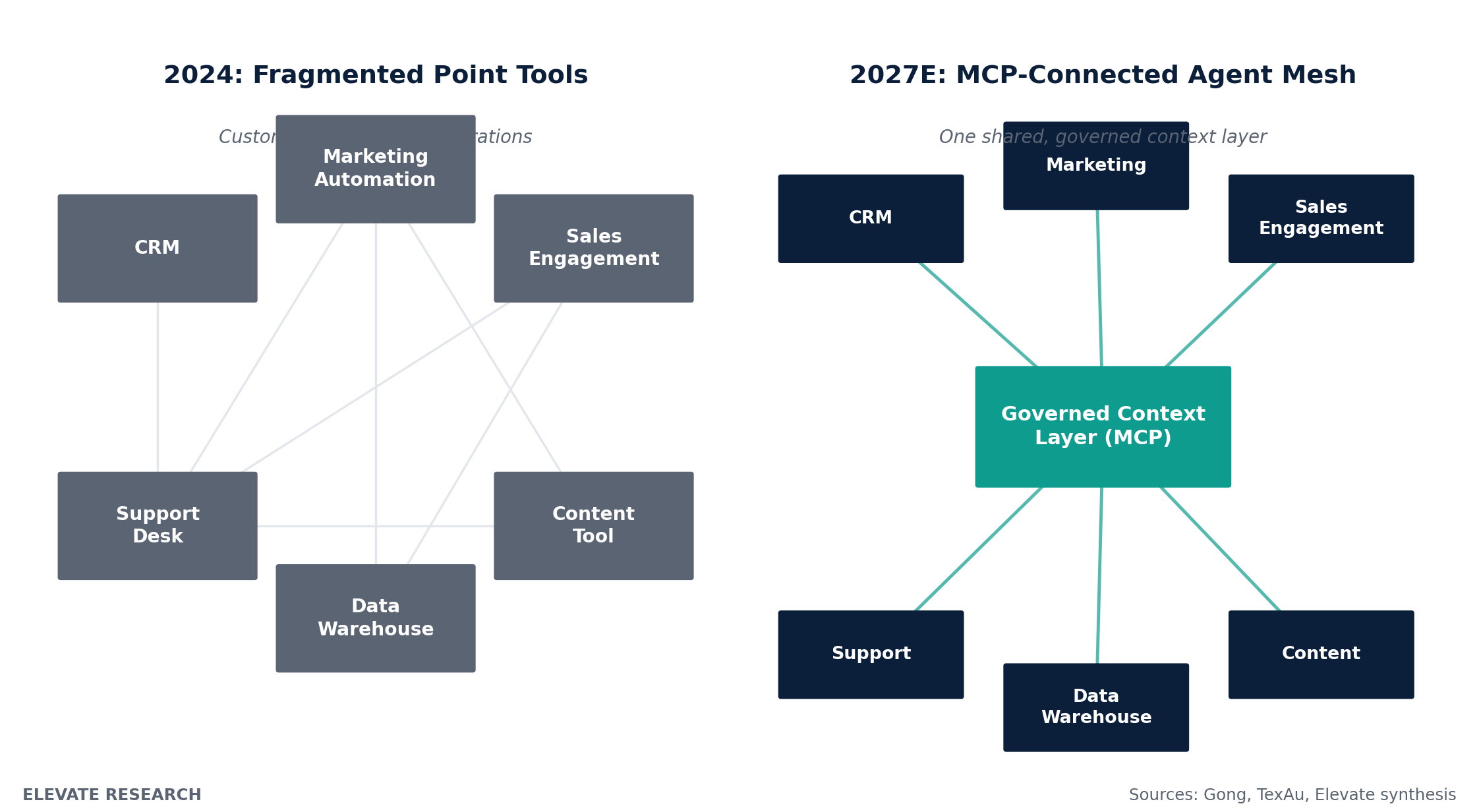 Figure 1. The shift from fragmented point tools connected by custom integrations to a governed, shared context layer that AI agents access directly.
On the buyer side, the current landscape already shows the early edge of the shift this report projects forward. The Digital Sales Institute reports that 94 percent of B2B buyers now use generative AI as a core research tool, that 91 percent are already familiar with a vendor before the first meeting, and that 73 percent are now willing to place orders above 50,000 dollars through self-service channels without direct seller involvement. These are not futuristic figures. They describe 2026 buyer behavior, and they are the leading edge of the agent-intermediated buying shift this report examines in the next section.
90% of B2B buying is projected to be AI agent intermediated by 2028, according to Gartner, representing more than 15 trillion dollars in B2B spend routed through automated exchanges. Source: Gartner, November 2025 to 2026 forecasts
The market is also beginning to price in the risk of moving too fast without preparation. Gartner's own research finds that more than 40 percent of agentic AI projects are at risk of cancellation by 2027, a figure identified in Asset 1 of this series that becomes even more consequential when read alongside the pace of change projected here: organizations that treat this as a multi-year infrastructure and governance transition, rather than a short-term tooling upgrade, are the ones positioned to capture the trillions of dollars in projected value rather than becoming a cancellation statistic.
The pace of vendor commitment to interoperability is itself a signal worth reading carefully. Product-level MCP support has moved from an experimental feature to a standard line item in vendor roadmaps within roughly a single year, a speed of coordinated adoption across competing platforms that is unusual for enterprise software. Historically, competing vendors converge on shared standards only when the alternative, continued fragmentation, actively threatens the value each platform can deliver to customers on its own. That several major, otherwise competing GTM vendors have reached that point within the same twelve-month window suggests the interoperability shift is not a marginal feature decision but a response to a genuinely shared recognition that isolated, ungoverned data is now the binding constraint on what any single platform's AI capability can deliver.
The starting position also varies substantially by industry, a pattern this report inherits directly from the regional and vertical findings in Asset 1 of this series. Insurance, technology, and healthcare organizations enter this forward-looking window with meaningfully more scaled AI agent deployment than the cross-industry average, while sectors with longer sales cycles, more regulated buying processes, or lower digital transaction volume are starting from a materially earlier point on the trajectories described in this report. This matters for planning purposes because the market-level percentages cited throughout this asset, such as Gartner's 90 percent agent-intermediated buying figure, describe an aggregate outcome that will arrive unevenly, and a revenue leader benchmarking their own organization's pace should weight industry starting position accordingly rather than assuming a uniform glide path to the 2028 and 2030 figures cited throughout this report.
4. Key Trends
Six forward-looking trends define how AI in go to market is likely to evolve between now and 2030.
1. Buying becomes agent-to-agent before it becomes fully agent-to-human
Gartner's most cited forecast, that 90 percent of B2B buying will be AI agent intermediated by 2028, is frequently misread as meaning buyers stop talking to sellers. The more precise reading, drawn from the same research, is that agents on both sides increasingly handle research, shortlisting, and initial negotiation, with humans re-entering the process at the points of highest judgment and highest stakes. Gartner's related prediction that one in four enterprise software purchases will be made by AI agents with no human in the loop at all by 2028 marks the outer edge of this trend, concentrated in lower-complexity, higher-frequency purchase categories such as recurring parts orders and SaaS renewals.
2. Programmable transactions become real financial infrastructure, not a concept
Gartner forecasts that by 2030, 20 percent of monetary transactions will be programmable, meaning terms and conditions are embedded directly in code, enabling machine-to-machine negotiation and automated settlement without manual invoicing or approval workflows. This is a distinct and more foundational shift than agentic buying alone, because it changes the financial plumbing that GTM, finance, and procurement systems all depend on, and it explains why vendors are racing to expose structured, machine-readable pricing and contract terms now rather than waiting for the technology to mature further.
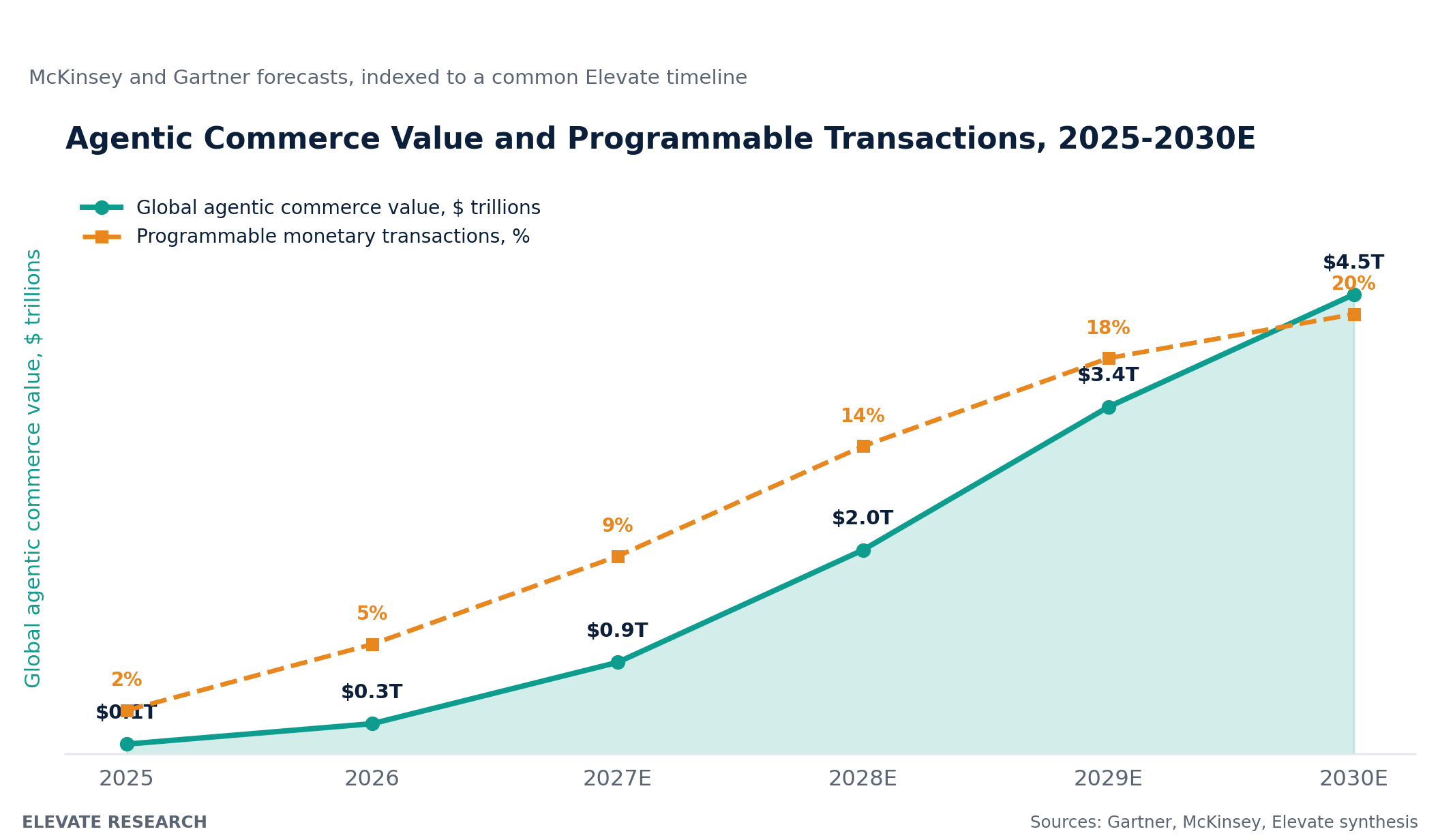 Figure 2. Global agentic commerce value and the share of monetary transactions expected to be programmable, 2025 to 2030.
3. GTM work redistributes toward supervision, exception handling, and relationships
McKinsey's future of work research is unambiguous about which skills face the least disruption: negotiation, coaching, and relationship-centered work remain among the least automatable activities studied, even as routine and structured tasks show the highest automation exposure. Applied to GTM specifically, this points toward SDR and content production roles absorbing the earliest and deepest automation, while account strategy, executive relationship management, and complex negotiation remain predominantly human for the foreseeable future, not because the technology cannot approximate them, but because the value of those interactions is tied to trust that AI cannot yet substitute for.
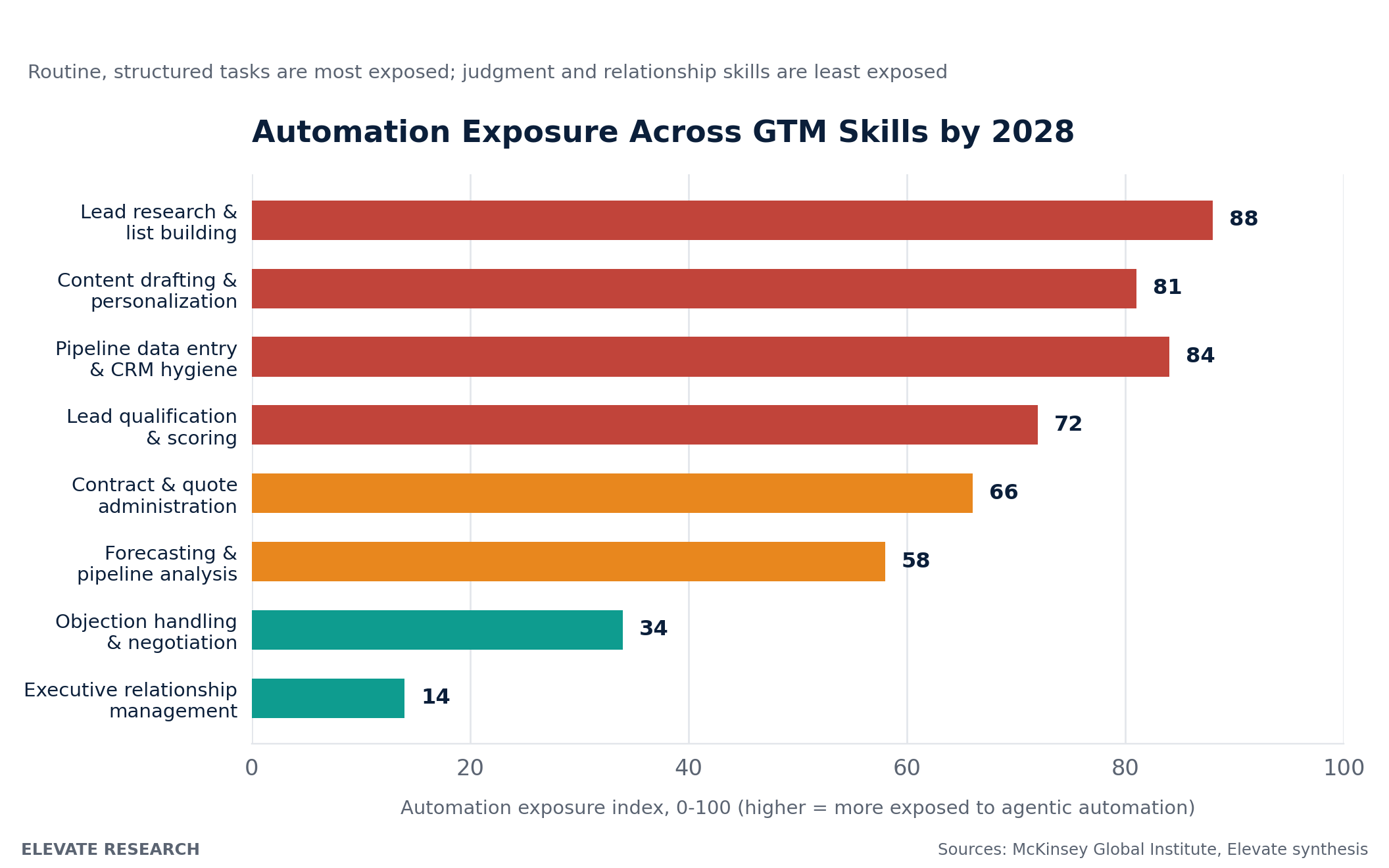 Figure 3. Elevate's automation exposure index across common GTM tasks, synthesized from McKinsey Global Institute skill-change research applied to revenue-function activities.
4. GTM roles reorganize around agent supervision rather than task execution
Industry commentary converging from multiple independent sources describes a common shape for the 2027 to 2028 GTM org chart: fewer entry-level task-execution roles, and a new layer of what several sources describe as agent supervisors, people who design agent workflows, review agent output, and audit results rather than performing the underlying task themselves. This is consistent with McKinsey's broader finding that the defining new workplace skill of this transition is effective human-agent interaction and orchestration, not any single technical competency.
5. The Chief Revenue Officer role gains authority as execution roles are compressed
A notable pattern across GTM commentary is the expectation that senior, judgment-heavy commercial leadership roles become more central, not less, as AI absorbs execution-layer work. As support, SDR, and content functions see the deepest automation, the coordinating function that decides how humans and agents divide GTM work, sets governance boundaries, and owns the commercial outcome becomes correspondingly more consequential, a dynamic that mirrors McKinsey's broader finding that the human role in an AI-augmented workforce shifts from executor to orchestrator.
6. Regulatory fragmentation becomes a genuine GTM planning constraint
Gartner predicts that by 2027, fragmented AI regulation will cover roughly half of the world's economies, driving an estimated 5 billion dollars in compliance spending as organizations stand up dedicated AI governance functions. For GTM leaders operating across multiple geographies, this means agent deployment decisions increasingly need to account for regulatory variance by market, not just technical or commercial fit, adding a genuinely new dimension to international go to market planning that did not exist in the pre-agentic era.
7. General-purpose agents give way to vertical, task-specialized agents
Early agentic GTM deployments favored broad, general-purpose assistants layered across an entire platform. The pattern now emerging across vendor roadmaps and enterprise adoption commentary is a shift toward narrower, more specialized agents built for a single high-value workflow, such as contract redlining, renewal risk scoring, or competitive battlecard generation, rather than one general agent expected to handle every task adequately. This mirrors a broader pattern in enterprise software adoption, where general-purpose tools tend to win the early pilot phase on flexibility, while specialized tools win the production phase on reliability and measurable outcome, and it suggests that 2027 and 2028 GTM technology budgets will increasingly be allocated by workflow rather than by platform.
5. Analyst Perspectives
The major research firms agree on direction but differ meaningfully in how they frame the pace and shape of the transition, and those differences matter for how a revenue leader should plan.
Gartner's forecasting is the most aggressive on timeline and the most granular on mechanism. Beyond the headline 15 trillion dollar B2B buying figure, Gartner's Scheibenreif has been explicit that the determining factor in who benefits is not adoption speed but governance discipline: an autonomous purchasing agent with no guardrails is a liability, while one with clear boundaries and good data is a competitive weapon, in Gartner's own framing. Gartner's parallel prediction that vendors whose product information is clean, machine-readable, and verifiable will hold an enormous advantage over those relying on human-mediated sales conversations reframes a core GTM discipline, content and product marketing, as fundamentally a data engineering problem in an agent-intermediated market.
McKinsey's contribution is the most economically rigorous treatment of the workforce transition. Its Global Institute research estimates that up to 57 percent of current US work hours are technically automatable, but stresses repeatedly that this is a technical ceiling, not a forecast of actual job loss, and that the 2.9 trillion dollar opportunity it identifies depends entirely on organizations redesigning workflows around human-agent partnership rather than automating individual tasks in isolation. McKinsey's Skill Change Index, which maps automation exposure across more than 800 occupations, provides the most granular evidence available for which parts of GTM work will change fastest, and its finding that AI fluency demand has grown nearly sevenfold in two years, faster than any other skill category tracked, is a direct, quantified signal of how urgently GTM hiring and training needs to adapt.
"The question isn't whether to deploy AI agents. It's whether you've done the governance work to deploy them responsibly." Gartner analyst commentary on agentic AI project risk, 2026
Deloitte and Salesforce's own public commentary, delivered jointly with Microsoft and Gong at a recent industry event, converges on interoperability as the practical precondition for realizing any of these forecasts. Their shared argument is that the market has moved past generative AI as a novelty and is now confronting a harder integration problem: agents that can reason well but cannot see enterprise context are far less useful than agents connected to a governed, shared data layer, which is precisely why competing platform vendors are cooperating on a shared open standard rather than each building a proprietary walled garden.
Bain and BCG's growth research, discussed in more depth in Asset 1 of this series, adds an important caution to the more dramatic forecasts from Gartner and McKinsey: 91 percent of commercial leaders expected to hit their 2026 growth targets, nearly identical to the share who expressed the same confidence a year earlier, when 42 percent ultimately fell short. Applied to this asset's forward-looking claims, the lesson is that organizational execution capacity, not technology roadmap, has historically been the binding constraint on ambitious commercial plans, and there is no strong evidence yet that AI adoption alone resolves that execution gap without the operating model changes described throughout this report.
IDC and Accenture offer the most explicitly long-range framing among the sources reviewed for this report. IDC's FutureScape research describes 2026 through 2030 as the period in which AI shifts from embedded feature to embedded infrastructure, a distinction IDC uses to explain why it expects roughly half of new digital business value in some regions to come specifically from organizations that treat AI as foundational architecture rather than an add-on capability. Accenture's own framing of its AI investment as reinvention-grade transformation, rather than incremental automation, points to the same conclusion from the implementation side: the firms advising the largest enterprises on this transition are consistently describing it in operating-model terms, not tooling terms, which is the same distinction this report and Asset 1 of this series both return to repeatedly.
Reading all six perspectives together, a clear division of labor emerges in how the analyst community is covering this transition. Gartner and IDC own the market sizing and timeline forecasting; McKinsey owns the workforce and skills modeling; Bain and BCG own the operating model and growth execution lens; Deloitte and Accenture own the implementation and organizational change perspective; and the platform vendors themselves, through their public roadmap commitments, provide the most concrete near-term evidence of where product capability is actually heading rather than where it might theoretically go. No single source in this list provides a complete picture on its own, which is precisely the gap Elevate's synthesis in the next section is designed to close.
6. Elevate Analysis
Reading the forecasts above side by side surfaces a pattern that no single source states directly: the future of AI in go to market is not a single trajectory but two converging trajectories, one on the buyer side and one on the seller side, that are currently moving at different speeds. Elevate's synthesis focuses on what that speed gap means in practice.
The market trend: the buyer side is moving faster than the seller side
Across the sources reviewed for this report, buyer-side AI adoption figures consistently run ahead of seller-side operational readiness. The Digital Sales Institute's finding that 94 percent of B2B buyers already use generative AI as a core research tool describes a buyer population that has largely already made the shift this report projects forward, while Gartner's finding that only 21 percent of organizations have mature agent governance describes a seller population still building the foundation to respond.
ELEVATE PERSPECTIVE This asymmetry is the single most important planning fact in this report. Sellers are not preparing for a future shift in buyer behavior; they are already several steps behind a shift that has substantially happened. The practical implication is that GTM investment priorities should weight content structure, data machine-readability, and agent-facing discoverability more heavily, and sooner, than most 2026 GTM budgets currently reflect, because the buyer-side agents this report describes are already evaluating vendors today, not in some future planning cycle.
Why workforce redesign, not headcount reduction, is the pattern that recurs
A pattern that shows up consistently once Elevate's platform cross-references McKinsey's future of work research against the GTM-specific commentary from Gong, Deloitte, and independent industry sources is that the organizations describing the most credible transition plans are not primarily talking about headcount reduction. They are talking about role redesign: fewer people executing high-volume, structured tasks, and a correspondingly higher-leverage role for the people who remain, now positioned to supervise, audit, and intervene in agent workflows rather than perform the underlying task themselves. This mirrors McKinsey's own economy-wide framing almost exactly, applied at the level of an individual revenue team rather than a national workforce.
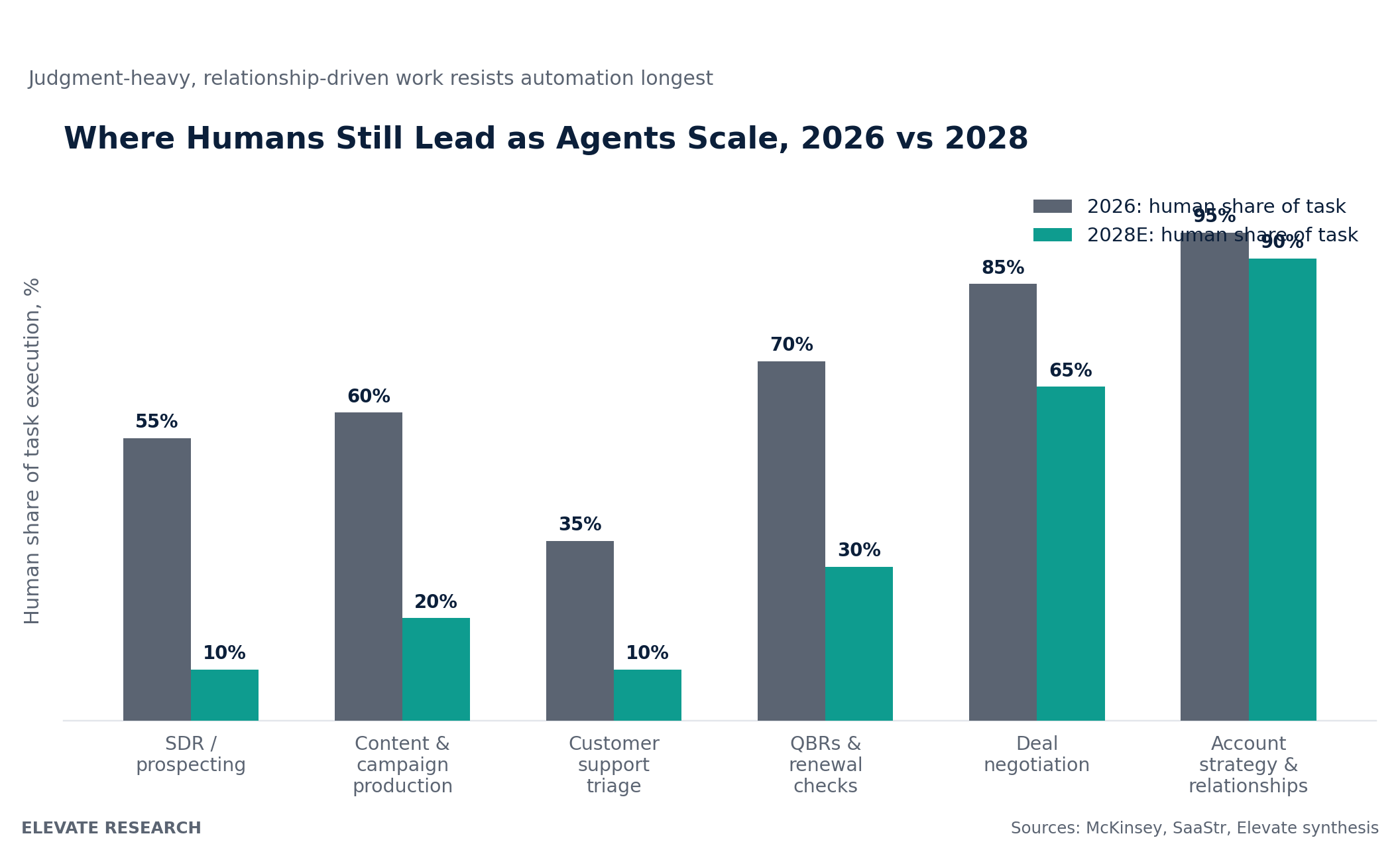 Figure 4. Elevate's projected human share of task execution across common GTM functions, 2026 versus 2028, synthesized from McKinsey skill-exposure data and GTM-specific industry commentary.
The pattern intelligence layer underlying this chart specifically cross-checked GTM-specific industry commentary describing SDR and support role compression against McKinsey's occupation-level automation exposure data and against Gartner's agent-to-seller ratio forecast from Asset 1 of this series, and found consistent directional agreement across all three independently produced sources: high-volume, structured GTM work is compressing fastest, while negotiation, executive relationship management, and account strategy remain predominantly human through the end of this decade in every source reviewed.
Where the interoperability trend actually changes competitive dynamics
The convergence of major platform vendors around the Model Context Protocol is, on the surface, a technical integration story. Elevate's synthesis treats it as a competitive dynamics story instead. When every major GTM platform can expose governed context to any agent through a shared standard, the basis of competition among CRM, marketing automation, and sales engagement vendors shifts away from which platform owns the most data, since data becomes more portable by design, and toward which platform provides the most trustworthy, well-governed version of that data. This is a meaningfully different competitive battlefield than the one most GTM technology buying committees are currently evaluating vendors against, and it should reshape how those buying committees weight interoperability and governance capability relative to feature breadth in 2027 vendor selection processes.
Why the shift toward vertical agents changes the build versus buy calculus
The pattern intelligence layer underlying this report also flagged a second-order consequence of the shift from general-purpose to vertical, task-specialized agents described in Section 4, one that does not appear explicitly stated in any single source but emerges clearly once vendor roadmap commentary, enterprise adoption case studies, and platform interoperability announcements are read together. As agents specialize by workflow rather than by platform, and as interoperability standards make it technically straightforward to combine agents from different vendors inside a single governed context layer, the traditional build versus buy decision in GTM technology stops being a binary choice made once at the platform level. It becomes a recurring, workflow-level decision made repeatedly as new specialized agents reach production maturity. Organizations that have already invested in the unified context layer recommended in Asset 1 of this series are positioned to adopt best-of-breed specialized agents from any vendor as they mature, while organizations still operating on fragmented, siloed data will find each new specialized agent adds another point of integration debt rather than another source of compounding value.
What this means for how success gets measured
One further pattern is worth naming explicitly, because it changes how the recommendations in the next section should be implemented rather than just what they recommend. As agent supervision, rather than task execution, becomes the primary human role in the functions most exposed to automation, the performance metrics revenue organizations have historically used to manage those functions, such as calls made, emails sent, or tickets closed per person, stop measuring anything meaningful. Elevate's synthesis of the workforce redesign research reviewed for this report points to a specific replacement discipline: measuring the quality of an agent's output as reviewed and corrected by its human supervisor, the frequency and severity of the exceptions that supervisor has to intervene on, and the commercial outcome of the workflow as a whole, rather than the volume of any single task within it. Organizations that continue managing agent-supervised functions with activity-volume metrics inherited from the pre-agentic era will systematically misjudge both individual performance and the actual return on their AI investment.
7. Strategic Recommendations
Elevate recommends five actions specific to preparing for the trajectory described in this report, distinct from and building on the sequencing recommendations in Asset 1 of this series. These are deliberately weighted toward decisions that need to be made in the next twelve months, since the pace of change documented throughout this report means recommendations calibrated for a slower timeline would understate the urgency the evidence actually supports.
1. Treat buyer-side agent readiness as a 2026 priority, not a 2028 one
Given that buyer-side generative AI usage is already close to universal, revenue teams should audit how their product information, pricing, and proposal content perform when evaluated by an AI agent today, not wait for agent-intermediated buying to become the dominant pattern before adapting. This means structured product data, machine-readable pricing logic, and verifiable claims, since Gartner's research indicates these are the specific signals buyer-side agents weight most heavily.
2. Build for interoperability, not platform lock-in
As Model Context Protocol adoption accelerates across major GTM vendors, technology decisions made in 2026 and 2027 should explicitly favor platforms that support open, portable context layers over platforms that keep agent-relevant data locked inside a proprietary system. This is both a practical hedge against vendor lock-in and a direct response to where competitive differentiation in the vendor market itself is heading. In vendor evaluation processes, this means adding interoperability and context portability as an explicit, weighted criterion alongside the feature comparisons that have traditionally dominated GTM technology selection, since feature parity across leading platforms is converging faster than most buying committees currently assume.
3. Redesign roles around supervision before automation forces the redesign
Rather than waiting for automation to compress a role and then reactively restructuring, revenue leaders should proactively define what agent supervision looks like for SDR, content, and support-adjacent functions now, including what a promotion path from task execution to agent orchestration looks like, so the transition is a planned career progression rather than an unplanned disruption.
4. Invest disproportionately in the roles that remain durably human
McKinsey's research is consistent: negotiation, coaching, and relationship-centered skills are the least exposed to automation through 2030. Revenue leaders should treat investment in account strategy, executive relationship management, and complex negotiation capability as the highest-return people investment available precisely because these are the functions where AI is least likely to substitute for the human directly, meaning skill built here compounds rather than depreciates.
5. Build regulatory variance into international GTM planning now
With AI regulation expected to fragment across roughly half the world's economies by 2027, GTM leaders operating internationally should build regulatory review into agent deployment planning by market from the outset, rather than treating it as a follow-on compliance exercise after a global rollout decision has already been made.
ELEVATE PERSPECTIVE The organizations most likely to capture the value described throughout this report share a common characteristic across every source reviewed: they are treating 2026 and 2027 as the preparation window for a shift that is already underway on the buyer side, rather than as early days of a future shift. The gap between those two framings, preparation versus anticipation, is the most consequential planning decision a revenue leader will make this year.
8. Executive Takeaways
- The buyer side has already moved: 94 percent of B2B buyers use generative AI as a core research tool today, meaning buyer-side agent adoption is a present reality, not a future forecast.
- The scale of agent-intermediated buying is enormous: Gartner projects 90 percent of B2B buying will be AI agent intermediated by 2028, representing more than 15 trillion dollars in B2B spend.
- Programmable transactions are a distinct, deeper shift: Gartner forecasts 20 percent of monetary transactions will be programmable by 2030, changing the financial infrastructure underneath GTM, not just the buying interface.
- Automation exposure is highly uneven across GTM work: Structured, high-volume tasks such as lead research and CRM data entry are the most exposed; negotiation and executive relationship management are the least exposed through 2030.
- Interoperability, not platform ownership, is becoming the competitive battleground: Major GTM vendors are converging on the Model Context Protocol as shared infrastructure, shifting competition toward governance and trust rather than data lock-in.
- Execution capacity remains the real constraint: Even amid these technology shifts, Bain's research shows commercial leaders have repeatedly overestimated their ability to hit growth targets, a reminder that operating model discipline, not technology adoption alone, determines outcomes.
9. Future Outlook
Extending the trajectories reviewed in this report to their logical endpoint, Elevate expects the go to market function of 2030 to look structurally different from 2026 in four specific ways.
First, the GTM technology stack will be substantially fewer, larger, more interoperable platforms rather than more numerous, more specialized point tools. The interoperability standards gaining adoption today, led by the Model Context Protocol, are the connective tissue that makes this consolidation technically possible, and the vendors that build durable competitive advantage will be the ones that win on trust and governance within that interoperable layer rather than on proprietary data lock-in.
Second, the GTM organization chart will have a visibly different shape, with fewer roles dedicated to structured task execution and a new tier of roles dedicated to agent supervision, workflow design, and output auditing. This is not primarily a headcount story; it is a skill redistribution story, consistent with McKinsey's finding that the core new workplace skill of this transition is effective human-agent interaction rather than any single technical competency.
Third, the majority of transactional, lower-complexity B2B buying will happen with minimal or no human involvement on either side, while complex, high-stakes purchasing will retain human negotiators on both sides, now supported rather than replaced by agents that handle research, shortlisting, and initial terms. The dividing line will not be deal size alone but complexity and relationship stakes, meaning the most durable seller value will concentrate in exactly the deals that matter most to a business's growth trajectory.
Fourth, regulatory variance will have become a standing input into GTM planning rather than a periodic compliance review, particularly for organizations operating across multiple major economies where AI governance requirements diverge. This is likely to be the least discussed but most operationally disruptive trend in this report, since it touches deployment timelines and market sequencing decisions that most GTM teams have not historically had to factor into planning at all. A GTM leader launching an agent-driven outbound motion in 2028 may find that the same agent configuration is fully compliant in one major market and restricted in another, making regulatory mapping as routine a step in international GTM planning as currency and localization review are today.
The organizations that treat this future as already arriving, rather than as a forecast to revisit later, will be the ones with the operating model, data foundation, and workforce structure in place to capture it. The cost of waiting is not evenly distributed across the trends described in this report. Buyer-side behavior, interoperability adoption, and workforce redesign are all already in motion and compounding; an organization that begins preparing in 2027 rather than 2026 is not simply a year behind, it is entering a market where the vendors, talent, and buyer expectations it must compete for have already been substantially shaped by competitors who moved first.
Subsequent assets in this series examine specific pieces of this transition in depth, including how GTM strategy planning itself is changing, how AI agents are reshaping revenue operations benchmarks, and how buyer journey and B2B buying behavior research is evolving alongside the trends described here.
10. References
- Gartner. Zero-click commerce and B2B agentic buying forecasts, including the 15 trillion dollar B2B purchasing projection by 2028. Gartner Research, November 2025 to 2026.
- Gartner. Strategic Predictions for 2026, including programmable transactions, AI regulation fragmentation, and agentic AI project cancellation forecasts. Gartner Research, 2026.
- Gartner. Forecasts on AI agent to human seller ratios and enterprise application agent adoption. Gartner Research, 2025 to 2026.
- McKinsey Global Institute. Agents, Robots, and Us: Skill Partnerships in the Age of AI. McKinsey and Company, November 2025.
- McKinsey Global Institute. Skill Change Index and automation exposure research. McKinsey Week in Charts, March 2026.
- McKinsey and Company. Superagency in the Workplace: Empowering People to Unlock AI's Full Potential. McKinsey Insights, January 2025.
- Bain and Company. B2B Growth Agenda 2026, survey of more than 1,100 commercial leaders across 18 sectors and 40 countries. Bain Insights, 2026.
- Digital Sales Institute. B2B e-commerce and buyer behavior statistics, including generative AI usage and self-service purchasing thresholds. Digital Sales Institute Research, 2026.
- Gong, in joint public commentary with Microsoft, Salesforce, and Deloitte. Industry perspectives on Model Context Protocol adoption and interoperable AI infrastructure. Gong Celebrate event proceedings, 2026.
- Outreach, Salesloft, Clari, and HubSpot. Public product announcements on Model Context Protocol server and client integrations. Company communications, 2026.
- Elevate Research. Automation exposure index and human-agent task split projections, proprietary frameworks derived from Elevate's pattern intelligence synthesis of McKinsey, Gartner, and GTM industry sources cited above. Elevate Research, 2026.
Contents
Related Research
GTM Research
Explore research, benchmarks, technology landscapes, and perspectives on the evolution of go-to-market.
View Research Library →