
State of AI-Native GTM 2026
How agentic AI is rewiring the marketing, sales, and customer success operating model, and what revenue leaders should do about it.
Published 2026-08-01
1. Executive Summary
Artificial intelligence has moved from a set of scattered productivity tools to the organizing logic of the revenue function. In 2026, go to market leaders are no longer asking whether to adopt AI. They are being forced to decide how fast to rebuild strategy, execution, and measurement around it.
The scale of the shift is now visible in hard numbers rather than vendor promises. Salesforce disclosed that Agentforce annual recurring revenue crossed 1 billion dollars in its first quarter of fiscal 2027, up from 800 million dollars only one quarter earlier, while the platform processed 28.6 trillion tokens for customers in a single quarter. Gartner projects that AI agents will outnumber human sellers by ten to one before 2028, even as fewer than 40 percent of sellers report that agents have measurably improved their productivity today. That gap between deployment and demonstrated value is the defining tension of this report.
This asset, the first in Elevate's 30 part AI and GTM research series, establishes the baseline for everything that follows. It synthesizes primary research from Gartner, Forrester, IDC, McKinsey, Bain, BCG, Deloitte, Accenture, and PwC, alongside public company earnings disclosures from Salesforce and HubSpot, and vendor product announcements, into a single view of where AI-native go to market actually stands today.
Three findings anchor the analysis. First, AI adoption in B2B revenue teams is now close to universal, with 81 percent of B2B sales teams using AI in some capacity in 2026, up from roughly half in 2024, yet true operational integration remains rare. Second, the constraint on value has shifted from model capability to organizational readiness: data quality, governance maturity, and workflow design now determine returns far more than which AI vendor a company selects. Third, buyer behavior is changing faster than most sellers have adjusted for, with AI agents expected to intermediate the majority of B2B purchasing interactions before the end of the decade.
For revenue leaders, the strategic implication is not to buy more AI tools. It is to treat AI-native go to market as an operating model decision, one that touches data architecture, team structure, governance, and how strategy connects to daily execution. The organizations that make this shift deliberately, rather than reactively, are positioned to compound an advantage that will be very difficult for laggards to close later in the decade.
The remainder of this report is organized to support that decision directly. Section 3 establishes the current state of the market with the most current, cross-validated figures available. Section 4 details the seven most consequential trends reshaping GTM technology and buyer behavior. Section 5 presents each major analyst firm's distinct perspective side by side. Section 6 provides Elevate's own synthesis and proprietary frameworks, including the GTM AI Maturity Matrix and AI Readiness Index introduced in this asset. Sections 7 through 9 translate that analysis into specific recommendations, executive-ready takeaways, and a forward look at 2027 and 2028.
2. Research Methodology
This report follows Elevate's standard research asset formula: analyst research, public data, proprietary analysis, and Elevate perspective, synthesized into a single, repeatable structure so that every asset in the series is comparable and auditable.
Sources synthesized
Elevate drew on primary and secondary research published between mid-2025 and mid-2026 from six categories of source, cross-referenced for consistency and triangulated where figures diverged:
- Analyst research: Global analyst firms, including Gartner, Forrester, and IDC, for market sizing, adoption forecasts, and buyer sentiment research
- Strategy consulting: McKinsey, Bain, and BCG for operating model, organizational, and productivity research
- Big Four and systems integrators: Deloitte, Accenture, and PwC for enterprise implementation, workforce, and governance perspectives
- Public company filings: Quarterly earnings calls and investor disclosures from Salesforce and HubSpot, used to validate adoption and revenue claims against audited, market-moving statements
- Vendor announcements: Product launches and platform roadmaps from CRM, marketing automation, and revenue intelligence vendors, used to confirm the pace and direction of capability delivery
- Regulatory and governance guidance: Public guidance relevant to AI accountability and data use in commercial settings, used to ground governance recommendations in more than vendor best practice
How Elevate adds value
Collecting analyst statistics is not, by itself, original research. The distinct contribution of this series comes from how Elevate's research platform processes that raw material. Rather than drawing conclusions from any single report, the platform uses a large language model, OpenAI's models, as its core reasoning and synthesis engine, paired with a pattern intelligence layer that scans across the full set of ingested analyst research, industry publications, vendor positioning, and public disclosures to identify recurring patterns, not isolated data points.
In practice, this means a finding only earns a place in an Elevate Perspective once it shows up as a pattern across multiple independent sources, rather than being lifted from a single report and restated. The pattern intelligence layer is also used to flag where sources disagree or measure different things, such as differing estimates of AI market size that describe software spend, infrastructure spend, or investment funding respectively, so that Elevate's synthesis favors the most directly comparable, GTM-relevant figure rather than blending incompatible numbers into a single misleading total. Every major data point in this report is attributed to its original source; every Elevate Perspective is clearly labeled as Elevate's own synthesis rather than a restatement of analyst findings.
3. Current Market Landscape
Go to market technology spend is being redirected toward AI at a pace that few categories in enterprise software have matched. Gartner forecasts that worldwide end user spending on AI models and platforms will total 64 billion dollars in 2026, up 63.4 percent from 39 billion dollars in 2025, with generative AI model spending alone growing 117 percent. A meaningful share of that spend is flowing directly into revenue generating functions, where CRM, marketing automation, and sales engagement platforms are being rebuilt around agentic capability rather than simple copilot assistance.
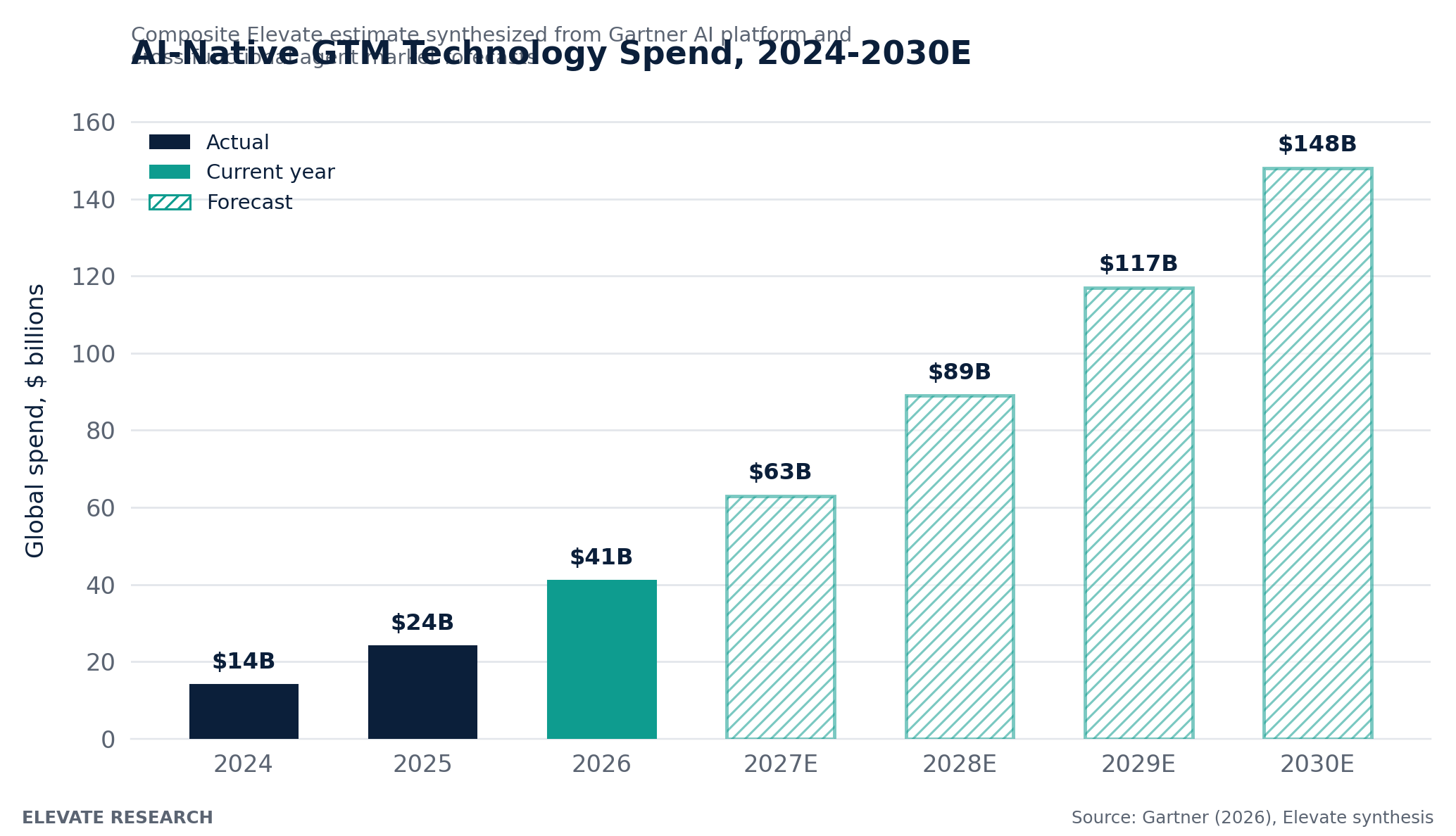 Figure 1. Composite AI-native GTM technology spend, synthesized from Gartner AI platform and cross-functional agent market forecasts. Figures are illustrative of directional scale, not a single-source forecast.
The clearest signal of this shift is coming directly from public company disclosures rather than analyst projections alone. Salesforce reported that Agentforce annual recurring revenue reached 800 million dollars in its fiscal fourth quarter of 2026, up 169 percent year over year, with cumulative deals surpassing 29,000 since launch and more than 60 percent of Agentforce and Data 360 bookings coming from existing customer expansion rather than new logo acquisition. One quarter later, in its first quarter of fiscal 2027, the company reported Agentforce had crossed 1 billion dollars in annual recurring revenue while processing 28.6 trillion tokens for customers, a 152 percent increase quarter over quarter. HubSpot, competing on speed to value rather than platform depth, reports that its Breeze AI agents now serve more than 279,000 customers embedded across every product tier, including its free CRM.
Gartner's own forecasting captures the scale of what is coming next. The firm predicts that up to 40 percent of enterprise applications will include integrated, task-specific AI agents by the end of 2026, up from less than 5 percent in 2025, and that the enterprise cross-functional AI agents and assistants market will exceed 23 billion dollars in annual spend by 2030, growing at a 59 percent compound annual rate. More striking still is Gartner's prediction that AI agents will outnumber human sellers by ten to one by 2028, a structural shift in how revenue organizations are staffed rather than a marginal productivity gain.
81% of B2B sales teams now use AI in some capacity in 2026, up from roughly half of teams in 2024. Source: Gartner 2026 market forecast
Adoption is not evenly distributed across functions or company sizes. McKinsey's most recent State of AI research finds that 88 percent of organizations now use AI in at least one business function, and that 72 percent report using generative AI specifically, up from 33 percent in 2024. Yet the same research shows that nearly two thirds of organizations have not yet begun scaling AI across the enterprise, and that companies with more than 5 billion dollars in revenue are roughly twice as likely to have moved into scaled deployment than smaller peers. Within McKinsey's function-level data, marketing and sales adoption of scaled AI agents trails software engineering and IT, though insurance and technology companies are notable outliers moving fastest in revenue-facing use cases.
Consulting firms are themselves a leading indicator of where enterprise AI investment is concentrating. BCG disclosed in April 2026 that 25 percent of its 14.4 billion dollars in 2025 revenue, roughly 3.6 billion dollars, came directly from AI-related consulting work, a figure that puts a hard number on what had previously been described only in qualitative terms. Deloitte has committed 3 billion dollars through 2030 to AI capability building, and Accenture has made a 3 billion dollar global commitment of its own, both firms explicitly framing revenue and commercial functions as priority areas for AI-enabled transformation work with clients.
Regional and vertical patterns add further texture to the headline figures. IDC's FutureScape research places the Asia Pacific region on what it calls a transition from the AI pivot to the agentic future, forecasting that by 2030, half of new economic value generated by digital businesses in the region will come from organizations that are investing in and scaling AI capability today. Within GTM specifically, McKinsey's function-level survey data shows insurance leading adoption of AI agents in marketing and sales, technology and software leading in engineering and IT-adjacent revenue functions, and healthcare showing disproportionate strength in knowledge management and service operations, a reminder that AI-native GTM maturity is not evenly distributed across industries and that benchmarking against a single cross-industry average can understate how far ahead, or behind, a given sector actually is.
Taken together, the market landscape shows a category in the middle of a structural transition: capital is committed, product capability is real and shipping in production at scale, and adoption headline numbers look close to saturated. What remains uneven, and what the rest of this report examines in detail, is whether that adoption is translating into the operational depth, measurable return, and buyer facing trust that determine whether AI investment actually compounds into competitive advantage.
4. Key Trends
Seven trends define how AI is reshaping go to market in 2026. Each is grounded in analyst data and, where available, corroborated by public company disclosures or vendor product direction.
1. Agentic AI is replacing single-prompt copilots as the default architecture
The defining technical shift of the past eighteen months is the move from AI that suggests to AI that acts. Where 2024 era CRM AI meant drafting a suggested email, 2026 era CRM AI means qualifying a lead, writing outreach, scheduling a follow up, and updating the pipeline autonomously. Salesforce's Atlas Reasoning Engine, HubSpot's Breeze agents, and comparable capability from Zoho and other CRM vendors all reflect this same underlying transition from human-prompted suggestion to agent-executed workflow.
2. B2B buyers are delegating research and negotiation to their own AI agents
Gartner projects that by 2028, 90 percent of B2B buying activity will be intermediated by AI agents, pushing more than 15 trillion dollars of B2B spend through agent-to-agent exchanges rather than traditional human negotiation. Forrester's research corroborates the direction of travel at a more granular level: 61 percent of purchase influencers in 2025 said their organization already uses, or plans to use, a private generative AI engine to support purchasing decisions, and Forrester predicts that at least one in five B2B sellers will be compelled to respond to AI-powered buyer agents with dynamically generated counteroffers from their own seller-controlled agents in 2026.
3. Trust and accuracy have become the binding constraint, not capability
Forrester's Buyers Journey Survey found that 19 percent of buyers using generative AI tools during purchasing report feeling less confident in their decisions because of inaccurate or unreliable information the AI provided. In response, human validation is regaining relative importance at the point of commitment: in 2025, only 30 percent of buyers viewed generative AI interactions as meaningful during the final commit stage of a purchase, compared with 17 percent who cited interactions with human product experts, and Forrester expects that gap to narrow further in favor of human validation through 2026 as buyers seek deeper proof before signing.
4. Governance has not kept pace with deployment
Only 21 percent of organizations report having a mature governance model for autonomous AI agents, even as deployment accelerates. Forrester estimates that ungoverned generative AI use will cost B2B companies more than 10 billion dollars in lost enterprise value in 2026 alone, through declining stock prices, legal settlements, and regulatory fines tied to unreliable or unvetted AI output reaching customers. Gartner separately forecasts that more than 40 percent of agentic AI projects are at risk of cancellation by 2027, driven primarily by unclear return on investment and governance gaps rather than model performance.
5. Martech and salestech stacks are consolidating around AI-native platforms
The martech landscape, estimated at more than 200 billion dollars in annual software spend spread across over 14,000 tools with average utilization near 33 percent, is entering a consolidation phase driven by AI rather than by cost cutting alone. AI-native suites, including Salesforce Agentforce, HubSpot Breeze, and Adobe's GenStudio, are absorbing point solutions for content, personalization, and campaign execution into fewer, agent-orchestrated platforms, shifting spend from many small subscriptions toward fewer, usage-priced AI platforms.
6. Pricing and packaging are shifting toward outcome and usage-based models
As AI agents take on execution work previously billed by the seat, vendors and even consulting firms are experimenting with pricing tied to usage or outcomes rather than headcount. McKinsey's B2B pricing research finds that 65 to 85 percent of pricing executives expect to adopt generative or agentic AI within pricing itself over the next one to three years, up from just 10 to 30 percent adopting it today, while roughly a quarter of McKinsey's own fees are now outcome-linked rather than time and materials, a pattern likely to spread into GTM software licensing over the next several years.
7. External influencers and analyst content are gaining weight in the buying process
As AI compresses the time buyers spend on open-web research, Forrester finds that analyst reports and social media are among the most commonly cited content assets that business buyers describe as meaningful to their decisions, and predicts that 75 percent of enterprise B2B companies will increase budgets for influencer relations in 2026. The practical implication for GTM teams is that credible third-party validation, of the kind this Elevate research series is itself designed to provide, is becoming more, not less, important as AI-generated content becomes cheaper and more abundant, since buyers are using trusted external sources specifically to counterweight the uncertainty created by AI-generated marketing claims.
5. Analyst Perspectives
Independent research firms broadly agree on direction while diverging on pace and emphasis. Reading their perspectives side by side reveals both the consensus view of where AI-native GTM is heading and the specific risks each firm believes revenue leaders are underestimating.
"AI agents should not be viewed as a shortcut to sales productivity. Sales leaders should be asking where agents can remove friction, improve decision quality, and create capacity, not simply where agents can be deployed." Gartner, sales research leadership, July 2026
Gartner's central warning is that organizations are trapped in what its analysts call a productivity paradox: rising investment in AI tools alongside flat commercial returns. Its own survey of 210 chief sales officers found that 60 percent believe their revenue outcomes are driven largely by factors outside their control, a signal of misalignment between AI tooling investment and the systems, data, and seller behavior needed to convert that investment into results. Gartner's prescription centers on three actions: building a centralized context layer that connects enterprise data and seller judgment so agents produce relevant, enterprise-specific output; using AI to reduce administrative burden and scale top performer behavior; and measuring AI impact through expanded seller capacity and effectiveness rather than time savings alone.
Forrester's research leans more heavily on the buyer side of the relationship and on the governance risk created by moving fast without controls. Its 2026 B2B predictions frame the year as a reckoning: AI adoption has outpaced governance, and buyers are demanding proof over promises. Forrester's chief research officer, Sharyn Leaver, has argued that success in this environment depends on disciplined, evidence-driven engagement with generative AI, balancing automated tools with human expertise, and that accountability and clarity will become the defining competitive differentiators for B2B leaders operating in a volatile market.
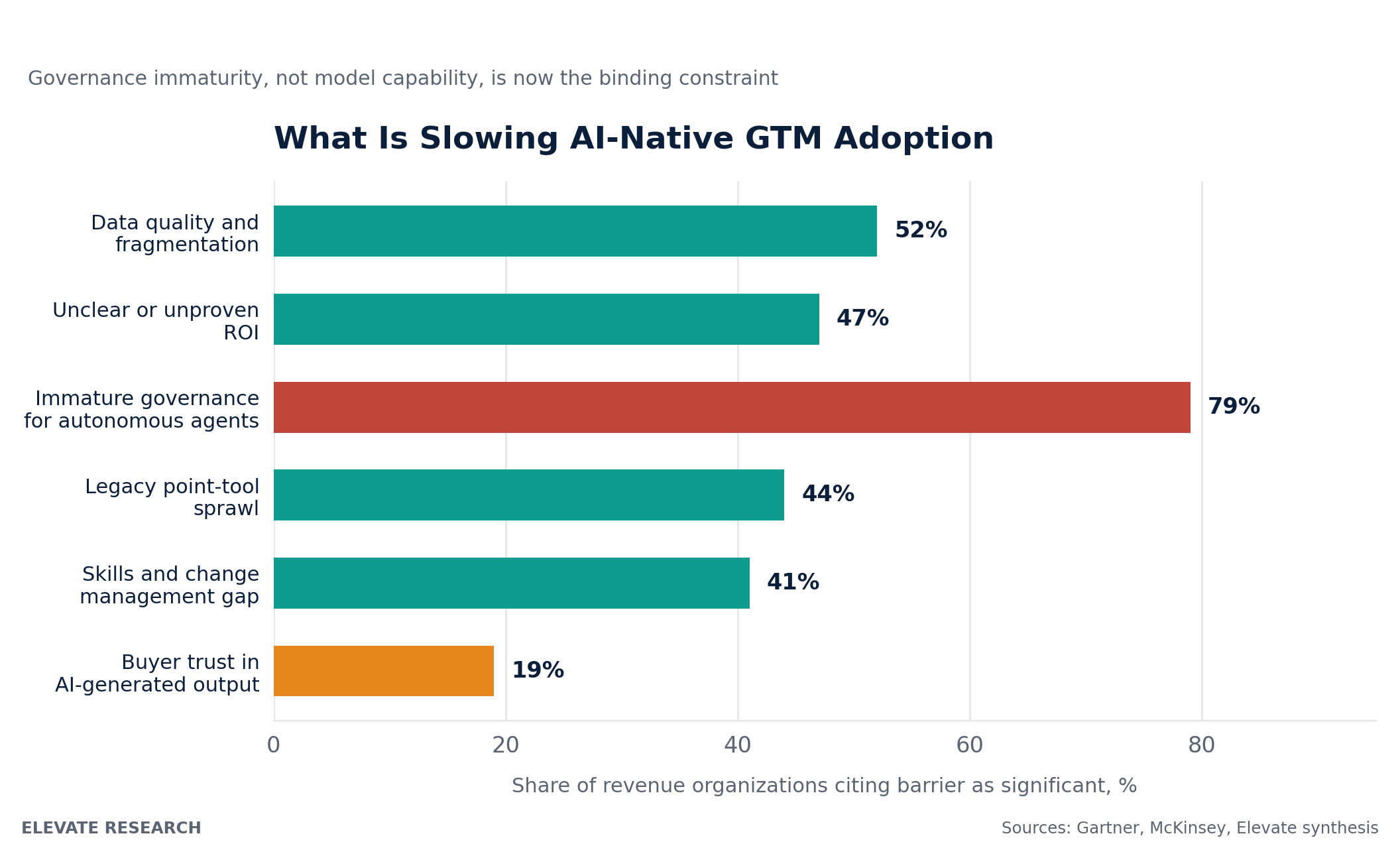 Figure 2. Barriers most frequently cited by revenue organizations as significant constraints on AI-native GTM adoption.
McKinsey's contribution is largely organizational. Its State of AI research draws a sharp line between organizations that have adopted AI, now the large majority, and those that have scaled it into transformed workflows, still a minority. High performing organizations, in McKinsey's framing, are distinguished less by which AI tools they use and more by whether they have defined human-in-the-loop validation processes: 65 percent of high performers have such processes in place, compared with only 23 percent of other organizations. McKinsey frames this as a discipline question rather than a technology question, one closer to service reliability engineering than to software procurement.
BCG and Bain, drawing on both market research and their own AI-driven consulting practices, emphasize the widening gap between AI leaders and laggards. BCG's research finds that the small minority of companies it classifies as future-built for AI, roughly 5 percent of the companies it studies, achieve five times the revenue growth and three times the cost reduction of their peers, evidence that the performance gap created by AI adoption is compounding rather than narrowing over time. Bain's 2026 B2B growth research, drawn from a survey of more than 1,100 commercial leaders across 18 sectors and 40 countries, finds that 91 percent of leaders expect to hit their 2026 growth targets, nearly identical to the share who expressed the same confidence a year earlier, when 42 percent ultimately fell short. Bain's conclusion is that AI-enabled operating models, paired with a genuinely differentiated value proposition, are now a precondition for closing that persistent execution gap rather than an optional accelerant.
Deloitte and PwC, closer to the implementation layer, both point to the skills and change management gap as the most underestimated risk. Deloitte identifies the AI skills gap as the single largest barrier to integration in its own research, noting that organizations reporting genuine productivity gains from AI are disproportionately those that invested in training before tool deployment rather than after, a sequencing point that shows up consistently across the wider body of research reviewed for this report.
IDC and Accenture round out the picture from the infrastructure and workforce sides respectively. IDC's FutureScape research frames 2026 as the transition point between what it calls the AI pivot, in which organizations proved AI could work, and the agentic future, in which AI becomes embedded infrastructure that autonomously executes revenue-generating work; IDC further predicts that by 2028, one in five marketing roles or functions will be held by an AI worker, a claim that reframes workforce planning as a GTM design question rather than only an HR one. Accenture's own AI investment commitment, which the firm has sized at 3 billion dollars globally, is explicitly targeted at what it calls reinvention-grade transformation of client operating models rather than incremental automation, a framing that echoes Bain's insistence that AI-enabled operating models, not point tools, are now the precondition for hitting growth targets reliably.
6. Elevate Analysis
The analyst data above describes a market in transition. What it does not fully explain is why so many well-funded AI initiatives inside revenue organizations are stalling despite strong executive sponsorship. Elevate's synthesis points to a structural, not technical, explanation.
The market trend: buyers now expect AI-assisted experiences
Across every source reviewed for this report, one pattern is consistent: buyers increasingly expect vendors to meet them with AI-assisted research, personalized engagement, and rapid, accurate response, while simultaneously distrusting AI output they perceive as generic, ungoverned, or disconnected from a real understanding of their business.
ELEVATE PERSPECTIVE This shifts go to market investment away from isolated automation point tools and toward unified, AI-native operating platforms that connect strategy, execution, and continuous optimization inside a single governed data layer. The winners in this market will not be the companies that deploy the most agents. They will be the companies that make their agents trustworthy, by grounding every agent action in the same unified customer context that a human seller or marketer would use, and auditable, by making every agent decision traceable back to the data and policy that produced it.
Why adoption is outpacing operational depth
This same pattern of fragmentation shows up repeatedly across the sources Elevate's research platform ingests for this series. Rather than treating any single analyst finding as conclusive, Elevate's platform uses a large language model as its reasoning and synthesis engine, layered with pattern intelligence that cross-references findings across the full body of research, so that a claim like this one is only elevated into a perspective once the underlying pattern recurs across multiple, independent sources rather than resting on one report's framing. In this case, the pattern is unambiguous: organizations are deploying agents on top of fragmented data and disconnected systems, then measuring success by activity, such as agent deployments or seat counts, rather than by commercial outcome. This mirrors what McKinsey's human-in-the-loop research and Gartner's productivity paradox findings describe from two different angles, and it is the direct explanation for why Gartner projects more than 40 percent of agentic AI projects are at risk of cancellation by 2027. An agent built on inconsistent data will produce inconsistent output regardless of how sophisticated its underlying model is.
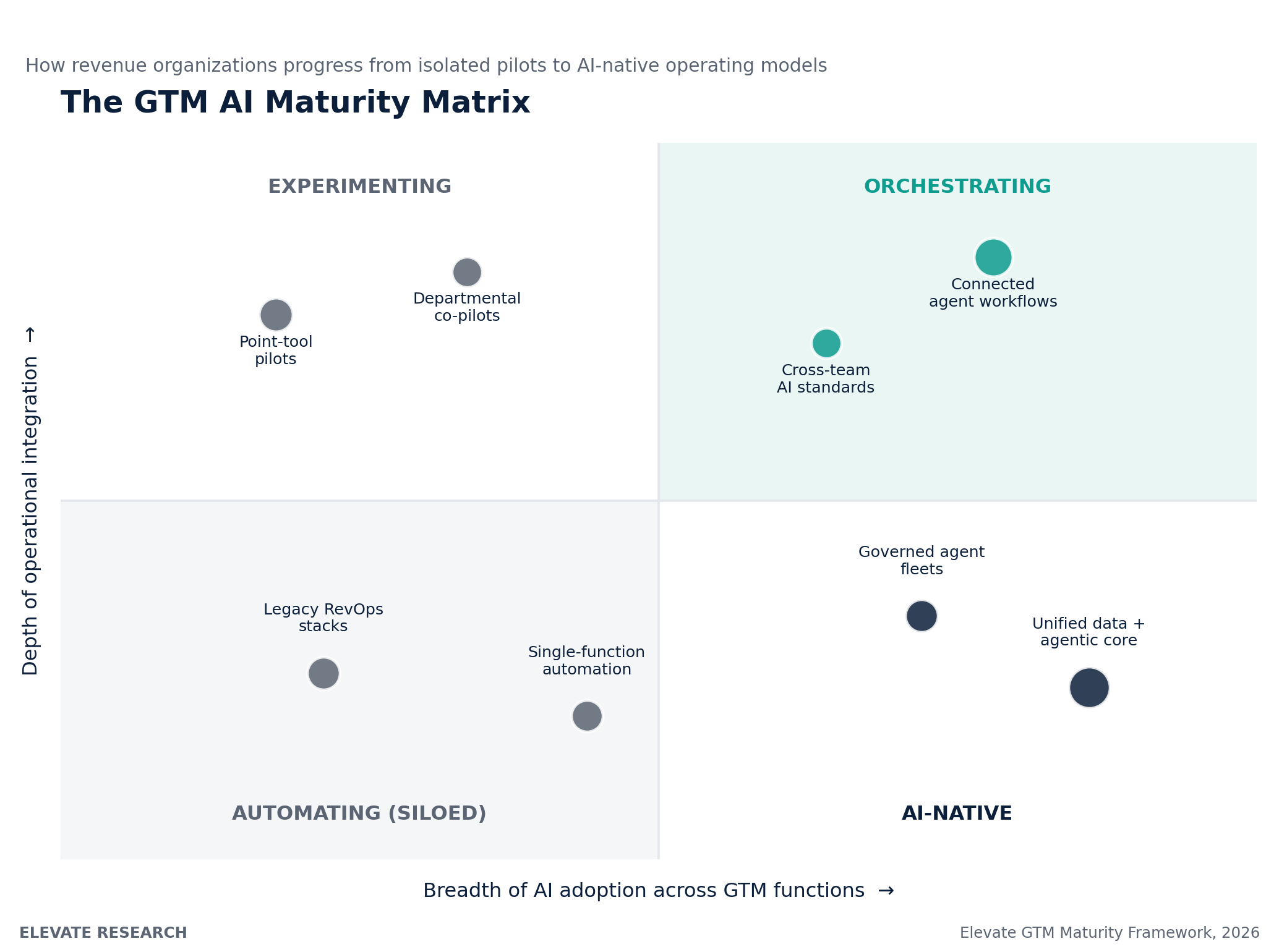 Figure 3. The Elevate GTM AI Maturity Matrix. Most organizations sit in the experimenting or siloed automation quadrants; the AI-native quadrant requires both breadth of adoption and depth of integration.
Elevate's synthesis of adoption patterns across the sources reviewed for this report suggests that organizations move through four recognizable stages on the path to AI-native GTM. In the experimenting stage, individual teams pilot point tools with limited data connectivity and no shared governance standard. In the siloed automation stage, functions such as sales development or content production automate discrete tasks but remain disconnected from adjacent teams, so gains in one function do not compound into the next. In the orchestrating stage, organizations begin connecting agents across functions on shared data and shared governance, and measurable productivity gains start to appear. In the AI-native stage, strategy, execution, and optimization run on a single connected operating model, where agents are a native part of how work gets done rather than a layer bolted onto legacy process.
Where the readiness gap is widest
Elevate's AI Readiness Index applies the same pattern intelligence approach to function-level adoption data drawn from McKinsey, Gartner, and the other sources synthesized in this report, scoring each GTM function on data maturity, agent coverage, governance, and adoption depth. The pattern that emerges is consistent across sources: the largest current gap between existing capability and near-term target state sits in pricing and revenue operations, the two functions most dependent on clean, unified data and the least likely historically to have received dedicated technology investment relative to marketing and sales.
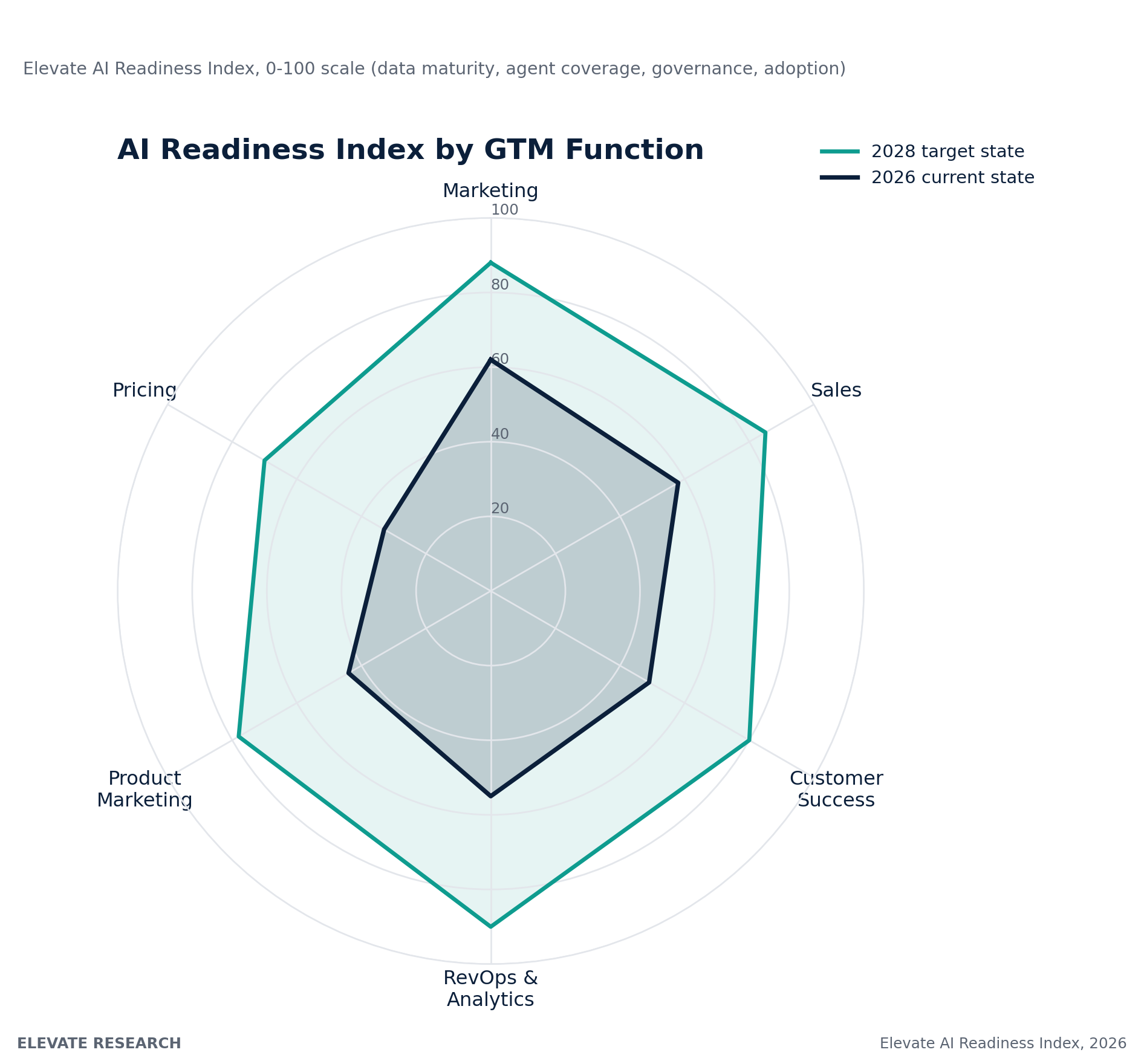 Figure 4. Elevate AI Readiness Index by GTM function, current state versus 2028 target state, scored 0 to 100 on data maturity, agent coverage, governance, and adoption depth.
This finding has direct planning implications. Organizations that concentrate AI investment in the most visible, customer-facing functions, typically marketing content and sales outreach, while leaving pricing and RevOps under-resourced, are optimizing the parts of the system that are easiest to demonstrate in a board deck rather than the parts of the system that most constrain enterprise-wide return. Elevate's recommendation, developed further in the next section, is to sequence investment toward the connective tissue functions first, even when they are less visible, because they determine whether gains in customer-facing functions actually compound rather than remain isolated.
The compounding cost of treating AI as a tooling decision
The most consistent pattern across the research synthesized for this report is that organizations which frame AI adoption as a tooling decision, evaluated primarily on feature comparisons between vendors, systematically underinvest in the data architecture and governance work that determines whether any of those features actually deliver value. This mirrors PwC's own finding, drawn from its client advisory work, that generative AI seat deployment scale, PwC reports roughly 200,000 internal users of its own AI tooling, is a weak predictor of value capture on its own; the firms PwC works with that report the strongest return are those that paired tool rollout with deliberate workflow redesign rather than layering AI on top of an unchanged process. Elevate's pattern intelligence synthesis of this dynamic across every source reviewed for this report leads to a simple rule of thumb for 2026 budget planning: for every dollar allocated to an AI agent license or seat, revenue leaders should expect to allocate a comparable amount to the data unification, governance, and workflow redesign work required to make that agent trustworthy in production. Organizations that treat this second dollar as optional, rather than as the actual source of return, are the ones most likely to appear in Gartner's 40 percent agentic project cancellation figure over the next 18 months.
7. Strategic Recommendations
The gap between AI adoption and AI value is closed through sequencing and governance, not through faster deployment. Elevate recommends five actions for revenue leaders planning their 2027 operating model now.
1. Build the unified context layer before scaling agents
Every analyst source reviewed for this report converges on the same root cause for stalled AI value: fragmented, inconsistent data. Before expanding agent deployment, invest in a single, governed source of customer and pipeline truth that every agent, and every human, draws from. Gartner's own guidance to sales leaders makes this the first priority for a reason: agents built on fragmented data cannot outperform the data they are given.
2. Measure capacity and effectiveness, not activity
Replace agent seat counts and deployment counts as success metrics with measures of expanded seller and marketer capacity, effectiveness of output, and commercial outcome. McKinsey's finding that high performers are nearly three times more likely to have defined human-in-the-loop validation processes than other organizations should inform how this measurement discipline is built, not just what is measured.
3. Fund pricing and RevOps at parity with customer-facing AI
Elevate's readiness data shows pricing and revenue operations as the widest current gap between capability and target state, yet these functions are consistently the last to receive dedicated AI investment. Correcting this sequencing unlocks compounding value across every customer-facing function that depends on accurate, real-time pricing and pipeline data. In practice, this means allocating budget to unify pricing logic, discount governance, and pipeline data quality before, or at minimum alongside, funding new customer-facing content and outreach agents, since those customer-facing agents inherit whatever quality of pricing and pipeline data sits underneath them.
4. Establish agent governance before it becomes a forced response to incident
With only 21 percent of organizations reporting a mature governance model for autonomous agents, and Forrester estimating more than 10 billion dollars in enterprise value at risk industry-wide from ungoverned generative AI in 2026 alone, governance should be built proactively. This includes clear policy for what agents can act on autonomously, what requires human review, and how agent decisions are logged and auditable.
5. Prepare for AI-mediated buyers now, not after adoption becomes mainstream
With Gartner projecting that 90 percent of B2B buying will be AI agent intermediated by 2028, and Forrester already predicting seller-facing agent negotiation in 2026, revenue teams should begin testing how their own content, pricing logic, and proposal information perform when evaluated by a buyer's AI agent rather than a human buyer, since the two do not always weigh the same signals the same way.
ELEVATE PERSPECTIVE None of these five actions require waiting for a bigger AI budget. They require reallocating the budget that already exists away from the most visible point solutions and toward the operating model foundation that determines whether every future AI investment compounds or dissipates. Organizations that treat 2026 and 2027 as the sequencing window, rather than the deployment finish line, will be structurally ahead of competitors who continue to add agents on top of the same fragmented systems.
8. Executive Takeaways
- Adoption has outpaced value: AI agents in B2B sales are projected to outnumber human sellers ten to one by 2028, but fewer than 40 percent of sellers currently report a measurable productivity gain, meaning deployment has outpaced demonstrated value.
- The revenue signal is now public and audited: Salesforce Agentforce annual recurring revenue crossed 1 billion dollars in Q1 FY2027, up from 800 million dollars the prior quarter, confirming agentic AI is now a material, audited revenue line for major GTM platforms.
- Governance, not capability, is the binding constraint: Only 21 percent of organizations report a mature governance model for autonomous agents, and Forrester estimates more than 10 billion dollars in enterprise value is at risk in 2026 from ungoverned generative AI use.
- Buyer behavior is changing faster than seller readiness: Gartner projects 90 percent of B2B buying will be AI agent intermediated by 2028; Forrester already expects seller-facing agent negotiation to begin in 2026, changing what content and pricing logic need to optimize for.
- Investment sequencing is misallocated: Elevate's readiness data shows pricing and RevOps as the widest current capability gap, yet these functions are typically the last to receive dedicated AI investment relative to marketing and sales.
- The gap between leaders and laggards is widening: BCG research finds the small share of companies it classifies as future-built for AI achieve five times the revenue growth of peers, evidence the performance gap is compounding rather than closing.
9. Future Outlook
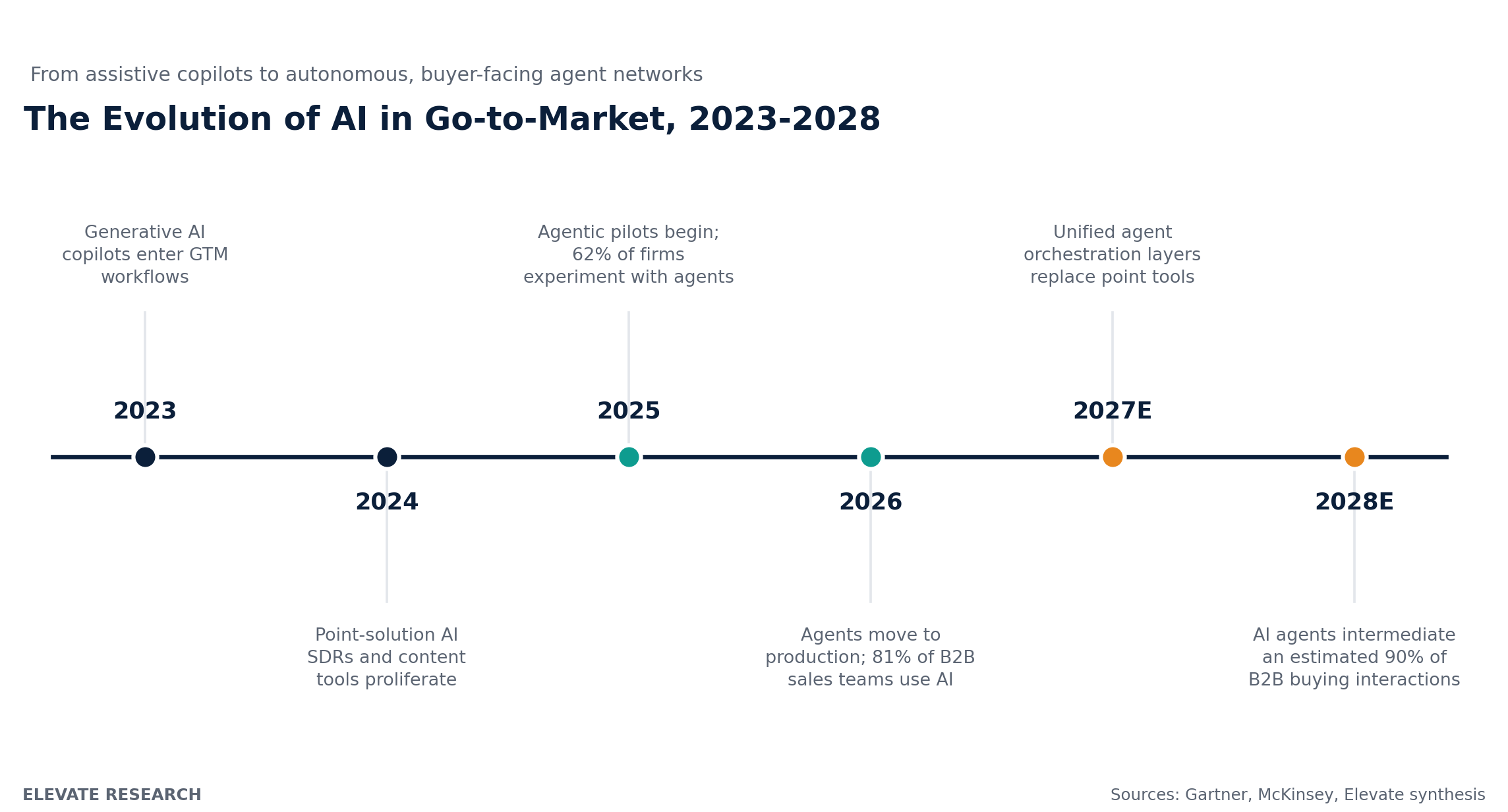 Figure 5. The evolution of AI in go to market, from assistive copilots in 2023 to projected agent-intermediated buying at scale by 2028.
The next 24 months will separate revenue organizations into two groups: those that treat AI-native go to market as a coherent operating model and those that continue accumulating disconnected AI features on top of legacy process. Based on the trajectory of the data reviewed in this report, Elevate expects four developments to define 2027 and 2028.
First, agent orchestration will become the primary competitive battleground among CRM and GTM platform vendors, replacing feature breadth as the main axis of differentiation. As Salesforce, HubSpot, and other platforms converge on comparable core agent capability, the deciding factor for enterprise buyers will increasingly be which platform offers the most trustworthy, governed, and interoperable orchestration layer across a company's full technology stack, including open protocols such as the Model Context Protocol that allow agents to operate across systems rather than within a single vendor's walled garden.
Second, the productivity paradox that Gartner has identified in 2026 will begin to resolve unevenly. Organizations that acted on the sequencing recommendations in this report, unifying data before scaling agents and measuring capacity rather than activity, will begin reporting credible, audited productivity gains, while organizations that continued adding point tools without addressing underlying data fragmentation will see their AI spend continue to grow without a corresponding improvement in commercial results, increasing pressure from finance and the board to justify continued investment.
Third, buyer-side AI agents will move from a minority behavior to a default expectation in enterprise procurement, particularly in technology and business services purchasing. Sellers who have not adapted their content, proposal structure, and pricing transparency to perform well when evaluated by an AI agent, rather than only by a human buyer, will find themselves systematically filtered out of consideration sets earlier in the buying process than they realize, a dynamic that Elevate expects to become measurable in win rate data by late 2027.
Fourth, governance will shift from a compliance afterthought to a competitive differentiator that buyers actively evaluate. As the direct financial cost of governance failures becomes more visible, through the kind of enterprise value losses Forrester has already begun quantifying, buyers will increasingly ask vendors and partners to demonstrate how AI agent decisions are logged, reviewed, and auditable, mirroring how data security and privacy questions became standard procurement criteria in the prior technology cycle.
The organizations most likely to be reading this report in a position of strength two years from now are not necessarily those with the largest AI budgets today. They are the ones treating this moment as an operating model transition, sequencing investment deliberately, and building the governance and data foundation that allows every subsequent AI investment to compound rather than dissipate.
Subsequent assets in this series examine specific dimensions of that transition in depth, including GTM strategy benchmarks, product marketing and pricing evolution, sales enablement and revenue growth benchmarks, and the changing shape of customer buying behavior. Readers building a 2027 GTM operating plan should treat this asset as the baseline against which every subsequent, more specific finding in the series should be weighed.
10. References
- Gartner. Gartner Predicts AI Agents Will Outnumber Sellers 10 to 1 by 2028, Yet Fewer Than 40% of Sellers Will Say Agents Improved Productivity. Gartner Newsroom, July 2026.
- Gartner. Gartner Forecasts Worldwide AI Platforms and Models Market to Grow 63% in 2026. Gartner Newsroom, July 2026.
- Gartner. Forecast Analysis: Cross-Functional AI Agents and Assistants, Worldwide, 2026. Gartner Research, February 2026.
- Gartner. Gartner Predicts 40% of Enterprise Apps Will Feature Task-Specific AI Agents by 2026, Up from Less Than 5% in 2025. Gartner Newsroom, August 2025.
- Gartner. Top Technology Predictions for 2026 and Beyond, including B2B buying and multi-agent AI forecasts. Gartner Research, 2026.
- Forrester. Predictions 2026: B2B Marketing, Sales, and Product. Forrester Research, October 2025.
- Forrester. Forrester's 2026 B2B Marketing, Sales, and Product Predictions: B2B Companies Will Lose More Than 10 Billion Dollars Because of Ungoverned Use of Generative AI. Business Wire, October 28, 2025.
- McKinsey and Company. The State of AI in 2025: Agents, Innovation, and Transformation. McKinsey Global Survey, November 2025.
- McKinsey and Company. Agentic AI Advances. McKinsey Week in Charts, January 2026.
- McKinsey and Company. The Future of B2B Sales: How Growth Champions Rewire Their Playbooks with AI. McKinsey Insights, 2026.
- McKinsey and Company. Past Forward: The Modern Rethinking of Marketing's Core, State of Marketing Europe 2026. McKinsey Insights, November 2025.
- Bain and Company. B2B Growth Agenda 2026, based on a survey of more than 1,100 commercial leaders across 18 sectors and 40 countries. Bain Insights, 2026.
- Boston Consulting Group. BCG AI revenue disclosure and future-built company research, as reported via company statements, April 2026.
- Deloitte. AI capability investment and workforce credentialing commitments through 2030, as reported in company statements, 2025 to 2026.
- Accenture. Global AI investment commitment and AI Refinery platform positioning, as reported in company statements, 2025 to 2026.
- PwC. Generative AI investment commitment and enterprise deployment scale, as reported in company statements, 2023 to 2026.
- Salesforce. Q4 FY2026 and Q1 FY2027 earnings calls and investor disclosures, covering Agentforce annual recurring revenue, deal volume, and token processing volume. Salesforce Investor Relations, February and May 2026.
- HubSpot. Breeze AI agent customer adoption figures, as reported in company product and investor communications, 2026.
- IDC. AI spending forecasts and FutureScape 2026 predictions on agentic enterprise transition. IDC Research, November 2025 to 2026.
- Elevate Research. Elevate GTM AI Maturity Matrix and AI Readiness Index, proprietary frameworks derived from Elevate's pattern intelligence synthesis of the analyst, public company, and vendor sources cited above. Elevate Research, 2026.
Contents
Related Research
GTM Research
Explore research, benchmarks, technology landscapes, and perspectives on the evolution of go-to-market.
View Research Library →