
By the Elevate GTM Solutions Team · Updated November 10, 2026 · 23 min read
What AI Search Citation Studies Actually Show: A Roundup of the Evidence, Its Limits, and What B2B Teams Can Do
A new genre of research has appeared in the last two years: studies that count which websites AI assistants cite when they answer questions. They produce confident headlines. Reddit is the most cited site. Wikipedia dominates one assistant. Only a small share of sources appear on more than one engine. If you run go-to-market for a software company, these findings seem to bear directly on your marketing: if assistants shape shortlists, then what they cite matters.
The studies are useful. They are also produced mostly by companies that sell AI visibility tools or related services, they use different questions, different time windows and different ways of counting, and they sometimes disagree. This roundup reviews the main studies we could verify as of November 2026, says what each measured, notes where they agree and disagree, explains why, and then turns the evidence into practical guidance with appropriate modesty. We have a stake too: Elevate GTM Solutions makes a GTM strategy platform, and our own AI visibility is something we are working to improve. We do not sell a visibility tracker, and we have tried to report each study as its authors describe it. Figures are attributed and paraphrased, links are in the sources section, and where we could only see a secondary summary of a study, we say so.
What Do AI Search Citation Studies Show?
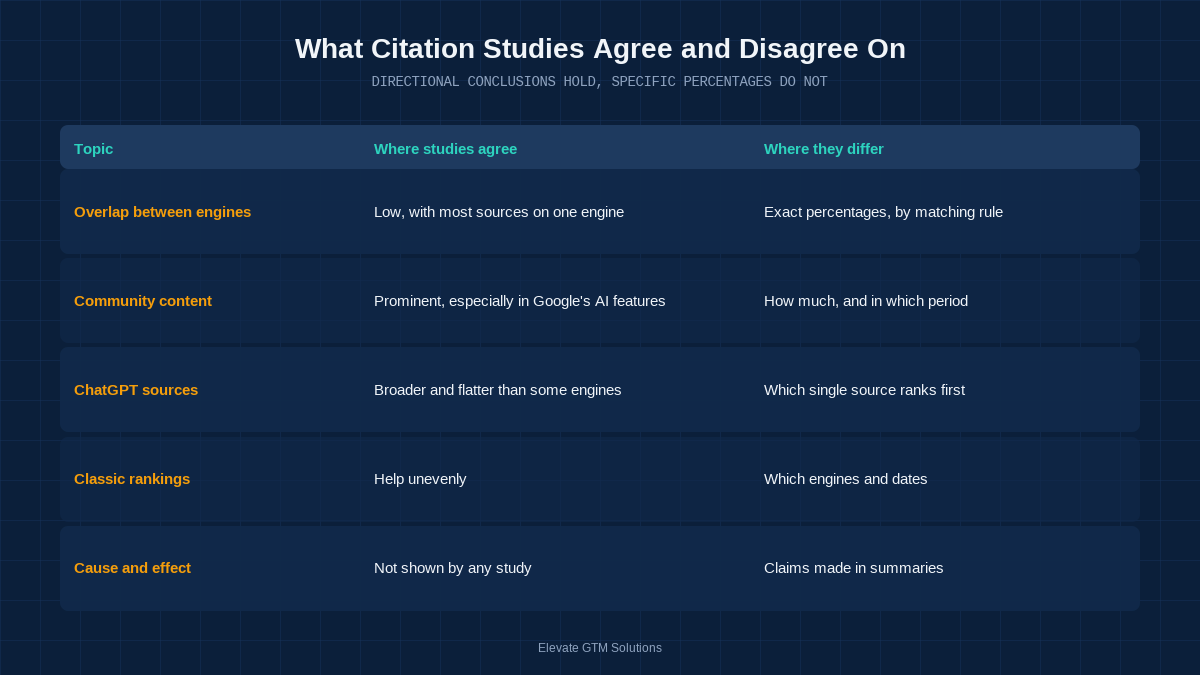
Across the studies we reviewed, a few patterns recur: the assistants cite quite different sources from one another; community and video sites such as Reddit and YouTube are prominent, especially in Google's AI features; Wikipedia is prominent in ChatGPT in at least one large study; and the set of cited sources changes over time. The studies disagree on specific rankings and percentages because they use different questions, periods, engines and counting methods. The most defensible conclusions are directional: no single source type or tactic works across all engines, clear and consistent public information helps, and any specific percentage should be treated as one study's result, not a law.
Can I rely on one study's top-ten list? No. Rankings differ by study, by engine and by topic, and they change.
Should B2B software companies care about Reddit? Possibly, as one place buyers and assistants look, but the evidence is about citation share, not about what drives purchases.
What this roundup covers, and what it does not
| Covered | Not covered |
|---|---|
| Studies that count citations or sources in AI answers, with a stated sample and method | Tools' proprietary scores that we cannot inspect |
| Large-sample studies by vendors and a small-sample study by a PR firm | Claims we could not trace to a primary or clearly attributed source |
| Findings about overlap between engines | Studies of whether citations cause purchases |
| What the studies imply for B2B software go-to-market | Legal, technical or platform-specific advice |
We read primary pages where we could and flag secondary summaries. Several figures circulate widely in blog posts without a traceable method, and we left those out.
The studies at a glance
| Study | Who ran it | Window | Size | Engines | Headline finding as reported |
|---|---|---|---|---|---|
| AI platform citation patterns | Profound, an AI visibility vendor | August 2024 to June 2025 | About 30 million citations | ChatGPT, Google AI Overviews, Perplexity | ChatGPT's most cited source was Wikipedia, at close to half of its top-source citations. Google AI Overviews and Perplexity leaned on Reddit |
| Citation overlap study | Wellows, an AI visibility vendor | January to June 2026 | About 22.7 million citations across more than a million questions | ChatGPT, Gemini, Perplexity, Google AI Overviews, Google AI Mode | Most sources cited on a question appeared on one engine only, and ChatGPT's sources overlapped least with the others |
| Citation source behavior | BrightEdge, an SEO platform vendor | 2026 | Prompts across ten industries | ChatGPT, Perplexity, Gemini, Google AI Mode, Google AI Overviews | ChatGPT's citations are spread more evenly across domains than other engines', and Google AI Overviews leans on community content |
| Most-cited domains by engine | Peec AI, an AI visibility vendor | March 2026 | About 30 million sources, United States | Five engines | Domain rankings differ by engine, with Reddit appearing prominently |
| AI search overlap | Ahrefs, an SEO vendor | Not stated in the summary we saw | Large, details in the original | Several | Perplexity's citations align most closely with classic search rankings, while ChatGPT and Gemini overlap least |
| State of AI citations 2026 | 5W, a public relations agency | 2026 | 288 AI answers plus 72 Google lookups | ChatGPT, Claude, Gemini, Perplexity, plus Google AI Overviews | A business publication was the most named source, and Google AI Overviews cited Reddit often in the sample |
Treat the table as a map, not a leaderboard. The studies are not comparable on a single scale.
Study by study
Profound: a large early study across three engines
Profound's analysis covered roughly thirty million citations from August 2024 to June 2025 across ChatGPT, Google AI Overviews and Perplexity. The finding most quoted is that Wikipedia accounted for a large share of ChatGPT's top citations, close to half in the figure reported by Search Engine Roundtable, while Google AI Overviews and Perplexity most often cited Reddit. The window is now more than a year old, the engines have changed since, and Profound sells a visibility product. The study remains a useful early marker of how different the engines' citation habits were.
Wellows: overlap between five engines
Wellows analyzed about 22.7 million citations from January to June 2026, collected from questions its customers track. Its central finding is about overlap rather than ranking: on questions where all five engines cited sources, most websites appeared on one engine only, and very few appeared on all five. ChatGPT's sources overlapped least with the other engines' sources. The authors are open about limits worth repeating here: the questions lean commercial and come from brands already paying attention to AI visibility, mostly in English and heavily from the United States; each question was collected once per engine, so run-to-run variation is not separated from real differences between engines; and Wellows sells an AI visibility tool. The authors also tested some of their own findings against a random baseline and reported that part of two headline claims did not survive, which is a useful example of how much interpretation depends on method.
BrightEdge: distribution of citations across domains
BrightEdge's AI Catalyst analysis compared how concentrated each engine's citations are. It reported that ChatGPT's top ten domains accounted for a smaller share of its citations than the top ten did for Perplexity, Gemini or Google's AI Mode, meaning ChatGPT's citations are spread more widely across the web. It also described Google AI Overviews as leaning toward user-generated content. The prompts span ten industries, including B2B technology. As with the others, the prompt set comes from the vendor's platform.
Peec AI: domain rankings by engine
Peec AI's research, published in March 2026, analyzed about thirty million sources for the United States and ranked the most cited domains for each engine. A secondary summary reports Reddit ranking first across the engines it covered. We read Peec's research page only in summary and recommend consulting the original for engine-specific lists.
Ahrefs: how citations relate to classic rankings
Ahrefs has published several studies on AI search and classic search overlap. The summary we saw reports that Perplexity is the most aligned with traditional search results, while ChatGPT and Gemini show the least overlap with them. Other Ahrefs work, as reported by Wellows, found that Google's two AI surfaces cited the same web addresses only a minority of the time and that a large share of AI Overview citations change between generations of the same answer. Ahrefs is an SEO vendor with an interest in showing that search skills still matter, and its analyses are among the more transparent about method.
5W: a small sample with a different design
The PR agency 5W analyzed 288 answers from four assistants and 72 Google lookups. In that sample, a business publication was the source named most often, and Google AI Overviews appeared for most lookups and often cited Reddit. The sample is small, and the study is best read as a snapshot that shows how a PR audience views the question.
Other figures in circulation
Several widely shared figures, including a claim that most B2B buyers use AI tools in research, trace back to press releases that summarize other analyses. We could not verify the underlying methods, so we do not use them. The G2 surveys discussed in our companion review on review sites and software buying are a better-documented source on buyer behavior.
Where the studies agree
| Pattern | Support |
|---|---|
| Assistants cite quite different sources from each other | Wellows' overlap study, BrightEdge's concentration analysis and Ahrefs' overlap work point the same way |
| Community and video content is prominent, especially in Google's AI features | Profound, BrightEdge and the 5W sample all show Reddit or user-generated content prominently |
| ChatGPT draws on a broader and flatter set of domains than some other engines | BrightEdge's concentration figures and Wellows' overlap findings are consistent with this |
| Citation patterns change over time | Ahrefs' findings on changing citations and the shift between Profound's 2024 to 2025 window and 2026 studies |
| Classic ranking helps unevenly | Perplexity looks most aligned with classic search, while ChatGPT and Gemini look least aligned in Ahrefs' summary |
Where they disagree, and why
| Disagreement | Likely reasons |
|---|---|
| Which single source ranks first | Different prompts, periods, engines and counting methods |
| How much Reddit is cited | Question mix, whether the engine's product changed in the window and whether the study counts citations or share of answers |
| How much overlap exists between engines | Matching at website versus exact page level, and whether the same questions are used for every engine |
| Whether classic top-ten ranking predicts citation | Different engines and different dates, as AI products changed during the studies |
| How large the effect of a tactic is | Most studies measure association, not cause |
The disagreements are not scandals. They are what you would expect when several vendors with different datasets measure a fast-changing system. They do mean that no single percentage should be copied into a strategy document as a fact.
How to read a citation study
| Question | Why it matters |
|---|---|
| Who produced it, and what do they sell? | Vendors have incentives to show citation as a lever they can help with |
| What were the prompts, and where did they come from? | A prompt set from customers of an AI visibility tool is not a random sample of buyer questions |
| Which engines, versions and modes? | Products change quickly, with and without web search |
| What window? | A study from a year ago may describe a different system |
| What was counted? | Citations, brand mentions, exact pages or domains |
| How many times was each question run? | Single runs confuse variation with difference |
| How was overlap or ranking calculated? | Matching rules change results a great deal |
| Was anything tested against a baseline? | Raw overlap can be produced by shared candidate pools |
| Does the study claim cause? | Most can show association only |
| Is the original available? | Secondary summaries drift |
If a study does not answer most of these, treat its numbers as marketing.
What B2B software teams can reasonably conclude
The evidence supports a few modest, practical conclusions.
Check what assistants say about you, by engine. Because engines cite different sources, a good result on one tells you little about another. Our guide to the AI search visibility audit shows a method.
Be present where buyers discuss software. Community and review content shows up in citations, according to several studies, and buyer surveys, discussed in our review-sites page, say that buyers use these sources. Honest participation and real customer reviews are better than manufactured activity.
Keep facts consistent across your own site and listings. Assistants draw on whatever they find, and conflicting prices or descriptions make accurate answers harder.
Publish clear, direct pages that answer real questions. This is good practice for buyers regardless of citations.
Do not chase a single tactic. The studies show differences between engines and over time, so a single trick is unlikely to hold.
Measure repeatedly. Single answers vary. Track mention rate, accuracy and sources over several rounds.
What the studies do not show
| Claim sometimes drawn | Why the evidence does not support it |
|---|---|
| "Reddit posts will get us recommended" | Studies show citation share, not that posting causes recommendations, and manipulation can backfire |
| "Wikipedia is what ChatGPT trusts" | One large study showed a high share in one window. Engines and models change |
| "Rank in the top ten and you will be cited" | Overlap with classic rankings varies by engine and study |
| "Citations drive revenue" | None of the studies we reviewed measured purchases |
| "Our tool predicts your visibility" | Tool scores may be estimates, and samples can be small |
| "This percentage applies to your market" | Prompt sets and categories differ |
A small study you can run yourself
You can learn more from a modest study of your own category than from a headline.
| Step | Practice |
|---|---|
| 1. Write the questions | Twenty to thirty real buyer questions, in groups: category, use case, comparison, alternatives, how-to |
| 2. Choose engines | The ones your buyers use, with web search on where offered |
| 3. Run each three times | To see variation |
| 4. Record everything | Mentions, descriptions, cited sources, competitors and dates |
| 5. Count by source type | Your own pages, review sites, communities, media, vendors and encyclopedias |
| 6. Compare engines | Overlap of sources between engines for the same question |
| 7. Repeat monthly | Look at direction, not single results |
| 8. Act on facts first | Fix wrong or conflicting information before building new content |
Keep the sample and the counts visible, and share caveats with leadership. A short, honest internal report beats a quote from a vendor's study.
Comparing two studies, with invented examples
To show how method changes a headline, here are two invented studies of the same engine in the same month. They are illustrations, not real data.
| Study A | Study B | |
|---|---|---|
| Prompt source | Customers of a visibility tool, mostly commercial questions | A panel of buyers asked to write questions about software they were evaluating |
| Counting rule | Share of all citations by domain | Share of answers that name each domain at least once |
| Collection | Each question run once | Each question run five times |
| Reported top source | A community site | A review site |
Both studies could be honest, and both could be right about their own data. The first counts every citation, so a site cited several times in one answer weighs more. The second counts answers, so a site is counted once per answer. The first draws prompts from brands already tracking visibility, which skews toward commercial questions. The second asks buyers, which may draw out different questions. A reader who sees only the headline learns less than a reader who sees the design.
A scorecard for judging a citation study
Score each line from one (weak) to three (strong). A total of nineteen or lower suggests treating the study as an illustration.
| Criterion | 1 | 2 | 3 |
|---|---|---|---|
| Independence | Sells a product that benefits from the finding | Has some interest but discloses it | Independent or fully disclosed |
| Prompt source | Not stated | Stated, from the publisher's customers | Stated and designed to represent buyers |
| Sample size | Not stated | Stated but small | Stated and large |
| Repeat runs | Single run, not acknowledged | Single run, acknowledged | Repeated runs |
| Counting rule | Unclear | Stated | Stated with alternatives tested |
| Engine versions and dates | Not stated | Dates only | Dates, versions and modes |
| Baseline or test | None | Informal | Tested against a baseline |
| Claims of cause | Strong claims of cause from association | Cautious language | Clear that it shows association only |
| Availability | Summary only | Report available with gaps | Full method public |
| Limitations stated | None | Some | Thorough |
A coding scheme for your own study
If you run your own small study, a consistent way to classify cited sources makes patterns visible.
| Source type | Examples of what to look for |
|---|---|
| Your own site | Product pages, guides, comparison pages, documentation |
| Review and comparison sites | Software marketplaces and comparison directories |
| Communities and forums | Discussion threads and question sites |
| Video | Channels and tutorials |
| Encyclopedias and reference | Reference sites |
| Media and trade press | Articles and interviews |
| Analyst and research | Reports and summaries |
| Competitor sites | Their product and comparison pages |
| Vendor-neutral guides | Independent explainers |
| Other | Anything else, with a note |
Record the domain and the type for every cited source, and note whether the source is accurate about your company. Count by type and by engine.
Questions to ask vendors who sell visibility tools
| Question | Why it matters |
|---|---|
| How are prompts chosen, and can I use my own? | Prompt choice drives results |
| How often is each prompt run, and on which engines and modes? | Variation and coverage |
| Is the score an estimate from my homepage, or from live answers? | Some starting scores are estimates |
| How are mentions and citations counted? | Counting rules change numbers |
| How large is the sample behind each chart? | Small samples mislead |
| Can I export raw answers and sources? | Verification |
| How do you handle personalization and location? | Answers vary by user |
| What are the known limits? | Honest vendors name them |
| Which of your published studies used your own customers' prompts? | Bias awareness |
| How will you report changes in engines and models? | Shifts can masquerade as progress |
How to brief leadership on citation research
| Element | Practice |
|---|---|
| Lead with direction, not numbers | Assistants cite different sources, and facts about us should be consistent |
| Show our own small study | Counts from our questions beat quoted percentages |
| Name the caveats | Vendor studies, small samples, changing engines |
| Propose low-regret actions | Fix wrong facts, publish clear answers, keep listings accurate, collect honest reviews |
| Avoid promises | No one can guarantee a mention |
| Set a review cadence | Monthly re-checks and a quarterly summary |
Glossary
| Term | Meaning |
|---|---|
| Citation | A source an assistant shows or names in an answer |
| Mention | The assistant names your company in the answer, with or without a link |
| Share of citations | A source's portion of all citations counted in a study |
| Overlap | How much two engines' cited sources coincide on the same question |
| Prompt set | The questions used in a study |
| Run-to-run variation | Differences between answers to the same question asked repeatedly |
| Baseline | A comparison, such as random picking, used to judge whether a pattern is unusual |
| User-generated content | Posts and comments written by users, such as forum threads |
A hypothetical example
This is an illustration, not a real company.
A software company's head of marketing read three vendor studies and concluded that her team should post more on community sites. Before changing the plan, she ran a small test with twenty-five questions across three engines, three runs each. Her own site was cited in a small share of answers. Most cited sources for her category were review sites, a handful of vendor comparison pages and two community threads. The engines named competitors she had not considered, and her description in one answer was out of date.
She did not start posting widely. She fixed the out-of-date description on her profiles, aligned pricing across her site and listings, published a plain what-is page and an honest comparison with the most common alternative, and invited real customers to leave reviews. She also joined one community as a participant. Three months later, her description was accurate in most answers and her company appeared in a few more category answers. She reported the result with counts and noted that she could not say which action caused the change.
A second hypothetical: reading a study before acting on it
This is another invented illustration.
A founder saw a vendor study claiming that a particular community site accounted for a large share of citations for software questions. The head of product marketing read the method. The prompts came from the vendor's customers and leaned toward consumer-style comparison questions. Each question had been run once. The counting rule was share of all citations, and the study did not say which engines or modes were used.
She asked her own question: do our buyers' questions look like those? They did not, since her buyers asked about integrations and security. She ran twenty-five of her own questions three times each on two assistants. A community site appeared occasionally, and review sites and vendor documentation appeared more often. She did not change her plan on the strength of the vendor study. She used her own counts to prioritize fixing her documentation pages and her listings, and she added a note to her quarterly report: re-run the small study each quarter.
Summary for busy leaders
If you remember three things: citation studies are mostly vendor-produced, use different prompts and counting rules and disagree on rankings, so treat any percentage as one study's result; the studies agree that engines cite different sources and that community and review content is prominent, so measure each engine and keep facts consistent; and none of the studies shows that citations cause purchases. Run a small study of your own, fix wrong facts first and review monthly.
Quick reference
| Question | Short answer |
|---|---|
| Who produces these studies? | Mostly vendors of AI visibility and SEO tools, plus agencies |
| What do they agree on? | Engines cite different sources, and community and review content is prominent |
| Where do they disagree? | Rankings and percentages, because prompts, periods and counting differ |
| What can I conclude? | Direction: measure per engine, keep facts consistent, take part honestly |
| What can I not conclude? | That a tactic works for you, or that citations drive revenue |
Questions teams ask about citation research
"Should we change strategy because of a study?" Not on one study. Read the method, run a small study of your own and take low-regret actions first.
"Which engine matters most?" The one your buyers use. Ask them, and check what each assistant says about you.
"Is the research getting better?" Some studies now test their own claims against baselines and state limits openly, which is encouraging. Many still do not.
"Do citations equal recommendations?" No. A citation is a source shown in an answer. A recommendation is what the assistant says about vendors. They are related and different, and studies measure them differently.
"How often should we check?" Monthly or quarterly, with the same questions, and note any changes in engines or in your own content.
"What if assistants get facts about us wrong?" Fix inconsistent public information first, publish a plain page that states the facts and request corrections where platforms allow.
In plain language
Citation studies are useful clues about a changing system, and they are not laws. They agree that assistants cite quite different sources and that community and review content is prominent. They disagree about rankings and percentages because they measure different things. They come mostly from vendors and show association, not cause. Use them to decide what to measure, run a small study of your own, keep your public facts consistent and avoid promising anything that depends on how an assistant behaves next month.
A checklist before you quote a citation study
- You have read the method, not only the headline.
- You know who produced it and what they sell.
- You know the prompts, engines, window and counting rule.
- You are quoting the figure with its source and date.
- You have not applied it to a different engine or market.
- You have said what it does not show.
- You have compared it with your own small study.
Final thoughts
Citation studies are the first drafts of a new field. They show that assistants draw on different parts of the web, that community and review content matters in some engines and that the picture changes quickly. They do not yet tell any company how to be recommended. The sensible response is modest and practical: measure what assistants say about you, keep your public facts consistent, publish clear and honest answers, take part where buyers talk and revisit your measurements regularly.
Related research terms
| Term | Meaning |
|---|---|
| Generative engine optimization | The practice of improving how AI assistants describe and cite a company |
| Answer engine | A system that answers questions directly, often with sources |
| Retrieval | When an assistant fetches pages to ground an answer |
| Grounding | Using retrieved sources to support an answer |
| Citation share | The portion of citations that go to a source |
Keeping up with new studies
New citation studies appear often. When you see one, read its method first, log it in a simple sheet with its publisher, window, sample, engines and counting rule, and compare it with the ones you have already read. Over time you will see which findings recur and which do not.
Questions executives ask
"Which number from these studies should we quote?" None as a promise. If you must quote, name the study, the year and what it measured.
"Should we hire for this?" Start by giving an existing owner a monthly measurement routine and a list of fixes. Hire when the work outgrows that.
Limits of this roundup
We reviewed the studies we could verify as of November 2026, and others exist. We relied on summaries for some. The studies come mostly from vendors, and new ones appear often. Figures here are paraphrased, and readers should consult the originals before quoting a number. Nothing here is evidence about our own product's effect on anyone's visibility.
What to do this week
Pick one study from the sources below and read its method section. Write down its prompt source, engines, window and counting rule. Run twenty of your own buyer questions on two assistants, three times each. Count which source types appear, and note which facts about your company are wrong.
Key takeaways
- Citation studies agree that assistants cite quite different sources from one another and that community content is prominent in some engines, and they disagree on specific rankings and percentages.
- Most studies are by vendors that sell AI visibility or SEO products, use their own prompt sets and show association, not cause.
- Overlap between engines is low, so measure each engine separately.
- Keep facts consistent, publish clear answers, take part honestly where buyers talk and fix wrong information first.
- Treat any percentage as one study's result and run a small study of your own.
Where Elevate GTM Solutions fits
Elevate GTM Solutions is an AI-native GTM operating system for B2B companies. It does not track AI citations or provide visibility scores, so teams use their own checks or a dedicated tool for that. Where it helps is upstream: it holds the decisions your public content and listings should state consistently, including the customer definition, category, positioning, messaging pillars with proof and pricing logic, across 15 modules, with workflows, weekly plans and a recurring review rhythm that can include audit findings. It connects to HubSpot, Salesforce, LinkedIn, Notion and Claude for supported actions. A free first strategy build is available, and published plans, billed annually, are Enable at USD 499 per month and Growth at USD 1,499 per month, with custom Scale pricing.
For related reading, see AI Search Visibility Audit for B2B SaaS, Review Sites and B2B Purchase Influence, What Is Elevate GTM Solutions? and Best AI-Native GTM Platforms for B2B Companies. See the pricing page, or request a demo.
Sources
All accessed in November 2026. We paraphrase findings and recommend reading the originals.
- Profound, AI platform citation patterns: https://www.tryprofound.com/blog/ai-platform-citation-patterns
- Search Engine Roundtable summary of the Profound study: https://www.seroundtable.com/chatgpt-google-aio-sources-39578.html
- Wellows, citation overlap study: https://wellows.com/research/ai-citation-overlap-study/
- BrightEdge, AI engines cite different sources but recommend the same brands: https://www.brightedge.com/resources/weekly-ai-search-insights/ai-search-same-brands-different-sources
- Peec AI, most cited domains by engine: https://docs.peec.ai/research/most-cited-domains-by-engine
- Ahrefs, AI search overlap: https://ahrefs.com/blog/ai-search-overlap/
- 5W, State of AI Citations 2026: https://5wpr.com/research/state-of-ai-citations-2026/
Frequently Asked Questions
What do AI search citation studies show?
That assistants cite quite different sources from one another, that community and video content is prominent in some engines, that one large study found Wikipedia prominent in ChatGPT, and that cited sources change over time. Specific rankings and percentages differ by study.
Which source do AI assistants cite most?
It depends on the study, engine, period and counting method. Reddit and Wikipedia appear prominently in some studies, and no single ranking is settled.
Why do citation studies disagree?
Different prompt sets, engines and versions, time windows, counting rules and matching levels, and a fast-changing underlying system.
Who produces these studies?
Mostly vendors that sell AI visibility or SEO products, plus agencies. That does not make them wrong, and it means readers should check the method.
Do the studies show that citations drive purchases?
No. They count citations. None of the studies we reviewed measured purchases.
How much do engines overlap in what they cite?
Overlap is low in the studies that measure it, with most sources appearing on a single engine, though exact figures depend on method.
Should a B2B software company post on Reddit to be cited?
Community content is prominent in some engines, and honest participation can help buyers find you. The studies do not show that posting causes recommendations, and manipulation can backfire.
How can I check what assistants say about my company?
Write real buyer questions, run them on the assistants your buyers use several times each, record mentions, descriptions and sources, and repeat monthly.
How should I read a percentage from a citation study?
As one study's result, with its prompts, window and method in mind, not as a law about all AI search.
Where can I read the original studies?
The sources section lists the pages we used, and we recommend reading the method section of each before quoting figures.
How can I judge the quality of a citation study?
Check who produced it and what they sell, where the prompts came from, the sample size, whether questions were repeated, how citations were counted, whether engine versions and dates are stated, whether a baseline was used and whether the claims go beyond association.
What should I ask a visibility tool vendor?
How prompts are chosen, how often they run and on which engines, whether scores are estimates or from live answers, how mentions and citations are counted, the sample behind each chart and whether you can export raw answers.
How should I classify cited sources in my own study?
By type: your own site, review sites, communities, video, reference sites, media, analyst reports, competitors, neutral guides and other, recording the domain, type and whether the source is accurate about you.