
By the Elevate GTM Solutions Team · Updated November 10, 2026 · 22 min read
Review Sites and B2B Software Buying: What G2's Buyer Surveys Report, What They Cannot Show, and What to Do
For a decade, software marketers have been told that buyers check review sites before they talk to vendors. More recently they have been told that buyers ask AI chatbots first, and that the chatbots draw on review sites. Both claims come with survey numbers, and most of the numbers come from the same place: G2, a software review marketplace that also sells marketing products to software vendors. That does not make the numbers wrong. It means the evidence has a particular shape, and a company deciding how much effort to put into review sites should know what that shape is.
This review looks at the buyer survey research we could verify as of November 2026, mainly two G2 reports, says what each measured, explains why headline figures from the two do not match each other, notes what the surveys cannot show and offers practical guidance for B2B software companies. Elevate GTM Solutions makes a GTM strategy platform, and we have listings on review sites that we are working to keep accurate. We do not sell review marketing. Findings are paraphrased, links are in the sources section and secondary summaries are flagged. Surveys are self-reported, and none of the research we reviewed measures whether reviews cause purchases.
Do Review Sites Influence B2B Software Purchases?
According to G2's surveys, many buyers say they do. In G2's 2025 Buyer Behavior Report, based on an April 2025 survey of 1,169 B2B decision makers, generative AI chatbots and software review sites were the top two sources influencing vendor shortlists, and enterprise buyers named review sites and AI search as their most used research sources. In G2's March 2026 follow-up, The Answer Economy, which surveyed 1,076 decision makers, a majority said they begin software research with an AI chatbot more often than with Google, and review-site citations were the most confidence-inspiring signal inside AI answers for the largest share of buyers. These are self-reported survey results from a company that sells to software vendors, and they show stated influence, not caused purchases. A sensible response is to keep review profiles accurate and honest, not to treat them as a guaranteed lever.
Should we invest in review sites? Probably in keeping profiles accurate and in collecting honest reviews, in proportion to how your own buyers say they research.
Can reviews be bought or faked? They should not be. Platform rules, buyer trust and legal exposure all argue against it.
The two G2 surveys
| 2025 Buyer Behavior Report | The Answer Economy, 2026 | |
|---|---|---|
| Fieldwork | April 2025 | March 2026 |
| Sample | 1,169 B2B decision makers who are responsible for or influence software purchases | 1,076 B2B software decision makers |
| Published | May 2025 | April 2026 |
| Main theme | How AI is changing every stage of software buying | How AI search is changing software buying, and the role of review sites as a trust signal |
| Publisher | G2, a software review marketplace | G2 |
Headline findings, as reported by G2
| Finding | 2025 report | 2026 report |
|---|---|---|
| Role of AI in starting research | A large majority said AI search had changed how they research, and a minority said they started with AI search more often than Google | A majority said they begin software research with an AI chatbot more often than with Google, up from a smaller share in April 2025 |
| Sources influencing shortlists | Generative AI chatbots and software review sites ranked as the top two influences, followed by vendor sites, market research firms, peers and salespeople | AI chatbots ranked first, with review sites among the most used sources in a different question |
| Enterprise buyers' research sources | Review sites and AI search were the top two sources for buyers at companies of one thousand to five thousand employees, with smaller shares among small businesses | Not the focus |
| Influence of AI on the choice | Not measured in the same way | Most buyers said a chatbot had led them to a different vendor than they had planned, and about a third bought from a vendor they had not heard of |
| Confidence in AI answers | Not the focus | A large majority of buyers said they think more highly of a vendor mentioned by a chatbot, and review-site citations were named most often as the signal that builds confidence in AI answers |
| Speed | Not the focus | Most buyers said AI chatbots accelerated their purchase |
We have kept exact percentages out of the table because G2 reports different percentages for different questions, and the figures are easy to misquote. The sources section links to G2's pages for the numbers.
Why the headline figures do not match
Readers sometimes see one G2 report say that AI chatbots influence shortlists for roughly one in six buyers and another say a majority. Both can be true.
| Source of difference | Explanation |
|---|---|
| Different questions | One question asked buyers to rank the sources that most influenced their shortlist, producing shares that sum to one hundred percent. Another asked which sources buyers use or are influenced by, where they can pick many |
| Different samples | Samples differ in size, timing and composition |
| Different time | Behavior may have shifted between April 2025 and March 2026 |
| Wording and framing | Changing wording shifts answers |
| Stated versus actual behavior | Surveys capture what people say they do |
When you quote these numbers, name the report, the question and the year, and avoid combining percentages across reports.
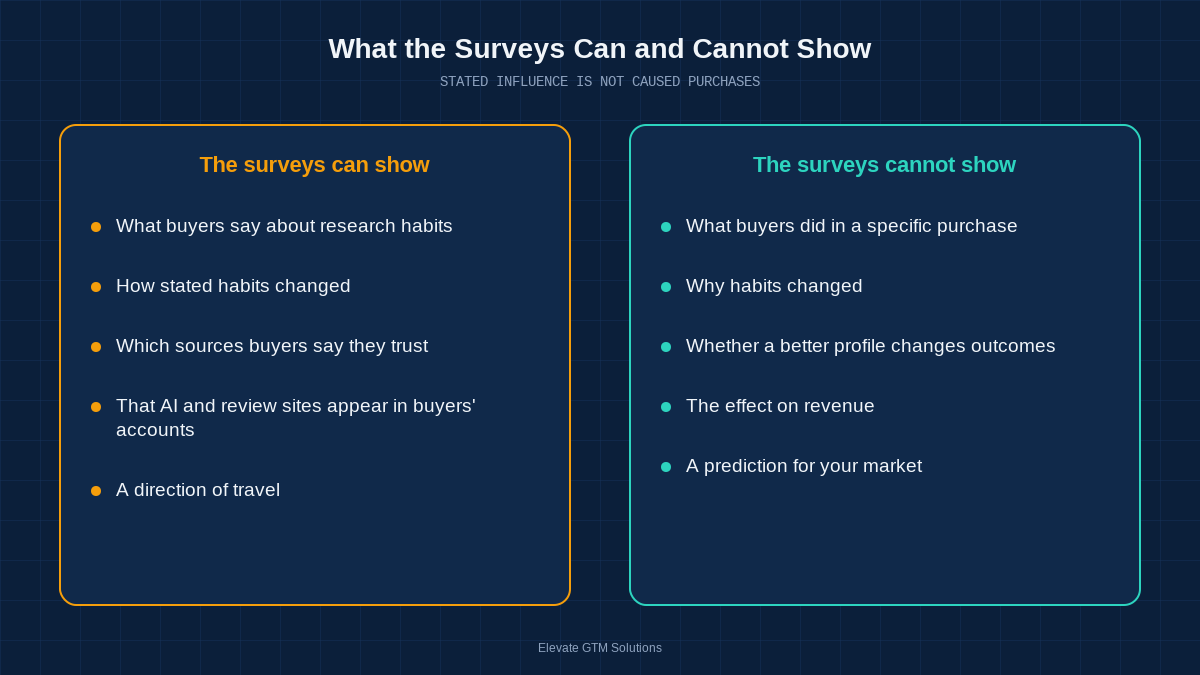
What the surveys can and cannot show
| The surveys can show | The surveys cannot show |
|---|---|
| What a sample of decision makers say about their research habits | What they actually did in a specific purchase |
| How stated habits changed between two surveys | Causes of the change |
| Which sources buyers say they use or trust | Whether a better profile would have changed an outcome |
| That AI chatbots and review sites appear in buyers' own accounts | The size of the effect on revenue |
| A direction of travel | A prediction for your market |
Other cautions apply. G2's respondents are buyers of software, and many may be more engaged with software review sites than average. G2's business benefits when vendors see review sites as important. Survey summaries by third parties sometimes alter numbers, so check them against the original.
Review sites and AI answers
A second claim in the 2026 research is that review sites serve as a trust layer in AI answers: buyers want citations, and review sites are the type of citation that makes them most confident. This links to the citation studies we review separately in what AI search citation studies show. Those studies measure which sources assistants cite, and several find community and review content among them, with large differences between engines and over time. A G2-related analysis by an independent growth advisor, as reported by G2, examined about thirty thousand AI citations and found review platforms to be core source material, with G2 the most cited review site in that dataset. As with every study in this area, the sample, prompts and counting rule shape the result, and the publisher has an interest.
The plausible chain is that customers write reviews, assistants may read them, and buyers may see summaries. Whether that chain moves purchases for your product is an empirical question for your own funnel.
What this means for B2B software teams
| Practice | Why |
|---|---|
| Claim and complete your profiles | Buyers and assistants see what exists, and incomplete profiles tell a poor story |
| Choose categories carefully | Categories decide which comparisons you appear in and how you are described |
| Keep facts consistent with your own site | Pricing, features and descriptions that conflict reduce trust and confuse assistants |
| Ask real customers for honest reviews | Reviews carry buyers' language and evidence |
| Follow each platform's rules | Incentives and gating are restricted, and violating rules can remove listings |
| Respond to reviews professionally | Responses show how you handle problems |
| Monitor listings quarterly | Prices and descriptions drift |
| Learn from reviews | They contain the language buyers use, objections and use cases |
| Ask your own buyers how they researched | Your funnel is the best evidence for your market |
| Do not rely on one source | Buyers use many sources, and engines draw on different ones |
What not to do
| Temptation | Why to avoid it |
|---|---|
| Buying, faking or trading reviews | Violates platform rules, damages trust and may carry legal risk |
| Pressuring only happy customers | Biases reviews and may break rules |
| Hiding unfavorable reviews or arguing with reviewers | Harms credibility |
| Letting profiles contradict your site | Creates confusion for buyers and assistants |
| Treating badges as proof | They signal popularity in a particular dataset, not suitability for every buyer |
| Spending heavily before checking your own buyers' habits | The survey sample may differ from your market |
| Quoting a survey percentage as a promise | It is a self-report |
How to learn what your buyers actually do
| Method | Practice |
|---|---|
| Win and loss interviews | Ask which sources they used, in what order, and which mattered. See our win-loss analysis framework |
| New customer survey | A short question about how they researched and what influenced the shortlist |
| CRM source notes | Record the first source in buyers' own words, not only a tracking field |
| Site analytics | Referrals from review sites and assistants, interpreted with care |
| Listing analytics | Profile views and leads where platforms provide them |
| Assistant checks | Ask assistants buyer questions and record which sources they cite |
Compare what your buyers say with what the surveys report. If they differ, trust your buyers for your market.
A listing audit
| Check | Question |
|---|---|
| Category | Does it match how buyers search and how you describe yourself? |
| Description | Is it accurate, current and consistent with your site? |
| Pricing | Does it match your own pricing page? |
| Features | Are they current? |
| Screenshots and media | Are they current? |
| Reviews | How many real reviews exist, how recent, and what do they say? |
| Responses | Have you replied to reviews respectfully? |
| Competitors | Who appears beside you and how are they described? |
| Rules | Are you following the platform's guidelines? |
| Ownership | Who updates the listing and when? |
Quarterly is a sensible cadence. Fix wrong facts first, then build review volume honestly.
Measuring the effect
It is hard to measure review sites' effect on revenue. A few approaches help, with modest claims.
| Approach | What it shows |
|---|---|
| Source-of-first-touch in buyer words | How often buyers name review sites or assistants |
| Win rate and cycle length for review-influenced deals versus others | A correlation, with selection effects |
| Before-and-after on profile changes | Direction, with many confounders |
| Buyer interviews | Why buyers trusted or distrusted what they saw |
Report counts, caveats and what you cannot separate.
A ninety-day plan for review sites
Days 1 to 15: audit. Review every listing against the audit table. Record category, description, pricing, features, media, review count and recency. List wrong or conflicting facts.
Days 16 to 40: fix and align. Correct facts. Align pricing and descriptions with your site. Choose categories deliberately. Assign an owner for each listing.
Days 41 to 70: ask honestly. Identify customers who have reached first value and ask them for honest reviews, within platform rules. Keep the request short and neutral, and make it easy to say no.
Days 71 to 90: learn and respond. Read new reviews for language, objections and use cases. Respond professionally. Bring themes to the monthly strategy review. Re-check what assistants say about you and compare with the start.
Asking for reviews: principles and a sample request
| Principle | Practice |
|---|---|
| Ask at a good moment | After the customer has reached a meaningful result |
| Ask a broad group | Not only the happiest customers |
| Keep it neutral | Do not tell people what to write |
| Follow platform rules | Many restrict incentives and require disclosure |
| Make it easy | A direct link and clear steps |
| Respect a no | Do not chase |
| Thank people | Without conditions |
A sample request, using invented details:
"Hello [name], thank you for working with us over the past few months. If you have a few minutes, we would value your honest review on [platform]. It helps other teams understand what working with us is like, including what could be better. There is no obligation, and we will read whatever you write. The link is below."
Have your legal advisers review your policy on requests, incentives and disclosures before you start.
Responding to reviews
| Situation | A professional response |
|---|---|
| A positive review | Thank the reviewer and, if appropriate, mention a specific point they raised |
| A mixed review | Acknowledge the concern, say what you are doing about it and offer to talk |
| A critical review | Stay calm, avoid defensiveness, correct factual errors politely and offer a route to resolve |
| A review that appears to be fake or from a competitor | Report it through the platform's process, and avoid public accusations |
| A review that raises a product gap | Share with product, and tell the reviewer you have passed it on |
Responses are read by prospective buyers. Tone matters more than winning the exchange.
Reading your reviews as research
Reviews are a free source of buyer language. A simple coding scheme makes patterns visible.
| Code | What to note |
|---|---|
| Problem solved | The situation that led the customer to buy |
| Reason chosen | What mattered in the decision |
| Alternatives mentioned | Competitors, spreadsheets and doing nothing |
| Strengths | What they praise |
| Weaknesses | What they criticize |
| Implementation | How long and how hard setup was |
| Support | Experience with help |
| Phrases | Exact words worth considering for messaging |
| Role and company size | Who is speaking |
Count themes monthly. Compare with win-loss interviews. Where a criticism recurs, treat it as strategy input, not only a reputation problem.
A review presence dashboard
| Measure | Why |
|---|---|
| Number of reviews and recency | Freshness matters to readers |
| Average rating, with counts | A rating from few reviews is fragile |
| Share of reviews from your target segment | Relevance |
| Themes in praise and criticism | Product and message learning |
| Response rate and time | Professionalism |
| Listing accuracy score from your audit | Consistency |
| Profile views and leads where provided | Rough demand signal |
| Mentions of review sites in buyer interviews | How buyers actually use them |
| What assistants say about you and which sources they cite | AI visibility link |
Review monthly alongside the rest of your go-to-market metrics. Our guide to GTM metrics and KPIs covers measurement.
Questions to ask a review platform
| Question | Why |
|---|---|
| What are the rules on soliciting and incentivizing reviews? | Avoid violations |
| How are reviews verified? | Trust in the content |
| How are categories assigned and changed? | Positioning |
| What data do I get about visitors and leads? | Measurement |
| How is the order of listings decided, and what is paid? | Transparency |
| How do I dispute an inaccurate or suspected fake review? | Process |
| How is my data used, including by AI products? | Privacy and visibility |
| What happens to my listing if I stop paying? | Dependence |
Keep the answers with your records.
Glossary
| Term | Meaning |
|---|---|
| Review site or software marketplace | A platform where buyers read and write reviews of software |
| Shortlist | The small set of vendors a buyer plans to evaluate seriously |
| Self-reported survey | A survey in which respondents describe their own behavior |
| Stated influence | What respondents say influenced them, which may differ from what did |
| Share of voice | A source's portion of mentions or citations in a dataset |
| Listing | A vendor's profile on a platform |
| Incentivized review | A review given in exchange for a reward, often restricted by platform rules |
| AI chatbot | A conversational AI product used for research |
Quick reference
| Question | Short answer |
|---|---|
| What does G2 report? | That many software buyers say AI chatbots and review sites influence shortlists, and more now start research with AI |
| What are the limits? | Self-reported, vendor-published and not measuring cause |
| What should I do first? | Fix listing facts and keep them consistent with your site |
| How should I get reviews? | Ask honestly, broadly and within platform rules |
| How do I check my market? | Ask your own buyers how they researched |
A hypothetical example
This is an illustration, not a real company.
A software company's marketing lead read that most enterprise buyers use review sites and wanted to launch a large review campaign. Before spending, she asked her sales team to add a field to the CRM: where did the buyer first hear of us, and which sources did they use to shortlist? After two months, a third of recent buyers mentioned review sites, others mentioned peers and communities, and several mentioned an AI chatbot recommending the company.
She audited the company's listings and found a pricing mismatch with the company's site, an outdated category and a description that omitted a main feature. She fixed those, wrote a short, honest request for reviews to customers who had completed onboarding and followed the platform's rules on incentives. She did not run a mass campaign. Three months later, the number of recent reviews had grown, the listing was consistent with the website and assistants described the product more accurately in a sample she checked. She reported the changes with counts and could not say how much the review work contributed to pipeline.
A second hypothetical: a listing that told the wrong story
This is another invented illustration.
A company discovered, while testing what AI assistants said about it, that three answers described its product as a basic scheduling tool for very small businesses. Its own site described a platform for mid-sized firms. The head of marketing traced the description to a review site listing created years earlier, in a category for small business tools, with outdated features and a price that no longer applied.
She corrected the category, rewrote the description to match the website, updated the pricing and features and added screenshots. She replied to the three most recent reviews and sent honest review requests to customers in the target segment who had completed onboarding. Two months later, a re-run of her question set showed that assistants described the product more accurately in most answers. She noted the improvement, the counts and the fact that other changes had happened in the same period.
An old, wrong listing can shape how a product is described without anyone noticing.
Questions marketing leaders ask
"Which review sites should we prioritize?" Those your buyers use. Ask recent buyers, check which sites appear in assistants' answers for your category and start with the few that matter most.
"How many reviews do we need?" There is no universal number. Fresh, specific reviews from customers like your target buyers matter more than a total.
"Should we pay for premium listings?" Evaluate the offer against your own funnel: what leads and visibility you get, and how you will measure them. Be cautious of promises based on survey percentages.
"How do we handle a competitor attacking us in reviews?" Report violations, respond professionally to genuine reviews and focus on honest evidence from real customers.
"What do we do if we have few reviews?" Ask customers who reached value, honestly and within rules, and make it easy. Avoid shortcuts.
"Does this apply to a product with a narrow audience?" Possibly less. Check where your small community looks, which may be forums, partners or events.
Questions founders ask
"Do we need to be on G2?" It depends on whether your buyers look there. Ask them. A complete, accurate profile is a low-cost default.
"Will AI assistants recommend us if we have reviews?" Reviews may be among the sources assistants read, and no one can guarantee a recommendation.
"Can we ask every customer for a review?" You can ask broadly, within each platform's rules, and accept that many will not respond.
"What if reviews are mixed?" Treat them as information. Respond professionally, fix what you can and let honest evidence speak.
"How much time should this take?" A listing audit each quarter, a small review request process and a monthly look at themes are enough for many teams.
A checklist before you spend on review sites
- You have asked at least ten recent buyers where they researched.
- Your listings are accurate and consistent with your site.
- You know each platform's rules on review requests and incentives.
- You have a plan to ask customers honestly and broadly.
- You will read and use the themes in reviews.
- You have set a measure beyond badges, such as buyer-reported influence.
- You have not promised anyone a result.
Summary for busy leaders
If you remember three things: G2's surveys report that many software buyers say AI chatbots and review sites influence their shortlists, and the research is self-reported and vendor-published; keep listings accurate, consistent with your website and honest, and treat reviews as buyer language you can learn from; and ask your own buyers how they researched, then weigh that above any survey percentage.
In plain language
Review sites matter if your buyers use them, and surveys from a review marketplace say that many do. The surveys show what people say, not what causes a purchase. A good, low-risk approach is to keep your profiles accurate and consistent, ask real customers for honest reviews within the rules, respond professionally, learn from what reviewers write and check what your own buyers and the AI assistants they use say about you. Avoid shortcuts and promises, and review the whole picture each quarter.
A short buyer survey you can run yourself
Ask new customers and recent evaluators these questions, in your own words and tone.
| Question | Purpose |
|---|---|
| Where did you first hear about us? | Origin |
| Which sources did you use to compare options? | Research mix |
| Did you use an AI assistant? Which one, and for what? | AI role |
| Did you read reviews? On which sites, and what stood out? | Review influence |
| Which source influenced your shortlist most? | Priority |
| Who else was involved, and what did they read? | Buying group |
| What nearly made you choose someone else? | Risks |
| What would have made your research easier? | Gaps |
Keep the sample size visible, and avoid leading questions. Share a one-page summary with marketing, sales and product each quarter.
Sizing the review effort
| Question | Practice |
|---|---|
| What share of buyers name review sites? | Use your survey to estimate it, with counts |
| Which platforms do they name? | Prioritize those |
| What is the cost of the effort? | Hours for audit, requests, responses and analysis |
| What is the likely return? | Hard to measure, so treat it as maintenance of accurate public information, not a growth engine |
| What would change your mind? | A buyer survey showing that reviews play little role in your market |
For many teams, the right amount is a quarterly audit, a modest request process and a monthly reading of themes.
Final thoughts
The best reading of the survey evidence is modest. Buyers say they use review sites and AI assistants. The review sites are one source among several. The evidence does not prove that effort on them produces revenue, and it suggests that accuracy, consistency and honest customer voices are worth maintaining. Ask your own buyers, keep your public facts straight and treat any survey percentage as a prompt for a question, not as an answer.
Using review insights in positioning and messaging
Reviews often contain the most direct statement of why customers chose you.
| Review content | How to use it |
|---|---|
| Problems customers describe | Test whether your message names the same problem in the same words |
| Reasons for choosing you | Check them against your pillars and proof |
| Alternatives mentioned | Update your competitive framing and comparison content |
| Praise that recurs | Consider whether it belongs in your positioning, with permission to quote |
| Criticism that recurs | Raise it with product, and be honest in your messaging about limits |
| Language | Adopt customer phrasing in sales talk tracks and public pages |
Treat reviews as one source and check them against buyer interviews and win-loss evidence. Quote customers only with permission and in line with platform terms.
Questions executives ask
"Can you give us a single number for how much buyers rely on reviews?" Not honestly. G2 reports several numbers from different questions, and your own buyers may differ. Offer a range, name the source and report your own buyer survey as soon as you have one.
"Should we benchmark our rating against competitors?" It can be useful context, with attention to the number of reviews, their recency and the segments they come from.
"Could a few bad reviews hurt us?" They can, and honest responses and steady, genuine reviews from a broad set of customers are a better remedy than attempts to suppress or inflate.
"Do we need a reviews budget?" Possibly for time to maintain listings and read themes. Treat paid placements like any other program: define what you expect and how you will measure it.
"How do we explain this research to the board?" Say that surveys suggest buyers use review sites and AI assistants, that the evidence shows stated influence, not caused purchases, and that the plan is to keep listings accurate, collect honest reviews and ask our own buyers.
Limits of this review
We reviewed two G2 surveys and some secondary analysis as of November 2026. G2 is a vendor with a commercial interest in review sites, and the surveys are self-reported. We did not find independent research that measures the effect of reviews on purchases. Some figures reach us through press releases and summaries. Nothing here measures any specific company's buyers.
What to do this week
Add a question about research sources to your next ten buyer conversations. Audit your listings for category, pricing, description and recency. Pick two assistants, ask five buyer questions and note which review sites they cite. Check the platform rules before asking for any reviews.
Key takeaways
- G2's surveys report that many software buyers say AI chatbots and review sites influence their research and shortlists, and a majority now say they start with an AI chatbot.
- The surveys are self-reported, come from a vendor that sells to software companies and show stated influence, not caused purchases.
- Headline percentages differ between reports because questions, samples and periods differ.
- Keep listings accurate and consistent with your site, collect honest reviews within platform rules and learn from them.
- Ask your own buyers how they researched, and weigh that above any survey.
Where Elevate GTM Solutions fits
Elevate GTM Solutions is an AI-native GTM operating system for B2B companies. It does not run review campaigns or measure review influence. It helps hold what listings and content should state consistently: the category, customer definition, positioning, messaging pillars with proof and pricing logic, across 15 modules, with workflows, weekly plans and a recurring review rhythm that can include a quarterly listing audit. It connects to HubSpot, Salesforce, LinkedIn, Notion and Claude for supported actions. A free first strategy build is available, and published plans, billed annually, are Enable at USD 499 per month and Growth at USD 1,499 per month, with custom Scale pricing.
For related reading, see What AI Search Citation Studies Actually Show, AI Search Visibility Audit, Win-Loss Analysis Framework and What Is Elevate GTM Solutions?. See the pricing page, or request a demo.
Sources
All accessed in November 2026. Findings are paraphrased. G2 is a vendor, and surveys are self-reported.
- G2, 2025 Buyer Behavior Report: https://learn.g2.com/2025-g2-buyer-behavior-report
- G2 press release on the 2025 Buyer Behavior Report: https://www.businesswire.com/news/home/20250514382531/en
- G2, new research on how AI is redefining the buyer journey: https://company.g2.com/news/buyer-behavior-in-2025
- G2 research for CMOs on the 2025 Buyer Behavior Report: https://research.g2.com/cmos-2025-buyer-behavior-report-research-g2
- G2, how AI is shaping deals in 2026: https://learn.g2.com/how-ai-is-shaping-deals-in-2026
- G2, The Answer Economy, press release summary (April 2026): https://techintelpro.com/news/marketing/ai/g2-report-51-of-b2b-buyers-now-start-software-purchases-with-ai-chatbots
- G2 AI search insight report: https://learn.g2.com/g2-2026-ai-search-insight-report
Frequently Asked Questions
Do review sites influence B2B software purchases?
According to G2's surveys, many buyers say so. In 2025, AI chatbots and review sites were the top two influences on shortlists, and enterprise buyers named review sites and AI search as top research sources. These are self-reported results from a vendor.
What did G2's 2026 report find about AI and buyers?
That a majority of surveyed software buyers begin research with an AI chatbot more often than with Google, that most said a chatbot led them to a different vendor than planned, and that review-site citations were the most confidence-inspiring signal in AI answers for the largest share.
Why do G2's percentages differ between reports?
Different questions, samples, periods and framings. One question ranks sources by influence and sums to one hundred percent, while another lets buyers select many sources.
Do the surveys prove reviews cause purchases?
No. They show what buyers say about their research habits, and none of the research we reviewed measured causes.
Is G2's research biased?
G2 is a review marketplace that sells to software vendors and has a commercial interest, and surveys are self-reported. That is a reason to check the method and to compare with your own buyers.
How should a software company use review sites?
Keep profiles complete, accurate and consistent with the website, choose categories carefully, collect honest reviews within platform rules, respond professionally and monitor quarterly.
Is it acceptable to pay for reviews?
Platform rules restrict incentives, and buying or faking reviews violates them, damages trust and may carry legal risk. Follow each platform's guidelines.
How can I find out where my buyers research?
Ask in win-loss interviews and new customer surveys, record the first source in buyers' words and check assistants for the sources they cite.
Do AI assistants use review sites?
Several citation studies find review and community content among cited sources, with large differences between engines and over time. Check what assistants cite for your category.
How should I ask customers for reviews?
At a good moment after they reach value, to a broad group, neutrally, within each platform's rules on incentives and disclosure, with an easy link and respect for a no.
How should I respond to critical reviews?
Calmly and professionally, acknowledge the concern, correct factual errors politely, say what you are doing and offer a route to resolve, because prospective buyers read the exchange.
Can I use reviews as research?
Yes. Code themes such as problems solved, reasons chosen, alternatives, strengths, weaknesses and exact phrases, count them monthly and compare with win-loss interviews.