
By the Elevate GTM Solutions Team · Updated November 13, 2026 · 28 min read
Why Do B2B Buyers Regret Purchases, and How Can Go-to-Market Teams Build Buyer Confidence?
A B2B sale that closes is not always a sale that worked. Buyers sign, then wish they had waited, bought something else or asked another question first. Some never sign at all: the deal stalls, nobody says no and the opportunity quietly turns into "no decision." Gartner has published a run of surveys since 2019 on exactly this, and the findings are more useful to a go-to-market team than most funnel benchmarks, because they point at a cause that sits upstream of the sales conversation: buyer confidence.
This page explains what purchase regret is, why it happens and what a go-to-market team can do about it. The evidence is Gartner's run of surveys from 2019 to 2023. For each we state who was surveyed, when and how many, what was found and what the release does not say. We add our own reading, clearly marked, and explain where a go-to-market platform like ours helps and where it does not.
A disclosure. We make Elevate GTM Solutions and so have an interest in how go-to-market problems are described. We have no survey data of our own. Every number on this page is attributed to a named Gartner press release that we read directly. Our examples are invented and labeled.
Why do B2B buyers regret purchases, and what builds confidence?
Regret mostly comes from low buyer confidence, not from bad products. Across several surveys from 2019 to 2023, Gartner found that buyer confidence, meaning how sure a buyer is that they are making the right choice, predicts purchase quality more than almost anything a seller does in the moment. In a 2021 survey of nearly 1,000 B2B customers, those with high decision confidence were 10 times more likely to make a high-quality, low-regret purchase. A 2023 survey of 1,503 technology buyers found 60% of those handling renewals or expansions regret nearly every purchase they make, and Gartner's analyst attributed this largely to how buying teams behave, not to the provider or product. The practical lesson is that sellers and marketers should spend more effort helping buyers reach agreement and confidence, and less on delivering more information.
Is regret about bad products? Gartner's Hank Barnes said it "usually has little to do with the provider or the products themselves."
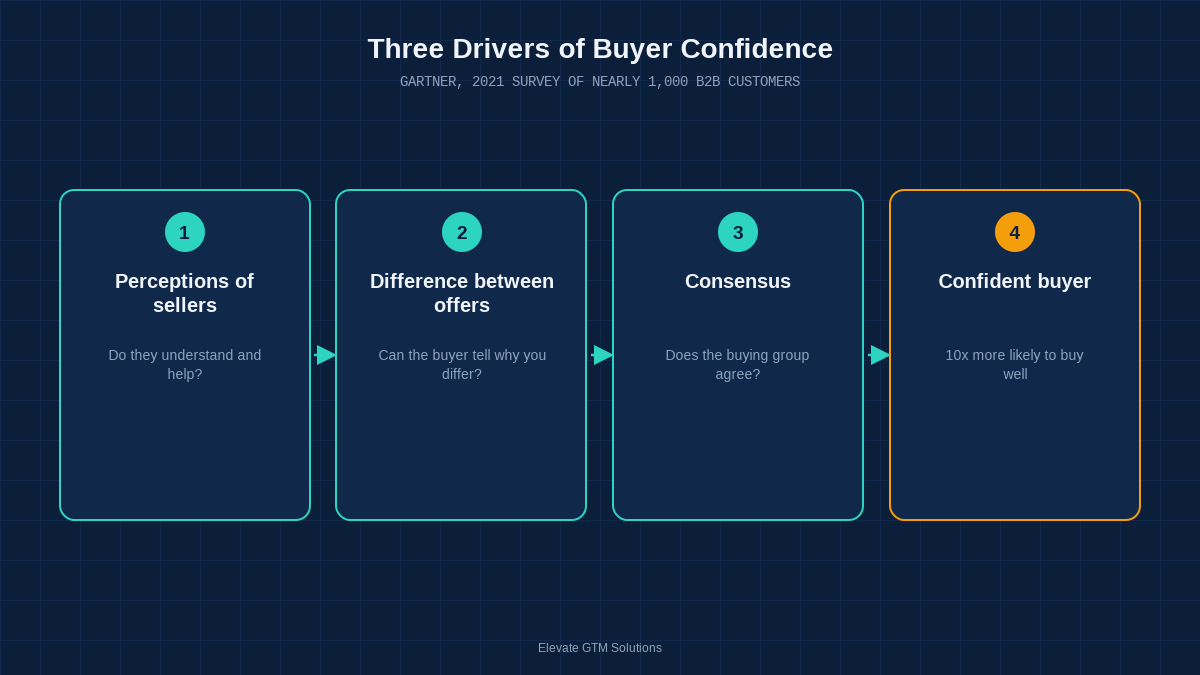
What raises confidence? Gartner's 2021 research names three drivers: perceptions of sellers, perceptions of the difference between supplier offerings, and the sense of consensus across the purchase process.
The short version
| Question | Answer |
|---|---|
| What is "purchase regret"? | A buyer's sense after buying that they should have chosen differently, asked more or taken longer |
| Who researches it? | Gartner, through a series of surveys and press releases from 2019 to 2023 |
| Biggest 2021 finding | High-confidence buyers were 10 times more likely to make a high-quality, low-regret purchase |
| Biggest 2022 finding | Only 24% of buyers in primarily rep-led purchases completed a high-quality deal, against 65% of those who self-navigated |
| Biggest 2023 finding | 60% of technology buyers handling renewals or expansions regret nearly every purchase they make |
| Main cause, per Gartner | Buying team behavior, distributed teams, funding and too many options |
| What helps, per Gartner | Buyer enablement, shared consensus tools, regret-signal spotting |
| What the research cannot do | Tell you your own regret rate, or prove any one fix works for you |
What buyer regret is and why it happens
Regret is the feeling after a purchase that a different choice, or a longer look, would have been better. In B2B it shows up in three places: a deal that stalls and ends in "no decision," a deal that closes but starts lukewarm, and a renewal where the customer quietly starts shopping around. They tend to share a cause. The buyer was never fully confident in the choice.
Confidence here has little to do with how much information a buyer has. Buyers can be buried in information and still not know which option to trust. In plain terms, three things seem to matter: whether the buyer trusts the people helping them, whether they can tell why one option differs from another, and whether their own group agrees. If any one is missing, the purchase is shaky even when the product is good.
Why teams miss it. Sellers see the buyer contact, not the internal conversation. Funnel metrics record stages, not doubt. Lost deals get labeled "lost to competitor" when the real competitor was inertia.
Where regret signals show up in your own data:
- Late-stage deals that go quiet after a new stakeholder joins.
- Questions about risk or reversibility that arrive at the end instead of the start.
- Customers who ask for extra reference calls or a pilot "just to be safe."
- Renewals where usage drifted, or where the person who bought has left.
What a team can change. Give buyers tools for agreement: a comparison they can forward, a plain summary of why this solves their problem, honest limits and a clear view of what happens after signing. Make the differences between options explicit, because buyers who cannot tell options apart fall back on price or delay. Help champions bring others along, rather than treating the champion as the whole account.
The sections below show what Gartner's surveys found on regret and confidence, how old each finding is and how much weight it can carry.
Why buyer confidence belongs in a go-to-market plan
Most go-to-market planning measures the seller's side: leads, meetings, pipeline, win rate. Those are useful. But they say little about why a promising deal went quiet or why a customer who signed is lukewarm at renewal. The buyer's side has its own measures, and the main one Gartner has studied is confidence.
If confidence drives purchase quality, then a plan that adds more content, more outreach and more demos without raising confidence is spending effort in the wrong place. It also changes how you read competition. In many deals your real competitor is not another vendor. It is the buyer's uncertainty, and the quiet option of doing nothing. See our page on how to tell if your GTM strategy is broken for symptoms that connect to this.
The evidence: what Gartner's surveys found, one release at a time
September 2019: a lack of customer confidence
In a September 17, 2019 press release, Gartner said the biggest challenge in B2B sales today is a lack of customer confidence. It described overwhelmed buyers who struggle to make large-scale purchase decisions, and introduced what it called buyer enablement: support designed to help buyers buy, as distinct from sales enablement, which helps sellers sell. The release says buyer enablement significantly decreases the kind of purchase regret known to reduce customer loyalty and advocacy, and increases a supplier's likelihood of winning a larger deal at higher quality. Brent Adamson, a Gartner analyst, is quoted saying that by combining empathy with deep industry and customer knowledge, suppliers can build information designed to help buyers buy.
What to take from it. The framing is the contribution. Instead of asking how to persuade, ask what a buyer needs in order to feel sure. The release is a statement of Gartner's position backed by its research; the public text does not give sample sizes in the passages we read, so treat it as an argument and not a measurement.
May 2021: confidence and the rep-free buyer
A May 17, 2021 release reported a survey of nearly 1,000 B2B customers in November and December 2020. Findings:
- 43% of B2B customers prefer not to interact with a sales rep at all.
- Purchase regret among those who prefer a rep-free experience is 23% higher than among customers who interact with a rep.
- Customers who report a high level of decision confidence are 10 times more likely to make a high-quality, low-regret purchase.
- Gartner identifies three statistically significant drivers of customer confidence: customers' perceptions of sellers, their perceptions of differences between supplier offerings, and their sense of consensus across the purchase process.
The title of the release says B2B sales organizations need to give customers a seller-assisted digital buying experience. The point is not "more reps." It is that going rep-free has a cost in regret and that digital buying works better when sellers help.
What to take from it. The three drivers are practical. Perceptions of sellers means the buyer's view of whether the seller understands them and is trustworthy. Perceptions of difference between offerings means whether the buyer can tell why your option differs from the others in ways that matter to them. Consensus means whether the buying group agrees. A buyer who cannot tell vendors apart, or whose colleagues disagree, is not confident, whatever the product's quality. That should make any positioning or messaging team uncomfortable, in a useful way.
June 2022: digital buying and rep-led buying both have pitfalls
A June 21, 2022 release reported a survey of 725 B2B buyers in November and December 2021. Findings:
- 72% had completed a recent significant purchase by ordering and paying online. A related release the next day reported that 83% prefer ordering or paying through digital commerce.
- Digital commerce buyers are significantly more likely to experience purchase regret than traditional buyers.
- Nearly all buyers still engage a sales rep at some point before buying.
- Only 24% of buyers in primarily sales rep-led purchases completed a high-quality deal, compared with 65% of buyers who self-navigated.
- Buyers who go through a self-reflective learning path are 147% more likely to buy more than they originally planned.
Sharon Cantor Ceurvorst, a senior director in Gartner's Marketing practice, is quoted: "The obvious solution, proactive sales rep intervention, comes with its own pitfalls." Gartner's recommendations: provide information and tools that prompt buyers to reassess their purchase needs; offer digital-first tools that help buying group members learn together and reach consensus; and work with sales to build multichannel learning paths. The June 22 release adds that when buyers say sales reps use technology effectively to facilitate buying group discussions, customer confidence rises by 17%.
What to take from it. This release is the one that stops anyone from concluding that the cure for digital regret is more sales pressure. Rep-led deals scored worse on quality than self-navigated ones. The cure, Gartner says, is better learning paths and shared tools. A rep helps when the rep helps the group think, and hurts when the rep pushes.
June 2023: technology buyers and renewal regret
A June 14, 2023 release, issued at Gartner's Tech Growth and Innovation Conference, reported a survey of 1,503 respondents from February through March 2023. Respondents worked at organizations with annual revenue of at least $50 million or equivalent, across Western Europe, North America and Asia Pacific, and were involved in decisions to renew or expand "as-a-service" agreements. Findings:
- 60% of technology buyers involved in these decisions regret nearly every purchase they make. Gartner describes this as a 6% increase from 2020.
- Regret is largely driven by the challenges of buying technology with distributed buying teams and funding.
- Negative attitudes stem from frustrating buying experiences, poor communication and too many options, which lead to longer buying cycles and conflicting team goals when pursuing expansion.
- 95% said they would have preferred a fully digital experience for their expansion purchase, though they want minimal sales interaction.
Hank Barnes, a Distinguished VP Analyst, said regret is "a known issue with enterprise technology purchase decisions," and that it "usually has little to do with the provider or the products themselves." Gartner's three actions for product leaders negotiating expansions: equip customer-facing teams to spot regret signals, which include buyers wanting to revisit earlier decisions, conflict in the buying team and lack of awareness of the steps needed to complete a purchase; expand buyer enablement content to build confidence; and digitize more of the buying process with checklists and shared workspaces where teams can set objectives and build business cases.
What to take from it. For software companies, this is the release closest to home. It says the renewal and expansion conversation is not a victory lap. A customer who regrets buying the first time, or who finds expansion a painful process, is a risk, and the cause may lie in the customer's own team dynamics. A vendor that makes the internal process easier gets rewarded. A vendor that makes it harder, even with a good product, does not.
One more point of care. A secondary trade article we saw claims that organizations reporting high regret took seven to ten months longer to complete a purchase. We could not trace that to the Gartner release we read, so we do not rely on it.
How much weight the regret research can carry
These are Gartner's surveys, not neutral observations. Gartner sells research and advice. Its interest is in telling sales and marketing leaders that something is going wrong that its subscriptions can help fix. That does not make the findings false. The sample sizes are respectable and the dates and methods are stated. But a reader should hold them as evidence from an interested party.
Regret is self-reported. It is the buyer's feeling, not an audit of the decision. A buyer can regret a good decision or feel fine about a bad one.
The studies differ in population. The 2021 and 2022 surveys cover B2B buyers generally. The 2023 survey covers technology buyers at larger organizations handling renewals and expansions. Do not apply the 60% figure to a first-time purchase of a small tool.
Percentages are not trends unless the samples match. The release itself describes 60% as up 6% from 2020, but different respondents answer in different years, and we would not build a plan on a six-point change.
Correlation is the main tool. "High confidence buyers are 10 times more likely to make a high-quality purchase" is a strong association. It does not prove that a particular enablement asset will cause confidence. Gartner argues it does and recommends actions, but your own tests are the evidence that counts for your company.
Elevate's reading
This is our interpretation. It is not data and not Gartner's view.
One. "No decision" is a confidence problem more often than a competitor problem. If regret and doubt come from buying group conflict, too many options and unclear steps, then a deal can die without anyone choosing another vendor. Teams that only analyze lost deals to competitors miss the ones that evaporate. Include stalled and no-decision deals in your win-loss review. Our page on the GTM win-loss analysis framework covers how.
Two. The three confidence drivers map onto three parts of a go-to-market strategy. Perceptions of sellers connects to sales enablement and messaging discipline. Perceptions of differences between offerings connects to positioning and competitive work. Consensus connects to buying group planning and the assets a champion uses internally. If your strategy treats these as separate projects owned by separate teams, no one owns the buyer's confidence. See who owns GTM strategy.
Three. Positioning is a regret-reduction tool. A buyer who cannot say how you differ from the alternatives will feel unsure after buying. Clear positioning is not marketing polish. It gives the buyer a reason they can repeat to a skeptical colleague.
Four. Make the buying process easy to describe. Gartner's finding that lack of awareness of the steps to complete a purchase is a regret signal suggests that a simple, honest outline of how evaluation, approval and onboarding usually go helps. Many vendors hide the process because it feels messy. Buyers feel the mess anyway.
Five. Do not equate reducing regret with discounting or pressure. The rep-led deals in the 2022 data did worse, not better. Pushing harder often lowers confidence.
Six. Expansion is part of go-to-market. The 2023 data places regret in the renewal and expansion moment. Customer success and marketing should share a plan for it. This is part of why Elevate's module set includes customer success and customer advocacy alongside acquisition.
What this means for different roles
Sales. Spend time on helping the group converge. Ask who else must agree and what they will want to know. Offer a short summary the champion can forward. Avoid adding urgency that the buyer does not have.
Marketing. Build content for the second and third reader, the person who was not on the call. Assets such as comparison guides, implementation overviews and internal business case outlines help consensus.
Product marketing. Test whether a new reader can state in one sentence how you differ from the closest alternative. If they cannot, work on that before producing more content.
Customer success. Treat the renewal as a purchase decision with its own buying group. Look for the regret signals Gartner lists: requests to revisit earlier decisions, disagreement among the customer's team and confusion about next steps.
Revenue operations. Add a field or tag for stalled and no-decision outcomes with a reason, and review it. Without it, the dominant failure mode is invisible in your reporting.
Leadership. Ask for a monthly review of confidence signals alongside pipeline: deals that stalled, reasons, and what helped the buyer move.
A worked example, invented for illustration
Picture a company selling a scheduling product to clinics. Its sales team reports good demo-to-proposal conversion, then a steady loss of proposals to silence. A win-loss review that only counts competitor losses shows little. The head of revenue adds a category for "no decision" and asks the team to call a few of those prospects.
What the calls surface, in this invented case: the office manager loved the product, the clinic owner was unsure about switching during a busy season, and the practice's IT contractor had questions nobody had answered. No one disagreed with the others; each held back.
The team's response follows Gartner's recommendations. They write a one-page guide for the owner on how a switch usually goes and what it costs in staff time. They prepare a short note for the IT contractor on data handling. They add a shared checklist that the office manager can use to track what the group still needs. They do not change the product or the price.
We cannot say whether this would work. It is one plausible reading of the research applied with care. The right test is to compare, over a quarter, how many proposals with the guide and checklist progress against those without, accepting that the samples are small and the comparison is rough.
How a go-to-market platform can help, and where it cannot
Elevate GTM Solutions, described on our homepage, is a platform for building, executing and evolving go-to-market strategy. It includes modules for market research, ideal customer profile and segmentation, competitive intelligence, account-based marketing, product positioning, product messaging, pricing, customer acquisition, distribution channels, marketing alignment, launch, measurement, sales enablement, customer success and customer advocacy. The product flow, as we describe it, runs from GTM Insights and Strategy Context through Strategy Builder, a Workflow Engine, Strategy Insights, GTM Activation, GTM Playbooks, GTM Pulse and executive dashboards.
Here is how that connects to the Gartner findings, without overstating.
Positioning and messaging in one place. The second confidence driver, the perceived difference between offerings, depends on clear positioning and messaging. The product positioning and messaging modules are where that work lives in our platform, connected to the same strategy as segmentation and competitive work.
Assets for the buying group. GTM Activation turns a strategy into a small set of focus assets. A landing page and an FAQ are natural homes for the buying-step explanations and the questions a second reader will ask. See how to turn a GTM strategy into focus assets.
Shared view for the team. The workflow stages (Draft, Defined, Launched, Optimizing) and collaborators give marketing, sales and customer success a common picture. That does not guarantee consensus inside your buyer's company, but it prevents your own teams from telling different stories.
Weekly attention. GTM Pulse offers weekly actions, recommendations and scores, which could include stalled-deal patterns if the team chooses to track them. The platform does not decide what counts as regret. You define the signals, and it helps you look at them regularly.
Where it cannot help. A platform cannot make a skeptical buyer confident, cannot resolve conflict inside another company and cannot replace the honest conversation that Gartner says reps should have. We do not claim that using Elevate reduces purchase regret, and we have no results data to support such a claim.
Questions to ask about your own deals
- How many of our lost opportunities last quarter ended in no decision, and why?
- Who on the buying side never spoke to us?
- Can a new reader at the buyer state how we differ from the closest alternative?
- What steps does a buyer need to take to complete a purchase with us, and do they know them?
- What do we send a champion to share internally, and does anyone use it?
- Where did our reps add pressure instead of clarity?
- At renewal, what do we do to make the customer's internal process easier?
- Which signals tell us a buyer wants to revisit an earlier decision?
- Do our teams give buyers the same answer to the same question?
- How do we measure confidence, even roughly?
Common mistakes
Measuring only closed-lost to competitors. Stalls and no-decisions are often the larger loss.
Adding information when confidence is the gap. More PDFs do not fix disagreement inside the buyer's team.
Turning up the pressure. Gartner's 2022 data on rep-led purchases is a warning.
Ignoring renewals. The 2023 data places regret in expansion and renewal.
Treating regret as the product's fault. Barnes' point is that it often is not. That cuts both ways: you cannot fix it only with product changes, and you cannot dismiss it either.
Over-reading a single percentage. The numbers are indications from specific samples.
What to do this week
Take the last ten deals that ended without a clear win or loss. For each, write one sentence on who was unsure and about what. Then group the reasons. If three or more share a cause, that is your first buyer-enablement asset. It will take an afternoon and will tell you more than a dashboard of funnel rates.
Turning confidence into something you can track
Gartner measures confidence with survey questions. Most companies will not run a Gartner-sized survey, and they do not need to. A rough, honest version is enough to start a conversation, as long as you do not pretend it is more precise than it is.
Ask two questions after every closed deal and every stalled one. For won deals: "Before you signed, how sure were you this was the right choice, and what made you sure?" For stalled deals: "What would have made it easier to decide?" Ask for a sentence, not a score. A pile of twenty sentences will show patterns that a one-to-five rating hides.
Look for proxies in your own data. Some behaviors tend to go with doubt. Deals with long gaps between meetings, new stakeholders appearing late, repeated requests for the same information and proposals that sit unopened are all worth a tag. None of these proves regret. Together they tell you where to look.
Separate the stages. Confidence at the first meeting, at the proposal and at renewal are different things with different causes. A buyer can be sure the problem is real and unsure about you, or sure about you and unsure about the budget. Gartner's three drivers help here: ask whether the doubt concerns the seller, the difference between options or the group's agreement.
Review monthly, not yearly. Doubt shows up in small behaviors that change quickly. A monthly fifteen-minute review of the stalled list, with one change agreed each time, is more useful than an annual study.
Be careful with incentives. If reps are rewarded only for closing, they will not log honest reasons for stalls. If success teams are rewarded only for renewals, they will not report customers who are quietly unhappy. Reward the honest record.
Regret across the customer lifecycle
The Gartner releases cover different moments. It helps to lay them out together.
Before the first purchase. Confidence depends on whether the buyer understands the problem, the options and the difference between them. Perceived difference between suppliers is one of Gartner's three drivers, so weak positioning shows up here as hesitation.
During evaluation. Consensus matters most. Buyers who learn together and agree make better decisions, according to the 2022 release. Evaluation is also where too many options and unclear steps cause delay.
At signature. This is where a lot of regret is created or avoided, but not by the signature itself. It is created by what came before: unresolved doubt, rushed internal agreement or a gap between what was promised and what the buyer expects.
At onboarding. A buyer who regrets the choice early will interpret every difficulty as proof. A clear first-month plan, agreed beforehand, gives both sides something to measure.
At renewal and expansion. The 2023 research places regret here, and says it often has little to do with the product. The buying team may have changed. Funding may be split. The people who chose the product may have left. Each renewal is a fresh decision by people who may not remember why the first one was made.
A go-to-market plan that covers only the first two moments leaves the later ones to chance. Customer success and customer advocacy belong in the plan, with a named owner.
What not to conclude
The research is easy to stretch into claims it does not support. A few to avoid.
"Buyers want to be left alone." The 2021 data says 43% prefer no rep at all, and also that they regret more. Preference and outcome differ. Treat the preference as a design constraint and the regret as the thing to solve.
"Sales reps cause regret." The 2022 figure compares primarily rep-led purchases with self-navigated ones. It does not say reps cause poor decisions. Buyers who need more help may be more likely to receive rep-led support, and buyers with simpler needs may self-navigate. The survey cannot untangle that.
"Regret is inevitable, so there is nothing to do." Barnes asked whether buyers hold negative attitudes by default. Even if so, Gartner still lists actions that can reduce regret, and a vendor that makes the process easier is easier to renew.
"Any enablement content will raise confidence." Content that adds volume without helping a group agree may not help. Gartner's phrase is information designed to help buyers buy, which is narrower than more content.
Glossary
Purchase regret. A buyer's belief after purchase that they should have chosen differently, researched more or taken longer.
Buyer enablement. Information and tools designed to help buyers make and agree on a decision, as distinct from helping sellers sell.
Decision confidence. How sure a buyer is that a choice is right, which Gartner found strongly associated with purchase quality.
Consensus. Agreement among the people involved in a buying decision.
No decision. An opportunity that ends without the buyer choosing any vendor, including the incumbent or doing nothing.
Learning path. A sequence of information and activities that helps a buyer understand a problem and options.
As-a-service agreement. A subscription contract for technology delivered as a service, the focus of Gartner's 2023 survey.
Regret signal. A behavior associated with regret, such as wanting to revisit earlier decisions or conflict within the buying team.
Where Elevate GTM Solutions fits
Elevate GTM Solutions is a go-to-market strategy platform, described on our homepage as a way to build, execute and evolve strategy across connected modules, with a first draft in five minutes or less and adaptation by region, vertical and segment. Its relevance to this research is limited and specific: keeping positioning and messaging consistent, turning strategy into a few assets for the buying group and giving teams a weekly view. For vendor comparison questions, see how to choose a GTM platform. For earlier thinking on the buyer side of the decision, see how B2B buyers use AI and sales reps.
Key takeaways
- Gartner links buyer confidence to purchase quality: in a 2021 survey of nearly 1,000 customers, high-confidence buyers were 10 times more likely to make a high-quality, low-regret purchase.
- Three drivers of confidence: perceptions of sellers, perceived difference between offerings and consensus across the purchase process.
- In 2022, only 24% of buyers in primarily rep-led purchases completed a high-quality deal, against 65% who self-navigated, so pressure is not the answer.
- In 2023, 60% of technology buyers handling renewals and expansions regretted nearly every purchase, and Gartner pointed at buying team behavior more than products.
- The practical response is buyer enablement: help groups agree, make steps clear and spot regret signals early.
- These are Gartner survey results. Test any change against your own deals.
Sources
- Gartner, Gartner Says the Biggest Challenge in B2B Sales Today Is a Lack of Customer Confidence, press release, September 17, 2019.
- Gartner, Gartner Says B2B Sales Organizations Need to Give Customers a Seller-Assisted Digital Buying Experience, press release, May 17, 2021 (read through search-result excerpts, not the full page).
- Gartner, Gartner Says Marketing Leaders Must Reconceive Their Digital Experience and Sales Enablement to Help Virtual Buying Groups Reach Better Outcomes, press release, June 21, 2022.
- Gartner, Gartner Sales Survey Finds 83% of B2B Buyers Prefer Ordering or Paying Through Digital Commerce, press release, June 22, 2022 (read through search-result excerpts).
- Gartner, Gartner Survey Reveals 60% of Technology Buyers Involved in Renewal Decisions Regret Nearly Every Purchase They Make, press release, June 14, 2023.
Frequently Asked Questions
What is purchase regret in B2B buying?
It is a buyer's feeling after a purchase that they should have chosen differently, consulted more information or taken longer to decide. Gartner measures it through surveys in which buyers report their own experience, so it reflects perception, not an audit of the decision.
How common is regret among B2B technology buyers?
In Gartner's 2023 survey of 1,503 respondents involved in renewing or expanding as-a-service agreements, 60% regret nearly every purchase they make, which Gartner described as a 6% increase from 2020. The sample was larger organizations in Western Europe, North America and Asia Pacific, so the figure does not necessarily apply to small first-time purchases.
What causes purchase regret, according to Gartner?
Gartner says it is largely driven by challenges buying technology with distributed buying teams and funding, along with frustrating buying experiences, poor communication and too many options. Hank Barnes said it "usually has little to do with the provider or the products themselves."
What is buyer confidence and why does it matter?
It is how sure a buyer is that a choice is right. In a 2021 Gartner survey of nearly 1,000 B2B customers, those with high decision confidence were 10 times more likely to make a high-quality, low-regret purchase. Gartner names three drivers: perceptions of sellers, perceptions of the difference between supplier offerings and consensus across the purchase process.
Do sales reps reduce regret?
Not automatically. Gartner's 2022 survey found only 24% of buyers in primarily rep-led purchases completed a high-quality deal, compared with 65% of those who self-navigated. A different Gartner finding is that when reps use technology well to help buying groups discuss, customer confidence rises by 17%. The difference is whether the rep helps the group think or pushes.
Do buyers who avoid reps regret more?
In the 2021 survey, regret among customers who prefer a rep-free experience was 23% higher than among those who interact with a rep. In 2022, digital commerce buyers were also significantly more likely to experience regret than traditional buyers. Gartner's response was to recommend seller-assisted digital buying, not a return to rep-led selling.
What is buyer enablement?
Gartner uses the term for support designed to help buyers buy, as distinct from sales enablement, which helps sellers sell. It includes information, tools and learning paths that help buying groups understand options, agree and feel confident.
How can a team spot regret signals?
Gartner's 2023 release lists buyers who want to revisit earlier decisions in the process, conflict within the buying team and lack of awareness of the steps needed to complete a purchase. Customer-facing teams can watch for these and respond with clarity and shared tools.
Is "no decision" really a regret problem?
Not exactly, but the causes overlap. Gartner's findings suggest that doubt, disagreement inside the buyer's team and unclear steps drive both regret and stalled deals. We think teams should track no-decision outcomes with reasons, because it is a loss that competitor-focused win-loss analysis tends to miss.
Can a GTM platform reduce purchase regret?
It can help your own teams give consistent positioning and messaging, produce a few assets for buying groups and review progress weekly. It cannot make a buyer confident or settle disagreement inside another company, and Elevate GTM Solutions has no published results showing it reduces regret.
How current is this research?
The releases date from 2019 to 2023. Buying behavior has changed with generative AI, so read it alongside newer work, such as Gartner's May 2026 survey that we review in how B2B buyers use AI and sales reps.
What should we do first?
Take the last ten deals that ended without a clear win or loss and write one sentence on who was unsure and about what. Group the reasons. If three or more share a cause, that is your first buyer-enablement asset.