
By the Elevate GTM Solutions Team · Updated November 13, 2026 · 27 min read
How Do You Turn a Go-to-Market Strategy Into Focus Assets Like a Webinar, Email Campaign, Landing Page and FAQ?
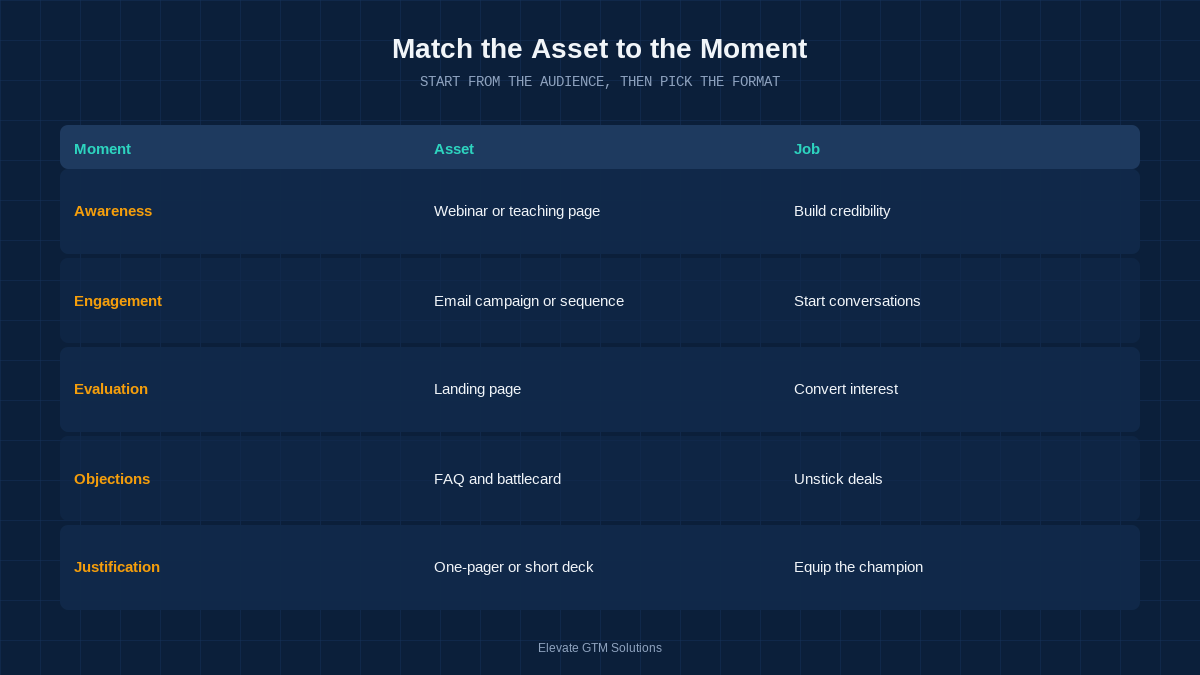
A strategy that stops at a report has done about half its job. The other half is converting decisions into things that real people see and use: a landing page that says what the strategy says, an email campaign that reaches the right segment with the right message, a webinar that teaches buyers how to think about the problem, an FAQ that answers the objections sellers keep hearing. Many teams have a strategy they like and a content calendar that has nothing to do with it, and the gap between the two explains a lot of wasted effort.
This guide explains how to pick a small number of focus assets, how to derive each from the strategy rather than from habit, how to brief them, how to sequence and test them, how to keep them consistent with each other and how to measure whether they are doing their job. We make a GTM strategy platform, Elevate GTM Solutions, and one step in our product turns selected reports into focus assets, so we have an interest, and we explain what the step does in a clearly marked section. We cite no statistics, we describe other approaches in general terms and our examples are invented and labeled.
How do you turn a GTM strategy into focus assets?
Pick a small set of assets, around five, that together carry the strategy's most important decisions to the audiences who matter first. For each asset, start from the strategy, not from a format: which segment is it for, what do they need to believe or do next, which message from the positioning does it carry and what proof backs it. Then choose the format that fits the job, such as a landing page for people who arrive with intent, an email campaign to reach a defined segment, a webinar to teach and build credibility and an FAQ to answer recurring objections. Write a short brief for each, sequence them so that they reinforce each other, ship a first version quickly, and measure against the strategy's own measures. Fewer assets, tightly tied to the strategy, usually beat a long calendar of loosely related content.
How many assets should you start with? Around five. Enough to cover the key audiences and moments, few enough to do well.
What should drive the choice of format? The audience's situation and the job the asset has to do, not what the team is used to making.
The short version
| Question | Answer |
|---|---|
| Why turn a strategy into assets? | Decisions only matter when buyers and sellers see them |
| How many assets to start? | Around five focus assets |
| What comes first when choosing an asset? | Audience, message and next action, then the format |
| Which formats are common? | Landing page, email campaign, webinar, FAQ, battlecard, sales deck, one-pager, sequence |
| How should assets relate? | They share the same positioning and proof and point to one another |
| How do you know it worked? | The measures chosen in the strategy, not vanity counts |
| What is the main mistake? | Making content that could be about any company |
| What should you do first? | Choose the top five from the strategy and write a one-page brief for each |
Why assets are where strategy becomes real
A strategy states choices: whom to serve, what to say, how to price and where to reach them. None of those choices reaches a customer on its own. They reach customers through assets: words on a page, an email in an inbox, a person on a call with a deck, a live session. If the assets contradict the strategy, the strategy has not been executed, whatever the document says.
Three problems recur when teams skip the translation step.
Content disconnected from strategy. The team produces what it usually produces: a blog post a week, a quarterly webinar, a standard sales deck. None of it reflects a recent decision to focus on a new segment.
Inconsistent messaging. Each asset is written by a different person from a different understanding of the positioning, so a buyer who sees three of them hears three stories.
Too much, too thin. Twenty assets are started and none is finished well.
A deliberate translation step, with a small number of assets tied to the strategy, fixes all three. See GTM strategy handoff and positioning.
Why around five
Five is not a magic number. It is a reasonable default that balances coverage and focus.
It forces prioritization. If you can only make five, you must decide which audiences and moments matter most.
It protects quality. A small team can make five assets well, with review and testing.
It keeps the message tight. Fewer assets are easier to keep consistent.
It leaves room to learn. After the first five ship, you will know what works and can choose the next set with evidence.
A larger company may run several sets of five, one per segment or region, and a very small team may start with three. The principle is a short list that is finished and used.
Start from the strategy, not the format
The sequence matters. Teams that start from formats ("we should do a webinar") end up with assets that are about the format. Teams that start from the strategy end up with assets that carry decisions.
For each candidate asset, answer five questions in order.
1. Who is this for? Name the segment and the persona. "Operations managers at regional carriers who currently use spreadsheets," not "logistics."
2. What situation are they in? Are they unaware of the problem, comparing options, evaluating you, justifying a purchase internally or already using you?
3. What should they believe or do afterward? One thing. For example, to see that your approach shortens implementation, or to book a call, or to share a page with their finance lead.
4. Which message and proof carry it? Pick the part of the positioning that matters for this audience and the evidence you can show.
5. What format fits? Only now choose the format, based on the first four answers.
If you cannot answer the first four, the asset is not ready to be made.
Choosing the format
| Format | Best for | Typical audience situation | Watch out for |
|---|---|---|---|
| Landing page | Converting people who arrive with a specific need | Comparing options, evaluating | A page that says what every competitor says |
| Email campaign | Reaching a defined list in a sequence | Aware of the problem, not yet engaged | Generic subject lines, lists that do not match the segment |
| Webinar or live session | Teaching, building credibility, handling complex topics | Early or mid research | Low attendance without a clear promise, content that is a sales pitch |
| FAQ | Answering recurring questions and objections | Evaluating, justifying internally | A list of questions nobody asks |
| Battlecard | Equipping sellers against a competitor | In a competitive deal | Overclaiming, stale facts |
| Sales deck | Supporting conversations | Evaluating | Slides that tell your story, not the buyer's |
| One-pager | Leave-behind, internal sharing | Justifying internally | Too dense to be read |
| Outbound sequence | Starting conversations with a target list | Unaware or early | Messages that sound mass-produced |
| Case study | Proof for a segment | Evaluating | Anonymous, vague outcomes |
Choose the formats that match your audience situations. Many strategies need a mix of one asset for each stage of the buyer's journey in the priority segment.
A way to choose the first five
A simple approach is to take the priority segment and map the moments that matter.
| Moment | Question | Candidate asset |
|---|---|---|
| Awareness | How do people in this segment first learn the problem has a better answer? | A webinar or a teaching page |
| Engagement | How do we reach the list we have chosen? | An email campaign or outbound sequence |
| Evaluation | Where do interested people go to decide? | A landing page |
| Objection handling | What do sellers hear most often that stalls deals? | An FAQ and a short battlecard |
| Internal justification | What do champions need to convince colleagues? | A one-pager or a short deck |
Pick the five that cover the moments where your segment is currently weakest. If deals stall at objections, an FAQ may matter more than a webinar. If nobody knows you exist, the webinar or sequence matters more.
Writing a one-page brief for each asset
A brief turns the strategy into instructions. Keep it to one page. Include:
- Name and format.
- Audience: segment, persona, situation.
- Goal: the one thing the audience should believe or do afterward.
- Message: the specific claim from the positioning, in plain words.
- Proof: the evidence you can show, such as customer results, demonstrations or comparisons you are able to substantiate.
- Objections to address: the top two or three.
- Tone and language: words buyers use, and words to avoid.
- Call to action: what happens next.
- Owner and date: one accountable person and a ship date.
- Measure: how you will know it worked.
- Links: where the asset connects to the others.
A brief makes review easier, since reviewers check the asset against the brief and not against their own taste.
Keeping assets consistent
Consistency does not mean identical. It means a buyer who meets several assets recognizes one company with one point of view.
One source of messaging. Keep the core positioning and the approved claims in one place, and write from it. See what is a GTM context layer.
Shared proof. Use the same case examples and facts across assets, and check them periodically.
Shared language. Maintain a short list of the terms you use for the product, the problem and the segments.
Cross-links. The webinar points to the landing page, the email points to the FAQ, the sales deck uses the same framing as the landing page.
One reviewer for consistency. Someone checks each asset against the positioning before it ships.
Sequencing
Assets work better when they are released in an order that mirrors how buyers move.
A common order for a new segment: start with the FAQ and the landing page, since they are needed for anyone who responds to anything else. Then prepare the sales deck or battlecard so sellers are ready for conversations. Then launch the email campaign or sequence to the target list. Then schedule the webinar, which benefits from having a landing page and follow-up material in place. Finally, collect what you learn and refine.
If you are launching a product, align with the launch plan. If you are refreshing positioning, update the existing assets that carry the old message before producing new ones. See first 90 days after a product launch.
Shipping a first version and testing
Perfect assets that ship late teach nothing. A better approach is to ship a good first version quickly and improve it with evidence.
Review against the brief, then ship. One round of review, not five.
Test one thing at a time. For an email campaign, test a subject line or an opening, not both. For a landing page, test the headline or the call to action.
Give tests enough volume. Small lists give noisy results. Interpret with caution, and avoid declaring a winner from a few responses.
Collect qualitative feedback. Ask sellers what prospects said. Ask customers what made them click.
Retire what does not work. Remove or rewrite assets that consistently underperform.
See GTM experimentation framework.
Measuring whether assets are doing their job
Measure against the strategy, not against vanity counts.
| Asset | Useful measures | Less useful measures |
|---|---|---|
| Landing page | Conversion to a meeting or trial from the target segment | Total visits from any source |
| Email campaign | Replies and meetings from the target list | Open rate alone |
| Webinar | Qualified attendees, follow-up conversations, pipeline touched | Registrations alone |
| FAQ | Whether sellers use it and whether objections are handled earlier | Page views |
| Battlecard | Win rate in competitive deals, seller feedback | Downloads |
| Sales deck | Stage progression in deals where it was used | Number of decks sent |
| Outbound sequence | Positive replies and meetings from the segment | Emails sent |
Tie each measure to a decision. If the number moved, what would you do differently?
A worked example, invented for illustration
Imagine a company of about seventy people selling expense management software. The details are invented and describe no real company.
The strategy, after a refresh, focuses on finance teams at mid-size professional services firms, with positioning built around reducing month-end close time and a proof point from three existing customers. The head of marketing picks five focus assets.
First, a landing page for finance leaders, built around the close-time message, with a short calculator and a request for a call. Second, an email campaign to a defined list of two hundred firms, three emails across three weeks. Third, a webinar for finance managers titled with the problem, not the product, featuring a customer. Fourth, an FAQ addressing the three objections sellers hear most: integration with the accounting system, data security and the cost of switching. Fifth, a one-pager for finance leaders to forward to their CEO.
Each has a one-page brief. The messaging comes from the same positioning statement, and each uses the same customer example. The FAQ and landing page ship first, in the first week. The sales team is briefed in week two. The email campaign starts in week three, and the webinar is held in week six, with the landing page and FAQ already live.
After six weeks, the data shows that the landing page converts well from email and poorly from general traffic, which is expected, since it speaks to a specific segment. The FAQ is used by sellers in about half of calls, and one objection about integration turns out to be more common than assumed, so the team writes a short integration guide as the sixth asset. The webinar attracts fewer people than hoped but produces five qualified conversations. The team keeps the format and sharpens the promise.
Notice that the choice of assets flowed from the strategy, that the assets reinforced each other and that the measures matched the strategy's goals.
Common mistakes
Starting from the format. Decide audience, message and next action first.
Making too many assets. Finish five well before starting more.
Generic content. If an asset could be about any company, it is not carrying your strategy.
No brief. Without a brief, reviewers argue about taste.
Inconsistent claims. Use one source for messaging and proof.
Shipping late. A good version this week beats a perfect one next quarter.
Measuring the wrong thing. Count what the strategy cares about.
Ignoring sellers. They hear objections first. Involve them.
Never retiring assets. Remove or rewrite what does not work or no longer matches the strategy.
Forgetting to update after a strategy change. Revisit assets when positioning changes.
Questions to ask yourself
- Which segment and moment is our weakest right now?
- What is the one thing we want that audience to believe or do?
- Which message and proof carry it?
- Which five assets would cover the moments that matter most?
- Who owns each, and by when will a first version ship?
- How will we keep the claims consistent across assets?
- What will we measure, and what would we do differently if it moved?
- Which existing assets contradict the current strategy?
What each of the four named assets should contain
The four assets most often chosen first are a landing page, an email campaign, a webinar and an FAQ. Here is a structure for each that you can adapt.
Landing page
A landing page for a defined segment has one job: help a person in that segment decide whether to take the next step. A workable structure:
- A headline that names the problem or outcome in the buyer's words. Not a slogan.
- A short subhead that says who it is for and what is different.
- Three or four reasons to believe, each tied to proof. Customer results, a short demonstration or a clear comparison you can substantiate.
- How it works, in plain steps. Enough that a reader understands what they would be getting.
- Answers to the top objections. Integration, effort, cost to switch and risk, as relevant.
- One call to action. A meeting, a trial or a short form, and not three competing buttons.
- A way to learn more. Links to the FAQ and a short case example.
Read it as the buyer would. If a competitor's page could carry the same headline, rewrite it.
Email campaign
A campaign to a defined list works best as a short sequence that gives the reader a reason to respond at each step.
- First email: the problem and a specific observation. Show you understand their situation. One idea, short.
- Second email: proof. A relevant customer example or result, with one link.
- Third email: a low-effort next step. A short call, a resource or an invitation to the webinar.
Keep each message short and written by a person. Avoid long openings about yourselves. Send only to a list that matches the segment, since the best copy fails on the wrong audience. See account tiering framework.
Webinar
A webinar can teach, build credibility and start conversations. A workable approach:
- Title it with the problem, not the product. People attend to learn something.
- Feature someone credible. A customer or an expert is more persuasive than a pitch.
- Teach something they can use that day. A framework, a checklist or a worked example.
- Show the product briefly, if at all. Ten minutes of demonstration after thirty of teaching is a reasonable ratio.
- Leave time for questions and capture them. They tell you what to put in the FAQ.
- Follow up within a day. A recording, a short summary and a clear next step.
FAQ
An FAQ is the quietest and often the most valuable asset, because it answers what stalls deals.
- Gather real questions. From sellers, support tickets, webinar chats and sales calls.
- Answer directly in the first sentence. Then explain.
- Include the uncomfortable questions. Pricing approach, limits, integration effort and what the product does not do. Honest answers build trust.
- Group by stage. Early questions, evaluation questions and implementation questions.
- Review quarterly. Remove what is no longer asked and add what is.
Auditing the assets you already have
Before making anything new, check what exists. A short audit often shows that the quickest improvement is to update an old asset, not to create a new one.
| Question | What to do with the answer |
|---|---|
| Does this asset describe the current positioning? | If not, update or retire it |
| Is it for a segment we still target? | If not, archive it |
| Do sellers use it? | If not, ask why, and fix or remove it |
| Are the facts and proof current? | Update or replace stale claims |
| Does it contradict another asset? | Resolve the conflict, with the strategy as the tiebreaker |
| Is it easy to find? | Fix the location or the naming |
List every asset in a simple table with its audience, owner, last update and status. The act of listing usually reveals duplicates, gaps and contradictions.
Reusing one idea across assets
A strategy gives you a small number of core ideas, and each can appear in several forms without repeating itself. A finding from a customer story might become a landing page proof point, an email opening, a webinar example and an FAQ answer. This reuse is a strength, since it makes the message consistent, and it saves effort. Reuse the substance and adapt the form: a webinar example needs more detail than an email, and an FAQ answer needs less. Keep a short library of approved proof points, customer examples and statements of the positioning that writers can draw from.
Using AI to draft assets safely
AI tools can produce first drafts of assets quickly, and there are good and bad ways to use them.
Give it the brief. A draft from a brief that names the audience, message, proof and tone is far better than one from a generic request.
Supply the proof. Do not let the tool invent customer results, statistics or comparisons. Provide the facts you can substantiate.
Edit for your voice. Read the draft aloud and replace phrases your buyers would not use.
Check every claim. Verify anything specific against a source you hold.
Keep a person accountable. Someone owns each asset and signs off before it ships.
Generated drafts save time on structure and wording, and the judgment about what to say and what to prove remains yours.
A plan for the first six weeks
Week one: choose and brief. Confirm the priority segment, choose the five assets and write the briefs. Gather the proof and the objections from sellers.
Week two: build the foundations. Draft and review the FAQ and landing page. Update any existing assets that contradict the strategy.
Week three: enable the team. Brief sellers on the strategy and the new assets. Prepare the sales deck or battlecard. Launch the first email or sequence to a small list.
Week four: expand. Send the rest of the campaign. Promote the webinar. Watch early responses and collect seller feedback.
Week five: hold the webinar and follow up. Capture questions and add them to the FAQ.
Week six: review. Read the measures against the strategy's goals. Decide what to keep, change or retire. Choose the next set of assets with what you learned.
A worked brief, invented for illustration
To make the brief format concrete, here is a filled-in example for the FAQ in the expense management scenario. The details are invented.
| Field | Entry |
|---|---|
| Name and format | Finance leader FAQ, a single web page |
| Audience | Finance managers and controllers at mid-size professional services firms who are evaluating options |
| Goal | The reader sees that their three biggest concerns have clear, honest answers and takes the next step with a seller |
| Message | Month-end close takes less time when expense data arrives complete and coded |
| Proof | Three customer examples that the company is permitted to reference, and a short demonstration |
| Objections to address | Integration with the accounting system, data security practices and the effort of switching |
| Tone and language | Plain, direct, the vocabulary finance teams use, no hype |
| Call to action | Book a short call with a seller |
| Owner and date | Product marketing manager, ready for review in five working days |
| Measure | Share of seller calls in which the FAQ was used, and whether the three objections come up earlier in conversations |
| Links | Landing page, one-pager, integration guide |
Notice what the brief does not contain: the headline, the paragraphs or the design. It says what the asset must achieve and with what evidence. The writer then has room to craft the words, and the reviewer has a standard to check against.
When to stop making assets
More assets are not always better. If the first five are performing, the next step may be to deepen them, for example by adding a second customer example or a short integration guide, and not to add a sixth format. If measures show that the strategy itself is the problem, such as a segment that does not respond to any asset, return to the strategy before producing more content. Assets cannot rescue a wrong target, and the cheapest way to find that out is to read the results of a small, focused set.
Handoffs between teams when assets are made
Assets usually cross team lines. Marketing writes, sales uses, product checks claims and customer success supplies stories. Without clear handoffs, assets wait in review queues. A few simple rules help: name the single person accountable for each asset, set a review window of a few working days and say who reviews for what, such as product for accuracy of claims and sales for tone and usefulness. Ask reviewers for specific changes and not general reactions, and when two reviewers disagree, let the owner decide against the brief. Publish a short note when an asset goes live, saying what it is, who it is for and where to find it, so that sellers know it exists on the day it ships.
A final test before anything ships
Ask five questions of each asset. Does it name a specific audience? Does it carry one message from the positioning? Does it include proof we can substantiate? Does it ask for one clear next step? Would a buyer in the target segment say these words? If any answer is no, send it back. The test takes two minutes and prevents most of the generic content that fills company websites.
Glossary
Focus asset. One of a small set of prioritized pieces of content or material that carry a strategy's key decisions to a defined audience.
Brief. A one-page set of instructions for an asset: audience, goal, message, proof, objections, call to action, owner and measure.
Positioning. How you are different and for whom. See positioning.
Battlecard. A short sales aid comparing you with a competitor in a given situation.
Proof. Evidence you can show that supports a claim.
Call to action. The next step an asset asks the audience to take.
Sequence. A series of outreach messages sent over a period.
Consistency review. A check of an asset against the core positioning before it ships.
Where Elevate GTM Solutions fits
Elevate GTM Solutions is an AI GTM platform for building, executing and evolving go-to-market strategy. A step in its product flow, GTM Activation, is designed for the translation this guide describes: you pick the reports that matter and the platform helps create the top five focus assets, for example a webinar, an email campaign, a landing page and an FAQ.
As we describe the flow, the strategy is first built in the Strategy Builder from fifteen modules or the Unified GTM option and moves through the stages Draft, Defined, Launched and Optimizing in the Workflow Engine. Strategy Insights produces images, PowerPoint or PDF material from the summarized report. GTM Playbooks record methodology, recommendations, key decisions and best practices for each discipline. GTM Pulse gives teams weekly actions, recommendations and scores, and executive dashboards give leaders visibility.
What it does not do: generated assets are a starting point, and they need review against your brief, your proof and your tone. It cannot verify your claims or substitute for a seller's knowledge of the buyer. We suggest treating the outputs as drafts, running the consistency review described above and checking with us directly about the formats, limits and editing options. See what Elevate GTM Solutions is.
What to do this week
- Write down your priority segment and the three moments where it is weakest.
- Choose five focus assets that cover those moments.
- Write a one-page brief for each, with audience, goal, message, proof, objections, owner, date and measure.
- Put the core positioning and approved claims in one place and write from it.
- Ask two sellers what objections they hear most and fold the answers into the FAQ.
- Ship the FAQ and landing page first.
- Schedule the briefing for sales before any outbound begins.
- Set a review date six weeks after launch to read the measures.
Key takeaways
- Strategy becomes real through assets, and assets that ignore the strategy waste effort.
- Start with around five focus assets, tied to the priority segment's most important moments.
- For each asset, decide the audience, situation, goal, message and proof before choosing the format.
- Write a one-page brief for each, and keep the claims consistent across assets from a single source.
- Sequence assets in the order buyers need them, shipping the FAQ and landing page early.
- Ship a good first version, test one thing at a time and retire what does not work.
- Measure against the strategy's goals and tie each measure to a decision.
- Generated assets, from any tool, need review against your own proof and tone.
Sources
- Elevate GTM Solutions: descriptions of the platform and the GTM Activation step, as stated on the company's homepage and in its product flow.
- Related Elevate guides linked in the text, including GTM strategy handoff and GTM experimentation framework.
- The five-question method, brief format and measurement approach reflect our judgment and common practice. The worked example is invented. We state no statistics and make no claims about other vendors.
Frequently Asked Questions
How do you turn a GTM strategy into assets?
Choose around five focus assets tied to the priority segment. For each, decide the audience, situation, goal, message and proof, then choose the format, write a one-page brief, sequence the assets and measure them against the strategy's goals.
How many assets should we start with?
Around five. That is enough to cover the key moments and few enough to finish well. Add more once you have learned what works.
Which formats should I pick?
Choose by the audience's situation: a landing page for people evaluating, an email campaign or sequence to reach a defined list, a webinar to teach, an FAQ to handle objections, and a battlecard, deck or one-pager to equip sellers and champions.
What should be in an asset brief?
Audience, goal, message, proof, objections, tone, call to action, owner, date, measure and links to related assets. Keep it to one page.
How do I keep assets consistent?
Write from one source of positioning and approved claims, share proof and language, cross-link assets and have one person check each against the positioning before it ships.
What order should assets be released in?
Usually the FAQ and landing page first, then seller enablement, then the email campaign or sequence, then the webinar, and then refinement based on results.
How do I measure whether assets work?
Use the strategy's own measures, such as meetings from the target segment, replies, qualified attendees, win rate in competitive deals and stage progression, and tie each to a decision.
Can AI generate these assets?
Yes, as drafts. They need review against your brief, your proof and your buyers' language, since AI cannot verify your claims or know your customers' situation.
What does Elevate's GTM Activation do?
It lets you pick the reports that matter and create the top five focus assets, for example a webinar, an email campaign, a landing page and an FAQ. Confirm formats and limits with us directly.
What if my team is very small?
Start with three assets, perhaps a landing page, an FAQ and a short outbound sequence, and add more as capacity allows.
Should assets change when the strategy changes?
Yes. When positioning, segments or pricing change, update the assets that carry the old message first, then produce new ones.
What is the most common mistake?
Making content that could be about any company. Tie each asset to a specific segment, message and proof from the strategy.
Contents