
By the Elevate GTM Solutions Team · Updated November 13, 2026 · 25 min read
What to Do in the First 90 Days After a Product Launch: A Week-by-Week Plan for Learning, Fixing and Scaling
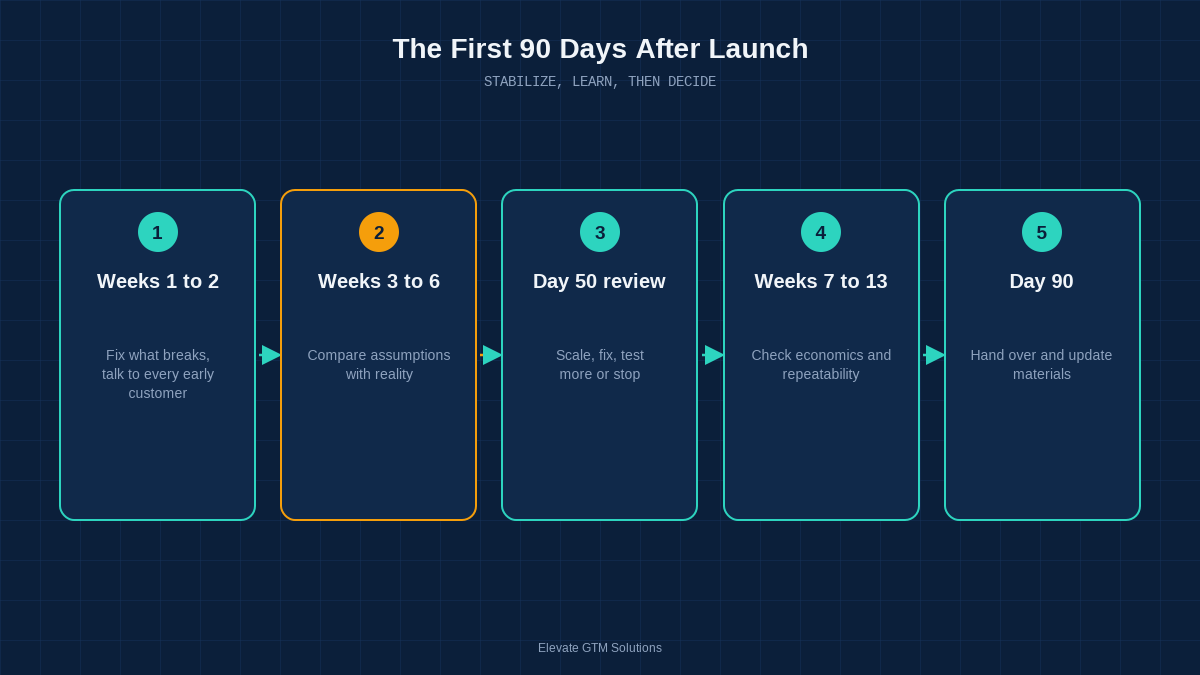
Most launch plans end on launch day. The slides, the checklist, the countdown and the announcement all point at one date. Then the date passes, the team exhales, and the real work begins with no plan attached: the first customers, the first objections, the first things that do not work, and the first tough questions from leadership about whether this is going well.
This guide is about what comes after. It is a plan for the first ninety days following a product launch, organized in three phases: the first two weeks, when you watch and fix; weeks three to six, when you learn what is real; and weeks seven to thirteen, when you decide what to scale, change or stop. It covers who does what, what to measure, what to ignore, how to run the weekly review and how to avoid the mistakes that make a launch look worse or better than it is.
We make a GTM strategy platform with launch and measurement modules, so we have an interest in this topic. We have tried to keep the advice useful for any team, with or without software. The examples are invented to illustrate the thinking, and we cite no benchmark numbers. Early results vary so widely by product, price and market that a number from another company will mislead more than it helps.
What should you do in the first 90 days after launching a new product?
Treat the first ninety days as a learning period with three jobs. In the first two weeks, stabilize: watch for broken things, answer every early customer personally, and fix problems fast. In weeks three to six, learn: compare what you assumed with what actually happened, in who showed up, what they asked, why they bought or did not, and how they used the product. In weeks seven to thirteen, decide: double down on what works, change what does not, and stop what is wasting effort. Keep a small set of measures, hold one weekly review with sales, marketing, product and customer success in the same room, and write down each decision and the evidence behind it.
What matters most? Speed of learning. A launch is a set of bets, and the first ninety days tell you which ones paid off.
When is a launch "successful"? When you compare results with the targets you wrote before launch, not with a general feeling.
The short version
| Phase | Weeks | Main job | What you are watching |
|---|---|---|---|
| Stabilize | 1 to 2 | Keep it working and talk to every early customer | Breakage, support issues, first reactions |
| Learn | 3 to 6 | Compare reality with your assumptions | Who buys, why, how they use it, what blocks them |
| Decide | 7 to 13 | Scale, change or stop | Efficiency, repeatability, early retention |
Notice what is missing from that table: a victory lap. The first ninety days are not the time to declare success or failure. They are the time to find out what you actually launched.
Before you start: set up the ninety days on the last week before launch
The best first-ninety-day plans are written before launch. If you are reading this after launch day, do these things in your first week instead.
Write down your assumptions. What did you believe about who would buy, what they would pay, how long it would take, what they would say and which channel would work? Write them in a table. You will need them in week three, and memory is a poor record. A launch team that cannot remember what it expected cannot learn from what happened.
Set targets with ranges. Pick a few measures and write a low, a likely and a high figure for each. A range protects you from arguing about whether a result is good or bad after the fact.
Name an owner for the ninety days. One person should be accountable for the learning, not for the success. That person runs the weekly review and keeps the decision log.
Agree on how decisions get made. Who can change the price, the message or the target segment during the period? What evidence do they need? Without a rule, small changes take weeks.
Make a "where to look" page. One place that lists every dashboard, folder and channel the team uses. It saves hours of asking.
If you are still preparing for launch, our enterprise product launch readiness framework covers what to have in place before the date.
Weeks one and two: stabilize
The first fortnight is about attention. Things will break in ways nobody predicted, and the first customers form their opinion of you from how you respond.
Daily habits
A fifteen-minute standup, every day. Product, engineering, support, sales and marketing. Three questions: what broke, what did customers say, what are we changing today. Keep it short. If it grows, split the problem-solving into separate conversations.
One shared log of issues and feedback. Every complaint, question, bug and compliment goes in one place with a date, a source and a tag. A spreadsheet works. The aim is to spot patterns, which you cannot do when feedback lives in individual inboxes.
Personal contact with every early customer. In the early days, the team can and should talk to everyone who buys or tries. Ask what they were trying to do, what almost stopped them and what they expected. Do not pitch. Listen.
A fast path for fixing. Decide in advance how a serious bug moves from report to fix, who approves a quick change and how customers hear about it. Launch weeks are the wrong time to discover that nobody can push a fix.
What to watch
| Area | Questions |
|---|---|
| Product | Does it work as described? What breaks? Where do users get stuck? |
| Sign-up and purchase | Can people buy or start easily? Where do they drop off? |
| Support | What do people ask? How fast do you answer? What repeats? |
| Messaging | Do people describe the product the way you do? |
| Sales | What objections come up in the first calls? Who is asking? |
| Pricing | Do buyers react to the price, the packaging or the terms? |
| Channels | Where did the first customers come from? |
What to ignore in the first two weeks
Vanity totals. Page views, sign-ups and social impressions say you were noticed, not that you are working.
Small samples. Five customers do not make a trend. They make five stories. Write them down, but do not rebuild the plan around any one of them.
Early revenue as a verdict. Early revenue depends on timing, deal cycles and who happened to be waiting for you. It is a thin signal in either direction.
Competitor reactions. A competitor's announcement the week after your launch is rarely about you. Note it, then get back to work.
What good looks like at day fourteen
You can answer these in a few sentences each: Who actually showed up? What did they say they wanted? What broke, and what did we fix? What did we learn that contradicts what we expected? What are we changing next week? If you cannot answer, spend more time with customers.
Weeks three to six: learn
By now there is enough activity to see some patterns. The job in this phase is to compare what happened with what you assumed.
Hold a day-twenty review
Around the end of week three, set aside two hours. Pull out your written assumptions and the log. For each assumption, mark it as confirmed, contradicted or unknown. Do this in a table.
| Assumption | What we expected | What happened | Verdict |
|---|---|---|---|
| Target buyer | Marketing directors at mid-size firms | Mostly operations managers | Contradicted |
| Price | Fine at the planned level | Several asked for a smaller starting plan | Partly contradicted |
| Main channel | Search and webinars | Referrals from two early customers | Surprise |
| Time to value | Under two weeks | About four weeks, mostly because of setup | Contradicted |
| Main objection | Security | Integration with their existing tools | Contradicted |
The example is invented. The point is the discipline of writing it down and facing the gaps. Most launches contradict several assumptions. That is normal. A launch that contradicts none either went exactly to plan or is not being examined honestly.
Segment what you see
Early results blend different kinds of customers. Break them apart.
- By who they are. Industry, company size, role, region.
- By how they found you. Channel, referrer, campaign.
- By how they bought. Self-serve, sales-assisted, partner.
- By how they behave. How fast they started, which features they use, how often they come back.
A blended average may say "mediocre" while one segment is excellent and another is a waste of time. You can only see that when you split the data. Do not slice so thin that each group has three people. Pick two or three cuts and check that each group is big enough to say anything.
Read the sales conversations
If you have a sales team, listen to calls or read notes from the first batch of opportunities. Look for four things.
- The words buyers use. If they describe the problem in terms you never used, your messaging may be off.
- The questions they ask first. These show what they care about.
- The point where deals stall. Is it price, risk, legal, a missing feature or a missing champion?
- The reasons for no. "No budget," "not now" and "chose someone else" mean very different things. Ask for the real reason and record it. Our win-loss analysis framework shows a way to do this.
Test one change at a time
Weeks three to six are for small, fast experiments. Pick the one or two issues that matter most and try a fix.
- If buyers do not understand the product, rewrite the first paragraph of the homepage and the opening of the sales call, then compare.
- If trial users stall at setup, add a guide or a call at that point.
- If one segment responds well, shift some effort there for a few weeks and watch.
- If price is the objection, test a different packaging with a small group before changing the list price.
Write down each test: what you changed, why, how you will judge it and when you will check. Our GTM experimentation framework lays out a simple format.
Handle the "is it working?" question from leadership
Executives will ask. A calm answer with structure goes a long way.
Share three things: what you expected, what happened and what you are doing about the gap. Avoid both gloom and spin. If the numbers are too early to read, say that, and say when they will not be. Give a date for the next update. Leaders handle uncertainty better than surprises.
Weeks seven to thirteen: decide
The final phase is when you turn lessons into choices. By week seven you have enough to decide where to put your effort.
The day-fifty decision review
Gather the team and ask four questions about each major part of the launch.
Scale. What is working in a way we can repeat? Evidence: a segment that converts, a channel with acceptable cost, a message that lands.
Fix. What is promising but flawed? Evidence: strong interest with a clear obstacle we can remove.
Test more. What is unclear? Evidence: mixed signals or too little data. Set a time-boxed test.
Stop. What is consuming effort without results? Evidence: a channel, feature or segment that has had a fair chance.
Be careful with the last one. Stopping is hard because the work is visible and the people are invested. A written rule helps: "If this channel has not produced X by date Y, we stop."
Check the economics
By now you can start looking at what it costs to win a customer and what you get back. Early numbers are rough, and you should say so.
| Question | What to look at | Caution |
|---|---|---|
| What does it cost to win a customer? | Spend and time on sales and marketing divided by customers won | Small counts swing wildly; use ranges |
| How long does it take? | Time from first touch to purchase | Early deals are not typical |
| Are customers using the product? | Activation and repeat use | Usage predicts retention, but only roughly this early |
| Are they happy? | Support themes, feedback, any renewals or expansions | Satisfaction at day thirty is not renewal at month twelve |
| Is it repeatable? | Can someone other than the founders or best sellers win deals? | The first deals are often won by the people who built it |
That last question matters more than people think. Early wins often depend on the enthusiasm and skill of the people closest to the product. A launch has not become a motion until others can repeat it. If you want to look at payback thinking in more detail, see our CAC payback research page.
Hand over to steady state
At around day ninety, the launch team usually dissolves and the work moves into normal operations. Do this on purpose.
- Move ownership. Each part of the launch needs a regular owner, such as product marketing for messaging, sales leadership for the sales process and customer success for onboarding.
- Document what you learned. A short report: assumptions, results, decisions, open questions.
- Update the materials. Messaging, sales decks, FAQs and onboarding should reflect what you learned, not the pre-launch guess. See what is GTM enablement for how to keep those up to date.
- Set the next review. Schedule a ninety-day check on the same assumptions.
The weekly review: a simple format
One meeting does more for a launch than any dashboard. Keep it to an hour, same time every week, with sales, marketing, product and customer success all present.
- Numbers (ten minutes). The small set of measures, against the ranges you wrote.
- What we heard (fifteen minutes). Top themes from customers, sales and support, from the shared log.
- What we tried (ten minutes). Results of last week's tests.
- What we will change (fifteen minutes). Decisions with owners and dates.
- What is blocked (ten minutes). Anything that needs a leader's help.
Write the decisions in a log with the date, the evidence and the owner. In week thirteen you will be glad you did.
What to measure
Pick a handful of measures, and tie each to a question. Too many dashboards bury the signal. Our guide on GTM metrics and KPIs can help choose.
| Stage | Example measure | The question it answers |
|---|---|---|
| Awareness | Qualified visits or inquiries from target accounts | Are the right people noticing? |
| Interest | Demo requests, trial starts, replies | Does the message get a response? |
| Conversion | Share of interested prospects who buy | Is the path working? |
| Speed | Days from first touch to purchase | How long does it take? |
| Activation | Share of new customers who reach a first meaningful use | Does the product deliver early value? |
| Early retention | Repeat use, renewals or expansions as they come due | Do they stay? |
| Efficiency | Cost to win a customer, in rough ranges | Can we afford to repeat this? |
| Sentiment | Themes from support and feedback | What do people feel and why? |
Define each measure in writing before launch, including the source and the rule for counting. "Qualified" means nothing until someone writes down what qualified is.
A note on lagging results
Many of the results you care about take longer than ninety days. If your sales cycle is four months, you will not see most closed deals in this window. Look at leading signals such as qualified pipeline, stage progression and the quality of conversations, and say clearly that closed revenue will come later. Our evidence page on B2B sales cycle length discusses why cycles vary.
Who does what
A launch is cross-functional, and unclear roles cause delay. Here is a general split that you should adjust.
| Role | First 90 days |
|---|---|
| Launch owner | Runs the weekly review, keeps the decision log, escalates blockers |
| Product | Fixes issues, watches usage, turns feedback into a prioritized list |
| Product marketing | Tracks how buyers describe the product, updates messaging and proof |
| Marketing | Runs the planned channels, reports on source quality, adjusts spend |
| Sales | Records objections and loss reasons, tests the pitch, shares what works |
| Customer success | Onboards early customers, tracks activation and early problems |
| Support | Tags and counts issues, flags patterns quickly |
| Leadership | Clears blockers, protects the learning period, avoids rewriting the plan weekly |
Leaders matter in an unexpected way. The biggest source of damage in the first ninety days is often a leader who reads one bad week as a verdict and orders a change of direction. Agree in advance on what would justify a major pivot, and when you will review it.
Common situations and what to do
Interest is high and sales are low
Look at where prospects drop off. If they try the product and leave, look at onboarding and value. If they book calls and stall, look at pricing, proof and decision makers. If they never reach a call, look at the path and the promise. Fix the biggest gap first.
Sales are fine and usage is low
This is a warning. Customers who buy and do not use the product tend not to renew. Contact them, find the obstacle and treat onboarding as part of the launch, not an afterthought.
The wrong customers are showing up
Check whether your message attracts the wrong people. If a different segment is buying and doing well, consider whether it is a better target than the one you planned. Our guide on ICP can help you reassess. If the wrong segment is buying and doing badly, narrow your targeting and your message.
One big customer dominates
A large early customer can make results look great or mask a problem. Look at results with and without them. Be careful about customizing the product for one account at the expense of everyone else.
The competitor responds
Gather facts: what changed, how buyers react, whether it affects your deals. Update the competitive material only if there is evidence of an effect. Avoid price wars or message changes based on rumor.
The launch missed its targets
Compare with the assumption table. Which assumptions failed? Was it the audience, the offer, the message, the channel, the price or the product? Be specific. "The launch did not work" is not a finding. "Our target buyers do not search for this problem, and our referral customers came from a different segment" is a finding you can act on.
The launch beat its targets
Check whether the results are repeatable and whether the early customers are typical. Resist the urge to spend everything at once. Scale in steps and watch whether efficiency holds.
Communication during the ninety days
Three audiences need different things.
Customers want to know that you are listening. Tell them what you fixed. A short note saying "you told us X, we changed Y" earns more trust than a feature announcement.
Employees want to know how it is going and what it means for them. Share the honest version, including the problems. Rumors fill gaps.
Leadership and the board want a clear picture and no surprises. Send a short update on a set schedule with three parts: what we expected, what happened, what we are doing.
Mistakes teams make
Declaring victory or defeat too early. The first weeks are noise as much as signal.
Changing everything at once. If you change the message, the price and the channel together, you will not know what mattered.
Ignoring support data. Support tickets are free research.
Letting sales and product work separately. Objections in sales calls often point to product gaps, and nobody connects them.
Chasing the loudest customer. One strong voice is not a market.
Skipping the decision log. In week thirteen nobody remembers why a change was made.
Starting the next launch too soon. If the team moves on at week four, nobody learns from this one.
Reporting activity instead of results. Emails sent and webinars held are not outcomes.
Treating launch as an event. A launch is the start of a learning period.
A short checklist for each phase
By day fourteen: a shared log is live and used; every early customer has been contacted personally; a fast path to fix serious problems exists and has been used once; a daily standup is running; the assumptions table is written; the team agrees what the first review will look at.
By day forty-five: the assumption review has been held and its verdicts recorded; at least two small tests have run, with results written down; objections and loss reasons are tagged consistently; segment cuts have been looked at; leadership has had one honest update.
By day ninety: a scale, fix, test-more or stop decision has been made for each major part of the launch; ownership has moved to regular teams; materials have been updated with what you learned; a short report is written; the next review is scheduled.
If a checkbox cannot be ticked, it is a sign of where to spend the next week. Do not treat the list as a pass-fail grade. Treat it as a map of what is still unknown.
Glossary
Launch. The point at which a product becomes available to its target market, along with the activities around it.
Assumption log. A written list of what the team believed before launch, used to compare with reality.
Activation. The point at which a new user or customer first gets meaningful value from the product.
Early retention. Whether customers keep using or paying for the product in the first months.
Leading indicator. A measure that tends to move before the result you care about, such as qualified pipeline before revenue.
Lagging indicator. A measure that shows results after the fact, such as closed revenue or renewals.
Win-loss analysis. A structured review of why deals were won or lost, based on conversations and data.
Decision log. A written record of choices, the evidence behind them and who made them.
Segment. A group of customers or prospects that share traits relevant to how they buy or use the product.
Pivot. A significant change in target customer, offer, message or approach.
CAC (customer acquisition cost). The cost of winning a new customer.
Ideal customer profile (ICP). A description of the companies and people most likely to buy and succeed with your product.
Where Elevate GTM Solutions fits
Elevate GTM Solutions is an AI GTM platform. Its homepage lists modules called "Launch & Execute" and "Measure & Optimize" alongside strategy, ICP and segmentation, positioning, messaging, pricing strategy, sales enablement and customer success, and it lists "Launch a new product" among its use cases. The homepage says "15 connected GTM modules" and names sixteen, so count what you see when you look.
Where that could help in the first ninety days is in keeping the plan and the learning connected. When the review shows that the real buyer differs from the planned one, the useful move is to update segmentation, positioning, messaging and enablement together, and a platform built on one shared set of inputs is designed to make that easier than juggling separate documents. That is the company's design intent, and the proof is whether your team finds the update faster and clearer in a trial. The company also describes its approach as continuous optimization, which matches the spirit of this guide, and it offers a free strategy build that it says takes about five minutes, which is a company claim.
A platform will not replace the work of talking to customers, reading sales calls and making hard calls on what to stop. It is a place to keep the plan current. For more, see what Elevate GTM Solutions is and continuous GTM optimization.
What to do this week
- Write down what you assumed before launch, in a table: audience, price, channel, time to value, main objection.
- Set low, likely and high figures for five measures.
- Name one owner for the ninety days and schedule the weekly review.
- Start one shared log for feedback, issues and objections.
- Book conversations with your first ten customers or trials.
- Block two hours in week three for the assumption review.
- Write the rule for what would justify a major change of direction.
Key takeaways
- The first ninety days are a learning period in three phases: stabilize, learn and decide.
- Write your assumptions down before launch. You need them to learn from what happens.
- Talk to every early customer. Small numbers favor conversations over dashboards.
- Segment results before judging them, and avoid slicing so thin that the groups are tiny.
- Hold one weekly review across sales, marketing, product and customer success, and keep a decision log.
- Many results arrive after day ninety. Use leading signals, and say what is still to come.
- At day ninety, hand ownership to normal operations and update the materials.
Sources
- Elevate GTM Solutions: descriptions of modules, use cases and the free strategy build, as stated on the company's homepage. The five-minute figure is the company's own claim.
- Related Elevate guides linked in the text, including the enterprise product launch readiness framework and the win-loss analysis framework.
- The three-phase plan, the review formats and the measures table reflect common practice and our judgment. They are not drawn from a study, and your launch may need a different shape.
- The worked tables and examples are invented for illustration. We cite no benchmark figures, because early launch results vary too widely to compare across companies.
Frequently Asked Questions
What should you do in the first 90 days after a product launch?
Work in three phases. In weeks one and two, stabilize: fix what breaks and talk to every early customer. In weeks three to six, learn: compare what happened with what you assumed, segment the results and test small changes. In weeks seven to thirteen, decide what to scale, fix, test more or stop, and hand ownership to normal operations.
How do you measure whether a launch is successful?
Compare results with the targets, written as ranges, that you set before launch. Use a small set of measures across awareness, interest, conversion, speed, activation, early retention and efficiency. Many results take longer than ninety days, so use leading signals and say what is still to come.
What metrics matter most in the first 90 days?
Qualified interest, conversion along the path, time from first touch to purchase, activation of new customers, early signs of retention and a rough cost to win a customer. Support and feedback themes matter too. Define each measure in writing so everyone counts the same way.
How often should we review launch performance?
Weekly. Keep it to an hour with sales, marketing, product and customer success in the room. Cover the numbers, what you heard, what you tried, what you will change and what is blocked, and write decisions in a log.
What if the launch does not hit its targets?
Go back to your written assumptions and find which failed: audience, offer, message, channel, price or product. A specific finding, such as the target buyers do not search for this problem, gives you something to act on. A general feeling that it did not work does not.
What if the launch is going better than expected?
Check whether the results are repeatable and whether the early customers are typical. Scale in steps and watch whether efficiency holds. Early wins often depend on the people closest to the product, so see whether others can repeat them.
When should we change our pricing after launch?
Only with evidence, and ideally through a small test. Buyers asking about the price in a few conversations is a signal to investigate, not a mandate to change the list price. Test different packaging with a small group before a broad change.
How do we handle early customer feedback without overreacting?
Log everything in one place with a date, a source and a tag, and look for patterns across customers. One strong opinion is a story, not a trend. Prioritize issues that repeat or that block purchase or early use.
Who should own the first 90 days?
One person should own the learning and run the weekly review, usually from product marketing, a GTM lead or a launch manager. Product, marketing, sales, customer success and support each own their part. Leadership's job is to clear blockers and avoid rewriting the plan after one bad week.
How is this different from pre-launch planning?
Pre-launch planning prepares the product, the message, the team and the materials. The first ninety days is about learning from real customers and adjusting. Both matter, and the second depends on writing down assumptions during the first. See the enterprise product launch readiness framework for the pre-launch side.
Should the launch team stay together after 90 days?
Usually not as a launch team. Hand each part to a regular owner, document what you learned, update the materials and schedule a ninety-day check on the same assumptions. Moving on without a handover loses the learning.
Can software help after a launch?
It can help keep strategy, messaging, enablement and measurement in one place so changes stay consistent. It cannot replace talking to customers or making decisions about what to stop. Use any tool as a place to keep the plan current, not as a source of verdicts.