
By the Elevate GTM Solutions Team · Updated November 13, 2026 · 23 min read
What Is GTM Enablement? Definition, Scope, Owners, Metrics, and How It Changes When Your Go-to-Market Shifts
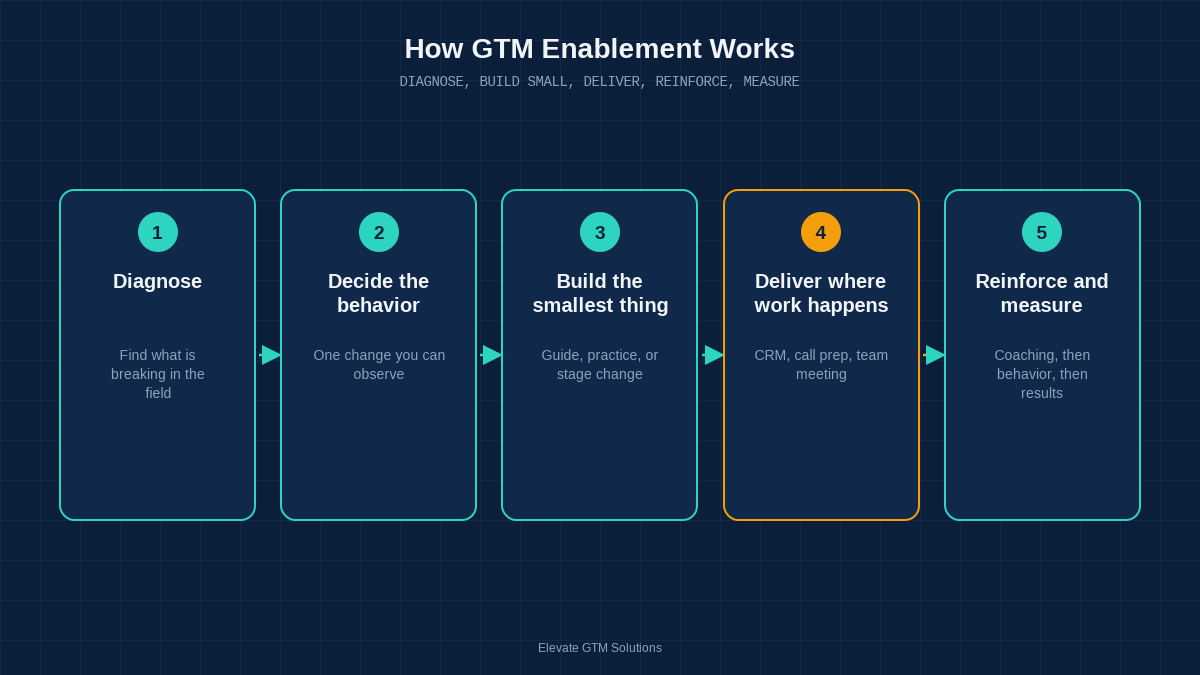
Ask three people at the same company what enablement means and you may get three answers: training for new hires, a library of sales decks, and a quarterly kickoff. All three are pieces of it. None is the whole. The word gets stretched further when "GTM" is attached, because GTM enablement is meant to cover more than sellers, and it is meant to move when the company's go-to-market moves.
This guide defines GTM enablement in plain terms, separates it from the neighboring ideas of sales enablement and revenue enablement, describes what it includes, who should own it and how to measure it, and spends real time on the situation that breaks most enablement programs: a shift in go-to-market, such as a new product, a new segment, a move from mid-market to enterprise, or a change of pricing. The failure usually has the same cause: the program was built for the old motion and nobody reset it.
We make a GTM platform with a Sales Enablement module, so we have a stake in the topic. We name enablement tools in general terms and do not rank them. The examples in this guide are invented to illustrate the thinking, and we use no benchmark figures.
What is GTM enablement?
GTM enablement is the work of making sure everyone who takes a product to market, including sellers, marketers, customer success, partners and support, has the knowledge, messages, materials, process and tools to do their part of the go-to-market strategy consistently. It differs from sales enablement mainly in scope: sales enablement focuses on sellers, while GTM enablement covers every customer-facing role and ties the work to the current strategy. When go-to-market shifts, enablement has to shift with it: update the audience, the message and the proof first, then the training and tools.
Is GTM enablement the same as sales enablement? Not quite. Sales enablement is one part of it. GTM enablement is wider and tied to the strategy.
Who owns it? One named leader, usually in a function that sits between product marketing, sales and customer success, with a seat at the planning table.
The short version of what it includes
Enablement answers a simple question for each role: what does a person in this role need to know, say and do, and what do they need to do it well? The answer has six parts.
| Part | What it covers | Example |
|---|---|---|
| Knowledge | What to know about the product, market, customers and competitors | Product training, competitor briefings |
| Messaging | What to say, to whom and with what proof | Messaging framework by persona |
| Content | Materials people use with customers | Decks, one-pagers, case studies, battlecards |
| Process | How the work is done and in what order | Sales stages, handoff rules, play steps |
| Tools | Systems that support the work | Content library, coaching tools, CRM views |
| Reinforcement | How learning sticks | Practice, coaching, certification, feedback |
A program that covers only content is a library. A program that covers only training is a course. Enablement is what happens when the six parts line up and someone checks they are used.
Where the term came from, and why it widened
Sales enablement grew up as a support function for sellers: help them learn the product, find content and follow a process. As buying groups grew and customer journeys involved more roles, companies found that sellers were not the only people whose consistency mattered. Marketers wrote the messages, customer success handled renewals and expansion, partners resold and support answered questions that shaped trust. If one group said something different from the rest, buyers noticed.
That is the logic behind broader terms such as revenue enablement and GTM enablement. The labels vary by company and by analyst, and there is no standard definition. What matters is the scope you choose, and whether you can say clearly who is in it.
| Term | Typical scope | Audience |
|---|---|---|
| Sales enablement | Training, content and coaching for sellers | Sales reps, managers, sales engineers |
| Revenue enablement | Sellers plus marketing and customer success | Customer-facing revenue teams |
| GTM enablement | The above plus partners, support and product roles, tied to the GTM strategy | Everyone who takes the product to market |
| Customer enablement | Helping customers adopt and succeed | Customers and their users |
| Product enablement | Helping internal teams understand a product launch | Cross-functional launch teams |
Pick one definition, write it down and publish it. Our page on GTM platforms versus sales enablement platforms covers where the software categories overlap.
Why it matters
Three problems recur when enablement is weak.
Inconsistent messages. Different people explain the product differently, buyers hear conflicting claims and the strongest reps carry the story while the rest improvise.
Slow ramp. New hires take a long time to become useful because the knowledge is scattered and the best material lives in individuals' heads.
Strategy that does not reach the field. The company changes its positioning, and a year later sellers still use the old deck. The strategy exists on paper and not in conversations.
Enablement does not fix a weak product or a wrong strategy. It makes a good strategy repeatable. See our guides on GTM strategy and unified GTM strategy for the part that comes before.
Who is in scope
A useful exercise is to list every role that talks to buyers or customers, then mark which ones your enablement program serves.
| Role | What they need | Typically served? |
|---|---|---|
| Sales development | Targeting, openers, qualification rules | Yes |
| Account executives | Discovery, positioning, objection handling, process | Yes |
| Sales engineers | Technical positioning, demo flow, proof | Often |
| Customer success | Onboarding, renewal and expansion messages | Sometimes |
| Marketing | Messaging, claims, proof points, approved language | Sometimes |
| Partners and resellers | Product knowledge, joint messaging, deal rules | Rarely |
| Support | Positioning boundaries, escalation, tone | Rarely |
| Product managers | Customer language, field feedback | Rarely |
| New hires in any of the above | A short path to usefulness | Often |
The "rarely" rows are where the biggest gains and the most disagreement live. Adding a role costs effort and attention, so add them on purpose.
How enablement works day to day
A simple cycle describes most programs that work.
- Diagnose. Find out what is breaking in the field: stalled stages, lost deals, ramp time, inconsistent messages. Use evidence, such as call reviews and win-loss notes, over anecdotes. Our win-loss analysis framework is a starting point.
- Decide the outcome. Choose a behavior change you can observe. For example, "reps ask about the economic buyer in the first call."
- Build the smallest thing that changes it. A one-page guide, a short practice session, a revised stage definition.
- Deliver it where work happens. In the CRM, in the call preparation page, in the team meeting, not in a rarely visited portal.
- Reinforce. Managers coach to it, practice repeats it and you celebrate people who do it.
- Measure and revise. Look at whether the behavior changed and whether the result moved.
A program that skips the first step builds content nobody asked for. A program that skips the fifth builds content nobody remembers.
What good enablement content looks like
Content is the most visible part and the one most likely to bloat. A small set of well-made pieces beats a large library.
| Content | What it is for | Quality test |
|---|---|---|
| Messaging framework | The agreed story by persona | A new rep can say it in their own words after one read |
| Battlecards | Short competitive guidance | A rep can use it in a live call without reading |
| Discovery guide | Questions that surface need and stakes | It produces answers you can write in the CRM |
| Case studies | Proof from customers | It names a problem, an action and a result you can verify |
| Demo script | A structure for showing the product | It is shaped around the buyer's problem, not the feature list |
| Objection responses | Honest answers to common concerns | Answers are true, and say when the product is not a fit |
| Onboarding path | A plan for the first ninety days | A new hire can follow it without asking for help |
| Play guides | Steps for a situation, such as a renewal or a displacement | Anyone can run the play from the page |
Retire content as carefully as you create it. An outdated battlecard does more harm than none at all. Put an owner and a review date on every asset.
Tools
Enablement software falls into a few categories. Names below are examples, not recommendations.
| Category | What it does | Example vendors |
|---|---|---|
| Content management | Stores and serves sales content, tracks use | Highspot, Seismic, Showpad |
| Learning and practice | Courses, certifications, role play | Mindtickle, Allego |
| Conversation intelligence | Records and analyzes calls for coaching | Gong, Chorus |
| Coaching and scorecards | Structures manager feedback | Often built into the above |
| Process in the CRM | Stage guidance, required fields, prompts | Salesforce, HubSpot and others |
| Strategy and planning | Keeps the source messages and decisions current | GTM platforms, product marketing tools |
Our guide to Gong, Seismic and Highspot discusses how these categories relate. A tool does not create enablement. It makes a good program easier to run and a poor one more expensive.
Ownership
Enablement fails most often because nobody owns the whole thing. Three patterns appear.
| Pattern | How it works | Risk |
|---|---|---|
| Inside sales | Reports to the head of sales | Narrow scope, ignores marketing and customer success |
| Inside marketing | Reports to product marketing | Content-heavy, may miss field reality |
| Revenue operations or a central team | Shared across functions | Can be distant from daily work |
| Distributed, no owner | Each team does its own | Inconsistent, duplicated, stale |
There is no right answer, and the choice matters less than three conditions. One person is accountable. That person has a seat at the strategy table, so enablement hears about changes before the field does. And that person has a budget and the standing to ask managers to coach.
Our page on who owns GTM strategy addresses what happens to consistency when leaders change, which is one of the main tests of an ownership model. If enablement lives in one person's head, it leaves when they do. Write it down, put it in a system and name a deputy.
Measuring enablement
Enablement is hard to measure because its effects arrive through other people and other metrics. Use a chain, from activity to behavior to result.
| Level | What to measure | Examples | Caution |
|---|---|---|---|
| Activity | Whether the thing was used | Content views, course completion | Easy to measure and easy to game |
| Knowledge | Whether people know it | Quiz results, certification | Knowing is not doing |
| Behavior | Whether people do it | Questions asked on calls, fields completed, stages used correctly | The most useful level, and the hardest to see |
| Result | Whether outcomes moved | Ramp time, win rate in a segment, deal size, sales cycle | Many things move these |
Link the levels. If you introduce a new discovery guide, the chain might be: guide used in call preparation, reps ask the new questions, deals that include those answers progress faster, win rate in the segment improves. You can check the first three. The fourth deserves honest language: "consistent with," not "caused by."
Our guides to GTM metrics and KPIs and B2B sales cycle length explain how to calculate the result measures consistently. For the broader question of how enablement maturity connects to GTM performance, see our sales enablement module.
A maturity view
A simple scale helps you see where you are and what to do next. It is a thinking aid, not a standard.
| Stage | What it looks like | Next step |
|---|---|---|
| Ad hoc | Content in folders, training by whoever has time | Name an owner and write the messaging framework |
| Organized | A library and a basic onboarding path | Link content to stages and roles |
| Aligned | Messages, content and process follow the strategy | Add coaching and measure behavior |
| Measured | Behavior and results are tracked by segment | Test changes and retire what does not work |
| Adaptive | Enablement updates quickly when strategy shifts | Share lessons back into strategy |
Most teams sit between the first two stages and talk as if they were at the fourth. Be honest about where you are, and aim for the next step, not the last.
What changes when go-to-market shifts
This is the situation that matters most. A shift in go-to-market changes who you sell to, what you say or how you sell. Enablement built for the old motion becomes a source of friction. The sequence below works for most shifts.
- Name the shift in one sentence. "We are moving from selling to mid-market teams to selling to enterprise buying groups."
- List what changes. Audience, message, proof, process, pricing, buying group, competitors, sales cycle, deal size.
- List what does not. Some of the existing material still works. Keep it.
- Update the foundations first. Messaging, personas and proof points, before decks and training.
- Retire what is wrong. Remove or mark outdated content on the day you release the new.
- Train for the new behaviors. Not for the whole product, for the three or four changes that matter most.
- Coach to the change. Managers need guidance on what to look for in calls and deal reviews.
- Measure the early signs. Behavior changes first. Results lag.
- Review in thirty, sixty and ninety days. Adjust.
Common shifts and what they ask of enablement
| Shift | What changes | What enablement must do |
|---|---|---|
| New product launch | New messages, proof and sometimes new buyers | Fast, focused readiness; clear boundaries with existing products |
| Mid-market to enterprise | More stakeholders, longer cycles, security and legal review, larger deals | Multi-threading skills, executive messaging, procurement and risk answers, mutual plans |
| New segment or vertical | New problems, language and proof | Segment messaging, relevant cases, vertical objections |
| New region | Language, regulation, local buying habits | Local adaptation within a global core; local ownership |
| Pricing or packaging change | New offers and rules | Value framing, discount rules, quote process |
| Move from sales-led to product-led, or the reverse | Who sells, when and how | Handoff rules between self-serve and sales; new roles |
| Acquisition or merger | Two products, two messages, two teams | One story, clear rules on cross-sell, retire overlap |
| New leadership | New priorities and vocabulary | Preserve what works, document decisions, avoid rework for its own sake |
Our guide to global versus local GTM decisions is useful for regional shifts. If your shift is a move upmarket, the account tiering framework helps decide which accounts get which level of effort.
A worked example of a move from mid-market to enterprise
This is a fictional illustration.
A company sells workflow software to teams of fifty to five hundred people, with a cycle of about six weeks and a single champion who usually has budget. Leadership decides to pursue enterprise buyers. Within a quarter, the first enterprise deals stall.
The diagnosis, from call reviews and a few lost deals, finds four changes the enablement program had not caught.
- Buying group. Enterprise deals involve security, legal, procurement and a finance approver. Reps are still treating the champion as the buyer.
- Message. The mid-market pitch is about speed and ease. Enterprise buyers ask about control, audit, integration and risk.
- Process. The stage definitions assume one decision maker. Nothing prompts reps to map the buying group.
- Proof. The case studies are all from small teams. Enterprise buyers ask for references at their scale.
The enablement response is small and sequenced. First, a new messaging layer for enterprise personas, written with product, security and two customer success managers who have worked with larger accounts. Second, a stage change in the CRM: a required buying-group map by the third stage. Third, a one-hour practice session on running a mutual plan with a dated timeline. Fourth, a security and legal pack that reps can send in the first week. Fifth, an honest list of what the company cannot yet offer, so reps stop promising it. The old training stays for mid-market deals.
Thirty days later, managers check three behaviors: is the buying group mapped, is a mutual plan dated and is the security pack sent early? Results, such as cycle length and win rate, come later and are reported by segment, so the enterprise numbers are not blended with mid-market.
The point is not that this exact set of changes fits you. The point is the shape: find the changes in the buyer, message, process and proof, update foundations first and measure behavior before results.
Enablement for a new product launch
A launch is a compressed version of the same problem. A reasonable readiness plan covers:
- A one-page story that says who the product is for, what problem it solves and why it is different.
- Boundaries. What the product does not do, and when to bring in another product.
- Proof. Even a few early customer statements, clearly labeled as early.
- A demo flow and a trial or pilot path.
- A pricing and packaging guide, with discount rules.
- Objection answers, especially honest answers about maturity.
- A feedback loop. A simple channel for the field to report what buyers say.
Our enterprise product launch readiness checklist covers the broader launch steps, and the launch and execute module covers planning and cadence.
Enablement and the other GTM functions
| Partner | What enablement needs from them | What they need from enablement |
|---|---|---|
| Product marketing | The messaging and positioning, kept current | Field feedback on what lands |
| Product | Roadmap and release notes in plain language | Customer language and requests |
| Sales leadership | Time and coaching commitment | Visibility into behavior and results |
| Marketing | Approved claims and proof | Gaps in content and message use |
| Customer success | Renewal and expansion insight | Training for handoffs |
| Revenue operations | Stage definitions, data and reporting | Requirements for fields and views |
| Finance and legal | Rules on pricing, terms and claims | Clear notes on what reps may promise |
An enablement lead who spends a day a week inside these relationships will usually have a better program than one who stays in the library.
AI in enablement
AI tools now write call summaries, draft emails, suggest next steps and generate first drafts of content. For enablement this helps in a few places and carries risks in others.
Where it helps. Summarizing calls for coaching, finding patterns across many calls, drafting first versions of content that an expert then edits, answering seller questions from approved materials and creating practice scenarios.
Where to be careful. AI will state things confidently that are not true. If sellers use an AI assistant to answer product questions, the source material must be accurate and current, and answers should point back to it. Review any customer-facing claim a person has not checked. Be clear what data goes into the tool.
A rule of thumb. AI should speed up the work that people review, not replace the review. And the quality of its answers depends on the quality of your messaging, which is an enablement problem to begin with. See our guide to AI tools for GTM execution and alignment.
Common failure modes
| Failure | Sign | Fix |
|---|---|---|
| Library without use | Many assets, few views | Cut the library by two thirds and attach each asset to a stage |
| Training without reinforcement | Good scores, no behavior change | Add manager coaching and practice |
| Content that is out of date | Reps say "I don't use that deck" | Owners and review dates on each asset |
| No owner | Nobody knows who decides | Name a leader and a deputy |
| Strategy shifts, enablement does not | Old messages in new deals | Put enablement in the planning process |
| Measuring only activity | Dashboards that look good while results are flat | Measure behavior and link to results |
| Everything for everyone | Programs too broad to land | Target a role, a segment and a behavior |
| Tools first | Software bought before a program exists | Define the program, then choose tools |
A first ninety days for a new enablement lead
If you have just taken the role, or are creating it, resist the urge to build. The first ninety days are for listening and choosing.
Weeks one to three: listen. Sit in on ten to fifteen customer calls across roles. Interview eight to ten people: new hires, top sellers, struggling sellers, two customer success managers, a product manager and a marketer. Ask what slows them down and what they do when the official material fails them. Collect the unofficial materials people actually use, because they show where the official ones fall short.
Weeks four to six: choose. From what you heard, pick one segment, one role and one behavior to change. Write the problem in a sentence a manager would recognize. Agree with the head of sales and the head of product marketing that this is the priority, and say what you will not do.
Weeks seven to nine: build small. Produce the smallest set of material that could change the behavior, and test it with three or four sellers before releasing it. Ask them to use it on a real call and tell you what failed.
Weeks ten to thirteen: release and coach. Release to the full group with a short session, give managers a one-page guide on what to look for and set a review date. Start a decision log and a content inventory with owners.
At the end, you should be able to show one behavior that changed and one thing you removed. Removing is as important as adding.
Enablement for customer success and partners
Two groups are often left out and are worth a closer look.
Customer success. Their conversations shape renewals and expansion. They need to know what was promised in the sale, how the product's value is described to different roles and what proof exists for expansion. A short handoff document from sales to success, filled in for every new customer, is the most useful single piece of enablement for this group. The customer success part of a go-to-market plan covers the wider approach.
Partners and resellers. They need a shorter, sharper version of the story, clear rules on who owns which deals and a simple path to get answers. Overloading partners with the full internal library backfires. Give them a partner-specific pack, review it twice a year and name one person on your side who answers their questions.
A one-page enablement plan you can copy
Write this on a single page and share it with sales, marketing and customer success leaders. If it does not fit on one page, the scope is too wide.
| Section | What to write |
|---|---|
| Purpose | One sentence on what enablement is for here |
| Audience | The roles and segments in scope this quarter |
| The shift or problem | What changed in go-to-market, or what is breaking |
| Target behavior | One to three behaviors you will look for |
| Deliverables | The few assets or sessions you will produce, with owners and dates |
| Reinforcement | How managers will coach and how practice will run |
| Measures | One activity, one behavior and one result measure |
| What we will stop | Content or programs being retired |
| Review date | When the group meets to decide what to change |
The "what we will stop" row is the one people skip, and it is the one that keeps the program small.
A short note on culture
Enablement works best where people believe the material is made for them and by people who understand their work. Programs lose trust when content arrives from far away, when sellers are blamed for not using things that do not fit and when leaders skip the training they ask others to take. A few small habits repair this: ask a respected seller to review before release, credit the people whose ideas are used, retire things publicly and let leaders practice the new message in front of their teams. None of these costs much, and together they make the difference between a library that is browsed and a program that changes how people sell.
Glossary
Battlecard. A short guide to positioning against a competitor.
Coaching. Regular feedback from a manager on specific behaviors.
Enablement. Giving people the knowledge, content, process and tools to do their work well.
GTM enablement. Enablement across every customer-facing role, tied to the current go-to-market strategy.
Messaging framework. The agreed story of who the product is for, the problem, the value and the proof.
Play. A defined set of steps for a recurring situation.
Ramp time. The time it takes a new hire to reach full productivity.
Reinforcement. Practice and feedback that make learning stick.
Sales enablement. Enablement focused on sellers.
Common mistakes
- Equating enablement with training.
- Starting with tools.
- Building for the whole company at once.
- Leaving out customer success and partners.
- Measuring only activity.
- Updating decks without updating messages.
- Leaving managers out of the coaching.
- Not retiring old content.
- Failing to write down what you decided.
- Starting a shift without asking what stays the same.
Where Elevate GTM Solutions fits
Elevate GTM Solutions includes a Sales Enablement module among its 15 connected modules, alongside product positioning, product messaging and customer success. In the platform's design, enablement starts from the same unified strategy as the other modules, so the messages sellers carry are drawn from the same inputs as the positioning and pricing logic. That is a design claim by the company, and the test is whether your own sellers find the output specific and usable. The platform is not a content library, a learning management system or a conversation intelligence tool, and it works alongside those if you have them. For more, see what Elevate GTM Solutions is and the sales enablement module.
What to do this week
- Write your definition of GTM enablement in one paragraph and decide who is in scope.
- Name the owner and a deputy.
- Pick one shift your company is going through, and list what changes and what does not.
- Audit your top ten assets: owner, date and stage.
- Choose one behavior that would help most, and agree how managers will look for it.
- Set a thirty-day review.
Key takeaways
- GTM enablement gives every customer-facing role the knowledge, messages, content, process and tools to carry the current strategy.
- It is wider than sales enablement, and the labels vary, so write your own definition.
- One accountable owner with a seat at the strategy table matters more than the org chart.
- Measure behavior, then link it to results with honest language.
- When go-to-market shifts, update messages and proof first, retire what is wrong and coach to the change.
- Start with a role, a segment and a behavior, not with the whole company.
Sources
- Elevate GTM Solutions: Sales Enablement module and platform overview: descriptions of the module and the company's design intent.
- The definitions and the maturity scale in this guide reflect common industry usage and the writers' judgment. There is no single standard. Vendors and analysts use the terms differently, so check how any source defines them before comparing figures.
- Tool names are given as examples of categories and are not endorsements. Confirm current product descriptions with each vendor.
Frequently Asked Questions
What is GTM enablement?
It is the work of giving everyone who takes a product to market, including sellers, marketers, customer success, partners and support, the knowledge, messages, content, process and tools to carry out the go-to-market strategy consistently. It is tied to the strategy and changes when the strategy changes.
How is GTM enablement different from sales enablement?
Sales enablement focuses on sellers. GTM enablement covers every customer-facing role and ties the work to the current strategy. The terms vary by company, so define the scope you intend.
What does a GTM enablement program include?
Knowledge, messaging, content, process, tools and reinforcement. A program that covers only one of these is a library or a course, not enablement.
Who should own GTM enablement?
One accountable leader, with a deputy, a budget and a seat at the strategy table. The function may sit in sales, marketing, revenue operations or a central team. What matters is clear accountability and early access to strategy changes.
How do you measure GTM enablement?
Measure a chain from activity to knowledge to behavior to result. Behavior, such as the questions reps ask on calls, is the most useful level. Link it to results such as ramp time or win rate in a segment, using careful language about cause.
How should enablement change when we shift from mid-market to enterprise?
Update the buyer, message, process and proof. Expect more stakeholders and longer cycles. Add buying-group mapping, executive and risk messaging, security and legal material and references at larger scale. Report results by segment so they are not blended.
What should enablement do when we launch a new product?
Provide a one-page story, clear boundaries, proof even if early, a demo flow, pricing and discount guidance, honest objection answers and a feedback channel. Keep the scope small and the timing tight.
What tools are used for GTM enablement?
Content management, learning and practice, conversation intelligence, coaching, CRM process support and strategy planning tools. Examples include Highspot, Seismic, Showpad, Mindtickle, Allego and Gong. A tool supports a program but does not create one.
How does AI help with enablement?
It can summarize calls, draft first versions, answer questions from approved material and create practice scenarios. Review customer-facing output, keep the source material accurate and be clear about what data goes into the tool.
Why do enablement programs fail?
Common causes are no owner, a library nobody uses, training without reinforcement, outdated content, measuring only activity and failing to update when strategy changes.
How is GTM enablement connected to GTM metrics?
Enablement changes behavior, and behavior shows up in stage conversion, ramp time, win rate and sales cycle. Connect each enablement effort to a behavior and a result measure and report them together.
Where does Elevate GTM Solutions fit in enablement?
It includes a Sales Enablement module that works from the same unified strategy as its other modules. It is not a content library or learning system, and it works alongside those.