
By the Elevate GTM Solutions Team · Updated November 13, 2026 · 23 min read
What Is a GTM Context Layer? Definition, Context Mapping, How to Build One, and How It Differs From a CRM, a Data Warehouse and a Knowledge Base
"Context layer" is one of those phrases that arrived in go-to-market conversations in the last couple of years, mostly alongside AI tools, and it is used with more confidence than precision. One vendor means a set of company facts that its AI reads before it writes anything. Another means a graph of accounts, people and signals. A third means a shared glossary. They are not wrong, and they are not describing the same thing.
This guide gives a working definition, explains why the idea became relevant, separates it from the systems it is often confused with, shows what goes into one, and walks through context mapping, the practice of deciding which context each decision and workflow needs. It also covers how to build and maintain a context layer without a large data project, and where it fails. We say plainly that the term has no standard definition, and we describe what we mean when we use it.
Elevate GTM Solutions has a GTM Context area as the first part of its platform, so we use the term and have a stake in it. Our description of our own product comes from our public pages. Everything else here is general. We use no statistics, and examples are invented.
What is a GTM context layer?
A GTM context layer is the maintained body of facts, definitions and rules about your company, customers, market, products and go-to-market decisions, held in a structured form that both people and AI tools can read and use. It sits between your raw data (CRM, analytics, documents) and the work that depends on it (strategy, messaging, outreach, planning). Its job is to make sure every person and tool starts from the same understanding: who the ideal customer is, how the product is positioned, what you can claim, what you charge and what has changed. The term is not standardized, so check what a vendor means by it.
What is context mapping in GTM? The practice of listing each decision or workflow, the context it needs, where that context comes from and who maintains it.
Is it a product or a practice? Both. You can keep one in documents and a spreadsheet, and some platforms provide it as a feature.
Why the idea became relevant
For years, go-to-market knowledge lived in people's heads, in slide decks and in a CRM full of fields that nobody trusted. That worked, roughly, because people filled in the gaps with judgment. They knew the product had changed, they knew which segments were priority this quarter and they knew which claims the legal team disliked.
AI tools do not have that background. A model asked to write a message for a prospect will use whatever it is given. If it is given only a name and a job title, it writes something generic. If it is given a wrong or stale description of the product, it writes something wrong, in good prose. The quality of AI-assisted GTM work depends heavily on the quality of the context it works from, and many teams found that out by reading outputs that sounded fluent and were off.
That is the practical reason the idea took hold. It would be a mistake to treat it as new, though. Good product marketers have always kept a source of truth: a messaging document, a battlecard set, a pricing sheet. The context layer is the same discipline, structured so that software can use it as well as people.
What goes into a context layer
A useful context layer holds a limited set of things, kept current. It is more like a well-run reference book than a data lake.
| Context type | What it holds | Example items | Typical owner |
|---|---|---|---|
| Company | What you sell, to whom, and why | Mission, product list, business model, stage | Founder or strategy lead |
| Customer | Who buys and why | Ideal customer profile, segments, personas, jobs to be done | Product marketing |
| Market | The environment | Category definition, trends, regulations, competitors | Product marketing, strategy |
| Product | What it does and does not do | Capabilities, limits, roadmap boundaries, packaging | Product management |
| Positioning and messaging | How you talk about it | Positioning statement, messages by persona, proof points | Product marketing |
| Commercial | How you sell and price | Pricing logic, discount rules, terms, sales process | Sales leadership, finance |
| Rules and constraints | What is allowed | Approved claims, legal limits, brand voice, regions | Legal, brand |
| Signals and triggers | Events that matter | Funding, hiring, leadership changes, product usage | RevOps, sales |
| History and learning | What you learned | Win-loss findings, past experiments, decisions and reasons | Everyone, with an owner |
| Current priorities | What matters now | Target segments this quarter, launch dates, campaigns | GTM leadership |
Two notes. First, "current priorities" is the part that goes stale fastest, and it is the part people most often leave out. Second, "history and learning" is the part that makes the layer more than a static document, because it holds what the company has learned and why it decided what it did.
What it is not
The term overlaps with several systems. The differences matter in practice.
| System | What it holds | How it differs from a context layer |
|---|---|---|
| CRM | Customer records, activities, pipeline | Records of what happened with specific accounts and people. A context layer holds the understanding that guides action across all of them |
| Data warehouse | Large volumes of structured business data | Built for analysis. A context layer is smaller, curated and written for decisions |
| Customer data platform | Unified customer profiles and events | Focused on identity and behavior of individuals. A context layer includes company-level knowledge and rules |
| Knowledge base or wiki | Documents and how-to pages | Written for people to read. A context layer is structured so software can use it as well |
| Semantic layer | Business definitions for data and metrics | A close relative. It defines how to calculate metrics. A context layer extends to positioning, rules and priorities |
| Retrieval over documents | Search across files, used by AI to find passages | A technique for fetching text. A context layer is the curated content and the structure that retrieval can draw from |
| Prompt library | Saved instructions for AI tools | Contains how to ask. A context layer contains what to know |
| Strategy document | A written strategy | Often a snapshot. A context layer is meant to be maintained and queried |
None of these is replaced by a context layer. A context layer draws on them. Our guide to GTM platform vs CRM goes further on the CRM question.
Context mapping
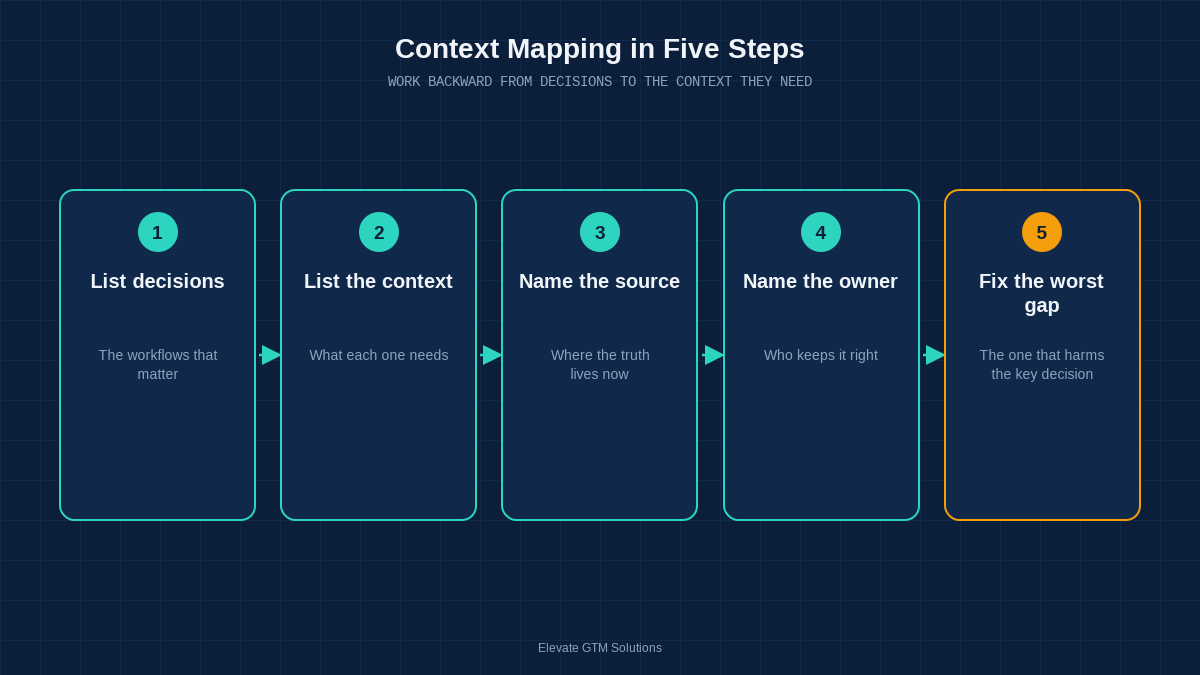
Context mapping is the part with the most practical value, and you can do it without buying anything. The idea is to work backward from decisions to the context they need, instead of forward from all the data you have.
The method
- List the decisions and workflows that matter. For example: choose target accounts, write first-touch messages, prepare a sales call, price a deal, brief a new hire, plan a launch.
- For each, list the context it needs. What must a person or tool know to do it well?
- For each item, write the source. Where does the truth live now? A person, a document, a system?
- Write the owner. Who is responsible for keeping it right?
- Write the refresh rule. When does it change, and how will the owner find out?
- Mark the gaps. Where is the context missing, conflicting or stale?
- Fix the worst gap first. Not the largest, the one that harms the most important decision.
An example map, with invented content
| Decision | Context needed | Source today | Owner | Refresh rule | Gap |
|---|---|---|---|---|---|
| Write first-touch message | Persona pains, approved claims, one proof point | Messaging doc, last updated nine months ago | Product marketing | After each positioning change; reviewed quarterly | Doc is stale; two claims were retired |
| Prepare a sales call | Account history, buying group, competitor in play | CRM, call notes, battlecard | Account owner | Before each call | Buying group is rarely filled in |
| Price a deal | Price list, discount rules, approved terms | Spreadsheet in finance | Finance | When pricing changes | Reps use an older sheet |
| Choose target accounts | Ideal customer profile, scoring rules, territory | ICP deck, scoring model in CRM | RevOps | Monthly | ICP deck and model disagree |
| Plan a launch | Positioning, readiness, dates, owners | Several documents | Product marketing | Weekly during launch | No single launch source |
The map above would take an afternoon to build, and by the end of it a team usually knows which three gaps are doing the most damage. That is more useful than a larger, more elaborate project.
What it looks like in practice
A context layer can be as simple as a shared set of documents with owners and review dates, or as structured as a database or a platform feature. The structure matters most when software needs to use it.
Plain-document version
A folder of short, maintained pages: one on the company and products, one on the ideal customer and segments, one on positioning and messages, one on pricing and rules, one on competitors and one on current priorities. Each has an owner, a date and a "last changed because" note. It is not glamorous and it works, especially for teams under fifty people.
Structured version
The same content, held in fields and records that software can read: for example, each segment is a record with a name, definition, size, priority, pains, proof and a status. Messages are linked to segments and personas. Claims are linked to evidence and flagged approved or not. Structure makes it possible for an AI tool to ask "what is the approved message for this persona in this segment?" and get one answer.
Platform version
Some GTM platforms provide this as a built-in area. Elevate GTM Solutions, for example, begins with a GTM Context area for structured inputs, including market, segment and product context, plus triggers and signals, and the other areas draw from it. Other products offer related capabilities under different names. If you consider a platform, ask exactly what it stores, how you edit it, who can change it and whether you can export it.
An illustrative record
The following shows what structure can look like. It is invented and simplified.
| Field | Value |
|---|---|
| Segment | Mid-size logistics software vendors |
| Definition | Companies with a product sold to logistics operators, between 100 and 1,000 employees |
| Priority this quarter | High |
| Main pains | Long onboarding for customers; limited visibility into partner performance |
| Approved message | "Cut onboarding time without adding implementation staff" |
| Proof | Two customer stories, one with a measured onboarding change |
| Claims we do not make | Any statement about regulatory approval |
| Competitors in deals | Two named alternatives and the status quo |
| Owner | Product marketing |
| Last reviewed | A date, and by whom |
Notice that the record includes a "claims we do not make" line. Constraints are as valuable as facts, especially when a machine is writing.
How AI uses it
There are several technical ways AI tools use context. You do not need to know the details to ask good questions, but a general picture helps.
| Method | What happens | Strength | Weakness |
|---|---|---|---|
| Pasted into the prompt | The context is included in each request | Simple and transparent | Limited length, easy to forget to update |
| Retrieval | The tool searches your content and adds relevant passages | Scales to a lot of material | May fetch the wrong passage; depends on content quality |
| Structured fields | The tool reads specific fields, for example the approved message | Precise and checkable | Needs structure to be built |
| Fine-tuning | The model is trained on your material | Can learn style | Costly, slow to update and hard to correct |
| Tools and connections | The AI queries your systems directly | Fresh data | Needs integrations and permissions |
Most GTM tools use some mix of the first three. For you, the useful question is not which method is in use. It is whether you can see what context went into an output, correct it at the source and have the correction used next time.
A caution: more context is not always better. Long, conflicting or low-quality context can make an output worse. A short, accurate, current context beats a large, messy one.
Why context layers fail
| Failure | What it looks like | Fix |
|---|---|---|
| Stale | Messages and priorities from last year | Owners, review dates and a trigger for change |
| Conflicting | The ICP deck and the scoring model disagree | One source of truth, with a decision on which wins |
| Too large | A hundred pages nobody reads | Cut to what decisions need |
| No owner | Everyone edits, nobody is accountable | Name an owner for each item |
| Not used | The layer exists and the work happens elsewhere | Put it where work happens: CRM, call prep, AI tools |
| Hidden assumptions | Facts nobody checked | Mark each item as evidence, belief or guess |
| No constraints | The AI says things you cannot say | Add claims you do not make and the rules to follow |
| Over-built | A data project that never ships | Start with the document version and one workflow |
The failure to watch most closely is the quiet one: a context layer that is wrong in a plausible way. Because AI output is fluent, wrong context produces wrong work that looks right.
Governance
Because a context layer shapes what people and tools say, it needs light governance.
- Owners. One person per section, with a deputy.
- Change process. Who may change what, and how others find out. For claims and pricing, require review by the right function.
- Versioning. Keep history, so you can see what changed and why, and restore if needed.
- Evidence labels. Mark whether an item is verified, an assumption or a hypothesis under test.
- Access. Decide who can read and who can edit. Some parts, such as pricing rules, may be sensitive.
- Data handling. If context includes customer information, apply the same privacy rules as the source system. See our GTM platform governance checklist.
- Review rhythm. Monthly for priorities, quarterly for positioning, and whenever strategy shifts.
Building one in four weeks
A modest first version can be built by one person with help from a few experts.
Week one: map. List the ten most important decisions and workflows, and do the mapping exercise described earlier. Choose the three worst gaps.
Week two: draft. Write the missing pieces for those three. Keep each to a page. Mark every statement as evidence, belief or guess. Ask for corrections from two sellers, one customer success manager and one product manager.
Week three: place it. Put the layer where people and tools will actually find it: a shared space, the CRM's help panel or the platform you use. Tell people it exists, and tell them what to do when it is wrong.
Week four: use and review. Use it on one real piece of work, such as a message set or a call preparation page, and compare the output with last month's. Record what was missing. Set the review date.
After the first month, expand to the next three gaps, not all at once.
How a context layer connects to strategy
A context layer is not a strategy. It is the record that a strategy draws from and writes back to. A decent test is whether a change flows through. If you change the target segment, does the message set change? Does the account list change? Does the plan for next quarter change? If each of those is a separate manual job in a separate tool, there is no layer. There are only documents.
That connection between strategy and execution is the reason some vendors call their product an operating system. See our guides on what a GTM operating system is and what an AI-native GTM operating system is. The same idea appears in unified GTM strategy, where decisions across modules are kept consistent.
Questions to ask a vendor that offers one
- What exactly does your context layer store, and in what structure?
- Who can edit it, and how do changes get reviewed?
- Can I see which context went into a given output?
- If I correct a fact, is the correction used everywhere next time?
- Does it keep version history?
- How do you handle conflicting information?
- What data from our other systems does it read, and what does it write?
- Where is the context stored, and who at your company can see it?
- Is our context used to train models for other customers?
- Can we export it in a standard format if we leave?
Our guide to questions to ask AI GTM vendors covers wider due diligence.
Context and the people who use it
A layer is useful only if people trust it. Three habits help.
Show the date and the owner on every page. People trust what they can see is current.
Make correcting it easy. A "this is wrong" link that goes to the owner works better than a policy. When a seller reports an error and sees it fixed, they report the next one.
Use it in public. Open a team meeting with the current priorities from the layer. Review a message from the layer in a call review. What leaders use, others use.
A short illustration
This is a fictional example.
A software company asks an AI tool to draft outreach for a new segment. The first draft is polished and generic. The team reviews it and finds four problems: it describes a feature the company retired, it uses a customer name the legal team has not cleared, it ignores that the segment is a priority only in two regions and it makes a claim about security that product management would not sign.
None of these is a model failure. They are context failures. The team spends two days writing a one-page segment record with approved messages, claims it will not make, regions in scope and one cleared proof point. The same tool, given that record, produces a draft the sales lead calls usable on the first read. The team did not buy anything new. It wrote down what people had kept in their heads.
Who maintains it, week to week
A layer without a maintenance routine decays in a quarter. The routine can be short.
| Rhythm | Activity | Who | Time |
|---|---|---|---|
| Weekly | Scan for changes: new competitor moves, product releases, deal learnings, pricing exceptions | Product marketing lead | Thirty minutes |
| Weekly | Triage reported errors and fix or assign them | The owner of each section | Fifteen minutes each |
| Monthly | Review current priorities and confirm target segments, campaigns and launch dates | GTM leadership | One hour |
| Quarterly | Review positioning, messages, proof points and claims | Product marketing with sales and customer success | Two hours |
| On change | Update affected items when strategy, pricing or product changes | The person making the change | As needed |
| Annually | Cut what is unused, and re-check the structure | The layer's owner | Half a day |
The most reliable trigger is a decision. Any time leadership decides something that touches who you sell to, what you say or what you charge, the decision log should list which parts of the layer change, and who will change them by when.
Using the layer in the tools people already use
Context helps when it appears at the moment of work. Four places are worth considering.
The CRM. A short panel or linked page on the account record that shows the segment definition, the approved message for the persona and the current priority. Sellers see it without leaving the system.
Call preparation. A template that pulls the account, the buying group and the relevant battlecard. If a preparation takes more than ten minutes, people skip it.
AI assistants. Whatever AI tools your team uses should draw from the same approved messages and constraints. If each tool keeps its own prompt with its own version of the story, you have rebuilt the inconsistency you were trying to remove.
Onboarding. A new hire's first week should use the layer as the reading list. If it is not good enough for that, it is not good enough for software.
Signals, and the problem of freshness
Some context changes fast: a prospect raises money, a competitor cuts prices, a customer's champion leaves. These are signals, and they matter because a message that fits last month's situation can miss this month's. Two design questions follow.
What counts as a signal worth recording? Be selective. A list of every news item is noise. Choose the five or six events that would change what you do, such as a leadership change in the buyer role, a new funding round, a product launch by a competitor or a pricing change in your category.
How fresh must it be? For most B2B work, daily or weekly is enough. Real-time updates are costly and rarely change the decision. Ask what action would be different if you knew an hour earlier, and if the answer is "none," a weekly refresh will do. Our page on signal-based selling covers how to choose signals and avoid noise.
When you probably do not need one
A context layer is not for everyone, and saying so is part of being honest about it.
- A founder selling to a handful of customers personally has the context in their head, and the most useful step is to write a one-page summary, not build a layer.
- A team with one product, one segment and a stable message may be well served by a good messaging document and a battlecard.
- A company without any owner for positioning should name one before building anything. Without an owner, the layer will rot.
- A team that has not yet chosen a target customer has a strategy question, not a context question. Start there. Our guide to ICP scoring can help.
The case for a more structured layer grows with the number of products, segments, regions and tools, and with the amount of work done by software.
One more test: the new-hire question
A quick check on whether you have a layer or only a pile of documents: give a new hire the layer and ask them to answer five questions without help. Who is our ideal customer this quarter? What do we say to a head of operations in the first call? What can we not claim? How do we price a deal of a given size? What changed in the last month? If they can answer all five from the layer, and a seller who has been here for years agrees with the answers, it is working. If not, the gaps you find are your to-do list.
Two short examples of what changes when the layer improves
These are fictional, and small on purpose.
A seller preparing for a call opens the account and sees, in one panel, the segment definition, the approved message for the contact's role, one proof point cleared for use and the three questions the team asks in discovery for this segment. She spends five minutes on preparation instead of twenty, and her opening is consistent with what her colleague said to the same company last month.
A marketer asks an AI tool for a landing page draft for a new region. Because the tool reads the layer's rules, the draft leaves out a claim that is not approved in that region and uses the right product name. The reviewer still checks it, and the review takes ten minutes instead of an hour.
Neither example is dramatic. Both are the kind of small, repeated saving that justifies keeping the layer current.
Glossary
Approved claim. A statement the company has checked and is willing to make to customers.
Context layer. The maintained, structured body of facts, definitions and rules that people and AI tools use for GTM work.
Context mapping. Listing the decisions and workflows that matter, the context each needs, its source, its owner and its refresh rule.
Constraint. A rule about what may not be said or done.
Ideal customer profile. A description of the customers most likely to benefit and buy.
Retrieval. A method that searches a body of content and passes relevant passages to an AI tool.
Semantic layer. A layer of shared business definitions for data and metrics.
Source of truth. The one place a fact is held and maintained.
Common mistakes
- Treating it as a data project.
- Building it all at once.
- No owners and no dates.
- Leaving out constraints.
- Mixing facts with guesses without labels.
- Putting it where nobody works.
- Letting tools hold their own private copies.
- Assuming AI output is right because it reads well.
- Not planning for change.
- Believing a vendor's definition without asking what it stores.
Where Elevate GTM Solutions fits
Elevate GTM Solutions starts with a GTM Context area, which holds structured inputs such as market, segment and product context, plus signals and triggers. The platform's other areas, covering intelligence, strategy, activation, execution and analytics, draw on that context, and you update inputs as conditions change and review what shifts. That is how the company describes it. It is a way to keep the layer connected to the outputs, and it is one way of building a layer among several. You can run the document version of this guide without any platform, and the quality of the platform's outputs, like any tool's, will depend on the quality of the context you give it. For more, see what Elevate GTM Solutions is.
What to do this week
- List your ten most important GTM decisions and workflows.
- For each, write the context it needs, the source and the owner.
- Mark the three worst gaps.
- Write a one-page record for the most important segment, including claims you will not make.
- Put it where sellers and tools will find it, and set a review date.
- Try it on one task and compare the output with your last attempt.
Key takeaways
- A GTM context layer is the maintained set of facts, definitions and rules that people and AI tools use to do go-to-market work consistently.
- The term has no standard meaning, so ask what a vendor stores and how you change it.
- Context mapping works backward from decisions to the context they need, with a source, an owner and a refresh rule.
- Constraints and evidence labels matter as much as facts.
- Most failures are stale, conflicting or unowned context, not a missing tool.
- Start small, with documents and one workflow, and expand from the worst gap.
Sources
- Elevate GTM Solutions platform overview: the description of the GTM Context area and how other areas draw on it.
- "Context layer" is used by different vendors with different meanings, and there is no standard definition. The definition here is the writers' working definition. Check how any vendor or source uses the term.
- The tables of methods and failure modes reflect general practice and the writers' judgment, not a published study.
Frequently Asked Questions
What is a GTM context layer?
It is the maintained body of facts, definitions and rules about your company, customers, market, products and go-to-market decisions, held in a structured form that people and AI tools can use. It makes sure everyone starts from the same understanding. The term is not standardized.
What is context mapping in GTM?
It is listing each decision or workflow, the context it needs, where that context comes from, who owns it and how often it changes. The aim is to find gaps and fix the ones that hurt the most important decisions first.
How is a context layer different from a CRM?
A CRM holds records of what happened with specific accounts, people and deals. A context layer holds the understanding that guides action across all of them: the ideal customer, positioning, rules and priorities. The layer draws on the CRM and does not replace it.
Is a context layer the same as a data warehouse or a knowledge base?
No. A data warehouse holds large volumes of data for analysis. A knowledge base holds documents for people to read. A context layer is smaller, curated for decisions and structured so software can use it too.
Why does AI need a context layer?
AI tools produce output from what they are given. Without accurate, current context, they produce generic or wrong work in fluent language. A maintained context improves consistency and lets you correct a fact once.
What goes into a context layer?
Company, customer, market, product, positioning and messaging, commercial rules, constraints and approved claims, signals and triggers, history and learning, and current priorities. Each item should have an owner and a review date.
Do I need software to build a context layer?
No. A set of short, owned, dated documents is a workable start. Software helps when you need structure that tools can read, version history and links to workflows.
How do I keep it from going stale?
Name an owner for each section, set review dates, define triggers for change such as a new pricing or positioning decision and make it easy for users to report errors.
What questions should I ask a vendor that offers a context layer?
Ask what it stores and in what structure, who can edit it, whether you can see which context went into an output, whether corrections carry forward, whether it keeps versions, how data is stored and used and whether you can export it.
How long does it take to build one?
A modest first version for one segment and a few workflows can be done in about four weeks by one person with input from a few experts. Expand from the worst gaps after that.
What is the biggest risk?
Wrong context that produces plausible, fluent output. Label evidence, include claims you will not make and review outputs for accuracy before they reach customers.
How does Elevate GTM Solutions use context?
Its platform begins with a GTM Context area for structured inputs such as market, segment and product context and signals, and its other areas draw on it. You update inputs and review what changes.