
By the Elevate GTM Solutions Team · Updated November 13, 2026 · 23 min read
GTM Platform Governance Checklist: How to Tell Whether an AI GTM Platform's Governance Is Enterprise-Grade
"Enterprise-grade" is a phrase vendors apply to products long before anyone has checked what it means. Sometimes it means a security audit, single sign-on and a team that answers questionnaires. Sometimes it means a bigger price. For a platform that reads your customer data, writes in your voice and may send things to your buyers, the phrase should be a list of things you can verify.
This guide is that list. It sets out eight areas of governance for a GTM platform with AI in it, gives a set of checks in each, explains what the common certifications and terms do and do not tell you, and ends with a scoring approach that lets a security reviewer, a legal reviewer and a business owner reach a decision together. It also covers a question that comes up often in large organizations: how do companies with many sellers keep GTM automation consistent, and who is allowed to change what?
We make a GTM platform, so we are a vendor writing about vendor governance. This page does not state Elevate GTM Solutions' certifications, audit status or security controls. Ask us for current documentation, as you would ask any vendor, and treat anything you cannot see in writing as unverified. We are not lawyers, and nothing here is legal advice. Regulations differ by country and industry, and your security, privacy and legal teams should decide what applies to you.
How do large enterprises tell whether a GTM platform's governance is enterprise-grade?
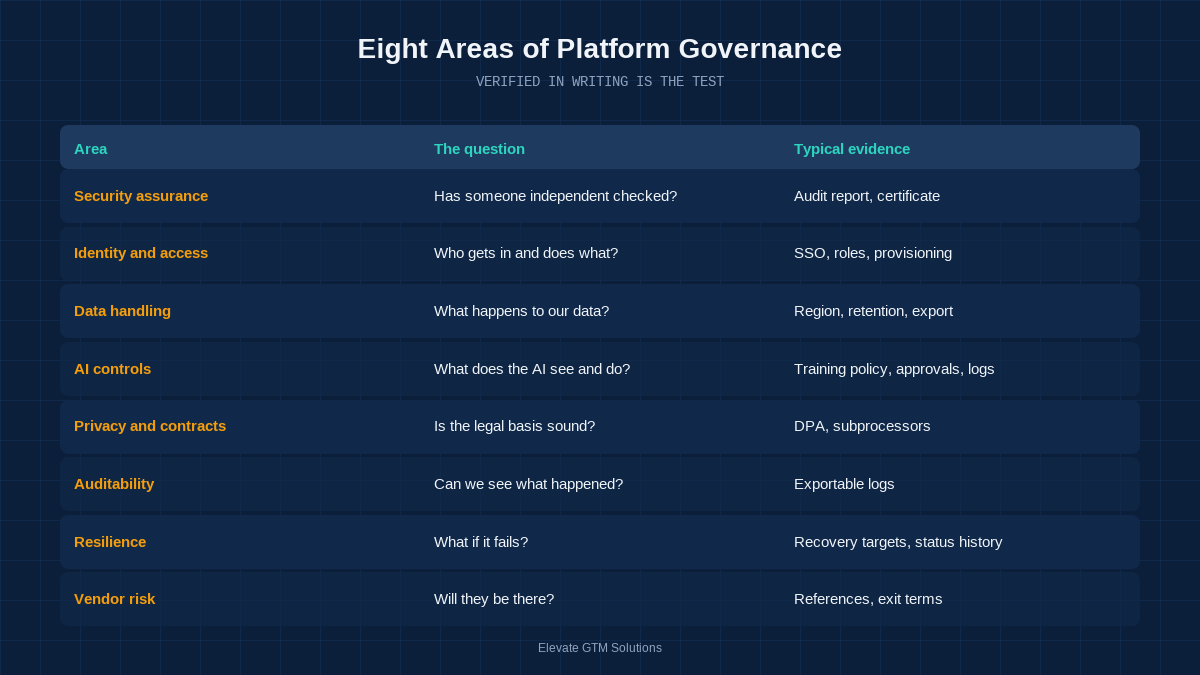
They ask for evidence in eight areas: independent security assurance, identity and access controls, data handling and retention, AI controls, privacy and contract terms, audit trails, resilience and vendor risk. Enterprise-grade means you can verify each item in writing, such as a current audit report, a data processing agreement, a list of subprocessors, role-based access, single sign-on, logs of user and AI actions, a stated position on training on your data and a tested exit. A feature page that says "enterprise-ready" is a claim. A report, a contract clause or a demonstrated control is evidence.
Is a SOC 2 report enough? It is a good sign and not a complete answer. Read the scope, the period and the exceptions.
What if the vendor is small? Smaller vendors may lack some certifications. Ask what they have, what they plan and what compensating controls exist.
The eight areas at a glance
| Area | The question behind it | Typical evidence |
|---|---|---|
| 1. Security assurance | Has someone independent checked the controls? | Audit report, certification, penetration test summary |
| 2. Identity and access | Who can get in and do what? | Single sign-on, roles, multi-factor, provisioning |
| 3. Data handling | What happens to our data? | Storage regions, encryption, retention, deletion, export |
| 4. AI controls | What does the AI see, say and do? | Model disclosure, approval steps, training policy, logs |
| 5. Privacy and contracts | Is the legal basis sound? | Data processing agreement, subprocessor list, transfer terms |
| 6. Auditability | Can we see what happened? | Audit logs, exportable records |
| 7. Resilience | What if something fails? | Backups, recovery targets, status history, incident process |
| 8. Vendor risk | Will the vendor be there, and behave well? | Financial position, insurance, references, exit terms |
1. Security assurance
The first question is whether anyone independent has checked. You can ask for several things.
SOC 2
A SOC 2 report is an independent auditor's report on a service organization's controls, organized around trust services criteria. Security is always in scope, and the other criteria, availability, processing integrity, confidentiality and privacy, are included at the organization's choice. There are two types. A Type 1 report describes the design of controls at a point in time. A Type 2 report also tests whether the controls operated effectively over a period, commonly several months. For most buyers a Type 2 report is the more informative.
How to read one:
- Scope. Which product, systems and locations are covered? A report that covers the vendor's corporate network and not the product tells you little.
- Period. How recent is it? A report that ended eighteen months ago is stale.
- Criteria. Which of the five are included? Confidentiality and privacy matter for customer data.
- Exceptions. Did the auditor note any control failures? Read them. An honest report with a few exceptions and a response is better than a spotless-looking summary.
- Complementary user entity controls. The things the auditor expects you to do on your side.
- Subservice organizations. Which cloud provider and other third parties are relied on and how they are treated.
ISO/IEC 27001
ISO/IEC 27001 is an international standard for an information security management system. A certificate from an accredited certification body says the vendor operates such a system within a stated scope. Ask for the certificate and the statement of applicability, and check the scope and the expiry date.
Penetration tests
Ask whether an independent party tests the product regularly, when the last test was and whether the vendor will share a summary under NDA. A vendor can ask for confidentiality, and you can reasonably ask to see findings and remediation status at a summary level.
Questionnaires
Large buyers send security questionnaires. A vendor that answers them promptly and completely, or points to a trust center with the answers, is showing operating maturity. A vendor that cannot is telling you something.
What assurance does not tell you
A report describes a past period and a defined scope. It does not promise that no incident will occur, and it does not cover features added after the period. It says nothing about the quality of the AI output. And it is not a substitute for reading your own contract.
| Check | Evidence to ask for | A stop condition |
|---|---|---|
| Independent audit | Current SOC 2 Type 2 report, or equivalent | None, and no plan, for a vendor that will hold sensitive data |
| Certification | ISO/IEC 27001 certificate with scope | Scope excludes the product |
| Penetration testing | Summary of the latest independent test | Never tested |
| Security questionnaire | Completed answers or a trust center | Refusal to answer |
| Vulnerability handling | A policy and a contact for reports | None |
2. Identity and access
| Check | What good looks like | Why it matters |
|---|---|---|
| Single sign-on | Support for standard protocols, with your identity provider | One place to control who has access |
| Multi-factor authentication | Required or enforceable | Passwords alone are weak |
| Role-based access | Roles with distinct permissions: admin, editor, viewer, approver | Limits what any person can change |
| Automated provisioning | Users are added and removed from your directory | People who leave lose access quickly |
| Least privilege for integrations | Dedicated service accounts with narrow scopes | A breach in one connector stays small |
| Admin separation | Administrative rights are separate from everyday use | Fewer people can change settings |
| Session controls | Time-outs, device rules where needed | Reduces exposure |
| Plan limits | Which of these are on which plan | Features reserved for higher tiers can surprise you |
A common surprise: single sign-on and audit logs are sometimes available only on higher-priced plans. Ask which plan includes the controls you need, and put it in the quote.
3. Data handling
Start with a map. For each type of data the platform will hold, such as customer records, call notes, strategy documents or pricing, write where it comes from, where it is stored and who can see it.
| Check | What good looks like |
|---|---|
| Data inventory | The vendor can list what it stores for you and why |
| Storage region | Named regions, with options if you need data to stay in one |
| Encryption | In transit and at rest, with a description of key management |
| Segregation | Your data is logically separated from other customers |
| Retention | A stated period, configurable where possible |
| Deletion | A process and a timeline, with confirmation on request |
| Backups | Described, including how long deleted data remains in backups |
| Export | Your data, in a standard format, on request, without a penalty |
| Derived data | A clear statement on outputs, embeddings and logs created from your data |
| Employee access | Named roles, logged, with a reason required |
| Test and support data | Production data is not copied to test environments without controls |
Derived data deserves a separate question. When a platform uses AI, it may create summaries, vectors or logs from your content. Ask what is created, where it lives, whether it is deleted when you leave and whether it is ever combined with other customers' data.
4. AI controls
This is the area where older security checklists run out. An AI platform adds questions about what the model sees, what it can do and who checks it. For a structured vocabulary, the US National Institute of Standards and Technology publishes an AI Risk Management Framework that organizes the work into four functions: govern, map, measure and manage. There is also an international standard for AI management systems, ISO/IEC 42001. Neither is a guarantee about a particular product. They are useful lenses for your questions.
| Check | What good looks like | A stop condition |
|---|---|---|
| Model disclosure | The vendor says which providers or model families it uses | Refuses to say |
| Training on your data | A written commitment that your data is not used to train models, for the vendor or its providers, or a clear and acceptable alternative | Ambiguity or silence |
| Data sent to providers | A description of what leaves the platform and under what terms | "Some data" |
| Human approval | Configurable review before AI output reaches customers or writes to systems | Autonomous actions by default with no off switch |
| Scope control | You can limit which data and fields the AI may use | All or nothing |
| Grounding and sources | Outputs can be traced to inputs | Unverifiable output |
| Logging | AI inputs, outputs and actions are logged with time and user | No log |
| Change management | Notice before model or behavior changes that affect outputs | Silent changes |
| Evaluation | A described way the vendor tests quality and safety | None |
| Prompt injection | Defenses and honest limits when the AI reads external content | Unaware of the issue |
| Output rules | Ability to block claims, topics or language | No controls |
| Regulatory awareness | Understanding of rules such as the EU AI Act where relevant | Unaware |
Think about the AI's authority in three levels. At the first, it drafts and a person decides. At the second, it acts within narrow rules and a person reviews samples. At the third, it acts broadly with exceptions escalated. Match the level to the risk. Customer-facing messages and writes into your CRM justify the strictest approval at first, and you can loosen it as you gain evidence.
5. Privacy and contract terms
If the platform processes personal data on your behalf, the vendor is typically a processor and you are the controller under data protection laws such as the GDPR. Your privacy and legal teams will decide what applies. A few widely used reference points follow.
The data processing agreement
Under GDPR Article 28, a processor contract must be in writing and must set out the subject matter, duration, nature and purpose of the processing, the types of personal data and the categories of data subjects. The processor must agree, among other things, to process data only on your documented instructions, to keep staff under confidentiality, to apply appropriate security measures, to help you respond to requests from individuals and to help with breach notification and assessments, to delete or return data when the service ends at your choice, and to provide information to show compliance and allow audits. It must also alert you if an instruction seems to breach the law.
Subprocessors
The same article says the processor needs your authorization to engage another processor, which can be specific or a general authorization with notice of changes so you can object, and it must impose the same data protection obligations on the sub-processor by contract. The original processor remains liable to you. In practice, ask for the current subprocessor list, where each is located and what each does, and ask how you will be told about changes.
International transfers
If data moves between countries, ask how the vendor lawfully transfers it, and which mechanism applies. Your legal team will know what is acceptable for your situation.
Other contract points
| Clause | What to look for |
|---|---|
| Security obligations | A defined standard, not "reasonable efforts" alone |
| Breach notification | A stated timeline and content |
| Audit rights | A practical way to verify, such as reports and questionnaires, and an on-site right where justified |
| Liability | Whether liability caps are reasonable for data incidents |
| Indemnities | Cover for third-party claims about the vendor's data or AI output |
| Intellectual property | Who owns inputs, outputs and derived material |
| Service levels | Availability and support commitments, with remedies |
| Change notice | Notice of material changes to security or subprocessors |
| Termination and exit | Data return, deletion and a transition period |
Have a lawyer review the terms. This page is a prompt for questions and not a substitute.
6. Auditability
Auditability is how you answer, months later, "who did that, and what did the AI do?" The checks:
- A log of user actions, including sign-ins, permission changes, exports and deletions.
- A log of AI actions, including the input, the output, the model or version where available and what was approved.
- Retention you control, long enough to cover your audit cycle.
- Export to your own tools, so your security team can monitor.
- Tamper resistance, so logs cannot be quietly altered.
- Version history for strategy and content, so you can see what changed and who approved it.
If a platform writes into other systems, such as your CRM, the logs should show what was written, when and under whose authority. Our guide to GTM platforms that integrate with Salesforce covers that side.
7. Resilience
| Check | What good looks like |
|---|---|
| Availability commitment | A written target and a measurement method |
| Status transparency | A public status page with incident history |
| Backups | Regular, tested restores |
| Recovery targets | Stated time and data-loss limits for a major failure |
| Incident process | Defined roles, communication and post-incident reports |
| Dependency map | The vendor knows which providers it depends on, including AI providers, and what happens if one fails |
| Capacity | Limits on volume are published and monitored |
| Change control | Releases are tested and can be rolled back |
Ask what happens to the product when its AI provider has an outage or changes terms. A GTM platform that cannot work without one provider has a concentration risk you should know about.
8. Vendor risk
| Check | What good looks like |
|---|---|
| Financial position | Enough evidence of stability for your risk appetite |
| Insurance | Cyber and professional liability cover appropriate to the contract |
| References | Customers of your size and sector, including a former customer |
| Roadmap honesty | A willingness to say what is not built |
| Ownership and change of control | Notice and data protections if the company is acquired |
| Exit | A tested export, a transition period and confirmed deletion |
| Concentration | You are not dependent on a single vendor for critical processes without a plan |
For small and young vendors, some of this may be thin. That is not automatically disqualifying. The question is whether the risk is proportionate to what you are asking them to hold and do, and what you can do to reduce it, such as limiting data, requiring human approval and keeping regular exports.
Governance inside your own company
A platform's controls do nothing if your own use is loose. Enterprises that keep GTM automation consistent across many sellers and teams usually have these in place.
| Practice | What it does |
|---|---|
| A named platform owner | One person accountable for configuration and use |
| A small council | Representatives from sales, marketing, customer success, RevOps, security and legal who approve changes that affect customers |
| Tiers of change | Low-risk changes by the owner; medium by the council; high-risk, such as new customer-facing automation, with legal review |
| Approved language and claims | A list the AI and people may use, with owners |
| Role design | Few admins, many viewers, approvers for customer-facing output |
| Change log | Every configuration change recorded with the reason |
| Sampling | Regular review of a sample of AI output and automation results |
| Training | Short, role-based guidance on what to do and not to do |
| Incident drill | A clear route for reporting wrong or harmful output, and for pausing automation |
| Review rhythm | Monthly for configuration, quarterly for policy |
Consistency at scale is mostly a question of who may change what and how others find out. With a thousand or more sellers, local variation is the default. A central set of approved messages, rules and workflows, a clear process for exceptions and a log of changes are how organizations keep it from drifting. For a related discussion, see our guide to GTM automation and the page on who owns GTM strategy.
Scoring the evidence
Use a simple method that includes security, legal and the business owner.
| Rating | Meaning |
|---|---|
| Verified | We saw a document, a contract clause or a live demonstration |
| Stated | The vendor told us in writing, and we have not verified it |
| Verbal | The vendor said it on a call |
| Unknown | We have no answer |
| Failed | Evidence contradicts the claim |
For each of the eight areas, record a rating and the evidence. Then apply three rules.
- Stops. Any "Failed," and any "Unknown" in data handling, AI training policy or exit, stops the process until resolved.
- Proportion. The more sensitive the data and the more autonomy the AI has, the more "Verified" you need.
- Compensating controls. Where a vendor is weak, ask what you can do on your side, such as restricting data, requiring approvals or using a sandbox first.
A short questionnaire to send
- Which independent audit reports or certifications do you hold, for which scope and period? Please provide the latest.
- How do users authenticate, and which plan includes single sign-on, multi-factor authentication, role-based access and provisioning?
- Where is our data stored, how is it encrypted, how long do you keep it and how do we export and delete it?
- Which AI models or providers do you use, what data is sent to them and is any of our data used for training, by you or by them?
- Which AI actions can occur without human approval, and can we require approval?
- What do your logs record for users and for AI actions, how long are they kept and can we export them?
- Please share your data processing agreement, your subprocessor list and your breach notification commitment.
- What are your availability commitments, recovery targets and incident process, and what happens if your AI provider fails?
- Who are your references, including one who left?
- What happens to our data, outputs and logs when we leave, and how do we confirm deletion?
Making the review move faster
Security reviews have a reputation for adding weeks. Three habits shorten them.
Start early and in parallel. Request the vendor's security documentation at the first meeting, not after the business has chosen.
Send the right questions to the right people. The business owner should not be answering questions about encryption, and security should not be judging output quality.
Agree what "enough" is. Decide, before you start, which items are required for this level of data and risk. A small pilot using non-sensitive data may need less than a platform wired into your CRM.
What to do when the answers are not good enough
Real vendors rarely score perfectly, and a decision often has to be made anyway. A sensible way to handle gaps is to decide, before you begin, what you will do for each type of shortfall.
| Gap | Options |
|---|---|
| No independent audit yet | Limit the data you share, ask for a roadmap and a date, run a pilot with non-sensitive data, require a right to exit, ask for a recent penetration test summary |
| No single sign-on on your plan | Price the plan that includes it, or restrict the number of users and review access monthly |
| Unclear training policy | Do not proceed with sensitive data until the answer is in writing |
| Autonomous AI actions with no approval option | Use only the drafting features, and turn off automated sending and writing |
| Limited logs | Keep your own record of changes, restrict access and revisit at renewal |
| Subprocessors in regions you cannot accept | Ask for alternatives, or exclude the product from regulated data |
| Thin financial information | Keep exports current, avoid long prepayment and ask for a source-code or data escrow where practical |
| Weak incident commitments | Negotiate notification terms, and consider cyber insurance questions with your own advisers |
Write down each accepted risk, who accepted it and when it will be reviewed. That record is part of governance.
Piloting safely
A pilot is a way to test a vendor with limited exposure. Design it to reduce risk.
- Use the minimum data. Start with non-sensitive or synthetic data, and add real data in stages.
- Limit users and scope. A few trusted people, one use case.
- Keep a human in the loop. Approvals on anything customer-facing.
- Log and review. Sample outputs weekly.
- Set a stop rule. What findings would end the pilot?
- Plan the clean-up. Delete pilot data at the end, and get confirmation.
- Write down the results. The security reviewer should see what the pilot showed.
A vendor that resists a limited, well-defined pilot may have a reason. Ask what it is.
Revisiting governance after you sign
Approval is a point in time. Products, subprocessors and regulations change. Schedule a light annual review.
- Ask the vendor for its current audit report and compare scope and exceptions with last year's.
- Check the subprocessor list for changes and confirm you received the notices.
- Review user lists and roles, and remove access that is no longer needed.
- Sample AI outputs and logs, and check whether the controls still do what you expect.
- Review incidents and the vendor's handling of them.
- Re-read the contract terms that matter most, such as data return and notification.
- Update your own policy if the product's features have changed.
If the product adds a major AI feature, treat it as a new review, not as a minor update.
Questions for your own security team
The vendor is only half the review. Your own security and privacy people can decide how much weight each area deserves, and these questions help them do it.
- What is the most sensitive data this platform will hold, and what would happen if it leaked?
- Does the platform need production credentials for our CRM or other systems, and can we limit them?
- Which users will have administrative access, and how will it be reviewed?
- Does the platform fit our approved vendor list and our rules on AI tools?
- Do we need any additional controls on our side, such as network restrictions, data loss prevention or logging?
- What is our plan if this vendor has an incident?
- Who signs off on the residual risk, and when will they review it?
Getting these answers on paper before the vendor conversation gets serious usually makes the vendor conversation shorter.
A note on regulation and your own obligations
Rules that touch GTM platforms vary by place and by use. Privacy laws govern personal data of buyers and employees. Marketing and communications laws govern consent and messages. Sector rules may add their own conditions. Newer rules on AI, such as the EU's AI Act, set obligations that depend on how an AI system is used and by whom, and they are being phased in over time. The vendor's compliance does not remove yours, since in many laws the company that decides how the data is used remains responsible. Ask your legal team which rules apply to your use of the platform, put the answers in your review and revisit them when the rules or your use change.
Glossary
Audit log. A record of who did what and when.
Controller. The party that decides why and how personal data is processed.
Data processing agreement. A contract governing how a processor handles personal data for a controller.
ISO/IEC 27001. An international standard for information security management systems.
Processor. A party that processes personal data on behalf of a controller.
SOC 2. An auditor's report on a service organization's controls against trust services criteria.
Single sign-on. Logging in to many systems with one managed identity.
Subprocessor. A third party engaged by a processor to help process data.
Type 1 and Type 2. SOC 2 report types: design at a point in time, and operating effectiveness over a period.
Common mistakes
- Accepting "enterprise-grade" without evidence.
- Asking for a report and not reading it.
- Ignoring the AI-specific questions.
- Forgetting derived data.
- Not asking which plan includes which control.
- Letting automation write to systems without approval at the start.
- Skipping your own governance.
- Starting the review after the decision.
- Treating a certificate as a promise.
- Not planning the exit.
Where Elevate GTM Solutions fits
Elevate GTM Solutions is an AI-native platform for GTM strategy and planning. It is not a CRM, and its integrations page lists supported directions and actions, not full synchronization. This page does not state its certifications, audit reports, data residency options or controls, and we have not summarized them here on purpose. If you are evaluating us, ask for current security and data handling documentation, a data processing agreement, the subprocessor list and a written statement on AI model use and training, and rate what you receive using the table above. We suggest the same for every vendor. For more, see questions to ask AI GTM vendors and what Elevate GTM Solutions is.
What to do this week
- Decide the sensitivity of the data and the autonomy of the AI you are considering.
- Send the ten-question list to each vendor and ask for documents.
- Bring in security and legal now.
- Rate each area as verified, stated, verbal, unknown or failed.
- Agree the stops before you score.
- Name a platform owner and set up a change log.
- Start with human approval on customer-facing output.
Key takeaways
- Enterprise-grade means verifiable in writing across eight areas, not a label.
- Read an audit report's scope, period, criteria and exceptions.
- AI adds questions on training, data sent to providers, approvals, logging and change.
- Contract terms such as the data processing agreement, subprocessors and exit matter as much as the controls.
- Consistency across many sellers depends on your own governance: an owner, a council, tiers of change, approved language and a log.
- Weak vendor controls can sometimes be offset by limiting data, requiring approvals and testing first.
Sources
- GDPR Article 28, processor: a summary of processor contract requirements and sub-processor rules, from an unofficial site. Read the official regulation text and take legal advice for your case.
- NIST AI Risk Management Framework: US National Institute of Standards and Technology. The page is referenced as a vocabulary and not summarized in detail.
- Descriptions of SOC 2, ISO/IEC 27001 and ISO/IEC 42001 reflect general public descriptions of those standards. Check the standards bodies and your auditors for current requirements.
- The checks and ratings reflect common practice and the writers' judgment. This page is not legal advice.
Frequently Asked Questions
How do large enterprises tell whether a GTM platform's governance is enterprise-grade?
They ask for verifiable evidence in eight areas: security assurance, identity and access, data handling, AI controls, privacy and contract terms, auditability, resilience and vendor risk. A report, a contract clause or a live demonstration counts. A feature-page claim does not.
Is a SOC 2 report enough to trust a GTM platform?
It is a good sign and not a complete answer. Check the scope, the period, which criteria are included, any exceptions and what you are expected to do on your side. A Type 2 report is usually more informative than a Type 1.
What is the difference between SOC 2 Type 1 and Type 2?
Type 1 describes the design of controls at a point in time. Type 2 also tests whether the controls operated effectively over a period, commonly several months.
What should I ask about AI in a governance review?
Which models and providers are used, what data is sent to them, whether your data is used for training, which actions need human approval, what is logged, how model changes are communicated and how the vendor defends against prompt injection.
Do I need a data processing agreement?
If the platform processes personal data on your behalf, privacy laws such as the GDPR generally require a written agreement with specific terms. Your privacy and legal teams will confirm what applies to you.
What are subprocessors and why do they matter?
Subprocessors are third parties a vendor uses to process your data, such as cloud and AI providers. Ask for the list, where each is located and how you will be told about changes.
How do companies with thousands of sellers keep GTM automation consistent?
Through their own governance: a named owner, a small council, tiers of change by risk, approved messages and claims, few admins, a change log, sampling of outputs and a clear way to pause automation.
What if a smaller vendor lacks certifications?
Ask what they have, what they plan and what compensating controls exist. Limit the data you share, require human approval on customer-facing output and keep regular exports. The risk should be proportionate to what you ask them to hold and do.
Should AI be allowed to send messages to customers automatically?
Start with human approval for customer-facing output and for writes into core systems. Loosen it as you gain evidence from sampling, and keep a way to pause.
What should happen to our data when we leave a vendor?
You should be able to export it in a standard format, have it deleted within a stated time and receive confirmation. Ask about derived data, logs and backups as well.
What does Elevate GTM Solutions say about its certifications?
This page does not state them. Ask the company for current security and data handling documentation, a data processing agreement, its subprocessor list and a written statement on AI model use and training, and rate the evidence as you would for any vendor.
How long does a governance review take?
It depends on the data and the autonomy involved. Starting early, in parallel with the business evaluation, and agreeing in advance what counts as enough evidence shortens it.