
By the Elevate GTM Solutions Team · Updated November 10, 2026 · 22 min read
AI-Powered GTM Operating System for Enterprises: What It Is, What It Needs, and How to Evaluate One
Large companies rarely lack go-to-market activity. They lack agreement. A global software company may run five products, three regions, a dozen segments and several sales motions, each owned by a different leader, each described in a different deck. Annual planning produces a strategy that is out of date by the second quarter. Regional teams adapt it in ways the center never sees. Marketing, sales, product and customer success each keep their own version of who the customer is and what to say.
An AI-powered GTM operating system is the category that has emerged to address that gap. The phrase is new and used loosely, so this guide defines it, lists what an enterprise should expect from one, explains where it sits among the CRM, account intelligence, enablement and analytics tools you already own, and gives you an evaluation method you can run in a few weeks. Elevate GTM Solutions describes its own product as an AI-native GTM operating system, so we have a stake in the category. We say plainly what the platform covers, what it does not, and what an enterprise should verify before buying.
What Is an AI-Powered GTM Operating System for Enterprises?
It is a connected system that holds the decisions behind go-to-market (customer definition, segments, positioning, messaging, pricing logic, channel plans and priorities), uses AI to draft and update them from shared context, and turns approved decisions into plans, workflows and reviews across products, regions and teams. It sits above the CRM, account intelligence, enablement and analytics tools instead of replacing them. For enterprises, the test is governance: clear decision rights, traceable outputs, version history, human approval and data controls.
Is it a CRM? No. A CRM records customers and pipeline. A GTM operating system decides what the CRM should be used to execute.
Is it the same as an ABM platform? No. Account-based platforms find and reach accounts. A GTM operating system sets the strategy those programs follow.
Why enterprises feel the problem more sharply
The need is not about company size alone. It is about the number of independent decision makers who must act on one strategy.
| Condition | What it produces |
|---|---|
| Several products sold to overlapping customers | Competing pitches and unclear cross-sell rules |
| Several regions with local leaders | Local adaptation without visibility at the center |
| Business units with separate budgets | Different definitions of the ideal customer |
| Annual or semi-annual planning | Strategy that lags the market by months |
| Many contributors to messaging | Decks and websites that disagree |
| Acquisitions | Two sets of positioning and two CRMs |
| Frequent leadership changes | Lost context and re-planning from scratch |
None of these is solved by buying another execution tool. Each is a decision-consistency problem. Our guide to who owns GTM strategy in a multi-product company covers decision rights, and the one on global vs local GTM decisions covers what to standardize.
What a GTM operating system should contain
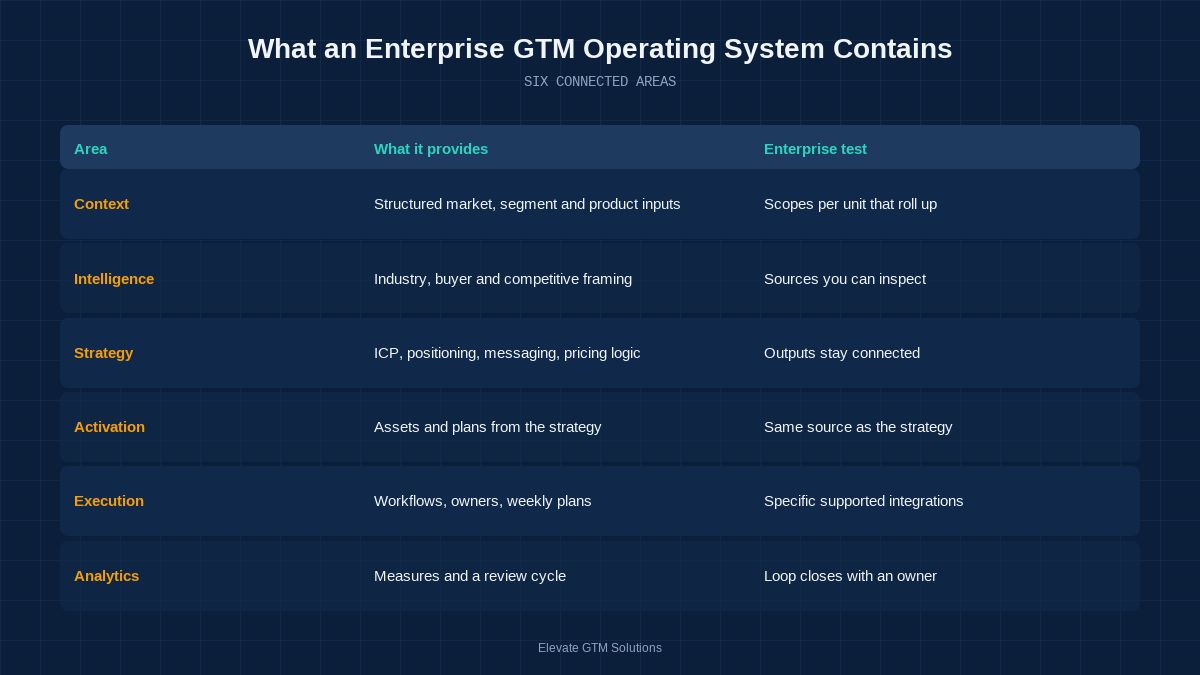
The website of Elevate GTM Solutions describes six connected areas. Whatever product you evaluate, expect equivalents of these.
| Area | What it should provide | Enterprise question |
|---|---|---|
| Context | Structured inputs: market, segment, product, constraints, signals | Can each business unit hold its own context and still roll up? |
| Intelligence | Industry, segment, buyer and competitive framing | How current is it, and what is its source? |
| Strategy | Customer definition, positioning, messaging, pricing logic, channel plans | Do outputs stay connected when an input changes? |
| Activation | Assets, plans and launch material derived from the strategy | Does it come from the same source as the strategy? |
| Execution | Workflows, owners, weekly plans, tracking | Can it connect to the systems where work happens? |
| Analytics | Measures and a review cycle that feed results back | Which data sources connect, and who owns the review? |
A system with only two or three of these is still useful, but you should know which ones it lacks and where they will live instead.
What "AI-powered" should mean at enterprise scale
At small scale, AI that drafts quickly is enough. At enterprise scale, speed is not the constraint. Trust is. Look for these properties.
| Property | Why it matters at scale |
|---|---|
| Traceability | A leader can see which inputs and evidence led to an output |
| Human approval | Named owners approve changes before they spread |
| Version history | You can see what the strategy said last quarter and why it changed |
| Comparability | Strategies for two regions or segments can be placed side by side |
| Controls on AI use | You can restrict what data goes in and what actions the system takes |
| Explainability | Recommendations include reasons, not only conclusions |
| Consistency | The same inputs give outputs that differ only for reasons you can explain |
| Honest limits | The vendor states what the AI cannot do |
Treat any product that offers fast generation but weak traceability as a drafting tool, not an operating system.
Where it sits in an enterprise stack
An enterprise already owns several of the tools a vendor may claim to replace. A GTM operating system works best as a layer above them.
| Existing layer | What stays | What the operating system adds |
|---|---|---|
| CRM (Salesforce, HubSpot) | Records, pipeline, forecasting | The strategy the CRM is configured to execute, and a feedback path from wins and losses |
| Account intelligence and ABM (Demandbase, 6sense) | Signals, advertising, account programs | The segment definitions and messaging those programs use |
| Enablement (Seismic, including Highspot) | Content library, training, coaching | Source positioning and talk tracks |
| Conversation intelligence (Gong) | Call analysis and coaching | Themes that feed strategy updates |
| Outreach and engagement | Sequencing and follow-up | Targeting criteria, themes and approved claims |
| Analytics and BI | Reporting | A defined set of strategic measures |
If a vendor says its platform replaces all of these, ask to see the depth in the function you care about most. Our guide to unified GTM platforms vs point solutions explains the trade-offs.
Governance: the part enterprises cannot skip
A shared strategy layer is only as good as the rules around it.
Decision rights. Name who owns each decision: customer definition, positioning, messaging pillars, pricing logic, channel plans, quarterly priorities. Decide what is global, what regions may adapt and who approves exceptions.
Approval flow. Changes to shared definitions should be proposed, reviewed and approved, with a record.
Scopes. Decide how products, markets and segments are organized so that strategies are comparable. In Elevate GTM Solutions a scope is a product, market or segment.
Access. Define who can view, edit and approve at each level.
Audit. Keep a history of changes, reasons and approvers.
Review rhythm. A monthly review of what changed and a quarterly reset with fresh win and loss evidence.
Without these, a shared layer becomes another place for versions to drift.
Security, privacy and compliance questions
Enterprise buyers should send these questions to any vendor before a pilot with real data.
| Area | Question |
|---|---|
| Data location | Where is data stored, and can it be restricted by region? |
| Model use | Is our data used to train models, and can we opt out? |
| Access control | How are roles, single sign-on and permissions handled? |
| Logging | What activity is logged and for how long? |
| Subprocessors | Which third parties process our data? |
| Retention and deletion | How do we delete data on request or on exit? |
| Certifications | Which security standards does the vendor state it meets, and can we see current evidence? |
| Integrations | How are connections authorized, scoped and revoked? |
| Incident handling | What is the notification process? |
Ask for current documentation and review it with your security and legal advisers. Do not rely on a website summary.
An evaluation method that takes about four weeks
Week 1: define the job. Write the three problems you want solved, such as inconsistent customer definitions across regions, slow strategy updates after market changes and unclear decision rights. Name the executive sponsor and the pilot owner.
Week 2: prepare one real scenario. Choose a product and two regions. Gather the context: segment evidence, win and loss reasons, competitor names, current messaging and constraints.
Week 3: run the scenario in two or three candidates. Ask each vendor to produce outputs from your inputs, live. Change an assumption and watch what updates. Ask for the version history and the approval flow.
Week 4: review and score. Have sellers, regional leaders and security review the outputs. Score each candidate against the criteria below, record evidence and decide on a pilot.
| Criterion | What good looks like |
|---|---|
| Output specificity | Names your customers, alternatives and proof, not categories |
| Traceability | Inputs link to outputs |
| Change handling | One change updates related outputs |
| Comparison | Side-by-side versions for regions or segments |
| Governance | Roles, approval and history |
| Integration | Specific supported actions with your CRM and tools |
| Security | Current evidence for your requirements |
| Effort | Hours your team spends entering inputs and reviewing |
| Honesty | Clear statement of what it does not do |
| Commercial terms | Plan structure, scopes, seats, export and exit |
Build, buy or hire
| Option | Strength | Risk |
|---|---|---|
| Build internally with documents and BI | Full control, no vendor | Versions drift, upkeep grows with scale |
| Build with a general AI assistant | Flexible, quick | No shared record, little governance |
| Buy a GTM operating system | Structure, traceability, shared record | An additional system to own, integration to confirm |
| Hire consultants | Judgment, facilitation, independence | Cost, point-in-time output, repetition |
| Combine | A system for the structured work, advisors for the decisions that need an outside voice | Needs clear roles |
Most enterprises combine. See GTM platform vs GTM consultant and how much GTM consulting costs.
The six areas, and what to test in each
A feature list tells you what exists. A test tells you whether it works for your company. For each area below, here is what to ask for and what a convincing answer looks like.
Context: can it hold how your business really works?
Enterprises have more context than a single form can hold: several products, regional constraints, regulatory limits, pricing rules and partner relationships.
Ask the vendor to show: how you describe a product, a segment and a region; how a regional scope inherits from a global one; how constraints are recorded; how you keep a record of what changed.
A convincing answer: structured fields that match your language, a clear way to organize scopes and a visible change history.
A warning sign: a single free-text box, or an assumption that every business is organized the same way.
Intelligence: is it current and attributable?
Intelligence in this context means the industry, segment, buyer and competitive framing that informs decisions.
Ask the vendor to show: where the framing comes from, how recent it is, how you add your own evidence and how conflicts between its framing and your evidence are handled.
A convincing answer: sources you can inspect, a way to override with your own data and a clear separation between what is supplied and what you provided.
A warning sign: confident statements about your market with no source.
Strategy: do outputs stay connected?
This is the heart of the category. The customer definition, positioning, messaging, pricing logic and channel plans must agree with each other.
Ask the vendor to show: the outputs for your scenario, then a change to the target segment and what updates; how two strategies for different regions are compared; how an output traces back to inputs.
A convincing answer: related outputs update together, differences are visible and reasons are available.
A warning sign: outputs that stand alone, or a regenerate button that overwrites without a record.
Activation: does it come from the same source?
Assets, launch plans and seller material should derive from the agreed strategy, so the field hears what leadership decided.
Ask the vendor to show: how a talk track, a customer profile or a launch plan is produced and how it changes when the strategy changes.
A convincing answer: material is generated from the same inputs and flagged as out of date when a decision changes.
A warning sign: a separate content tool with no link to the strategy.
Execution: where does the work happen?
Execution inside the operating system is usually planning and tracking: weekly plans, owners, tasks and reviews. Heavy execution stays in specialist tools.
Ask the vendor to show: how weekly plans are created, how owners are assigned, how progress is tracked and which actions work with your CRM and other tools.
A convincing answer: specific supported actions, listed by tool, with limits stated.
A warning sign: a logo wall with no detail about what each connection does.
Analytics: does the loop close?
A strategy that never learns from results goes stale.
Ask the vendor to show: which data sources connect, how results are compared with the plan and how learning feeds the next review.
A convincing answer: a defined set of strategic measures and a review cycle with an owner.
A warning sign: dashboards of activity with no connection to strategic decisions.
The operating model around the system
Software does not run itself. The enterprises that benefit have a small operating model.
| Role | Responsibility |
|---|---|
| Executive sponsor | Removes blockers, arbitrates conflicts between units |
| GTM strategy owner | Owns the shared structure, definitions and review rhythm |
| Product owners | Maintain the strategy for each product |
| Regional owners | Maintain regional adaptations and report exceptions |
| Evidence owner | Brings win and loss reasons, customer conversations and market changes |
| Reviewers | Sales, customer success and product leaders who test outputs |
| Operations and RevOps | Connect the system to the CRM and other tools |
| Security and legal | Review data handling and access |
| Ritual | Cadence | Purpose |
|---|---|---|
| Input update | Monthly | Add new evidence and market changes |
| Strategy review | Monthly | Review what changed and decide what to act on |
| Regional exception review | Monthly | Approve or reject local departures |
| Quarterly reset | Quarterly | Revisit the customer definition and positioning with fresh evidence |
| Annual planning | Annual | Set priorities using the year's recorded decisions |
If these roles and rituals are not in place, the system will not matter, whichever product you buy.
Integration patterns that work
| Pattern | Description | When it fits |
|---|---|---|
| Strategy to CRM | Targeting criteria and qualification rules flow from the strategy to CRM configuration, often by a person at first | Teams that want the CRM to reflect the strategy |
| CRM to strategy | Wins, losses, reasons and pipeline by segment flow back as evidence | Every enterprise, ideally monthly |
| Strategy to enablement | Customer profiles and talk tracks feed the content library | Teams with a formal enablement platform |
| Strategy to outreach | Segments, themes and approved claims form the brief for outreach tools | Teams using sequencing or AI outreach |
| Conversation insight to strategy | Themes and objections from calls inform updates | Teams with conversation intelligence |
| Notion and documents | Selected outputs are pushed to shared workspaces | Teams that keep wikis |
Confirm which of these flows are supported, which are manual and who owns each. A supported connection is not the same as automatic synchronization of every field.
Failure modes, and what prevents them
| Failure | What it looks like | Prevention |
|---|---|---|
| Shelfware | The system is used for a month, then forgotten | Named owners, monthly review and visible decisions |
| Shadow strategies | Regions keep their own decks | Decision rights, scopes and an exception process |
| Generic output | Drafts that could describe any company | Specific inputs and review by sellers |
| Over-trust | Outputs accepted without checking | Review gates and an assumption log |
| Integration sprawl | Many partial connections nobody maintains | An owner and a documented map |
| Scope creep | Trying to model everything at once | Start with one product and two regions |
| Lost history | Changes made without a record | Version history and approvals |
| Misaligned incentives | Units rewarded for local metrics that conflict with the shared plan | Align metrics with the shared strategy |
Questions to ask a vendor's references
Speak to at least two customers of similar size and structure. Ask:
- What problem were you solving, and did you solve it?
- How long did it take to see a first useful output, and a useful change in behavior?
- How many people maintain it, and how much of their time?
- What did you have to fix in your own process first?
- Which integrations work as described, and which needed work?
- What surprised you, and what would you do differently?
- What would make you stop using it?
- How did the vendor respond when something went wrong?
A vendor that cannot offer a reference of comparable size should be asked what evidence it can provide instead, such as a structured pilot.
Cost and return: a method that avoids invented numbers
- Name the problem in your own data. For example, days from a market change to updated material, the number of live versions of the customer definition, or the hours spent rebuilding regional decks each quarter.
- Price the problem. Hours multiplied by loaded cost, plus the effect of delays on launches or deals, labeled as assumptions.
- Price the solution over three years. Subscription, integration, training, administration and your team's time.
- Define measures. Time to update strategy after a change, consistency of messaging across regions, win rate by segment, launch readiness.
- Pilot. One product and two regions, with a baseline and a review date.
Our business case guide walks through a worked commercial model.
Three enterprise situations, and what each needs first
| Situation | Typical symptom | What to prioritize |
|---|---|---|
| A multi-product company with a central strategy team | Product teams describe the same customer differently | Shared customer definition, scopes per product and a monthly review |
| A multi-region company with strong local leaders | Regions adapt messaging and the center cannot see it | Decision rights, an exception process and side-by-side regional strategies |
| A company integrating an acquisition | Two sets of positioning, two sales motions | Settle the decisions first, then consolidate tools |
Multi-product companies
The central question is how products relate: which are sold to the same buyer, which compete for attention and which are cross-sold. A shared structure helps teams see overlaps. Start by agreeing one customer definition for each product, and one set of rules for where products appear together.
Multi-region companies
The question is what must be the same everywhere. Typical standards include the core positioning and the claims that may not be made. Regions typically adapt language, proof points, pricing presentation and channels. Write down which is which, and review exceptions monthly.
Integrating an acquisition
The temptation is to merge systems quickly. A better order is to decide the combined positioning, ideal customer and messaging, then choose which tools survive. Merging tools before decisions merges two inconsistent systems.
A procurement and legal checklist
Bring procurement, legal and security in early, so that a good evaluation does not stall at contract.
| Topic | Question |
|---|---|
| Plan structure | What is included at each tier, and what do additional scopes or seats cost? |
| Term and renewal | What are the minimum term, renewal terms and price protection? |
| Exit | How do we export inputs, outputs and history, and what is the notice period? |
| Product changes | What happens if features are retired or the company is acquired? |
| Data processing | What is the data processing agreement, and which subprocessors are used? |
| Service levels | What availability and support commitments exist? |
| Intellectual property | Who owns outputs generated from our inputs? |
| Confidentiality | How is confidential strategy information protected? |
| AI terms | How is AI used with our data, and what controls exist? |
| Pilot terms | Can we run a limited pilot before committing to full scope? |
Write the answers down and keep them with the contract.
How the first four quarters tend to unfold
These are planning assumptions, not guarantees. Timelines vary by company.
Quarter 1: pilot. One product, two regions. Settle scope structure and owners. Gather inputs. Run the first build and review with sellers. Measure the baseline for time to update strategy and consistency of messaging.
Quarter 2: extend. Add products or regions where the pilot worked. Connect the CRM feedback path. Start the monthly review rhythm and the exception process.
Quarter 3: connect. Link the shared strategy to enablement and outreach through supported connections or documented manual steps. Add analytics to the review.
Quarter 4: embed. Use the recorded decisions in annual planning. Review what the system has changed in how teams work, retire duplicate decks and decide where to extend or stop.
If progress stalls, look first at ownership and review, not at the software.
A hypothetical example
This is an illustration, not a real company.
A global software company sold four products in North America, Europe and Asia-Pacific. Each product had a marketing lead, each region had a sales lead and the central strategy team owned the annual plan. Three months after the plan was approved, a competitor repriced in Europe. The European team adjusted its messaging. The North American team did not hear about it. Two months later, a global account was quoted different positioning by two regions.
The head of GTM strategy ran a four-week evaluation. She chose the newest product and two regions as the scenario. Each candidate produced customer definitions and positioning from the same inputs. She then changed the pricing logic for Europe and asked what updated. She asked for the history and the approval flow, and she asked a regional leader and a security adviser to review.
The company chose a platform, piloted it on one product, assigned an owner per product and region, and put a monthly review in the calendar. The next time a competitor moved, the regional owner updated the inputs, the change was reviewed and approved, and the other region saw it within days. The platform did not make the pricing decision. It made the decision visible and consistent.
Common misunderstandings
"It will tell us our strategy." It drafts and structures options from the context you provide. People decide.
"It replaces the planning cycle." It shortens the distance between a market change and an updated plan. Annual planning still sets direction and budgets.
"One system means everyone must work the same way." The point is to be consistent about what must be consistent, and to record what may vary.
"The CRM already does this." The CRM records execution. Few teams keep strategy there.
"AI makes governance unnecessary." AI makes governance more important, because drafts spread faster.
"A pilot proves the whole rollout." A pilot shows whether the approach works in one place. Scaling still requires owners, rhythm and integrations.
"If the vendor says it is enterprise-ready, it is." Verify security, data handling and integrations yourself against current documentation.
Terms used in this guide
| Term | Meaning |
|---|---|
| GTM operating system | A connected system for the decisions, plans and measurement behind go-to-market |
| Scope | A product, market or segment that a strategy covers |
| Decision rights | Who may decide, approve or must be consulted on each decision |
| Version history | A record of what the strategy said at each point in time and why it changed |
| Exception | A regional or product departure from a shared standard, with a recorded reason |
| Traceability | The ability to follow an output back to the inputs and evidence behind it |
| Governance | The rules, roles and routines that keep a shared system trusted |
What to do this week
Write down the three decisions where your regions or products disagree most. Count how many live versions of the customer definition exist. Name the owner of each decision, or note that none exists. Choose one product and two regions as a pilot scenario and gather their win and loss reasons. Those four steps are worth doing whether or not you buy anything.
A quick-start checklist
- Write the three decisions where your products or regions disagree most.
- Count the live versions of the customer definition.
- Name one owner for each decision, or note that none exists.
- Choose one product and two regions for a pilot.
- List the tools the pilot must connect to and who owns each connection.
- Send the security questions to any vendor before sharing real data.
Key takeaways
- An enterprise GTM operating system holds the decisions behind go-to-market and keeps them consistent across products, regions and teams.
- It sits above the CRM, account intelligence, enablement and analytics tools. It does not replace them.
- At enterprise scale, trust matters more than speed: traceability, approval, version history and honest limits.
- Governance decides success: decision rights, scopes, access, audit and a review rhythm.
- Evaluate with one real scenario in two or three candidates, and have sellers, regional leaders and security review the output.
- Build the business case from your own data, over three years, including your team's time.
Final thoughts
An AI-powered GTM operating system is worth considering when the cost of inconsistent decisions exceeds the cost of owning one more system. That is true more often in companies with several products and regions, and less often in companies with one product and one owner. In either case, the technology is the smaller part. Decision rights, review rhythm and evidence do the work. If you can name an owner for each decision, hold a monthly review and bring real customer evidence into it, you will get most of the benefit with a simple tool. If you cannot, the most capable platform will not help.
Where Elevate GTM Solutions fits
Elevate GTM Solutions is an AI-native GTM operating system for B2B companies. It connects GTM context, intelligence, strategy, activation, execution and analytics through 15 modules plus a unified strategy, supports comparing strategies side by side, and adds workflows, weekly execution plans, task ownership and a recurring review rhythm. It works across products, markets and segments, which its plans call scopes. Published plans, billed annually, are Enable at USD 499 per month and Growth at USD 1,499 per month, with custom Scale pricing that covers unlimited scopes and advanced intelligence. A free first strategy build is available.
It connects to HubSpot, Salesforce, LinkedIn, Notion and Claude for supported actions, and it does not replace a CRM, a contact data provider or an outreach tool. Enterprises should ask for current security documentation, data-handling terms and integration specifics before a pilot, and should treat the outputs as drafts to be tested with customers. For related reading, see What Is Elevate GTM Solutions?, What Is a GTM Operating System?, AI-Native GTM Planning for Enterprise Teams and the implementation roadmap. See the pricing page, or request a demo.
Frequently Asked Questions
What is an AI-powered GTM operating system for enterprises?
A connected system that holds the decisions behind go-to-market, uses AI to draft and update them from shared context and turns approved decisions into plans and reviews across products, regions and teams. It sits above the CRM and other tools and depends on governance and human approval.
How is a GTM operating system different from a CRM?
A CRM records customers, deals and activity. A GTM operating system decides the strategy the CRM is used to execute: who to target, how to position, what to say, what to charge and what to prioritize.
What should an enterprise look for in an AI GTM operating system?
Traceability from inputs to outputs, human approval and version history, side-by-side comparison of strategies, specific supported integrations, current security evidence, honest limits and clear commercial terms.
Does a GTM operating system replace Salesforce or HubSpot?
No. It sits above them and connects to them for supported actions. The CRM remains the system of record for customers and pipeline.
Who should own a GTM operating system in a large company?
Usually a head of GTM strategy, product marketing or revenue operations, with named owners per product and region, an executive sponsor and representatives from sales, marketing, product and customer success.
How do you evaluate a GTM operating system?
Define the three problems to solve, prepare one real scenario with two regions or products, run it in two or three candidates, change an input to test updates, review version history and approvals, and have sellers, regional leaders and security review the outputs.
How do you handle global and local differences?
Decide what is global, what regions may adapt and who approves exceptions. Use separate scopes for regions or segments so that strategies are comparable, and record exceptions with reasons.
What security questions should enterprises ask?
Where data is stored, whether it is used to train models, how access and single sign-on work, what is logged, which subprocessors are involved, how data is deleted, which certifications the vendor states and how integrations are authorized.
How much does an enterprise GTM operating system cost?
It depends on the vendor. Elevate GTM Solutions publishes Enable at USD 499 per month and Growth at USD 1,499 per month, billed annually, with custom Scale pricing. Compare cost over three years including integration, training and your team's time.
Can AI make go-to-market decisions for an enterprise?
AI can draft options and keep outputs consistent. People must make and approve the decisions. Published studies show AI helps on some tasks and hurts on others, so outputs should be reviewed against customer evidence.
How long does it take to roll out?
A focused pilot on one product and two regions can run in weeks. A broader rollout takes longer and depends on governance, integrations and adoption. Our implementation roadmap sets out phases.
Is Elevate GTM Solutions suitable for enterprises?
It supports multiple products, markets and segments, side-by-side comparison, workflows and a custom Scale plan. Enterprises should verify security, data handling and integration requirements against current documentation before committing.
What integrations matter most for an enterprise GTM operating system?
The CRM, for wins, losses and qualification rules; the enablement platform, for talk tracks; the outreach tools, for targeting and approved claims; and any conversation intelligence, for themes. Ask for the specific supported actions for each.
What are the signs a GTM operating system is working?
Teams describe the customer in the same words, updates take days instead of weeks, regional exceptions are recorded, sellers use messaging derived from the strategy and leaders can see why decisions were made.
What are the most common reasons these implementations fail?
No named owners, no review rhythm, generic inputs, shadow strategies in regions and trying to model everything at once. Start narrow, assign owners and review monthly.
Should we run a pilot before a full rollout?
Yes. Choose one product and two regions, set a baseline for time to update strategy and consistency of messaging, and define a review date.