
By the Elevate GTM Solutions Team · Updated November 10, 2026 · 22 min read
Enterprise GTM Operating System Implementation Roadmap: Phases, Owners, Timeline, and Exit Criteria
Most enterprise software projects fail slowly. The contract is signed, the kickoff is cheerful, and six months later a handful of people use the system while everyone else works as before. A GTM operating system is especially exposed to this, because its value depends on behavior: whether teams really start from one customer definition, one message and one review rhythm.
This roadmap is for the person who has to make that happen. It breaks an enterprise rollout into phases, names the owners and workstreams, gives planning ranges for timing, sets exit criteria so you know when to move on and lists the risks that usually derail the work. It applies to any AI-powered GTM operating system. Elevate GTM Solutions makes one, so we use its published structure (scopes, versions, workflows, weekly plans) in places, and we say where your own process matters more than any product. All timings are planning assumptions, not promises, and your situation will differ.
How Long Does It Take to Implement an Enterprise GTM Operating System?
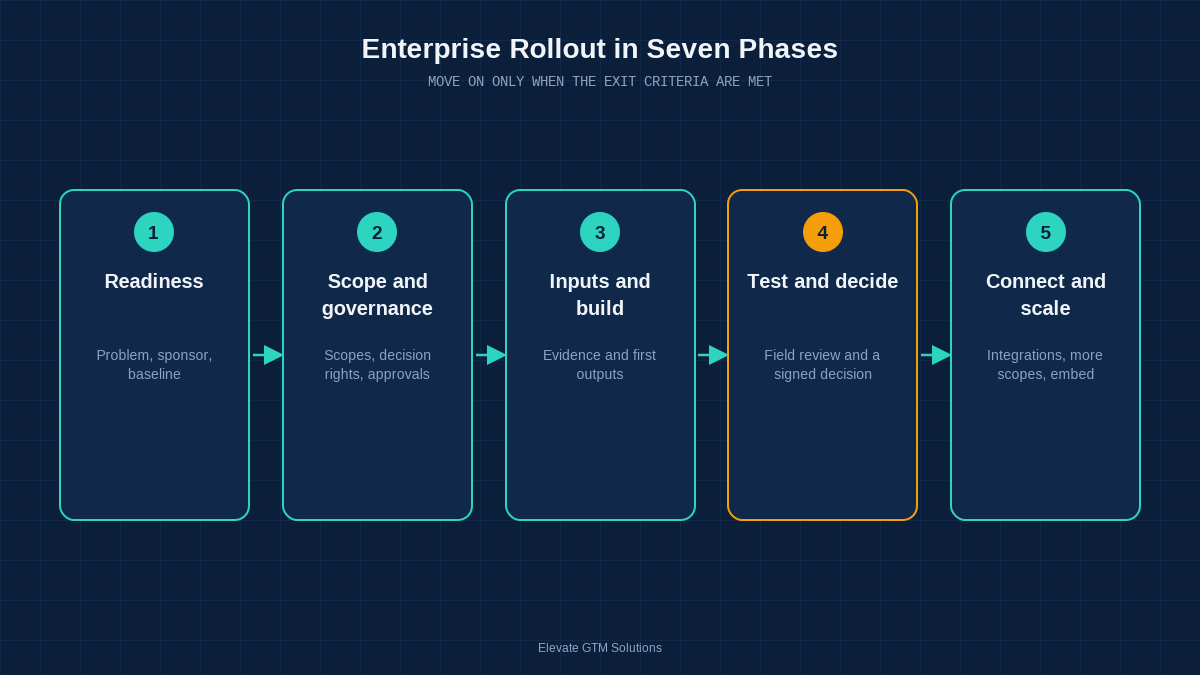
A focused pilot on one product and two regions can produce a first reviewed strategy in a few weeks. Reaching a steady operating rhythm across several products and regions typically takes two to four quarters, depending on governance, integrations and adoption, not on software installation. Plan in seven phases: readiness, scope and governance, inputs and first build, test and decision, connect, scale, and embed. Move to the next phase only when the exit criteria for the current one are met.
What takes the most time? Agreeing decision rights and getting teams to use the shared output. Technical setup is usually the smaller part.
Can we skip the pilot? You can, but the first real test of governance and adoption then happens at full scale.
The seven phases at a glance
| Phase | Purpose | Typical duration (planning range) | Exit criterion |
|---|---|---|---|
| 0. Readiness | Confirm the problem, sponsor and baseline | 1 to 3 weeks | Written problem, sponsor named, baseline measured |
| 1. Scope and governance | Choose the pilot, set structure and decision rights | 2 to 4 weeks | Scopes defined, owners named, approval flow agreed |
| 2. Inputs and first build | Gather evidence and produce the first outputs | 2 to 4 weeks | First reviewed outputs for the pilot scope |
| 3. Test and decide | Test with sellers and buyers, decide and record | 3 to 6 weeks | Decision record and assumption log signed |
| 4. Connect | Link to CRM, enablement and outreach | 4 to 8 weeks | Supported flows working and documented |
| 5. Scale | Extend to more products and regions | 1 to 3 quarters | Each added scope has an owner and a review |
| 6. Embed | Use the system in planning and onboarding, retire duplicates | Ongoing | Annual planning uses recorded decisions |
Phases can overlap, but exit criteria should not be waived. A project that skips phase 1 pays for it in phase 5.
Phase 0: readiness
Goal. Know what problem you are solving and how you will tell whether you solved it.
Actions.
- Write the problem in your own terms: for example, regions describe the ideal customer differently, strategy updates take months or product launches repeat discovery work.
- Measure a baseline: days from a market change to updated material, number of live versions of the customer definition, hours spent rebuilding regional decks each quarter.
- Name an executive sponsor with authority to settle conflicts between units.
- Name a program owner who will run the work day to day.
- Inventory current assets: where the customer definition, positioning and messaging live today.
- Check data and security constraints with your advisers.
Exit criteria. A one-page problem statement, a sponsor, an owner and a baseline.
Common mistake. Starting with a vendor demo before you can say what problem you are solving.
Phase 1: scope and governance
Goal. Choose where to start and decide how the system will be organized and governed.
Actions.
- Pick one product and two regions for the pilot. Choose places with an engaged owner, enough evidence and a real near-term decision.
- Define scopes. In Elevate GTM Solutions a scope is a product, market or segment. Whatever the product, decide the structure so strategies are comparable.
- Write decision rights: who owns the customer definition, positioning, messaging pillars, pricing logic and channel plans, and who approves changes.
- Decide what is global and what regions may adapt.
- Define the approval flow and how exceptions are recorded.
- Set access: who can view, edit and approve.
- Agree the review rhythm: monthly input update, monthly strategy review, quarterly reset.
Exit criteria. A scope map, a decision-rights table, an approval flow and a calendar of reviews.
Common mistake. Treating governance as paperwork to do later. Governance is what makes the output trusted.
Phase 2: inputs and first build
Goal. Produce the first set of outputs from real evidence.
Actions.
- Gather evidence for the pilot scope: win and loss reasons for the last year, notes from customer calls, competitor descriptions, current positioning and messaging, pricing and constraints.
- Run a handful of fresh buyer or lost-deal conversations to fill the largest gaps.
- Enter the context in structured form.
- Generate outputs: customer definition, segment priorities, competitive framing, positioning, messaging, pricing logic and channel plans.
- Review them with sellers and customer success. List what is wrong, generic or missing.
- Correct inputs, regenerate and compare versions.
Exit criteria. Reviewed outputs for the pilot scope and a list of assumptions to test.
Common mistake. Entering thin inputs and then judging the system on generic output.
Phase 3: test and decide
Goal. Turn drafts into decisions that people accept.
Actions.
- Share positioning and messaging with a few customers or prospects, and with sellers who will use them.
- Run small tests where possible: message variants, price reactions, qualification questions.
- Update the assumption log.
- Hold a decision meeting with the owner and regional leaders. Decide, or name the evidence that would let you decide.
- Record the decision, the reasons and the review date.
- Produce short handoff material: a one-page customer profile, message pillars, objection responses.
Exit criteria. A signed decision record, an updated assumption log and handoff material in the field's hands.
Common mistake. Leaving the decision implicit. If nobody signs, nobody follows.
Phase 4: connect
Goal. Link the shared strategy to the tools where work happens.
Actions.
- List the flows you need: strategy to CRM configuration, CRM wins and losses back to strategy, strategy to enablement, strategy to outreach briefs.
- For each flow, confirm with the vendor which actions are supported and which are manual.
- Assign an owner per flow and document how it works.
- Set up the feedback path: monthly export of wins, losses, reasons and pipeline by segment.
- Test each flow with a small sample before relying on it.
Exit criteria. Each needed flow is working, documented and owned.
Common mistake. Assuming a listed integration synchronizes every object. Check what each connection actually does.
Phase 5: scale
Goal. Extend to more products and regions without losing quality.
Actions.
- Add scopes in waves of two or three, not all at once.
- For each, appoint an owner, gather evidence and run the same build, test and decide cycle.
- Compare scopes side by side to see where strategies differ and why.
- Run the regional exception review monthly.
- Hold a quarterly reset across scopes.
- Track the baseline measures: time to update, version count, messaging consistency.
Exit criteria. Each scope has an owner, a decision record and a place in the review calendar.
Common mistake. Adding scopes faster than owners can maintain them.
Phase 6: embed
Goal. Make the system the default way the company works.
Actions.
- Use recorded decisions as the input to annual planning.
- Make the shared definitions the starting point for new campaigns, decks and onboarding.
- Retire duplicate decks and documents.
- Add the system to new-hire onboarding.
- Review adoption and outcomes with the sponsor each quarter.
- Decide where to deepen and where to simplify.
Exit criteria. Annual planning and onboarding use the shared system, and duplicates are retired.
Workstreams that run across phases
| Workstream | Lead | What it covers |
|---|---|---|
| Governance | GTM strategy owner | Decision rights, approvals, exceptions, audit |
| Evidence | Evidence owner | Win and loss data, customer conversations, market changes |
| Integrations | RevOps or operations | CRM, enablement and outreach connections |
| Security and legal | Security and legal advisers | Data handling, access, contract terms |
| Change management | Program owner | Communication, training, adoption |
| Measurement | Program owner and finance | Baseline, measures, reviews |
Who does what
| Activity | Sponsor | Program owner | Strategy owner | Regional owners | Sellers and CS | RevOps | Security |
|---|---|---|---|---|---|---|---|
| Problem and baseline | A | R | C | C | C | C | I |
| Decision rights | A | R | R | C | I | I | I |
| Inputs and evidence | I | A | R | R | C | C | I |
| Review of outputs | I | A | R | R | R | I | I |
| Decisions | A | R | R | R | C | I | I |
| Integrations | I | A | C | I | I | R | C |
| Security review | I | A | I | I | I | C | R |
| Training | I | A | R | R | C | C | I |
R means responsible, A accountable, C consulted, I informed. Adjust to your organization, and make sure each row has exactly one A.
A week-by-week plan for the first ninety days
This is a sample for a pilot of one product and two regions. Adjust the weeks to your calendar.
| Week | Focus | Key outputs |
|---|---|---|
| 1 | Problem, sponsor, owner | One-page problem statement, named sponsor and program owner |
| 2 | Baseline | Counts and timings for the baseline measures |
| 3 | Scope map | Pilot scopes, naming and structure |
| 4 | Decision rights | A signed table of who decides what |
| 5 | Evidence gathering | Win and loss data, call notes, competitor descriptions |
| 6 | Buyer conversations | Five or more conversations with notes |
| 7 | First build | First outputs for each pilot scope |
| 8 | Review with the field | List of corrections and gaps from sellers and customer success |
| 9 | Second build and comparison | Corrected outputs, regional versions compared |
| 10 | Testing | Message and price conversations, qualification questions tested |
| 11 | Decision meeting | Signed decision record and updated assumption log |
| 12 | Handoff and rhythm | Handoff material, review calendar, first monthly review held |
| 13 | Retrospective | What worked, what did not, whether to extend |
If the schedule slips, protect weeks 6, 8 and 11. Buyer conversations, field review and a real decision are what make the pilot informative.
Checklists by phase
Readiness checklist
- The problem is written in operational terms, not as a wish.
- A sponsor with authority to settle disputes is named and has agreed.
- A program owner has time allocated.
- The baseline is measured, not estimated.
- Current assets are inventoried, including where the customer definition lives.
- Security and legal contacts are identified and informed.
- The pilot's likely scope is identified and the owners are willing.
Governance checklist
- Scopes are named in a consistent way.
- Each decision has one owner and a list of who must be consulted.
- What is global and what is local is written down.
- The approval flow is defined, including who can approve exceptions.
- Roles for viewing, editing and approving are set.
- Meeting dates for monthly and quarterly reviews are in calendars.
- The record-keeping method is agreed, including where decisions are stored.
First build checklist
- Inputs include evidence from the last twelve months of wins and losses.
- At least five fresh buyer or lost-deal conversations have been held.
- Competitors include non-obvious alternatives such as spreadsheets and doing nothing.
- Current messaging and pricing are entered.
- Outputs have been read by at least two sellers and one customer success person.
- A list of generic or unsupported statements exists and has been addressed.
- Versions are saved and labeled.
Decision checklist
- Every message pillar has proof or is labeled as untested.
- The positioning can be repeated by a seller after one reading.
- The decision owner has signed.
- Dissenting views and open questions are recorded.
- The assumption log shows what will be tested and by when.
- The next review date is set.
Connection checklist
- Each required flow is listed with an owner.
- The vendor has confirmed in writing which actions are supported.
- Manual steps are documented.
- A small sample has been tested for each flow.
- A fallback exists if a connection fails.
- Credentials are authorized with appropriate scope and a way to revoke.
Scale checklist
- New scopes are added in small waves.
- Each new scope has an owner, evidence and a decision record.
- Exceptions are logged with reasons.
- Side-by-side comparisons are reviewed by leaders.
- Baseline measures are updated.
- Training for new owners is delivered before they start.
Embedding checklist
- Annual planning documents cite recorded decisions.
- New campaigns and decks start from the shared definitions.
- Duplicate decks are archived or removed.
- Onboarding includes the shared system.
- Quarterly reviews with the sponsor are in the calendar.
- A plan exists to retire or simplify what is not used.
Templates you can copy
Decision rights
| Decision | Owner | Must be consulted | Approver | Global or local |
|---|---|---|---|---|
| Ideal customer definition | ||||
| Positioning | ||||
| Messaging pillars | ||||
| Pricing logic | ||||
| Channel plan | ||||
| Quarterly priorities | ||||
| Regional exceptions |
Scope map
| Scope name | Type (product, market, segment) | Owner | Parent scope | Review date |
|---|---|---|---|---|
Exception log
| Date | Scope | What differs from the standard | Reason | Approved by | Review date |
|---|---|---|---|---|---|
Decision record
| Field | Entry |
|---|---|
| Decision | |
| Options considered | |
| Evidence | |
| Decided by and date | |
| Dissent or open questions | |
| Assumptions to test and by when | |
| Review date |
Meeting agendas
Monthly strategy review (sixty minutes)
- Evidence since last month: new wins, losses, buyer language and competitor changes (fifteen minutes).
- What changed in the outputs after the inputs were updated, and whether the changes are supported (fifteen minutes).
- Regional exceptions: approve, reject or ask for evidence (fifteen minutes).
- Decisions and owners (ten minutes).
- Actions and the next date (five minutes).
Quarterly reset (ninety minutes)
- Review the quarter's win and loss evidence by segment (twenty minutes).
- Revisit the customer definition and positioning for each scope (thirty minutes).
- Compare scopes side by side and discuss differences (twenty minutes).
- Check the baseline measures and adoption (ten minutes).
- Decide changes, owners and the plan for the next quarter (ten minutes).
Sponsor review (thirty minutes, quarterly)
- Progress against the roadmap and exit criteria.
- Measures and what they suggest.
- Risks and blockers needing sponsor action.
- Decisions needed from the sponsor.
Record decisions from every meeting in the decision record, and circulate within a day.
Change management and training
Adoption is where rollouts succeed or fail, so plan it deliberately.
| Audience | What they need | Format | Timing |
|---|---|---|---|
| Executives | Why, what changes, what they must decide | A short briefing and a quarterly review | Phase 0 and each quarter |
| Product and regional owners | How to maintain their scope and use the approval flow | A working session | Phase 1 and before each new scope |
| Sellers | The customer profile, the message and how to give feedback | A walkthrough with practice | Phase 3 |
| Marketing | How campaigns draw on the shared definitions | A working session | Phase 3 and 4 |
| Customer success | What was promised and how to feed back | A walkthrough | Phase 3 |
| RevOps | How connections work and who owns them | Documentation and a handover | Phase 4 |
| New hires | Where the definitions live and how to ask questions | Onboarding module | Phase 6 |
Three habits help. Use sellers' own words in outputs so they see themselves in it. Tell people when their feedback changed something. And retire old decks, because two sources of truth are worse than none.
Managing the vendor relationship through the rollout
The vendor is a partner in the first quarters, so manage the relationship deliberately.
| Stage | What to agree | Why |
|---|---|---|
| Before the pilot | Pilot scope, success measures, duration and what happens at the end | Prevents drift and surprise commitments |
| During the pilot | A named contact, response times and a weekly check-in | Problems surface early |
| At the pilot review | A joint review against the measures, with evidence | Decisions rest on data |
| Before scaling | Plan structure, scopes and seats, price protection and exit terms | Avoids cost shocks |
| During scaling | A quarterly business review and a roadmap conversation | Keeps expectations aligned |
| At renewal | A review of use, outcomes and alternatives | Keeps leverage and relevance |
Ask the vendor what a typical customer of your size does in the first ninety days, and what the most common causes of delay are. Good vendors can answer specifically and will not claim that setup alone delivers the result.
Commercial checkpoints
Link spending to evidence.
| Checkpoint | Evidence required before moving on |
|---|---|
| Approve the pilot | A written problem, a baseline, a sponsor and named owners |
| Extend to more scopes | A signed decision record, field review done and baseline measures moving in the right direction or explained |
| Sign a multi-year commitment | A completed pilot review, confirmed integrations, reviewed security documentation and agreed exit terms |
| Expand seats | Evidence that owners and reviewers use the system on schedule |
| Renew | An annual review of measures and adoption |
Avoid committing to scale before you have seen governance working in the pilot. A larger contract does not fix an unowned system.
Diagnosing a rollout that is going wrong
| Symptom | Likely cause | First thing to check |
|---|---|---|
| Few people log in after the first month | No clear owner or review rhythm | Is a monthly review in the calendar and attended? |
| Regions ignore the shared definitions | They were not involved, or the definitions feel imposed | Were regional leads part of the decision? |
| Outputs are criticized as generic | Thin or vague inputs | What evidence was entered, and was it reviewed with sellers? |
| Updates are slow | Approval flow is unclear | Who approves, and how long do approvals take? |
| Integrations are manual and forgotten | No owner | Who owns each flow? |
| Leaders ask what the system is for | The problem and baseline were never stated | Is the one-page problem statement visible? |
| New scopes are added but unmaintained | Scale outpaced owners | Does each scope have an owner with time? |
| The sponsor disengages | Reports show activity, not outcomes | Are measures tied to the original problem? |
When several symptoms appear together, pause scaling, fix ownership and review, and restart the next wave afterward.
Communication plan
People support what they understand. A simple plan prevents rumors and resistance.
| When | Message | Audience | From |
|---|---|---|---|
| Phase 0 | The problem we are solving and why it matters | Executives and function heads | Sponsor |
| Phase 1 | The pilot scope, who is involved and what we need from them | Pilot owners | Program owner |
| Phase 2 | What we are learning from customers and how it will be used | Sellers and customer success | Strategy owner |
| Phase 3 | The decision, the reasons and how to give feedback | Whole field | Sponsor and strategy owner |
| Phase 4 | How the connections work and who to ask | Operations, marketing and sales leaders | RevOps |
| Phase 5 | What is changing as new scopes join | New owners and their teams | Program owner |
| Phase 6 | How the system now supports planning and onboarding | Everyone | Sponsor |
Keep messages short, specific and honest about what is still undecided. Share early wins with evidence, such as a competitor response that reached all regions in days. Avoid claiming credit for results the system did not cause.
Reading the baseline honestly
A baseline is useful only if it is measured the same way later.
Days from a market change to updated material. Choose a recent example, trace each step and record the dates. Repeat the measure on the next real change. Do not choose an easy example for the second measurement.
Number of live versions of the customer definition. Search the places teams keep decks and documents and count distinct versions, including slides in shared drives. The count is often higher than leaders expect.
Messaging consistency. Take the website, the main sales deck and three recent outbound emails for one product, and compare how each states the customer, the problem and the main claim. Score them from one to five for agreement, with two reviewers.
Seller recall. Ask five sellers to state the positioning and the ideal customer without notes. Record how many agree.
Record how you measured each, and repeat in the same way every quarter. These simple measures are persuasive precisely because they are specific to your company.
Measuring progress
| Measure | Baseline | Target direction | Review |
|---|---|---|---|
| Days from a market change to updated material | Measured in phase 0 | Down | Monthly |
| Live versions of the customer definition | Counted in phase 0 | Down to one per scope | Monthly |
| Messaging consistency across site, deck and emails | Sampled in phase 0 | Up | Quarterly |
| Share of regional exceptions with a recorded reason | Unknown at start | Up | Monthly |
| Seller ability to state the positioning | Tested in phase 3 | Up | Quarterly |
| Time for a new seller to describe the customer correctly | Measured at onboarding | Down | Quarterly |
| Win rate and cycle length by segment | From CRM | Differences understood | Quarterly |
Choose three, record the baseline and review them with the sponsor. Avoid claiming that the system caused a change in win rate unless you have evidence beyond timing.
Risk register
| Risk | Likelihood | Impact | Mitigation |
|---|---|---|---|
| No sponsor authority | Medium | High | Name a sponsor who can settle disputes before phase 1 |
| Owners not available | High | High | Agree time commitments and backups |
| Thin inputs | High | Medium | Run fresh buyer conversations in phase 2 |
| Generic output accepted | Medium | High | Review gates with sellers |
| Shadow strategies in regions | High | Medium | Exception process and visible comparisons |
| Integration gaps | Medium | Medium | Confirm supported actions in phase 4 |
| Security objections late | Medium | High | Involve security in phase 0 |
| Scope creep | High | Medium | Add scopes in waves |
| Stalled adoption | Medium | High | Training, feedback loops and retired duplicates |
| Vendor change | Low to medium | Medium | Contract protections and exportable data |
Review the register monthly in the first two quarters.
Resources and budget
Plan resources for people as well as software.
| Resource | Typical need in the pilot | Typical need at scale |
|---|---|---|
| Program owner | A substantial share of one person's week | Steady part-time role |
| Strategy owner | A few hours a week | A few hours a week per scope group |
| Product and regional owners | Two to four hours a week during build and review | One to two hours a week for maintenance |
| Evidence owner | Several days over the first month | A few hours a month |
| RevOps | Short bursts in phase 4 | Ongoing, small |
| Security and legal | Early review, then occasional | Occasional |
| Software | Subscription for the pilot scope | Plan sized to scopes and users |
Treat these as planning figures to adjust. The most common budget error is counting the subscription and forgetting the owners' time.
A hypothetical example
This is an illustration, not a real company.
A European software group with three products and four regions appointed a head of GTM strategy to improve consistency. In phase 0, she counted six live versions of the customer definition for its main product and found that updating a competitor response across regions took about six weeks. Those became the baseline.
In phase 1, she chose the main product and two regions. She wrote decision rights with each region's lead, and agreed that the core positioning was global while proof points and pricing presentation could vary. In phase 2, she gathered a year of win and loss reasons and arranged five buyer conversations. The first outputs said the target was mid-sized firms with a dedicated operations team. Regional sellers rejected one claim as generic, and the team rewrote it using a customer's words.
In phase 3, the regional leads and the head of product signed a decision record. In phase 4, the team set up a monthly export of wins and losses from the CRM and a documented step for passing messaging to the outreach team. By phase 5, two more products had owners, and the monthly review compared strategies side by side. After three quarters, the number of live customer definitions for the main product was one, and a competitor response took days to reach all four regions.
The software did not do the hard part. Owners, review and visible decisions did.
Questions sponsors often ask
"Can we move faster?" You can compress phases by narrowing scope and securing owners early. You cannot skip the decision and review steps without losing trust in the output.
"How will we know it is working?" Compare the baseline measures each quarter, and ask sellers to state the positioning without notes. If both improve, something real is changing.
"What if the regions resist?" Involve regional leads in the decision-rights session, use their language in outputs and make the exception process fair and visible.
"Should we wait for the perfect strategy?" No. Start with a reviewed draft and improve it. A good strategy that stays current beats a perfect one that is stale.
"What if the pilot disappoints?" Look at inputs, ownership and review first. If those are sound and the outputs are still not useful, the product may be wrong for you, and the pilot has done its job by showing that cheaply.
"Do we need consultants?" Possibly for facilitation or independent challenge. See our guide on when you still need a GTM consultant.
What to do this week
Write the one-page problem statement. Count how many live versions of your customer definition exist. Name a sponsor with authority to settle disputes. Choose a pilot product and two regions, and list the owner of each. If you cannot name owners, you have found the first thing to fix.
Key takeaways
- Implementation is mostly about governance, evidence and adoption, not installation.
- Use seven phases with exit criteria: readiness, scope and governance, inputs and first build, test and decide, connect, scale and embed.
- Start with one product and two regions and add scopes in waves.
- Plan training by audience, and retire duplicate decks.
- Measure a baseline and review a few measures monthly.
- Budget the owners' time as well as the subscription.
A final word on pace
Enterprises often want a rollout schedule that impresses the board. A better schedule is one the organization can keep. Choose a scope small enough that owners can give it real attention, hold the monthly review even when nothing seems to have changed and publish decisions where the field will see them. Slow, steady adoption of a shared strategy usually beats a fast launch that fades.
Where Elevate GTM Solutions fits
Elevate GTM Solutions is an AI-native GTM operating system for B2B companies. Its structure of scopes (product, market or segment), versions you can compare side by side, workflows, weekly execution plans, task ownership and a recurring review rhythm maps onto the phases above. Published plans, billed annually, are Enable at USD 499 per month, Growth at USD 1,499 per month and custom Scale pricing with unlimited scopes and advanced intelligence, and a free first strategy build is available for a quick test. The company also offers Guided GTM and focused advisory engagements for teams that want help with a rollout, sold separately.
It connects to HubSpot, Salesforce, LinkedIn, Notion and Claude for supported actions, and it does not replace a CRM or an outreach tool. Check the specific actions for each connection and review current security documentation before you rely on them. For related reading, see AI-Powered GTM Operating System for Enterprises, What Is Elevate GTM Solutions?, Enterprise Product Launch Readiness and GTM Strategy Handoff. See the pricing page, or request a demo.
Frequently Asked Questions
How long does it take to implement a GTM operating system?
A focused pilot on one product and two regions can produce a first reviewed strategy in a few weeks. A steady rhythm across several products and regions typically takes two to four quarters. Timing depends on governance, integrations and adoption more than on software setup.
What are the phases of a GTM operating system rollout?
Readiness, scope and governance, inputs and first build, test and decide, connect, scale and embed. Each phase has exit criteria that should be met before moving on.
Who should lead the implementation?
A program owner runs it day to day, a strategy owner holds the shared structure, an executive sponsor settles conflicts, and product and regional owners maintain their scopes.
What should we pilot first?
One product and two regions with an engaged owner, enough evidence and a real near-term decision. Avoid starting with everything.
What causes these rollouts to fail?
No sponsor authority, unavailable owners, thin inputs, generic output accepted without review, shadow strategies in regions, late security objections, scope creep and stalled adoption.
How do we measure success?
Track a baseline and review measures such as days from a market change to updated material, number of live versions of the customer definition, messaging consistency, share of regional exceptions with recorded reasons and seller ability to state the positioning.
How much internal time does it need?
Plan a substantial share of a program owner's week, a few hours a week from the strategy owner and two to four hours a week from product and regional owners during build and review. Adjust to your organization.
What integrations should we set up first?
The feedback path from the CRM (wins, losses, reasons and pipeline by segment) and the path from strategy to enablement and outreach. Confirm which actions are supported and which are manual.
How do we get sellers to use it?
Use their own words in the output, brief them during the test phase, tell them when their feedback changed something and retire old decks so there is one source.
What should the exit criteria for each phase be?
A written problem and baseline for readiness, scopes and decision rights for governance, reviewed outputs for the first build, a signed decision record for testing, documented working flows for connection, owners and reviews for each new scope, and annual planning that uses recorded decisions for embedding.
Can we use consultants for the rollout?
Yes. Many teams use advisors for facilitation and decisions that need an outside voice while the platform handles structured work. Scope the engagement narrowly and arrive with evidence and a draft.
What does Elevate GTM Solutions offer for rollout support?
Guided GTM and focused advisory engagements, sold separately, alongside published platform plans. Ask what is included at each plan and what costs extra.