
By the Elevate GTM Solutions Team · Updated November 13, 2026 · 23 min read
Questions to Ask AI GTM Vendors: A Buyer's Checklist for Evaluating GTM AI Software
Most vendor evaluations fail in the same way. The buyer watches a polished demo, asks questions the demo already answered, signs, and discovers six weeks later that the product does something slightly different from what they pictured. With AI products the gap is wider, because the demo shows the best output from the best input, and nobody can tell from the outside what the product does on an ordinary Tuesday with your messy data.
This guide is a working checklist. It lists what to compare when you evaluate GTM AI software, the questions that surface the real answers, what a good answer sounds like and what should worry you. It is organized by topic so that different people on your side, such as the business owner, RevOps, security and finance, can take their part. It ends with a scoring sheet, a demo script and an email you can send to every vendor so you get answers you can compare.
We make a GTM platform, so we are a vendor writing a guide for buyers. We have tried to make the questions fair to any vendor, including ours, and we say at the end which ones we would expect you to ask us. We do not name or rate other vendors.
What should I compare when evaluating GTM AI software?
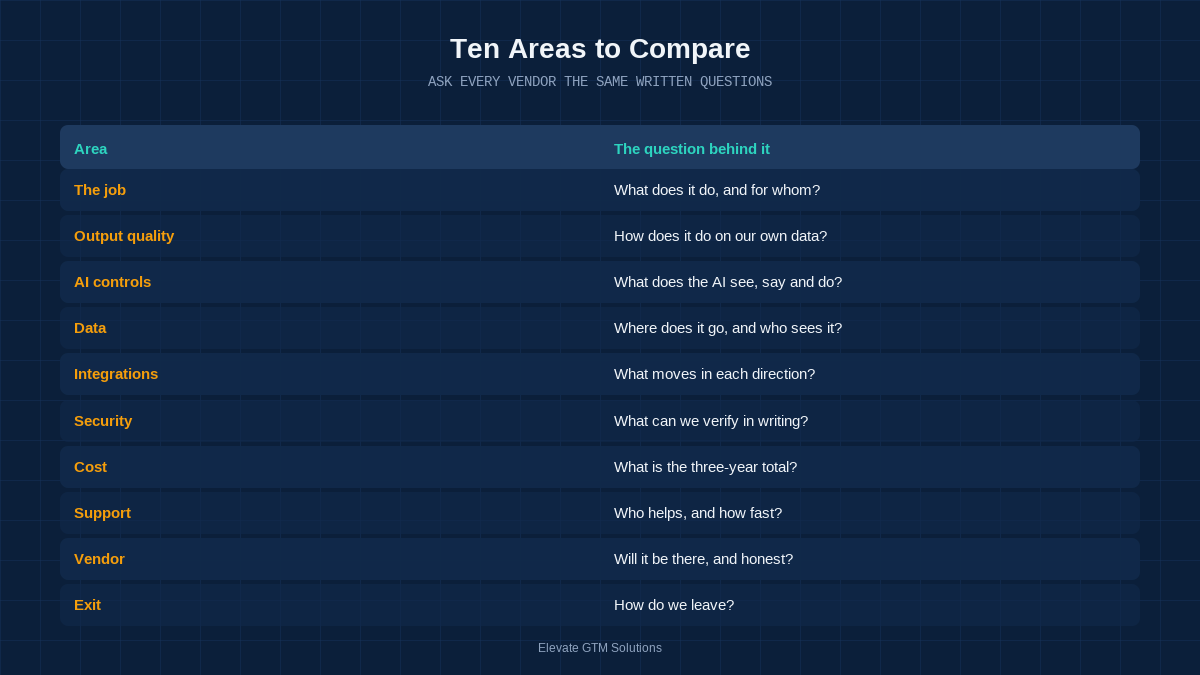
Compare eight things: the job it does and for whom, the quality of its output on your own cases, what data it uses and where that data goes, how it connects to your tools, how it is governed and secured, what it costs in total, how well the vendor supports you and what it takes to leave. Ask each vendor the same written questions, run the same test on your own data and score the results. Treat a polished demo as a claim, not as evidence, and weigh what you can verify over what you are told.
What is the most important question? "Show me this on my own data, and show me where it is wrong." A vendor who is comfortable with the second half is usually one you can work with.
How many vendors should I compare? Three is enough. More produces noise.
How to use this guide
Pick the sections that apply. A small team buying a planning tool can skip much of the security section, though not all of it. A large company in a regulated industry needs all of it. Send the written questions to every vendor in the same email, ask for answers in writing, and note both what they say and how quickly and clearly they say it. Responsiveness during a sale is a reasonable preview of support afterwards.
For each question there is a short note on what a good answer looks like. Treat those as prompts for discussion, not as an answer key.
1. The job
Start here. Many mismatches come from buying a tool built for a different job than the one you had in mind. Our guide to how to choose a GTM platform goes through the categories.
| Question | A good answer | Concern |
|---|---|---|
| What job does the product do, in one sentence? | A clear, specific job | A list of buzzwords |
| Who is the main user, and who else benefits? | Named roles | "Everyone" |
| What does it not do? | A direct answer | "Nothing, it does it all" |
| Which other tools do customers usually use alongside it? | Named tools and why | Claims that it replaces everything |
| What does a customer like us typically do first? | A specific first use | A long implementation plan with no early result |
| Which customers are a poor fit? | A candid description | "It works for everyone" |
| What changed in the product in the last year? | Specific releases | Vague "innovation" |
2. Output quality
For AI products, quality is the heart of it, and it is the hardest thing to judge from a demo.
| Question | A good answer | Concern |
|---|---|---|
| Can we test on our own product, segment and data before buying? | Yes, with a defined test | Only sample data |
| How do you measure output quality? | A method, such as human review against criteria | "Customers love it" |
| What are the common failure modes? | Named, with examples | "Rare" |
| How does the product handle uncertainty? | It flags low confidence or missing data | It always sounds sure |
| Can we see the sources or inputs behind an output? | Yes, in the interface | A black box |
| How do we correct an output, and does the correction carry forward? | A clear mechanism | Edits are one-off |
| What proportion of outputs do customers use without edits? | A candid answer, or an honest "we do not track it" | An impressive figure with no definition |
| Can we compare outputs from different versions or settings? | Yes | No |
A fair quality test
- Choose a case your team knows very well, so you can judge the answer.
- Give each vendor the same inputs.
- Define in advance what a good output contains. For example, "names the right buyer role, uses language our customers use and makes no claim we cannot support."
- Have two people who know the product score the outputs without knowing which vendor produced which.
- List every error, including small ones.
- Ask each vendor to explain the errors. How they respond matters as much as the number.
3. AI specifics
These questions are about the AI itself. A good vendor can answer them in plain words.
| Question | A good answer | Concern |
|---|---|---|
| Which AI models or providers does the product use? | Named providers, or a clear description of the approach | Evasion |
| Do you change models, and how do you tell customers? | A notice process and a way to compare | Silent changes |
| Is our data used to train models, yours or anyone's? | A clear "no," in writing, or a clear explanation | Ambiguity |
| Can we turn off AI features? | Yes, by feature | All or nothing |
| How do you reduce made-up statements? | Grounding in your content, citations, review steps | "Our model is very accurate" |
| What does a human review before it reaches a customer? | A configurable approval step | Autonomous sending by default |
| Is there a log of what the AI produced and changed? | Yes, with who and when | No log |
| How do you test for harmful, biased or non-compliant output? | A described process | No process |
| What happens when the AI provider has an outage? | A fallback or clear communication | No plan |
| How do you handle prompt injection, where text in a document or web page tries to steer the AI? | A described defense and an honest limit | Never heard of it |
For a general framework on managing AI risk, the US National Institute of Standards and Technology publishes an AI Risk Management Framework, which many organizations use as a vocabulary for these questions. Your security and legal teams may already have their own.
4. Data
| Question | A good answer | Concern |
|---|---|---|
| What data does the product need from us? | A specific list | "Everything you have" |
| What data does it collect on its own, and from where? | Named sources and how they were obtained | Unclear sourcing |
| Where is our data stored, and in what region? | Named regions and options | Unknown |
| Who at your company can see our data? | Named roles, under controls | "Our team" |
| How long do you keep it, and how do we delete it? | A policy and a process | Indefinite retention |
| Can we export all of it, in what format and at what cost? | Yes, standard format, no fee | Hard or costly |
| What happens to our data and derived outputs when we leave? | Deletion with confirmation | No answer |
| Does the product combine our data with other customers' data? | A clear answer on isolation | Vague |
| How do you handle personal data and consent? | A described process and a data processing agreement | "We are compliant" |
If the product uses contact or company data from third parties, ask how that data was collected and whether it complies with the laws that apply to your market. Privacy rules vary by country and by use, and your legal team should review the answers.
5. Integrations
Integrations decide whether the tool fits into your work or sits beside it. For the most common case, see our guide to GTM platforms that integrate with Salesforce.
| Question | A good answer | Concern |
|---|---|---|
| Which integrations are native, and which need development or middleware? | A clear list | "We integrate with everything" |
| For each, what data moves in each direction? | A specific description | "It syncs" |
| Which actions are supported, not only which data? | A list of actions | Only reading |
| Can we test in a sandbox before production? | Yes | No |
| How do you handle schema changes? | Alerts and clear behavior | Silent failure |
| How are errors reported and to whom? | An error log and alerts | A green status page |
| What permissions do you need, and can we limit them? | Least-privilege options | Broad access by default |
| Is there an open interface for our own developers? | A documented API | Closed |
| What are the limits on volume and frequency? | Published limits | Unknown |
6. Security and governance
For depth, use our GTM platform governance checklist. The core questions follow.
| Question | A good answer | Concern |
|---|---|---|
| What independent security assurance do you have, such as an audit report or certification, and can we see it? | Current reports shared under NDA | "We follow best practices" |
| How do users sign in, and do you support single sign-on? | Standard options, with plan limits stated | Passwords only |
| What roles and permissions exist? | Granular roles | One level |
| Is there an audit log of user and AI actions? | Yes, with export | No |
| How is data encrypted? | In transit and at rest, described | Silence |
| Who are your subprocessors, and how do you notify us of changes? | A list and a notice process | Unknown |
| What is your incident notification process and timeline? | A defined commitment | No process |
| Do you test your security, and how often? | Regular independent testing | "We test internally" |
| What is your business continuity and backup approach? | A described plan | None |
7. Cost
See our pricing guide for the full treatment, and use these questions to get comparable numbers.
| Question | A good answer | Concern |
|---|---|---|
| What is the total first-year cost for our stated needs? | A written quote | A range, verbally |
| What are years two and three, including increases? | Written, with a cap | "We will see" |
| What is not included? | A candid list | "Everything you need" |
| How are extra users, scopes or usage priced? | Published rates | Case by case |
| What do customers usually add in the first six months? | A frank answer | "Nothing" |
| What are the renewal and termination terms? | Clear dates and notice | Unclear auto-renewal |
| Is there a free trial, a free first output or a pilot? | A defined offer | Demo only, with pressure to sign |
8. Support and success
Support is where many deals disappoint. Our guide to evaluating GTM platform customer support covers how to test it. A short list here.
| Question | A good answer | Concern |
|---|---|---|
| What support is included, and what costs extra? | A clear table | Vague |
| What are the response targets, by severity? | Written commitments | "Fast" |
| Who handles onboarding, and for how long? | Named roles and a plan | "Self-serve" with no guidance |
| Is there a named contact after onboarding? | Depends on plan, stated plainly | Unclear |
| How do you handle escalations? | A described path | None |
| Where can we see product status and incidents? | A public status page | None |
| How do we give product feedback, and how is it handled? | A channel and examples of results | "We love feedback" |
9. The vendor
| Question | A good answer | Concern |
|---|---|---|
| How long have you been selling this product, and to how many customers like us? | A specific answer | Evasion |
| What is your funding or financial position, in general terms? | A candid answer | Refusal |
| What is the plan if the company is acquired or closes? | A described approach, such as data export and notice | None |
| Who owns the roadmap and how do you decide what to build? | A named process | "Customers drive everything" |
| Can we speak to two customers in the last year, including one that ended? | Yes | References only from friends |
| What would make you tell us not to buy? | A real answer | "Nothing" |
The last question is the one that tells you the most about a vendor's honesty.
10. Exit
| Question | A good answer | Concern |
|---|---|---|
| How do we leave? | A written process | Not discussed |
| What do we get on exit, and in what form? | Full export in a standard format | Partial or proprietary |
| How long do you keep our data after we leave, and how do we confirm deletion? | A time limit and written confirmation | Unclear |
| Are there fees or notice periods? | Stated clearly | Hidden |
| Can we run the system after contract end for a transition period? | Yes, for a defined time | No |
The email to send to every vendor
Copy and edit. The point is to ask the same questions, in writing, so answers are comparable.
Subject: Evaluation questions for [your company]
Thank you for the demo. To compare vendors fairly, we are asking everyone the same questions. Please answer in writing, in the order below, and mark any question you cannot answer.
- In one sentence, what job does the product do, and for which roles?
- What does it not do, and which tools do customers usually use alongside it?
- Can we test it on our own product and data before purchase? What would the test include?
- Which AI models or providers does the product use, and is our data used to train any model?
- How can we see the inputs or sources behind an output, and correct them?
- What data do you need from us, where is it stored, who can access it and how do we export and delete it?
- Which integrations are native, what data and actions move in each direction and how are errors reported?
- What independent security assurance do you hold, and can we see it under NDA?
- What is the total cost for our stated needs for three years, including increases, and what is not included?
- What support is included, with response targets, and what does onboarding involve?
- May we speak to two customers, including one who ended the contract?
- What would lead you to advise us not to buy?
A scoring sheet
Weight each category by what matters to you, score from one to five and record the evidence for each score.
| Category | Weight | Vendor 1 | Vendor 2 | Vendor 3 | Evidence |
|---|---|---|---|---|---|
| The job fits our need | |||||
| Output quality on our test | |||||
| AI controls and transparency | |||||
| Data handling | |||||
| Integrations in our stack | |||||
| Security and governance | |||||
| Three-year cost | |||||
| Support and onboarding | |||||
| Vendor stability and honesty | |||||
| Exit terms |
A simple rule: if a vendor scores below three on data handling, security or exit, treat it as a stop even if every other score is high.
A demo script that reveals more
Replace the vendor's script with yours, for at least part of the session.
- Start with your problem. Ask them to show the product doing your job, not theirs.
- Use your input. Give them a real product, account or segment from your business.
- Ask for an error. "Show me an output that is wrong, and how I would find and fix it."
- Ask who can see it. Walk through permissions and logs.
- Ask what happens when data changes. Change a field and watch what the system does.
- Ask to see the admin view. Not the user view.
- Ask to repeat a step without help. If the demo requires the presenter's hand, so will your team.
- End with the exit. Ask them to show how you export your data.
Red flags
- Evasive answers to questions about training on your data.
- No test on your own data.
- A demo that never leaves a prepared path.
- No way to see the inputs behind an output.
- Claims that the product replaces everything.
- Autonomous sending of customer messages with no approval option.
- Pressure to sign before security review.
- Reluctance to provide references, especially one who left.
- No written answers.
- Pricing that changes between conversations.
Questions your own team should answer first
Evaluations also fail because the buyer has not decided something. Settle these internally before the first demo.
| Question | Why it matters |
|---|---|
| Who owns the decision and the result? | Without an owner, nobody can say whether it worked |
| What problem are we solving, in one sentence? | Prevents buying a different product from the one you needed |
| What will we measure after thirty, ninety and one hundred eighty days? | Makes a pilot a test and not a hope |
| What data are we willing to share, and what is off limits? | Settles governance early |
| What must it connect to? | Narrows the field quickly |
| What is the budget range, and who approves it? | Saves time |
| What would make us stop? | Gives you an exit condition |
Including the right people
Different people ask different questions, and a complete evaluation needs all of them.
| Person | What they usually ask |
|---|---|
| Business owner | Does it do the job, and will people use it? |
| Sellers or marketers who will use it | Is the output good, and does it save time? |
| RevOps | Does it fit our systems and data? |
| Security and privacy | Is our data safe, and are we allowed to use it? |
| Legal and procurement | What do the terms say, and what are the risks? |
| Finance | What does it cost over the term, and what does it replace? |
| IT | How is it deployed, and who administers it? |
Bring security and legal in early. A vendor who passes the demo and fails the review costs weeks. An early start usually costs a few hours.
Running a pilot
If you reach a pilot, make it a test with a written result.
- Set a short period, usually four to eight weeks.
- Name the users and the work. A small group with a real task.
- Write the success measures before you start. For example, time to produce a first draft, share of outputs used with light edits, user ratings and number of errors found.
- Keep a log. Every error, every surprise, every time someone gave up.
- Review mid-way. Fix what you can, or stop.
- Decide on the data. Compare the results with the criteria, and with the vendor's claims.
- Do not extend by default. Decide to buy, to change the scope or to stop.
A pilot with no measures is a trial period with extra meetings.
What we would expect you to ask us
Because this is a vendor-written guide, we should say which questions we expect from you. Elevate GTM Solutions is a platform for GTM strategy and planning, and it is not a CRM, a data provider or a sales engagement tool. Expect to ask us what the integrations support, since the integrations page lists supported directions and not full synchronization. Expect to ask for evidence of outcomes, since our public case studies describe how the platform was used and do not report performance figures. Expect to ask about security documentation, data handling and AI model use, and ask for the answers in writing. Ask what the free first strategy build covers. And expect to test it on a product your team knows well. We think a vendor should welcome all of this.
How to read the answers
Collecting answers is half the job. A few habits help you interpret them.
Look for specifics. "We take security seriously" is a sentiment. "Our latest independent audit covers these systems for this period" is a fact you can check. Prefer facts.
Compare across vendors, not against perfection. No vendor will score highly on everything. The useful question is who is strongest where you need it most.
Notice how answers arrive. Fast and complete is a good sign. Slow and vague is information. An answer that comes from a salesperson alone, with no involvement from product or security people, may not be reliable on technical points.
Separate promises from capabilities. A feature "on the roadmap" is a promise. Ask for the date, and for a contract clause if it matters to you.
Watch for changes in the story. If answers shift between calls, ask which is current.
Check the claim, not only the answer. If the vendor says it holds an audit report, ask to see it. If it says an integration is native, ask to see the listing or documentation.
Three example evaluations, as illustrations
These are fictional composites.
A ten-person company choosing a planning tool. The owner cares most about speed to a first result, price and the chance to try it on her own product. She skips most of the security section but asks the training and export questions, and runs a free first build with each of two vendors. She decides on the one whose draft her two salespeople say is specific to their customers, and on whose price she can see a three-year total. She sets a ninety-day review.
A mid-size company choosing an account intelligence tool. The RevOps lead cares most about integrations and data quality, and brings in security for a standard review. The test is whether the tool's scores correlate with outcomes in the company's last two quarters of closed deals. One vendor will run the test and the other will not. The decision follows from that.
A large company choosing an AI platform that writes to its CRM. The governance questions dominate. The team agrees stops in advance: no training on company data, human approval on customer-facing output, single sign-on and a current audit report. A pilot runs for six weeks with non-sensitive data, and legal reviews the data processing terms in parallel. The platform is approved for a limited scope first, then widened.
Each case uses the same list of questions, weighted differently. That is the point of having a list.
Keeping the evaluation fair
Bias creeps into vendor evaluations. A few safeguards keep yours honest.
- Use the same test and the same questions for every vendor.
- Score before you discuss. Have each person write scores privately, then compare. Early discussion anchors everyone on the loudest voice.
- Blind the output test where you can. Remove vendor names from outputs when people score them.
- Record dissent. If one person disagrees, write down why.
- Beware the last demo. People remember what they saw most recently. Review notes from all of them.
- Do not let a discount decide. Compare the three-year totals.
- Admit sunk cost. If the vendor you started with falls short, drop it.
Special cases
A few situations change the weight of the questions.
You are buying for a regulated team. Add questions on retention, audit access, records management and the vendor's experience with your regulator's expectations. Ask for references in your sector.
You will connect it to customer data. Add questions on how the vendor handles personal data requests, how it deletes data on instruction and where support staff can see it. Our governance checklist goes into detail.
The vendor is young. Do not disqualify it for its age. Instead, add questions on funding runway, key person risk, escrow or export arrangements and how the company will keep serving you if circumstances change. Limit the data you give it and keep regular exports.
The product writes to your systems. Add questions on approvals, logs, reversal and error handling. A product that can change records can also change them wrongly at speed.
You are replacing an existing tool. Add questions on migration, parallel running and what history you will keep.
After the decision
Whichever vendor you choose, keep the evaluation file. It becomes your baseline for the first review. Put the promises made during the sale, the answers you received and the test results in one place, and review them at ninety days: what was promised, what happened, what changed. Share the file with whoever will own the renewal, since they will otherwise start from nothing. If the vendor met its answers, say so, since vendors tend to improve where they are told what works. If it did not, the file is your evidence for a conversation about fixing it, and a reasonable basis for a decision at renewal.
Glossary
Audit log. A record of who did what and when.
Data processing agreement. A contract that sets out how a vendor handles personal data on your behalf.
Grounding. Tying an AI output to specific sources so it can be checked.
Human in the loop. A step where a person reviews or approves before an action happens.
Pilot. A short, scoped test with written success measures.
Prompt injection. Text that tries to steer an AI tool into ignoring its instructions.
Single sign-on. A way to log in to many tools with one company identity.
Subprocessor. A third party that a vendor uses to process your data.
Training. Using data to improve or build an AI model.
Common mistakes
- Believing the demo.
- Testing only on sample data.
- Asking verbally and not recording answers.
- Skipping the question about training on your data.
- Leaving security and legal until the end.
- Not asking about exit.
- Comparing too many vendors.
- Having no owner.
- Not defining success.
- Treating a high score from one voice as a decision.
Where Elevate GTM Solutions fits
Elevate GTM Solutions is an AI-native platform for GTM strategy and planning with 15 connected modules, published plans and a free first strategy build. It is software, with guided programs and advisory sold separately. The questions in this guide apply to us as much as to anyone, and we suggest running the same email and the same test across every vendor on your list, including us. For a view of the category, see Top GTM Platforms and what Elevate GTM Solutions is.
What to do this week
- Write your one-sentence problem and name an owner.
- Choose three vendors.
- Send the twelve-question email to each.
- Define a fair test on your own data, with criteria written in advance.
- Bring in security and legal now.
- Score the answers and the test on the sheet.
- Run a pilot with written measures before you sign.
Key takeaways
- Compare the job, output quality, data, integrations, security, cost, support and exit.
- Ask every vendor the same questions in writing and compare the answers.
- Test on your own data and ask to see the errors.
- Ask whether your data trains any model, and get the answer in writing.
- Bring security and legal in early.
- A vendor that tells you when not to buy is easier to trust.
Sources
- NIST AI Risk Management Framework: a voluntary framework from the US National Institute of Standards and Technology for managing AI risks. Referenced as a shared vocabulary; this page does not summarize it in detail.
- Elevate GTM Solutions platform overview: the description of what the platform is and is not.
- The questions and answer notes reflect common buying practice and the writers' judgment. They are not drawn from a published survey.
Frequently Asked Questions
What should I compare when evaluating GTM AI software?
Compare the job it does, output quality on your own cases, data handling, integrations, security and governance, total cost, support and exit terms. Ask each vendor the same written questions and run the same test on your data.
What are the most important questions to ask an AI GTM vendor?
"Show me this on my own data, and show me where it is wrong." Also ask whether your data trains any model, which integrations are native and what is supported in each direction, what security assurance you can see and what happens when you leave.
How do I test AI output quality fairly?
Choose a case your team knows well, give every vendor the same inputs, define good output in advance, have two people score blind and list every error. Ask each vendor to explain the errors.
Should I ask whether my data is used to train AI models?
Yes. Ask whether the vendor or its providers train on your data, and get the answer in writing. Also ask where the data is stored, who can see it and how you delete it.
How many vendors should I compare?
Three is usually enough. More adds noise and delays the decision.
What security documents should I ask for?
Ask what independent assurance the vendor holds, such as an audit report or certification, and request the current report under NDA. Also ask for a list of subprocessors, a data processing agreement and the incident notification process.
What is a good pilot for GTM software?
A four to eight week test with named users, a real task, written success measures, an error log and a mid-point review. Decide to buy, change scope or stop. Do not extend by default.
What are red flags in an AI GTM vendor?
Evasive answers on training, no test on your data, a demo that never leaves a script, no way to see inputs behind an output, claims that it replaces everything and pressure to sign before security review.
Who should be involved in evaluating AI GTM software?
The business owner, the people who will use it, RevOps, security and privacy, legal and procurement, finance and IT. Bring security and legal in early.
What should I ask about integrations?
Which are native, what data and actions move in each direction, whether you can test in a sandbox, how schema changes are handled, how errors are reported and what permissions are needed.
How do I compare prices from different AI GTM vendors?
Ask each for a written quote for the same needs, including years two and three, increases, what is not included and exit terms. Compare three-year totals.
What would you expect me to ask Elevate GTM Solutions?
What the integrations support, what evidence of outcomes exists, what security documentation and data handling terms apply, how AI models are used and what the free first strategy build includes. Ask for the answers in writing.