
By the Elevate GTM Solutions Team · Updated November 13, 2026 · 28 min read
How Do B2B Buyers Use AI and Sales Reps in the Buying Process, and What Should Go-to-Market Teams Do About It?
Two ideas are being repeated in B2B go-to-market meetings right now, and they pull in opposite directions. One says buyers have stopped wanting salespeople and do their research alone, with AI. The other says buyers still need people, and AI will never replace a good seller. Both can be quoted from real research. That is the problem: a team that reads only one of them builds the wrong plan.
This page explains how buyers actually combine AI, self-service and people when they buy, and what that means for sellers, content and the go-to-market plan. The evidence comes from analyst research: Gartner's May 2026 survey of B2B buyers, Gartner's earlier surveys on rep-free buying and Forrester's State of Business Buying 2026, reported through the trade press. For each we say who ran it, how many people were asked, when, and what the survey cannot tell you. Then we add our own reading, clearly marked, and describe how a go-to-market platform like ours can help a team act, and where it cannot.
A disclosure first. We make Elevate GTM Solutions, so we have an interest in how this topic is framed. We have no survey data of our own, and nothing numerical on this page is ours. Every figure comes from a named report that we read at the source or, where we could not, through a trade publication that we name. Our interpretation is labeled as ours. Our examples are invented and labeled too.
How do B2B buyers use AI and sales reps?
Buyers use AI to move faster and people to feel safe. Gartner's survey of 645 B2B buyers, fielded in August and September 2025 and published in May 2026, found that most buyers prefer a rep-free, self-service experience and that nearly as many still prefer to check AI-generated insights with a sales rep. Forrester's State of Business Buying 2026 points the same way: buyers use generative AI as a starting point and then validate what it tells them with a wider network of peers, experts, analysts and providers. The consistent message is that AI changes where buyers get information, not whether they need confidence. Sellers and content that help buyers validate, reduce risk and agree internally are still wanted. Sellers who only deliver information are the ones most exposed.
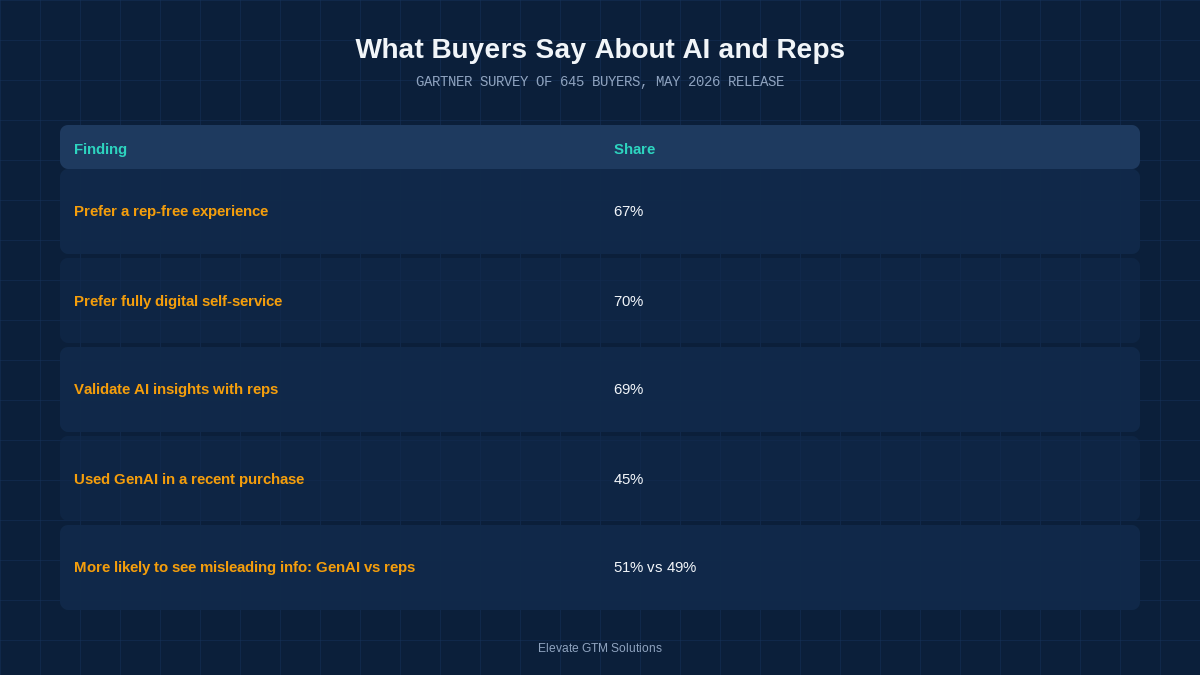
Do buyers want to talk to salespeople? Gartner reports that 67% prefer a rep-free experience, and also that 69% prefer to validate AI-generated insights with reps.
Is AI replacing the research phase? It is changing it. Forrester found generative AI was the most-cited meaningful interaction type for researching purchases in 2025, but buyers validate its output elsewhere.
The short version
| Question | Answer |
|---|---|
| Who ran the main survey? | Gartner, 645 B2B buyers, August to September 2025, released May 20, 2026 |
| Do buyers prefer to avoid reps? | 67% prefer a rep-free experience and 70% a completely digital, self-service one (Gartner) |
| Do they still want reps? | 69% prefer to validate AI-generated insights with sales reps (Gartner) |
| How many buyers used GenAI? | 45% used GenAI in a recent purchase, mainly to gather information on vendors and products (Gartner) |
| How trusted is AI? | 51% said they are more likely to meet misleading information from GenAI; 49% said the same of sales reps (Gartner) |
| What does Forrester add? | Buyers use AI for speed and then validate through a buying network; buying groups average 13 internal and nine external participants (Forrester 2026, via Digital Commerce 360) |
| Where do reps matter most? | Researching a business problem, identifying a preferred supplier and securing internal support, and finalizing the purchase (Gartner) |
| What should teams change? | Make sellers and content sources of validation, not just information |
How buyers use AI, self-service and people at different stages
A purchase is not one decision. It is a string of smaller jobs: agreeing there is a problem, finding out what options exist, narrowing the list, checking the risk, getting colleagues to agree, negotiating and signing. Buyers use different kinds of help for different jobs, and that is the simplest way to make sense of the survey numbers further down this page.
Jobs that are mostly about information. Understanding a category, listing vendors, comparing features, finding rough price ranges. Search and AI assistants are fast at these, and buyers are glad to do them alone. This is where a rep-free, self-service experience is welcome. If your website, documentation and public material are thin, the AI summary a buyer reads about you will be thin too, or borrowed from someone else's description of you.
Jobs that are mostly about confidence. Is this vendor safe? Will it work in our setting? What will go wrong? Can I defend this choice to my boss? These are judgment calls with personal risk attached. A buyer may still use AI to prepare, but wants a person, a peer or a trusted outside source to check the answer. This is where buyers go back to people.
Jobs that are about agreement. Buying groups are large, and the person who did the research still has to bring others along. Material that is easy to forward, easy to summarize and consistent across everything a vendor publishes helps. Contradictions between your website, your deck and your sales emails hurt, because someone in the group will notice.
What this means in practice, in our reading:
- Treat your public content as the raw material AI tools will summarize about you. Accuracy, specifics and consistency matter more than volume.
- Put people where buyers need confidence, not where they need facts. A seller who adds judgment, evidence and honest limits is useful. A seller who walks through a feature list is competing with a search box.
- Give the buying group something to share internally: a short, honest summary of the problem, the options and the trade-offs.
None of this needs a new framework. It asks you to look at your own deals and ask, for each stage, whether the buyer is trying to get information or get confidence, and whether you are serving that need. The sections below show how far the analyst research supports this view and where it does not.
Why two true stories get told as one false one
Start with how the confusion arises. A survey asks buyers many questions. Some are about preference, and some are about what they did. Preference for a self-service experience is a statement about convenience. Preference for validating AI with a person is a statement about confidence. A buyer can hold both at once, and the survey data say many do.
Headlines compress this. "Most buyers prefer to buy without a rep" is true of the Gartner data and gets shared on LinkedIn by people who believe reps are obsolete. "Most buyers check AI answers with a rep" is true of the same data and gets shared by people who sell enablement tools to reps. Each camp quotes the half that suits it. The honest reading holds both halves together, and the useful question is what a team should do given that buyers want both speed and reassurance.
Hold that thought. The rest of this page adds detail to it.
The evidence: Gartner's May 2026 buyer survey
What it is
Gartner is a research and advisory firm that sells subscriptions to sales and marketing leaders. On May 20, 2026, at its CSO and Sales Leader Conference in Las Vegas, it released findings from a survey of 645 B2B buyers conducted from August through September 2025. The headline: 69% of B2B buyers prefer to validate AI-generated insights with sales reps.
The press release is public, and we read it directly. The full report is for Gartner clients, and we have not read it. So what follows is limited to what the release states.
What it found
The release reports these findings.
Buyers used an average of seven information sources during a recent purchase. That matters for any team that thinks of "the website" or "the rep" as the buyer's main source. There is no main source. There are about seven.
45% used generative AI, mainly to gather information on vendors and products. So a little under half of the surveyed buyers had used GenAI in a recent purchase, and what they used it for was early and informational, not final.
67% prefer a sales rep-free experience, and 70% prefer a completely digital, self-service buying experience. Notice that these are two different questions, and the percentages are different. Both are majorities.
51% say they are more likely to encounter misleading information from GenAI, while 49% say the same about sales reps. This is the most interesting finding in the release for sellers. Buyers do not trust AI much more than they trust reps. They are nearly even on which is more likely to mislead them. That is a humbling number for both sides.
Reps remain the most important information source for three stages: researching a business problem or need, identifying a preferred supplier and securing internal support, and finalizing the purchase. These are early framing, mid-process selection and the end. They are not the middle details. Buyers go digital for the comparison work in between.
What the analyst said
Robert Blaisdell, a VP Analyst and Chief of Research in Gartner's Sales practice, is quoted as saying buyers are more comfortable using digital channels and GenAI on their own, but that "does not eliminate the role of the seller." He added: "Buyers still turn to sales reps to validate AI-generated insights." And a caution aimed squarely at sales leaders: "Sales leaders should not interpret buyer preference for digital self-service as a signal that sellers matter less." His conclusion: "sellers need to show up differently."
What Gartner recommends
The release gives three recommendations for sales leaders. Shift the seller's role from primary information source to a source of validation and confidence at key points. Instead of maximizing rep involvement at every stage, enable sellers to engage where they add the most unique value. Focus seller engagement on helping buyers validate information, reduce risk and move forward with confidence.
What this survey cannot tell you
A few limits, and we think they matter.
It is a survey of stated preference and recent behavior, not an observation of purchases. People are reasonably good at saying what they did last time and less good at predicting what they would do.
The release gives no breakdown by deal size, industry or country. A preference for rep-free buying may look very different for a small software subscription and a multi-year enterprise contract. If your deals are at one extreme, the average may not describe your buyers.
We do not know how the 645 buyers were recruited, and the release does not say. Gartner's usual practice is to survey people who have recently been involved in a purchase, but we cannot confirm it from the release alone.
Finally, Gartner sells research to sales leaders. A finding that sellers still matter is not a surprising one for that audience to publish. We do not think that makes it false, and the 49% and 51% numbers are not flattering to sellers. But it is worth knowing who is speaking.
The evidence: earlier Gartner surveys on rep-free buying
The May 2026 release is part of a series.
A Gartner press release from June 25, 2025 reported a survey of 632 B2B buyers conducted in August through September 2024. It found that 61% of B2B buyers preferred an overall rep-free buying experience, and that most buyers prefer independent research through digital channels. It also found that for buying tasks requiring contextual intelligence, such as deciding whether a product or service fits their company's needs, buyers prefer to seek seller input. The release reports that, across all stages, buyers complete an average of 3.0 activities both online and with supplier reps, 2.3 activities with supplier reps and 1.8 activities through digital self-service tools.
Read that carefully. The rep-free preference was 61% in the 2024 survey and 67% in the 2025 survey, though the two surveys had different respondents and we cannot say the change is meaningful. But even in the 2024 data, buyers' actual behavior was mixed: more activities involved a rep, alone or with digital, than digital alone.
A trade article in Digital Commerce 360, dated March 17, 2026, reported the 2025 survey with 646 buyers (the Gartner release says 645, and we use Gartner's figure), 67% rep-free preference and 45% having used AI tools in a recent purchase. It quotes Alyssa Cruz, a senior principal analyst in Gartner's sales practice: "Sellers can't rely on static collateral to carry influence in those moments." We take that as a statement about content: a PDF that says what every PDF says does not move a buyer who can ask an AI the same question.
The evidence: Forrester, The State of Business Buying 2026
What it is
Forrester is another research and advisory firm. Its State of Business Buying, 2026 report draws on its 2025 Buyers' Journey Survey. We could not read the report, which is for Forrester clients, but we read the Digital Commerce 360 account of it from January 22, 2026. That article does not report the sample size. A podcast summary we saw elsewhere says nearly 18,000 global business buyers, but we treat that as secondary and do not rely on it. Everything below is as reported by the trade article.
What it found
Generative AI quickly became a top research tool. Forrester first added it as a research option in 2024, and it was immediately one of the most-cited tools. In 2025 it was the single most-cited meaningful interaction type for researching purchases.
Confidence is mixed. 36% of respondents said they felt more confident they made a better-informed decision because of generative AI. 20% said they felt less confident because they encountered unreliable or inaccurate information. Both numbers are real. More people are helped than hurt, and a fifth are hurt.
Buyers validate through a network. Forrester describes a "buying network" of internal stakeholders and external sources: industry experts, peers, analysts and providers. Buyers use AI for speed and then check it. Asked what primarily triggers engagement with providers, respondents more often cited industry experts than AI tools.
Buying groups are large. On average, 13 internal stakeholders and nine external participants influence a B2B purchase decision. Purchases that include generative AI features tend to need added evaluation and cross-functional input, and those buying groups are twice the size of those for purchases without such features. Among respondents with six or more internal participants, 94% said larger groups delivered clear benefits, such as broader perspectives, shared validation effort, reduced risk of poor decisions and a greater likelihood of budget approval. Fewer than half cited more complexity or slower decisions as significant drawbacks.
Procurement is early and involved. C-suite leaders are the most likely decision-makers, at 68%. Procurement professionals are identified as decision-makers by 53% of respondents, and procurement joins at the earliest stages of the buying cycle, not only at the end. Procurement seeks more information beyond price and is more likely to interact directly with sales reps. Among procurement respondents, 28% felt less confident in a decision because of inaccurate AI output, compared with 19% of all buyers.
Trials matter. More than 60% of respondents engaged in some form of trial before a full purchase, including limited free pilots, paid sandbox environments and usage-based trial periods. Trial likelihood rises with purchase size and cost.
What Forrester recommends to providers
As reported: demonstrate business value and return on investment through messaging tailored to specific industries and buyer roles; make content credible and discoverable in AI-driven search environments; engage intentionally with the buyer's extended network, including partners, analysts and industry voices; and design trials as conversion tools rather than product previews, with matching use cases, guided onboarding, defined success measures and follow-up.
Limits
We have only the trade summary, so we cannot check the exact survey wording, the base for each percentage or the regional mix. The "twice the size" figure is a comparison of group sizes, not a claim that AI features cause larger groups. And Forrester, like Gartner, sells to the people who pay for sales and marketing programs.
Where the two sources agree, and where they differ
They agree on the shape. Buyers have more self-service options than ever. They use AI early. They do not fully trust it. They check it with other people. Those other people are, in Gartner's data, often sales reps and, in Forrester's data, more often experts, peers and analysts, with providers part of the network.
They differ on who the validators are. Gartner's survey focused on whether buyers use reps to validate AI, and 69% said they prefer to. Forrester's reported finding emphasizes a wider network and says industry experts more often trigger engagement than AI tools do. These are not contradictory. A buyer can validate with a peer and then talk to a rep. But the emphasis matters. If you read only Gartner, you might invest in seller training. If you read only Forrester, you might invest in analyst relations, peer communities and customer references. Doing both is a more complete reading.
They differ on size and date. Different samples, different months, different questions. Do not subtract one percentage from another and call it a trend.
Elevate's reading
Everything in this section is our interpretation, not data. We offer it because the surveys stop at what buyers do, and teams have to decide what to change.
One. The unit of work is confidence, not information. If buyers can get information from AI in seconds, a seller who is mainly an information source is competing with a free tool. The work that remains is the work AI cannot easily do for a buyer: pressure-testing whether a product fits this specific company, helping an internal group agree, and taking responsibility for a promise. That is what Gartner's recommendation, shifting the seller to a source of validation, describes.
Two. Consistency matters more because the number of sources is high. If buyers use around seven sources, a gap between what the website says, what a rep says and what an AI answer says is likely to be noticed. McKinsey's 2026 B2B survey, which we review on another page, lists inconsistent information across teams as the top reason buyers switch suppliers. A go-to-market strategy that exists in a slide deck and in nobody's daily tools produces exactly that inconsistency.
Three. Static content is the weakest asset. Cruz's remark about static collateral points at a real change. Content that AI can summarize without loss adds little. Content that carries something an AI cannot make up on its own, such as your specific evidence, your method, your customers' constraints, is harder to replace. See our review of whether thought leadership still builds trust when buyers use AI.
Four. The buying network is a target, not a footnote. If buyers check with 13 internal and nine external people, the seller's champion is one voice among many. Plan for the people who never join a call: finance, procurement, security, the skeptical engineer. Our page on buying group evidence goes further on group size and why figures differ.
Five. Do not read "rep-free" as "strategy-free". A buyer who researches alone is still following a path you can design. If the first AI answer a buyer gets about your category is wrong or missing, a rep never gets a chance to correct it. That is a messaging and content problem, which is a strategy problem.
What this means for different roles
For a head of sales. Audit where reps spend time in the buying journey. If most of it is spent delivering product information that the buyer could get elsewhere, that time is poorly placed. If little of it is spent on helping the buyer's internal group agree, that is the gap. Gartner's three stages where reps matter most are a place to start: framing the business problem, helping the buyer identify you and gain internal support, and finalizing.
For a head of marketing. Treat the website and content as part of the validation process, not only the information process. Pages that help a champion explain the choice to colleagues are worth more than another top-of-funnel summary. Make sure the facts about your company are consistent everywhere an AI might read them.
For product marketing. Positioning and messaging need to survive paraphrase. If your core claim only works in your exact words, an AI summary will flatten it. Say something that stays true when it is shortened.
For customer success. Gartner's findings on renewal and expansion (see why B2B buyers regret purchases) suggest buyers want the same low-friction experience at renewal. Plan for that.
For revenue operations. If buyers use seven sources and sellers see only the part that touches your systems, your data is a partial picture. Be careful about attributing outcomes to the last touch you can see.
For a founder. Do not rush to remove the human. Do not assume the human alone will carry the sale either. Pick the two or three moments where your presence changes the outcome and make those excellent.
A worked example, invented for illustration
Imagine a 60-person company that sells workflow software to mid-size logistics firms. Its sales team spends most of its first calls walking through a product overview. Win rates are fine for small deals and poor for larger ones, where several people at the buyer must agree.
Applying the survey findings, the head of sales makes three changes. First, first calls stop being overviews, since buyers can get those elsewhere. They become a short discussion of the buyer's specific problem, and the overview moves to a self-serve page. Second, the team builds a short evaluation guide a champion can send to finance and IT, answering the questions those people tend to ask. Third, the company reviews what an AI assistant says about it when asked about the category, and corrects the public pages where the answer was wrong or thin.
We are not claiming these changes would produce a particular result. They are a response to what the surveys suggest buyers want: speed, plus help being confident. The company would then check its own data, such as how deals with a shared evaluation guide progress compared with those without, and not take our word or Gartner's.
How a go-to-market platform can help, and where it cannot
Here is where Elevate GTM Solutions comes in, described honestly. Our homepage describes the platform as a way to build, execute and evolve go-to-market strategy, with connected modules covering areas such as market research, ideal customer profile and segmentation, competitive intelligence, account-based marketing, product positioning, product messaging, pricing, customer acquisition, sales enablement and customer success. The workflow, as we describe it: GTM Insights, Strategy Context, Strategy Builder, a Workflow Engine, Strategy Insights, GTM Activation, GTM Playbooks, GTM Pulse and executive dashboards.
Here is how that maps to the findings, without overstating it.
Consistent strategy in one place. The buyer-facing risk the surveys raise is inconsistency across sources. A platform that holds positioning, messaging and the ideal customer profile in one connected strategy gives marketing, sales and customer success the same starting point. Whether the output is consistent in market still depends on whether people use it.
Strategy to assets. GTM Activation, as we describe it, turns a strategy into a small set of focus assets, such as a webinar, an email campaign, a landing page and an FAQ. An FAQ and a landing page are the kind of assets that answer the questions an AI or a buyer will ask. See how to turn a GTM strategy into focus assets.
Different strategies for different segments. Buyers differ by region, vertical and segment, and our platform is built to adapt strategy that way. The surveys here do not break results down, so check your own segments.
A weekly loop. GTM Pulse provides weekly actions, recommendations and scores. That cannot tell you how buyers will react to AI. It can help a team notice sooner, in its own data, if something in the buying journey is changing. See what a weekly GTM scorecard is.
What it cannot do. A platform does not read buyers' minds, does not replace talking to customers and does not make a weak product persuasive. It cannot tell you whether your buyers match Gartner's sample. We do not claim that using it changes win rates, and we have no data of our own to support such a claim.
Questions to ask about your own buyers
The surveys give averages. Your buyers are specific. Ten questions to answer with your own evidence:
- What did the last ten buyers say they used to research us before talking to us, and in what order?
- Which of them mentioned AI tools, and what did the AI tell them?
- At which stage did our reps change the outcome, and at which did they only repeat what the website said?
- Who in the buying group never took a call with us, and how did they learn about us?
- What did the buyer need to be confident enough to buy, and who gave it to them?
- What do prospects ask AI assistants about our category, and does the answer name us accurately?
- Where do our reps, our website and our sales decks disagree?
- Which assets does a champion forward internally, and which does nobody forward?
- Do we offer a trial or pilot, and is it designed to convert or only to show the product?
- How do deals with a shared evaluation document differ from deals without one, in our own data?
Mistakes teams make with this research
Taking one half of the finding. "Buyers want no reps" and "buyers want reps" are both partial. Hold both.
Treating survey percentages as your funnel. A preference stated by 67% of surveyed buyers is not a conversion rate. Your buyers may sit anywhere.
Cutting the human to match a trend. If your deals are complex, the stages where Gartner finds reps matter most are the ones that decide them.
Adding AI to old content. An AI assistant that writes more of the same collateral produces more of what Cruz says cannot carry influence.
Ignoring procurement. Forrester's finding that procurement joins early and wants more than price is easy to overlook if your champions are in the business unit.
Measuring only what you can see. If buyers use many sources, your system sees a fraction. Qualitative feedback from buyers and sellers fills the gap.
What to do this week
Pick one recent won deal and one recent lost deal. For each, write down who was in the buying group, what sources they likely used, where a human changed the outcome and what an AI might have said about you at the start. It takes an hour. You will learn more about how these surveys apply to you than from reading another report.
Then look at the first two minutes of your sales conversations. If they are information delivery, plan to move that to a page and use the time for validation.
Glossary
Rep-free buying. A purchase completed without direct interaction with a supplier's sales representative.
Self-service. A buyer completing research or purchase steps with digital tools and content, without help from a person.
Validation. A buyer checking a claim or an AI-generated answer against a second source before relying on it.
Buying network. Forrester's term for the internal stakeholders and external sources, such as experts, peers, analysts and providers, a buyer draws on.
Buying group. The set of people who take part in or influence a purchase decision.
Static collateral. Fixed content, such as a brochure or standard deck, that says the same thing to every reader.
Generative AI (GenAI). AI systems that produce text, images or other content in response to prompts, which buyers use to research vendors.
Procurement. The function that manages purchasing, which Forrester finds joins buying cycles early.
Where Elevate GTM Solutions fits
Elevate GTM Solutions is a go-to-market strategy platform. Its homepage says teams can build, execute and evolve go-to-market strategy, with a connected set of modules and a flow from insights and context to strategy, workflow, activation, playbooks, weekly pulse and executive dashboards. It describes work in about five minutes or less for a first draft, adaptation by region, vertical and segment, and coverage of many industries and product categories. We describe the flow in more detail on our page about what a GTM platform can be used for.
For the questions this page raises, the relevant parts are narrow: keeping positioning and messaging consistent across teams, turning a strategy into a few assets buyers and AI systems can use, and checking weekly whether the plan is holding. If you are comparing vendors, how to tell if a GTM platform is really AI-native gives questions to ask any of us. We do not publish statistics about our own results here, because we have none to publish.
Key takeaways
- Gartner's May 2026 survey of 645 B2B buyers found both that most prefer rep-free, digital buying (67% and 70%) and that 69% prefer to validate AI-generated insights with reps.
- Buyers do not trust AI much more than reps: 51% said they are more likely to meet misleading information from GenAI, 49% from reps.
- Forrester's 2026 report, as reported, says buyers use AI for speed and then validate through a wide network, and buying groups average 13 internal and nine external participants.
- The shared message is that AI changes where buyers get information, not whether they need confidence.
- The practical shift is from sellers and content as information sources to sellers and content as sources of validation.
- These are survey averages. Check them against your own buyers, deal sizes and segments.
Sources
- Gartner, Gartner Survey Finds 69% of B2B Buyers Turn to Sales Reps to Validate AI-Generated Insights, press release, May 20, 2026.
- Gartner, Gartner Sales Survey Finds 61% of B2B Buyers Prefer a Rep-Free Buying Experience, press release, June 25, 2025.
- Digital Commerce 360, Gartner: B2B buyers prefer rep-free purchasing as AI reshapes sales, March 17, 2026.
- Digital Commerce 360, Forrester: B2B buying groups expand as they question AI, January 22, 2026, reporting Forrester, The State of Business Buying, 2026.
- Forrester, The State Of Business Buying, 2026, report summary page (full report for clients).
Frequently Asked Questions
Do B2B buyers really prefer to buy without a sales rep?
In Gartner's survey of 645 B2B buyers, fielded in August and September 2025, 67% said they prefer a sales rep-free experience and 70% a completely digital, self-service one. The same survey found 69% prefer to validate AI-generated insights with reps, so the preference is about speed and convenience, not about never wanting human help.
How many B2B buyers use generative AI?
Gartner's 2025 survey reported that 45% of buyers used GenAI during a recent purchase, mainly to gather information on vendors and products. Forrester, as reported, found generative AI was the most-cited meaningful interaction type for researching purchases in 2025. The two figures measure different things and should not be compared directly.
Do buyers trust AI more than salespeople?
Not by much. In Gartner's survey, 51% said they are more likely to encounter misleading information from GenAI and 49% said the same about sales reps. Forrester reported that 36% felt more confident in a decision because of generative AI and 20% felt less confident because of unreliable information.
At which stages do reps matter most?
Gartner reports reps remain the most important information source for three stages: researching a business problem or need, identifying a preferred supplier and securing internal support, and finalizing the purchase. Buyers rely more on digital sources in the comparison work between those stages.
What does "validate" mean in this research?
It means checking an answer, often one produced by AI, against another source before relying on it. Gartner found most buyers prefer to do that with sales reps. Forrester describes validation across a wider buying network of peers, experts, analysts and providers.
Is the Gartner survey enough to plan a sales strategy?
Not on its own. It gives averages across 645 buyers and the public release does not break results down by deal size, industry or region. Use it to form questions, then check against your own deals and buyers.
How large are B2B buying groups according to Forrester?
As reported by Digital Commerce 360, an average of 13 internal stakeholders and nine external participants influence a purchase decision, and groups for purchases with generative AI features are twice the size of those without. See our page on buying group evidence for why figures differ across sources.
What should sellers do differently?
Gartner's recommendation is to move from being the main information source to being a source of validation and confidence: engage where you add unique value, and help buyers validate information, reduce risk and move forward. Practically, that means less product overview on calls and more help with fit, internal agreement and risk.
Does this mean content marketing matters less?
It means content has to do a different job. A Gartner analyst is quoted as saying sellers cannot rely on static collateral to carry influence, because buyers can get generic answers elsewhere. Content that carries original evidence and understanding of the buyer's situation is harder to replace.
Why does procurement matter here?
Forrester, as reported, found procurement professionals are identified as decision-makers by 53% of respondents and join at the earliest stages of buying. They want information beyond price, and 28% of procurement respondents said inaccurate AI output left them less confident, against 19% of all buyers.
How can a GTM platform help with this?
A platform can keep positioning, messaging and the ideal customer profile consistent across teams, help turn a strategy into assets buyers and AI systems can use and give a weekly view of whether the plan is holding. It cannot tell you how your buyers behave or replace talking to them. Elevate GTM Solutions has no published results data on this.
How current is this research?
The Gartner release is dated May 20, 2026, based on a survey fielded in August and September 2025. The Forrester report is based on its 2025 Buyers' Journey Survey and was reported in January 2026. Buyer behavior with AI is changing quickly, so check for newer releases before you rely on a figure.