
By the Elevate GTM Solutions Team · Updated November 13, 2026 · 27 min read
What Can You Use a GTM Platform For? Twelve Situations, What the Work Looks Like in Each and When a Platform Is Not the Answer
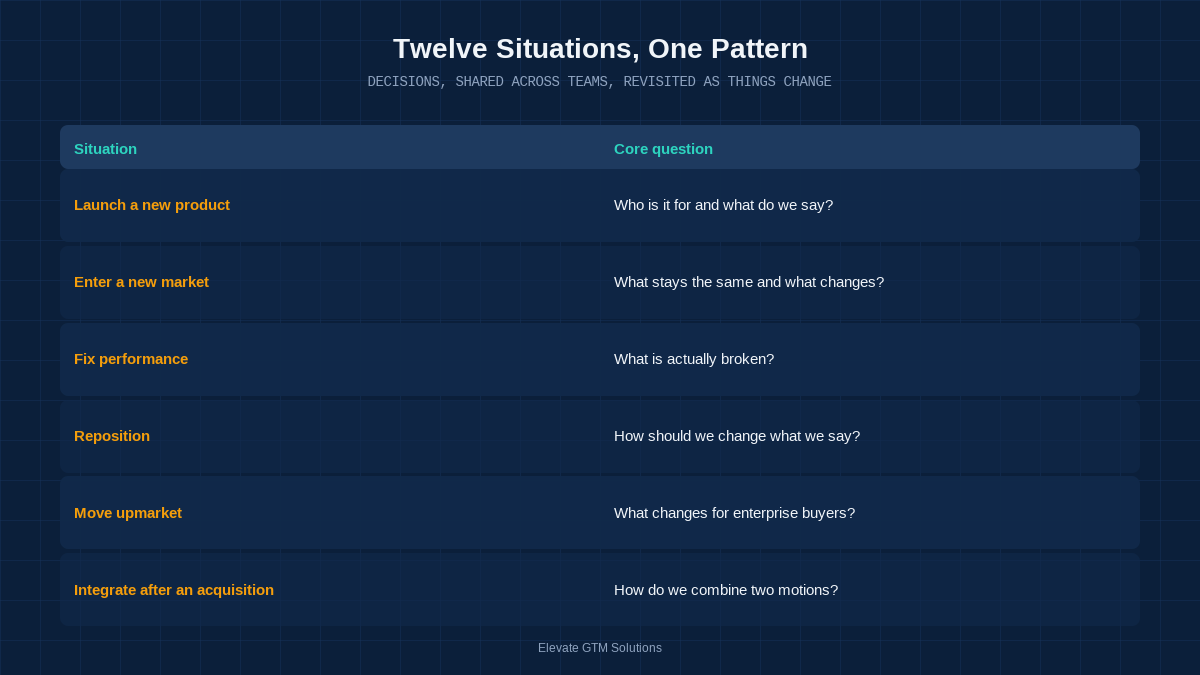
Buyers often ask what a GTM platform does in the abstract, and abstract answers are not much use. A more helpful way to understand the category is to look at the situations in which companies reach for one: a product is about to launch, a new market is opening, win rates are slipping, two companies have merged and their sales teams describe the product differently. In each case the question is the same: what decisions need to be made, who needs to make them and how do the results reach the people who act on them?
This guide goes through twelve common situations. For each, it explains what the work looks like, which questions a platform can help answer, what it cannot do and what to do first. It also covers how to decide whether a platform is the right tool at all. We make a GTM strategy platform, Elevate GTM Solutions, so we have an interest, and several of the situations below appear on our own homepage as use cases. We cite no statistics, we describe other approaches in general terms and our examples are invented and labeled.
What can you use a GTM platform for?
A GTM platform is used to make and coordinate go-to-market decisions across a company: who to serve, what to say, how to price, where to sell and how to measure. Common situations include launching a new product, entering a new market, expanding an existing product, fixing GTM performance, improving win rates, aligning cross-functional teams, repositioning a product, changing pricing and packaging, moving upmarket to enterprise, building a partner and channel motion, integrating GTM after an acquisition and winning against a dominant competitor. In each case the platform helps structure the strategy, keep it consistent across teams and connect it to execution and results. It does not replace market knowledge, customer conversations or the judgment of the people who will run the plan.
Is a GTM platform only for large companies? No. The situations occur at every size, and the effort to handle them scales with the company.
When is a platform the wrong tool? When the problem is a single function, such as data or call coaching, or when the strategy is already clear and shared and the gap is execution in one area.
The short version
| Situation | Core question | What the platform helps with |
|---|---|---|
| Launch a new product | Who is it for and what do we say? | Segments, positioning, messaging, launch plan |
| Enter a new market | Where do we start and what must change? | Market context, adapted variants, sequencing |
| Expand an existing product | Which new segments or uses come next? | Segment options, messaging variants |
| Fix GTM performance | What is actually broken? | Diagnosis, reset of segments and messages |
| Improve win rates | Why do we win and lose? | Positioning, competitive context, enablement |
| Align cross-functional teams | Are we all working from one version? | Shared strategy and workflows |
| Reposition a product | How should we change what we say? | Positioning options, messaging updates |
| Change pricing and packaging | What model fits the market and our costs? | Options, assumptions, communication |
| Move upmarket | What changes for enterprise buyers? | Segment profile, messaging, sales motion |
| Build partner and channel GTM | How do partners fit and sell? | Partner segments, enablement, plays |
| Integrate GTM after an acquisition | How do we combine two motions? | One shared strategy and messaging |
| Win against a dominant competitor | Where can we credibly differ? | Competitive context, positioning, battlecards |
What a GTM platform is, in one paragraph
A GTM platform is software that holds the decisions and context behind a company's go-to-market and connects them to the work that follows. Traditional tools are strong at recording activity: a CRM records deals, a marketing system records campaigns, an analytics tool records results. A GTM platform sits upstream and alongside them, and aims to hold the strategy: the market and segment context, the positioning and messaging, the pricing considerations, the channels and the measures, and to keep them consistent across teams. See AI GTM platform, AI GTM platform features and GTM platform vs CRM.
1. Launching a new product
What the work looks like
A launch asks a set of questions in a short window: who is the first customer, what problem do we solve for them, how do we describe it, how do we price it, which channels reach them and what must be ready on the day. The risk is that different teams answer these questions differently and independently, and the market sees a muddle.
How a platform helps
It gives you a structure for answering the questions in one place, keeps positioning, messaging and the launch plan consistent and makes it easy to produce the assets that follow. It also provides a place to record the assumptions behind the launch so they can be tested.
What it cannot do
It cannot tell you whether anyone wants the product. Customer conversations and early trials do that.
Start here
Write the first customer profile and the single sentence you will say to them. See best GTM strategy software for product launches, enterprise product launch readiness and first 90 days after a product launch.
2. Entering a new market
What the work looks like
A new region, country or industry brings new buyers, regulations, competitors and norms. The temptation is to copy the home-market plan and translate it. The better approach is to keep what is common and adapt what differs.
How a platform helps
It lets you hold a core strategy and create an adapted variant for the new market, with updated market and competitive context, while keeping the variants consistent with the core.
What it cannot do
It cannot supply local knowledge. People who know the market must provide it.
Start here
List what you believe is the same and what you believe is different in the new market, then test the differences with a handful of local conversations. See how to enter a new market without wasting budget and global vs local GTM strategy.
3. Expanding an existing product
What the work looks like
You have a product with customers and want to grow by serving new segments, new use cases or new buyers. Expansion tests whether your positioning holds beyond your first customers.
How a platform helps
It lets you draft messaging and positioning for each new segment against the same product facts, and compare which segments best fit your strengths.
What it cannot do
It cannot show you which segment will buy without real conversations and data.
Start here
Look at your best customers and ask what they have in common that you could find elsewhere. See what is land and expand and ICP scoring framework.
4. Fixing GTM performance
What the work looks like
Pipeline is thin, conversion is poor or growth has stalled. Everyone has a theory: the leads are bad, the sellers are weak, the product is lacking. The first job is diagnosis.
How a platform helps
It provides a structured way to write down the current strategy and compare it with what is actually happening, which often reveals unclear segments, inconsistent messaging or goals that do not match capacity. It then supports the reset.
What it cannot do
It cannot fix a problem that is really about product fit, pricing or sales skill, though it can help you see that the problem lies there.
Start here
Run a short diagnostic on whether the strategy is clear and shared. See how to tell if your GTM strategy is broken.
5. Improving win rates
What the work looks like
You win less often than you should, or you win in some segments and lose in others. Win and loss reviews reveal patterns: losing to one competitor, losing when a certain buyer is involved, losing on price or on a missing capability.
How a platform helps
It connects what you learn from wins and losses to positioning, competitive context and enablement, so that changes reach sellers.
What it cannot do
It cannot replace deal coaching or fix a product gap.
Start here
Review the last twenty wins and losses and group the reasons. See GTM win-loss analysis framework.
6. Aligning cross-functional teams
What the work looks like
Marketing, sales, product, customer success and revenue operations each have a version of the strategy. Their definitions of the ideal customer, the stages and the messages differ. Meetings are spent reconciling.
How a platform helps
It gives all teams a shared model of the strategy, with one place for context and decisions, and workflows that tie each team's work to it.
What it cannot do
It cannot make teams agree. Leaders must settle the differences, and the platform records the outcome.
Start here
List the three definitions teams disagree on most and decide who can settle each. See best platform to align sales, marketing and customer success and sales and marketing SLA framework.
7. Repositioning a product
What the work looks like
The market has moved, a competitor has changed the conversation or your product has outgrown how you describe it. Repositioning changes what you say, to whom and in contrast to what.
How a platform helps
It lets you draft alternative positioning, develop messaging for each audience and update the assets that carry the old story.
What it cannot do
It cannot judge whether the new positioning is credible to buyers. Test it in conversations.
Start here
Write the current positioning and the proposed one side by side and test both with ten buyers. See positioning.
8. Changing pricing and packaging
What the work looks like
A new model, a new tier or a change in price affects sales conversations, margins and customer perception. It touches product, finance, sales and marketing.
How a platform helps
It provides a place to lay out the options and assumptions, link pricing to positioning and segments and prepare the communication.
What it cannot do
It cannot determine willingness to pay. Customer research and market evidence do that.
Start here
List the options, the assumption behind each and the cheapest test. See how to price a new B2B product and AI GTM platform pricing guide.
9. Moving upmarket to enterprise
What the work looks like
Enterprise buyers bring longer cycles, buying committees, security reviews and different expectations. The motion, the messaging and the proof all change.
How a platform helps
It helps define the enterprise segment profile, adapt messaging for the buying group and align the teams that must support a different motion.
What it cannot do
It cannot give you enterprise references or hire the enterprise sellers you need.
Start here
Identify what a typical enterprise buyer will ask that your current materials do not answer. See how to move upmarket from SMB to enterprise.
10. Building a partner and channel GTM
What the work looks like
Partners resell, refer or integrate. They need to understand the offer, the segment and the message, and they need materials and incentives that work for them.
How a platform helps
It helps you describe partner segments, create partner-specific messaging and enablement and keep partner motions consistent with your direct strategy.
What it cannot do
It cannot create partner interest. That depends on the economics and relationships.
Start here
List the three partner types you want and what each needs to sell. See how to build a partner and channel GTM strategy.
11. Integrating GTM after an acquisition
What the work looks like
Two companies, two products, two sets of customers and two sales teams. Messaging conflicts, territories overlap and customers are confused.
How a platform helps
It provides a place to define one combined strategy, decide how the products fit together and give both teams a common set of messages and priorities.
What it cannot do
It cannot resolve organizational and cultural issues. Leadership must.
Start here
Decide the single sentence that explains why the combined company exists and what it offers customers. See how to combine GTM teams after an acquisition.
12. Winning against a dominant competitor
What the work looks like
A larger rival dominates the conversation. Direct comparison on its terms loses. The question is where you can credibly differ and for whom.
How a platform helps
It brings competitive context into the strategy, helps you find angles and segments where you are stronger and supports enablement for sellers.
What it cannot do
It cannot make false claims true. Positioning must rest on real strengths.
Start here
List the situations where customers chose you over the leader and why. See how to win against a dominant competitor and what is competitive intelligence.
The pattern across all twelve
Across these situations, the pattern is consistent.
- A set of decisions has to be made and recorded: who, what, how, where and how to measure.
- Several teams have to act on the same decisions.
- The context changes, so the decisions must be revisited.
- Results should flow back to improve the next decision.
A GTM platform is a way to hold those decisions and keep them consistent. That explains why the same tool can serve a launch, an entry into a new market and a post-acquisition merge of teams, and also why it will not help if the problem lies elsewhere.
When a platform is not the answer
Honesty about limits matters. A platform is probably the wrong tool, or at least not the first step, in these cases.
| Situation | What is probably needed instead |
|---|---|
| Nobody wants the product | Product and customer discovery work |
| One function is the bottleneck, such as data quality | A specialist tool for that function |
| Sellers lack skills or coaching | Training and coaching |
| The strategy is clear and shared, and execution in one area lags | Process and capacity in that area |
| There is no owner for GTM and no one will use the output | An owner first, then tools |
| The company is too early to have segments or a repeatable motion | Customer conversations and a simple written plan |
| You need contact data | A data provider |
A platform amplifies decisions. If the decisions are not being made, it will not make them for you.
How to decide if you need one
Ask five questions.
- Do multiple teams act on the same go-to-market decisions?
- Do those decisions change often enough that a document goes stale?
- Is there a real cost today from inconsistency, such as mixed messages or misaligned effort?
- Is there someone who will own the strategy and the platform?
- Can you name a specific situation, from the list above, that you are facing now?
If most answers are yes, a platform may help, and a pilot on one situation is the way to find out. If most are no, a simpler approach may be better for now. See how to choose a GTM platform and AI GTM platform buyer guide.
A worked example, invented for illustration
Imagine a company of about a hundred and twenty people selling compliance software. The details are invented.
In one year the company faces three of the situations above. It plans to launch a new module, it has just acquired a small competitor whose customers are in a different region and its win rate against its largest rival has slipped.
The head of go-to-market recognizes that the three share a root: the company has no single, current statement of who it serves and what it says. She starts with the acquisition, since it is the most urgent. She writes a combined strategy: the segments both companies serve, the positioning of the combined product and the messages for each segment. The adapted variant for the acquired company's region keeps the core and adds local regulatory language.
She then uses the same core to prepare the launch of the new module, drafting its positioning against the combined strategy rather than separately. Finally, she reviews the last quarter's losses to the largest rival and finds that most occurred in one segment where the new combined offering is actually stronger. She updates the battlecard and adjusts the messaging for that segment.
The platform did not solve any of the three problems alone. It gave her one place where the decisions lived and a way to carry changes from one situation to the next. The judgments about segments, positioning and competitors were hers and her team's.
Common mistakes
Buying before naming the situation. Name the problem first.
Expecting the platform to make decisions. It structures and connects. People decide.
Treating every situation as the same. A launch, a market entry and a post-acquisition merge have different risks.
Skipping ownership. Without an owner, the output goes unused.
Starting with everything. Pilot one situation and expand.
Ignoring non-platform causes. Pricing, product fit and sales skill matter.
Not testing assumptions. A well-written strategy built on an untested assumption is still a guess.
Who usually owns each situation
Ownership varies by company, though patterns are common. Knowing who typically owns a situation helps you involve the right people from the start.
| Situation | Typical owner | Others who must be involved |
|---|---|---|
| Launching a new product | Product marketing or a launch lead | Product, sales, customer success, finance |
| Entering a new market | A regional or business unit lead | Marketing, sales, legal, local partners |
| Expanding an existing product | Head of marketing or growth | Sales, product, customer success |
| Fixing GTM performance | Chief revenue officer or head of go-to-market | Marketing, sales, RevOps, finance |
| Improving win rates | Head of sales with product marketing | Sales enablement, product, customer success |
| Aligning cross-functional teams | Revenue operations or chief of staff | Heads of marketing, sales, product, customer success |
| Repositioning a product | Product marketing | Product, sales, executive sponsor |
| Changing pricing and packaging | Product or finance leader | Sales, marketing, customer success |
| Moving upmarket | Head of sales or a segment lead | Product, security, marketing, customer success |
| Building partner and channel GTM | Head of partnerships | Sales, marketing, legal, finance |
| Integrating after an acquisition | Integration lead or a chief revenue officer | Sales, marketing, product, human resources |
| Winning against a dominant competitor | Product marketing or competitive intelligence | Sales, product, executive sponsor |
In a small company the same person may own several of these. The point is to name one accountable person for each situation you are working on.
Facing several situations at once
Real companies rarely face one situation at a time, as the worked example showed. When two or three arrive together, a few principles help.
Find the shared root. Often the situations share a missing decision, such as who the company serves. Fixing that once helps all of them.
Sequence by urgency and dependency. Deal with the situation that has a deadline or that others depend on first. An acquisition may need a combined message before a launch can use it.
Keep one core. Hold the shared strategy in one place and derive each situation's plan from it. Separate documents for each situation recreate the problem you are trying to solve.
Limit the number of active efforts. Teams that try to run five situations at once finish none. Pick two or three and defer the rest explicitly.
Record the order and the reasons. Others should know what is being done, what is waiting and why.
Running a pilot on one situation
If you decide to try a platform, test it on a real situation with a defined scope.
Choose a situation with a clear owner and a near-term decision. A launch in the next quarter or a repositioning that leadership has already approved works well.
Define the question. For example: can we produce a consistent positioning, messaging and launch plan for this product in two weeks that sales and marketing both accept?
Fix the baseline. Note how the same work would normally be done and how long it would take.
Involve the people who will use the output. Include a seller, a marketer and a product lead from the start.
Set the scope and the exit criteria. Decide the period, what you will produce and what result would justify continuing.
Review honestly. Compare the output with what you would have produced anyway, count the time and note what the platform could not do.
A pilot of four to six weeks on one situation gives more reliable information than a long evaluation of features. See pilot to scale framework.
Questions each role tends to ask
Different people look at a platform for different reasons. Anticipating the questions makes adoption smoother.
Founder or chief executive. Will this save time and money? Does it reduce risk in a major decision? Can I see the whole picture without reading forty slides?
Head of marketing. Will it help us keep messaging consistent and turn strategy into assets faster? Does it connect to how we run campaigns?
Head of sales. Will sellers get clearer positioning and better material? Does it add work for them?
Head of product. Does it reflect what the product does and does not do? Will it help the market understand what we are building?
Head of customer success. Does it capture what customers value and why they leave? Will it help us align on expansion?
Revenue operations. Does it connect to our systems? Who owns the data? Does it create reporting we can trust?
Finance. What does it cost to run and what does it replace? How will we judge whether it was worth it?
Answer these honestly and early. A platform adopted by one function and ignored by the others delivers little of the alignment it promises.
How to know it is working
Whichever situation you start with, a few signs suggest the tool is earning its place.
- People refer to the platform's strategy, not to private copies.
- Messaging across sellers and assets is more consistent.
- Decisions are recorded with their reasons.
- Changes in the market lead to visible updates within days or weeks, not quarters.
- The time from "we need a plan" to "teams are running it" has shortened.
- Reviews produce decisions rather than status reports.
If after a quarter none of these is true, ask whether the situation was the right one, whether an owner exists and whether the team was given time to use it.
A second worked example: a small company with one situation
Not every case is large or complicated. Imagine a company of about fifteen people selling a scheduling tool to dental practices. The details are invented.
The founder realizes that two salespeople describe the product in different ways and that the website emphasizes features that customers rarely mention. The situation is a repositioning, the smallest and most common kind. She writes down what she knows: the five best customers, why they bought, what they use most and what they complained about. She lists her assumptions: that practices with several dentists are the better target and that reminders matter more to buyers than reporting.
She uses a platform to draft positioning and messaging from that context, and then spends two days checking it. Six conversations with customers confirm the first assumption and contradict the second, since customers care more about reducing no-shows through reminders than about reporting, though the reporting is what they use to justify the purchase to a partner. The positioning is revised to lead with no-shows and to give practice owners a simple way to show the return.
Total elapsed time is about a week, much of it spent on the conversations. The result is a one-page strategy, a rewritten homepage headline and a short briefing for the two sellers. The company did not need a large process. It needed a structure for the decisions, a check against customers and a place to keep the result.
Signs you are not ready yet
Some companies are too early for this kind of tool, and saying so saves money. Signs include having fewer than a handful of customers and no pattern yet in who buys, a product that is still changing weekly, no one with time to own the strategy and a belief that the tool will supply the answers. In these cases, spend the time on customer conversations, write a one-page plan by hand and revisit tools when you have patterns to record. A platform holds and connects decisions. It works best once there are decisions to hold.
Glossary
GTM platform. Software that holds go-to-market decisions and context and connects them to execution and results.
Use case. A specific situation in which a tool is applied.
Core and variant. The shared strategy and its adaptations for a region, segment or product.
Win-loss analysis. A structured review of why deals are won or lost.
Repositioning. Changing how a product is described, to whom and in contrast to what.
Enablement. Materials and training that help sellers and partners sell. See what is GTM enablement.
Packaging. How features and services are grouped into offers.
Where Elevate GTM Solutions fits
Elevate GTM Solutions is an AI GTM platform for building, executing and evolving go-to-market strategy. The twelve situations in this guide follow the use cases listed on our homepage: launching a new product, entering a new market, expanding an existing product, fixing GTM performance, improving win rates, aligning cross-functional teams, repositioning a product, changing pricing and packaging, moving upmarket to enterprise, building a partner and channel GTM, integrating GTM after an acquisition and winning against a dominant competitor.
As we describe the product, you capture context in GTM Insights and Strategy Context, build a strategy in the Strategy Builder from fifteen modules or the Unified GTM option, work through the stages Draft, Defined, Launched and Optimizing in the Workflow Engine, create focus assets in GTM Activation, record methodology and decisions in GTM Playbooks and give teams weekly actions and scores in GTM Pulse, with executive dashboards for leaders. Our homepage also lists industries and product categories we support, and we suggest you confirm how that applies to yours.
What it does not do: it does not replace customer research, local knowledge or leadership decisions, and it is not a contact database or a CRM. We suggest choosing the one situation that matters most to you now, running a pilot on it and checking the platform's fit against the questions in this guide. See what Elevate GTM Solutions is.
What to do this week
- List which of the twelve situations you are facing now or in the next two quarters.
- Pick the one that matters most and write the core question for it.
- Write what you already know and what you are assuming.
- Identify who would own the strategy for that situation.
- List the teams that must act on it.
- Note what a platform could not help with in your case.
- Decide how you would test a platform on this single situation.
- Set a date to review the result.
Key takeaways
- A GTM platform is best understood through the situations in which it is used, not as an abstract category.
- Twelve common situations include launches, new markets, expansion, performance fixes, win rates, alignment, repositioning, pricing, moving upmarket, partners, acquisitions and dominant competitors.
- In each, the platform helps structure decisions, keep teams consistent and connect strategy to execution and results.
- It does not replace market knowledge, customer conversations, local expertise or leadership judgment.
- A platform is probably the wrong tool when the problem is product fit, one function, sales skill or the lack of an owner.
- Decide by naming a real situation, an owner and a way to test.
- Start with one situation and expand once it works.
Sources
- Elevate GTM Solutions: the use-case list, module descriptions and product flow, as stated on the company's homepage and in its product flow.
- Related Elevate guides linked in the text, including AI GTM platform and how to choose a GTM platform.
- The situation guide and the tests reflect our judgment and common practice. The worked example is invented. We state no statistics and make no claims about other vendors.
Frequently Asked Questions
What can you use a GTM platform for?
To make and coordinate go-to-market decisions in situations such as launching a product, entering a new market, expanding, fixing performance, improving win rates, aligning teams, repositioning, changing pricing, moving upmarket, building partner motions, integrating after an acquisition and competing with a dominant rival.
Is a GTM platform only for large companies?
No. The situations occur at every size. Smaller companies need a lighter process, and larger ones need more governance.
Does a GTM platform replace a CRM?
No. A CRM records customers and deals. A GTM platform holds the strategy and context behind go-to-market and works alongside the CRM.
When is a platform the wrong tool?
When the real problem is that nobody wants the product, one function is the bottleneck, sellers need coaching, the strategy is already clear and shared or nobody will own the output.
Which situation should I start with?
The one that matters most now and that has a clear owner and a decision to make. Pilot it, learn and then expand to others.
How does a platform help with a product launch?
It structures the questions of audience, positioning, messaging, pricing and plan, keeps them consistent across teams and helps produce the assets that follow. It cannot tell you whether anyone wants the product.
How does a platform help after an acquisition?
It provides one place to define a combined strategy and shared messages for both sales teams. Organizational and cultural issues remain a leadership job.
Can it help me win against a bigger competitor?
It can bring competitive context into positioning and enablement, helping you find segments and angles where you are credibly stronger. Claims must rest on real strengths.
How do I decide if I need one?
Ask whether multiple teams act on the same decisions, whether those decisions change often, whether inconsistency costs you today, whether someone will own it and whether you can name a specific situation.
Does Elevate support my industry?
Our homepage lists industries and product categories. Confirm how that applies to yours directly with us.
What should I do before buying one?
Name the situation, assign an owner, write what you know and what you assume and plan a pilot with a measure and a review date.
Will it make the decisions for me?
No. It structures and connects. People make the judgments about segments, positioning, pricing and priorities.