
By the Elevate GTM Solutions Team · Updated November 13, 2026 · 25 min read
How to Move Upmarket From SMB to Enterprise Customers: What Changes, What Breaks and a Staged Plan That Does Not Bet the Company
Moving upmarket looks like arithmetic. Enterprise deals are bigger, so a handful of them should replace a pile of small ones. Then the first enterprise prospect asks for a security questionnaire, a procurement review, a custom contract and a pilot that can be cancelled, and the sales cycle that used to take three weeks takes seven months. The product that delighted small teams turns out to be missing single sign-on, audit logs and an admin console. The sellers who were great at closing fast, simple deals struggle with a buying group of nine.
None of this means moving upmarket is a mistake. For many companies it is the right move. It does mean that moving upmarket is a change to nearly everything at once: the product, the price, the sales process, the team, the support model and the message. This guide explains what changes, how to decide whether and when to go, how to run the move in stages, and where companies commonly stumble.
We make a GTM strategy platform, and moving upmarket is one of the use cases on our site, so we have an interest. The advice here works with or without our software. Examples are invented to illustrate the thinking, and we cite no benchmark numbers, because published figures on enterprise cycle length and win rates vary too widely to be a safe target. We point to ways of building your own baseline.
How do you move upmarket from SMB to enterprise customers?
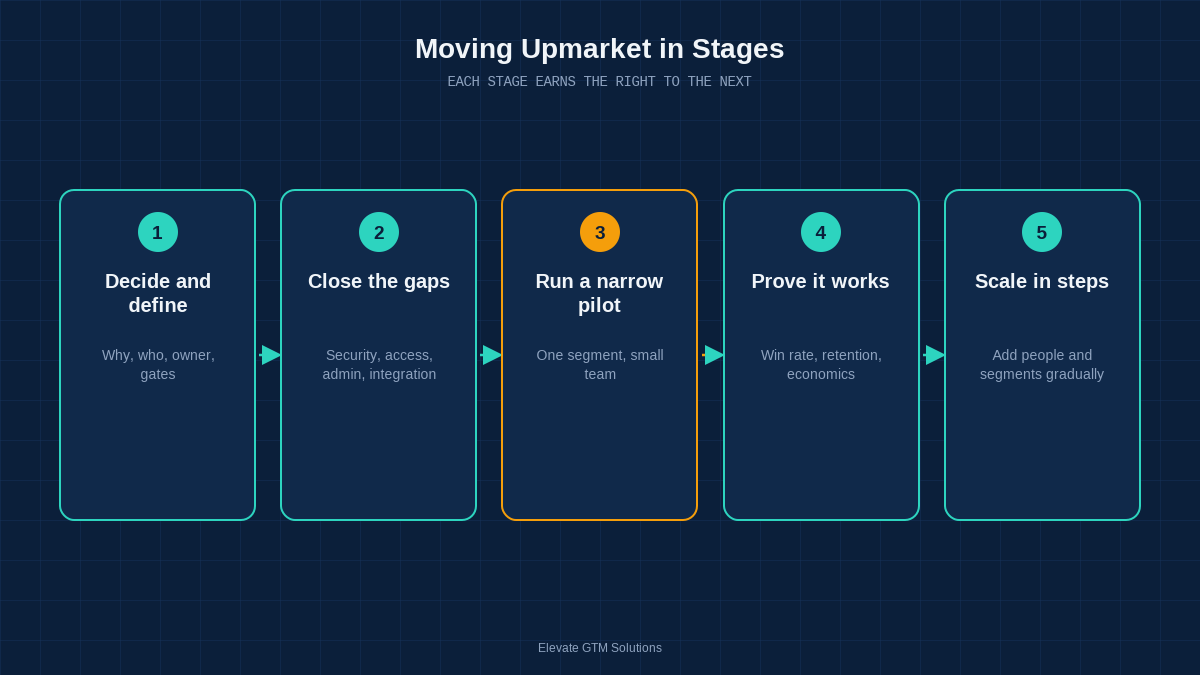
Treat it as a staged experiment, not a switch. First, confirm that larger customers already want what you have: look at your biggest current customers and the enterprise inquiries you already get. Second, close the product gaps that block enterprise deals, usually security, access control, administration, integration and support. Third, build a separate enterprise motion with its own sellers, process, pricing and messaging, while the small-business motion keeps running. Fourth, start with a narrow target, such as one segment or one department inside larger companies, and prove you can win and keep those customers before you widen the net. Measure each stage: cycle length, win rate, deal size, time to value and retention. Move more of the company over only when the numbers justify it.
How long does it take? Usually longer than planned. A first real enterprise cycle can run for many months, and the organization needs time to learn.
Do we have to give up SMB? Not necessarily. Many companies run both, with separate teams and rules.
The short version
| Area | SMB motion | Enterprise motion | What has to change |
|---|---|---|---|
| Buyer | One or two people | A buying group, often with security, legal, finance and IT | Multi-threading, champion building, a business case |
| Sales cycle | Short | Long and uneven | Forecasting, patience, pipeline coverage |
| Product | Easy to start, few controls | Controls, integration, scale, reliability | Security, SSO, roles, audit, admin, APIs |
| Price | Public, self-serve or simple | Negotiated, annual or multi-year | Packaging, discount rules, procurement terms |
| Sales team | Fast closers | Consultative sellers, solution engineers | Hiring, coaching, compensation |
| Support | Help center, chat | Named contacts, service levels, onboarding plans | Customer success, support tiers |
| Message | Speed, simplicity, price | Risk, scale, integration, business outcomes | New positioning and proof |
| Proof | Reviews, trials | References from similar enterprises, pilots, security documents | Case studies, security materials |
Read across a row. If the last column looks large in more than three rows, the move is a company-wide project and should be planned like one.
Why companies go upmarket, and whether yours should
There are good reasons and weak ones. Be honest about which are yours.
Good reasons.
- Larger customers already find you, ask for more and succeed with the product.
- Your SMB churn is high and larger customers stay longer. Check this with your own data.
- Your product gets more valuable as more people at a company use it, so a bigger company means a bigger deal.
- The SMB market for your product is smaller or more crowded than you hoped.
- Your cost to win SMB customers has risen faster than what they pay.
Weak reasons.
- Investors or the board like enterprise revenue multiples.
- A competitor moved up and you feel you must follow.
- One large prospect expressed interest.
- Leadership wants a bigger logo list.
A single enterprise customer asking for a feature is a data point, not a strategy. Many companies have bent their product around one large account and paid for it for years.
A test before you commit
Look at your current customers. For the largest ones, answer:
- Why did they buy, and who inside the company pushed for it?
- Did they succeed? How do we know?
- What did they need that we did not have, and what did we do about it?
- Did the sale take longer than a typical SMB sale? Why?
- Do they renew and expand?
If the answers are mostly positive and specific, you have an enterprise beachhead. If your largest customers were exceptions, or bought for reasons unrelated to your strategy, think twice. Our guides on ICP and ICP scoring show how to look for patterns in who succeeds.
What "enterprise" means, and why you should define it
The word covers a wide range. A company with a few hundred employees behaves differently from a global company with tens of thousands. Define what you mean before building anything.
By size. Employee count or revenue bands. Pick lines that match your reality, not a textbook.
By complexity. Number of business units, regions, regulated activities, IT systems and decision makers.
By buying behavior. Do they run formal procurement and security reviews? Do they need legal terms redlined? Do they buy through a committee?
Many companies find that "mid-market" is a better first step than "enterprise." Mid-market customers often want more than small businesses can use and less than a global company demands. It is a way to learn the move at lower risk. If your jump from SMB to the largest enterprises is too big, aim for the middle.
What breaks first
These are the failures that show up most often, roughly in the order they appear.
The product
Enterprise buyers ask for things SMB customers rarely need.
| Requirement | Why enterprises ask |
|---|---|
| Single sign-on and identity management | They control access centrally |
| Role-based permissions and admin tools | Different people need different access |
| Audit logs | Compliance and incident review |
| Security documentation and attestations | Their security team must approve vendors |
| Data residency and retention controls | Regulation and policy |
| Integrations and APIs | The product has to fit their systems |
| Reliability and support commitments | Business processes depend on it |
| Scalability for many users | Rollouts across large teams |
The list varies by product and industry, and we do not claim a standard. The point is to find your gaps early. Ask a few enterprise prospects and your own security-conscious customers what they check. A security questionnaire from a real buyer is a free requirements document. Do not claim certifications or capabilities you do not have. Misstating them in a questionnaire creates legal and reputational risk.
The sales process
An enterprise deal usually involves several roles: a champion who wants it, an economic buyer who funds it, users, a technical evaluator and people in security, legal, procurement and finance who can each delay or stop it.
Sellers need to:
- find and build relationships with more than one person;
- understand the buyer's internal process and timeline;
- build a business case in the buyer's terms;
- coordinate technical evaluation, often with a solutions engineer;
- manage security and legal reviews in parallel, not at the end;
- forecast honestly when cycles are long.
Fast closers are valuable and different. Some will adapt. Some will not. Hire for the enterprise motion, and do not assume your best SMB seller will be your best enterprise seller. Our research page on buying groups and the one on sales cycle length discuss what the evidence says about group buying and long cycles.
Pricing and packaging
SMB pricing is often public and simple. Enterprise buyers expect to negotiate, to buy annually or for multiple years, to get volume terms and to sign a contract with their own legal language. They also expect clarity on what is included. See how to price a new B2B product and our pricing guide for AI GTM platforms, which lists contract terms that move the price.
Set discount rules before the first negotiation. Decide who can approve what. Decide what you will never trade, such as price for a custom feature you do not want to maintain.
Support and success
Enterprise customers expect named contacts, agreed response times, onboarding plans and regular reviews. A help center and a chat widget are not enough. They also expect you to help them roll out the product across teams. If you cannot support that, an enterprise deal can turn into a churn event one year later.
Messaging and positioning
SMB messages stress speed, ease and price. Enterprise messages need to speak to risk, integration, scale, governance and business outcomes, and to different readers. A CIO, a head of security and a line-of-business leader care about different things. See positioning.
The organization
Enterprise selling pulls on every function: engineering for custom needs, legal for contracts, finance for terms, security for reviews, support for service levels. If those teams are not ready, deals stall inside your own company.
A staged plan
Treat the move as a series of gates. Each stage has a goal, a test and a decision to continue, adjust or stop.
Stage 0: Decide and define (about four to six weeks)
- Write down why you are going upmarket, using the test above.
- Define the target: size, segment, department, region.
- Name an executive owner. Cross-functional moves with no owner drift.
- Set the gates and the metrics (see below) before you begin.
- Decide what you will not do: custom features for one buyer, steep discounts, entering regulated areas you cannot serve.
Stage 1: Close the gaps that block deals (about one to two quarters)
- Collect real enterprise requirements from prospects, customers and security questionnaires.
- Rank them by how many deals each blocks and the effort to fix.
- Build the few that block the most, and document the rest honestly on a roadmap you are willing to share.
- Prepare the security and legal packet: policies, a standard questionnaire response, standard contract terms.
- Write the enterprise onboarding plan.
Stage 2: Run a narrow pilot motion (about two to four quarters)
- Choose one segment or one use case where your product is strongest.
- Assign a small team: one or two enterprise sellers, a solutions engineer, a customer success lead and an executive sponsor.
- Pursue a defined list of accounts. See account tiering.
- Keep notes on every deal: who was involved, how long each step took, where it stalled, why it was won or lost. Our win-loss analysis framework gives a format.
- Review monthly with product, sales, marketing, success and security.
Stage 3: Prove it works
Use evidence, not enthusiasm. At the end of the pilot, ask:
| Question | Evidence |
|---|---|
| Can we win? | Win rate in the target segment, compared with your own plan |
| Can we win repeatably? | Did more than your star seller win? |
| Do they stay and grow? | Early retention, usage and expansion in the new customers |
| Is the economics workable? | Cost to win and payback, in rough ranges. See CAC payback |
| Can we serve them? | Support load, onboarding time, escalations |
| Is the product holding up? | Incidents, performance, requests that block renewal |
If the answers are good, expand. If mixed, fix and extend the pilot. If poor, be willing to step back. Stopping at this stage is cheaper than at a later one.
Stage 4: Scale in steps
- Add sellers in small groups and measure ramp time.
- Widen the target one segment at a time.
- Build marketing for enterprise: proof, references, events and content aimed at multiple roles.
- Establish a partner path if integrators matter in your market. See how to build a partner and channel GTM strategy.
- Formalize pricing, deal desk and contract processes.
Stage 5: Decide the long-term shape
By now you will know whether you are an enterprise company, a company with two motions or something in between. Align the structure, the incentives and the roadmap to that answer. See how to structure a GTM team.
A worked example, invented for illustration
Imagine a company that sells workflow software to small agencies. It has a few thousand customers, high churn among the smallest and a handful of customers with hundreds of users. A review of the largest accounts finds that all of them came in through one department, operations, and that they renewed and expanded. Three prospects have asked about single sign-on and audit logs in the past quarter. Each said they would otherwise buy.
The company decides not to "go enterprise." It decides to test the operations department of mid-sized firms. It builds single sign-on, roles and an audit log first, because those blocked the three prospects. It writes a security packet and a standard contract. It hires one enterprise seller and one solutions engineer and assigns a customer success manager. It pursues thirty accounts. It keeps its self-serve motion unchanged.
After three quarters, it has closed four deals, lost five and has several in progress. The win-loss notes show a pattern: it wins when the buyer is the operations head and loses when IT insists on a tool it already owns. It also finds that onboarding takes longer than expected, because large teams need training. It adjusts: it targets operations leaders directly, builds a training program and drops accounts where IT owns the decision. The pilot did what it was meant to do, which is to produce lessons before the company bet more.
How the SMB business keeps running
A common failure is neglecting the base while chasing the new thing. SMB revenue often funds the move. Protect it.
- Keep the SMB motion separate. Different sellers, different process, different targets where possible.
- Watch for conflict. If SMB and enterprise sellers chase the same accounts, set clear rules about who owns what.
- Protect product focus. If every roadmap decision serves enterprise, SMB customers will notice and leave. Decide the split on purpose.
- Keep pricing coherent. A small customer who sees an enterprise price list with unexplained differences will be confused. Explain the difference in terms of what is included.
- Communicate. Tell your SMB customers what is changing and what is not.
Our guide to what is a GTM motion covers running more than one motion.
Metrics for the move
Choose a small set and review them monthly. Our guide to measuring whether a GTM strategy works goes deeper.
| Stage of the funnel | Example measures |
|---|---|
| Pipeline | Qualified enterprise opportunities, stage progression, coverage against target |
| Deal quality | Average deal size and spread, discounting, number of stakeholders engaged |
| Speed | Days in each stage, security and legal review time |
| Win | Win rate in the target segment, reasons for loss |
| Delivery | Time to first value, onboarding duration, support load |
| Retention | Renewals, expansion, usage across teams |
| Economics | Cost to win, payback, seller ramp time |
Record your baseline from the SMB motion first, so you know how different the enterprise numbers are.
Common patterns that go wrong
Bending the product around one deal. A large prospect asks for a custom feature, you build it, and you maintain it forever.
Hiring too many enterprise sellers too soon. Without a proven motion, they will have nothing to repeat.
Underestimating security and legal. Late reviews kill deals. Start them early and in parallel.
Ignoring onboarding. Large customers need rollouts. A weak start leads to a weak renewal.
Price without a plan. Ad hoc discounts set precedents that hurt later.
Leaving customer success out. Enterprise value shows up after the sale.
Forgetting the message. The SMB pitch does not work with a CIO.
Treating one win as proof. A single deal can be luck. Look for patterns.
Losing the base. SMB customers leave when they feel ignored.
No exit criteria. A move with no stop rule can drain a company.
Running a security and procurement review without losing the deal
Most first-time enterprise sellers meet the security review as an ambush. It does not have to be.
Start it early. Ask in the first or second conversation who will review security, legal and procurement, and what their process is. Offer to begin in parallel with the business evaluation. A review that starts after the champion says yes can add months.
Prepare a standard packet. Keep a current set of documents ready: a description of how data is handled, a completed standard questionnaire, a list of policies and any independent assessments you truly hold. Never describe a certification, control or capability you do not have. A wrong answer in a questionnaire can become a contract problem later, and buyers' security teams check.
Name a single owner. One person, often a solutions engineer or a security lead, answers every question and keeps a log of what was said to whom. Inconsistent answers raise doubt.
Be honest about gaps. If a requested control is on the roadmap but not built, say so and offer what you can do now, such as compensating measures or a phased scope. Many reviewers accept an honest gap with a plan better than a vague yes.
Expect legal and procurement to want changes. Decide in advance which contract terms you can move on and which you cannot. A short list of non-negotiables, agreed with your own legal counsel, saves weeks of back and forth. This guide is not legal advice.
Track the time. Record how long each review step takes. After a few deals, you will know your real cycle and can forecast honestly.
What your best SMB seller may and may not become
Sellers are often promoted or moved into enterprise roles on the strength of speed. The skills are related and different.
| SMB strength | Enterprise requirement | What to watch |
|---|---|---|
| Closing quickly | Patience through a long, uneven process | Pushing too early, damaging trust |
| One conversation with a buyer | Many relationships across a group | Single-threading to one champion who then leaves |
| Demonstrating the product | Building a business case in the buyer's terms | Feature-led pitches to executives |
| High activity volume | Careful account planning | Spraying instead of targeting |
| Short forecast horizon | Honest forecasting of long cycles | Optimistic stage movement |
Some SMB sellers make the jump. Give them a path with coaching, a solutions engineer and a smaller number of accounts before you promote the whole team. Hire at least one person who has run enterprise cycles before, so that the team has someone to learn from, and pair them with the SMB team's best product knowledge.
When to stop or pause
Write the stop rule at the start. Examples of conditions that justify pausing an enterprise push: the pilot has run its full period and win rate in the target segment is well below your plan, deals keep stalling on a product gap that you cannot close within a reasonable time, the economics show a cost to win that the deal sizes cannot repay, or the effort is damaging the SMB base that funds the company.
Pausing is not failure. A paused pilot with written lessons is worth far more than a half-funded enterprise motion that drifts for two years. You can return to the idea when the product, the team or the market changes.
Marketing for an enterprise audience
Enterprise marketing is not SMB marketing with a bigger font. The audience, the proof and the channels change.
Write for several readers. The champion wants to look good. The economic buyer wants a business case. The technical evaluator wants to know how it works and fits. Security wants documentation. Legal wants clear terms. Build a short piece for each, and let sellers send the right one at the right moment.
Replace speed and price with risk and outcomes. Enterprise content speaks about reliability, integration, governance and results for organizations like the buyer's.
Collect proof from comparable customers. A case study from a five-person agency does little for a bank. Seek references from larger customers, with permission, and be accurate.
Use account-based thinking. For a defined list of target companies, coordinate marketing and sales: relevant content, events and outreach to several people at each account. See account tiering.
Keep a trust center or a clear security page, with what you can honestly say about how data is handled and who to contact.
Do not abandon what works for SMB. Self-serve and inbound can still feed the funnel and give enterprise champions a way to try the product inside their own team.
What to tell your existing customers
Small customers pay attention when you move upmarket. Silence invites rumor.
- Say what is not changing: support, pricing for their plan and the features they rely on.
- Say what is changing and why, in terms of what they gain, such as a more reliable, better-resourced product.
- Offer a way to give feedback, and respond to it.
- Be careful about steep price changes for existing customers. Notice periods and contract terms apply, and trust is hard to rebuild. See how to price a new B2B product.
- Watch churn in the small-business base during the transition, and treat a rise as an early warning that product focus has shifted too far.
Questions for the leadership team before you start
Move-upmarket plans fail more often from unspoken disagreement than from bad tactics. Put these questions on the table early and write the answers down.
- What exactly do we mean by enterprise, and which segment first?
- What are we willing to stop doing to make room, in product, sales and support?
- How much will we invest before we judge, for how long, and what would make us stop?
- Who owns the move, and who owns the SMB business while it happens?
- Which product requests will we accept, and which will we decline even for a large customer?
- How will we treat existing customers who feel left behind?
- What will we tell investors, employees and customers, and when?
If the leadership team gives different answers, resolve that before hiring anyone. Alignment at the top is cheaper than discovering a split after six months of spending.
Glossary
Upmarket. Moving from smaller customers toward larger ones.
Enterprise. A large customer, usually defined by size and complexity. Definitions vary, so write your own.
Mid-market. Companies between small business and large enterprise, with a range that varies by company.
Buying group. The set of people involved in a purchase decision.
Champion. A person inside the buyer who advocates for you.
Economic buyer. The person who controls the budget.
Solutions engineer. A technical specialist who supports sales through evaluation and integration.
Security questionnaire. A form buyers use to assess a vendor's security practices.
Single sign-on (SSO). A system that lets users log in once to access multiple services under central control.
Deal desk. A function that reviews and approves pricing and contract terms.
Pilot. A limited trial of a product or motion before a full commitment.
Land and expand. Winning a small initial deal and growing it over time.
Where Elevate GTM Solutions fits
Elevate GTM Solutions is an AI GTM platform for creating, executing and adapting go-to-market strategy. Its homepage lists "Move upmarket to enterprise" as a use case, alongside others such as "Reposition a product," "Change pricing and packaging" and "Win against a dominant competitor." Its modules include "ICP & Segmentation," "Product Positioning," "Product Messaging," "Pricing Strategy," "Sales Enablement" and "Unified GTM Strategy." The homepage says "15 connected GTM modules" and names sixteen, so count what you see when you look.
How that could help: a move upmarket changes the target, the message, the price and the enablement at once, and a platform built on one shared set of inputs is designed to keep those decisions consistent while you test. The company also says strategies can be compared side by side and adapted by segment. Those are design claims by the company, and the test is whether your own team finds the output specific enough to use with real enterprise buyers.
What a platform cannot do is build single sign-on, pass a security review, hire an enterprise seller or tell you whether your largest customers are a trend or an exception. Those come from your product, your people and your data. For more, see what Elevate GTM Solutions is and the pilot to scale framework.
What to do this week
- List your ten largest customers and answer the five questions in the test above.
- Write your definition of enterprise for your company: size, complexity and buying behavior.
- Ask three prospects or customers what their security and IT teams check, and collect any questionnaires you have received.
- Rank the product gaps by how many deals each blocks.
- Pick one segment or department for a narrow pilot, and write the gates and stop rules.
- Name an executive owner.
- Record your SMB baseline for cycle length, win rate and deal size.
Key takeaways
- Moving upmarket changes the product, price, sales process, team, support and message together. Plan it like a company-wide project.
- Start by checking whether your largest current customers show a pattern. One large prospect is not a strategy.
- Close the few product gaps that block the most deals, and never claim capabilities you lack.
- Pilot with a narrow target, a small team and written gates and stop rules.
- Build a separate enterprise motion and protect the SMB base.
- Mid-market is often a safer first step than the largest enterprises.
- Expand only when win rate, retention and economics support it.
Sources
- Elevate GTM Solutions: descriptions of modules and use cases, as stated on the company's homepage.
- Related Elevate guides linked in the text, including the buying groups evidence page, the sales cycle length evidence page and the win-loss analysis framework.
- The staged plan, the list of what breaks and the pilot gates reflect common practice and our judgment. They are not drawn from a single study, and your market may need a different shape.
- The worked example is invented for illustration. We cite no benchmark figures, because published enterprise cycle lengths and win rates vary too widely to be a safe target.
Frequently Asked Questions
How do you move upmarket from SMB to enterprise customers?
Treat it as a staged experiment. Confirm that larger customers already want and succeed with your product, close the product gaps that block enterprise deals, build a separate enterprise motion with its own team, pricing and message, and start with a narrow target. Expand only when win rate, retention and economics support it.
What changes when you sell to enterprise instead of SMB?
Nearly everything: a buying group replaces one or two buyers, cycles lengthen, the product needs security and administration features, pricing becomes negotiated, sellers need consultative skills, support needs named contacts and the message must address risk, scale and integration.
How long does it take to move upmarket?
Longer than most plans assume. A first real enterprise sales cycle can take many months, and the product, team and processes need time to mature. Plan in stages of several quarters each and judge progress by gates, not by dates.
Do we need to stop selling to small businesses?
Not necessarily. Many companies run both with separate teams and clear rules. The risk is neglecting the base while chasing larger deals, so protect product focus and communicate with small customers about what is changing.
What product features do enterprise buyers usually require?
Commonly single sign-on, role-based permissions, admin tools, audit logs, security documentation, data controls, integrations and reliability commitments. The list varies by product and industry, so ask real prospects and review the security questionnaires you receive.
Should we try mid-market before enterprise?
Often yes. Mid-market customers usually want more than small businesses can use and demand less than global enterprises. It lets you learn the new motion at lower risk. Decide based on where your best current customers sit.
How should pricing change when going upmarket?
Expect negotiated, annual or multi-year contracts, volume terms and procurement requirements. Set discount rules and approval levels before the first negotiation, and decide what you will not trade, such as price for a custom feature you do not want to maintain.
Should we hire enterprise sellers right away?
Start with a small team, such as one or two enterprise sellers and a solutions engineer, and test the motion on a narrow target. Add more sellers in small groups after you can show that more than one person can win.
How do we know if our company is ready for enterprise?
Check whether your largest current customers show a pattern: they found you, succeeded, renewed and expanded. Then check whether you can close the main product gaps and support larger customers. If your large customers were exceptions, wait and learn more.
What are the biggest mistakes in moving upmarket?
Bending the product around one deal, hiring too many sellers before the motion is proven, underestimating security and legal reviews, ignoring onboarding, using SMB messaging with enterprise buyers and neglecting the existing base.
How do we measure whether the move is working?
Track qualified pipeline, deal size, stage speed, security and legal review time, win rate and loss reasons, onboarding time, retention and expansion, and rough cost to win with payback. Record your SMB baseline first.
Can a GTM platform help with moving upmarket?
It can help keep segmentation, positioning, messaging, pricing and enablement consistent as you change them, and compare options by segment. It cannot build product features, pass security reviews or tell you whether your large customers are a trend. Use it as a planning aid.