
By the Elevate GTM Solutions Team · Updated November 13, 2026 · 25 min read
How to Build a Partner or Channel Go-to-Market Strategy: Choosing Partner Types, Setting the Deal and Making Partners Want to Sell You
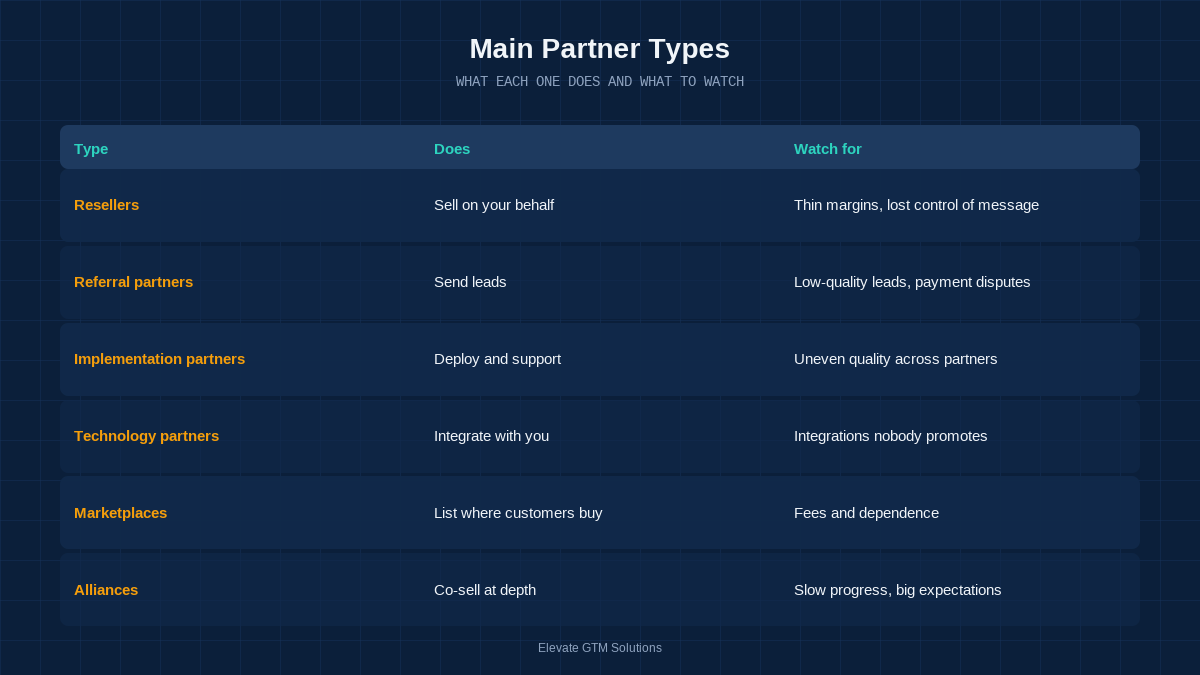
"Let's do partnerships" is one of the most common sentences in a growth meeting and one of the least specific. It can mean resellers who sell your product, consultants who implement it, technology companies that integrate with it, influencers who recommend it or a marketplace that lists it. Each of these works differently, costs differently and takes a different kind of person to run. A company that signs fifty partners without choosing a type usually ends up with fifty logos on a page and almost no revenue.
A partner or channel strategy is a way of reaching customers through other companies that already have their trust, their budget or their attention. Done well, it extends your reach beyond what your own team can cover. Done badly, it consumes months of effort, creates conflict with your direct sales team and teaches partners to ignore you.
This guide explains the main partner types, how to decide whether a channel motion fits your business, how to design the program, how to recruit and enable partners, how to avoid conflict, how to measure results and what to do when it is not working. We make a GTM strategy platform, and "Build a partner and channel GTM" is one of the use cases on our site, so we have an interest. Elevate also runs its own partner program, which is a separate matter from the advice here. Examples are invented, and we cite no benchmark numbers on margins or partner-sourced revenue, because published figures vary widely by industry and are rarely comparable.
How do you build a partner or channel go-to-market strategy?
Start by deciding what job you want partners to do: find customers, sell to them, implement your product, extend it or make it more valuable by integrating with it. Choose one or two partner types that do that job, define who they serve and why they would benefit from working with you, and write the deal in plain terms: what they do, what they earn, what you provide and who owns the customer. Recruit a small number of partners, enable them well, run a pilot and measure it before you scale. Appoint one person to own partner success, settle conflicts with your direct team in writing, and review the program with partners regularly. A partner motion works when partners make money and look good to their own customers by working with you.
Which partner type should we start with? The one that already has your buyer's trust and a reason to recommend you, such as an implementation firm your customers already hire.
How long before a channel pays off? Usually longer than direct sales. Partners take months to learn, win and repeat. Plan accordingly.
The short version
| Question | What to decide |
|---|---|
| What job do partners do for us? | Find, sell, implement, extend or influence |
| Who are the right partners? | One or two types that already reach and serve your buyer |
| Why would they bother? | Revenue, margin, customer value, differentiation or a better product for their clients |
| What is the deal? | Roles, pricing, margin or fees, support, ownership of the customer |
| How do we recruit, train and support them? | A pilot with a few partners, a clear onboarding path, a named contact |
| How do we avoid conflict with direct sales? | Written rules on deal registration, territories and compensation |
| How do we measure it? | Partner activity, partner-sourced and partner-influenced revenue, customer outcomes, partner health |
What a channel motion is, and what it is not
A channel or partner motion is one way of reaching customers. It sits next to others such as product-led, sales-led and inbound. See what is a GTM motion. It is not a shortcut. Partners do not sell for free, and they will not push a product that is hard to sell, hard to implement or poorly supported.
Think of a partner as a business that has its own customers, its own costs and its own reasons. Your strategy is only as good as its answer to the question, "Why would this company spend its limited time on us?"
The main partner types
The labels vary by industry, and many companies fit more than one. These are the types most B2B companies meet.
Resellers and distributors
They buy from you, or sell on your behalf, and deal with the customer. They bring reach, local presence, existing relationships and sometimes services.
Fit: products that are easy to explain, that customers prefer to buy locally or with other products, or markets you cannot staff.
Watch for: loss of control over pricing and message, thin margins that make you a low priority, and customers who do not know who to call.
Referral and affiliate partners
They send leads or introductions and earn a fee or a share. They may be consultants, agencies, communities or individual advisors.
Fit: a clear buyer profile that referral partners already serve and a simple offer they can describe in a sentence.
Watch for: low-quality leads, unclear rules about who gets paid and conflicts with your own pipeline.
Implementation and services partners
Consultants, agencies and system integrators who help customers set up, configure and use your product.
Fit: products that need real setup, integration or change management. Services partners often decide which product a client buys, because they will be the ones making it work.
Watch for: partners recommending whichever product pays them best, uneven quality across partners and customers blaming you for a partner's mistakes. Certification and review help.
Technology and integration partners
Companies whose products work with yours. Integrations make both products more useful and let each reach the other's customers.
Fit: products that sit inside a larger workflow, where customers already use specific other tools.
Watch for: integrations that exist on paper and are poor in practice, and partners with no plan to promote the integration. An integration nobody knows about brings no customers.
Marketplace and platform partners
Listing your product in another company's marketplace, so customers can find and buy it there.
Fit: when your customers already live in a platform and buy through its marketplace, sometimes using committed budgets there.
Watch for: fees, listing rules, visibility limits and dependence on someone else's platform.
Strategic alliances
Larger, deeper relationships with another company, such as co-selling, joint offers and shared roadmaps. They take significant executive time.
Fit: when a few relationships matter more than many.
Watch for: slow progress and big expectations. Each side tends to overestimate what the other will do.
Communities, influencers and associations
Groups that influence buying: industry associations, user communities, trusted advisors. They may not earn money directly.
Fit: markets where trust travels through peers.
Watch for: slow, hard-to-attribute impact and a risk of looking promotional.
Should you build a channel at all?
Be honest about the preconditions. A channel works better when these are true.
| Precondition | Why it matters |
|---|---|
| You win deals directly and can describe how | Partners cannot repeat what you cannot explain |
| The product is stable and supported | Partners put their reputation on it |
| Customers need help partners can provide | Otherwise partners add little |
| There is room for partners to earn | Margins, fees or service revenue that make it worth their time |
| You can support partners | Training, contacts, materials, technical help |
| Leadership will back it for more than a quarter | Channels take time |
| Direct sales will cooperate | Conflict can sink a program |
If several of these are missing, spend the time on your direct motion first. A channel built on a motion that does not yet work simply spreads the problem. For early-stage companies, one or two good integration or referral relationships often make more sense than a formal program. See GTM strategy for startups.
Designing the program
Step 1: define the job
Write one sentence: "Partners will [job] for [type of customer] so that [result]." For example, "Implementation firms will deploy our product for mid-size manufacturers so that customers reach value in weeks and we can reach customers we cannot staff for." If you cannot write that sentence, you are not ready to recruit.
Step 2: choose the partner profile
Describe the ideal partner the way you describe an ideal customer. See ICP for the method.
- What do they sell and to whom?
- How big are they, and where?
- What would make them want to work with us?
- What capabilities do they need?
- What would make them a bad fit?
Few good partners beat many weak ones. Define the profile narrowly at first.
Step 3: design the value for the partner
Partners ask, "What is in it for us?" Possible answers include:
- Revenue: margin on resale, referral fees or services revenue.
- Customer value: the product solves a problem their clients have.
- Differentiation: it makes the partner's offer stronger.
- Pipeline: leads or introductions from you.
- Credibility: association with a respected product.
- Ease: simple to sell, implement and support.
Check the economics from the partner's side. Estimate what a typical partner would earn from one customer, and what it costs them to win and serve it. If the numbers are thin, they will not prioritize you.
Step 4: write the deal
Put the terms in plain language, then in a contract reviewed by counsel. Cover:
| Term | Questions to settle |
|---|---|
| Roles | Who finds, sells, implements, supports and renews? |
| Customer ownership | Who owns the relationship and the data? What happens if the partner leaves? |
| Pricing and margin or fees | What does the partner earn, and when is it paid? Are there tiers? |
| Deal registration | How does a partner claim a deal, for how long and how are conflicts resolved? |
| Territory or segment | Any exclusivity? How long, and what must the partner do to keep it? |
| Requirements | Training, certifications, minimum activity, quality standards |
| Support | What help do partners get, and how fast? |
| Brand and messaging | What can the partner say and show? |
| Data and compliance | Who handles customer data and under what rules? |
| Exit | How does either side end the relationship, and what happens to customers? |
This guide is not legal advice. Partner agreements involve competition, data protection, tax and commercial law that vary by country. Have a lawyer review the terms.
Step 5: set up tiers sparingly
Many programs create tiers such as registered, certified and premier, with benefits rising with commitment. Tiers can motivate, and they add complexity. Start with one or two levels and add more only when you have enough partners to justify them. Base advancement on results and capability, not only on paying a fee.
Recruiting the first partners
Start with who already works with you. Customers who asked for help, consultants who implemented your product unprompted, vendors your customers already use. These relationships have a head start.
Ask customers who they trust. Your customers know which advisors and vendors they rely on.
Find overlaps. Which companies serve the same buyer at a different point? A company that sells to your buyer and does not compete with you is a natural fit.
Pitch the partner's outcome, not your product. "Here is how this helps your clients and your business" beats "please sell our product."
Run a pilot with a handful. Five to ten partners you can support well beat a hundred you cannot. Set a short period and clear goals, such as a number of qualified conversations or deployments.
Be honest about what you can offer. Over-promising leads to disappointed partners who tell others.
Enabling partners
Partners need to learn your product and your market quickly, and they have many other things competing for attention.
| Need | What helps |
|---|---|
| Know the product | Short training, a sandbox or demo environment, clear documentation |
| Know the buyer | The ICP, the problem you solve, the questions buyers ask |
| Know the message | A short positioning guide and a simple pitch |
| Know the process | How to register a deal, quote, deliver and get paid |
| Win deals | Materials that work in the partner's own conversations, not just yours |
| Deliver well | Technical guides, escalation paths and quality standards |
| Stay current | A regular update on product changes, new proof and market news |
Keep it short. Partners will not read a hundred-page manual. See what is GTM enablement for how to keep materials current, and positioning for the message.
Give every partner a named contact at your company who answers within a stated time. Nothing frustrates a partner more than silence from the vendor after they have brought you a deal.
Avoiding conflict with direct sales
The most common cause of channel failure is internal. Direct sellers see partners as competitors for commission. Partners see direct sellers as a threat to their deals.
Write the rules down.
- Which accounts or segments go to partners and which to direct sellers?
- How are deals registered, and how long does a registration last?
- What happens when both claim a deal?
- Who gets paid, and how?
Align compensation. If direct sellers lose commission whenever a partner closes a deal in their territory, they will undermine partners. Consider credit rules that reward cooperation, such as partial credit for partner-assisted deals.
Share information. Make deal registration visible to both sides, in a system everyone can see.
Escalate quickly. Pick someone senior to settle disputes in days, not weeks.
Do not surprise partners. If you plan to sell directly to a segment they serve, tell them first.
Our sales and marketing SLA framework shows how to write handoff rules, and the same ideas apply between direct and partner teams.
Who runs it
A partner program needs an owner. The role is part business development, part customer success, part marketing and part operations.
- Early: a single person, often a senior seller or a founder, who knows the product and the buyer.
- Growing: a partner manager for each major partner type, plus someone for enablement and operations.
- Mature: a team with a head of partnerships who reports into revenue leadership and has a seat in planning. See who owns GTM strategy.
Avoid hiring a partner leader before you know what you want partners to do. A senior hire with no program to run will either leave or invent one.
Measuring a partner motion
Partners cause results at several stages, so measure several.
| Layer | Example measures | Caution |
|---|---|---|
| Partner health | Active partners, partners with a deal in the last period, time from signing to first deal | Signed partners who never act are not a pipeline |
| Activity | Leads registered, opportunities created, deployments started | Count quality, not just volume |
| Results | Partner-sourced revenue, partner-influenced revenue, win rate with partners | Define sourced and influenced in writing |
| Customer outcomes | Time to value, satisfaction, retention of partner-delivered customers | Compare with direct customers |
| Economics | Cost of the program, margin or fees paid, cost to win through partners | Include your team's time |
| Partner satisfaction | A short regular survey and direct conversations | Ask what you could stop doing |
Record a baseline for the same measures on direct deals. If partner-delivered customers churn faster than direct ones, the program needs repair before it needs growth. Our guide on measuring GTM success explains how to build a scorecard.
A note on attribution
Partners often influence deals they do not source. A consultant recommends you early, and a seller closes the deal months later. Do not argue about credit endlessly. Agree on a simple rule, record the partner touch and look at influenced revenue as well as sourced revenue, using ranges and honest language.
A worked example, invented for illustration
Imagine a company that sells data-quality software to finance teams. Its direct team reaches large firms well and struggles with mid-size ones. It notices that several mid-size customers came through accounting consultancies that already managed their month-end close.
The company decides to focus on one partner type, accounting and finance-systems consultancies, for one customer type, mid-size finance teams. It writes the job: "Consultancies will recommend and deploy our product for mid-size finance teams, so that customers reach value in weeks." It builds a short certification, a deployment guide and a sandbox. It offers a referral fee for introductions and encourages partners to charge for implementation. It recruits six consultancies it already knows, writes deal registration rules with a sixty-day window and tells direct sellers that mid-size accounts with a registered partner belong to the partner, with the seller receiving partial credit for support.
After two quarters, two of the six partners have closed deals, two have opportunities and two have done nothing. The company talks to all six. The inactive ones say the product's setup is longer than they expected. The company adds a quick-start guide and pairs those partners with its solutions team on the next deal. It resists the urge to sign twenty more partners and spends the next quarter making the first six successful.
Common mistakes
Signing many partners with no type. Logos are not revenue.
Assuming partners will sell for free. They need to make money or look good to their clients.
No enablement. Partners cannot sell what they do not understand.
No single owner. A program run in someone's spare time rarely works.
Ignoring direct sales conflict. Unwritten rules lead to quiet sabotage.
Setting terms you cannot support. Promising fast support and then going silent costs trust.
Over-tiering. Elaborate programs for a handful of partners.
Measuring only revenue. You miss partner health and customer outcomes.
Losing control of the customer experience. A weak partner damages your name.
Expecting fast results. Channels typically take longer than direct sales to ramp.
Partner onboarding, step by step
The first ninety days of a partner relationship decide whether it becomes productive. A simple sequence helps.
Week one: welcome and align. Hold a kickoff with both sides. Agree on the job, the target customer, the first goals and who the named contacts are. Share the ICP and the positioning in a short document.
Weeks two to four: learn. Short training on the product and the buyer. Give the partner access to a demo or sandbox and a guide to the two or three most common customer situations. Ask them to explain the product back to you in their own words. Gaps show up quickly.
Weeks four to eight: first opportunities. Pair the partner with one of your team on the first one or two opportunities. Agree on registration, pricing and who does what. Debrief after each conversation.
Weeks eight to twelve: review. Look at what happened. How many conversations, how many opportunities, what blocked progress? Ask the partner what you could do better. Adjust the program and the support.
Partners who have no first opportunity by the end of the first quarter usually need a conversation, not another email. Ask whether the product fits their clients, whether the economics work and whether they have the right people assigned.
Funding and effort
Channel programs cost money before they earn it. Budget for the following.
| Cost | What it covers |
|---|---|
| People | A partner owner, enablement help, technical support, operations and legal review |
| Enablement | Training, documentation, sandbox environments, demo materials |
| Incentives | Margins, referral fees, rebates, marketing funds for partners |
| Marketing | Joint campaigns, events, a partner directory page, co-branded material |
| Systems | Deal registration, partner reporting and payments |
| Management time | Executive attention to relationships that matter |
Compare the total program cost with the revenue and customer outcomes it produces, and compare that with the same figures for your direct motion. Our research page on CAC payback discusses how to think about the economics. Many channels look cheap because the cost of your own team's time is left out.
Ending a partnership well
Some partnerships do not work. Plan the exit as you plan the start.
- Write exit terms into the agreement, including notice periods and what happens to customers the partner served.
- Give honest feedback before ending a relationship, and a chance to fix problems.
- Protect customers. A partner leaving should not leave a customer without support. Offer to take over or transfer to another partner.
- Handle data and materials: return, delete or transfer, as the agreement and the law require.
- Communicate to other partners that standards exist and are applied.
A fair, clear exit protects your reputation among the partners you want to keep.
Co-marketing and joint selling without wasted effort
Partners often propose joint campaigns. Many produce little. A few rules help you choose.
Start with a shared customer problem. A joint webinar about a topic both audiences care about works better than one that exists because a partnership was signed.
Agree on the goal in numbers. How many qualified conversations, from whom, by when? Without a target, nobody can judge success.
Split the work and the data. Decide who hosts, who promotes, who follows up and who owns the leads. Privacy and consent rules apply to shared contact data, so take legal advice. This guide is not legal advice.
Follow up fast. Leads from a partner are warm. Slow follow-up wastes the partner's credibility as well as your own.
Debrief. After each activity, record what happened and decide whether to repeat, change or stop.
Prefer a few repeated plays to many one-offs. A partner who knows exactly what to do with a customer type, and has done it three times, outperforms one who has been invited to twenty events.
For joint selling, agree before the first opportunity who leads the conversation, who brings which expertise and how you present to the customer. Customers notice a poorly rehearsed handoff between two companies.
Partner communications and governance
A program with more than a handful of partners needs a rhythm.
| Cadence | What happens |
|---|---|
| Monthly | A short partner update: product changes, new proof, events, program changes |
| Quarterly | A business review with each major partner: results, pipeline, what is working, what to fix |
| Annually | A review of the program: tiers, terms, partner mix and investment |
| As needed | A fast channel for deal registration questions and escalations |
Ask partners what to stop, not only what to start. Programs gather rules over time, and partners notice when each rule adds work without value.
Keep a short, public description of the program, so that prospective partners understand the job, the benefits and the requirements before the first call. Write it in plain language and update it when terms change.
Glossary
Channel. A route to customers through another company instead of directly.
Partner program. The structure of terms, benefits, training and support offered to partners.
Reseller. A company that sells your product to its own customers, often with a margin.
Referral partner. A company or person that introduces customers and earns a fee or share.
Implementation partner. A firm that helps customers set up and use your product.
Technology partner. A company whose product integrates with yours.
Marketplace. An online store, run by another company, where customers can find and buy products.
Deal registration. A process in which a partner records an opportunity so the vendor recognizes it and protects the partner's claim.
Partner-sourced revenue. Revenue from opportunities a partner originated.
Partner-influenced revenue. Revenue from deals a partner touched but did not originate.
Co-selling. Working together with a partner on a customer opportunity.
Enablement. Giving partners the knowledge, materials and support they need to succeed.
Where Elevate GTM Solutions fits
Elevate GTM Solutions is an AI GTM platform for creating, executing and adapting go-to-market strategy. Its homepage lists "Build a partner and channel GTM" as a use case, and its modules include "Distribution Channel Strategy," "ICP & Segmentation," "Product Positioning," "Product Messaging" and "Sales Enablement." The homepage says "15 connected GTM modules" and names sixteen, so count what you see when you look. The site also lists a Partner Program and an Advisor Network. Those are programs Elevate runs for its own partners, and they are a separate matter from the planning advice in this guide.
How the platform relates to a partner strategy: choosing partner types, defining who they serve, writing the message partners will carry and keeping that message consistent with your direct motion are strategy tasks. A platform that holds segmentation, positioning and channel decisions together is designed to make that consistency easier. That is the company's design intent, and the test is whether the channel plan it produces reflects your real buyers and your real economics.
A platform will not recruit partners, negotiate terms, resolve conflict with your direct team or tell you what partners earn in your market. Those take people and conversations. For more, see what Elevate GTM Solutions is and GTM strategy handoff.
What to do this week
- Write the job you want partners to do, in one sentence.
- Review your last twenty customers and note any that came through, or were helped by, another company.
- Choose one or two partner types and describe the ideal partner.
- Sketch what a typical partner would earn from one customer and what it would cost them.
- Draft the deal in plain language: roles, money, customer ownership, deal registration.
- Agree on conflict rules with your direct sales leader.
- Pick five to ten candidate partners for a pilot and name one person to own it.
Key takeaways
- A channel strategy begins with the job partners will do, not with a list of logos.
- Choose one or two partner types that already reach and serve your buyer, and describe the ideal partner narrowly.
- Partners join when they make money, look good to their clients or both. Check the economics from their side.
- Write the deal in plain terms, and have counsel review the contract.
- Pilot with a handful of partners, enable them well and give each a named contact.
- Settle conflict with direct sales in writing before it starts.
- Measure partner health, activity, results and customer outcomes, and compare partner-delivered customers with direct ones.
Sources
- Elevate GTM Solutions: descriptions of modules, use cases, the Partner Program and the Advisor Network, as stated on the company's homepage. No terms of Elevate's own program are described here.
- Related Elevate guides linked in the text, including the sales and marketing SLA framework and GTM strategy handoff.
- The partner types, preconditions, program design steps and measures reflect common practice and our judgment. They are not drawn from a single study, and terms vary widely by industry.
- This guide is not legal advice. Partner agreements involve competition, data protection, tax and commercial law that vary by country.
- The worked example is invented for illustration. We cite no benchmark figures on margins or partner-sourced revenue.
Frequently Asked Questions
How do you build a partner or channel go-to-market strategy?
Decide what job partners will do, choose one or two partner types that already reach your buyer, define why they would benefit, write the deal in plain terms, recruit a small pilot group, enable them well and measure results. Appoint one owner and settle conflicts with your direct team in writing.
What are the main types of GTM partners?
Resellers and distributors, referral and affiliate partners, implementation and services partners, technology and integration partners, marketplace partners, strategic alliances and communities or associations. Many companies work with more than one type, and labels vary by industry.
When should a company start a channel program?
When you can win deals directly and explain how, the product is stable and supported, customers need help partners can give, partners can earn money and you can support them. If those are missing, strengthen the direct motion first.
How do you recruit the first partners?
Start with companies that already work with you, such as consultants who implemented your product or vendors your customers already use. Ask customers who they trust, and pilot with five to ten partners you can support well, rather than signing many.
What should be in a partner agreement?
Roles, customer ownership, pricing and margin or fees, deal registration, territory or segment, requirements, support, brand and messaging, data and compliance, and exit terms. Have a lawyer review it, since rules vary by country.
How do you avoid conflict between partners and direct sales?
Write the rules for accounts, deal registration and disputes, align compensation so direct sellers are not penalized for partner-assisted deals, make registrations visible to both sides and settle disputes quickly. Tell partners before you change how you sell to a segment they serve.
How do you measure whether a partner program works?
Track partner health, activity, partner-sourced and partner-influenced revenue, customer outcomes for partner-delivered customers, program cost and partner satisfaction. Compare partner-delivered customers with direct ones, and define sourced and influenced in writing.
How long does it take for a channel to pay off?
Usually longer than direct sales, because partners need time to learn the product, build pipeline and close deals. Plan in quarters, judge a pilot by activity and early results and avoid scaling before the first partners succeed.
What makes partners want to sell your product?
Revenue or fees, customer value, differentiation for their own offer, a steady flow of leads and a product that is easy to sell, implement and support. Check the economics from their side, and give each partner a named contact.
Should a startup build a partner program?
Often not a formal one. One or two integrations or referral relationships with companies that already serve your buyer usually make more sense. A full program needs a direct motion that works and people to support partners.
What is the difference between partner-sourced and partner-influenced revenue?
Sourced revenue comes from opportunities a partner originated. Influenced revenue comes from deals a partner touched but did not originate. Agree on definitions and a simple rule in advance, and report both with honest language.
Can software help plan a channel strategy?
A GTM platform can help define partner profiles, segments, messaging and channel choices consistently with your direct motion. It cannot recruit partners, negotiate terms or resolve conflicts. Use it for planning, and treat generated plans as drafts to test.