
By the Elevate GTM Solutions Team · Updated November 10, 2026 · 22 min read
Sales and Marketing SLA Framework: Definitions, Response Times, Handoffs, and Reviews That Stop Lead Disputes
Few arguments in a company are as predictable as the one between marketing and sales about leads. Marketing says it delivered what was asked and sales ignored it. Sales says the leads were weak and nobody followed up on the good ones because there were too many bad ones. Both are usually partly right, and the argument continues because nothing between them is written down: what counts as a lead worth sales' time, how quickly sales will respond, what marketing will deliver and what happens when someone falls short.
A service level agreement between sales and marketing, often shortened to SLA, writes it down. Done well, it is a short, specific, mutual agreement that replaces blame with measurement. Done badly, it is a document that nobody reads and a dashboard that becomes a weapon. This guide gives you a framework: the shared definitions, the commitments each side makes, routing and escalation, reporting, review cadence, exceptions, and the traps to avoid. It uses worked examples with invented numbers and avoids published benchmarks, which vary widely. Elevate GTM Solutions makes a GTM strategy platform that holds the customer definition and qualification criteria an SLA depends on, and it does not run lead routing or marketing automation, so we say plainly where other tools matter. Nothing here guarantees results.
What Is a Sales and Marketing SLA?
A sales and marketing SLA is a written agreement between the two teams that defines what counts as a qualified lead, what marketing commits to deliver, what sales commits to do with it and how quickly, how outcomes and rejections are recorded, how disagreements are resolved and how the arrangement is reviewed. It works best when it is mutual, based on shared definitions drawn from the ideal customer and qualification criteria, and focused on qualified conversations and pipeline instead of raw lead counts. It should fit on a page or two and be reviewed monthly.
Is an SLA only about response time? No. Response time is one part. Definitions, feedback and review matter as much.
Can product-led and partner leads be included? Yes. The same principles apply, with definitions suited to each source.
Why disputes happen
| Cause | What it looks like |
|---|---|
| Different definitions of a lead | Marketing counts form fills, sales counts accepted meetings |
| No shared ideal customer | Leads match marketing's targeting, not sales' experience |
| Volume targets without quality | Marketing is rewarded for numbers, sales for closed deals |
| Slow or inconsistent follow-up | Good leads go cold |
| No feedback loop | Marketing never learns why leads are rejected |
| Unclear routing | Leads sit unassigned or are claimed by several people |
| No review | Problems persist until they become conflicts |
An SLA is a response to these causes. It cannot fix a message that does not resonate or a target that is wrong. It can make those problems visible.
The shared definitions
Start here. Without shared definitions, nothing else holds.
| Term | Example definition | Who decides |
|---|---|---|
| Lead | A person or account that has shown interest or been identified as a possible fit | Marketing and sales together |
| Marketing qualified lead | A lead that meets fit criteria from the ideal customer definition and an engagement criterion | Marketing, with sales approval |
| Sales accepted lead | A qualified lead that sales agrees to pursue after a quick review | Sales |
| Sales qualified opportunity | An opportunity that meets agreed criteria, such as a recorded problem, a decision maker identified and a defined next step | Sales, with marketing informed |
| Rejected lead | A lead sales declines, with a reason code | Sales |
| Recycled lead | A lead returned to marketing for nurture, with a reason | Sales and marketing |
| Customer | A signed, paying account | Finance and operations |
Draw the definitions from your ideal customer definition and qualification questions. Our guides on the ICP scoring framework and what a GTM playbook is cover where they come from. Write each definition in plain language and give two examples: one that meets it and one that does not.
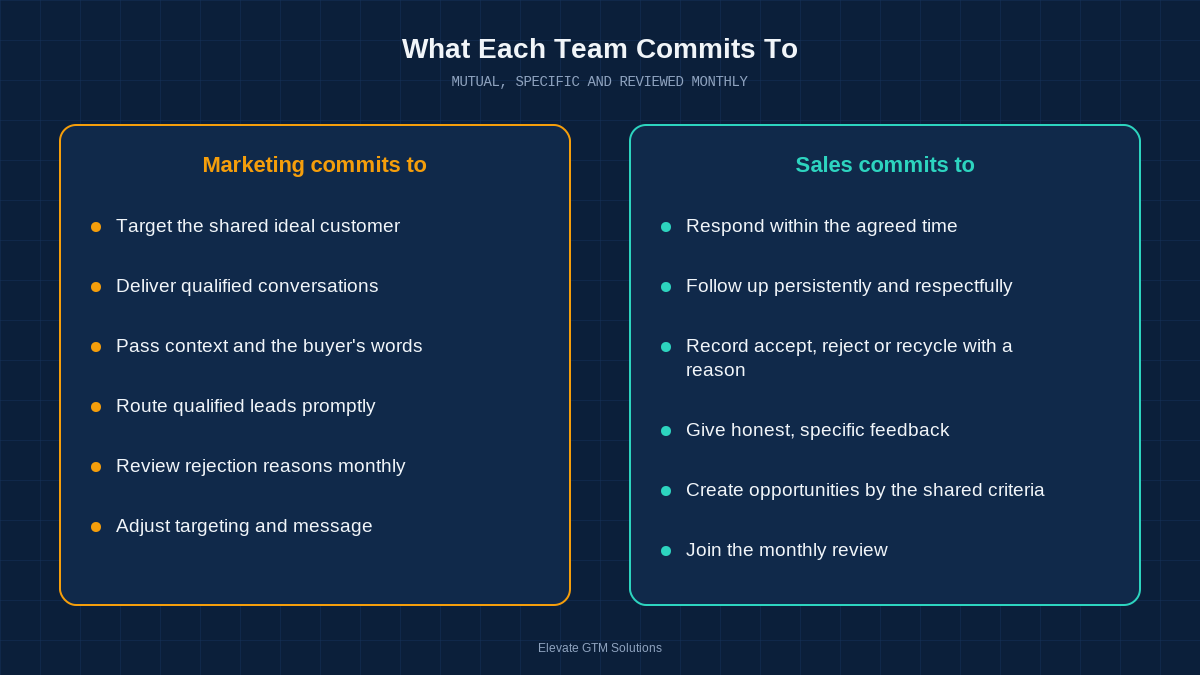
What marketing commits to
| Commitment | Practice |
|---|---|
| Deliver qualified conversations, not only contacts | Target a number of qualified leads accepted by sales, and meetings that become opportunities |
| Target the agreed ideal customer | Use the shared fit criteria and exclusions |
| Pass context with every lead | Source, content engaged with, the problem named and the buyer's words |
| Route within an agreed time | Qualified leads reach the right owner promptly |
| Keep content and messages consistent | Use approved pillars and proof |
| Respond to feedback | Review rejection reasons monthly and adjust targeting and messaging |
| Nurture recycled leads | Maintain a path for leads that are not ready |
| Share results | Report by segment and theme, not only volume |
What sales commits to
| Commitment | Practice |
|---|---|
| Respond within an agreed time | A defined response time by lead type and tier |
| Follow up persistently and respectfully | An agreed number and spacing of attempts across channels |
| Record outcomes | Accept, reject or recycle, with a reason, within an agreed period |
| Give honest feedback | Specific reasons, not "bad lead" |
| Use the shared definitions | Create opportunities according to the criteria |
| Share what buyers say | Objections, language and competitor mentions |
| Join reviews | Attend the monthly meeting |
| Update records | Keep the CRM current |
An SLA that binds only one side is a complaint, not an agreement.
Response times and follow-up, in principle
Response expectations depend on lead type. A person who requests a demo is in a different situation from one who downloaded a guide.
| Lead type | Example expectation | Notes |
|---|---|---|
| Demo or contact request | Same working day, or a short window | Highest intent, fastest decay |
| Pricing or comparison page inquiry | Within one to two working days | Active evaluation |
| Product-qualified account | Within an agreed window with context from usage | Offer help, not a pitch |
| Event or content lead from a fit account | Within a few working days with a relevant touch | Needs a reason to reach out |
| Recycled lead | Per nurture plan | Return only with a reason |
| Top-tier account signal | Per the account play | See account tiering |
These are illustrations. Set your own from how quickly interest decays in your market, and review actual response times monthly. Avoid copying numbers from other companies' policies.
Routing and ownership
| Question | Practice |
|---|---|
| Who gets the lead? | Rules by segment, tier, territory or named account, written in order of priority |
| What if the owner is absent? | A backup and an escalation after a defined time |
| What about existing customers? | Route to the account owner or customer success |
| What about named top-tier accounts? | Notify the account owner and the marketer assigned to the account |
| What about leads that fit two segments? | A tie-break rule |
| What about duplicates? | A rule for merging and ownership |
| How is routing tested? | Test with sample leads before switching on |
Routing is part of the agreement. A lead nobody owns fails the SLA before anyone has a chance to follow up.
Feedback and reason codes
Feedback is how marketing learns. A short list of reasons beats free text that nobody reads.
| Reason code | Meaning |
|---|---|
| Not a fit: size | Outside the ideal customer size range |
| Not a fit: industry or use case | Does not match the target |
| Not a fit: need | No relevant problem |
| No budget or authority | Cannot buy or influence |
| Not now | A genuine timing reason, with a date |
| Duplicate or existing customer | Already in the system |
| Contact information invalid | Data problem |
| Competitor locked in | Under contract elsewhere |
| Unresponsive after the agreed attempts | No reply |
| Accepted | Moved to opportunity or active pursuit |
Review reason codes by segment and source each month. If one source has a high rate of "not a fit: size," the targeting needs work. If one seller rejects more than peers with similar leads, the issue may be coaching or capacity.
Reporting
| Report | Question | Cadence |
|---|---|---|
| Lead flow by source and segment | What is arriving, from where? | Weekly |
| Response time against the SLA | Is follow-up happening in time? | Weekly |
| Acceptance and rejection rates with reasons | Is quality matching expectations? | Weekly and monthly |
| Conversion to opportunity by source and segment | Do accepted leads progress? | Monthly |
| Pipeline and win rate by source and segment | Do they close? | Monthly and quarterly |
| Recycled and nurtured leads | Are not-ready leads being kept warm? | Monthly |
| Disputed leads | Where do we disagree? | Monthly |
Show counts beside rates and note small samples. Use reports to find problems, not to assign blame.
The review
| Cadence | Meeting | Content |
|---|---|---|
| Weekly | Short sync of marketing and sales development | Leads in flight, response times, stuck leads |
| Monthly | SLA review with sales and marketing leaders and operations | Results, reasons for rejection, disputes, changes to targeting or messaging |
| Quarterly | Reset | Review the definitions, thresholds and commitments, and update them with fresh win and loss evidence |
End each monthly review with decisions and owners, and record changes to the SLA with dates and reasons.
Handling exceptions and disputes
| Situation | Practice |
|---|---|
| A seller disagrees with a lead's qualification | Record the reason, and review at the monthly meeting |
| Marketing disagrees with a rejection | Ask for a short conversation, examine the lead against the definition |
| A lead is time-critical | Allow a direct escalation path |
| A strategic account contacts through marketing | Route to the account owner immediately |
| Capacity is short | Prioritize by tier and agree what will wait |
| Repeated breaches | Discuss patterns, not individuals, and fix causes such as capacity or targeting |
Write the escalation path and who decides. Escalation should be rare and quick.
An SLA on one page
| Section | Content |
|---|---|
| Purpose | Shared goal: qualified conversations and pipeline in priority segments |
| Definitions | Lead, marketing qualified, sales accepted, opportunity, rejected, recycled, with examples |
| Marketing commitments | Targeting, context, routing time, feedback response, nurture |
| Sales commitments | Response time by type, follow-up attempts, outcome recording, feedback |
| Routing | Rules and backups |
| Reason codes | The short list |
| Reports | The weekly and monthly set |
| Reviews | Cadence and attendees |
| Exceptions | How handled and who decides |
| Owners | One named owner in each team and in operations |
| Version | Date, changes and next review |
SLAs in other sources of leads
| Source | Adjustment |
|---|---|
| Product-led sign-ups | Define product-qualified accounts, a response that offers help, and who owns the account |
| Partner referrals | Define what a qualified referral is, how it is acknowledged and how the partner is informed of the outcome |
| Events | Define qualified follow-up for attendees from target accounts and the time to act |
| Outbound development | Define the handoff from development to account executive and what counts as an accepted meeting |
| Customer expansion | Define who owns expansion conversations and how signals are shared |
A sample SLA, filled in
This is an invented example showing how specific an agreement can be.
| Section | Entry |
|---|---|
| Purpose | Create qualified conversations and pipeline in the two priority segments, and replace disputes with measurement |
| Definitions | Marketing qualified lead: fit score at least a stated level plus a high-intent action such as a demo or pricing request. Sales accepted lead: reviewed by sales development and judged worth pursuing. Opportunity: a recorded problem, an identified decision maker and an agreed next step |
| Marketing commits to | Targeting the shared ideal customer, passing the buyer's words and engagement history, routing qualified leads within one working hour of qualification, reviewing rejection reasons monthly and adjusting |
| Sales commits to | Responding to demo requests the same working day, other qualified leads within two working days, making six attempts over fourteen days across email and phone, recording accept, reject or recycle with a reason within five working days, attending the monthly review |
| Routing | Named accounts to account owners, then by segment and territory, with a backup after two working days and an escalation to the sales development lead after three |
| Reason codes | The ten-item list |
| Reports | Weekly lead flow and response times, monthly acceptance and conversion by segment and source, quarterly win rate and cycle |
| Reviews | Weekly sales development and marketing sync, monthly SLA review, quarterly reset |
| Exceptions | Time-critical leads escalate directly. Disputed leads are reviewed monthly against the definitions |
| Owners | Revenue operations owns the document, with named leads in sales development and marketing |
| Version | Dated, with a change log |
The numbers in this example are illustrations. Set yours from your own market and capacity.
Examples of routing rules
| Rule | Example |
|---|---|
| Priority 1 | If the account is a named one-to-one account, route to the account owner and notify the assigned marketer |
| Priority 2 | If the account is an existing customer, route to customer success or the account manager |
| Priority 3 | If the lead matches a priority segment, route by territory to the segment's sales development rep |
| Priority 4 | If the lead fits two segments, route to the owner of the segment with the higher fit score |
| Priority 5 | If no rule matches, route to the sales development lead for review within one working day |
| Backup | If the owner is absent or the lead is unworked after the agreed time, reassign to the backup |
| Duplicates | Merge into the existing record and notify the owner |
Test rules with a sample of past leads before switching them on, and check for leads that fall through.
A weekly SLA dashboard
| Panel | What it shows | What to watch |
|---|---|---|
| Leads in the last week by source and segment | Flow | Sudden changes |
| Time to first response by lead type | Speed | Misses against the agreement |
| Leads unworked past the limit | Risk | Owners and reasons |
| Accepted, rejected, recycled | Early quality | Rejection reasons |
| Meetings booked from qualified leads | Conversion | By source and segment |
| Opportunities created | Progress | Quality notes |
| Disputed leads | Disagreements | Patterns |
Use the dashboard in the weekly sync to fix problems, and avoid using it to rank individuals.
Capacity and peaks
An SLA that ignores capacity creates breaches that nobody can fix.
| Situation | Practice |
|---|---|
| A big event or campaign will produce many leads | Plan staffing and tell sales in advance |
| Sellers are on holiday | Use backups and a rota |
| Volume exceeds capacity | Prioritize by tier and intent, and agree what waits |
| A source produces many poor-fit leads | Pause or retarget it |
| New sellers are ramping | Adjust expectations and provide support |
| Sales development is stretched | Review volume, routing and automation before adding rules |
Do not promise response times you cannot keep. Honest commitments build trust.
Rolling out an SLA in thirty days
Week 1. Gather data on current lead sources, response times, rejection reasons and conversion. Agree who will own the document.
Week 2. Hold a working session with sales, marketing and operations to settle definitions with examples and to agree the commitments on each side.
Week 3. Configure routing, reason codes and reports. Test with past leads. Train sales development and marketing.
Week 4. Launch. Hold the first weekly sync. Review the first week's data and fix problems. Schedule the first monthly review.
Start small. A short agreement that people follow is better than a long one that nobody remembers.
Questions teams ask about SLAs
"Who owns the SLA?" Revenue operations is a common owner, with named leads in sales and marketing. The owner keeps the document current and runs the reviews.
"What if sales never follows the SLA?" Look for causes first: capacity, lead quality, unclear routing or distrust. Fix those, and involve sales leaders in setting realistic commitments.
"What if marketing delivers fewer leads after we tighten definitions?" Expect that. Lead volume falls, and qualified conversations and acceptance should rise. Watch pipeline and win rate by segment.
"Should the SLA include revenue targets?" It can reference shared outcomes such as pipeline from qualified leads. Keep targets realistic, and keep the SLA focused on process commitments.
"How do we handle leads that come from sellers' own outreach?" Include them in the definitions and records so that reporting is complete.
"Can we have one SLA for all segments?" Start with one, and add segment-specific commitments where the process differs, such as enterprise accounts.
"What if leadership wants more leads?" Show the pipeline and conversion by source, and discuss what quality and capacity can support.
Terms used in this guide
| Term | Meaning |
|---|---|
| SLA | Service level agreement between sales and marketing |
| MQL | Marketing qualified lead |
| SAL | Sales accepted lead |
| Reason code | A required reason for accepting, rejecting or recycling a lead |
| Routing | Assigning leads to owners by rule |
| Recycle | Returning a lead to marketing for nurture |
| Speed to lead | Time between a lead's action and the first response |
How AI affects the SLA
| Task | How AI helps | Caution |
|---|---|---|
| Lead scoring and routing | Suggests scores and rules | Keep criteria explainable and tested |
| Drafting responses | Speeds replies | Review for accuracy and tone |
| Summarizing context | Prepares lead briefs | Check against the source |
| Detecting stuck leads | Flags breaches | Use to help, not to punish |
| Agents that respond to inquiries | Reply automatically | Need limits, approvals and logs |
If AI responds to leads, the SLA should say what it may do, when a person takes over and how responses are reviewed.
Common mistakes
| Mistake | What happens | Fix |
|---|---|---|
| One-sided SLA | Resentment and non-compliance | Make commitments mutual |
| Volume targets only | Quantity over quality | Measure qualified conversations and acceptance |
| Definitions not drawn from the ICP | Leads match no one's experience | Build from evidence |
| Too many rules | Nobody remembers them | One or two pages |
| No reason codes | Marketing cannot learn | A short, required list |
| Using the SLA as a weapon | Defensive behavior | Review patterns and causes |
| Never reviewing | The SLA goes stale | Monthly and quarterly cadence |
| Ignoring capacity | Promises that cannot be kept | Check how many leads sellers can work |
| Skipping routing | Leads fall between people | Write and test routing rules |
| Treating the SLA as strategy | Process without direction | Keep ICP and message current |
A hypothetical example
This is an illustration, not a real company.
A software company's marketing and sales teams argued monthly about lead quality. Marketing reported hundreds of leads, sales accepted a small share and nobody could say why. The head of revenue operations convened both leaders and the head of sales development. They wrote shared definitions drawn from the company's ideal customer scorecard, with one example each. They agreed to measure accepted leads and meetings that became opportunities, not raw leads.
Sales committed to respond to demo requests the same working day and other qualified leads within two working days, to make a specific number of attempts across email and phone and to record an outcome and a reason from a short list within five working days. Marketing committed to pass the buyer's words and the content they engaged with, to review rejection reasons monthly and to adjust targeting.
After two months, the reason codes showed that many rejections were "not a fit: size," concentrated in one paid channel. Marketing narrowed the targeting. Response times improved once routing rules assigned leads to named owners with backups. The monthly review replaced the monthly argument. Acceptance rose in some segments and stayed flat in others, and both teams could see why. The SLA had not made anyone's leads better. It had made the conversation specific.
What to do this week
Write the definitions of lead, marketing qualified, sales accepted and opportunity, with one example each, and ask both teams whether they agree. Check actual response times for the last month. List the most common reasons leads were rejected. Draft a one-page SLA and schedule the first monthly review.
Examples of SLA disputes and how to resolve them
| Dispute | A resolution path |
|---|---|
| Sales says leads are weak, marketing says sales did not follow up | Check response times and attempts, then read ten rejected leads together against the definitions |
| Marketing says sales rejects leads that match the criteria | Review the criteria with real examples and adjust the definition if sellers show evidence that it misses what matters |
| Both say the other is not providing context | Agree a lead brief template with the fields that matter, and check completion |
| A strategic account contacted through a form was treated as a normal lead | Add a named-account rule to routing, and notify the owner automatically |
| A seller claims a lead that belongs to another | Apply the routing rules, and review exceptions monthly |
| Marketing wants credit for an opportunity the seller sourced | Record the source accurately, and use cohort comparisons for attribution |
Each resolution changes the SLA or the process, not just the argument.
A lead brief template
Giving sales the right context speeds follow-up and raises quality.
| Field | Content |
|---|---|
| Who | Name, role, company, segment and tier |
| Why now | The action that made them qualified |
| What they read or did | Content and pages, in order |
| What they said | Any words they used, including form answers |
| Fit notes | Why they match the ideal customer, and any concerns |
| Suggested opening | One relevant line based on their interest |
| History | Previous contacts and owners |
| Next step | What marketing recommends |
A short brief beats a long data dump. Sellers read what is useful and ignore the rest.
Recycling and nurture
Leads that are not ready should not be lost.
| Practice | Why |
|---|---|
| Record a reason and a date | So marketing knows when and why to re-engage |
| Define a nurture path | A few relevant messages, not constant promotion |
| Set an exit rule | When to stop or suppress |
| Watch for signals | Fit accounts that show new interest can return to sales |
| Share results | Show sales how recycled leads perform |
In plain language
An SLA is a promise between two teams to work from the same definitions and to do specific things for each other. Marketing promises to deliver qualified conversations with context. Sales promises to respond promptly, follow up properly and explain decisions. Both promise to review results together, change what is not working and keep the document short. It will not fix a weak message or a poor target, and it will make those problems easier to see, which is half the value.
A second hypothetical: an SLA for product-led handoffs
This is another invented illustration.
A software company with a self-serve plan wanted sellers to help accounts that showed signs of readiness without annoying small users. The head of revenue operations, the head of growth and the head of sales wrote a short SLA for product-qualified accounts. A product-qualified account was one with at least three active users, a set number of key actions in the first two weeks and a fit score above a threshold.
Growth committed to passing the account's usage summary and the name of the person who started the trial. Sales committed to a short helpful message within one working day, an offer of help and not a pitch, and to record whether the account wanted help. Accounts that declined stayed self-serve and were not contacted again for sixty days. They reviewed outcomes monthly. After two quarters, the share of product-qualified accounts that converted to paid was higher than the self-serve average, the share that complained about contact was low and sellers reported that the usage context made their first message more relevant.
The principles were the same as for marketing leads: shared definitions, specific commitments, a record of outcomes and a regular review.
Quick reference
| Question | Short answer |
|---|---|
| What is an SLA? | A mutual agreement on definitions, commitments and review |
| What comes first? | Shared definitions drawn from the ICP and qualification criteria |
| What should marketing commit to? | Qualified conversations, context and feedback response |
| What should sales commit to? | Response time, follow-up, outcome recording and honest feedback |
| What keeps it alive? | Reason codes, reports and a monthly review |
| What goes wrong? | One-sided agreements, volume targets, no review and ignoring capacity |
Final thoughts
An SLA is a small document with a large effect, because it moves a conflict from opinion to evidence. Keep it short, make it mutual, base it on shared definitions, measure what matters and review it often enough that it stays true. The goal is not compliance. It is a shared view of what a good lead is and what each team does to turn leads into customers.
A checklist before launching an SLA
- Definitions are written, with an example that meets each and one that does not.
- Both teams helped write them and agree.
- Commitments are mutual and realistic for current capacity.
- Routing rules are written, tested and have backups.
- Reason codes are configured and required.
- Reports show response times, acceptance, rejection reasons and conversion by source and segment.
- Weekly and monthly meetings are scheduled.
- An owner and an escalation path are named.
- The document fits on one or two pages and is easy to find.
- A version log exists.
Questions about incentives
"Should sales be paid on accepted leads?" Tying pay to acceptance can encourage rejecting too much or accepting too much. Pay on outcomes, such as opportunities and revenue, and use the SLA for process commitments.
"Should marketing be paid on opportunities?" Shared pipeline goals align the teams, with caution about attribution. Pair them with measures of acceptance and conversion.
"What if one team's incentives conflict with the SLA?" Fix the incentives. An SLA cannot overcome rewards that point the other way.
"How do we reward the behavior we want from sales development?" Reward meetings that become opportunities, not meetings alone.
"How do we recognize good feedback?" Praise specific, useful reason codes and notes, and show how they changed targeting or messaging.
Summary for busy leaders
If you remember three things: write shared definitions before anything else, drawn from your ideal customer and qualification criteria; make commitments mutual, specific and realistic for your capacity; and review results together every month, using reason codes to learn and change targeting, messaging and routing. An SLA does not fix lead quality by itself. It makes the causes visible and replaces blame with evidence.
Questions to ask at the first monthly review
- Did we meet the response commitments, and where not, why?
- What were the top three reasons for rejection, and which sources produced them?
- Which segments converted best from accepted leads to opportunities?
- Which disputed leads should change a definition?
- What one change will each team make before the next review?
Key takeaways
- A sales and marketing SLA writes down what counts as a qualified lead, what each team commits to and how outcomes are recorded and reviewed.
- Shared definitions come first, drawn from the ideal customer and qualification criteria.
- Commitments should be mutual and focused on qualified conversations and pipeline.
- Reason codes turn rejection into learning, and routing rules prevent leads falling between people.
- Review monthly, record changes and discuss patterns instead of blaming individuals.
- If AI responds to leads, define limits, handovers and review.
Where Elevate GTM Solutions fits
Elevate GTM Solutions is an AI-native GTM operating system for B2B companies. It holds the decisions an SLA depends on: the ideal customer and exclusions, qualification criteria, segment priorities, messaging pillars with proof and the marketing alignment plan, across 15 modules, with workflows, weekly plans, task ownership and a recurring review rhythm that can include the monthly SLA review. It does not route leads, run marketing automation or enforce response times, and it connects to HubSpot, Salesforce, LinkedIn, Notion and Claude for supported actions. A free first strategy build is available, and published plans, billed annually, are Enable at USD 499 per month and Growth at USD 1,499 per month, with custom Scale pricing.
For related reading, see GTM Platform vs Marketing Automation, Marketing Alignment, What Is Revenue Operations? and What Is Elevate GTM Solutions?. See the pricing page, or request a demo.
Frequently Asked Questions
What is a sales and marketing SLA?
A written agreement defining what counts as a qualified lead, what marketing commits to deliver, what sales commits to do and how quickly, how outcomes and rejections are recorded and how it is reviewed.
What should be in a sales and marketing SLA?
Shared definitions, marketing commitments, sales commitments, routing rules, reason codes, reports, a review cadence, an exception process and named owners, on one or two pages.
How fast should sales respond to leads?
It depends on lead type and how quickly interest decays in your market. Demo requests usually warrant the fastest response. Set expectations from your own data and review actual times.
Should marketing be measured on lead volume?
Better to measure qualified conversations accepted by sales and meetings that become opportunities, so volume does not displace quality.
What are reason codes and why do they matter?
A short list of required reasons for accepting, rejecting or recycling a lead. They let marketing learn which sources and messages produce poor-fit leads.
How often should the SLA be reviewed?
Weekly in a short sync, monthly in a review with leaders and operations, and quarterly for a reset of definitions and commitments.
How do I handle disagreements about a lead?
Record the reason, review against the shared definition at the monthly meeting, allow a quick escalation path for time-critical cases and look for patterns instead of blaming individuals.
Does an SLA work for product-led and partner leads?
Yes, with definitions suited to each source, such as product-qualified accounts and qualified referrals, and rules for ownership and response.
How does AI change the SLA?
AI can score, route, draft and flag stuck leads. If it responds to leads, define what it may do, when a person takes over and how responses are reviewed.
Is an SLA enough to fix lead quality?
No. It makes problems visible. Quality also depends on a clear ideal customer, a resonant message and adequate sales capacity.
What does a filled-in SLA look like?
A one-page document with definitions, marketing commitments, sales commitments with response times and attempts, routing rules, reason codes, reports, review cadence, exceptions, owners and a version log.
How should routing rules be written?
In priority order: named accounts first, then existing customers, then segment and territory, with tie-break rules, backups and escalation, tested on past leads before launch.
How do I roll out an SLA?
Gather current data in week one, settle definitions and commitments in a working session in week two, configure and test routing and reports in week three and launch with a weekly sync and a scheduled monthly review in week four.
What if capacity is a problem?
Plan for peaks, prioritize by tier and intent, agree what will wait, pause poor-fit sources and avoid promising response times that cannot be kept.